Key Takeaways
- White hat link building isn't a category of tactics — it's a quality standard. Any backlink that exists because real editorial judgment put it there qualifies. Any link that exists only because someone wanted to manipulate rankings doesn't.
- SpamBrain evaluates link patterns, topical fit, and site quality continuously — manipulative tactics get devalued faster than at any previous point, and the detection gap is widening.
- AI search amplifies the gap. ChatGPT, Perplexity, Gemini, and Google AI Overviews show a strong bias toward earned media when deciding which brands to cite — a pattern University of Toronto researchers documented in 2025 as overwhelmingly favoring third-party editorial coverage over brand-owned content.
- The most effective methods in 2026: digital PR, niche edits on editorial sites with real traffic, and linkable assets other sites actually want to reference.
The "white hat vs. black hat" framing has been around since SEO's earliest days. In 2026, it's less an ideological distinction and more a math problem: manipulative link building carries higher detection risk and lower durable reward than at any previous point, while editorial links compound in value across both traditional search and AI citation.
This guide covers what white hat link building actually means in practice (the quality standard, not the tactics list), how to evaluate whether any given link qualifies, the six strategies producing real results right now, and why the economics have moved against manipulation for good.
What Is White Hat Link Building?
White hat link building is earning backlinks through methods that align with search engine guidelines — meaning a real person at a real publication decided your content, expertise, or resource was worth referencing.
That's the test. Not whether you paid for it (editorial fees for content creation are common in legitimate media). Not whether you initiated outreach (all PR involves outreach). The test is whether the link exists for editorial reasons — because the content it points to has genuine value for the linking site's audience.
A link you'd be comfortable showing to a Google manual reviewer passes. If it exists within genuine editorial content, on a site with real organic traffic, pointing to something topically relevant — it qualifies. If you'd need to justify why the link exists, it probably doesn't.
Why It Matters More in 2026
Two things have moved the calculus past the point of return:
1. SpamBrain detects patterns in real time
Google's AI-powered spam detection doesn't just evaluate individual links — it identifies patterns. Sudden spikes from unrelated sites, clusters of links from domains with no real organic traffic, articles that exist solely to house outbound links — SpamBrain catches these faster than any previous algorithm. Manipulative links don't just fail to help; they actively trigger suppression. The December 2022 link spam update made this real-time, and every subsequent core update has refined it further. For what specifically Google considers manipulative, see our unnatural links guide.
2. AI search rewards earned media, not just links
This is the dimension most SEO strategies haven't fully internalized. ChatGPT, Perplexity, Gemini, and Google AI Overviews don't rank pages the way classical search does — they decide which brands and sources to cite when generating answers. And the data on what they cite is increasingly clear.
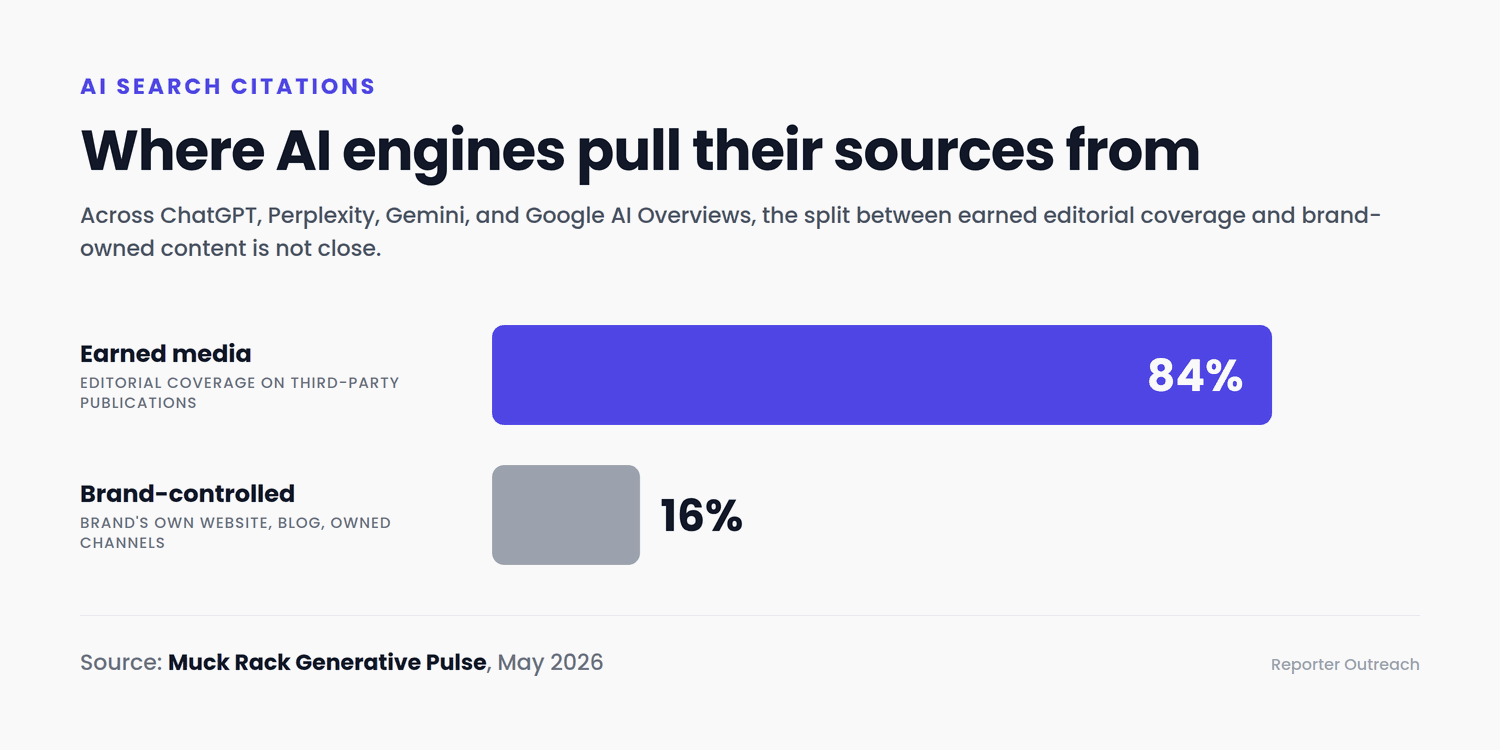
A University of Toronto 2025 GEO study (arXiv:2509.08919) found that AI engines exhibit a "systematic and overwhelming bias toward earned media over brand-owned content" when selecting citations. A Muck Rack Generative Pulse analysis from May 2026 measured the gap: 84% of AI citation sources are earned media — editorial coverage on third-party publications — not content from the brand's own site.
The 5W Public Relations AI Citation Source Index, also published in May 2026, surfaced a related pattern: 68% of all AI engine citations concentrate in the top 15 publisher domains across each industry vertical. Authority doesn't distribute evenly. AI cites the publications it has the strongest signal for — which means the same outlets PR has always targeted.
Manipulative link tactics produce links on sites AI can't validate through independent mentions. Editorial digital PR generates both backlinks and the brand mentions across trusted publications that AI engines actually reference. See our GEO guide for how this maps onto a full AI search strategy.
The 5-Factor Quality Framework
Not all white hat links are equal. Here's how to evaluate whether a specific link is genuinely valuable:
| Factor | What to check | Red flags |
|---|---|---|
| Editorial context | Link sits inside content a human reader would naturally engage with | Listicle full of outbound links; sentences written backward from the anchor |
| Topical relevance | Linking page's topic genuinely relates to your destination page | SaaS product linked from a recipe blog; finance brand linked from a fashion site |
| Site authority + traffic | High DR alongside real organic traffic from a credible audience | DR 60+ with under ~1,000 monthly organic visitors — authority is mostly notional |
| Link type | In-content editorial link inside a body paragraph | Sidebar or footer placements that read as ad inventory |
| Anchor text | Branded, URL, or naturally descriptive language | Exact-match commercial keywords in every link to one page |
Use this as your evaluation framework when reviewing prospects, auditing your existing backlinks via a link audit, or vetting a service provider's sample placements.
White Hat vs. Black Hat vs. Gray Hat
White hat — links earned through methods that comply with Google's guidelines. The link exists because the content earned editorial inclusion. Digital PR placements, journalist-sourced quotes, niche edits on editorial sites with real traffic, organic citations of original research or tools.
Black hat — links acquired through methods that explicitly violate guidelines. PBN links, automated tools, link farms, hacked sites, hidden links, mass comment spam. The link exists for one reason: ranking manipulation.
Gray hat — the ambiguous middle. Reciprocal exchanges, paying editorial fees on sites that are primarily ad inventory dressed as articles, scaled guest posting on "write for us" sites with no real traffic.
Here's how the common tactics line up on a single continuum from earned to acquired:
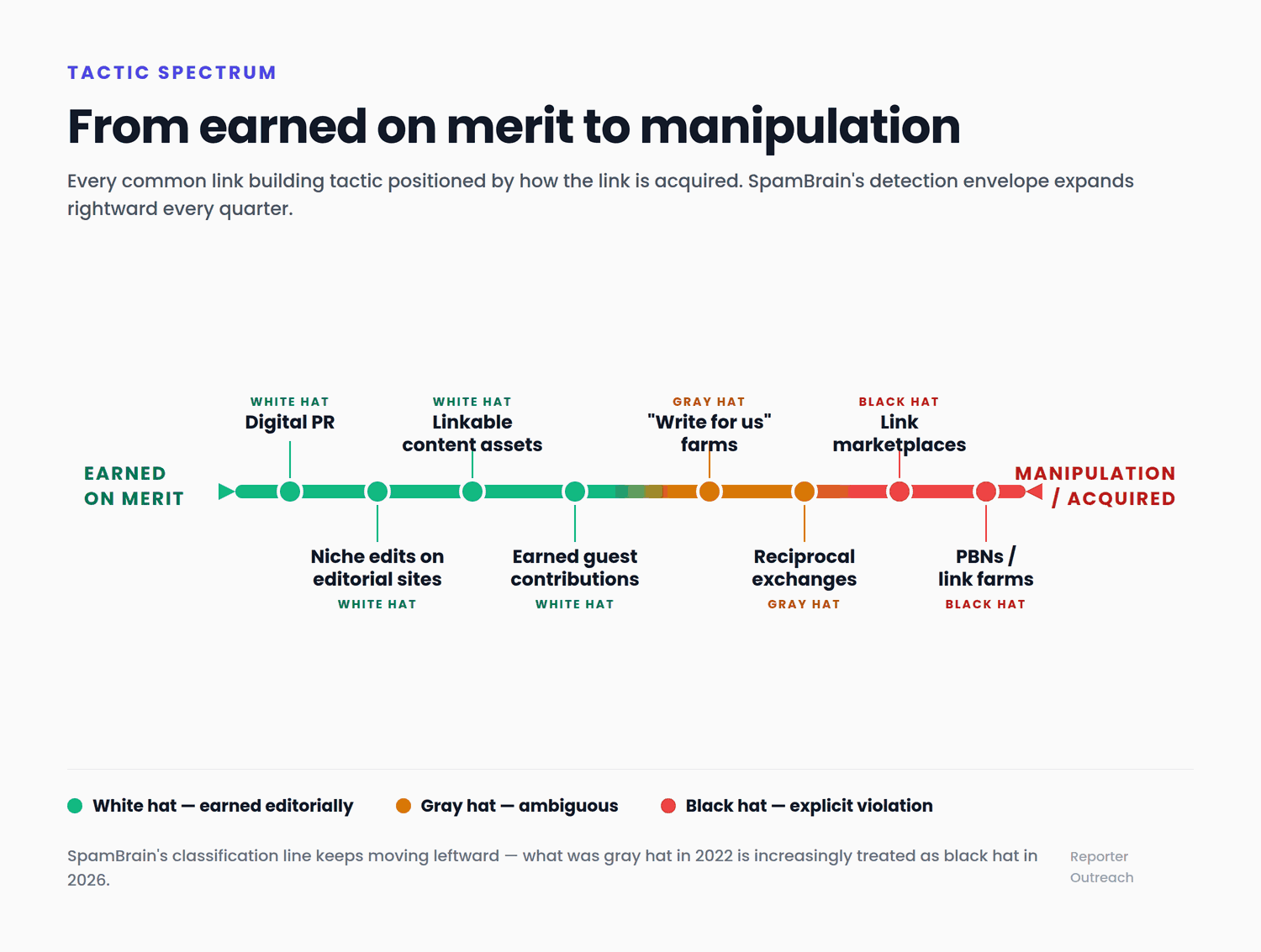
In 2026, the line between gray hat and black hat is functionally gone. SpamBrain increasingly classifies gray hat patterns — large-scale guest posting on sites whose only business is selling placements, link insertions on domains with no genuine audience — the same way it classifies outright spam. The margin of safety is shrinking every quarter.
6 Strategies That Actually Work
Ranked by per-link impact and AI search benefit based on real campaign data:
1. Digital PR — editorial backlinks from real publications
Positions your team as expert sources for journalists at established publications. When a reporter needs a quote, data point, or expert perspective, your brand gets cited with a backlink — and just as importantly, with a brand mention in the surrounding editorial text that AI engines index. This is the highest-impact method by a wide margin, and it's the only method that meaningfully builds the kind of authority signals AI search rewards. Reporter Outreach's digital PR service runs both modes below.
Two primary approaches. Reactive PR: monitoring journalist platforms like Qwoted, Featured, and Source of Sources, then pitching your expert when relevant queries come in. Full-Feature Articles: writing complete editorial pieces for target publications, with the brand cited inside the content. Both produce genuine editorial backlinks.
2. Niche edits — contextual insertions in existing content
Niche edits place your link inside an already-published, already-ranking article on a relevant site. Because the page is already indexed and receiving organic traffic, authority passes immediately rather than waiting for a new page to age. The ethics test for niche edits: the linking page must have a real audience, the link must be topically relevant, and the insertion must add genuine value for readers — not just slot a commercial anchor into a sentence that doesn't need it.
3. Linkable content assets
Original research, free tools, interactive calculators, comprehensive guides, and data visualizations attract backlinks naturally because they provide something other sites want to reference. A well-promoted data study can earn dozens of links as outlets in your industry cite the findings. The threshold for "well-promoted" matters more than people think — assets get few links on their own; assets paired with proactive outreach to journalists earn the bulk of the link total.
The key: the asset must contain information that doesn't exist elsewhere. Original data, original analysis, or a unique framework. Aggregating existing information rarely earns links at scale.
4. Resource pages + earned guest contributions
Resource pages: Curated lists of tools, guides, and references that sites in your niche maintain. Search "[topic] + resources" or "[topic] + useful links" to find prospects. The pitch: your content fills a specific gap in their list.
Earned guest contributions: Writing for sites with real editorial standards in your niche, where the content has to clear a real editor's bar before publication. Approach it as a content partnership — you're creating something their readers genuinely benefit from. Sites with editorial standards beat "write for us" farms by a wide margin; sites that accept anything send no real signal.
5. Broken link building + reclamation
Finding broken outbound links on relevant, high-authority sites and offering your content as a replacement. Mutually beneficial — the site fixes a broken link, you earn an editorial placement. Ahrefs' Broken Link Checker and the Check My Links Chrome extension are the standard tools for finding prospects.
Link reclamation: Finding unlinked mentions of your brand across the web and asking the author to add a link. If a journalist quotes your brand without linking, a polite email often converts the mention into a live backlink. Low effort, high success rate.
6. Competitor backlink analysis
Analyzing competitors' backlinks reveals sites already linking to content in your space. If a publication links to a competitor's guide and yours is genuinely better, a personalized pitch can earn a replacement or addition. This works because the linking sites have already demonstrated willingness to link to topics like yours.
Integrating Into Your SEO Strategy
Link building is one component of a broader strategy that includes on-page optimization, technical SEO, and content development. The most effective campaigns follow a structured sequence:
Start with keyword research. Before building links to a page, confirm it targets keywords with real volume and that the underlying content is comprehensive enough to rank. Link building amplifies existing quality — it doesn't compensate for thin content.
Match the method to the page type. Product pages benefit from contextual niche edits on sites that discuss your product category. Blog content benefits from digital PR and linkable assets. Resource pages attract links passively when they're genuinely comprehensive references.
Track impact past rankings. Monitor how backlinks affect organic traffic, which referring domains send engaged visitors, and whether ranking improvements translate into business outcomes — qualified leads, signups, revenue. A site can rank for everything and convert nothing.
Build for search and AI simultaneously. In 2026, your strategy needs to account for how AI platforms discover and cite your brand. Digital PR produces the brand authority signals these platforms rely on. A strategy that only optimizes for traditional search is leaving AI-search visibility on the table.
What to Avoid
These tactics either violate guidelines outright or have been so heavily targeted by SpamBrain that the risk-reward has collapsed:
- PBN links. SpamBrain's pattern detection makes private blog networks one of the riskiest tactics on the board. Shared hosting fingerprints, similar site structures, overlapping link profiles — exactly what AI spam detection is designed to catch.
- Link farms and large-scale exchanges. Systematic reciprocal link building is a pattern Google explicitly calls out. Our 2026 SEO survey: 43.8% of SEOs still use exchanges, but 0% ranked them as their best-performing method. Activity volume isn't effectiveness.
- "Write for us" guest post farms. Sites that exist primarily to sell guest placements — thin content, hundreds of outbound links to unrelated brands — are being systematically devalued. The links may not trigger a manual penalty, but they're approaching zero value.
- Automated link building tools. Any tool promising links at scale generates them through comment spam, forum profiles, Web 2.0 properties, and directory submissions. No real value, real downside.
- Link marketplaces selling by DR tier. Your link sits alongside dozens of other paid links on a page search engines can easily identify. The DR number means little when the site has no traffic and no editorial standards. See our guide on evaluating link providers for the honest filter.
How to Evaluate a Link Building Service
If you're outsourcing, the provider determines whether you're getting genuine editorial links or paying for manipulative work marketed as ethical:
Ask for sample placements. Check the linking sites yourself. Genuine audience? Topically relevant? Real editorial content — or written solely to place a link?
Check organic traffic on linking sites. The single highest-leverage step. If a site has DR 70 but under 1,000 monthly organic visitors, the authority is mostly notional. Legitimate links come from sites with both authority and real audience.
Ask about their process. Genuine providers earn links through journalist relationships, editorial outreach, and publisher partnerships built over years. "We have a network of sites" is a tell — that's not editorial PR, that's the PBN model with a friendlier label. For a related tactic that is frequently misused, see our explainer on tiered link building.
Evaluate pricing. Editorial links from DR 50+ sites typically run $200–$600 per link depending on tier. "DR 70+ links for $50 each" means the provider is sourcing from a network where they own the inventory. The math doesn't work otherwise.
Look for reporting transparency. Ethical providers send live URLs, report on DR, traffic, and topical relevance per placement, and don't hide behind vague monthly summaries. Reporter Outreach delivers a live tracking document updated daily — publication name, DR, organic traffic, anchor text, and live URL for every placement. If a provider can't share that level of detail, ask why.
What This Looks Like in Practice
A campaign built entirely on editorial methods, executed consistently over time, against a competitive eCommerce category:
BloomsyBox needed to build domain authority for high-value product and category keywords against major retail players. The campaign focused exclusively on editorial placements — earning backlinks from lifestyle, home, and gift publications through reactive PR and full-feature articles. No PBNs, no guest post farms, no exchanges.
54 placements at an average DR 79 over 10 months — every link from a publication with a real editorial audience. Organic traffic grew 555% across the engagement.
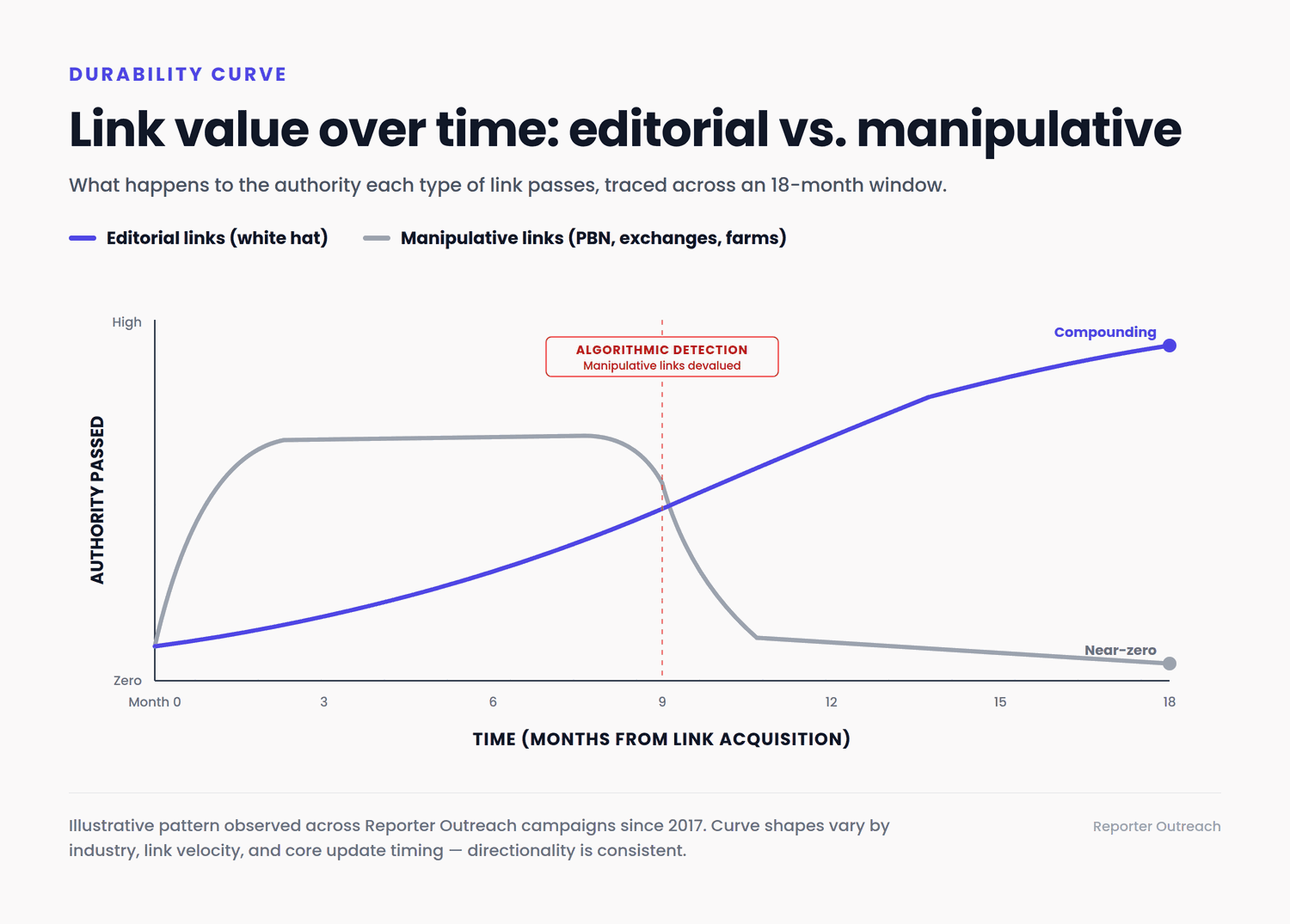
Every link came from an editorial source with genuine audience. Because the links were earned on merit, they kept passing authority as the linking sites themselves grew — exactly the compounding pattern manipulative sources never replicate, since they get deindexed before they ever compound.
Build Links That Actually Last
We earn editorial backlinks from real publications with real audiences — the kind that compound rather than decay.
Frequently Asked Questions
What is white hat link building?
It means earning backlinks through methods that comply with Google's guidelines — the link exists because a real editor reviewed and approved it on its merits, not because someone manufactured it for rankings. The methods include digital PR, journalist sourcing, contextual niche edits on editorial sites, and creating original content that other publications genuinely want to reference.
Is white hat link building more expensive than manipulative tactics?
Per link, often yes — editorial placements from DR 50+ sites run $200–$600 vs. $5–$50 for links from networks and farms. But quality links produce durable improvements that compound, while manipulative links carry detection risk, get devalued at the next algorithm pass, and need constant replacement. Over any multi-year horizon the editorial route runs cheaper.
How long until I see results?
Typically 2–4 months for early ranking movement and significant results between 6–12 months. The compounding nature of editorial backlinks means each new placement amplifies the value of the prior ones. Slower than manipulative approaches on the front end, but the gains hold — they don't reverse at the next core update.
Can I do this in-house?
Several pieces of the playbook are accessible internally. Creating linkable assets, responding to journalist source requests on Qwoted or Featured, finding broken links, and contributing to relevant publications are all doable. Where teams typically need outside help: scaled digital PR (relies on journalist relationships built over years) and niche edits (relies on publisher networks).
Is paying for a link always against guidelines?
It comes down to editorial intent. Paying an editorial fee to a publication that reviews and accepts your contributed article — and maintains editorial control over the content and placement — is common in media and generally aligned with guidelines. Paying a site directly for a link with no editorial purpose or audience benefit isn't. The question is whether real editorial judgment was applied.
How do I know if my current backlinks are clean?
Pull your domain's referring domains in Ahrefs and run each through the 5-factor framework. Check organic traffic per linking site, topical relevance, and whether the link sits in genuine editorial content. A periodic backlink audit catches manipulative links before they accumulate into a pattern Google can flag. Disavow anything that fails the editorial test.
Sources: Reporter Outreach State of Link Building 2026 (500 SEOs surveyed) · University of Toronto — Generative Engine Optimization study, arXiv:2509.08919 (2025) · Muck Rack Generative Pulse (May 2026) · 5W Public Relations AI Citation Source Index (May 2026) · Google Search Central — Link Spam Update (December 2022)