Key Takeaways
- Links under $100 each usually come from PBNs and link farms with no real readers, the exact pattern Google's link spam systems are designed to catch. Only 6% of SEOs in our 2026 survey cap what they'd pay per link below $100.
- For AI visibility, earned editorial coverage carries the most weight: Muck Rack's Generative Pulse analysis (May 2026) found 84% of AI citations come from earned media.
- For moving a specific page in Google, a vetted link insertion on a site with real traffic is the most direct route. Full-feature articles add a guaranteed, full-length feature about your brand on a DR 70 to 93 publication.
- Digital PR is the top-rated method: 34% of the 500 SEOs in our 2026 survey rank it their best-performing tactic, nearly double guest posting (18%).
- Google's SpamBrain neutralizes link spam instead of always penalizing it: per Google, any credit passed by unnatural links is lost. Cheap links cost money and move nothing, with no warning sign.
Let's skip the part where I pretend there's a moral debate about buying backlinks. Every website that ranks for competitive keywords has invested money in link building, through agency fees, content costs or direct placement fees. You know this. I know this.
The real question, and the reason you're searching for the best place to buy backlinks, is where to spend that money so it actually moves rankings and, increasingly, gets your brand recommended by AI search tools like ChatGPT, Perplexity and Google AI Overviews.
I run a link building and digital PR agency, and I also run an annual survey of SEO professionals about their link building practices and results; the 2026 edition covered 500 of them. This guide is built on that data and on the campaigns we run, not recycled advice from other "buy backlinks" articles.
The Short Answer
For AI visibility and lasting authority: digital PR agencies that earn editorial placements on real publications. Earned coverage is what AI answers draw on most, and it builds Google authority at the same time.
For pushing a specific page up the rankings: managed link insertions that vet placements for real traffic and relevance. It's the most direct route to ranking a page, at a lower cost per link.
For a guaranteed feature on a major publication: full-feature articles, which put a full-length feature about your brand on a DR 70 to 93 site you choose, from $1,500 per article.
For hands-on control: self-serve link marketplaces, but only if you have the SEO expertise to evaluate quality yourself. As a benchmark, the median placement in our own data sits on a site with 793,000 monthly visits.
Three Things That Changed the Game
SpamBrain got quieter, and more effective. Google's December 2022 link spam update said its SpamBrain system can now detect both sites buying links and sites used to pass outgoing links, and that any credit passed by those unnatural links is lost. For buyers of cheap links, that's worse than a penalty, because nothing tips you off. You just keep paying for links that do nothing while wondering why rankings aren't moving.
AI search engines lean most on editorial coverage when they decide which brands to recommend. Muck Rack's May 2026 Generative Pulse analysis of more than 25 million links cited by ChatGPT, Claude and Gemini found 84% came from earned media, not brand-owned content. If your link building never produces editorial coverage, you're missing the sources AI answers draw on most.
The price floor went up. The $20 to $50 links that once worked now mostly come from link farms and private blog networks with no real audience. Legitimate placements cost more, and 75% of respondents in our 2026 survey expect link prices to keep rising over the next two years.

What Actually Makes a Link Worth Paying For
Before comparing providers, calibrate your quality bar. A link worth paying for has five traits:
Relevance. The site covers your industry. A cybersecurity company getting a link from a tech publication carries weight. A link from a food blog doesn't, whatever its DR.
Real authority. DR 40 or higher at a bare minimum (our own floor is DR 50), backed by actual organic traffic rather than metrics inflated by link exchanges. Pull the site in Ahrefs: if it gets no search traffic, don't trust the DR. (See our guide to evaluating your backlink profile for the full audit process.)
Editorial context. The link sits inside the body of a real article, a true contextual link, surrounded by text that's relevant to the page it points to. Not a sidebar. Not a footer. Not a list of 50 other links.
Traffic to the domain. The linking site should get real organic traffic from Google. A DR 60 domain with zero organic visitors is a red flag: the metrics may be inflated through link exchanges, or the site may have been penalized. For new placements, the specific page won't have traffic yet, and that's fine. What matters is that the publication itself has a real, active readership.
A brand mention. This is the one most guides miss. The strongest placements don't just pass authority; they name your brand in editorial context. That pairing of link and mention supports both rankings and AI visibility, so ask whether a placement will mention your brand by name.
What Every Method Costs
Here's what you'll actually pay, based on what we see across our own campaigns and partner pricing:
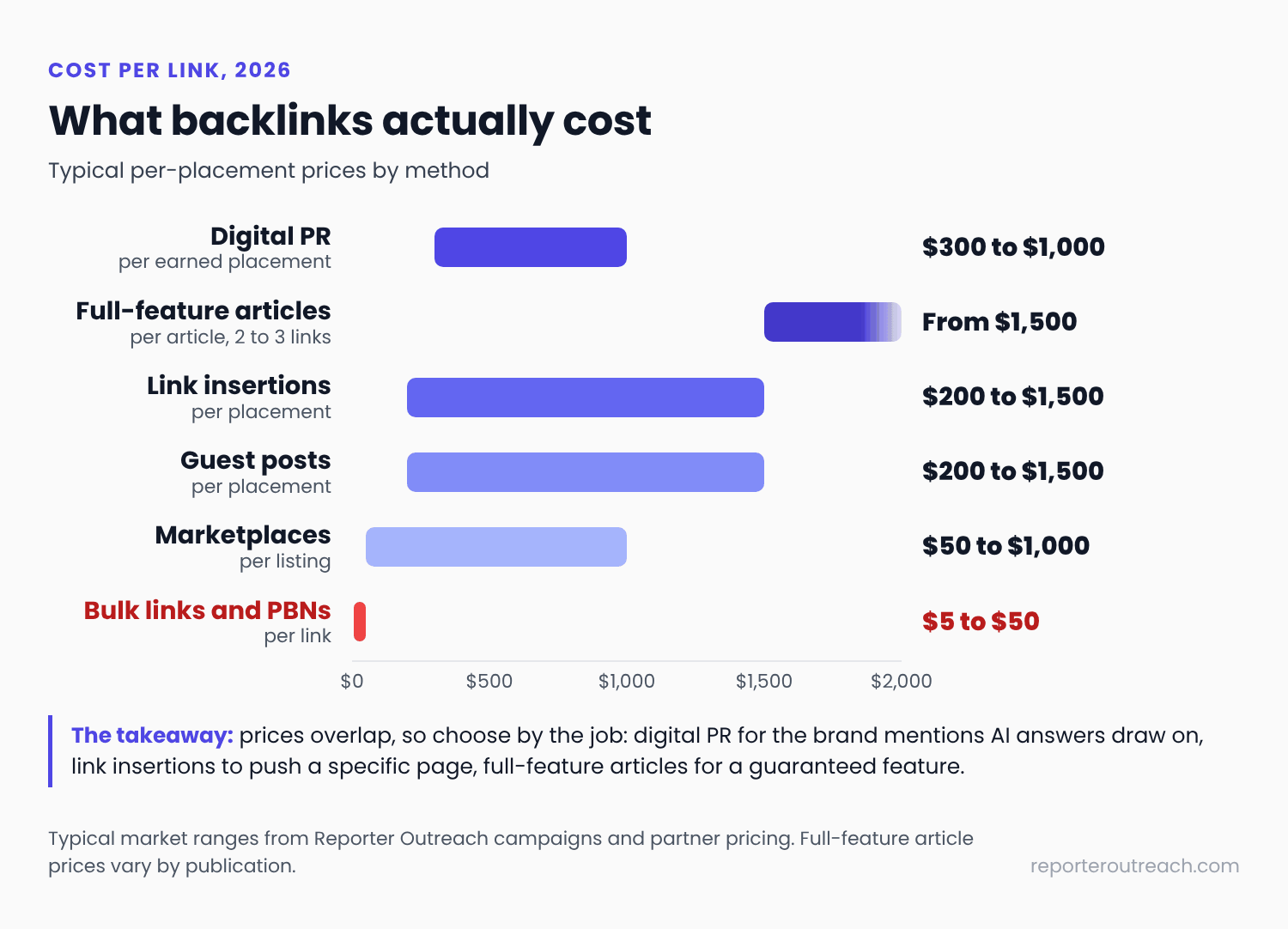
Don't read this chart as "digital PR is the expensive option." Premium link insertions and guest posts on top-tier publications can cost more per placement than digital PR: DR 80+ placements often run $1,200 to $1,500 each. Prices overlap across every vetted method, so choose by the job each one does, not by price alone.
Our 2026 survey of 500 SEOs makes the floor problem obvious. Asked the most they'd pay for a single link, only 6% put their ceiling under $100. At the other end, 31% would go up to $500 to $1,000, and 16% would pay more than $1,000. In all, 76% would pay $300 or more for one link.
Where to Buy Backlinks: Six Methods Compared
Digital PR Agencies
Agencies like Reporter Outreach, Fractl, Digitaloft and Siege Media earn coverage by giving journalists something worth covering: expert commentary on stories already in progress, original data, or campaigns built for the news cycle. The journalist decides whether to cite you, which is why these links carry very low risk and read like naturally earned ones.
This is what we do at Reporter Outreach, so I'm biased. But the data supports the bias: 34% of SEOs in our 2026 survey ranked digital PR as their best-performing method, ahead of HARO-style journalist requests (21%) and guest posting (18%). Our placements average DR 75+. (Read our full breakdown of how digital PR link building works, or learn more about our digital PR service.)
The catch: A higher monthly cost, typically $3,000 to $12,000. You can't control exact anchor text; journalists write what they write. And you need a credentialed spokesperson who can provide expert commentary.
Link Insertion Providers
Providers like Authority Builders, Loganix and Reporter Outreach add your link to an existing, already-indexed article on a relevant site. Because the host page already has authority, and often rankings of its own, the equity can pass quickly. It's the most direct way to push a specific page up the rankings.
Our managed link insertions run $300 to $500 per placement, set by DR and traffic floors (from DR 50+ with 1,000+ monthly visits up to DR 70+ with 10,000+), and go live within 2 to 3 weeks of approval.
The catch: Quality varies widely by provider. Some place links on pages already carrying 30 other outbound links, which makes the link close to worthless. Verify the host site has real traffic and the article isn't stuffed with outbound links; our niche edits guide covers the full vetting checklist. And because the article belongs to the site owner, ask what happens if a link disappears. Ours come with free replacement for 12 months.
Full-Feature Articles
Full-feature articles are full-length features about your brand on major publications such as USA Today, VentureBeat and the Los Angeles Times. You choose the outlet from 200+ publications rated DR 70 to 93, pay once the publication's editor approves your topic, and approve the draft before it runs. Most features go live 2 to 3 weeks after topic approval, typically with 2 to 3 contextual links. Prices start at $1,500 per article.
Think of it as the guaranteed counterpart to digital PR. You trade the journalist's independent choice for certainty about where you'll appear and what the story covers, and search engines and AI tools get an in-depth piece about your brand on a trusted publication. (See how full-feature articles work.)
The catch: A higher price per article than a single insertion. In return you get a full feature rather than one link, and you only pay once the editor has approved your topic.
Guest Post Services
Services like The Hoth, Fat Joe and Loganix write an article and place it on a third-party site in exchange for a backlink. You get more anchor text control than with PR, and a simpler process.
The catch: Quality ranges widely. Many "guest post" providers place content on thin sites with no real audience, and Google's link spam systems are built to find exactly those networks. Many top publications don't accept guest posts written to win links, either, so check every site's traffic and editorial standards before you pay.
Link Marketplaces
Platforms like Adsy, Collaborator and WhitePress let you browse sites by DR, traffic and price. You get full control over selection and transparent pricing.
The catch: Quality control is entirely on you. The platform lists sites; it doesn't vet them. If you don't know how to evaluate link quality yourself, you'll buy bad links, and there's no strategic guidance.
Bulk Links / Fiverr / PBNs
Don't. DR 90+ links for $50 come from PBNs, hacked sites or link farms. "1,000 backlinks for $99" builds a toxic profile. Google's SpamBrain is built to detect sites that exist to pass outgoing links, and any credit those links pass is lost. You're paying for the privilege of being ignored.
If you can invest $3,000 to $5,000 a month, start with digital PR for the authority and brand mentions that compound over time, then add 3 to 5 link insertions a month to push the specific pages you need to rank.
If your budget is under $3,000 a month, focus on managed link insertions from a provider that vets placements for real traffic and editorial standards. Skip guest posts and marketplaces until you have the expertise (or the agency) to evaluate quality.
If you need to appear in a specific publication, say around a launch or a funding announcement, a full-feature article lets you choose the outlet.
Either way, never buy links under $100. The money you save becomes the money you waste.
Red Flags: Walk Away If You See These
These are the patterns that end badly:
- DR 90+ links under $100. Legitimate publications at that authority level don't sell links for $100. Period.
- Same anchor text on every link. Natural profiles lean heavily on branded and plain URL anchors. If a provider uses your exact target keyword on every placement, they're building a penalty pattern.
- "Proprietary network" with no specifics. Translation: PBN. If they won't show you where links go before you pay, they're hiding something.
- Links from domains with zero organic traffic. If Google doesn't send any traffic to the site, a link from it has little value, whatever the DR number says. Check the domain in Ahrefs before approving any placement.
- No answer for lost links. Sites get redesigned, sold and pruned. A provider confident in its sites will replace a link that drops; ours do it free for 12 months.
- First-page rankings promised in 30 days. First placements can go live within 2 to 3 weeks, but ranking movement usually shows in months 3 to 6. Anyone promising instant results is using tactics that won't last.
How to Budget
Our survey found 64% of SEOs spend $3,000 or more per month on link building, and 38% spend $6,000 or more. Here's how that typically breaks down by stage:
| Stage | Monthly budget | What you get |
|---|---|---|
| Starting out | $3,000 to $5,000 | 5 to 10 links a month (PR plus insertions) |
| Growth | $5,000 to $10,000 | 10 to 20 links a month, mixed methods |
| Scaling | $10,000 to $15,000+ | 20 to 35+ links a month across all channels |
The most important principle: fewer quality links beat more cheap ones. Our own plans follow the same shape, and every placement clears a DR 50 floor.
Consistency matters more than budget size. Expect first placements within 2 to 3 weeks, meaningful movement in months 3 to 6, and compounding from months 6 to 12 as the links from your first months amplify the ones that follow. Stopping and restarting breaks that curve.
What This Looks Like in Practice
One of our healthcare clients, Villa Oasis, a luxury addiction treatment center operating in one of Google's most scrutinized YMYL categories, needed to build authority in a saturated market. We ran a digital PR campaign focused on health and treatment publications, positioning their clinical team as expert sources for journalists covering recovery, mental health and substance use.
No PBNs, no bulk links. Just 39 editorial placements and mentions in 9 months, averaging DR 80, on trusted health publications. Organic traffic rose 352%, and the coverage built the E-E-A-T and trust signals that YMYL search and AI assistants look for. Read the full case study →
The Dimension Most Guides Miss: AI Visibility
Every "buy backlinks" guide covers rankings. Almost none cover AI.
Here's why that matters: when someone asks ChatGPT "what's the best CRM for a small business" or Google AI Overviews "top project management tools for remote teams," those tools decide which brands to recommend based partly on what the web says about them: which publications mention them, and which pages rank.
They don't weight every source equally. As the Muck Rack data above shows, earned media makes up 84% of what AI tools cite. Most SEOs haven't caught up yet: only 24% of respondents in our 2026 survey actively track AI visibility, and just 19% have changed how they build links to account for it.
The practical implication for how you spend your link budget:
| Signal | Link insertions | Guest posts | Digital PR | Full-feature articles |
|---|---|---|---|---|
| Links | One link in an established article | Links in a new article | Earned links and mentions | Typically 2 to 3 links |
| Brand mention | Sometimes | Sometimes | Yes, journalist-written | Yes, the article is about you |
| Google impact | High for the target page | Medium | High | Helps: links from a major site |
| AI citation impact | Indirect: ranking pages feed AI answers | Low to medium | High | An in-depth piece about your brand |
| Risk | Low when vetted | Moderate | Very low | Low |
| Cost | $200 to $1,500 | $200 to $1,500 | $300 to $1,000 | From $1,500 per article |
If you're only optimizing for Google's traditional algorithm, you're building half a strategy. The brands winning right now build for both channels at once: insertions and features for the pages that need to rank, earned coverage for the mentions AI answers draw on. For the full framework, see our Generative Engine Optimization (GEO) guide.
Ready to Build Links That Actually Work?
We'll audit your backlink profile and map out a placement strategy for your market.
Frequently Asked Questions
Is it safe to buy backlinks?
It depends on the method. Editorial links earned through digital PR carry very little risk, because a journalist made an independent decision to cite you. Vetted link insertions and full-feature articles on established publications with real traffic are low risk too. Cheap links from PBNs or Fiverr aren't safe, though Google often neutralizes them rather than issuing a penalty, so the usual cost is wasted money.
How much do quality backlinks cost?
Digital PR runs $300 to $1,000 per earned placement. Link insertions and guest posts vary by publication tier: typically $200 to $500 for mid-tier sites, climbing to $1,200 to $1,500 for premium DR 80+ publications. Full-feature articles start at $1,500 per article. Anything under $100 per link usually comes from thin sites with no real traffic. Our link building pricing guide breaks it down further.
How many links do I need per month?
Check how many referring domains your top 3 to 5 competitors have, then build a plan to close the gap. Most brands seeing results build 7 to 20 quality links per month, and consistency matters more than volume. Our guide to how many backlinks you need walks through the math.
Do backlinks help with AI search visibility?
Yes, but not all equally. For AI visibility, earned editorial coverage carries the most weight: AI tools like ChatGPT, Perplexity and Google AI Overviews lean on third-party publications to decide which brands to recommend, which is why digital PR, with its journalist-written brand mentions, is the highest-leverage spend if you care about being cited in AI answers. For moving a specific page in Google, a vetted link insertion on a site with real traffic is the most direct route.
How long before I see results?
First placements typically go live within 2 to 3 weeks. Meaningful ranking movement usually shows in months 3 to 6, and link building compounds from there: results in months 6 to 12 are usually much stronger than in month 3 at the same level of effort.
Can you buy permanent backlinks?
No one can honestly promise a link will stay live forever: sites get sold, redesigned or taken down. What you can buy is durability: placements on established sites with real traffic, backed by a written replacement guarantee. Our link insertions come with free replacement for 12 months. Be wary of "permanent" or "lifetime" packages priced at a few dollars a link; they're usually PBN or bulk links.
What are high PR or high DA backlinks?
PR means PageRank. Google stopped updating its public PageRank score in 2013 and retired it in 2016, so anyone selling "PR9 backlinks" today is selling a number no one can check. DA is Moz's Domain Authority, a third-party score like Ahrefs' Domain Rating. Both can be inflated, so judge a site on DR or DA plus real organic traffic and topical relevance. Our guide to Domain Rating explains what a good score looks like.
Should I buy a backlink package?
A monthly package from a link building agency is fine if it names the sites, DR and traffic floors before you pay, and you approve each placement. A package of 1,000 or 10,000 backlinks is a different product: links at that volume and price come from automated spam, PBNs or hacked sites, the patterns Google's link spam systems are built to catch.
Can a service guarantee placements on real publications?
Yes, when you're buying a feature the publication runs, and the outlet and price are named up front. Our full-feature articles work that way: you choose a DR 70 to 93 publication, pay once the editor approves your topic, and the article publishes once you approve the draft. Earned digital PR can't guarantee a specific outlet, because a journalist decides what to cover. Treat guarantees that come with no named sites as a red flag.
Sources
- Reporter Outreach, "State of Link Building 2026" (survey of 500 SEO professionals, Q1 2026)
- Muck Rack, Generative Pulse analysis of AI citations (May 2026)
- Google Search Central, "December 2022 link spam update releasing for Google Search" (December 2022)