Key Takeaways
- Your backlink profile is the full set of external links pointing to your site — and Google judges the pattern, not the count.
- Referring domains is the single most important metric. Ten links from ten different sites beat 100 links from one site, every time.
- A strong profile is diverse in authority, anchor text, and source type. Profiles that look too perfect — all DR 70+, all exact-match anchors, all dofollow — get filtered.
- You can audit your profile for free using Google Search Console. Paid tools like Ahrefs and Semrush add depth, but GSC shows what Google actually sees.
- The fastest way to strengthen a weak profile is editorial digital PR. One DR 75+ placement in a real publication does more than twenty guest posts on DR 30 sites.
Most businesses have never actually looked at their backlink profile. They know links matter. They pay someone to build them, or they don't. But ask them what their current profile looks like — the mix of domains, the anchor text spread, the ratio of editorial to directory links — and you'll get a shrug.
That's a problem. Google doesn't rank you based on how many backlinks you have. It ranks you based on the shape of your entire profile. If you've never looked at the shape, you have no idea whether your links are helping you, hurting you, or just sitting there doing nothing.
This guide walks through what a backlink profile actually is, how to analyze yours, and how to build one that holds up in 2026 — an environment where Google's spam systems are smarter than ever and AI search tools are using the same authority signals to decide which brands to cite.
What Is a Backlink Profile?
Your backlink profile is the complete collection of external links pointing to your site — and everything Google can learn from that collection. It includes every referring domain, every individual link, the anchor text used, the authority of each referring site, whether links are followed or nofollowed, and how topically relevant each linking page is to your content.
Think of it less as a list and more as a fingerprint. The profile tells Google whether your authority was earned (natural, diverse, accumulated over time) or manufactured (concentrated, over-optimized, acquired in bursts). Two sites can have the same total link count and look completely different once you zoom out to the profile level.
Three terms get used interchangeably in this space, and shouldn't be:
| Term | What it is |
|---|---|
| Backlink | A single link from one external page to your site. |
| Backlink profile | The full pattern of every external link pointing to your site, including authority, anchors, types, and velocity. |
| Domain Rating (DR) | Ahrefs' single-number score that summarizes profile strength. Useful shorthand, but it can't capture anchor distribution, relevance, or velocity. |
A single junk link won't hurt you. But a profile that's 80% junk links will cap how high you can rank, no matter how good your content is. Google evaluates patterns, not individual links in isolation.
Why Your Backlink Profile Still Matters in 2026
Links remain one of the strongest ranking signals Google uses. When other sites link to yours, Google reads those links as endorsements — votes that your content is worth surfacing. More endorsements from trusted sources, higher rankings.
What changed is how the endorsements get evaluated. A site with 300 links from relevant, authoritative publications will outrank a site with 5,000 links from directories and forum signatures, every time. The profile — the shape of the whole thing — is what Google actually uses.
The stakes got higher in 2024 and 2025. Google's AI Overviews now reach roughly 2 billion monthly users and appear on around 25% of all searches, according to Conductor's analysis of 21.9 million queries. When an AI summary appears, Pew Research found that only 8% of users click through to a result, compared to 15% when the summary isn't there. The clicks aren't disappearing — they're being absorbed into the AI answer itself.
Which means the question isn't just "do my links rank me in the blue links" anymore. It's "does my brand register with the AI engines deciding what to cite." Aira's industry survey found 80% of SEO professionals believe unlinked brand mentions still influence rankings, and the brand-mention signal is even more important for AI search than for traditional SERPs. ChatGPT, Perplexity, Gemini, and Google AI Overviews all weight editorial brand presence heavily — and that presence comes from the same channels that build a strong link profile.
Before 2024: a strong profile helped you rank. After 2024: a strong profile determines whether AI search even surfaces your brand. Same channels, more downstream value.
The 7 Components of a Strong Profile
When SEO professionals audit a backlink profile, they evaluate seven dimensions. Understanding each one helps you spot where yours is strong and where it needs work.
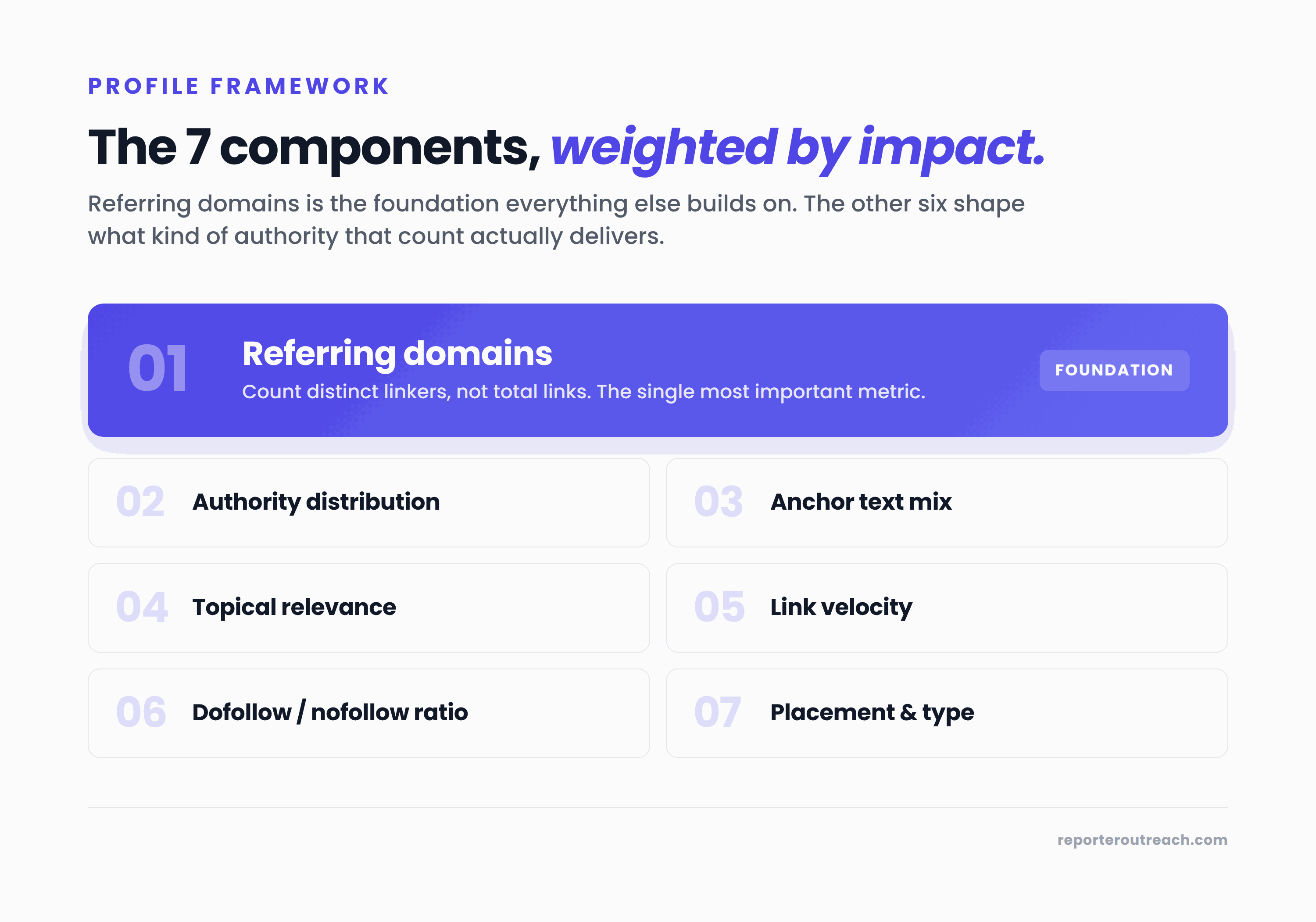
1. Referring domains
The number of unique sites linking to you. This is the single most important metric in any profile audit.
Total backlinks is a vanity number. A site with 10,000 backlinks from 50 referring domains is far weaker than a site with 500 backlinks from 500 different domains. Google discounts repeated links from the same source heavily — the first link from a domain counts, the 50th adds almost nothing. Pages that rank in the top 10 results on Google have an average of 112 referring domains and a median of 6, per Semrush data. The gap between average and median tells you most pages on page one have a small number of distinct linkers; a few pages have a lot. Our breakdown of how many backlinks you actually need goes deeper, but the short version: count referring domains, ignore total link count.
2. Domain authority distribution
The authority spread across your referring domains. Healthy profiles have a natural bell curve — some high-authority links (DR 70+), a larger cluster in the mid-range (DR 30–60), and some from smaller niche sites. A profile where every link is DR 10–20 signals thin authority. A profile where every link is DR 70+ looks bought. Real authority looks uneven because it's earned from real places.
3. Anchor text distribution
The words used in the links pointing to your site. This is where most profiles get flagged for manipulation.
A natural profile has a mix: branded anchors ("Reporter Outreach"), URL anchors ("reporteroutreach.com"), generic anchors ("click here," "learn more"), and a small percentage of keyword-rich anchors. Over-optimization — where 30%+ of your anchors are exact-match commercial keywords — is a fast way to get algorithmically penalized. Google's Penguin filter, now part of the core algorithm and operating in real-time, specifically looks for this.

The visual above shows the proportional shape of a healthy profile — branded dominates, exact-match commercial is the smallest slice. The table below gives the exact ranges plus examples of what each anchor type looks like in practice.
| Anchor type | Healthy range | Example |
|---|---|---|
| Branded | 40–60% | "Reporter Outreach" |
| URL / naked | 15–25% | "reporteroutreach.com" |
| Generic | 10–20% | "click here," "this guide" |
| Exact / partial-match keyword | 5–15% | "digital PR agency" |
4. Topical relevance
How closely the sites linking to you relate to what you do. A marketing agency getting linked from marketing publications, business sites, and tech outlets has high relevance. The same agency getting linked from recipe blogs and pet care forums does not — and Google can tell the difference.
Relevance isn't about perfect topical matching. Some off-topic links are fine and look natural. But the majority of your profile should come from sites in or adjacent to your niche. If 80% of your links are from sites with no plausible reason to be citing you, that's the profile of someone who bought links, not earned them.
5. Link velocity
The rate at which you earn new links over time. Natural velocity is gradual and steady. A campaign that produces 200 new links in a single week and then nothing for six months looks manufactured. A profile that shows 8–15 new referring domains per month, consistently, looks like a brand that's growing.

This is why sustained campaigns outperform one-off pushes. You're not just building links — you're building a velocity pattern that signals organic growth.
6. Dofollow to nofollow ratio
Dofollow links pass authority. Nofollow links don't pass direct authority but still count as profile diversity. A healthy profile runs roughly 70–80% dofollow, 20–30% nofollow.
Here's the counterintuitive part: a profile that's 100% dofollow looks manipulated. Real link acquisition always picks up some nofollows from social media, forums, Wikipedia, comment sections, and news aggregators. If your profile has zero of these, something is wrong — you've either filtered them out artificially or you're only getting links through paid channels.
7. Link placement and type
Where the link sits on the page matters. A link embedded in the body of an article carries far more weight than a link in a sidebar, footer, or author bio. These are contextual links, and they're the ones that actually move rankings.
Strong profiles also have variety in link types — editorial mentions, contextual citations, resource page links, a few directory listings. Profiles dominated by a single type (all guest posts, all directories, all forum signatures) look engineered.
Strong vs. Weak Profiles Side by Side
Here's what the difference actually looks like when you audit two profiles next to each other:
| Signal | Strong | Weak |
|---|---|---|
| Referring domains | Hundreds of unique sites | Concentrated from few sources |
| Authority spread | Natural bell curve | All clustered below DR 30 |
| Anchor text | Branded-heavy, varied | Exact-match commercial anchors |
| Topical relevance | Niche-adjacent sources | Random, unrelated sites |
| Velocity | Steady monthly growth | Bursts then dead periods |
| Dofollow ratio | 70–80% dofollow | 100% dofollow (unnatural) |
| Link types | Editorial + contextual | Directories, forum spam |
The weak profile isn't just less effective — it can actively limit how high you can rank. Even if you add high-quality links later, the existing ballast drags your average profile quality down until you either audit out the worst offenders or overwhelm them with enough good links to change the ratio.
How to Check Your Backlink Profile
You can't improve what you haven't measured. Before any link building work, run a baseline audit of your current profile.
Paid tools (if you have the budget)
Ahrefs Site Explorer. The most widely used backlink tool — and the tool 69% of link builders cite as their primary metric source, per Editorial.Link's 2025 survey. Ahrefs maintains one of the largest link indexes on the web. You enter your domain, and it shows referring domains, DR, anchor text distribution, new vs. lost links over time, and the organic traffic of each linking site. The competitor comparison feature lets you benchmark your profile against sites ranking for your target keywords.
Semrush Backlink Analytics. Close second in the category. Semrush includes a toxicity score that flags potentially harmful links — useful for finding candidates for disavowal. It also does anchor text analysis well and tracks lost links in a cleaner interface than most competitors.
Moz Link Explorer. Smaller link index than Ahrefs or Semrush, but Moz is the origin of the Domain Authority (DA) metric and offers a useful spam score for toxic link detection. Best used as a cross-reference, not a primary audit tool.
Free tools (if you don't)
Google Search Console. The most authoritative free option because it shows what Google actually sees in its index. Navigate to Links → External Links to see your top linking sites, linked pages, and top anchor text. You won't get DR scores or traffic estimates, but you'll see the ground truth of your profile. Every site should have GSC connected anyway — this is one more reason why.
Ahrefs Free Backlink Checker. The free version of Ahrefs shows your top 100 backlinks, referring domains, and basic DR data. Not comprehensive, but enough for a quick pulse check.
Ubersuggest. Neil Patel's free tier includes basic backlink analysis with a few checks per day. Useful supplementary data source.
Realistic advice: if you're serious about SEO, pay for one tool. Ahrefs or Semrush, pick one, doesn't really matter which. If you're not at that stage yet, GSC plus a free tier of Ahrefs will get you 80% of the way there.
How to Analyze What You Find
Pulling the data is easy. Making sense of it is the part most people skip. Here's the process we use on every client audit:
- Pull baseline numbers. Total referring domains, total backlinks, your Domain Rating. Write them down. These are the numbers you'll compare against in 3 and 6 months. If you don't have a baseline, you can't measure progress.
- Break down authority spread. Sort referring domains by DR. How many are DR 50+? DR 70+? If your profile has zero DR 50+ links and you're trying to rank for anything competitive, that's the first gap to close. If it has 200 DR 70+ links and nothing below, that's also suspicious — audit where those came from.
- Check anchor text distribution. Pull the anchor text report. If any single commercial keyword is more than 10–15% of your anchors, flag it. That's over-optimization territory. Branded should dominate. URL anchors next. Commercial keywords should be the smallest slice.
- Review link velocity. Look at new vs. lost links over the last 12 months. Flat trending up is good. Spikes followed by cliffs are bad. If you see a spike you don't remember running a campaign for, investigate — it might be a negative SEO attack or a competitor getting you featured somewhere.
- Filter for toxicity. Sort referring domains by DR ascending. Any site with DR near zero, no organic traffic, and no obvious editorial purpose is a disavow candidate. Don't be aggressive here — Google ignores most junk automatically — but flag anything clearly from link schemes, hacked sites, or spam directories.
- Run competitor comparison. Most tools let you compare profiles side by side. Pull the top 3 sites ranking for your target keywords. Where are they getting links you aren't? Those sites are immediate outreach targets. Competitors have done the research for you — they've already identified which publications in your space will link.
- Check which pages are getting links. Are your key service and product pages getting links, or is everything pointing at your homepage and blog? If your money pages are link-starved, you have an internal link equity problem and a link insertion opportunity — two different fixes for the same underlying issue.
- Document what needs to happen. By the end of step 7 you should have: a list of disavow candidates, a list of outreach targets from competitor analysis, a list of pages that need more links, and a velocity target (e.g., "add 10 referring domains per month for the next six months"). That's the plan. Everything else is execution.
If you want the long version with screenshots and specific filter settings, see our full backlink audit walkthrough.
What Competitive Profiles Actually Look Like
Numbers help anchor what "strong" actually means. Authority Hacker's analysis of Google's top SERP positions found that pages ranking #1 have an average of 1,962 referring domains, #2 has 416, and #3 has 299. The drop between positions is not gradual — it's exponential.

The implication: competing for position #1 isn't 5x harder than competing for #3 — it's closer to 7x. And 96% of all first-page Google results have over 1,000 referring domains, per Backlinko's analysis. If your profile has fewer than that and you're chasing first-page rankings on competitive commercial keywords, the gap is the gap.
That said, these are top-of-the-curve numbers driven by big brands. The realistic answer for most businesses isn't "match position 1." It's "match the average referring domain count of pages ranking in the top 5 for your specific target keywords." That number varies wildly by vertical — local services might compete with 30–60 referring domains, national SaaS might need 500+. Run the analysis on your actual keywords; nothing else is useful.
How to Build a Strong Profile
Once you know what's broken, you have to fix it. Building a profile isn't about chasing a backlink count — it's about systematically hitting the seven components above through channels that actually produce quality links.
Lead with digital PR
Editorial links from digital PR campaigns check every box. High authority. Topically relevant. Contextual placement. Branded anchors by default. Natural velocity. They generate the brand mentions that correlate with AI search visibility — the thing that most link building tactics miss entirely.
This is also where the channel data lines up. Multiple recent industry surveys (Aira, Editorial.Link, Authority Hacker, BuzzStream) put digital PR at the top of "most effective tactic" rankings, with guest posting consistently second and link exchanges trailing in distant single digits despite still being widely practiced. The gap between what works and what's habit is wider than most teams admit.
Use link insertions for surgical wins
Digital PR builds domain-wide authority. Link insertions let you push authority at specific pages — your pricing page, a comparison article, a product category that needs a rankings lift. Reserve them for money pages where you know which keyword you're trying to move.
Together, these two channels handle the broad and the targeted. Digital PR makes your whole domain stronger. Link insertions push specific pages over the line.
Earn links with content worth citing
Original research, industry surveys, free tools, data studies — these are the assets that earn links without outreach. When journalists, bloggers, and content teams find something they want to cite, they cite it. The links arrive naturally, which means they look natural in your profile (because they are).
This is the slowest channel but produces the most defensible links. A research asset published today can still be earning citations five years from now.
Stay consistent
Consistency matters more than volume. Earning 10 quality links per month for 12 months produces a stronger profile than earning 100 links in month one and then nothing. The velocity signal, the relationships built with journalists over time, the compounding effect of being cited alongside the same brands repeatedly — all of that comes from showing up consistently, not from campaigns.
Avoid shortcuts that hurt more than they help
PBNs, bulk directory submissions, reciprocal link exchanges, tiered link schemes, and paid links from sites that sell to anyone — these all pollute your profile. They get used because they're cheap and fast, but every shortcut link added to your profile is a liability you'll eventually have to audit out. It's cheaper to never add them in the first place.
Maintaining Your Profile Over Time
A backlink profile isn't a finished asset. Sites go offline, editorial decisions change, pages get deleted, competitors run campaigns that reshape the landscape. Maintenance matters.
Quarterly audits. Run a full profile review every 3 months. Same process as the initial audit — baseline numbers, authority spread, anchor text, velocity, new toxic signals. Compare to your last quarter to see what's shifted.
Recover lost links. When a high-value link drops off, investigate why. If the linking page was deleted, the link might be recoverable with outreach. If the site went offline, that one's gone. If the link was edited out, understand why and see if you can pitch a replacement. Lost link recovery is one of the highest-ROI activities in link building because the relationship already exists — you're just re-opening the door.
Disavow sparingly. Only disavow links that are clearly from link schemes, hacked sites, or obvious spam. Google is good at ignoring junk automatically. Moz's data shows that only 27% of websites with spam scores above 30% see DA improvement after disavowing, and the gain averages 2–3 points. That's not nothing, but it's not transformative either. Aggressive disavowal can actively hurt you by removing links that were quietly helping. If you're unsure, don't disavow.
Watch competitors. Use your tool's competitor comparison to see where competitors are earning new links. If a competitor suddenly picks up 40+ referring domains in a month, they've launched something. Figure out what it is. The publications that just linked to them are candidates to link to you.
How Profiles Affect AI Search Visibility
The biggest shift in link building over the last two years isn't a Google algorithm update. It's the emergence of AI search as a second discovery channel running parallel to traditional search — and using overlapping signals to decide what to surface.
When you ask ChatGPT, Perplexity, Gemini, or Google's AI Overviews a question, the answer pulls from sources those systems consider authoritative. The definition of authoritative looks a lot like what Google has been ranking on for years: editorial citations, expert mentions, trusted publications.
But there's a difference. AI systems weight editorial brand mentions — where you're cited by name in a real article — much more heavily than raw link counts. A profile built on anonymous guest posts and directory listings might still help you rank in traditional results, but it won't register meaningfully with AI search.
Editorial digital PR placements — real articles in real publications where your brand is cited by name — are the one channel that builds both kinds of visibility at once. If you're thinking about the next five years instead of the next five months, that's the profile shape to build.
Backlink Profile FAQ
What's the difference between a backlink profile and Domain Rating?
DR is a single score that summarizes profile strength into one number. Your profile is the underlying data — every link, every domain, every anchor, every context. DR is useful shorthand, but it can't capture anchor text distribution, topical relevance, or velocity patterns. Two sites with identical DR can have completely different profiles, and Google treats them differently.
How many referring domains do I need to rank?
There's no universal number. A local service business might compete with 40–60 referring domains. A national SaaS brand might need 500+. The only meaningful answer comes from running competitor analysis on your target keywords and matching the referring domain counts of sites ranking in the top five. See our framework for calculating your target.
Can I audit my profile without paying for Ahrefs or Semrush?
Yes. Google Search Console is free and shows the backlinks Google actually knows about. You won't get authority metrics or traffic data, but you'll see the underlying profile. Combine GSC with Ahrefs' free tier (top 100 backlinks) and you have a reasonable starting point. For ongoing work, a paid tool pays for itself quickly.
Can a bad profile hurt my rankings?
Rarely through direct penalty — Google is much better at ignoring junk than penalizing for it. But the opportunity cost is real. A profile dominated by weak links has almost no ranking power, so any money spent building it is money wasted. The question is about link quality, not link quantity.
How often should I audit my profile?
Full audit every three months. Between audits, a monthly quick check is enough — look at referring domain count, flag any sudden spikes or drops, scan new links for anything suspicious. Most tools will email alerts when you gain or lose high-DR links, which handles the day-to-day monitoring for you.
What's the fastest way to strengthen a weak profile?
Focus on editorial quality over volume. A single high-DR placement in a trusted publication does more for your profile average than a stack of low-authority guest posts, and it's also the type of link that registers with AI search tools. Our campaigns typically produce first placements within 2–3 weeks, with profile-level changes showing up in tools around the 90-day mark.
Want a professional audit of your profile?
We'll walk through your current profile, show you exactly where the gaps are versus competitors, and map out what it would take to close them.
Sources
Conductor — 2026 AEO/GEO Benchmarks (analysis of 21.9 million queries); Pew Research Center — AI summary click-through study (2025); Aira — State of Link Building, brand mentions and ranking influence; Authority Hacker — Google SERP referring domain analysis; Backlinko — first-page referring domain study; Semrush — top-10 referring domain averages; Moz — disavow tool effectiveness data; Editorial.Link — 2025 SEO metric preference survey; Google Search Central — Link Schemes and Spam Policies documentation.