Key Takeaways
- An editorial link is an inbound link you didn't pay for and didn't trade for. A journalist or editor decided your work was worth citing, and they linked to you in their own words.
- They carry more weight than any other link type because they bundle three signals at once — third-party trust, editorial discretion, and a contextual brand mention — that paid placements and exchanges can't replicate.
- AI search has changed which links matter. 84% of AI citations across ChatGPT, Claude, and Gemini come from earned media. Paid and advertorial content represents 0.3% (Muck Rack Generative Pulse, May 2026).
- Most agencies selling "editorial link building" aren't earning editorial links. They're selling sponsored placements, wire-distribution dressed as coverage, or pay-for-play guest posts on networks that publish anyone.
- Real editorial links come from journalist outreach — being a credible source for stories reporters are already writing. The mechanics are slow, but the asset compounds in ways nothing else does.
An editorial link is the cleanest signal a search engine or AI model can find. Someone you don't pay decided your work was worth pointing readers to, and put a link in an article they were going to publish anyway.
That's the whole definition. Everything else — DR transfers, AI citation correlations, "earned media value" calculations — is downstream of that one fact. A third party with no financial interest in your business chose to cite you in front of their audience.
What follows is what an editorial link actually is, why it's the highest-value link type in 2026, how to tell a real editorial link from the sponsored content that often gets sold as one, and what it actually takes to earn them.
What is an editorial link?
An editorial link is an inbound link from a third-party publication where someone made an editorial decision to include it, in context, without payment from the linked-to party.
Three pieces have to hold for the link to be editorial:
Third-party publication. The site doesn't belong to you, your client, or a network controlled by either.
Editorial discretion. A journalist or editor chose to include the link as part of writing the article.
No pay-to-include arrangement. The linked-to party didn't pay the publisher (or a middleman) to be referenced. Syndication of an earned editorial mention is fine. Paying to be mentioned in the first place is not.
The terms earned link and organic backlink mean roughly the same thing. Earned media is the broader umbrella — it covers any third-party coverage, whether or not it includes a hyperlink.
The phrase still gets misused constantly, often by agencies who know better. Sponsored content with a "partner content" disclosure tag is not an editorial link. A guest post you wrote and pitched to a publisher who accepts almost anything is not an editorial link. A press release amplified across a wire network is one earned mention with mechanical syndication, not dozens of editorial decisions. Most forms of blogger outreach fail the same test for the same reason: the publisher's selection wasn't independent of the brand's interest.
The cleanest mental model: an editorial link is a link a journalist would have included whether or not you ever heard from anyone in PR. Your job in earning one is to be the source they were already looking for.
The four types of editorial links you'll actually encounter
Not every editorial link looks the same. The four formats below cover roughly all of them, and the difference matters because each one carries a slightly different signal — both for traditional ranking and for AI citation.
- Feature mention. Your brand or product is named in the article body, with a hyperlink, as part of the journalist's own narrative. Often a sentence like "companies including [yours] now offer…" or "[your brand], which specializes in…" These are the most common and the highest-trust format because the journalist is doing the framing.
- Expert quote or source citation. Someone from your team is quoted in the article — a stat, a perspective, a forecast — with a backlink to your site or a bio page. The link sits next to a credibility signal (you were quoted as a source), which is what makes the format especially valuable for both authority transfer and AI citation. Most reactive PR placements look like this.
- Resource roundup inclusion. A publisher curates "the best X for Y" or "tools every Z should know about" and includes you alongside competitors. The trust signal is implicit endorsement: a third party put you on the same shelf as the alternatives readers already trust.
- Ranked list inclusion. Same shape as a roundup, but ordered. You're #3 on someone's list of best providers. AI search engines favor this format heavily — large language models extract ranked lists wholesale and surface them as recommendations.
The fifth thing that gets called an editorial link, and isn't, is the sponsored feature — an article that reads like editorial coverage but carries a "sponsored," "partner content," or "in association with" disclosure somewhere on the page. Search engines and AI models read the disclosure. Treat sponsored placements as a different product, with different value, on a different line item.
— meaning a fee changes hands so your brand can be mentioned — it is not an editorial link, regardless of how editorial the surrounding article looks. The economic relationship determines the link type, not the visual styling.
Editorial vs. everything else.
Most marketers buying link building are working with a vocabulary that flattens five very different products into one bucket called "links." The differences below are not semantic. They affect ranking, AI citation, and risk profile in measurably different ways.
| Link type | Who pays whom | Editorial discretion | AI citation potential |
|---|---|---|---|
| Editorial | No payment between parties | Yes — journalist or editor selects | Highest. Earned media drives 84% of AI citations. |
| Paid placement | Brand pays publisher (directly or via broker) | No — placement is purchased | Near zero. Paid/advertorial = 0.3% of AI citations. |
| Link exchange | No money — sites trade links | Mechanical, not editorial | Low. Pattern-detected by Google; ignored by AI. |
| Guest post | Brand provides content; sometimes pays | Light at best — many sites accept anything | Variable. Depends entirely on the host site's editorial standards. |
| Sponsored / partner content | Brand pays for editorial-style article | No — disclosed as sponsorship | Near zero. AI models read the disclosure. |
The two columns that matter most are the second and the fourth. Whoever pays whom determines the editorial nature of the link. AI citation behavior in 2026 reflects exactly that economic distinction — paid content gets ignored, earned content gets cited.
Manual penalty exposure is concentrated in paid placements, link exchanges, and PBN-style guest post networks. Editorial links don't carry the same exposure because there's no transactional pattern for an algorithm or a manual reviewer to detect — they look identical to any other organic citation a publication makes.
Why editorial links carry more weight.
The short answer is that editorial links are scarce, hard to fake, and bundled with signals that other link types lack. The longer answer takes apart what's actually inside one of these links.
Three things are happening at once when a major publication runs an editorial mention of your brand:
A third party with audience trust is endorsing you. Trust in national news organizations sits at 56% in the US, with local news at 70% (Pew Research Center, September 2025). Globally, trust in news brands has held steady at 40% for the third year running, and trusted news brands remain the single most-named source people use to verify online information (Reuters Institute Digital News Report 2025). When a publisher with that kind of standing chooses to cite you, you inherit a slice of the credibility readers extend to that publisher.
An editor with no financial interest selected you. The selection itself is a signal. Editors decide to mention companies all the time, and the decisions are not random — they're based on what the editor thinks adds value to the story. A link inside that decision carries information that no purchased link can carry, because the selection process is exactly what gets stripped out when money changes hands.
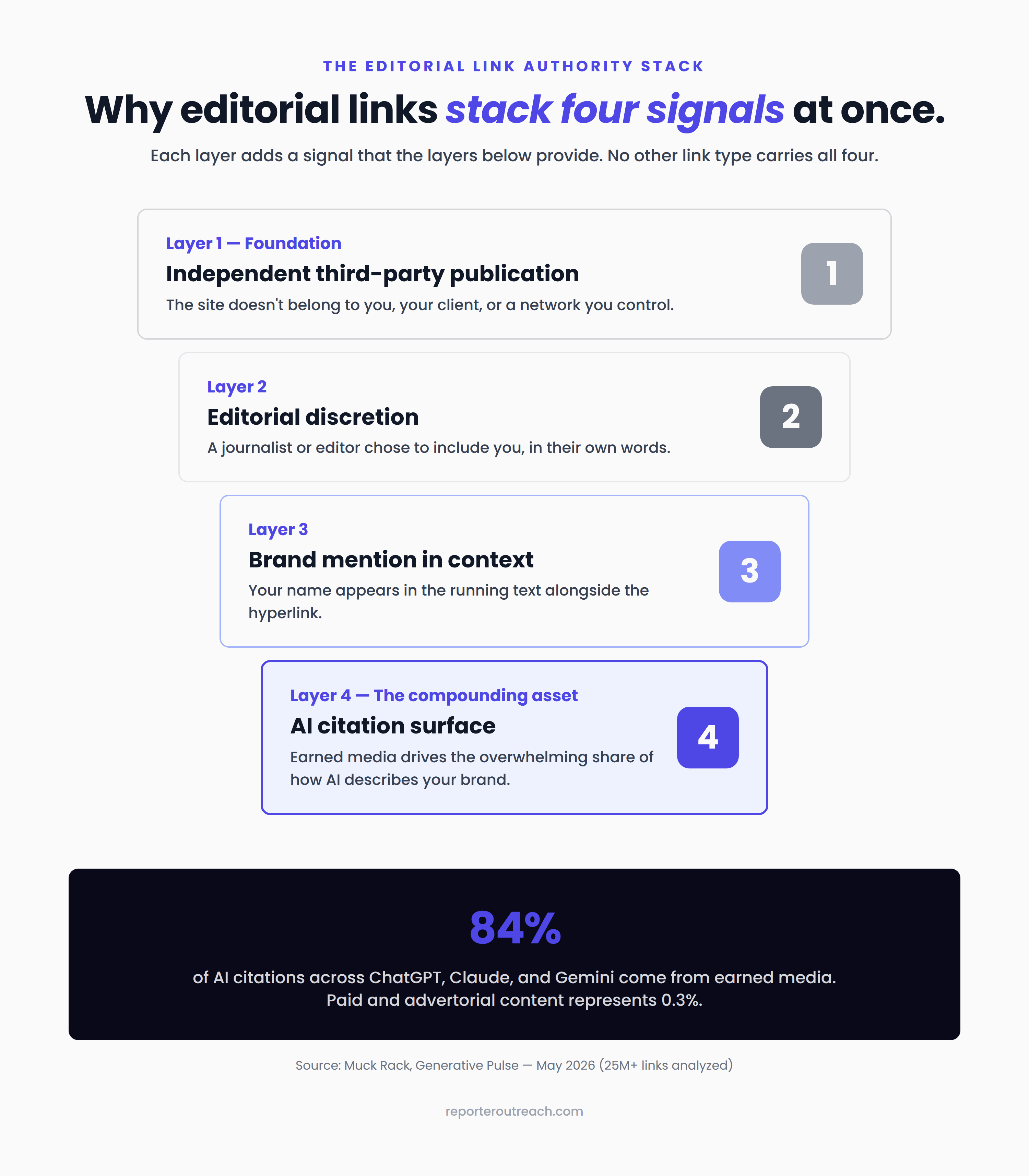
The link is bundled with a brand mention. Editorial coverage almost always names you in the article copy alongside the hyperlink. That dual-signal — link plus contextual brand mention — is what makes editorial coverage compound across both Google ranking and AI citation. Search engines weight contextual mentions; AI models extract them as ground truth about what your brand does and who it serves.
None of these three signals is replicable through paid mechanisms. A paid placement can produce a link, but it strips the trust transfer. A link exchange can produce a link, but it strips the editorial decision. A guest post you write yourself can produce a link, but it strips the third-party endorsement. The reason editorial links are the most valuable is that they are the only link type that carries all three at once.
And in 2026, a fourth signal stacks on top of those three — the AI citation surface, where editorial coverage is now the dominant input into how AI describes your brand:
For a deeper breakdown of how authority signals behave at scale, see our explanation of domain rating — DR is the metric most heavily influenced by editorial-link inflows.
Why editorial links matter more in 2026.
The shift from search engines to answer engines has changed the underlying economics of link building. Editorial links were the highest-quality link type before AI search emerged. Now they are something different — they are the primary input into how AI models describe your brand to potential customers.
Three findings from 2025 and 2026 make this concrete:
Earned media drives 84% of AI citations. Muck Rack's Generative Pulse study analyzed more than 25 million links cited by ChatGPT, Claude, and Gemini in May 2026. Earned media — journalism, academic research, government sources, encyclopedic sites, and third-party corporate content — accounted for 84% of citations. Journalism alone accounts for 27% of all cited links. Paid and advertorial content, despite being a multi-billion-dollar industry, represents 0.3%. The number has held in the 82-89% range across three editions of the study, indicating this isn't a quirk of one model or moment.
Authority is concentrating. 5W's AI Platform Citation Source Index, released in May 2026 and consolidating findings from six citation studies and roughly 680 million individual citations, found that the top 15 domains capture 68% of all citation share across ChatGPT, Google AI Overviews, Perplexity, Gemini, and Claude. That's a steeper concentration than Google PageRank ever produced. The implication for link building is severe: a small number of authoritative news, encyclopedic, and community publications now decide what AI models say about your brand category.
AI platforms are now paying publishers. Perplexity announced a $42.5M publisher revenue-share program in August 2025, paying out 80% of subscription revenue from its Comet browser to publishers whose work gets cited. The launch partners included TIME, Fortune, Der Spiegel, Entrepreneur, and The Texas Tribune; subsequent expansion added the Los Angeles Times, ADWEEK, and others. The economic structure underneath AI search is starting to look less like Google's index and more like a curated set of trusted publishers being compensated for citation share. Editorial links from those publishers are the asset; everything else is increasingly invisible.
An editorial link earned in 2026 compounds across two surfaces simultaneously. It contributes to traditional Google ranking authority, the way a backlink always has. And it contributes to AI search visibility, where the citation graph determines which brands get named in answers. A paid placement contributes to neither at meaningful scale. The gap between editorial and non-editorial is widening, not closing.
The strategic case for prioritizing editorial coverage above other link types is not a stylistic preference. It's a recognition that the link-building market is bifurcating into one segment that compounds across both search and AI, and another segment that increasingly does neither. For more on how AI search is reshaping link strategy, see our breakdown of generative engine optimization.
Why most "editorial link building" services aren't earning editorial links.
The phrase "editorial link building" appears in marketing copy across hundreds of agency websites. Most of those agencies are selling something else and using the phrase because it sells better. Four patterns account for the bulk of the misrepresentation.
Sponsored placements sold as editorial. The agency lands you a placement on a real publication. The article looks like coverage. Somewhere on the page — sometimes at the top, sometimes only in the byline area, sometimes only in the article footer — a "sponsored," "partner content," or "in association with" disclosure tells search engines and AI models that the placement was paid for. The placement still has some value as a brand awareness asset. It does not behave like an editorial link in either Google's index or in AI citation behavior.
Press release wire blasts dressed as coverage. A single press release distributed via Cision, PR Newswire, or Business Wire produces dozens of "publications" picking up the same release verbatim. The agency reports each pickup as a placement. None of them involved editorial selection — the article was published because it came through the wire, not because anyone read it and decided to run it. Most of the publishing sites in question are themselves low-quality wire-republishers with minimal independent traffic. AI models filter heavily against this pattern.
Pay-for-play guest post networks. The agency offers placement on a list of publications. The publications all accept guest posts. The placement goes through because a fee was paid, not because an editor decided your byline was worth running. The article publishes with a generic author bio that doesn't establish expertise. The site itself often publishes anyone willing to pay, which is exactly what makes the link non-editorial regardless of how mainstream the publication looks.
Brand-network sites engineered to look independent. A network of sites is privately owned by one operator (or by a small group with shared interests) but presented as independent publications. The network sells links to itself. Some networks are sophisticated enough to have real-looking author bios, original-looking content, and decent design. Google detects most of them eventually. AI models tend to ignore them faster because the citation graph between such sites is internally circular rather than externally validated.
None of these four practices is necessarily catastrophic in small doses. Pay-for-play guest posts can be useful for diversifying anchor text. Wire releases have their place in announcement cycles. Sponsored content can build awareness. The problem is the misrepresentation — selling these as editorial links when they are not earning the trust transfer, the editorial discretion, or the AI citation surface that actual editorial links carry.
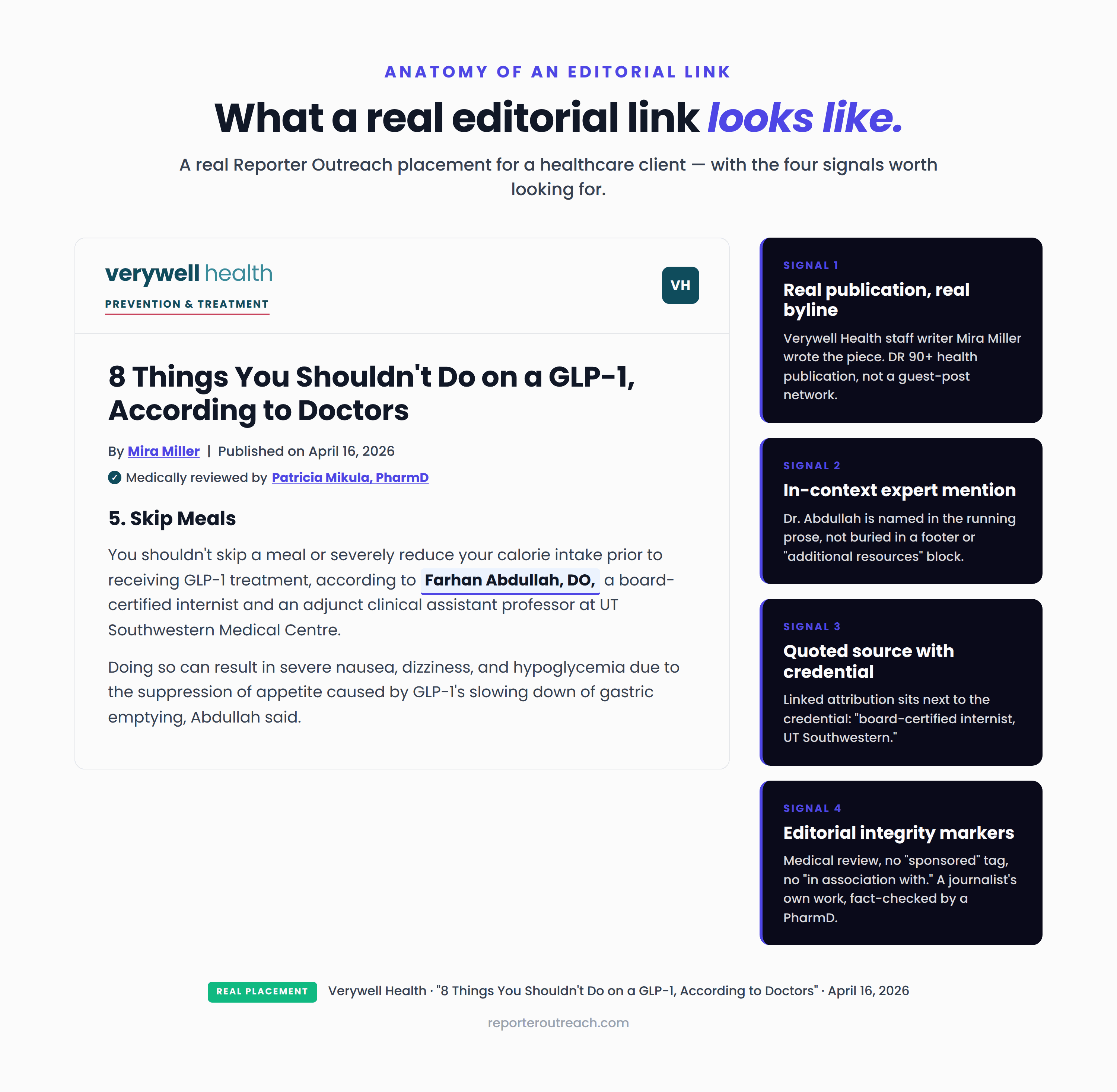
By contrast, here's what a real editorial link actually looks like on the page, with the four signals worth checking for:
How real editorial links get earned.
The mechanics are slower than agencies pretending otherwise will admit. They are also less mysterious. Visualized as a sequence:
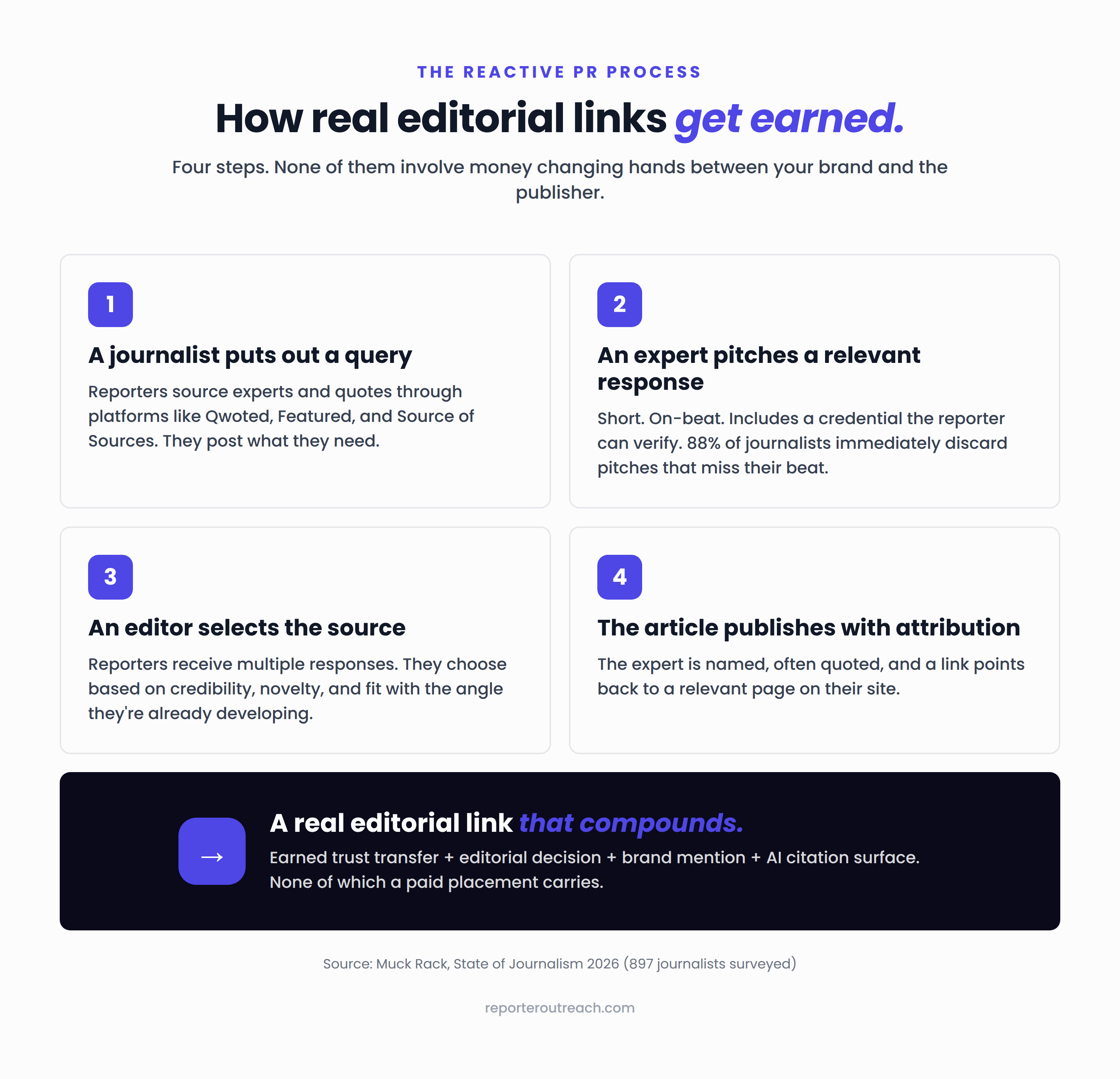
Each step looks simple individually. The actual difficulty is in step two — what makes a pitch land versus what makes it land in the trash. Below, what each step actually involves in practice.
- A journalist puts out a query. Reporters working on stories increasingly source experts and quotes through platforms like Qwoted, Featured, and Source of Sources. They post what they need: a quote on X, an expert in Y, a stat from a Z-shaped business. Some sources are also sourced through direct reporter relationships, but most reactive PR work flows through these platforms.
- An expert pitches a relevant response. The pitch matches the reporter's beat, addresses what they actually asked for, and includes a credential or angle the reporter can verify. Concision matters: 88% of journalists immediately disregard pitches that miss their beat (Muck Rack State of Journalism 2026, surveying 897 reporters). The pitches that land are short, specific, and offer something the reporter would have to invent if they didn't have a source.
- An editor or journalist selects the source. Reporters typically receive multiple responses to a query. They choose the most useful one based on whatever criteria they care about — credibility, novelty, fit with the angle they're already developing, deadline pressure. The link in the eventual article is downstream of this selection.
- The article publishes with attribution. The expert is named, often quoted, and a link points back to a relevant page on their site. It accumulates authority in Google's index and citation in AI models for as long as it stays live.
This is the short version. The longer version — including pitch templates, source-platform mechanics, and what makes the difference between a 5% and a 50% pickup rate — is in our full guide to media outreach for SEO. The HARO ecosystem runs on this same logic — journalist queries, expert responses, editorial selection — and it's the reactive engine behind digital PR link building.
Three signs you're being sold something else.
If you're evaluating an agency or service that claims to deliver editorial link building, these three checks separate the real product from everything else:
- Ask how the placement got selected. Real editorial links result from a journalist or editor choosing to include you. If the answer is "we have a list of publications we work with" or "we have relationships with these sites," that's a guest post network or a paid placement broker. The right answer involves a query, a pitch, and an editorial decision that didn't have a price tag attached.
- Check the disclosure on a sample placement. Pull up two or three placements the agency has produced and look for "sponsored," "partner content," "promoted," "in collaboration with," or any sentence in the byline area that reads "[brand] paid for this placement." If those disclosures are present, the placement is paid, not editorial. If the disclosures are absent and the article looks like it was actually researched, written, and edited by the publication's normal editorial staff, you're looking at a real editorial link.
- Look for the brand mention in context. Real editorial coverage names you in the article copy, in a sentence the journalist wrote. Pay-for-play placements often link to you with generic anchor text in a footer or "additional resources" block, with no contextual mention. AI search models strongly favor in-context brand mentions. If your brand isn't named in the running text, the citation surface is much weaker than it appears at first glance.
None of these checks requires you to be a PR specialist. The three signals are visible on the article itself, and a 90-second review is enough to tell whether what you're being sold is editorial or something dressed to look like it.
Ready to earn editorial links that actually rank?
Reporter Outreach has run reactive PR campaigns for 500+ clients across healthcare, SaaS, eCommerce, and a dozen other verticals since 2017. The placements we earn are real editorial links — selected by journalists, published in real coverage, cited in AI search.
Frequently Asked Questions
What's the difference between an editorial link and a backlink?
A backlink is any inbound link, whether earned, paid, exchanged, or otherwise. An editorial link is specifically the subset of backlinks that came from a third-party publication where someone made an editorial decision to include the link, with no payment from the linked-to party. Every editorial link is a backlink; most backlinks are not editorial.
How long does it take to earn an editorial link?
For reactive PR work, individual placements often take two to six weeks from pitch to publication. Cumulative results — the kind that move domain authority or change AI citation patterns — typically show up over three to six months of sustained outreach. The first month is mostly about pitch volume and learning what each reporter responds to; the compounding effect kicks in once placements start linking from publications with audience overlap.
Can you buy editorial links?
By definition, no. The moment money changes hands for a placement, the placement stops being editorial. What can be purchased is the work of earning editorial links — the time, expertise, and pitching infrastructure required to land them. Agencies that claim to sell editorial placements directly are usually selling sponsored content, pay-for-play guest posts, or wire-distribution dressed up with editorial-sounding language.
Do editorial links still matter for SEO in 2026?
More than they did in 2024. Traditional Google ranking still rewards them as it always has, but the bigger shift is in AI search citation. ChatGPT, Claude, Gemini, and Perplexity pull 84% of their citations from earned media according to Muck Rack's May 2026 analysis, with paid content sitting at 0.3%. Editorial links are now the primary input into how AI describes your brand to buyers — a surface that didn't exist three years ago and is now driving a measurable share of high-intent traffic.
What's the difference between an editorial link and a guest post?
A guest post is content you write and pitch to a publisher who then publishes it under your byline. An editorial link is content the publisher writes that mentions and links to you. The author identity is the cleanest test — if the byline is yours, it's a guest post. If the byline belongs to a journalist on the publication's staff and you're cited as a source, it's an editorial mention. Guest posts can carry value when the host publication has real editorial standards, but they don't carry the third-party endorsement signal that defines an editorial link.
Sources: Muck Rack, Generative Pulse: Earned Media Consistently Drives AI Citations (May 2026). 5WPR, AI Platform Citation Source Index 2026. Pew Research Center, Trust in News Organizations (September 2025). Reuters Institute for the Study of Journalism, Digital News Report 2025. Perplexity, Comet/Comet Plus publisher revenue-share announcement (August 2025). Muck Rack, State of Journalism 2026 (March 2026, surveying 897 journalists).