Key Takeaways
- Media outreach for SEO means earning editorial backlinks by getting cited as an expert source in real news articles. These are the highest-authority, lowest-risk links available.
- Reactive pitching (responding to journalist queries on platforms like Qwoted, Featured, and Source of Sources) converts at dramatically higher rates than cold outreach because the reporter is already looking for a source.
- Editorial placements deliver a dual signal — a high-authority backlink plus a brand mention in real news coverage. No other link building method produces both at once, which is why 66.2% of digital PR practitioners now prioritize AI citations as a primary benefit of their work (BuzzStream State of Digital PR 2026).
- 88% of journalists immediately delete pitches that miss their beat. Concision and 1:1 personalization both rank in the top three pitch preferences across nearly 900 reporters surveyed (Muck Rack State of Journalism 2026).
- The average digital PR campaign earns links from dozens of unique referring domains with an average DR of 75+ — performance that press releases and guest posts cannot touch.
Most outreach guides tell you to "build relationships" and "create compelling pitches." That advice is true and completely useless. It is the SEO equivalent of a fitness article that says "eat less and move more."
This guide covers the specific, practical process of earning editorial backlinks through media outreach — the same approach we use at Reporter Outreach to earn high-authority placements for clients across healthcare, SaaS, eCommerce, and a dozen other verticals. We have been running this daily since 2017, across 500+ client campaigns. What follows is what actually works.
What Media Outreach Actually Means for SEO
Media outreach is the process of connecting with journalists and editors to earn editorial placements — specifically, getting your company's experts cited as sources in real news articles on real publications.
For SEO, the goal is narrow: earn backlinks that were placed by an editor because your expertise was genuinely useful to their story. Not paid placements. Not syndicated press releases. Not guest posts on blogs that accept anyone with a credit card. Editorial links from journalists who independently decided your expert was worth quoting.
Why does this distinction matter so much? Two reasons.
First, editorial links carry the highest authority. The average link earned through a digital PR campaign has a DR of 75+. That is authority you cannot buy through niche edits or link insertions at any price point — those methods top out at individual high-DR placements, while media outreach produces them consistently at scale.
Second — and this is the part most SEOs still have not caught up to — every editorial placement creates two signals, not one. You get the backlink, obviously. But you also get a brand mention in the context of a real news article. Ahrefs studied 75,000 brands and confirmed that branded coverage across trusted publications is one of the strongest signals AI search engines use to decide which companies to cite. ChatGPT, Perplexity, Gemini, and Google AI Overviews all weight editorial mentions heavily when generating their answers. Media outreach is the only link building method that feeds both ranking systems at once.
A year ago, AI citations did not appear on BuzzStream's annual practitioner survey at all. In their 2026 report, two-thirds of respondents named it as a core outcome of their work — moving from "not measured" to top-three KPI in a single year. The companies investing in editorial outreach today are building the authority that AI systems will use to recommend brands for years.
Reactive vs. Proactive: Two Different Games
The same word covers two operations that share almost nothing in common — different platforms, different cadences, different conversion rates. Most guides lump them together, which is how teams end up running one approach badly while believing they have covered the channel.
Reactive outreach (responding to queries)
Reactive outreach means monitoring platforms where journalists post source requests, then responding with expert commentary when a query matches your client's expertise. The reporter is already writing a story and actively looking for a source. Your job is to provide the best possible answer before their deadline.
This is our core service model at Reporter Outreach. We monitor source platforms daily and position our clients as expert sources when relevant queries appear. The conversion rate is dramatically higher than cold outreach because you are responding to existing demand. The reporter has already committed to writing the article — they just need the right expert.
Think of it this way: cold outreach is knocking on doors hoping someone is hungry. Reactive outreach is answering the phone at a restaurant that is already full of customers placing orders.
Proactive outreach (pitching story ideas)
Proactive outreach means identifying reporters who cover your industry and pitching them a story idea, data study, or expert commentary they have not specifically requested. You are creating demand rather than responding to it.
It is harder. Reporters typically receive a dozen-plus pitches per day, and Muck Rack's 2026 data shows 88% of journalists immediately delete pitches that miss their coverage area. You are competing against dozens of other companies for attention, and the reporter has not committed to covering your topic. But proactive outreach gives you control over the narrative — you choose the angle, the timing, and the publication targets.
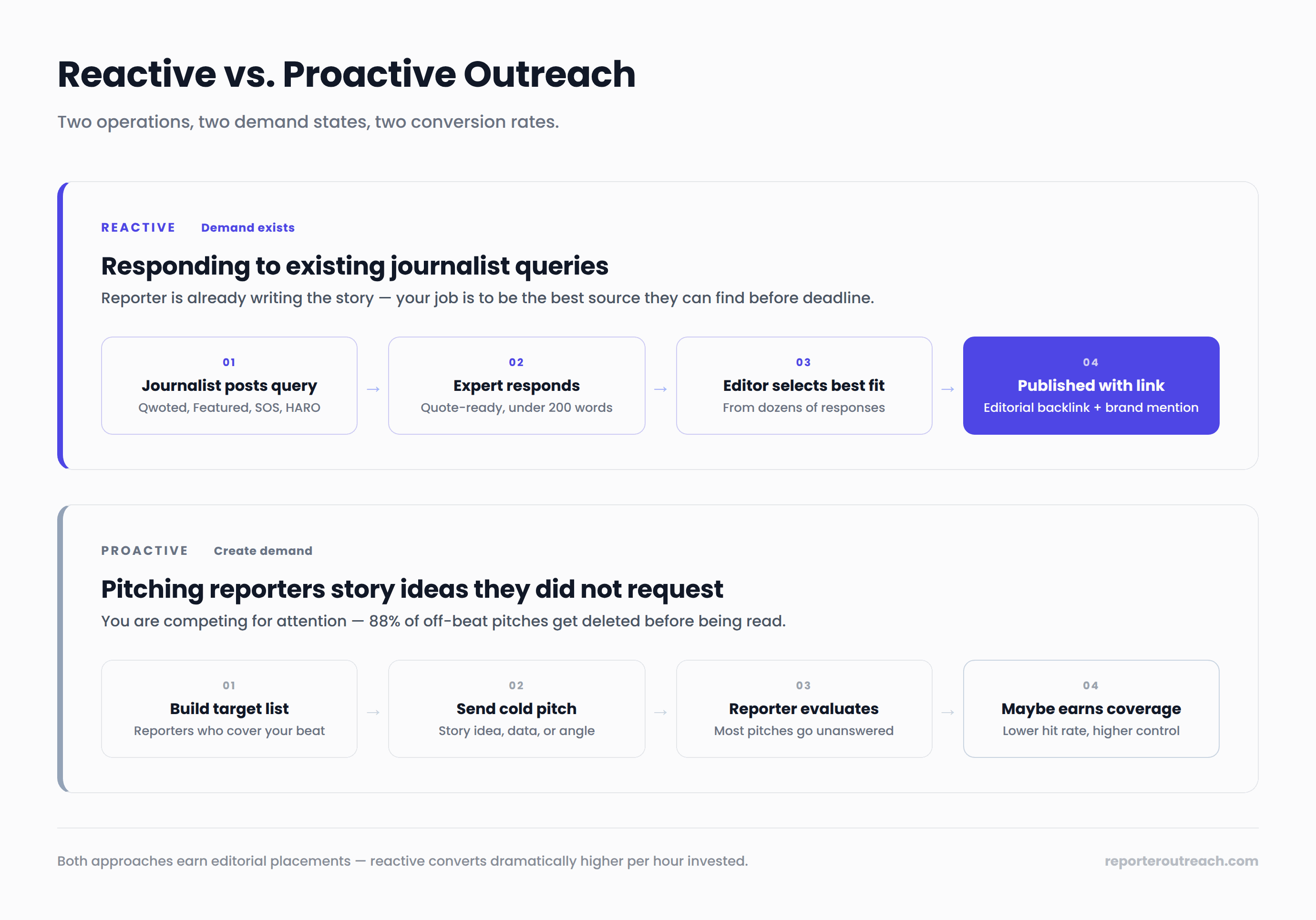
The most effective strategy uses both: reactive pitching as the consistent foundation (this is where the majority of monthly placements come from), supplemented with proactive campaigns around data research, major announcements, or industry trends. But if you have to pick one, reactive outreach delivers more placements per hour invested. It is not even close.
The breakdown below answers the question directly — which approach earns links faster, and what each one trades away to get there:
| Dimension | Reactive outreach | Proactive outreach |
|---|---|---|
| Speed to first link | Fast — the quickest wins in a campaign, usually landing within the first couple of weeks | Slower — typically weeks to months, since you are creating demand from scratch |
| Conversion rate | High — you are answering a request a journalist already posted | Low — you compete for attention, and 88% of off-beat pitches get deleted on sight |
| Effort per placement | Low — a tight, quote-ready response to a live query | High — original research or a data angle plus a targeted pitch |
| Control over angle and timing | Low — you take the queries that happen to appear | High — you choose the story, the timing, and the target publications |
| Cost efficiency | Highest placements per hour invested | Lower per placement, but one strong data study can earn many links at once |
| How it compounds | Reporters who use your source once come back to it unprompted | Original data keeps getting cited long after the campaign ends |
| Best for | Consistent monthly placement volume — the foundation of a campaign | Narrative control and flagship, data-led campaigns |
Where Reporters Find Sources in 2026
Reactive outreach depends on monitoring the right platforms. Here is where journalists actually post source requests — not the platforms that market the hardest to SEOs, but the ones where real queries from real reporters appear daily.
Qwoted — The most active source-matching platform right now. Journalists post detailed queries with deadlines, publication names, and topic requirements. Covers business, tech, health, finance, and lifestyle beats. If you are only going to monitor one platform, make it this one.
Featured (formerly Terkel) — Reporters submit questions, experts respond with quotes, and selected responses get published with attribution and backlinks. Particularly strong for thought leadership content. The structured format makes it easier to respond quickly. Featured acquired HARO in April 2025 and now operates both products.
HARO (now under Featured) — Featured.com brought HARO back in April 2025 as a free, ad-supported daily email digest after Cision shuttered the platform's Connectively rebrand in late 2024. The format is the classic three-times-daily email blast. Volume has not returned to HARO's golden-era level — newsletters now run roughly 15-20 queries each, compared to 100+ per day in the platform's peak years. It is still useful, but it works best as a supplement to Qwoted rather than a primary channel, and Featured uses HARO as a top-of-funnel for its paid product.
Source of Sources (SOS) — A curated platform that tends to feature queries from higher-authority publications. Requires quality responses to maintain access, which keeps the noise level down. Smaller query volume but higher placement value per response.
#JournoRequest on X — Less structured than dedicated platforms, but catches opportunities from journalists who do not use formal source services. Worth monitoring alongside the dedicated platforms, especially for breaking news and trending topics.
ProfNet (via Cision) — The legacy enterprise option. Expensive, but connects to reporters at major outlets. Typically used by larger PR teams with existing Cision subscriptions.
For how these platforms fit into a full campaign — the five-stage process, budget expectations, and what results actually look like — see our digital PR link building guide.
We have responded to thousands of journalist queries across all of these platforms since 2017. The single biggest factor in conversion rate is not the platform — it is response speed. Queries from major outlets often close within hours, not days. The teams that monitor daily and respond the same day get the placements. Everyone else gets ignored.
Writing Pitches That Get Used
Whether you are responding to a source request or pitching proactively, the same fundamentals determine whether your pitch gets used or deleted. And most pitches get deleted — the data on this gets bleaker every year.
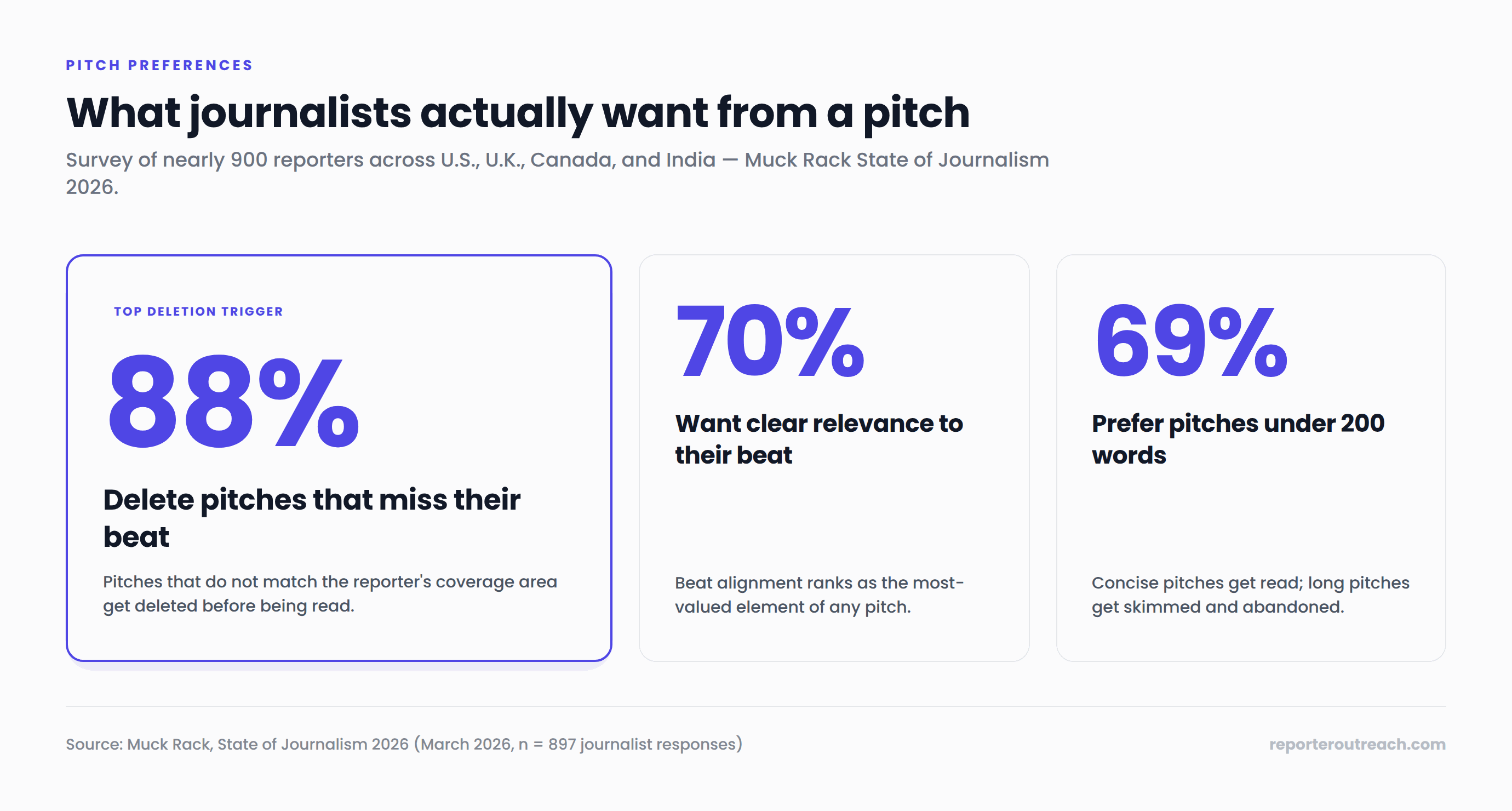
Look at those numbers. Nearly nine in ten journalists delete pitches that miss their beat — instantly, no second chance. The bar you are clearing is just being relevant. Most pitches do not even hit that floor.
Here is what separates pitches that get used from pitches that get ignored:
Lead with the quote, not your bio. Reporters scan dozens of responses per query. The pitches that get selected put a strong, usable quote in the first two sentences. Your expert's credentials go at the end — the journalist will look for them if the quote is good. Nobody reads a three-paragraph bio and then decides to check the quote.
Write quote-ready commentary. The best pitches include commentary a reporter can paste directly into their article. Write in the expert's voice, in complete sentences, with a clear point of view. "We believe AI will transform the industry" is worthless. "AI is eliminating the mid-tier SEO agency — the ones charging $3K/month for work that ChatGPT can now do for free" is quotable.
Back claims with original data. Muck Rack's 2026 data shows 40% of journalists explicitly value original data or research as part of a strong pitch. When your expert's perspective comes with a stat, a study citation, or original numbers, the pitch immediately becomes more valuable. Reporters need credible claims they can cite. Original data provides that credibility.
Keep it under 200 words. 69% of journalists explicitly prefer pitches under 200 words — and that is for the pitch itself, not counting the bio. If your response requires scrolling, it is too long. A concise 2-4 sentence expert quote plus a two-sentence bio is the format that converts. AI can help draft that, but use it carefully: our survey of how PR pros use AI found only 15% always let it draft the pitch itself.
Send 1:1, not blast. 62% of journalists prefer 1:1 email pitches over mass distribution. Pitches that look obviously templated get treated like spam. Even small personalization — referencing the reporter's recent piece, addressing them by name, signaling familiarity with the publication — separates your pitch from the auto-generated noise.
Press Releases vs. Earned Outreach
This confusion costs companies real money, so let me be direct: press release distribution and media outreach are not the same thing, and the SEO value gap between them is enormous.
Press release distribution means paying a newswire service (PR Newswire, Business Wire, etc.) to push your announcement to a network of syndication partners. The newswire guarantees your release appears on their network. What it does not guarantee is editorial coverage — and the distinction is everything.
Most links from press release distribution are syndicated, low-authority, or carry no SEO weight at all. The reporter did not choose to cite you. A wire service placed your content on a syndication page that nobody reads. Search engines have learned to discount these signals almost entirely.
Earned media outreach — the approach this guide covers — produces citations where a reporter chose to include your expert because the insight was genuinely useful to their story. That editorial judgment is what gives the link its authority. It is the difference between a paid advertisement and a genuine recommendation.
Here is how the two stack up across the metrics that matter:
| Dimension | Press Release Distribution | Earned Media Outreach |
|---|---|---|
| Who decides to publish | Wire service automation | A journalist or editor |
| Typical placement DR | Syndication network (mostly low DR) | DR 75+ on average |
| SEO authority transfer | Discounted by search engines | Full editorial weight |
| AI citation value | Minimal (not real journalism) | High (fits AI source patterns) |
| Best use case | Funding round announcements, compliance disclosures | Building rankings, authority, and AI visibility |
Press releases still have a role. They are useful for getting the word out about a company event, a product launch, or a funding round. But they should not be confused with outreach, and they should not be expected to move SEO metrics. For rankings and authority, earned editorial placements are in a different category entirely.
What a Real Campaign Actually Produces
Theory is useful. Results are better. Here is what sustained media outreach looks like when it is executed consistently over time.
One of our eCommerce clients, BloomsyBox, ran a sustained media outreach campaign over ten months. The result was 555% organic traffic growth, with placements averaging DR 79 across the entire campaign. That DR average is not a cherry-picked best placement — it is the average across ten months of consistent outreach. Guest posts and niche edits typically deliver DR 30-50 links. The authority gap is massive.
Notice the timeline. Ten months. Media outreach compounds — the first month builds your pitch pipeline and gets your expert's name in front of reporters. Months two through six are where placements accelerate as journalists start recognizing your source. Companies that treat outreach as a one-month test are measuring the learning curve, not the method. For more campaign breakdowns across industries, see our case studies.
Once a reporter uses your expert as a source and the quote works well, they remember. The next time they need commentary on a related topic, your expert is the first person they contact. We see this pattern across nearly every long-term campaign — month one produces scattered wins, but by month six the same journalists are coming back unprompted.
Mistakes That Kill Outreach Campaigns
After running outreach across 500+ client campaigns, these are the mistakes that actually matter. Not the obvious ones like "send bad pitches" — the ones that sabotage otherwise competent teams.
Pitching every query regardless of fit. Volume feels productive. It is not. Journalists talk to each other, and if your expert starts appearing in queries about topics they clearly are not qualified for, you burn credibility with the reporters you actually need. Pitch fewer queries with better-matched expertise. Quality of response beats quantity every time.
Writing sales copy instead of expert commentary. This is the most common failure mode for in-house teams. Your VP of Marketing writes a "quote" that reads like a product brochure. Reporters want genuine insight that serves their readers — not a disguised advertisement. If your pitch would work as a LinkedIn ad, rewrite it.
Treating outreach as a project instead of a process. The biggest killer. A team gets excited, pitches hard for three weeks, gets discouraged by slow early results, and stops. Meanwhile, those first pitches are just starting to bear fruit — the journalists are working on articles that take weeks to publish, and the source relationships that would have produced recurring placements never get built. Media outreach is a daily practice. It does not work as a burst campaign.
Confusing press release distribution with real outreach. This burns more budget than any other mistake. A company pays a newswire $500-$2,700 to distribute a press release, sees it appear on 200 syndication sites, and believes they have "done PR." Those syndicated placements carry almost no SEO value. The budget would have been better spent on a single month of targeted reactive pitching that produces three or four editorial links from real publications.
Treating coverage as the finish line. The campaign isn't done when the article publishes. Around 20% of placements arrive as a brand mention without a hyperlink, and another portion arrive with a link to the wrong URL. Teams that stop pitching once the story runs leave significant link equity on the table. Reclaiming unlinked brand mentions after coverage runs is the difference between earning a placement and earning a link.
DIY vs. Agency: When to Hire Help
Media outreach can absolutely be done in-house. The question is whether the math works for your situation.
DIY works when: You have someone who can dedicate 1-2 hours daily to monitoring platforms and writing responses. You have a spokesperson with clear expertise and credentials. And you are willing to accept a 2-3 month learning curve before placements become consistent. If all three are true, you can build an effective in-house operation.
An agency makes sense when: You do not have the daily bandwidth (this is the most common reason — outreach does not pause for busy weeks or competing priorities). You need results faster than the DIY learning curve allows. You are in a competitive niche where pitch quality and existing journalist relationships matter significantly. Or you want to scale beyond what a single team member can handle.
The main advantage of working with a specialized agency is operational consistency. Source queries do not take holidays. An agency's monitoring runs daily regardless — which is what produces the steady monthly placements that compound into serious authority over 6-12 months. A good agency also brings existing reporter relationships, a library of pitch templates that have been tested across thousands of queries, and the pattern recognition to know which queries are worth responding to.
Reporter Outreach offers media outreach packages starting at $3,000/month for 7 authority placements (DR 75+ average). If you want to compare options, our guide covers the top digital PR agencies working in this space.
Ready for Editorial Links That Move Rankings?
We monitor source platforms daily and pitch your experts to earn high-authority editorial placements — the links that build Google rankings and AI visibility simultaneously.
FAQ
What is media outreach?
It is the practice of connecting with reporters and editors to earn editorial coverage for your company. In an SEO context, the specific goal is earning backlinks from high-authority publications where a journalist has independently decided to cite your expertise — as opposed to paying for placements or distributing content through wire services.
How is media outreach different from press release distribution?
Press release distribution pays a newswire to push your announcement to syndication partners. Media outreach earns coverage by providing genuinely useful expert commentary to journalists writing real stories. The SEO difference is significant: wire syndication produces low-value placements that search engines discount, while earned editorial citations carry full authority and build the brand mentions that drive AI search visibility.
How long before media outreach produces results?
First placements typically appear within 2-6 weeks. Measurable SEO impact (ranking improvements and organic traffic growth) usually shows up within 3-6 months. The process compounds — early months build your pipeline and journalist relationships, while months four through twelve are where placement volume and quality accelerate as reporters start coming back to your expert proactively.
Do I need a PR background to do media outreach?
Not at all. What you need is genuine expertise in your field and the ability to express it concisely. Reporters want credible sources who can provide specific, useful insight in 2-3 quotable sentences — not polished PR messaging. The skills that matter most are subject matter knowledge, writing clarity, and consistency in showing up every day to respond to queries.
How does media outreach help with AI search visibility?
Editorial placements generate two authority signals at once: a high-DR backlink and a brand mention embedded in real journalism. ChatGPT, Perplexity, Gemini, and Google AI Overviews all draw from editorial source patterns when deciding which companies to recommend. That is why BuzzStream's 2026 industry data shows 66.2% of digital PR practitioners now treat AI citations as a primary KPI — a metric that did not exist in their 2025 survey.
Sources
- Muck Rack — State of Journalism 2026 Report (March 2026, ~900 journalist responses)
- BuzzStream — State of Digital PR 2026 Report
- Ahrefs — Brand Radar AI Visibility Study (75,000 brands, 2025)
- Featured.com / PR Newswire — HARO acquisition announcement (April 2025)