Key Takeaways
- The AI visibility tool category went from zero to 18+ vendors in 24 months. Every competing "best of" list is written by a vendor that ranks itself first.
- Every entry-tier price advertised is functionally useless for a real program. Profound's $99 Starter covers ChatGPT only. Otterly's $29 Lite gives you 15 prompts and no Gemini. The real working tier is usually 2-5x the headline price.
- Ahrefs Brand Radar is the most expensive serious option on this list at $828-$1,148/mo for full coverage including the base Ahrefs plan, and one independent test documented a 97.5% discrepancy between reported and actual ChatGPT mentions. Existing Ahrefs power users only.
- Tracking shows the gap. It does not close it. The work that actually moves a brand into AI citations is editorial coverage on the sources AI engines pull from, not better dashboards.
Type "best AI visibility tools" into Google and a depressing pattern surfaces. Every result is a "Top 10" written by a tool vendor, and that vendor always ranks first. Visiblie's listicle puts Visiblie #1. Otterly puts Otterly #1. Even Profound publishes Profound-favorable comparisons.
The frustrating part is that some of those tools are genuinely good. Most reviewers just can't say so honestly while running the same playbook.
This list isn't ranked. Reporter Outreach doesn't sell a tracker. The ten tools below are organized by practical fit for the typical reader, with the most-recognized SEO-suite options and specialist mid-tier tools first, and enterprise, agency, and compliance picks covered in dedicated sections. All pricing is verified against each vendor's pricing page in May 2026, with honest notes about what each one quietly hides on its checkout flow.
What AI Visibility Tools Actually Do
AI visibility tools run scripted prompts across ChatGPT, Perplexity, Gemini, Claude, Copilot, and Google AI Overviews on a recurring schedule, then report how often a brand appears in the answers and which URLs the AI cites as sources. They're the measurement layer for answer engine optimization — turning citation frequency from an abstract goal into a tracked metric. A tracker is one slice of a fast-growing AI tool budget, too: in our survey of 500 SEO and PR pros, 47% now spend more than $200 a month on AI tools.
The core job is identical across all 10 tools below. The differences show up in:
- Coverage: Which AI engines the tool actually queries. Most claim "multi-platform" but lock half the engines behind enterprise tiers or paid add-ons.
- Frequency: How often prompts get re-run. Daily is standard at mid-tier. Weekly is the floor for entry plans.
- Methodology: UI scraping (more accurate, captures what real users see) versus API calls (faster, cheaper, often diverges from real outputs).
- Output: Mention counts alone versus mention counts plus AI citation tracking, recommendations, content generation, or compliance reporting.
- Security and compliance: SOC 2, HIPAA, SSO. Matters for regulated industries, irrelevant for everyone else.
Every tool below does the core job. The buying question is which tradeoff fits the team buying it.
How We Picked the 10 Tools on This List
Selection criteria: multi-platform coverage, pricing published on the vendor's own page (not hidden behind a sales call), real customer adoption signals through G2 reviews and Clutch profiles, distinct positioning, and meaningful presence in independent reviews from non-vendor sources.
The 10 tools are ordered by practical fit, not by raw quality ranking. Asking "which is best" without naming who's buying makes no sense. A $3,000/mo enterprise platform is not "better" than a $29/mo entry tool. They serve different teams. The order below leads with the tools most readers will recognize and can actually afford — specialist leaders and SEO-suite add-ons — then moves through mid-market specialists, agency tools, budget picks, enterprise-only platforms, and compliance-specific options.
The 10 Best AI Visibility Tools at a Glance
The price-and-platform breakdown for all 10 tools, with the practical-floor pricing where the advertised entry tier is functionally too limited to run a real program:
| Tool | Practical Pricing | Engines | Best For |
|---|---|---|---|
| Profound | $399/mo Growth floor, $2,000+/mo for full | 10+ at Enterprise | Enterprise marketing teams |
| Semrush AI Visibility Toolkit | $99/mo per domain, $199/mo+ in Semrush One | 4 engines | Existing Semrush users |
| Ahrefs Brand Radar | $828-$1,148/mo for full coverage | 6 engines | Ahrefs power users only |
| Peec AI | $95-100/mo Starter, $200+/mo Pro | 3 base + add-ons | Mid-market daily tracking |
| Otterly.AI | $29/mo Lite, $189/mo Standard | 4 base + add-ons | Entry-level buyers |
| SE Ranking SE Visible | $119+/mo add-on or $189+/mo standalone | 5 engines | Multi-client agencies |
| LLMrefs | Free tier or $79/mo Pro | 11+ engines | Budget standalone option |
| AIclicks | $59/mo Starter, $189/mo Pro | 10+ engines | B2B SaaS, ChatGPT-heavy buyers |
| Evertune | $3,000+/mo starting | 9+ engines | Brand perception focus |
| Scrunch AI | $300/mo for 350 prompts | Multi-platform | Regulated industries (SOC 2) |
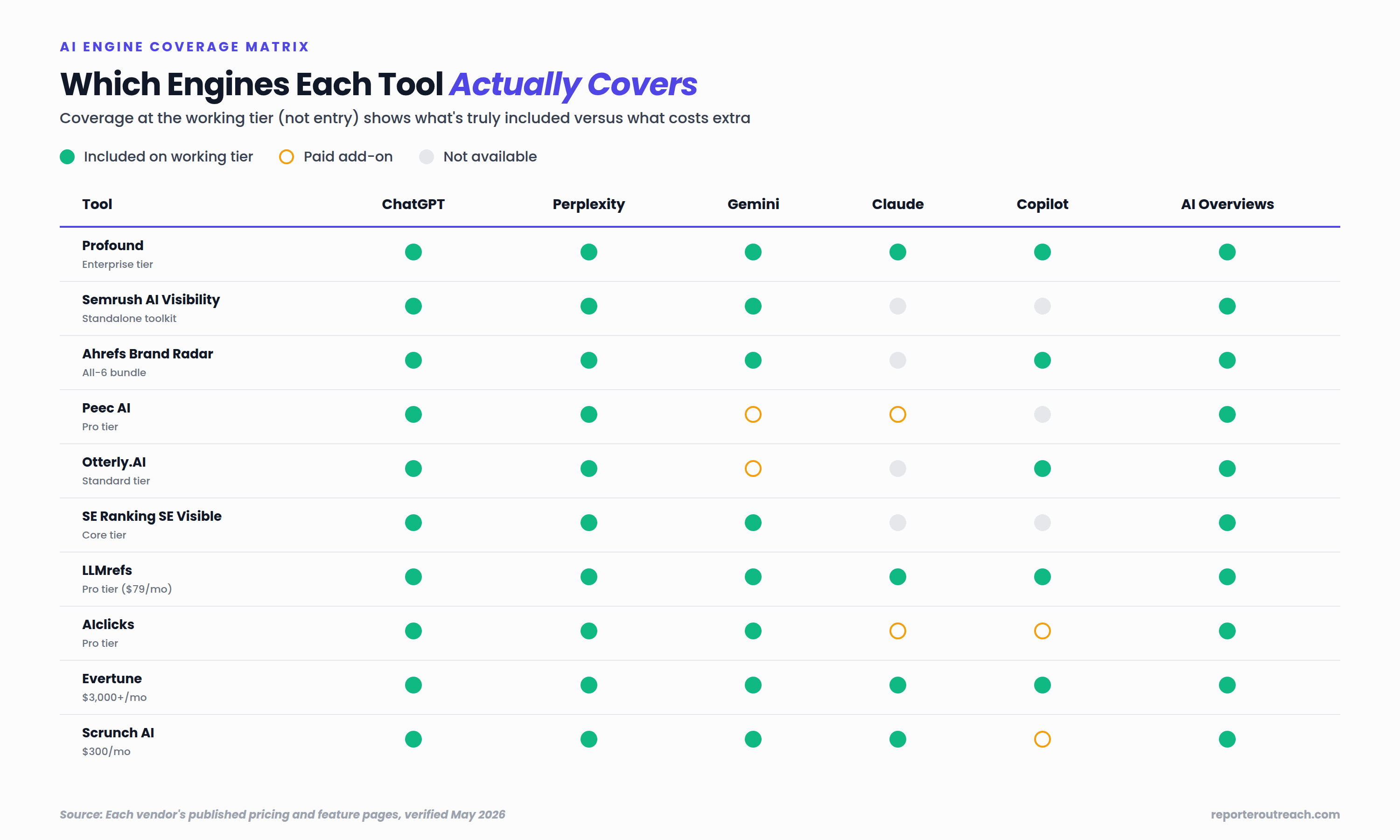
Coverage isn't binary. Most tools advertise "multi-platform" but quietly gate half the AI engines behind paid add-ons or enterprise tiers. The matrix below shows which engines come included on each tool's working tier versus which require an upgrade or extra fee:
1. Profound — Best for Enterprise
Profound is the AI visibility platform built for Fortune 500 procurement, with $58.5M in venture funding from Khosla, Sequoia, Kleiner Perkins, and NVIDIA, and a customer list that includes Ramp, MongoDB, Figma, Docusign, Walmart, and LG.
The real differentiator is Prompt Volumes — actual search demand data across AI engines, broken down by region and demographics. No other tool on this list publishes equivalent demand intelligence. The Agents content generation engine and SOC 2 Type II compliance round out the enterprise positioning.
The catch is what "entry tier" actually buys. The advertised $99 Starter plan tracks ChatGPT only with 50 prompts. The $399 Growth tier covers three platforms. Claude, Gemini, Grok, Meta AI, and AI Mode all sit behind Enterprise pricing, which lands in the $2,000-$5,000+/mo range and requires a 1-3 week sales cycle.
- Pricing: $99/mo Starter (ChatGPT only, 50 prompts) | $399/mo Growth (3 platforms) | $499/mo Lite | $2,000-$5,000+/mo Enterprise (10+ platforms, custom)
- Platforms covered: ChatGPT, Claude, Gemini, Perplexity, Google AI Overviews, Grok, Meta AI, DeepSeek, Microsoft Copilot, AI Mode (Enterprise only for full coverage)
- Best for: Fortune 500 marketing teams with dedicated competitive intelligence functions and budget to treat AI visibility as its own measurement workstream
- Watch out for: No free trial, no self-serve checkout, no middle ground between constrained lower tiers and a real enterprise contract
2. Semrush AI Visibility Toolkit — Best for Semrush Users
The Semrush AI Visibility Toolkit is the cheapest path to AI visibility tracking for teams already paying for Semrush, because it consolidates AI mention data with the rest of an existing SEO workflow.
The toolkit covers ChatGPT, Gemini, Perplexity, and Google AI Overviews with a Brand Performance dashboard, AI Visibility Score, prompt research, and competitive benchmarking against up to 9 named competitors. The advantage is context — AI mention data sits alongside backlink analysis, keyword research, and site audits in one platform.
The pricing is where the calculus changes. The toolkit costs $99/mo per domain as a standalone add-on, but every meaningful expansion triggers another fee: $99 per additional user, $99 per extra domain, and $60 per 50 extra prompts beyond the included 25. Most agencies and multi-brand teams end up on Semrush One, which bundles SEO and AI Visibility starting at $199/mo.
- Pricing: $99/mo per domain (standalone) on top of Semrush Pro ($139.95/mo+) | $199/mo Semrush One Starter | $299/mo Pro+ | $549/mo Advanced
- Platforms covered: ChatGPT, Gemini, Perplexity, Google AI (no Claude, Copilot, or AI Mode)
- Best for: Teams already invested in Semrush who want to integrate AI visibility into a single SEO operating system
- Watch out for: Add-on stacking. A 3-person agency tracking 3 client domains at 100 prompts each easily exceeds $700/mo on the standalone toolkit before SEO classic costs
3. Ahrefs Brand Radar — Best for Ahrefs Power Users (With Caveats)
Ahrefs Brand Radar is the AI visibility add-on for Ahrefs subscribers, and it's the most expensive serious option on this list once the full stack is factored in.
The product itself is ambitious. Brand Radar pulls from Ahrefs' 271M+ prompt database, tracks brand mentions across YouTube and Reddit in addition to AI engines, and integrates AI citation data directly into Site Explorer. For brand managers already deep in the Ahrefs ecosystem, the unified dashboard is genuinely useful.
The pricing is where it falls apart for most teams. Brand Radar costs $199/mo per AI engine, or $699/mo for the bundle of all six engines, on top of a required Ahrefs subscription that starts at $129/mo Lite. That's a minimum of $328/mo for one engine of AI tracking and $828-$1,148/mo for full AI coverage depending on the Ahrefs plan, before adding custom prompts beyond the default 2,500 monthly checks.
In testing documented by independent reviewers, Brand Radar reported 3 ChatGPT brand mentions globally for a target brand versus an actual count of 123. That's a 97.5% discrepancy. The methodology is keyword-first rather than prompt-level, which creates fundamental mismatches with how AI search actually works. The Google AI Overviews tracking fared better in the same tests, but ChatGPT and Perplexity accuracy remains a documented limitation.
- Pricing: Ahrefs base $129+/mo (Lite) | $199/mo per AI engine OR $699/mo all-6-engine bundle | Full coverage = $828-$1,148+/mo
- Platforms covered: ChatGPT, Perplexity, Gemini, Google AI Overviews, AI Mode, Copilot (no Claude, no Grok)
- Best for: Enterprise brands already running Ahrefs at scale with marketing budgets that absorb the add-on, and teams that specifically want YouTube and Reddit mention tracking alongside AI
- Watch out for: Per-domain pricing makes agency use prohibitive. No Claude or Grok tracking despite the price. Custom prompts beyond default checks incur additional fees
4. Peec AI — Best for Mid-Market Daily Tracking
Peec AI is a Berlin-based mid-market platform that uses UI scraping (not API calls) to capture the same AI responses real users see, with daily tracking included on every plan.
Founded in early 2025, the company hit €650K ARR within four months of launch and raised $21M Series A in late 2025. Customers include Chanel, Axel Springer, ElevenLabs, TUI, Wix, and Glide. Reviews consistently flag direct Slack access to the founding team as a meaningful support advantage — unusual for a platform that has scaled to enterprise customers this fast.
The pricing model is prompt-based with three AI models included per tier. Extra models cost $30-$140/mo each depending on tier. The Pro plan at roughly $200-$241/mo is the practical floor for serious use; Starter is acceptable for early experimentation.
- Pricing: ~$95-100/mo Starter (50 prompts, 3 models) | ~$200-241/mo Pro (100-150 prompts) | ~$495-505/mo Advanced (300+ prompts) | Enterprise custom
- Platforms covered: ChatGPT, Perplexity, Google AI Overviews on all tiers; Claude, Gemini, Grok, DeepSeek as add-ons
- Best for: Mid-market B2B teams that want UI-accurate daily tracking with multi-language and regional benchmarking, and agencies that need unlimited team seats
- Watch out for: Add-on costs stack quickly for full multi-model coverage. No SOC 2 or HIPAA certifications publicly listed
5. Otterly.AI — Best Entry-Level Option
Otterly.AI offers the lowest entry price in the AI visibility tool category at $29/mo, and it's the practical starting point for solo founders or small teams that need to baseline visibility before committing to a real budget.
The Vienna-based platform reached $770K revenue with a 7-person team in 2025, earned Gartner Cool Vendor recognition, and is used by 20,000+ marketing professionals. The GEO Audit feature (25+ on-page factor analysis) is genuinely differentiated at this price point. Looker Studio integration is included on Standard and above.
The honest read on the entry tier: $29 buys 15 prompts across 4 engines (ChatGPT, Perplexity, AI Overviews, Copilot). Gemini and Google AI Mode are paid add-ons starting at $9/mo on Lite and scaling to $149/mo on Premium. The Standard plan at $189/mo is where most serious use begins.
- Pricing: $29/mo Lite (15 prompts, 4 engines, no Gemini/AI Mode) | $189/mo Standard (100 prompts) | $489/mo Premium (400 prompts) | Custom Enterprise
- Platforms covered: ChatGPT, Perplexity, AI Overviews, Copilot included; Gemini and AI Mode as paid add-ons on every tier
- Best for: Solo marketers and small teams under $50/mo budget who need to validate that AI visibility tracking matters before scaling up
- Watch out for: Lite tier's 15 prompts run out fast. No Claude, Grok, DeepSeek, or Meta AI tracking on any tier
6. SE Ranking SE Visible — Best for Multi-Client Agencies
SE Ranking's SE Visible is the most agency-friendly AI visibility tool on this list, with white label reporting included on every plan, multi-client workspace management, and pricing structured for agencies running 5-50 client brands.
The platform offers two paths. The AI Visibility Tracker add-on layers onto an existing SE Ranking SEO subscription, starting around $119/mo plus the base SE Ranking plan. The standalone SE Visible product (Core $189/mo, Plus $355/mo, Max $519/mo) is purpose-built for AI tracking without the SEO suite, and includes a 25-factor GEO Audit and Looker Studio integration.
The 10-day free trial is among the more generous in the category. Daily tracking is included on every tier. The agency tooling — separate client workspaces, branded reporting, pitch workspaces for prospecting — is the strongest reason to pick this tool over alternatives at similar prices.
- Pricing: AI Visibility Tracker add-on from ~$119/mo on top of SE Ranking ($65-$259/mo). Standalone SE Visible: $189/mo Core, $355/mo Plus, $519/mo Max
- Platforms covered: ChatGPT, Perplexity, Gemini, Google AI Overviews, AI Mode
- Best for: SEO agencies and consultancies managing AI visibility for 5+ client brands who need white label deliverables included by default
- Watch out for: Pricing reporting varies across sources. Confirm at checkout. The SEO suite underneath is solid but not at Ahrefs or Semrush depth
7. LLMrefs — Best Standalone Budget Option
LLMrefs offers the broadest engine coverage in the AI visibility category at the lowest serious price point, with 11+ AI platforms included on a single $79/mo Pro plan and a free tier for testing the workflow on one keyword.
Founded in May 2025 by James Berry, LLMrefs takes a keyword-first approach to AI visibility — closer to traditional rank tracking than prompt-level monitoring. The platform auto-generates "fan-out prompts" from tracked keywords, which is convenient for SEO teams already thinking in keyword terms but removes some control over the exact prompts being tested.
The bundled extras genuinely earn their place at this price. The AI crawlability checker, Reddit threads finder, llms.txt generator, and A/B tester turn LLMrefs from a monitoring dashboard into a workflow helper. The Pro plan covers 50 keywords with 500 prompts and all engines included, which competes favorably with mid-tier plans on competitors at 2-3x the price.
- Pricing: Free tier (1 keyword) | $79/mo Pro (50 keywords, 500 prompts, all engines, 7-day free trial) | Custom Enterprise
- Platforms covered: ChatGPT, Perplexity, Claude, Gemini, Grok, AI Overviews, AI Mode, and 4+ additional platforms — all included on Pro
- Best for: SEO teams and freelancers on tight budgets who want multi-engine AI tracking without a $200+/mo commitment
- Watch out for: No sentiment analysis. No SOC 2 certification. Newer platform with limited historical data. Pricing jump from Free to Pro is steep for very small budgets
8. AIclicks — Best for ChatGPT-Heavy B2B SaaS
AIclicks bundles AI visibility tracking with AI content generation in a single platform, making it the practical pick for B2B SaaS teams whose buyers research predominantly in ChatGPT and who want monitoring plus optimization output without buying two tools.
The platform claims 10+ AI platforms covered (ChatGPT, Perplexity, Gemini, Google AI Overviews, AI Mode, Claude, Grok, DeepSeek, Meta AI, Copilot) and serves 1,000+ brands and 400+ agencies. Reviews consistently highlight the Recommendations tab, which converts visibility data into prioritized actions — content creation, source outreach, Reddit conversation participation. The UI methodology queries AI platforms through actual user interfaces rather than APIs.
The 3-day free trial is shorter than category norm. Pricing scales relatively predictably: Starter at $59/mo covers 30 prompts on 3 platforms; Pro at $189/mo covers 150 prompts on 4 platforms; Business at $499/mo opens up Claude and Grok with 300+ prompts.
- Pricing: $59/mo Starter (30 prompts, 3 platforms) | $189/mo Pro (150 prompts, 4 platforms) | $499/mo Business (300+ prompts, 6 platforms, Claude + Grok)
- Platforms covered: Up to 10+ engines depending on tier
- Best for: B2B SaaS teams competing for top spots in AI answers who want tracking and content generation in one platform, particularly when ChatGPT is the dominant research surface for their buyers
- Watch out for: Short 3-day trial. Higher prompt tiers require more expensive plans. Less independent reviewer coverage than Profound, Peec, or Otterly
9. Evertune — Best for Brand Perception
Evertune is an enterprise GEO platform built by Trade Desk veterans with $19M in venture funding, designed for brands that need to understand how AI describes them, not just whether AI mentions them.
The platform samples each prompt 100 times to capture true model behavior rather than a single noisy draw, then layers sentiment analysis and competitive perception data on top. The EverPanel consumer panel (near-25M users) augments AI sampling with real-world behavior context. Clients include Canada Goose, Miro, Roku, Virgin Voyages, and WPP's Choreograph.
Evertune's pitch is statistical rigor at scale. The tradeoff is that it's enterprise-only with no self-serve path, no free trial, and the starting price filters out most teams below the Fortune 500 line. The platform also lacks SOC 2 Type II, which matters for some procurement processes.
- Pricing: $3,000/mo starting, custom enterprise pricing only
- Platforms covered: ChatGPT, Claude, Gemini, Perplexity, Meta AI, Copilot, DeepSeek, AI Overviews, AI Mode
- Best for: Enterprise brands in high-consideration categories (automotive, healthcare, financial services) where AI brand perception affects purchase decisions
- Watch out for: Insight-to-action gap. The platform identifies what needs to change but execution still requires in-house content and SEO bandwidth
10. Scrunch AI — Best for Regulated Industries
Scrunch AI is the only mid-tier AI visibility tool on this list with SOC 2 compliance, which is the gating requirement for marketing teams at healthcare, financial services, and other regulated companies.
At $300/mo for 350 custom prompts and three personas, Scrunch sits between the mid-market platforms and enterprise tier on price, but covers the compliance posture that most mid-tier tools skip. The platform tracks the URLs and domains that AI engines repeatedly cite for a given query set, which is particularly valuable for content strategy — it shows missing sources, competitor citations, and which pages to refresh to compete for inclusion.
The source-level focus makes Scrunch a better fit for teams that care less about whether they're mentioned and more about which third-party URLs AI engines pull from when answering category-defining questions. That's a different job than counting mentions.
- Pricing: $300/mo for 350 prompts and 3 personas | Enterprise and AXP pricing custom on request
- Platforms covered: ChatGPT, Perplexity, Claude, Gemini, plus additional engines
- Best for: Regulated industries (healthcare, financial services, legal, government contracting) where SOC 2 compliance is a procurement requirement, plus content teams that want source-citation intelligence over raw mention counts
- Watch out for: Smaller user base than the mid-market category leaders. Pricing model is prompt-credit-based, which can create unpredictable scaling costs
One pattern is worth naming across all 10 tools. The advertised entry tier is almost never the price actually paid to run a real program. Ahrefs Brand Radar's $129 Ahrefs base balloons to $828+/mo for full AI coverage. Otterly.AI's $29 Lite is 15 prompts on 4 engines — anyone running real tracking moves to the $189 Standard tier. Profound's $99 Starter is ChatGPT-only; multi-platform tracking requires the $399 Growth plan minimum. Three or four times the headline number is the working price across most of the category.
How to Pick an AI Visibility Tool by Stage
Pick by the stage a team is at, not by feature count. A $3,000/mo enterprise platform isn't "better" than a $29/mo entry tool — they solve different problems for different teams. The decision tree below shows which tool fits at each budget tier and buyer type, with the full breakdown after:
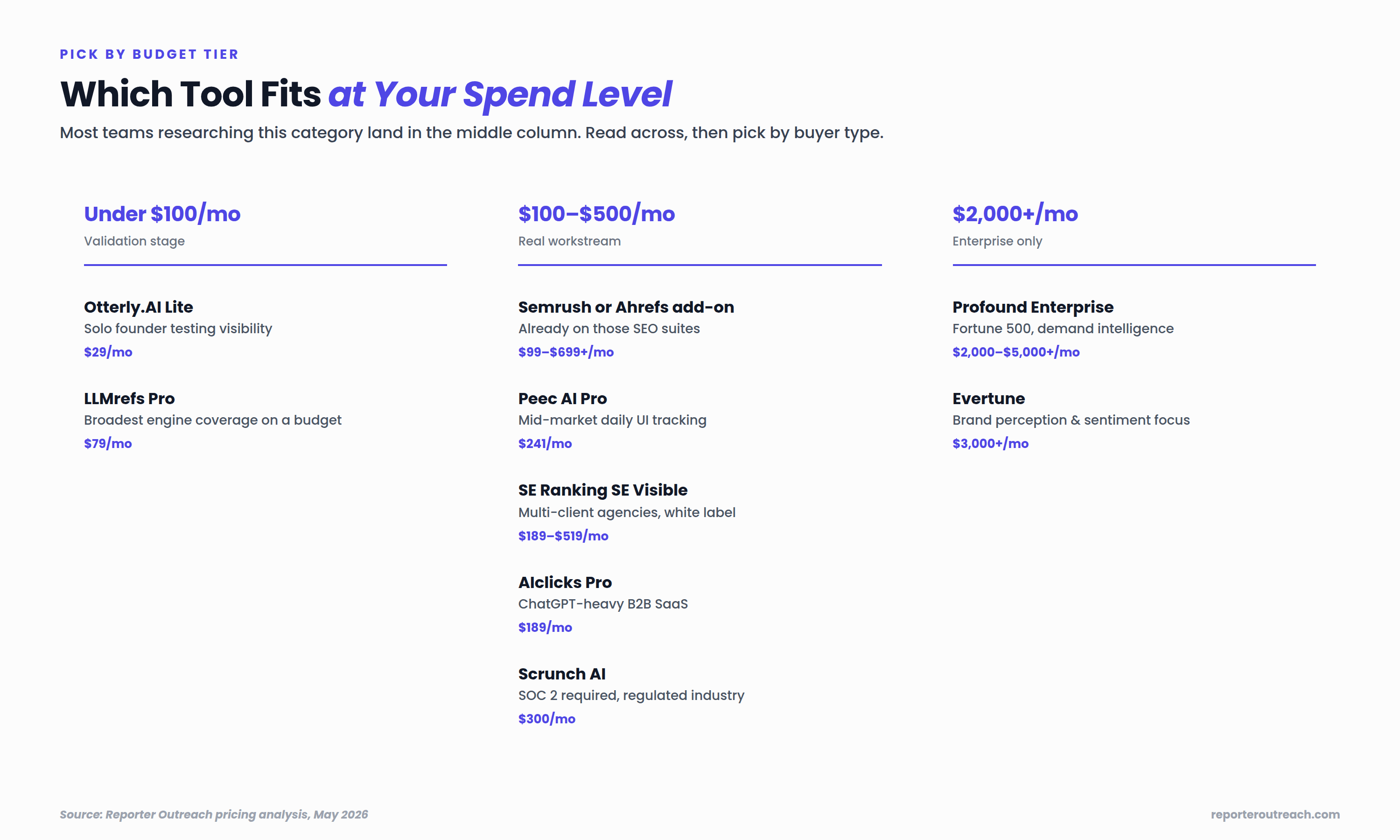
- Solo founder or pre-product-market-fit team validating that AI visibility matters: Start with Otterly.AI Lite at $29/mo or LLMrefs free tier. Baseline current visibility. Decide whether the channel is worth investing in before scaling spend.
- Growing team with established content and need broader coverage: LLMrefs Pro at $79/mo or AIclicks Starter at $59/mo. Both cover 10+ engines at sub-$100/mo with real prompt limits.
- Mid-market B2B team treating AI visibility as a real workstream: Peec AI Pro (~$200-241/mo) or Otterly Standard ($189/mo). Daily tracking, multi-platform, real prompt volumes, unlimited team seats.
- Agency managing 5+ client brands: SE Ranking SE Visible ($189-$519/mo) for native white label and multi-client workspaces, or Peec AI's agency tier for unlimited seats and Slack support from the founding team.
- Already deep in Semrush or Ahrefs: Add the in-suite AI visibility module rather than introducing a new tool. Semrush AI Visibility Toolkit at $99/mo per domain or Ahrefs Brand Radar at $199-$699/mo on top of base. The integration value typically beats best-of-breed for existing power users.
- Regulated industry with SOC 2 procurement requirements: Scrunch AI ($300/mo) or Profound Enterprise. Most mid-tier tools skip enterprise compliance.
- Fortune 500 with dedicated AI visibility headcount: Profound Enterprise ($2,000-$5,000+/mo) for Prompt Volumes panel data and SOC 2/HIPAA, or Evertune ($3,000+/mo) for sentiment and competitive perception analytics. Pick Profound for demand intelligence; Evertune for perception depth.
The decision should rarely come down to "which tool has the most features." It should come down to which tool's gotchas match what the team can absorb.
Why Tracking Alone Isn't Enough
Tracking shows the gap. It does not close it. Brands that buy a visibility tracker without a content engine to act on the data typically watch flat dashboards for 6 months and churn off the platform. The map below shows where the disconnect lives:
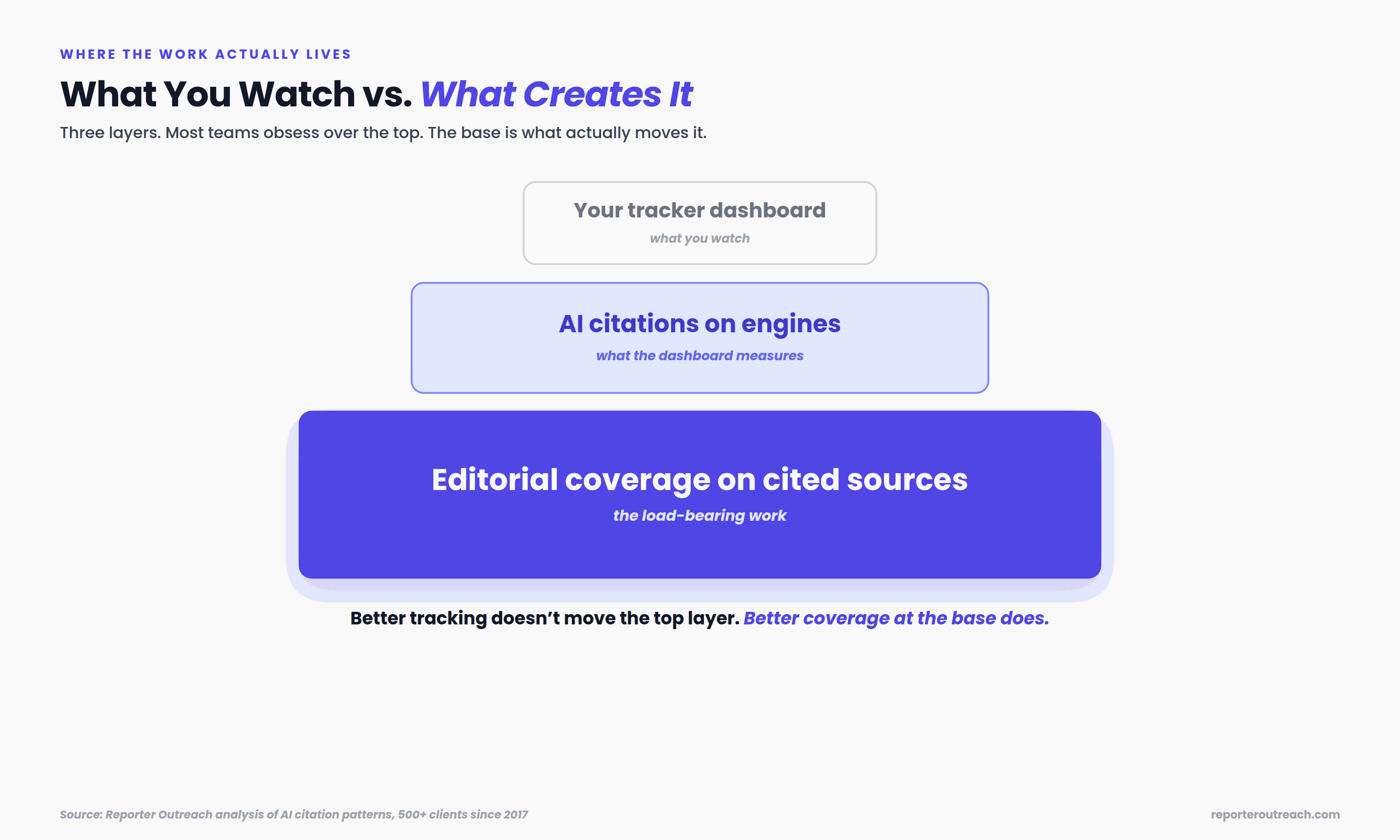
The gap a tracker reveals usually has the same root cause across categories: AI search engines cite the sources they trust, and most brands aren't published on those sources yet. Reddit threads, third-party listicles, industry publications, journalist-written articles. Those are the URLs Perplexity and ChatGPT pull from when answering category-defining questions. A dashboard that shows zero mentions on Perplexity isn't a dashboard problem. It's a coverage problem.
This is why the most useful tools on the list above pair measurement with action signals. Otterly's GEO Audit identifies on-page factors. AIclicks generates content recommendations. Peec AI shows which third-party domains AI engines repeatedly cite. Scrunch AI's source-level focus exists precisely because the source set, not the brand site, is what determines AI visibility.
Even the best AI visibility tools can have meaningful accuracy gaps. The Ahrefs Brand Radar 97.5% mention-count discrepancy isn't unique — it's documented because Ahrefs has the largest user base to test against. Most tools above operate within a 70-90% accuracy band depending on AI engine, methodology, and how the prompts are structured. Use the data directionally, not absolutely.
The work that actually moves the numbers is editorial — earning coverage on the third-party sites AI engines already trust, getting quoted in industry publications, building enough source-level authority that AI engines pull from a brand's coverage rather than a competitor's. Digital PR link building is the most direct mechanism for this. Generative engine optimization is the broader strategy that ties everything together. If you would rather hire that layer out, our comparison of generative engine optimization agencies sorts the vendors by the stage each one actually works on.
Reporter Outreach has run that coverage work for 500+ clients across 12+ industries since 2017, with 25,000+ editorial placements on publications AI engines actively cite. A tracker shows where the gap is. Coverage closes it.
Frequently Asked Questions
What's the difference between AI visibility tools and traditional SEO tools?
Traditional SEO tools (Ahrefs, Semrush, Moz, SE Ranking) measure keyword rankings in Google search results. AI visibility tools measure how often a brand appears in AI-generated answers from ChatGPT, Perplexity, Gemini, Claude, and Google AI Overviews, plus which URLs the AI cites as sources. The signals are different. A page can rank #1 on Google and never get cited by AI, or get cited heavily by AI without ranking in the top 10. Most teams need both layers of measurement, which is why incumbents like Ahrefs and Semrush built AI add-ons rather than letting standalone trackers replace their suites.
Which AI engines should I actually be tracking?
At minimum, ChatGPT, Perplexity, and Google AI Overviews. ChatGPT is the largest by weekly active users (900M+) and dominates B2B research queries. AI Overviews appear on a growing share of Google searches and intercept buyers before they click through. Perplexity has a smaller user base but disproportionate influence among researchers and journalists. Claude, Gemini, Grok, Copilot, and Meta AI matter for specific audiences (developers for Claude, Google-stack users for Gemini, enterprise Microsoft buyers for Copilot) but aren't universal coverage requirements. Pick a tool that includes the three core engines on its working tier without forcing add-on purchases.
How accurate are AI visibility tools?
Generally good enough to use directionally, but not reliable as absolute mention counts. Most platforms operate within a 70-90% accuracy band depending on AI engine and methodology. UI scraping (used by Peec AI, AIclicks, and others) captures what real users see more accurately than API-based methods. Keyword-first approaches like Ahrefs Brand Radar have documented gaps versus prompt-level methodologies. Treat the trend lines and competitive positioning as the signal; treat the raw numbers as estimates.
Do I need an AI visibility tool if I already use Ahrefs or Semrush?
Probably yes, but the in-suite add-on is usually the right starting point. Ahrefs Brand Radar and Semrush AI Visibility Toolkit both layer AI data onto an existing workflow without forcing a new vendor relationship. The tradeoff is depth — neither suite goes as deep on AI-specific features as purpose-built tools like Profound, Peec, or Otterly. Teams that find themselves running heavy AI optimization workflows often end up adding a dedicated tracker alongside the SEO suite, but starting with the in-suite option is cheaper and faster than a parallel evaluation.
How long until tracking shows results?
Initial visibility lifts typically appear within 2-8 weeks of structured optimization work, but the visibility a tracker measures is downstream of editorial coverage that can take 3-6 months to compound. Brands that buy a tracker expecting numbers to move on their own watch flat dashboards. Brands that pair tracking with sustained content production, technical AI search optimization, and third-party editorial coverage typically see measurable share-of-voice gains by month three and material pipeline impact by month four to six.
Stop Watching the Dashboard. Start Moving the Numbers.
Reporter Outreach earns the editorial coverage that puts brands into AI citation sets. 25,000+ placements across 500+ clients in 12+ industries since 2017.
Sources: Ahrefs pricing page; Profound pricing (G2, Trakkr review, vendor materials); Peec AI pricing page; Otterly.AI pricing page; Semrush pricing page; SE Ranking pricing and SE Visible product page; LLMrefs vendor materials (Trakkr review); AIclicks vendor pricing page; Scrunch AI public pricing; Evertune SourceForge and vendor disclosures; Dageno AI Brand Radar accuracy testing; independent reviews from Trakkr, Averi, Rankability, and Pikaseo. All pricing verified May 2026.