Key Takeaways
- ChatGPT crossed 900 million weekly users in early 2026 — roughly double its count a year earlier, and the clearest sign of how fast search behavior is shifting into AI tools.
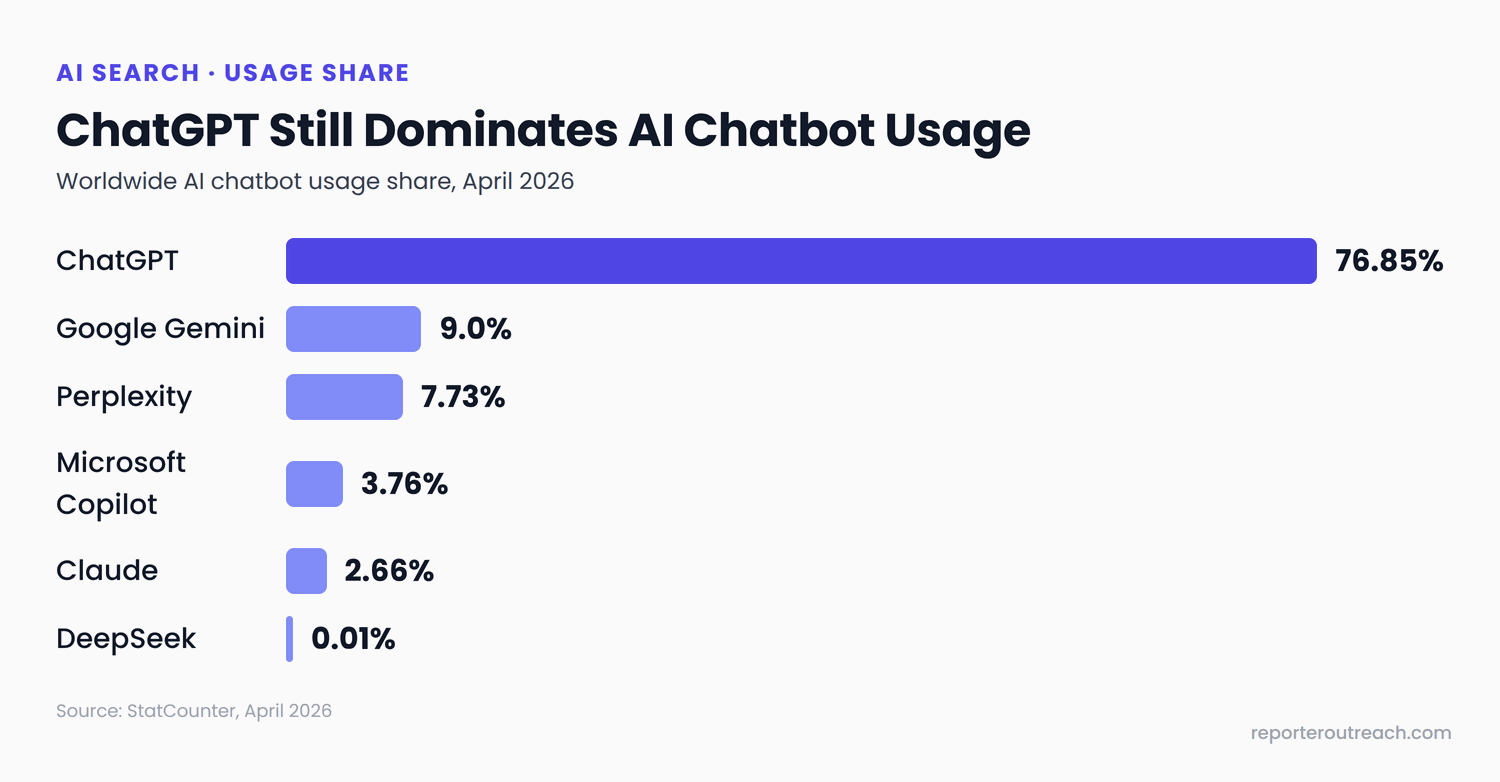
- By raw usage share, ChatGPT (76.85%) towers over Gemini, Perplexity, Copilot, Claude, and DeepSeek (StatCounter, April 2026) — but referral-traffic share tells a different story, with Claude punching far above its usage weight.
- AI Overviews showed up in 18% of Google searches in early 2025 and roughly 25.8% by late 2025 — and they cut clicks to websites sharply. A randomized 2026 field experiment measured a 38% drop.
- 84% of AI citations come from earned media, not brand-owned pages (Muck Rack, May 2026) — so getting covered by third-party publications, not publishing more of your own content, is what wins AI visibility.
- The practical version: getting cited by the sources AI engines trust is a digital PR problem before it's an SEO one.
The AI search statistics that matter in 2026 start with a single number: ChatGPT reached 900 million weekly active users in February 2026, according to OpenAI — more than double the 400 million it reported a year earlier. AI search stopped describing a fringe behavior a while ago. It now describes where a meaningful slice of research, product comparison, and discovery actually happens.
This page pulls together the numbers that matter for 2026 — market share by platform, how often AI Overviews appear, what they do to clicks, and where AI engines source the answers they give. Every figure below is dated and attributed, because in a space moving this fast, a stat without a date is worthless. For the strategy behind the numbers, our guides on GEO versus SEO and AI search optimization go deeper.
The State of AI Search in 2026
AI search is no longer additive to traditional search — it's starting to substitute for it. ChatGPT alone reports 900 million weekly users and more than 50 million paying consumer subscribers. Google's Gemini sits around 400 million monthly users. And the trajectory is the headline, not the snapshot.
Semrush projects that AI-search visitors will overtake traditional search visitors by 2028. Gartner's nearer-term call: roughly 25% of organic search traffic shifts toward AI assistants and chatbots by the end of 2026. Pew Research already found that 58% of US Google users encountered at least one AI summary in a single month back in early 2025 — a share that has only grown since.
When hundreds of millions of people get answers inside an AI interface, the question isn't whether your brand ranks. It's whether the AI mentions you at all — and whether the sources it trusts have anything to say about you.
AI Search Engine Market Share
ChatGPT leads every measure of AI search market share — but by how much depends entirely on what you measure. Usage share, referral-traffic share, and raw user counts give three different pictures, and conflating them is the most common mistake in AI-search reporting.
| Engine | Usage share StatCounter, Apr 2026 |
B2B referral share Goodie, Mar–Apr 2026 |
Reported users |
|---|---|---|---|
| ChatGPT | 76.85% | 62.6% | 900M weekly |
| Google Gemini | 9.0% | 10.6% | 400M monthly |
| Perplexity | 7.73% | 7.3% | — |
| Microsoft Copilot | 3.76% | ~4% | 33M |
| Claude | 2.66% | 18.5% | 18.9M monthly |
| DeepSeek | 0.01% | — | 125M monthly |
| Grok | — | — | ~29.6M visits |
Look at Claude. It holds 2.66% of measured usage share but 18.5% of B2B referral traffic — because the people using it click out to source sites at a much higher rate than the usage number implies. DeepSeek is the mirror image: a reported 125 million monthly users, yet a rounding error in StatCounter's web-referral measurement, because its base is heavily app-based and concentrated in markets that tool doesn't capture well.
The lesson for anyone optimizing for AI visibility: there is no single "AI search market share" figure. Usage share tells you where attention is; referral share tells you which engines actually send traffic to the open web. Both matter, and they don't agree. Our roundup of the best AI visibility tools covers how to track presence across more than one of them.
On raw usage share, though, the distance between ChatGPT and the field is hard to overstate.
AI Overviews Prevalence
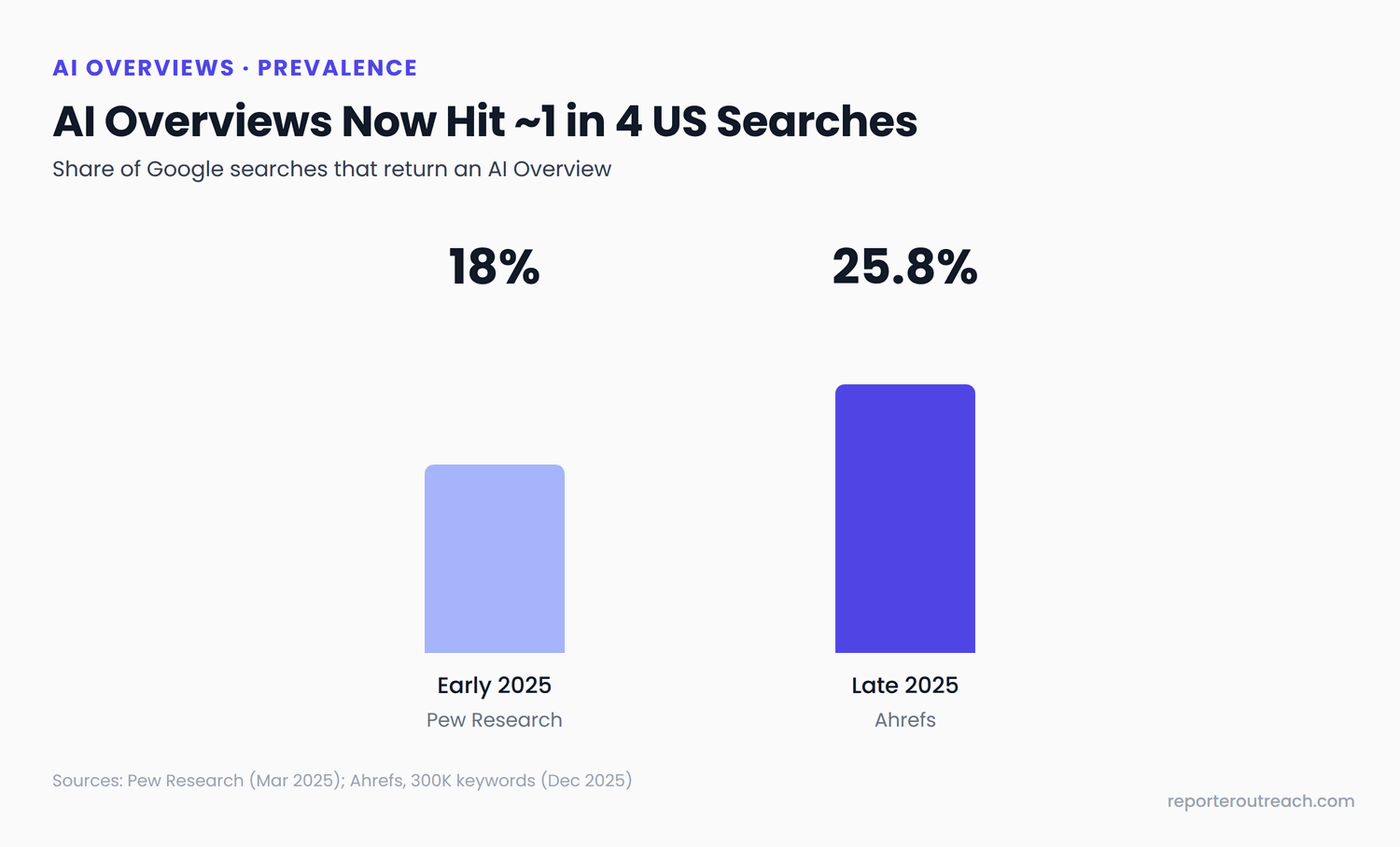
AI Overviews now appear on roughly a quarter of US Google searches — up from about one in six a year earlier. Pew Research measured AI summaries on 18% of searches in its early-2025 study; by late 2025, Ahrefs put the figure at 25.8% across 300,000 keywords. The direction is consistent across every independent count.
That growth isn't evenly distributed. AI Overviews skew hard toward longer, question-style queries — the exact searches where someone is trying to learn or decide something:
- One- or two-word searches trigger an AI summary only about 8% of the time.
- Ten-plus-word searches trigger one roughly 53% of the time.
- Question-based searches (who, what, why) produce an AI summary about 60% of the time.
The trajectory, side by side:
How AI Search Affects Clicks
Every credible study points the same way: when an AI answer appears, fewer people click through to websites. What varies is the magnitude, not the direction — and the most rigorous study available is also the most recent.
| Study | Scope | Finding |
|---|---|---|
| ISB & Carnegie Mellon (SSRN), Jan–Feb 2026 | Randomized field experiment, 1,065 users | AI Overviews cut organic clicks 38% |
| Pew Research, Mar 2025 | ~69,000 real queries, 900 adults | Click rate 8% with an AI summary vs 15% without |
| Amsive, 2025 | ~700,000 keywords | 15.49% average CTR decline |
| Pew Research (session data) | Same dataset | 26% of sessions end after an AIO page vs 16% without |
Pew's most quietly damning number: when people did see an AI summary, they clicked a link inside that summary just 1% of the time. The answer was usually enough. The click gap is the whole story.
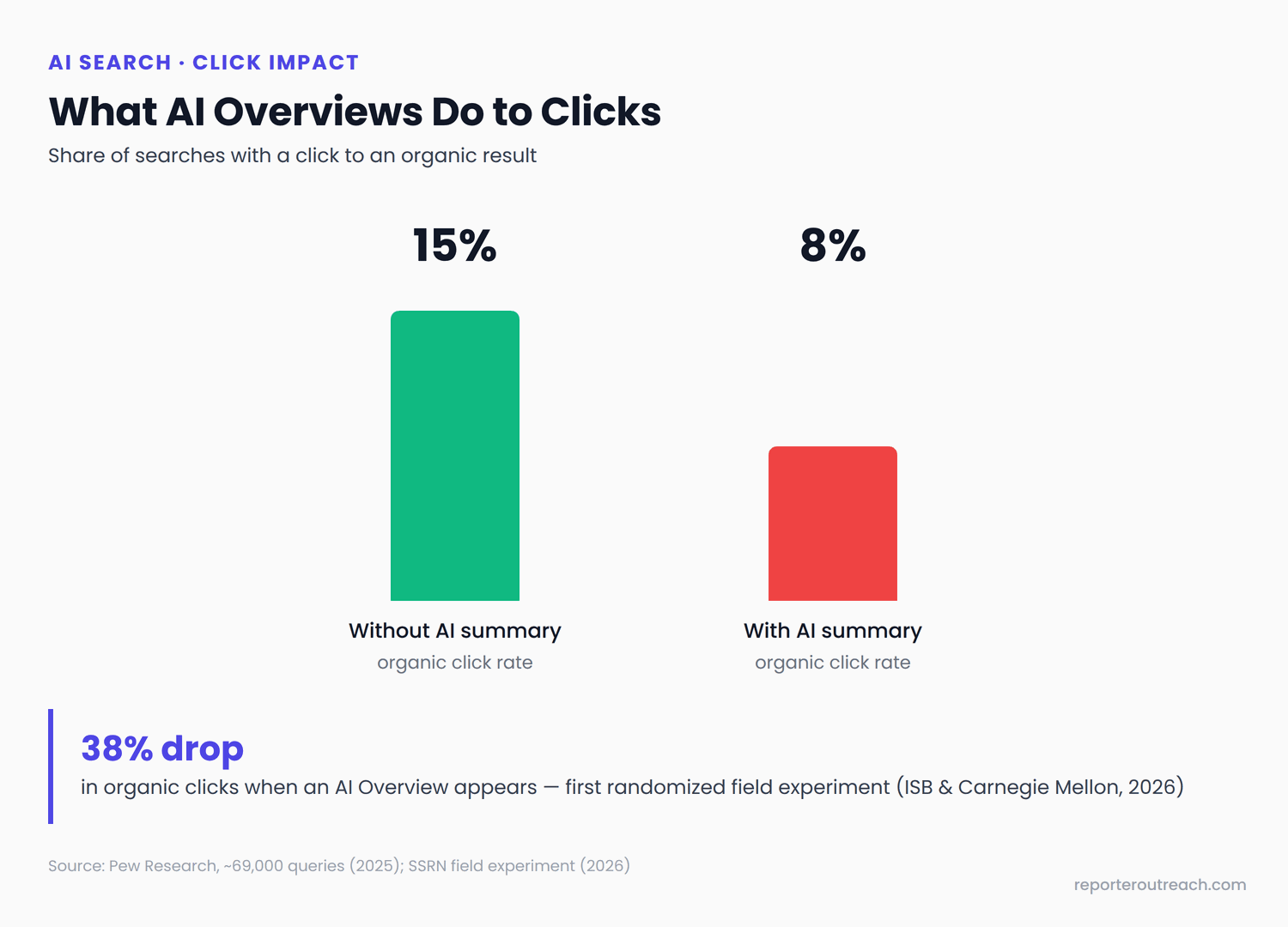
These are organic-result click rates, and the 85% that didn't click an organic result was never all "no click." Even before AI, only about a third of Google searches ended in any click at all — most ended right on the results page, or the user clicked an ad or one of Google's own features. AI Overviews widen a gap that was already large. So the real takeaway isn't "SEO is dead"; it's that ranking #1 is worth less when an AI answer sits above it, and visibility increasingly means being cited inside the answer, not just below it.
Where AI Engines Get Their Sources
AI answers don't pull from one place — they synthesize multiple sources per response. In Pew's analysis of Google's AI Overviews, 88% of summaries cited three or more sources, and only 1% relied on a single one. The decisive question for any brand isn't how many sources get cited — it's which kind.
The answer is earned media. Muck Rack's May 2026 Generative Pulse analysis of more than 25 million links found that 84% of AI citations come from earned media — earned editorial coverage in real publications, not brand-owned content.
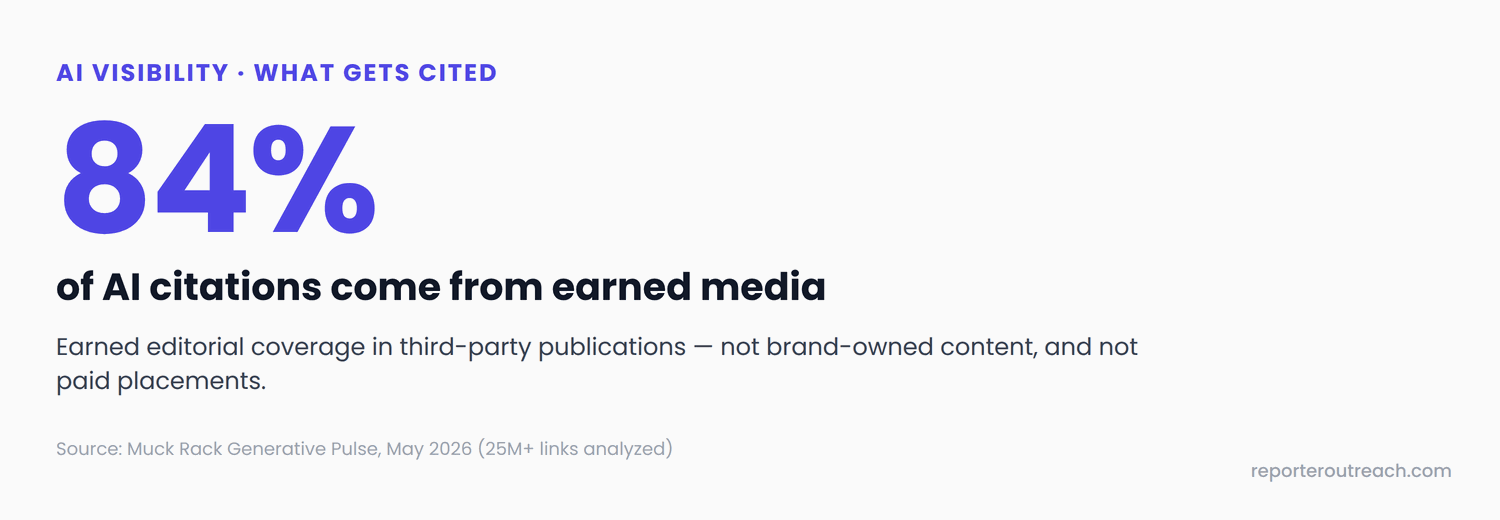
That's the entire mechanic for AI visibility. AI engines surface coverage you earned in third-party publications — not the pages you publish on your own site. You don't get cited by adding more to your blog. You get cited when credible publications write about you.
What AI Search Statistics Mean for Brand Visibility
If AI engines cite third-party coverage and rarely link out, the path to AI visibility runs through earned media — not your own pages. That single mechanic reframes the whole opportunity. The brands that show up in AI answers are the ones already covered by the news sites, industry publications, and authoritative domains those engines pull from.
The market is starting to act on this. Industry surveys put the share of business decision-makers who have allocated budget specifically to AI search optimization at around 38% — early, but moving fast for a discipline that barely existed two years ago. Practitioners are moving even faster on AI tools in general: in our survey of how 500 SEO and PR pros use AI, 91% already use it in their day-to-day work. The teams treating AI visibility as an extension of digital PR, rather than a new on-page checklist, are the ones positioned for the 2028 crossover Semrush is forecasting. For who to hire for which part of that work, see our roundup of the best GEO agencies.
This is exactly what digital PR link building is built to do: earn coverage in the third-party publications AI engines cite, so your brand becomes part of the answer rather than a buried link below it. For the mechanics of optimizing content itself for AI extraction, our guide to answer engine optimization breaks down the on-page side.
Want Your Brand Cited by AI?
We earn the editorial coverage AI engines pull from — the third-party citations that put your brand inside AI answers, not buried beneath them.
Frequently Asked Questions
How many people use AI search?
Adoption is now mainstream. ChatGPT alone reported 900 million weekly active users in early 2026, with Gemini around 400 million monthly users, and Pew found a majority of US Google users had already encountered AI summaries in their results by early 2025.
Which AI search engine has the largest market share?
ChatGPT, by a wide margin on usage share — about 76.85% as of April 2026 per StatCounter, ahead of Gemini, Perplexity, Copilot, Claude, and DeepSeek. The ranking shifts, though, when you measure referral traffic to websites rather than raw usage.
Do AI Overviews reduce clicks to websites?
Yes. Pew recorded an 8% click rate when an AI summary appeared versus 15% without, and a randomized 2026 field experiment from researchers at ISB and Carnegie Mellon measured a 38% drop in organic clicks. Clicks on links inside the summary itself happened only 1% of the time.
Where do AI engines get their information?
Overwhelmingly from earned media. Muck Rack's May 2026 analysis found 84% of AI citations come from earned editorial coverage in third-party publications — not brand-owned pages. AI answers also tend to draw on several sources at once rather than any single one.
Does AI search hurt SEO, and how do brands stay visible?
It changes what visibility means rather than killing SEO outright. Because AI answers cite trusted third-party sources, the most reliable way to appear is earning coverage in those publications — a digital PR approach — rather than adding more pages to your own site.
Sources: OpenAI; StatCounter (April 2026); Goodie AI Search Traffic Report (2026); Similarweb; Pew Research Center (2025); Muck Rack Generative Pulse (May 2026); Agarwal & Sen, Indian School of Business & Carnegie Mellon, SSRN (2026); Amsive; Ahrefs (2026); Semrush; Gartner.