Key Takeaways
- Most digital PR programs cost under $10,000 a month. The market-average contract is $5,458 a month, and about half of all contracts come in below $5,000 (BuzzStream).
- Per-link economics run from about $375 to $1,500 depending on how you buy: $597 on average across BuzzStream's survey, $663 for agencies, and $1,250 to $1,500 per unique linking domain on campaign-based work.
- Traditional PR minimum retainers run $7,500 to $50,000 a month (O'Dwyer's) and bill for time. Digital PR increasingly bills for outcomes.
- Earned media drives 84% of AI citations (Muck Rack, May 2026). Coverage budgets are following that math.
- Pay-per-placement pricing moves delivery risk to the provider: you pay when coverage lands, not for hours spent trying.
Digital PR pricing is one of the most opaque corners of marketing. Four in ten teams running digital PR can't name their own average cost per link: 39.2%, per BuzzStream's State of Digital PR 2026, down from 51.4% a year earlier. The industry is getting more transparent. Slowly.
Here's the short version: most programs run under $10,000 a month, the market-average contract is $5,458, and the per-link economics underneath those retainers range from under $300 to more than $1,500 depending on how you buy. This guide covers the full market: what retainers actually cost, how the three pricing models compare, how digital PR stacks up against a traditional PR retainer, and how to set a budget that maps to outcomes instead of hours.
How Much Does Digital PR Cost in 2026?
Digital PR costs $3,000 to $10,000 a month for most programs, with the market-average monthly contract at $5,458, according to BuzzStream's dedicated digital PR cost survey. Agencies charge about 50% more than freelancers ($6,357 versus $4,200 a month on average), which buys creative production, larger teams and reporting depth.
The high end is growing. BuzzStream's 2026 data shows budgets above $20,000 a month more than doubled year over year (4% to 8.8%), while budgets under $5,000 shrank from 34.1% to 25.7%. Earning coverage is getting harder, and the market is repricing accordingly.
| How you buy | Typical cost | Per-link economics | Source |
|---|---|---|---|
| Freelancer or consultant | About $4,200 a month on average | $416 average per link | BuzzStream cost survey |
| Digital PR agency retainer | About $6,357 a month on average; most under $10,000 | $663 agency average; $597 across all respondents | BuzzStream cost survey |
| Campaign-based digital PR | A $5,000 to $10,000 campaign | $1,250 to $1,500 per unique linking domain | BuzzStream pricing guide |
| Productized pay-per-placement | $3,000 to $12,000 a month | $375 to $429 per placement | Reporter Outreach pricing |
The spread looks contradictory until you see what's being amortized. A managed program spreads campaign setup (research, creative, journalist relationships) across every placement it produces, which is how survey averages land around $600 and well-run programs deliver below that. A single campaign carries those same setup costs on a handful of links: BuzzStream estimates a $5,000 to $10,000 campaign typically nets 6 to 7 unique linking domains, or $1,250 to $1,500 each. Our full link building pricing guide breaks down what every method costs; this page stays on the digital PR market.
Here's the per-link spread in one view:

Digital PR vs Traditional PR Retainers
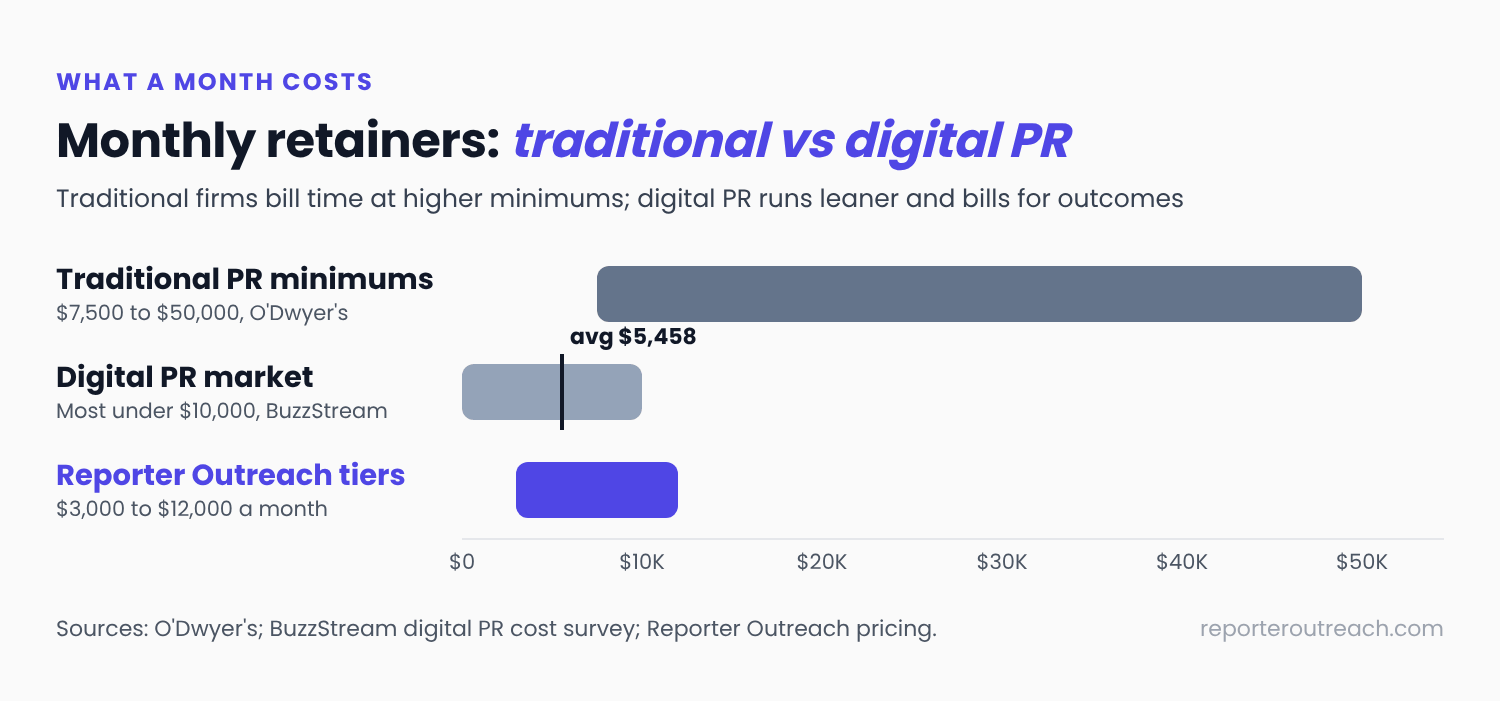
Traditional PR retainers start at $7,500 to $50,000 a month at established firms, according to O'Dwyer's annual agency survey, and they bill for time. Digital PR averages $5,458 a month and increasingly bills for outcomes. That's the whole comparison in two sentences; everything else is detail.
The detail matters, though. PRWeek's Agency Business Report puts enterprise retainers at $20,000+ a month and small-business engagements at $3,000 to $8,000. For what that small-business range buys from specific firms, see our list of PR firms for small businesses with published prices. Senior agency time bills at $300 to $500 an hour per Gould+Partners' billing-rate survey, and O'Dwyer's pegs agency CEO time at $439. At those rates, a $15,000 retainer buys roughly 35 to 45 senior hours. What those hours produce is where the two models diverge.
| Traditional PR retainer | Digital PR | |
|---|---|---|
| What you pay for | Time and activity | Coverage outcomes |
| Typical cost | $7,500 to $50,000 a month minimums (O'Dwyer's) | $5,458 a month average; about half under $5,000 (BuzzStream) |
| Primary outputs | Impressions, share of voice, AVE | Linked editorial placements, brand mentions, AI citations |
| Measurement | Hard to attribute | A per-placement ledger: URL, DR, anchor text |
| Typical commitment | 6 to 12 months | Shorter; output-billed programs usually run 3-month minimums |
The reason budgets are migrating isn't fashion. It's measurement, and AI search just raised the stakes. Muck Rack's Generative Pulse analyzed more than 25 million links cited by ChatGPT, Claude and Gemini, and in May 2026 earned media accounted for 84% of all AI citations. As AI answers take over more searches, the retainer that produces linked editorial coverage is buying visibility in the channel that's growing. The retainer that produces impressions is buying a metric.
Ask any PR firm what a single placement costs. If the answer is a number, you're buying outcomes. If the answer is "it doesn't work that way," you're buying hours, and the delivery risk is yours.
The monthly numbers side by side:
Retainer, Campaign, or Pay-Per-Placement?
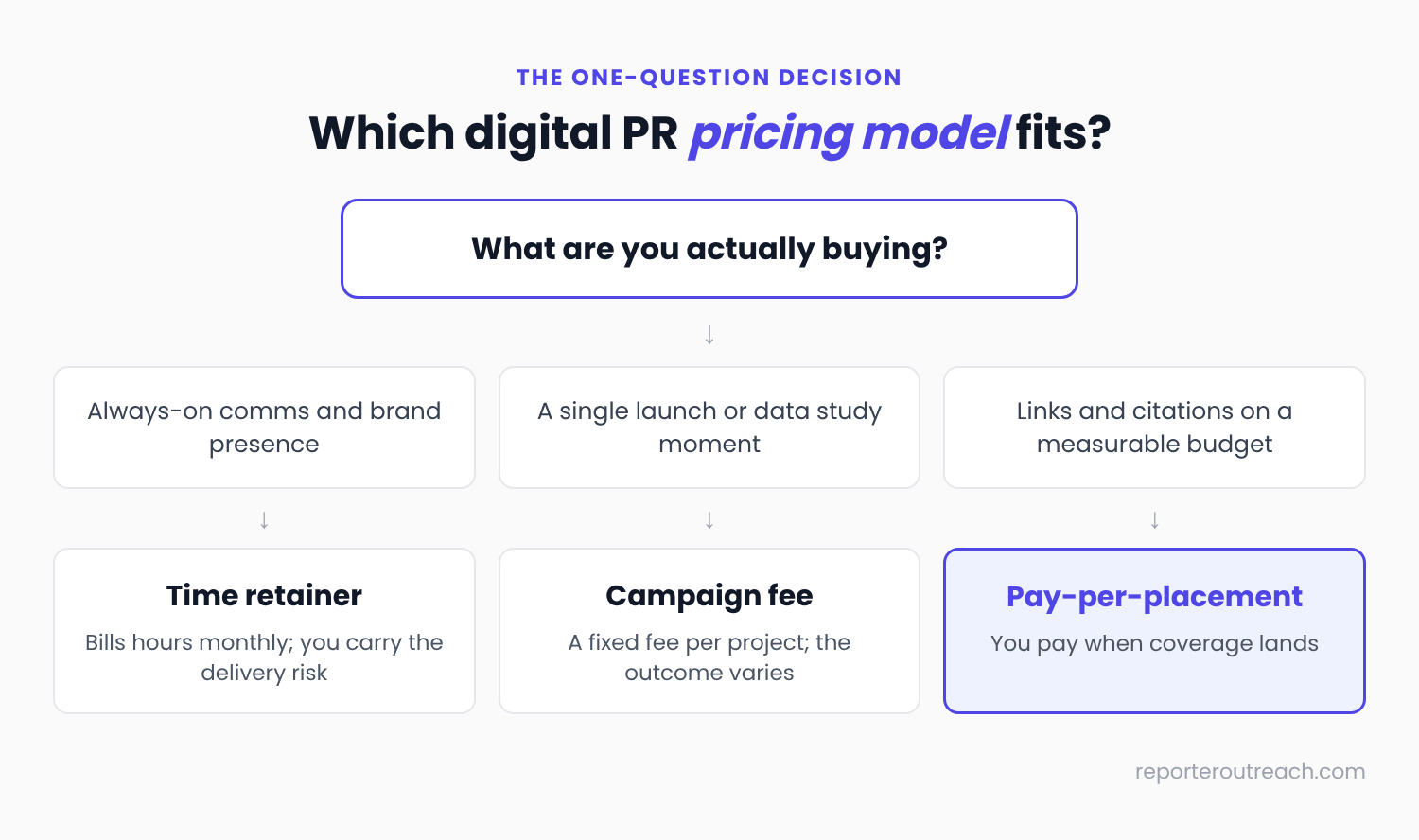
Digital PR is sold three ways: monthly time retainers, fixed campaign fees and pay-per-placement. The work underneath is the same; the risk allocation is completely different.
| Model | How it bills | Commitment | Who carries delivery risk |
|---|---|---|---|
| Time retainer | A fixed monthly fee for hours and activity | 6 to 12 months | You: dry months still invoice |
| Campaign or project fee | A fixed fee per campaign | One-off | Shared: the outcome varies per campaign |
| Pay-per-placement | Per delivered placement | A 3-month minimum is typical, then monthly | The provider: you pay when coverage lands |
Here's the position this guide takes: if the outcome you're buying is links and citations, pay-per-placement is the model that aligns incentives. The unit cost is visible before you sign. The provider only earns when coverage lands, so a slow month costs the agency, not you. And it makes vendors comparable: you can put three quotes side by side and know what each placement costs, which a retainer is structurally designed to prevent. Most providers still bill on retainer, which is exactly why asking for per-placement terms is the fastest way to learn how confident a provider is in its own delivery.
Retainers aren't a scam, to be clear. They're the right structure when the work isn't link-shaped: always-on communications, crisis preparedness, or heavy creative production where a data study takes six weeks before outreach even starts. If your KPI sheet says referring domains and AI citations, though, you want a billing model denominated in the same units as your goals.
One version of this question shows up constantly: journalist-request platforms (HARO-style services, Qwoted) versus custom campaign packages. The honest answer is that platform access is an input, not an outcome. Reactive digital PR, positioning your experts as sources in stories journalists are already writing, is some of the most efficient coverage money can buy, but only if you're paying for coverage secured rather than pitches sent. It's the same model question wearing different clothes.
If you're torn between the three, the decision usually comes down to one question:
Why Digital PR Quotes Vary by 4x
Because cost structures differ, not just quality. The average cost per earned link sits around $600 to $660 in BuzzStream's cost survey, and its 2026 State of Digital PR shows the share of teams reporting $750+ per link more than tripled in a year, from 3% to 10.2%. Earning a real editorial placement means research or creative worth covering, a journalist who chooses to cover it, and pitching cycles that mostly end in silence. That production reality puts a floor under honest pricing.
Which makes the floor a useful filter. Quotes that should make you pause:
- Priced far below production cost, with Tier 1 promises. If the market average is around $600 and someone quotes $150 per link on major publications, the corners being cut are the ones you care about.
- Guaranteed first-page rankings or specific positions. A provider can commit to delivering placements; where Google ranks you afterward, it can't. Anyone promising a specific ranking position is either naive or counting on you not to check.
- No per-placement reporting. If a provider can't show you each link with its URL, DR and anchor text, the deliverable is the invoice.
Bringing it in-house doesn't escape the math, either. Salary, tools and months of relationship-building all land before the first link does; our outsource link building breakdown runs those numbers if you're weighing build versus buy. Niche matters too: regulated and YMYL industries pay a premium because fewer publishers will touch them.
Reporter Outreach Digital PR Pricing
Reporter Outreach prices digital PR per placement: three monthly tiers, with the rate set by your commitment and undelivered placements rolling into the next billing cycle. The full breakdown lives on the pricing page; here are the numbers.
| Tier | Monthly | Placements a month | Per placement |
|---|---|---|---|
| Starter | $3,000 | 7 | $429 |
| Growth | $6,000 | 15 | $400 |
| Elite | $12,000 | 32 | $375 |
Every tier targets the same Tier 1 publications; what changes with commitment is unit economics, not publication quality. Placements average DR 75+, and reactive digital PR campaigns position client experts as sources in stories journalists are already writing. Engagements carry a 3-month minimum to build measurable authority; after that, you can cancel anytime with 30 days' notice. Undelivered placements roll into the next billing cycle automatically, so nothing billed is lost.
That's pay-for-performance in practice: the per-placement number is on the table before the engagement starts. Against the market figures above (about $600 to $660 on survey averages, $1,250 to $1,500 per linking domain on campaign work), $375 to $429 per Tier 1 placement is the arithmetic doing the selling.
If you need to rank specific pages rather than build domain-wide authority, our link insertions are priced per link instead: $300 to $500 depending on DR and traffic floors, with no retainer and free replacement if a link drops within 12 months.
How to Budget for Digital PR
Work backward from referring domains, not forward from a round number. If competitive analysis says you need 8 to 10 quality placements a month to close the authority gap, the budget writes itself: at market-average per-link economics (about $600 to $660), that's roughly $4,800 to $6,600 a month. At productized per-placement rates ($375 to $429), the same volume runs $3,000 to $4,300. Sanity-check your targets against our digital PR statistics benchmarks before committing to either number.
Then budget time, not just money. First placements typically land within 2 to 3 weeks, meaningful ranking movement starts around months 3 to 6, and compounding effects build through months 6 to 12. That curve is why 3-month minimums are standard at output-billed shops: a single month tells you almost nothing.
Before you sign with anyone, ask these five questions:
- What is your effective cost per placement, and how is it billed? If the answer isn't a number, the retainer is the product.
- What happens in a month with zero placements? Under pay-per-placement, nothing: you don't pay, or the volume rolls over. Under a time retainer, the invoice arrives anyway.
- What's the average DR of your placements over the last quarter? Average, not best-ever. One DR 90 outlier can decorate a deck full of DR 20s.
- Which placements are earned, and which are paid features? Both do a job. Earned coverage drives AI citations most (84%, Muck Rack), and a paid feature guarantees the outlet. A good provider tells you which one you're buying.
- How do you report? A per-placement ledger (URL, DR, anchor text, date) or an activity summary. The format tells you what the provider is actually accountable for.
Pay for Placements, Not Promises.
Reporter Outreach prices digital PR per placement: DR 75+ average, Tier 1 publications and a link tracker showing every placement. See the model on a strategy call.
Frequently Asked Questions
How much does digital PR cost per month?
Most digital PR programs cost between $3,000 and $10,000 a month. BuzzStream's market survey puts the average monthly contract at $5,458, with about half of all contracts priced below $5,000. Productized pay-per-placement programs start at $3,000 a month for 7 placements.
What is a typical PR retainer?
Traditional PR agency minimum retainers run $7,500 to $50,000 a month according to O'Dwyer's annual survey, billed against time and activity. Digital PR retainers are smaller, averaging $5,458 a month, and increasingly bill against delivered coverage instead of hours.
What is the average cost per link from digital PR agencies?
BuzzStream's cost survey puts the all-respondent average at $597 per link, with agencies averaging $663 and freelancers $416. About 1 in 4 buyers pay under $300. Campaign-based work lands higher, at $1,250 to $1,500 per unique linking domain in BuzzStream's pricing guide, because a whole campaign's setup is spread across a handful of links.
How much does a digital PR link insertion cost per placement?
Link insertions are a separate product from digital PR: a link added to an existing article on a site you approve. Ours run $300 (DR 50+, 1,000+ monthly organic visits), $400 (DR 60+, 5,000+) and $500 (DR 70+, 10,000+) per link, with no retainer, live within 2 to 3 weeks of approval and free replacement if a link drops within 12 months.
Do digital PR agencies work without retainers?
Yes. Fixed campaign fees cover one-off projects like data studies, and pay-per-placement pricing bills for coverage that actually lands. Reporter Outreach prices per placement, with a 3-month minimum and then the option to cancel anytime with 30 days' notice.
Is digital PR cheaper than traditional PR?
Usually. Digital PR averages $5,458 a month while traditional minimums start at $7,500 and scale to $50,000. The bigger difference is measurability: digital PR produces a per-placement ledger of links and citations, while traditional retainers bill time against impressions and share of voice.
Sources
- BuzzStream, "State of Digital PR Report (2026)" (February 2026, 150+ digital PR professionals)
- BuzzStream, digital PR cost survey (about 70 agencies and freelancers; published October 2025, updated June 2026)
- BuzzStream, link building pricing guide (updated October 2026)
- O'Dwyer's PR agency survey
- PRWeek Agency Business Report
- Gould+Partners billing rate survey
- Muck Rack, Generative Pulse, "What Is AI Reading?" (May 2026)
- Reporter Outreach pricing page (October 2026)