
Key Takeaways
- Quality link building runs $3,000 to $12,000 per month for retainer engagements at agencies that target Tier 1 publications. Per-link, the average price SEOs are willing to pay for a quality backlink is $508.95 (Editorial.link, 2025), with 76% willing to pay $300+ and 47% willing to pay $500+ (Reporter Outreach, 2026).
- SEO budgets typically allocate around 32% to link acquisition (Editorial.link, 2025). On a $10K/mo SEO budget, that means roughly $3,000-$3,600 per month going to links.
- Reporter Outreach bills per-placement. The rate scales with monthly commitment: $430/placement at Starter ($3K/mo), $400 at Growth ($6K/mo), $375 at Elite ($12K/mo). Same Tier 1 publications across all tiers — what changes is unit economics. For the market-wide view — retainer benchmarks by provider type and how digital PR compares to traditional PR — see our digital PR pricing guide.
- Median SEO ROI is 748%, or $7.48 returned for every $1 invested (First Page Sage, 2026). Most campaigns reach measurable ranking impact in 3-6 months and stronger compounding movement in months 6-12.
- The cheapest option per link is rarely the cheapest option per result. Pricing alone tells you nothing — what matters is publisher authority, editorial standards, and topical relevance.
Researching link building pricing usually leads to the same wall: a sea of "it depends" answers, conflicting price ranges, and providers who refuse to quote anything until they get on a call. This guide gives you the actual numbers — what quality work costs, where the money goes, and how to evaluate whether what you are being quoted lines up with what the market actually pays.
The framing matters more than the price tag. Median SEO ROI is 748% (First Page Sage, 2026) — meaning a well-executed program returns $7.48 for every $1 invested. That is not a marketing claim; it is the median across hundreds of three-year campaigns. Once you understand the return side, the cost conversation gets a lot more rational. The question is not "what is the cheapest link I can buy" — it is "what spend gets me into the kind of compounding return First Page Sage is measuring."
We have been running campaigns since 2017. We have seen pricing evolve from "buy 50 links for $200" marketplaces to a 2026 market where a single editorial mention on a high-authority publication can run $1,000+. The market matured. Quality and price both rose. The middle hollowed out. Below is what the current landscape looks like, where the spend is actually going, and how to set a budget that produces results rather than receipts.
Link Building Pricing by Method
Each link building method has its own pricing structure because each involves different labor, relationship requirements, and quality ceilings. Before comparing prices, it helps to know exactly what you are pricing — the terms get used loosely and the products are not interchangeable.
| Method | What it is |
|---|---|
| Digital PR | Editorial placements earned through journalist relationships. Clients are positioned as expert sources; reporters cite them in stories on high-authority publications. |
| Link Insertions | Adding a link to existing content on a third-party site, typically with chosen anchor text and target page. Used for surgical page-level authority. |
| Full-Feature Articles | Dedicated editorial pieces on Tier 1 publications, written and placed under editorial standards. Distinct from guest posts — these are not byline-supplied content. |
| Guest Posts | Author-supplied article published on a third-party site, typically with the author's byline and a link back. Lowest-tier method — most quality publications do not accept them. |
With those distinctions clear, here is what current 2026 pricing looks like at the DR 50+ quality tier.
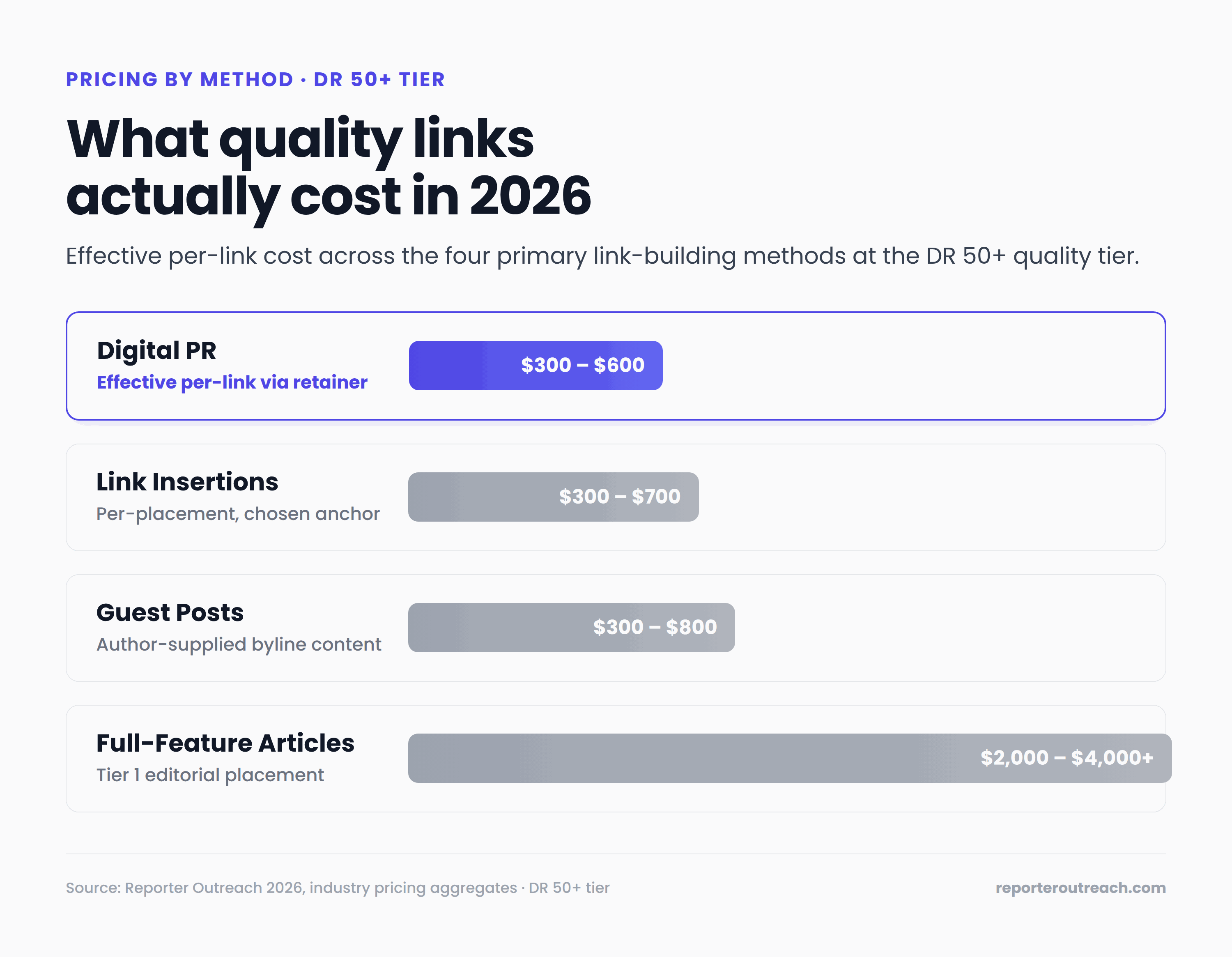
Digital PR earns editorial placements from high-authority publications by positioning your brand as a credible expert source. The labor is in the daily journalist monitoring, the relationships, and the pitch quality — not in producing more emails. Per-link cost is calculated against a retainer that produces multiple placements, which is why the effective number lands lower than methods that charge per placement.
Link insertions — niche edits, in industry shorthand — give you something digital PR does not: precise anchor text and the ability to direct authority to a specific page. They work best as a complement to digital PR, not a replacement — domain-wide authority from PR plus targeted page-level signals from insertions.
Full-Feature Articles are a separate category from guest posts. These are dedicated editorial pieces on publications like USA Today or VentureBeat, written and placed under editorial standards. The price reflects the labor of producing and placing publishable editorial content — not just buying placement.
A high-DR publication with 500 monthly visitors and weak editorial standards is worth less than a slightly lower-DR site with 50,000 real visits and journalist oversight. Always verify organic traffic, topical relevance, and editorial quality alongside DR — these are the dimensions that separate links that move rankings from links that occupy a spot in your backlink profile.
How Per-Placement Pricing Scales with Volume
Reporter Outreach bills per-placement. Every placement is invoiced individually at a rate determined by your monthly commitment level. Bigger monthly commitments unlock lower per-placement rates — same Tier 1 publications, same DR 75+ average, same 2-3 week first-placement timing across all tiers. What changes is unit economics.
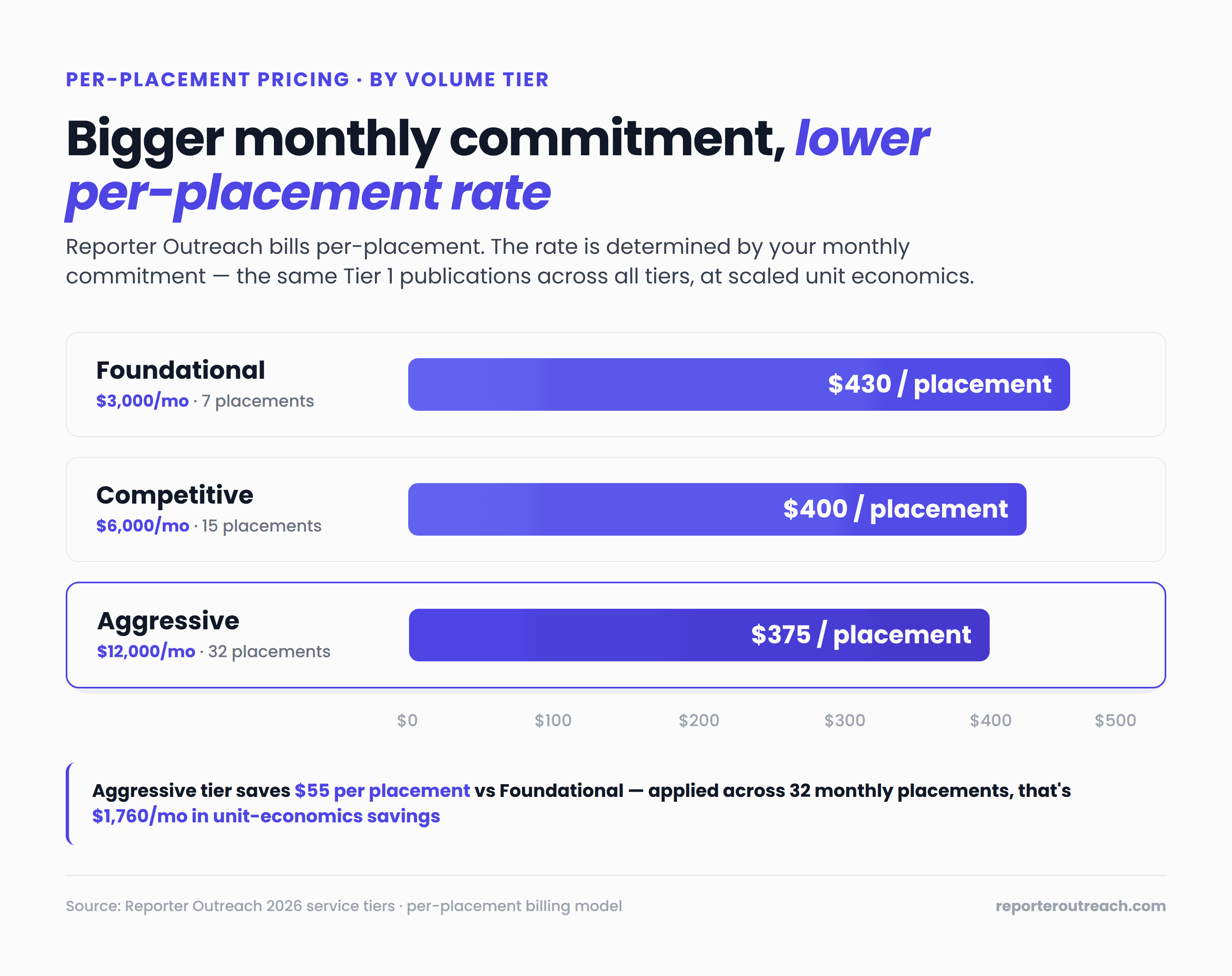
The Elite tier saves $55 per placement versus Starter. Across 32 monthly placements, that translates to $1,760/month in unit-economics savings — meaningful at scale, and one of the reasons sustained programs run cheaper per result than smaller engagements topped up with additional ad-hoc placements.
Compare this against pay-per-placement methods on similar-DR publications, where each placement is priced individually with no volume discount: a single editorial mention on a high-authority publication routinely runs $1,000+ when bought ad-hoc. The retainer-driven volume tier model produces the same DR 75+ placements at $375-$430 per placement, depending on commitment level. That gap is what makes sustained editorial PR the most cost-effective path to high-authority links — not because individual placements are cheaper, but because the engagement model unlocks better unit economics.
Monthly Commitment vs. Ad-Hoc Placement Buying
Most companies producing serious results work on a monthly commitment rather than buying placements one at a time. Monthly commitments give you a predictable pipeline, lower per-placement rates, and the kind of consistent authority signal that compounds over months. Ad-hoc per-placement buying makes sense for supplementing an existing strategy or running small tests — but as a primary approach, it almost always costs more per result.
The Starter $3,000/month tier is where most agency engagements start producing measurable ranking results. Below this level, most campaigns cannot sustain the cadence required for compounding work in competitive niches — there are not enough placements per month to move authority signals meaningfully. The Growth $6,000 tier doubles placement volume to 15/mo at a lower per-placement rate ($400), with the same reactive PR cadence and broader topic flexibility across more outreach. The Elite $12,000 tier carries the highest sustained cadence (32 placements/mo) and the lowest per-placement rate ($375).
Publication caliber stays constant across all three tiers. Reporter Outreach targets Tier 1 publications regardless of engagement scale, with DR 75+ average and AI visibility focus baked in across all tiers. What scales with investment is volume of placements per month and per-placement rate — the program itself is identical at every tier.
Use the 32% allocation as a directional benchmark. If your total SEO budget is $10,000/month, expect roughly $3,000-$3,600 going to links. Below the Starter tier, most companies are spreading budget too thin to fund quality work; above $12,000/month, combined PR plus insertion strategies start producing the kind of compounding returns that SEO ROI benchmarks like First Page Sage's 748% median figure are built on.
What You Are Actually Paying for With Digital PR
Digital PR pricing confuses people because you are not buying links. You are buying a process — and the placements are the output of that process working consistently over time.
Daily journalist monitoring and expert pitching. Reporter Outreach monitors platforms where journalists post active source requests — real reporters at real publications writing real stories. When a query matches client expertise, the team crafts a specific, credible, useful response. This happens every day across dozens of queries. It is not template outreach — a Forbes pitch looks nothing like a TechCrunch pitch, and treating them the same is why most generic outreach fails.
Relationship compounding. A journalist who has cited a source three times is materially more likely to include them in a fourth story. After 6-12 months of consistent work, some clients get proactively contacted by reporters covering their space. This compounding dynamic is unique to PR — it is the reason digital PR campaigns tend to accelerate over time rather than plateau, and it is why the 3-month minimum exists. The first month proves the model works; the compounding shows up later.
AI visibility. Editorial placements earn brand mentions alongside links. Those mentions are what AI search engines (ChatGPT, Perplexity, Gemini, and Google AI Overviews) draw on when deciding which brands to recommend in response to user queries. As AI search captures more of the discovery layer, editorial placements on authoritative publications are doing double duty — driving rankings AND shaping which brands AI tools surface. This is the dynamic that makes editorial PR particularly valuable in 2026 versus methods that earn links without earning visibility.
First placements typically land within 2-3 weeks of campaign kickoff regardless of engagement scale. Ranking shifts begin showing in months 3-6, with more pronounced movement in months 6-12 as authority compounds. Anyone selling faster results is either misrepresenting what is possible or attached to results that will not last.
What Drives Link Building Costs Up and Down
Pricing variation is not random. Four factors explain most of it.
Publisher authority and traffic. A publication with 100,000+ monthly visitors and editorial oversight charges 3-5x more than a comparable-DR site with 2,000 visitors. Inventory is limited and demand is constant. This is the biggest cost driver — and the reason quality links compound while volume links do not.
Niche competitiveness. Finance, legal, healthcare, and SaaS typically run 20-50% above general business pricing. Publishers in YMYL niches have stricter acceptance criteria and there are more buyers competing for limited editorial inventory. Digital PR's relationship-based model has the strongest advantage here — the publications that matter most in YMYL niches rarely sell direct placements at any price. In healthcare, the acceptance bar is a credentialed clinician a journalist can quote; the healthcare link building page walks through how that changes the process and what each tier delivers.
Method labor and quality ceiling. A digital PR campaign requires daily monitoring, expert pitching, relationship management, and editorial coordination. A guest post requires writing one piece. Pricing reflects the labor — but more importantly, it reflects the quality ceiling each method can reach. The labor difference is why you cannot get digital-PR-quality outcomes at guest-post prices, regardless of who you hire.
Publisher fee inflation. Publication placement fees have risen consistently since 2022 across the broader link market. Publications with real editorial standards have raised rates because demand keeps rising while inventory is fixed. Digital PR is partially insulated since it earns editorial placements through journalist relationships rather than direct publisher fees — but the broader inflation trend affects everyone buying placements.
How to Set a Realistic Budget
The right budget depends on your competitive landscape, not an arbitrary benchmark. Here is the framework that actually works:
Step 1: Benchmark your competitors. Pull up Ahrefs or Semrush and check how many referring domains your top 3-5 competitors have. If they average 500 and you have 50, the gap is the budget. The size of the authority gap defines the spend required to close it.
Step 2: Calculate your authority gap. It is not just how many links — it is where they come from. If competitors are earning DR 60-70+ placements and yours are clustered at DR 30-40, volume alone will not close the gap. You need to reach higher-authority publishers, which means budgeting for methods that can actually land those placements.
Step 3: Estimate lifetime link value. Take the monthly organic traffic value of the top-ranking site in your niche (via Ahrefs), divide by referring domains, multiply by 24 months. That gives a rough lifetime value per link. Your cost per link should be well below this number for positive ROI.
Step 4: Commit to 3 months minimum. Most campaigns take 3-6 months to show measurable ranking impact. A 30-day test tells you nothing about whether the work is working — placements take 2-3 weeks to start landing, and rankings move quarters later. Budget for 90 days minimum before evaluating, and ideally for 6-12 months before deciding whether the investment is producing the compounding return SEO ROI benchmarks suggest.
Below $3,000/month, most campaigns cannot sustain the placement cadence required for compounding work in competitive niches. Either scale the budget up to a level that can fund consistent work, target less competitive keywords first while you build the budget, or accept a much longer timeline. There is no middle path that produces serious results at sub-Starter spend.
Quality Signals That Justify the Investment
Once you have a budget, the question shifts from "how much" to "how do I tell whether what I am being quoted is actually quality work." Six dimensions every backlink should clear before it counts as an investment rather than an expense:
- Domain Rating. DR reflects relative authority within the broader link graph. A useful starting filter, never the whole picture.
- Organic traffic verification. A high-DR site with no real visitors is selling a metric, not a result. Verify Ahrefs or Semrush traffic before paying for placement.
- Editorial standards. Real journalists, real fact-checking, real bylines. Sites that publish anything for a fee eventually trigger algorithmic skepticism.
- Topical relevance. A finance link from a relevant publication outperforms a higher-DR link from an unrelated topic cluster, every time.
- Indexation health. Confirm the publication's pages are actually indexed by Google. Deindexed sites pass zero authority regardless of DR.
- Content freshness. Active publishing cadence signals an alive site. Stale archives that have not published in months are red flags.
The pattern across these signals is consistent: authority alone is not enough. The links that compound — the ones that hold value as Google's quality systems get more sophisticated — clear all six dimensions, not just the first one. Most SEOs now prioritize quality over quantity precisely because they have learned that profiles built on cheap link buying eventually hit a wall, while profiles built on editorially placed links keep compounding.
Pricing by Provider Type
Who you hire matters as much as what you buy. Three categories of provider can deliver quality work at the $300+ floor — each with different tradeoffs.
| Provider | Typical Cost | Strengths | Tradeoffs |
|---|---|---|---|
| Specialized Link Building Agency | $300-$1,000+ per link or $3K-$12K/mo retainer | Quality control, established publisher relationships, strategy, transparent reporting | Higher cost, often retainer minimums, must vet methodology |
| Full-Service SEO Agency | $300-$800/link bundled into broader retainer | Integrated SEO strategy, single point of contact | Link building may not be their core specialty; quality varies |
| In-House Team | $5K-$15K+/mo (specialist salary plus tools) | Full control, brand alignment, institutional knowledge | Slow ramp, requires hiring expertise, only cost-effective above $15K/mo total spend |
For deeper provider comparison, our breakdown of the best link building services compares specific agencies by methodology, pricing, and case study results.
Approximately 56% of SEOs outsource at least part of their link building (Editorial.link, 2025), while 44% handle it entirely in-house. The split makes sense — most companies outsource the relationship-heavy work (outreach, journalist pitching, publisher management) and keep strategy in-house. The pure in-house path only pencils out at higher total spend levels because of fixed cost overhead: a specialist salary, the tools (Ahrefs, outreach platforms, monitoring tools at $500+/month), and the months required to build publisher relationships from scratch all happen before the first quality link lands.
Price is only half the evaluation. Once a quote passes the sanity check, our agency vetting guide covers the questions that test whether the provider behind it can actually deliver.
Our Pricing
Reporter Outreach offers two core services with transparent commitment-based pricing. Every package includes strategy, journalist outreach, follow-ups, and a live tracking document updated daily as placements go live — publication name, DR, organic traffic, anchor text, and live URL for each link, available to check anytime rather than waiting for a monthly rollup. All packages also carry a delivery guarantee: undelivered placements roll over to the next month.
Digital PR Packages
| Package | Placements/mo | Avg. DR | Monthly | Per placement |
|---|---|---|---|---|
| Starter | 7 | DR 75+ | $3,000 | $430 |
| Growth | 15 | DR 75+ | $6,000 | $400 |
| Elite | 32 | DR 75+ | $12,000 | $375 |
All packages target Tier 1 publications regardless of engagement scale. What changes is volume, cadence, and unit economics — AI visibility is built into every tier, and more placements per month means more editorial mentions for AI engines to draw on. Billing is per-placement — every placement is invoiced individually at the rate determined by your monthly commitment. 3-month minimum on all engagements; month-to-month after that. See full pricing details on our pricing page.
Link Insertions (Supplementary)
For clients who want to complement digital PR with targeted page-level authority, Reporter Outreach also offers link insertions. These work best alongside PR — digital PR builds domain-wide authority and AI visibility, while insertions direct that authority to specific target pages with chosen anchor text.
| DR Tier | Min. Monthly Traffic | Cost Per Link |
|---|---|---|
| DR 50+ | 1,000 organic visits | $300 |
| DR 60+ | 5,000 organic visits | $400 |
| DR 70+ | 10,000 organic visits | $500 |
Anchor text and target URL are client-chosen. Every placement is Ahrefs-verified with traffic and DR data, and appears in the live tracking document the day it goes live.
Get a Custom Pricing Plan
Tell us your competitive landscape and goals. We will build a plan with pricing, timelines, and projected deliverables.
Link Building Pricing FAQ
How much should I budget per month for link building?
Companies producing meaningful ranking improvements typically invest $3,000 to $12,000 per month on link building. The right number depends on how competitive your niche is and how large the authority gap is between you and the sites you need to outrank. SEO teams allocate around 32% of their total SEO budget to link acquisition, so a $10K/mo SEO budget usually puts $3K-$3.6K toward links.
Why is per-link pricing so variable across providers?
Because the underlying products are different. A $300 link from a vetted DR 50+ publication with editorial oversight and real organic traffic serves a fundamentally different purpose than a sub-$300 link from a thin-content site that exists primarily to sell placement. Same word, different product. Pricing reflects the publisher tier, the labor required to land the placement, and whether the link is paired with editorial credibility.
Is building links in-house cheaper than outsourcing?
Rarely below $15,000/month in total link building activity. In-house requires hiring a specialist ($60K-$100K+ salary), tools ($500+/month), and the months required to build publisher relationships from scratch. Specialized agencies arrive with the relationships, processes, and templates already built. Around 56% of SEOs outsource at least part of their link building, and the math gets cleaner as a smaller spend.
How long until link building shows ROI?
First placements typically land within 2-3 weeks of campaign kickoff. Measurable ranking shifts begin in months 3-6, with stronger movement in months 6-12 as authority compounds. Median SEO ROI of 748% (First Page Sage, 2026) plays out over a 7-9 month average breakeven window, which is why 30-day tests are not informative.
Per-link or monthly retainer — which is better?
Retainers win on most dimensions: better effective per-link economics, consistent placement cadence (which compounds over months), and strategic context that per-link buying does not include. Per-link makes sense for supplementing an existing strategy or running small-scale tests. As a primary approach, retainers produce better results for the same total spend.
Are link building costs going up?
Yes. Publisher placement fees have risen consistently since 2022 across the broader market. AI search is increasing the value of editorial placements specifically — placements drive both rankings and AI tool citations, while editorial inventory remains fixed. The 2026 budget you set now will likely look like a discount in 2027.
Sources: Reporter Outreach — State of Link Building 2026 (our annual survey of SEO professionals) · Editorial.link — State of Link Building 2025 · First Page Sage — SEO ROI Statistics 2026 · HubSpot — 2025 CPL and CAC Benchmarks · BuzzStream — Link Building Pricing Study 2025