Key Takeaways
- Your Google Business Profile is the single most important asset in restaurant SEO. Restaurants average 2,520 GBP views per month — the highest of any industry — and 70% of guests view photos before choosing where to eat.
- Most restaurant SEO guides stop at reviews and GBP. The restaurants dominating local search have something else: editorial backlinks from food publications, local news, and industry sources that Google and AI search engines use as trust signals.
- AI search is already reshaping restaurant discovery. Only about 15% of brands secure primary recommendation positions in AI-generated answers — and the signals that earn those spots are reviews, structured data, and editorial coverage.
- Schema markup is your competitive moat. Restaurants with complete structured data appear in rich snippets, voice search, and AI recommendations. Most competitors haven't implemented it yet.
- Direct online ordering saves 15-30% per order compared to third-party delivery apps — and generates engagement signals that improve your search rankings.
Here's what most restaurant SEO guides will tell you: claim your Google Business Profile, get more reviews, add photos, and make sure your NAP is consistent. That's all true. It's also table stakes.
Restaurant SEO is the process of making your restaurant visible across Google Search, Maps, and increasingly, AI-powered tools like ChatGPT and Perplexity — so that when someone searches "best Italian restaurant near me," you're the one that shows up. The restaurants that actually dominate local search have gone further than the basics. They have press coverage from food media and local news outlets, structured data that AI can parse, and a review profile that signals authority across multiple platforms.
This guide covers all of it. But I'm going to spend the most time on the part nobody else talks about — building the kind of authority that separates page-one restaurants from everyone fighting over positions 4 through 20.
Google Business Profile: Your Digital Front Door
Your GBP gets more eyeballs than your website. That's not an exaggeration — according to SOCi's 2026 data, restaurants lead every other industry in GBP views, averaging over 2,500 per month. Seven in ten guests browse listing photos before deciding where to eat.
When someone searches for restaurants on Google or Maps, the local pack results are pulled directly from GBP listings. If yours is incomplete, you're not in the conversation.
Google confirmed in 2025 that every GBP should link to a corresponding local page on your website — not your homepage. This is now a core ranking factor for both traditional search and AI Overviews.
What to Optimize (and What Most Restaurants Miss)
Four things, in this order. Get them right and you'll rank ahead of most competitors before you do anything else on this list.
- NAP consistency. Your name, address, and phone number must be identical across your website, GBP, Yelp, TripAdvisor, Apple Maps, and every other listing. Google cross-references these citations and inconsistencies create ambiguity. 62% of consumers say they'd avoid a business if they found incorrect information online.
- Photos with depth. Profiles with high-quality images receive 42% more direction requests and 35% more website clicks. Listings with 20 or more photos earn about 18% more clicks than those with fewer than five. Upload dining room shots, signature dishes, exterior signage, and menu pages — at least monthly.
- Specific categories. "Italian Restaurant" outperforms "Restaurant" every time. Add secondary categories for services you actually offer — "Pizza Delivery," "Catering," "Brunch Restaurant." Google uses these to match you with specific queries like "Italian restaurant with outdoor seating near me."
- Weekly posts. Restaurants publishing weekly updates earn 3-7x more direction requests than those that don't. Specials, events, new menu items — anything that shows Google (and potential customers) that you're active and engaged.
Local SEO: Citations, Keywords, and What Actually Ranks
Local SEO is the location-specific layer that determines which restaurants show up in "near me" results. Virtually every restaurant search has local intent — nobody googles "Italian restaurant" without wanting one nearby. So local ranking factors aren't optional; they're the entire game.
Local Citations Build Trust Signals
Claim and optimize your profile on every major platform: Yelp, TripAdvisor, OpenTable, Apple Maps, Bing Places, Foursquare, Facebook, Eater, and your local chamber of commerce. Google cross-references these listings. Consistent information across multiple platforms validates your legitimacy.
This is boring work. It's also the kind of thing your competitors skip because it doesn't feel strategic. Do it anyway.
Target the Keywords Diners Actually Search
The right keywords combine what you serve with where you are. Think "[cuisine] restaurant [neighborhood]," "best [dish] in [city]," or "[restaurant type] near me." Use Google Search Console to find which terms already drive impressions to your site — that data tells you exactly what Google thinks you're relevant for.
A few things most guides get wrong about restaurant keywords: don't target only broad terms like "restaurants near me" where you'll never compete with aggregators. Focus on specifics. "Best wood-fired pizza in [neighborhood]" is a term you can actually win. And put those terms on your menu page — which should be HTML text, not a PDF. More on that below.
Open Google Search Console, go to Performance, filter by pages containing "/menu" or your location page. The queries tab shows you exactly what diners search before landing on your site. Sort by impressions to find terms where you're showing up but not getting clicks — those are your quick wins.
Your Restaurant Website: Speed, Menus, and Conversions
Your website is the destination every SEO effort points toward. A fast, well-structured site converts search traffic into reservations and orders. A slow, clunky one sends people to your competitors.
Mobile First, Everything Else Second
The majority of restaurant searches happen on phones. If your site takes more than 3 seconds to load on mobile, you're losing customers before they even see your menu. Run your site through Google's PageSpeed Insights and fix what it flags — image compression and server response time are usually the biggest culprits.
Keep "Order Online" and "Reserve a Table" buttons visible in your top navigation at all times. These are the two actions mobile visitors want to take. Burying them behind multiple taps costs conversions.
Your Menu Page Is Your Most Important SEO Asset (After GBP)
If your menu is a PDF, Google can't read it. That means every dish, every ingredient, every cuisine descriptor is invisible to search engines. An HTML menu page with dish names, descriptions, prices, and dietary labels lets Google index your entire offering — so you can rank for searches like "gluten-free pasta [city]" or "lobster bisque near me."
This is one of those changes that feels minor but has outsized impact. Your menu page is almost certainly your second most-visited page. Make it indexable.
Essential Pages Every Restaurant Site Needs
Beyond your menu, the basics:
- A homepage that mentions your cuisine type, neighborhood, and what you're known for
- An About page with your chef's bio and culinary philosophy
- A Contact page with embedded Google Maps
- A reservations or online ordering integration
- Meta descriptions on every page — those short summaries under your page title in search results directly affect click-through rates
Reviews and Reputation Management
Google uses three review signals for local rankings: quantity, quality, and velocity. A restaurant with 200 reviews at 4.3 stars will typically outrank one with 40 reviews at 4.8. That math surprises restaurant owners, but it's consistent across local SEO data.
Build a System, Not a Campaign
You need a repeatable process for generating reviews. The best ones are simple: a card with the check that includes a QR code linking to your Google review page, a follow-up email after online orders with a direct link, a tablet at the host stand for dine-in guests. The goal is steady velocity — new reviews coming in every week — not a one-time push that spikes and flatlines.
Respond to every review within 48 hours. Positive reviews get a specific thank-you (mention what they ordered — it shows you're paying attention). Negative reviews get a professional response that addresses the concern. Eighty-eight percent of consumers say they're more likely to use a business that responds to all its reviews.
AI tools like ChatGPT and Perplexity synthesize review data from multiple platforms when generating restaurant recommendations. Detailed reviews that mention specific dishes, atmosphere, or experiences give AI more "attributes" to match your restaurant against diverse queries. A restaurant with reviews mentioning "great date night spot" and "best patio in [neighborhood]" will surface for both of those conversational queries.
Don't Ignore Non-Google Platforms
Yelp, TripAdvisor, and OpenTable reviews carry less weight for Google rankings specifically, but they matter for overall discovery. When someone asks ChatGPT "what's the best Italian restaurant in [city]," the AI pulls from multiple sources — not just Google. A strong review presence across all major platforms improves your chances in both traditional and AI-powered search.
Online Ordering: Keep the Revenue, Keep the Data
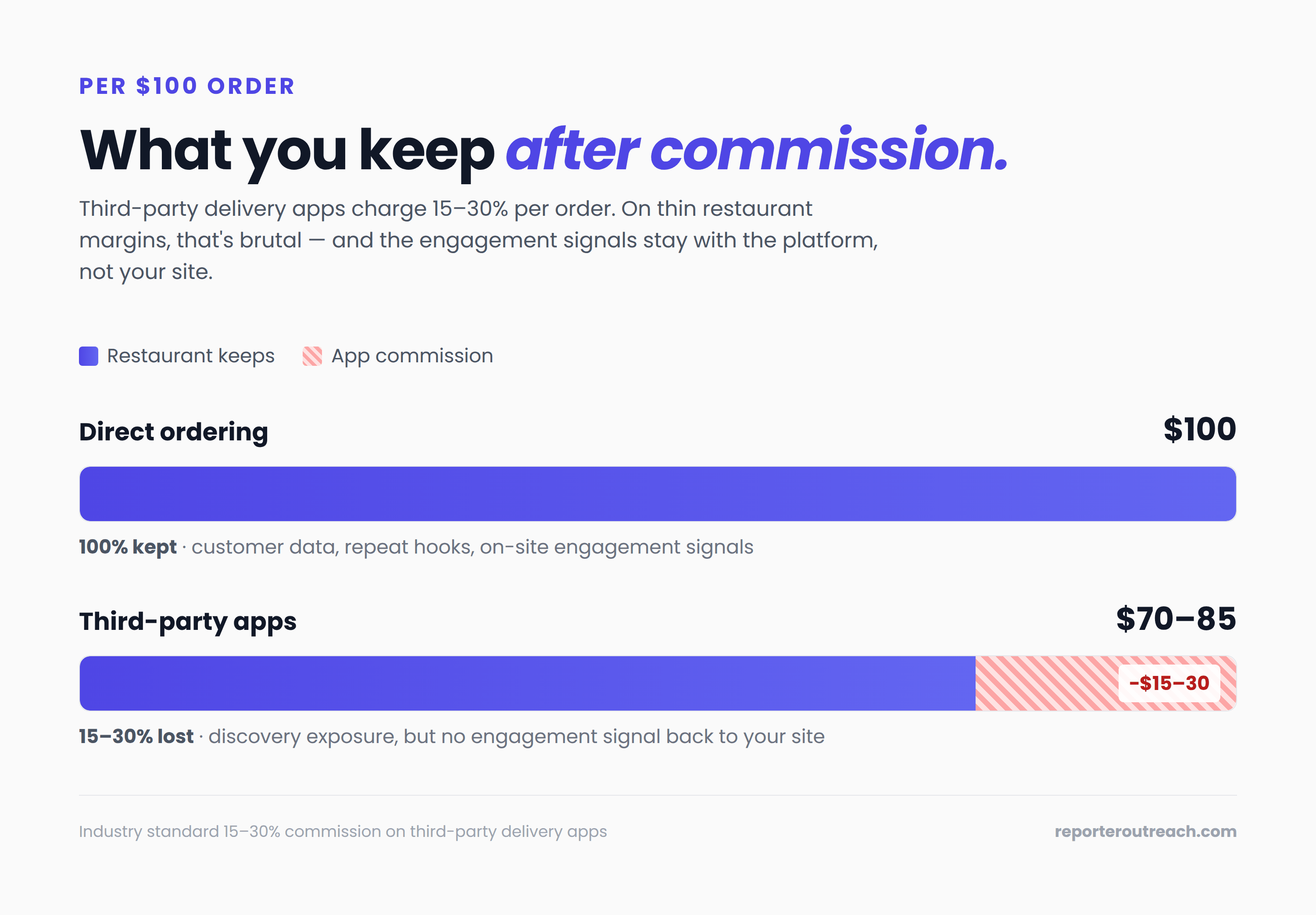
Third-party delivery apps charge 15-30% commission on every order. On already thin restaurant margins, that's brutal. But the SEO argument for direct ordering is just as compelling as the financial one.
When customers order through your site, they spend more time on it, view more pages, and complete transactions — all engagement signals that Google tracks. Restaurants that process orders through their own website tend to rank better in local search because of these behavioral signals.
| Channel | What you keep | What you gain |
|---|---|---|
| Direct ordering | 100% of revenue, customer data, repeat purchase relationship | SEO behavioral signals (engagement on your site), email list ownership, loyalty hooks |
| Third-party apps | 70–85% of revenue (after 15–30% commission) | Discovery exposure to a national user base, no infrastructure to build |
The practical move is a hybrid approach. Keep your profiles on DoorDash and Uber Eats for discovery — many diners browse those apps first. But incentivize direct ordering through your site with lower delivery fees, loyalty points, or exclusive menu items. Include your website URL prominently on every third-party profile. The goal is to use the apps for customer acquisition, then convert repeat orders to your direct channel.
Schema Markup: The Competitive Moat Nobody's Built Yet
Schema markup is structured code on your website that tells search engines exactly what your restaurant is, where it is, and what it serves. It's what makes star ratings, hours, price ranges, and menu items show up directly in search results. And it's increasingly what AI tools use to generate restaurant recommendations.
Most restaurant websites have zero schema. That's your opportunity.
| Schema type | What it surfaces | Who needs it |
|---|---|---|
| Restaurant | Name, address, hours, cuisine type, price range in local pack and AI recommendations | Every restaurant — this is the foundation |
| Menu | Specific dishes in dish-level queries ("lobster bisque near me") | Any restaurant with a stable HTML menu page |
| AggregateRating | Gold star ratings as rich snippets in search results | Restaurants with 5+ verified reviews |
| Event | Wine dinners, classes, live music as event listings in search | Restaurants hosting recurring or special events |
Each location needs its own Restaurant schema object with a unique @id value and accurate geo-coordinates. The address in the schema must match the GBP listing exactly. This consistency is what makes both Google and AI tools confident enough to recommend a specific location.
Restaurants that implement schema now are building a moat. As AI search becomes the primary discovery channel for dining decisions, structured data is the language these tools speak. If your data isn't structured, AI can't recommend you — regardless of how great your food is.
Building Authority: The Strategy Most Restaurants Miss
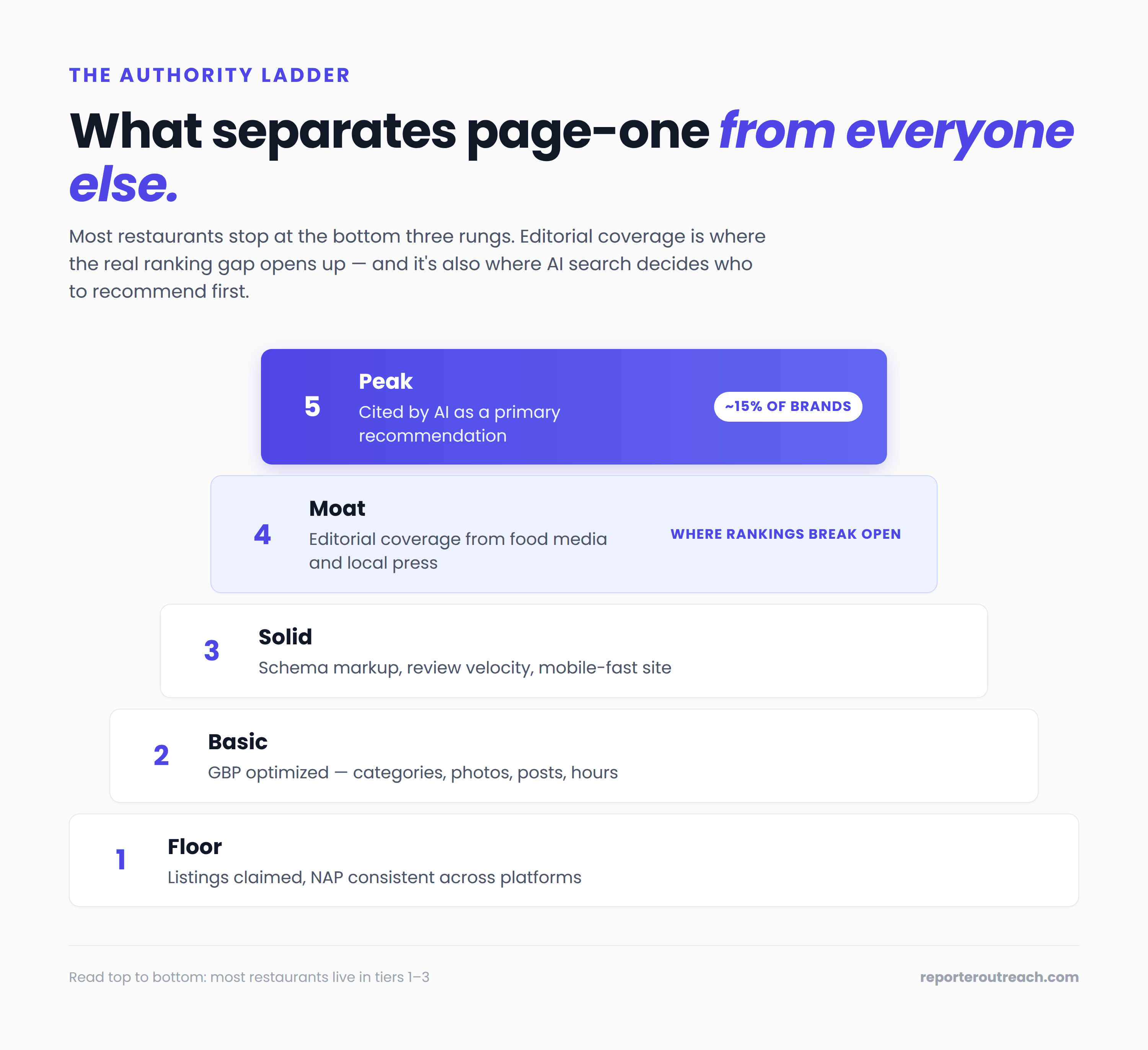
This is the section that matters most. Everything above is necessary — GBP, reviews, website speed, schema. But they're the floor. The restaurants that actually dominate local search and show up in AI recommendations have something most competitors don't: editorial authority. We've seen this pattern consistently across restaurant and food brand clients — the ones with press coverage outperform on every local ranking metric (see our case studies for specific examples).
When your chef is quoted in a food publication about seasonal trends, when your restaurant is featured in an Eater city guide, when a food journalist covers your new tasting menu — those editorial backlinks carry massive weight in Google's algorithm. They're the difference between showing up in position 3 of the local pack and not showing up at all.
Every Restaurant Has a Built-In Expert: The Chef
The restaurant industry has a unique advantage that most businesses don't: a natural expert spokesperson. Your chef can comment on food trends, explain seasonal ingredient sourcing, discuss cooking techniques, or weigh in on industry shifts. Food journalists need these expert sources for their stories constantly.
This is what digital PR does for restaurants. Instead of paying for ads or hoping a blogger notices you, you proactively position your chef as a source for journalists who are already writing stories. When a food writer at your local paper needs a quote about farm-to-table trends — your chef is the one who answers. The resulting article includes a link to your restaurant, and that editorial backlink carries real authority in Google's ranking algorithm.
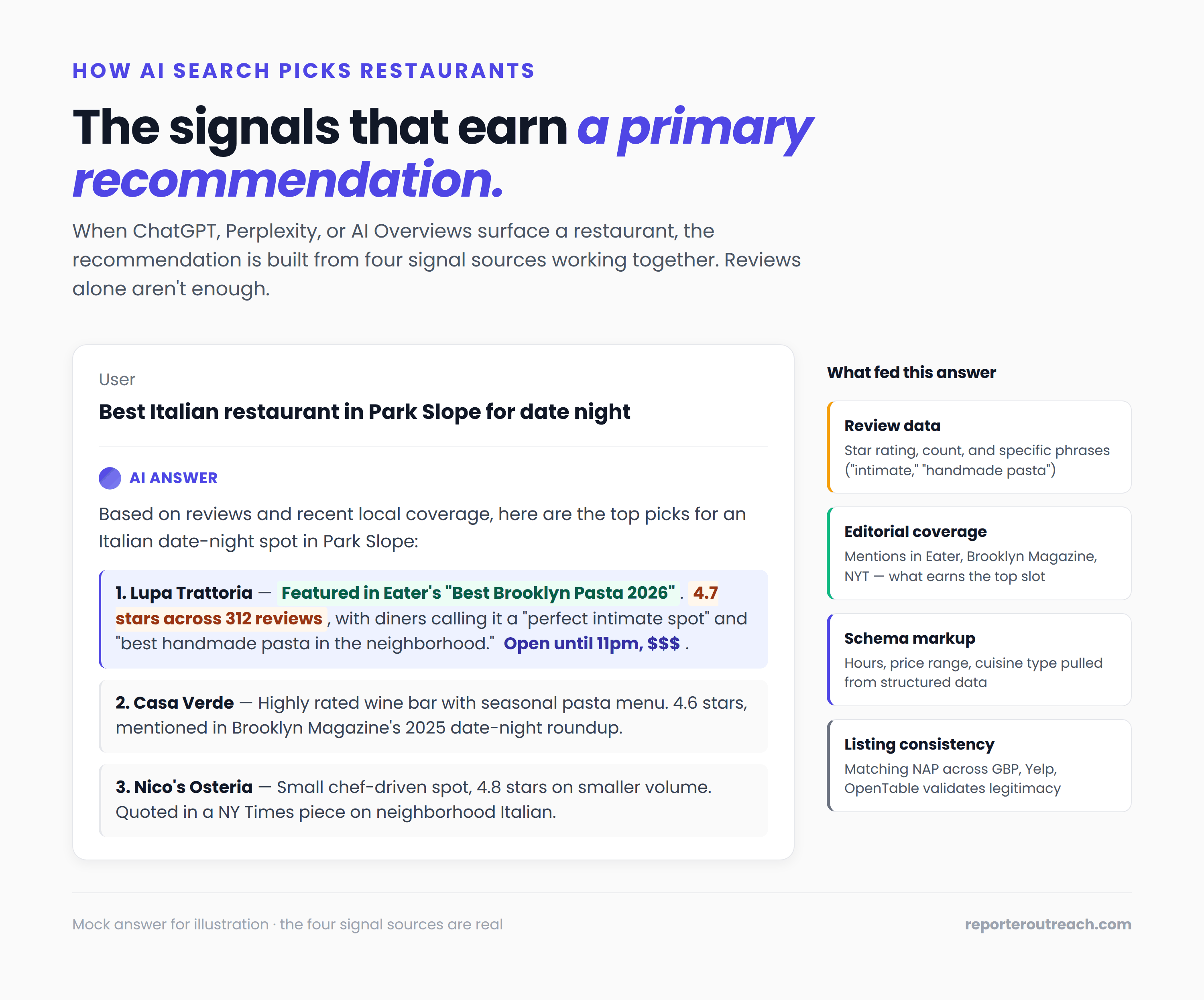
The editorial backlinks your restaurant earns from press coverage don't just boost Google rankings. They're also the signals AI search tools use to validate credibility. Birdeye's State of AI Search 2026 report found that the vast majority of brands get cited at least once in AI results, but fewer than one in six earn a primary recommendation slot — and those brands have strong editorial footprints, not just good reviews. For more on how food businesses can leverage this approach, see our food and recipe industry page.
AI Search and the Future of Restaurant Discovery
This isn't a future trend. It's happening now. When someone asks ChatGPT "where should I eat Italian food tonight" or asks Google's AI Mode for restaurant recommendations, the AI generates answers based on review data, editorial mentions, structured data, and your overall digital footprint.
Seventy-nine percent of restaurant searches are non-branded, according to Malou's 2026 restaurant benchmark. That means most diners aren't searching for your name — they're searching for what you serve, and the AI is deciding whether to recommend you.
The customer journey has already shifted. Diners search, check Maps, read reviews, browse your menu, and increasingly ask AI for recommendations — all before deciding where to eat. Restaurant SEO in 2026 means being visible at every step, across both standard search and AI-powered discovery.
Multi-Location Restaurant SEO
Restaurant groups face a unique challenge: every single location competes in its own geographic market. You can't centralize this. Each one needs a separate GBP listing, a dedicated local page on your website, and a tailored optimization strategy.
Each location page should have unique content — the specific address, hours, menu (if it varies), a Google Maps embed, photos of that particular location, and local reviews. Google penalizes duplicate content across location pages, so "copy the template and swap the address" doesn't work. Each page needs to read as a genuine resource for diners in that specific area.
The schema requirement compounds too. Every location requires a dedicated Restaurant schema with unique @id values and precise geo-coordinates. The NAP on each location page must exactly match its GBP listing. For groups with 10+ locations, this gets operationally complex fast — but it's what the algorithm requires.
Tracking What's Working
You can't improve what you don't measure. Three tools cover almost everything you need to know:
- Google Search Console. The most important free tool. It shows which terms drive traffic, your click-through rates, and technical issues affecting your site. Connect it, check it monthly, and sort queries by impressions to find terms where you're showing up but not getting clicks — those are your quick wins.
- GBP Insights. Tracks how people find your listing (direct search vs. Maps discovery), direction requests, calls, and website visits. GBP actions grew 41% year-over-year between 2025 and 2026, which means the platform is getting more important, not less.
- A monthly dashboard covering: organic visits, rankings for your top 5 target terms, Maps views, direction requests, phone calls from GBP, review count and average rating, direct ordering revenue vs. third-party, and whether organic traffic is trending up or down month over month.
Track how many customers find you through AI search. Check your analytics for referral traffic from chat.openai.com, perplexity.ai, and google.com with AI-specific parameters. This channel is growing fast, and the restaurants that measure it now will have an early read on what's working.
Ready to Outrank Your Competition?
We'll run a free competitive analysis and show you how your restaurant's online authority compares to the competitors ranking above you.
Frequently Asked Questions
How long does restaurant SEO take to show results?
GBP optimizations and review generation tend to show measurable ranking improvements within 2-4 months. Website SEO and backlink building take longer — typically 3-6 months before you see meaningful movement. The timeline depends heavily on competition in your market. A restaurant in a mid-sized city will see faster results than one competing in Manhattan or San Francisco.
Is a blog worth it for a restaurant website?
It can be, but only if you publish content that's genuinely useful — not just "Top 5 Reasons to Visit Our Restaurant" posts. Seasonal menu features, chef interviews, event recaps, and stories about sourcing local ingredients give Google fresh pages to index and opportunities to rank for additional terms. Even one quality post per month makes a difference. But if you can't maintain it consistently, your time is better spent on GBP and reviews.
Google Ads or SEO — which should I invest in first?
SEO, unless you have an immediate event or promotion that needs visibility now. Ads stop working the day you stop paying. SEO compounds over time — every review, backlink, and schema update builds on the last. Most restaurants get the best ROI from investing in SEO foundations first, then layering in targeted ads for specific campaigns like grand openings or holiday promotions.
How do reviews affect local rankings?
They're one of the top three local ranking factors. Google evaluates your total review count, average rating, how recently reviews were posted, and whether you respond to them. Detailed reviews mentioning specific dishes or experiences also help AI search tools understand what your restaurant offers. The consistent flow of new reviews matters more than having a perfect 5.0 rating.
What schema markup should I add to my restaurant website?
Start with Restaurant schema (business info, hours, cuisine type), then add Menu schema for individual dishes and AggregateRating schema for your review scores. If you host events, add Event schema. For multi-location restaurants, you'll need a separate schema object per location. This is what powers rich snippets in search results and what AI tools rely on for generating accurate recommendations.
Can AI search engines actually drive customers to my restaurant?
Yes, and the channel is growing fast. ChatGPT alone accounts for roughly 87% of all AI referral traffic to websites. When a diner asks an AI tool for restaurant recommendations, it generates answers based on reviews, editorial mentions, and structured data. Restaurants with strong signals across these areas get recommended. Restaurants without them get ignored — regardless of food quality.
Sources: SOCi Restaurant Industry Report 2026, BrightLocal Local SEO Statistics 2025-2026, Birdeye State of AI Search 2026 Report, Birdeye State of Google Business Profiles 2025, Malou 2026 Digital Benchmark for Restaurants, Conductor AI Search Benchmarks 2026, Google Business Profile documentation