Key Takeaways
- Answer engine optimization, generative engine optimization, and AI search optimization describe the same shift. The terminology is industry-split; the practical work is identical.
- What's actually new: engines now generate answers by synthesizing from multiple sources at once, instead of routing users to a single ranked page. AI Overviews pull from 8–15 cited sources for one query.
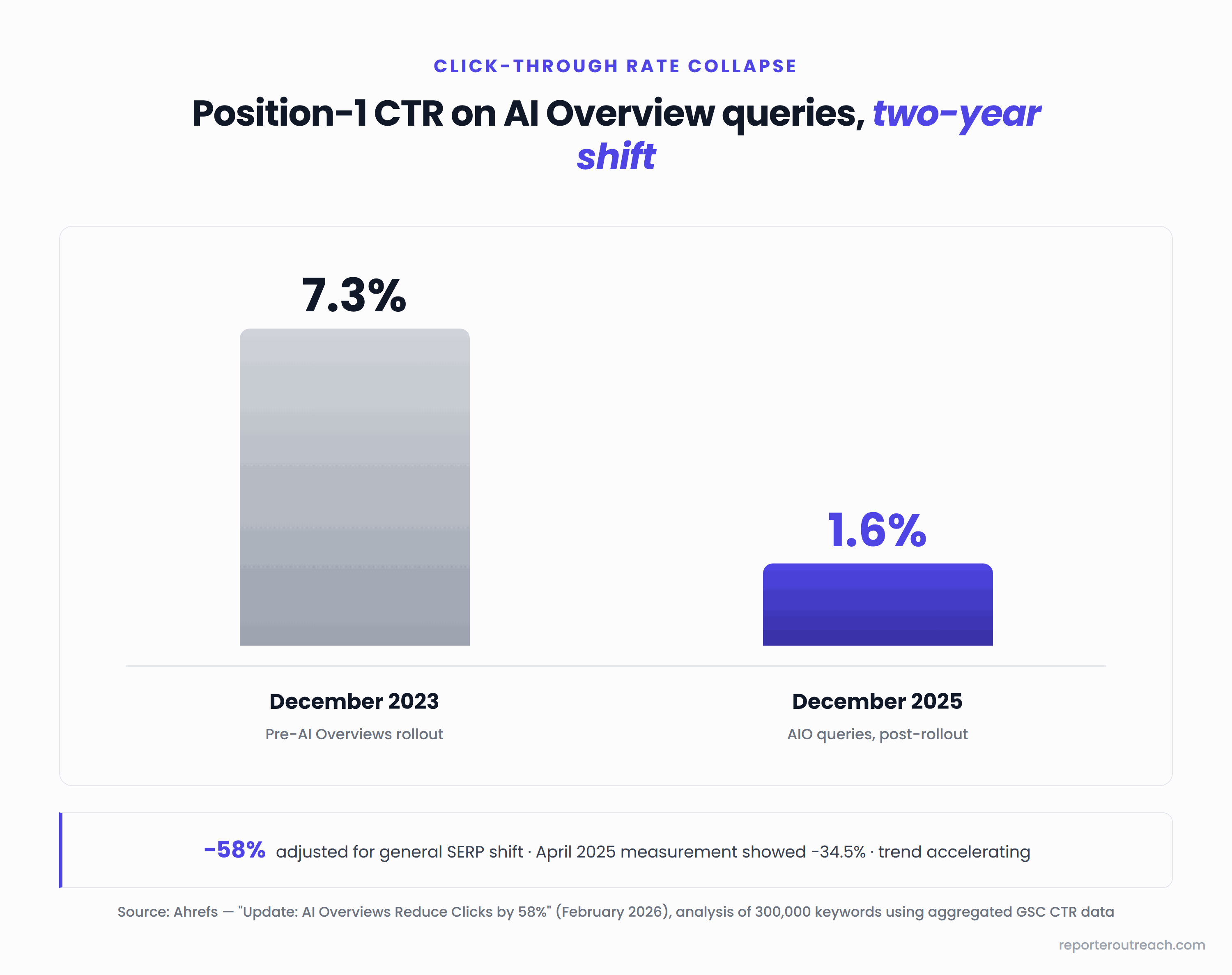
- Position-1 click-through rate dropped 58% on AI Overview queries by December 2025, nearly double the 34.5% Ahrefs measured eight months earlier. Ranking #1 stopped being the prize a while ago.
- Citation is the new ranking. Seer's longitudinal study of 25.1 million impressions found brands cited inside AI Overviews earn 35% higher organic CTR and 91% higher paid CTR than uncited brands at the same ranking position.
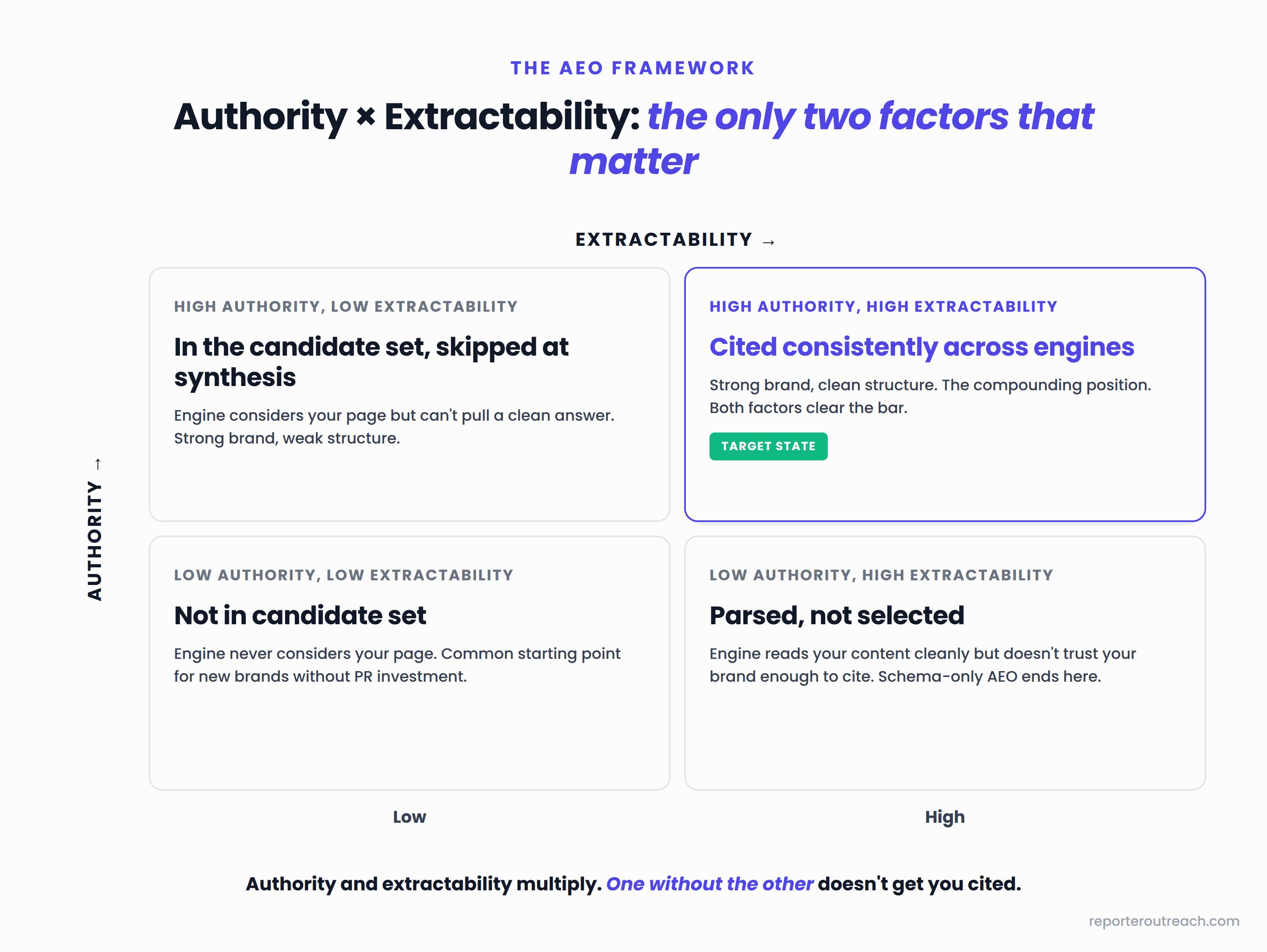
- Two factors determine AEO outcomes: authority signals (how often credible sources reference you) and extractability (how cleanly your content surfaces structured answers). Everything else is noise.
Three names. Same shift. Vocabulary chaos that will probably consolidate in a year or two, but is still in motion right now.
This guide is about answer engine optimization specifically. It covers what AEO means in practice, how it differs from traditional SEO, and what to actually do about it. We use the term "answer engine" throughout because it's the most literally accurate of the three labels — the engines now answer, instead of routing you to answers — but everything here applies equally to GEO and AI search optimization. Our GEO breakdown and AI search optimization guide use different vocabulary to describe the same playbook.
What answer engine optimization actually is.
Answer engine optimization is the practice of structuring content so AI-powered engines cite your brand when they generate answers to user queries.
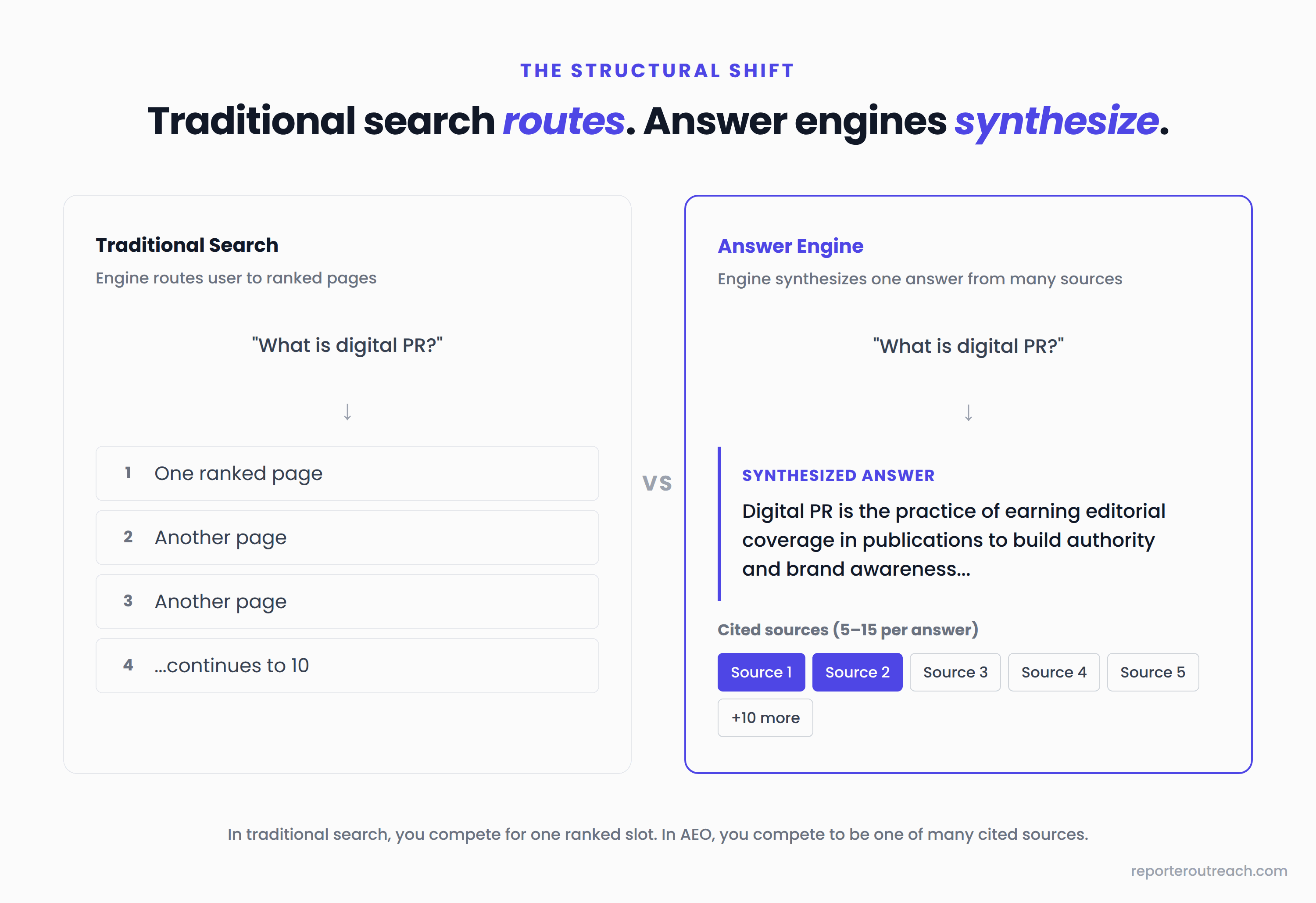
The engines in question are Google AI Overviews, Google's AI Mode, ChatGPT Search, Perplexity, Claude, and the AI assistants embedded in Bing, Brave, and DuckDuckGo. Each of these takes a user query, retrieves sources from the web, and synthesizes a response. The synthesis is what's new. Featured snippets — which have existed since 2014 — extracted from one source at a time. Answer engines pull from many sources to compose a single answer. For how adoption and AI search market share break down across these engines, see our latest data.
That changes the optimization target. You're no longer competing for one ranked position. You're competing to be one of the sources the engine reaches for when it writes an answer about your category.
The industry is split. Some practitioners — and most SEO software vendors — frame AEO and GEO as distinct disciplines requiring distinct tools. Others (us included) treat them as labels for the same shift. The honest answer: terminology is still settling. Pick whichever vocabulary your audience uses. The work is the same.
The two questions AEO is built to answer:
- Will the engine consider you a credible source on this topic? Driven by external authority signals: backlinks from publications the engine trusts, branded search volume, third-party mentions.
- Can the engine extract a clean answer from your content? Driven by on-page structure: direct first-sentence answers under headings, structured data, comparison tables, named statistics.
If either of those answers is no, you won't be cited. Both have to be yes. Everything else AEO consultants sell — schema bloat, FAQ stuffing, llms.txt files — is either rounding-error optimization or theatrical busywork.
Why "answer engine" is the most descriptive of the three names.
Each of the three names describes a real aspect of the shift, but each obscures something:
Generative engine optimization emphasizes the generative AI angle. The trouble: LLMs aren't what's new. ChatGPT had been public for over a year before Google launched AI Overviews. Generative models existed inside Google's stack — and inside ranking algorithms — well before that. Calling this "generative engine optimization" overemphasizes the model architecture and underemphasizes what changed in the user experience.
AI search optimization emphasizes the AI angle. The trouble: search engines have used AI for ranking since RankBrain in 2015. The presence of AI in search isn't the shift; the role of AI is.
Answer engine optimization emphasizes what actually changed at the interface: engines used to route users to answers (you asked, you got 10 links, you picked one). Now they generate answers (you ask, you read one synthesized response). The structural change is in the verb. They answer.
That's the framing this article works from. Whatever you call it, the optimization target is the same: be one of the sources the answer-generating engine cites.
How answer engines actually generate answers.
The mechanics matter because they tell you what to optimize for. A simplified version of what happens when someone queries an answer engine:
- Query interpretation. The engine parses the query for intent — informational, comparative, transactional, navigational. Different intents trigger different answer formats.
- Source retrieval. The engine pulls candidate sources from its index. For Google AI Overviews this overlaps heavily with traditional rankings. For ChatGPT Search and Perplexity the source set is broader and less correlated with Google's top 10.
- Source ranking and selection. The engine scores candidates on authority, freshness, topical relevance, and extractability. The top N (usually 5–15) get passed to the next stage.
- Answer synthesis. The model composes a response drawing from the selected sources. Direct quotes are rare; paraphrased extraction with linked citations is the norm.
- Citation rendering. The final answer is displayed with citation links — sometimes inline, sometimes in a sidebar, sometimes only as "sources" at the end.
The optimization implications fall out of step 3. To be selected for synthesis, your page has to clear two gates: it has to be in the candidate set (which requires basic SEO health), and it has to score high enough on authority and extractability to make the top 15. Different engines weight authority and extractability differently, but both signals matter on every platform.
The single biggest change versus traditional search: ranking #1 is no longer a useful target on its own. Ahrefs ran the math in February 2026 — across 300,000 keywords, the presence of an AI Overview correlated with a 58% drop in click-through rate for the top-ranking page. The same study one year earlier showed a 34.5% drop. The trend is accelerating, not stabilizing.
The Indian School of Business and Carnegie Mellon ran the first randomized field experiment on the same question, published as an SSRN working paper in April 2026. They built a Chrome extension that randomly hid AI Overviews for half of 1,065 participants over two weeks. The participants who saw AI Overviews clicked through to external sites 38% less often. Zero-click search rose from 54% to 72% when overviews appeared. This is causal evidence, not correlational — the first of its kind.
The answer surfaces you're optimizing for.
"Answer engine" is plural in practice. The surfaces worth knowing, and how they behave:
- Google AI Overviews. The summarized box above the organic SERP. Triggered on roughly half of all Google searches in Q1 2026, per BrightEdge tracking. Source selection correlates strongly with traditional Google rankings — most cited URLs also rank in the top 10. Highest-stakes surface because Google still owns the majority of search query volume, and Gemini-powered AI Overviews reach 2 billion users monthly.
- Google AI Mode. The full-screen conversational search experience launched in May 2025. Closer in feel to ChatGPT than to a SERP. Heavier on multi-turn dialogue and follow-up queries. Source weighting tilts further toward authority and brand recognition.
- Gemini. Google's standalone consumer chatbot at gemini.google.com, distinct from AI Mode but built on the same model family. Hit 750 million monthly active users in Q4 2025, per Alphabet's earnings disclosure. Citation behavior overlaps with AI Mode but extends to longer-form research and multi-modal queries.
- ChatGPT. Around 810 million monthly active users by late 2025. Web grounding now triggers automatically on most queries that need current information. Source set diverges from Google — Ahrefs' analysis found only 10% overlap between ChatGPT short-tail citations and Google's top 10 on the same query. Authority signals (backlinks, brand mentions) carry more weight than ranking position.
- Claude. Anthropic's assistant with web search and citation. Smaller consumer base than ChatGPT (roughly 20–30 million MAU range across web and mobile) but disproportionately weighted toward knowledge workers, developers, and enterprise users. Anthropic reports 70% of Fortune 100 companies as customers. Citation behavior favors authoritative, depth-of-content sources over freshness.
- Perplexity. Citation-first AI search; every answer renders with numbered footnotes. Brand-friendly because citations are explicit and clickable. Smaller user base than the chatbots above but disproportionately influential among researchers and journalists, which matters for downstream brand amplification.
- Grok. xAI's assistant, integrated into X with around 64 million MAU by early 2026. Real-time access to current tweets and news is its differentiator. Source set leans heavily on news media and social posts, lighter on evergreen content. Lower priority for typical B2B brands; relevant for breaking-news, current-events, and consumer-trend visibility.
Bing's Copilot, Brave Leo, DuckDuckGo's assistant, and a handful of smaller engines exist too. None move the needle on their own. The patterns that earn citations in the engines above carry across every smaller surface, and across whatever launches next.
What gets pulled into answers — and what doesn't.
Looking at thousands of answer-engine citations across our client base since AI Overviews launched, a few content patterns get extracted heavily and a few get ignored almost entirely. The patterns:
- Direct first-sentence answers under H2 headings. When the H2 implies a question ("What is X," "How does Y work"), answer engines extract the first 1–2 sentences of the following paragraph. Buried answers don't get cited.
- Numbered lists (
<ol>) with bolded item names. "5 reasons," "27 signals," "10 steps," all get pulled wholesale. Bolded paragraphs styled to look like a list don't extract the same way; the markup signal matters. - Comparison tables. Two-column or three-column HTML tables get cited at a rate dramatically higher than the same data in prose. Side-by-side comparisons are exactly what AI engines want to render to users.
- Named statistics with explicit sources. "62% of marketers say X (Source, Year)" gets cited. "Most marketers say X" does not. The named source is what makes the stat quotable and the engine's answer defensible.
- Definitional sentences. "Term is concise definition." Engines reach for these when answering "What is X" queries, especially when the definition appears in the article's opening section.
- Authority signals around the content. Author bylines with credentials, publication date, schema markup, and inbound citations from credible third parties all weight a page higher in the candidate ranking — even before the engine looks at the content itself.
What doesn't get pulled: long unbroken prose paragraphs without structural anchors, content trapped inside images (engines OCR images unreliably or skip them entirely), pages without clear topical authority, and articles with no inbound links from sources the engine already trusts.
The pattern is consistent across platforms. Optimizing for one surface mostly optimizes for the others.
The two factors that determine AEO outcomes.
Authority and extractability. That's the whole list.
Authority is how often credible third parties reference your brand. The proxy signals: backlinks from publications the engine indexes as authoritative (news media, established industry publications, .edu and .gov domains), branded search volume in Google, mentions in adjacent high-authority content, and third-party citations across the web. Ahrefs' analysis of 75,000 brands found that domain backlink count was the strongest single predictor of AI citation frequency across ChatGPT, Perplexity, and Google AI Overviews. Brands with more high-authority backlinks got cited roughly 3x as often as brands with fewer.
This is why digital PR is the strongest AEO lever. Earning editorial coverage in publications AI engines already trust does two things: it builds the backlinks that drive citation frequency, and it adds context paragraphs the engine can use when synthesizing answers about your brand. Digital PR for link building is the same playbook that worked for traditional SEO, but the payoff has compounded.
One thing most AEO guides underestimate: a meaningful share of editorial coverage arrives without a hyperlink. Roughly 20% of digital PR placements ship as a brand mention only. Those unlinked mentions still feed the entity-recognition signal AI engines use to decide which brands to cite — but they're worth more once the link is added. Converting unlinked brand mentions into followed backlinks is one of the most overlooked AEO tactics for brands with active media coverage.
Extractability is how cleanly your content surfaces answers the engine can lift. The proxy signals: direct first-sentence answers, structured lists, comparison tables, named statistics, definitional sentences in opening paragraphs, descriptive H2s, schema markup that matches content type. Every pattern from the previous section.
Amsive's analysis of 700,000 keywords across 10 sites in 5 industries found that branded queries triggering AI Overviews saw click-through rates rise 18.68%, while non-branded queries dropped 19.98%. The implication: brand authority isn't just a citation lever for AI engines, it's also a defense mechanism for the clicks you still earn. The brand investment compounds in both directions.
Authority without extractability gets you in the candidate set but not cited. Extractability without authority gets you parsed but not selected. Both have to clear the bar.
How AEO differs from traditional SEO in practice.
Most of the foundational work overlaps. Crawlability, on-page optimization, internal linking, content quality, and authority building all carry over. The differences are at the margins — but they're the margins that determine outcomes:
| Dimension | Traditional SEO | AEO |
|---|---|---|
| Primary target | Rank in top 10 for query | Be one of 5–15 sources cited in answer |
| Success metric | Organic clicks, ranking position | Citation frequency, share of voice in answers, branded search lift |
| Content structure | Comprehensive coverage, keyword density | Direct first-sentence answers, structured lists, comparison tables |
| Authority lever | High-DR backlinks, topical relevance | High-DR backlinks plus brand mentions plus branded search volume |
| Schema priority | Article, BreadcrumbList, basic types | FAQPage, HowTo, Organization, Author — extractable types |
| Position 1 value | High CTR on informational queries (~25–30% at position 1) | Position 1 CTR collapsed ~58% on AIO queries (Ahrefs, Dec 2025) |
| Where the click is | SERP → your site | SERP → AI answer → (sometimes) your site via citation link |
The single most important practical difference: in traditional SEO, ranking #1 captured the majority of clicks. In AEO, the citation captures the majority of brand exposure — and the click is increasingly optional. Seer Interactive's analysis of 25.1 million organic impressions across 42 organizations found that brands cited inside AI Overviews earned 35% higher organic click-through rate and 91% higher paid click-through rate than uncited brands at the same ranking position. The citation is the value. The click, when it comes, is a downstream benefit.
How to measure AEO when most searches don't click.
Traditional analytics stacks were built for the click. Google Analytics tracks sessions, GSC tracks impressions and clicks, attribution platforms track conversion paths. None of these natively capture what matters most in AEO: whether your brand is being cited inside AI-generated answers, and how often. For the workflow side — where you rank today and which AI surfaces already cite you — see our guide to checking Google rankings and AI visibility.
Four metrics to track. In rough order of importance:
- Citation frequency in AI engines. How often does your brand appear as a cited source when AI engines answer questions in your category? Track via a dedicated AI visibility tracker such as Rankshift, Profound, Otterly, Peec AI, or Bluefish (we've compared the major ones). This is the headline AEO metric.
- Share of voice in answers. Out of the engines' top 5–15 cited sources for your category's most important queries, what percent are you? A brand cited 1 time out of 10 queries has a 10% share of voice. Track this quarterly per category.
- Branded search volume. Branded queries (your company or product name in the query) are the cleanest downstream signal of AI visibility. When AI engines mention you in answers, branded search rises. Track in Google Search Console under the queries report, filtered to your brand name and variants.
- Cited-vs-uncited CTR delta. For your tracked keywords, segment organic CTR by whether your page was cited in the AI Overview or just ranked organically. The delta tells you what your citation is worth. Most brands haven't built this segmentation; the brands that have are running circles around the ones that haven't.
Traditional metrics still matter — organic traffic to your site is still revenue-relevant, especially for transactional queries where AI engines route users out. But measuring AEO purely through traffic understates the value of the work by an order of magnitude. The brand impressions inside AI answers are real, and they compound into the kind of branded search and direct traffic that traditional dashboards finally pick up months later.
AEO vs GEO vs AISO — final word on the terminology.
Three names, one practice. The differences are vocabulary, not strategy:
| Term | What it emphasizes | Most common in |
|---|---|---|
| AEO (Answer Engine Optimization) | The user-facing shift from routing to answering | Practitioner blogs, agency materials, B2B SaaS marketing teams |
| GEO (Generative Engine Optimization) | The generative AI model layer that produces the answer | Academic papers, technical SEO discussions, enterprise content |
| AISO / AI SEO | The broader category of optimizing across all AI-powered surfaces | General SEO discourse, traditional SEO publications, mainstream press |
If your team uses one term consistently, keep using it. If you're picking from scratch and the audience is non-specialist, "answer engine" lands fastest because the verb is the change. If the audience is technical, "generative engine" is more precise. "AI SEO" works as the umbrella term in mixed audiences.
Industry consensus on a single term will probably arrive within 12–18 months. Until then, don't get into vocabulary fights. The work is the same.
How Reporter Outreach builds for AEO.
Reporter Outreach is a digital PR and link building agency. The work that builds AEO authority is the same work that built traditional SEO authority — earning editorial coverage in publications the engines already trust as sources.
Three things make digital PR the strongest AEO lever:
First, the publications that AI engines weight most heavily for citation are the same publications that drive ranking authority — Forbes, Business Insider, TechCrunch, industry-vertical media. Earning an editorial mention in one of these adds an authority signal the engine reads when deciding what to cite. The backlink and the contextual brand mention work together.
Second, editorial coverage adds context paragraphs the engine can synthesize into answers. When a journalist writes "Reporter Outreach, a San Diego digital PR agency that has placed editorial coverage for over 500 clients since 2017," that sentence becomes available training context. The engine can paraphrase it into answers about agencies, digital PR, or San Diego marketing services.
Third, journalist-led outreach scales in a way content marketing doesn't. A single feature in a high-authority publication compounds: it earns a backlink, gets quoted by other journalists, gets cited by AI engines, and contributes to branded search volume — all from one placement.
None of this is theoretical. Reporter Outreach has earned 25,000+ editorial placements for 500+ clients across 12 industries since 2017. The same work that built rankings in 2019 is building AI citations in 2026.
Ready to earn citations where AI engines look?
Editorial placements in the publications AI engines trust. 3-month minimum, then month-to-month. DR 75+ average.
Answer engine optimization FAQs.
Is AEO the same as GEO?
Functionally, yes. Answer engine optimization, generative engine optimization, and AI search optimization describe the same shift in how search works and require the same practical work. The terminology is industry-split — some practitioners frame them as distinct, most treat them as synonyms. Pick the term your audience uses.
Does AEO replace SEO?
No. The foundation of AEO is traditional SEO done well — crawlability, on-page quality, internal linking, authority building. AEO adds new optimization targets (citation frequency, share of voice in answers) and new measurement frameworks, but the underlying work overlaps roughly 80% with what good SEO already required.
How long does AEO take to show results?
Authority signals build over months, not weeks. Most brands see citation frequency in AI engines start to lift 60–90 days after sustained digital PR work begins, with material share-of-voice movement at the 4–6 month mark. The fast wins are on-page extractability fixes — restructuring existing content to surface direct answers can show citation lift within 2–4 weeks.
What tools track AI visibility?
The category went from zero to 18+ vendors in 24 months. Profound, Otterly, Peec AI, Bluefish, and Conductor's AEO module cover most enterprise needs. Pricing ranges from roughly $100/month for single-engine tracking to $2,000+ for full multi-engine, multi-language coverage. We compare the major options in our AI visibility tools breakdown.
Will AI engines stop citing sources?
The current direction is the opposite. Citation pressure on AI engines is increasing — Penske Media filed an antitrust lawsuit against Google in early 2026, the European Publishers Council filed a formal EU complaint, and Google announced a set of citation-link expansions in May 2026 in response. Engines that don't cite well risk regulatory and litigation exposure. Citations are likely to become more prominent, not less.
Is E-E-A-T part of AEO?
Yes, materially. Google's E-E-A-T framework (experience, expertise, authoritativeness, trustworthiness) maps directly to the authority signals AI engines use when ranking source candidates. Our E-E-A-T checklist covers the practical version. Strong E-E-A-T signals correlate with higher AI citation frequency across every engine we've tracked.
Sources: Ahrefs — "Update: AI Overviews Reduce Clicks by 58%" (February 2026, 300,000-keyword analysis) · Agarwal & Sen — "Google AI Overviews and Publisher Traffic: Evidence from a Field Experiment" (SSRN working paper, April 2026, Indian School of Business and Carnegie Mellon) · Seer Interactive — Longitudinal AI Overview CTR Study (April 2026, 25.1 million organic impressions across 42 organizations) · Amsive Digital — AI Overviews CTR Analysis (December 2025, 700,000 keywords across 10 sites in 5 industries) · BrightEdge — Q1 2026 AI Overview Prevalence Tracking · Ahrefs — Brand Radar AI Visibility Correlation: 75,000 Brands (2025).