Key Takeaways
- Blogger outreach is not one tactic but five — product seeding, sponsored placements, guest contributions, inclusion pitches, and reactive pitches. Each does a different job and faces different rules.
- The FTC's revised Endorsement Guides (16 CFR Part 255, effective July 26, 2023) treat free product, payment, and any other material connection between brand and blogger as a disclosure trigger. Civil penalties run up to roughly $50,000 per violation.
- Google's published guidance is unambiguous: links inside guest posts and sponsored placements should carry rel="sponsored" or rel="nofollow." That position has been formally enforced since the July 2021 link spam update.
- The form of blogger outreach with the future is the one most people don't classify as blogger outreach at all — reactive pitching, where journalists and bloggers initiate the request and you respond. It's the only mechanism AI search engines reliably reward as an authority signal.
Type "blogger outreach" into Google and you'll get a clean stack of definitions, all roughly identical: contacting bloggers to promote your product, brand, or content. The definitions are clean. The reality is messier.
What people actually mean by blogger outreach varies wildly. A B2C brand sending free skincare to lifestyle bloggers and an SEO agency mass-emailing site owners to buy guest post placements are doing two completely different things — but both call it blogger outreach. So does the marketer pitching expert quotes for a "Top 10 Tools" roundup. So does the PR person responding to a journalist's source request on Qwoted.
The label has stretched far enough that giving readers a single yes/no answer on whether blogger outreach "still works" is dishonest. The honest answer is: it depends which blogger outreach you mean.
This guide breaks the practice into the five distinct things people actually do under that label, evaluates each one against current FTC rules, Google's enforcement posture, and what AI search engines reward, and lands on the one form that's quietly absorbing the value the other four are losing.
What Blogger Outreach Actually Means in 2026
Blogger outreach, used precisely, is the practice of contacting independent blog publishers — not journalists at established publications, not influencers running primarily on social platforms — to secure coverage, links, or both. The category covers anyone who runs a blog as their primary platform, from a one-person food blogger with 30,000 monthly readers to a niche industry site with editorial staff.
That definition matters because the rules diverge sharply once you split blogger outreach from its closest neighbors. Journalist outreach (often called digital PR or media outreach) operates under different incentives — journalists protect editorial independence and are rarely paid by sources. Influencer outreach lives mostly on Instagram, TikTok, and YouTube, where FTC disclosure rules dominate but link-passing is largely irrelevant. Blogger outreach sits in the awkward middle: blog content can pass SEO authority, but the blogs themselves operate without journalistic norms, which means brands routinely pay for placement and the FTC has spent fifteen years tightening the rules around what that means.
Within that middle, five distinct practices have emerged. They share the "blogger outreach" label and almost nothing else:
- Product seeding. A brand sends free product to bloggers in exchange for review coverage. Primarily B2C — beauty, fashion, food, lifestyle, parenting. Goal is brand awareness with link-and-rankings as occasional byproducts.
- Sponsored placements. A brand pays a blogger to publish content. The most-sold form of "blogger outreach link building" services. Google requires these links to carry rel="sponsored" or rel="nofollow."
- Guest contributions. A brand writes content and pitches it to a blog for publication, with or without payment. Google's posture: any link inside the guest post should carry rel="sponsored" or rel="nofollow," even when no money changes hands.
- Inclusion pitches. A brand pitches itself to be added to existing content — a resource page, a "best tools" roundup, an expert-quote collection. Pitch is to a curator who is already publishing the kind of content you want to be in.
- Reactive pitches. A brand or expert responds to inbound source requests posted by bloggers and journalists on platforms like Qwoted, Featured, and Source of Sources. The blogger or journalist initiates; the brand responds.

The overlap with guest posting is the part most readers come in confused about. Guest posting and blogger outreach aren't the same thing — guest posting is one of the five subtypes here. For a deeper treatment of guest posting specifically, including Google's enforcement timeline and where it still earns rankings, see the full breakdown on guest posting in 2026. The rest of this guide covers the four other practices alongside guest contributions in shorter form.
Product Seeding: When Free Stuff Becomes a Link
Product seeding is the original form of blogger outreach. A brand sends free product to a blogger — a skincare set, a meal kit, a pair of shoes — and asks for honest coverage. If the blogger likes it, they post a review. Sometimes the review includes a link back to the brand's site.
The mechanic is straightforward. The legal reality around it is not.
The FTC's revised Endorsement Guides (16 CFR Part 255), finalized June 29, 2023 and effective July 26, 2023, are the first major update to these rules since 2009. The Guides treat free product as a "material connection" between brand and blogger that consumers are unlikely to expect — and material connections must be disclosed clearly and conspicuously, in the same medium as the endorsement. Civil penalties under the FTC Act now run up to approximately $50,000 per violation.
The 2023 update also expanded liability. Both the brand and the endorsing blogger can be held responsible. Built-in platform disclosure tools — Instagram's "Paid Partnership" tag, for example — may not satisfy the "clear and conspicuous" standard on their own. Generic hashtags like #sponsored or #ad may not be enough either, depending on placement and context. The FTC sent enforcement letters to a dozen health influencers in November 2023 specifically over inadequate disclosures, signaling that the post-2023 rules are not theoretical.
If a blogger received anything of value from your brand — free product, payment, equity, an affiliate cut, even a discount code — that connection has to be disclosed in a way readers can't miss. The disclosure has to be in the post itself, not buried in a profile bio or a separate page. Both you and the blogger can be held liable if it isn't.
For the SEO-minded reader, the second layer of complication is what Google does with these links. A genuine product review where the blogger uses the product, forms an opinion, and links to the brand looks superficially like an editorial link. Google's published guidance treats it differently. Material-connection links — anything where the brand provided value in exchange for the coverage — should carry rel="sponsored" or rel="nofollow." When they don't, Google's spam systems can devalue them or apply manual actions to either party.
Where product seeding genuinely works: when the goal is brand awareness, social proof, or product validation rather than rankings. A skincare brand sending samples to ten lifestyle bloggers gets photos, reviews, social distribution, and consumer trust signals — all valuable, none of which require a followed link. Where it falls apart: when a brand sends free product specifically expecting SEO outcomes. Compliant disclosure and proper link tagging mean the SEO outcome is rarely worth the cost of the program.
Sponsored Placements: The Honest Math on Paid Posts
Sponsored placements are what most "blogger outreach link building" services are actually selling, despite the label. A brand pays a blogger or site owner a flat fee — typically $150 to $1,000+ per post depending on the site's domain rating and traffic — and the blogger publishes content with a link back to the brand. The post may or may not be labeled as sponsored. The link may or may not carry the proper rel attribute.
Google's position on this has been on the public record since the July 2021 link spam update. The Search Central blog stated then, and continues to state, that sites publishing or acquiring links via "excessive sponsored and guest posting without proper link tags" can be hit with algorithmic or manual actions. The fix Google asks for is straightforward: rel="sponsored" or rel="nofollow" on the paid link.
The math problem for buyers: a sponsored link with rel="sponsored" passes essentially no PageRank. Which means most of the SEO benefit a brand thinks it's buying isn't actually being purchased. Brands either accept that and treat the spend as brand-awareness budget, or they push back on the publisher to skip the disclosure tag — at which point they're knowingly buying a link Google's policy explicitly targets, exposing both sides to enforcement.
The 2024–2025 enforcement cycle made the risk concrete. Google's December 2024 site-reputation-abuse policy update tightened enforcement on third-party content published on host sites to exploit ranking signals. The October 2025 spam update extended that further to "AI-generated guest post farms" — sites publishing thin content solely to embed paid links. SpamBrain, Google's machine-learning spam detection, now operates close to real-time; link devaluation can begin within hours of a manipulative pattern being detected. Sites with diversified link profiles that mix legitimate editorial links with paid placements are increasingly seeing the contaminated portion devalued without the editorial portion being affected — meaning the spend on paid placements isn't just zero ROI, it can be negative.
Many influencer marketing campaigns now include a blog post component on the influencer's owned site, with a link back to the sponsoring brand. These fall under both rule sets at once: the FTC requires clear and conspicuous disclosure on the post (sponsored, ad, paid partnership), and Google requires the link to carry rel="sponsored" or rel="nofollow." The blog post can drive brand visibility, social signals, and discovery; the followed-link SEO benefit remains roughly zero when the rules are followed correctly.
Where sponsored placements still earn their cost: brand-awareness goals on niche sites with engaged audiences, where the value is in front of the right reader rather than in the link. Where they don't: anywhere a brand is paying primarily to acquire ranking authority. The supply of agencies selling sponsored placements as "editorial links" hasn't shrunk, but the gap between what's being sold and what's actually being delivered has widened every year for a decade.
Guest Contributions on Blogger-Owned Sites
Guest contributions sit awkwardly between sponsored placements and earned coverage. A brand or expert writes content and pitches it to a blog for publication. Sometimes there's payment involved, sometimes there isn't. The blogger maintains some editorial standard but is also receiving free content they'd otherwise have to write themselves.
Google's position on guest-post links is direct. The Search Central blog, going back to the 2021 update, treats guest-post links the same way it treats sponsored links: they should carry rel="sponsored" or rel="nofollow." John Mueller, Google's Search Advocate, has repeatedly clarified that this applies even to "natural" links a guest contributor adds within their own post — if the contributor placed it, the contributor benefits, and the link should be tagged.
That guidance covers the dominant industry practice. It does not eliminate every variant. A genuine industry blog with real editorial oversight, where the editor evaluates submissions on merit and accepts only a small fraction, still produces content that resembles editorial coverage more than commercial placement. Links from those contexts have a different character — but they're rare, hard to scale, and sit in a narrow band where the "guest post" framing is technically accurate but the dynamic resembles being a published expert source more than buying a placement.
Most agencies marketing "guest post outreach" are not operating in that band. They're operating in the band Google has been targeting since 2021 — networks of sites that accept contributors with minimal vetting, primarily to monetize the link spend, often selling placements through marketplaces or intermediaries. The deeper analysis on where guest posting still earns rankings, what Google's enforcement timeline looks like, and how real industry blogs differentiate from contributor-link networks lives in the guest posting for SEO breakdown.
Inclusion Pitches: Resource Pages, Roundups, Expert Quotes
The form of blogger outreach with the highest reply rates and the cleanest editorial standing is the one most underused: pitching to be included in content the blogger has already decided to publish.
Three flavors share the same underlying mechanic. Resource page outreach targets pages that exist specifically to curate "the best of" — best link building tools, best home cooking blogs, best learning platforms for designers. The maintainer wants the resource to be useful; adding a relevant entry serves their goal as much as yours. Roundup pitches target "Top X" or "Best of" article formats where the publisher rounds up multiple options. Expert-quote pitches offer the blogger a 50-to-150-word commentary they can use inside an article they're already writing.
Across all three, the pitch lands on a curator who is actively looking for quality additions. That dynamic alone produces meaningfully higher response rates than cold outreach. The same Backlinko and Pitchbox study of 12 million outreach emails — the largest public dataset on outreach mechanics — found that personalizing the subject line lifts response rates by 30.5%, personalizing the message body lifts response by 32.7%, and a single follow-up lifts response by 65.8%. Those mechanics compound especially well on inclusion pitches because the recipient's job is to evaluate fit, not to sniff out commercial intent.
Not every "Top 10 X" page is genuine curation. Some exist solely to take payment for inclusion — these have the structure of resource pages but operate as paid placements with extra steps. Two tells: every entry has the same boilerplate description, and the page accepts unrelated entries. Real curation pages have variable depth per entry, omit obvious players when they don't fit, and reject submissions regularly. The Google posture on bought inclusion is the same as on any other paid link.
The reason inclusion pitches stay underused isn't that they don't work — it's that they don't scale the way sponsored placements do. Each pitch has to be researched, the resource has to genuinely fit, and the brand has to actually deserve inclusion. Building a list of resource pages worth pitching takes time. The result, when the pitches land, is closer to a real editorial mention than anything in the first three categories above.
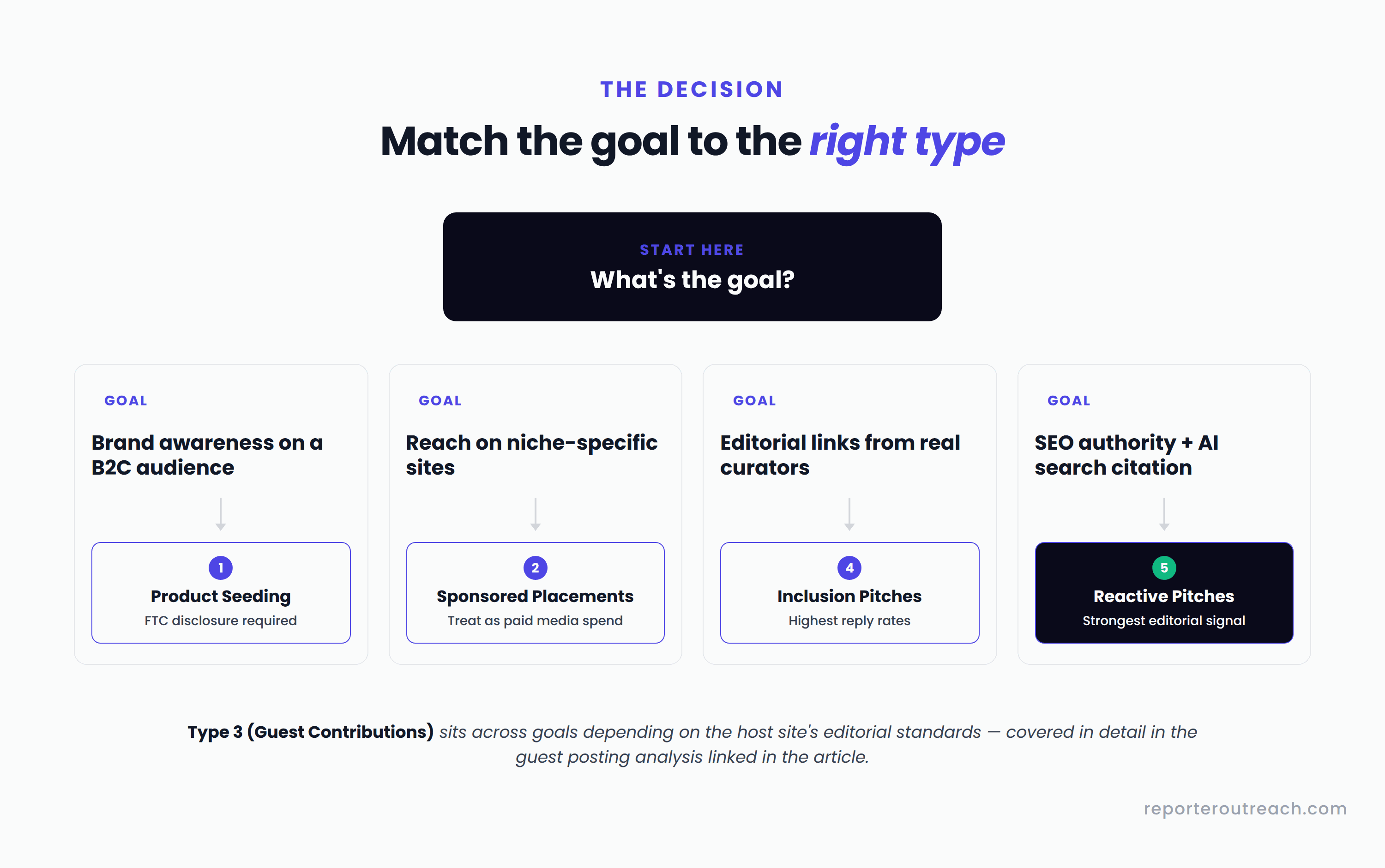
With four of the five types now mapped, the practical question is which one to use when. The answer depends almost entirely on the goal, and the goals split cleanly into four lanes:
Reactive Pitches: Why This Is Replacing the Other Four
The fifth type of blogger outreach is the one that breaks the frame. In every form above, the brand initiates the contact. The blogger receives an inbound message — wanted or unwanted — and decides whether to engage. The brand is the salesperson; the blogger is the customer.
Reactive pitching flips that. The blogger or journalist posts a request — "looking for an SEO expert for a piece on AI search," "need a quote from a financial advisor on Roth conversions," "researching email tools for a roundup." The brand or expert responds with a useful answer. If the source is a fit, the blogger picks them. The selection is the editorial decision.
That dynamic flip changes everything downstream. The link the blogger places isn't a paid placement — no money changed hands. It isn't a guest post — the brand didn't write the article. It isn't an inclusion pitch — the blogger initiated the request. It looks, mechanically, like editorial coverage by a journalist of an expert source. Which is exactly what it is.
Platforms exist specifically to facilitate this flow. Qwoted, Featured, and Source of Sources are the most active, with thousands of source requests per day across categories — covered in detail in our media outreach playbook. The bloggers and journalists posting on them are doing genuine sourcing — they need expert input for content they're already committed to writing.

The AI search dimension matters even more than the SEO dimension here. ChatGPT, Perplexity, Gemini, and Google's AI Overviews don't cite sponsored content, paid placements, or thinly-disguised guest posts as authority signals — they cite editorial coverage from real publishers. Reactive pitching is the only systematic way to consistently produce that kind of coverage at any scale. The brands quietly building large reactive pitching programs are seeing AI search citations grow alongside their organic rankings; the brands still buying sponsored placements are seeing both stagnate.
This isn't traditionally classified as blogger outreach. Most agencies selling "blogger outreach services" don't sell reactive pitching at all. But it absorbs almost every legitimate use case the other four types had — brand awareness, link authority, AI search citation, expert positioning — without the FTC exposure, the Google enforcement risk, or the credibility cost of buying placements that look like editorial coverage. The data behind digital PR as a primary engine covers the model in depth.
Want Coverage You Didn't Have to Chase?
Reactive PR puts you in front of journalists and bloggers who are already looking for expert sources. Real placements, real editorial decisions, real authority — and AI search engines reward it the same way they reward earned journalism.
Blogger Outreach FAQ
What's the difference between blogger outreach and guest posting?
Guest posting is one type of blogger outreach, not a synonym. Guest posting specifically means writing content yourself and pitching it to a blog for publication. Blogger outreach is the broader category that also includes product seeding, sponsored placements, inclusion pitches to resource pages and roundups, and reactive pitching to bloggers running source requests.
Does blogger outreach still work for SEO in 2026?
It depends entirely which form. Sponsored placements and most guest posting carry rel="sponsored" or rel="nofollow" under Google's stated policy and pass minimal ranking value when handled correctly. Inclusion pitches to legitimate resource pages and roundups still produce real editorial links. Reactive pitching produces the cleanest editorial coverage and the strongest AI search signal, but most agencies don't sell it under the "blogger outreach" label.
Do I have to disclose free product sent to bloggers?
Yes. The FTC's Endorsement Guides at 16 CFR Part 255, last revised in June 2023, treat free product as a material connection that consumers wouldn't reasonably expect — which means it has to be disclosed clearly and conspicuously in the same medium as the endorsement. Both the brand and the endorsing blogger can be held liable. Civil penalties run up to roughly $50,000 per violation under the FTC Act.
Are sponsored blog posts worth paying for?
For brand awareness on niche sites with engaged audiences, sometimes. For SEO authority, almost never — when the rules are followed correctly, the link carries rel="sponsored" and passes essentially no PageRank. Brands buying sponsored placements as "editorial links" are usually paying for a link Google's spam systems either ignore or actively devalue.
What's replacing blogger outreach for AI search visibility?
Reactive pitching — responding to source requests posted by journalists and bloggers on platforms like Qwoted, Featured, and Source of Sources. AI search engines cite editorial coverage from real publishers, not sponsored content or paid placements. Reactive pitching is the only systematic way to produce editorial citations at any meaningful scale.
Sources: Federal Trade Commission, 16 CFR Part 255 (Endorsement Guides, finalized June 29, 2023); Federal Register, "Guides Concerning the Use of Endorsements and Testimonials in Advertising" (effective July 26, 2023); Google Search Central Blog, "A reminder on qualifying links and our link spam update" (July 2021); Google Search Central Blog, "Updating our site reputation abuse policy" (December 2024 update); Backlinko & Pitchbox, "We Analyzed 12 Million Outreach Emails" (subject line, body personalization, and follow-up findings).