Key Takeaways
- 54% of businesses run competitor analysis as part of their link building strategy (Aira State of Link Building) — but only a fraction extract genuinely actionable opportunities from the data they pull.
- Competitor backlink analysis shows you exactly where rivals earn their links, what authority level those links carry, and which publications are realistic targets for your own outreach.
- The backlink gap — publications linking to competitors but not to you — is where the highest-probability link opportunities live. A single gap analysis can surface dozens of viable targets in minutes.
- Quality matters more than count. If competitors earn editorial placements through digital PR link building, you won't match those results with low-authority guest posts.
- The most actionable output: a list of publications and journalists already covering your industry — then pitch those same outlets with better expertise.
You can spend months guessing at where to build links — or you can look at exactly what's working for the sites that outrank you and reverse-engineer it.
Analyzing competitor links isn't about blindly copying every backlink a rival has. It's about understanding the landscape: how many links you need, what authority level matters, which publications are realistic targets, and what Google rewards in your specific niche. That intelligence shapes every outreach decision you make.
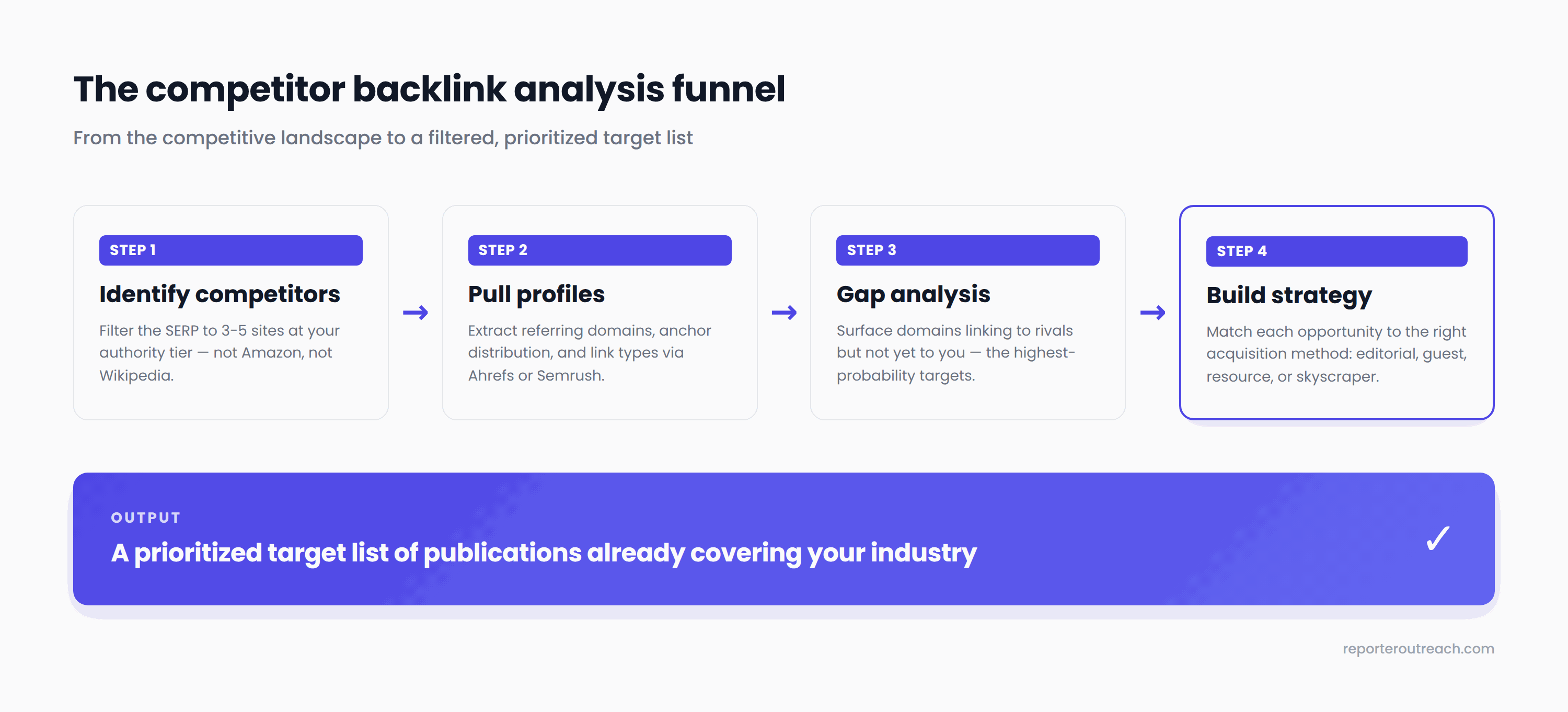
This guide walks through the full process — from identifying the right competitors to analyzing their profiles, running gap analyses, and turning all of it into an outreach strategy that produces results.
Why Competitor Backlink Analysis Actually Matters
Every competitive keyword in Google is an authority race. The pages sitting at the top have earned enough trust — primarily through links from authoritative publications — to outperform everything else. Without understanding what your competitors have built, you're essentially guessing at what "enough" looks like.
Aira's State of Link Building survey found that 29% of SEO professionals specifically target sites where their competitors already have backlinks. That's not a coincidence. Those publications have already demonstrated willingness to link to content in your industry — which makes them the highest-probability targets you'll find anywhere.
Competitor analysis answers the four questions that matter most:
How many links do you actually need? If the top three results for your primary keyword average 120 referring domains and you have 15, you know the gap. That shapes your budget, timeline, and how aggressively you need to build.
What authority level is required? If competitors earn links from DR 60-80 publications, building DR 20-30 guest posts won't move the needle. You need links at the same authority tier — or higher.
Which publications should you target? Competitor profiles reveal the specific publications and journalists already covering your industry. These are your highest-probability targets because they've already demonstrated interest in your topic.
What does Google reward in your niche? Some verticals are dominated by editorial placements earned through digital PR. Others lean heavily on resource pages or industry directories. The link types that dominate the top results tell you what works.
We've seen companies spend six figures on content marketing and link building only to realize they were targeting the wrong authority level entirely. A one-hour competitor analysis at the start would have redirected that investment toward methods that actually close the gap.
Step 1: Identify Your Real Competitors
Here's where most people start wrong. Your SEO competitors aren't always your business competitors.
A direct business rival might have a weak website that barely ranks. Meanwhile, an industry blog or media publication might dominate the top five for every keyword you care about. The sites occupying your target SERPs are the ones you need to study — regardless of whether they sell competing products.
Search your target keywords manually. Look up your top 5-10 priority keywords in Google and note which domains appear repeatedly in the top five results across multiple searches. Repeated presence means consistent authority. Those are the competitors worth analyzing.
Use tool-based competitor discovery. In Ahrefs, enter your domain in Site Explorer and navigate to Organic Competitors. The tool surfaces sites ranking for overlapping keywords automatically. Semrush and SE Ranking offer equivalent features. This catches competitors you wouldn't have found through manual searching alone.
Separate domain-level from page-level competitors. Some competitors compete with you across dozens of keywords — those need a full domain analysis. Others only outrank you for one or two specific terms — those need a page-level analysis. Both matter, but page-level analysis is more actionable when you're trying to rank for a specific keyword.
If Amazon, Wikipedia, or a major news outlet ranks for your keyword, don't include them. Their profiles are built on decades of authority and millions of links. Focus on competitors that are realistically comparable to your site in size, age, and industry focus. These are the ones whose link strategies you can actually replicate.
Step 2: Pull and Evaluate Their Backlink Profiles
With 3-5 competitors identified, it's time to dig into their actual link data. Open each competitor's domain in your preferred backlink tool and start with the high-level metrics.
Classifying individual links
After the overview, go into the actual backlink list. In Ahrefs, navigate to Backlinks and select "One link per domain" to avoid duplicates. Then classify what you see.
Editorial and digital PR placements. Links placed by journalists within news articles, expert roundups, or industry coverage. These come from high-authority publications and carry the most weight. If a competitor has a stack of these, they're running digital PR campaigns — and that tells you something important about what's working in your niche.
Guest contributions. Articles written by the competitor (or their agency) and published on another site. You'll spot these through author bios or content that reads more like branded material than editorial coverage. These vary wildly in quality — a guest post on a DR 70 industry publication is valuable; one on a DR 15 blog farm is noise.
Resource page and directory links. Links from curated lists, industry directories, or "best tools" roundups. Often lower authority but easy to replicate because the page maintainer is actively looking for additions.
One pattern we see constantly: companies look at a competitor's link count and panic. "They have 400 referring domains — how do we compete with that?" But when you actually classify those links, half are often low-quality directory submissions and forum links that carry no real weight. The 50 editorial placements are what's driving their rankings. That's a much more achievable target.
Step 3: Run a Backlink Gap Analysis
This is the most actionable step in the entire process. A gap analysis reveals sites that link to your competitors but not to you. These are your highest-probability targets — they've already demonstrated willingness to link to content in your industry.
In Ahrefs: Go to Link Intersect. Enter competitor domains in the top fields and your domain in the "But doesn't link to" field. The tool returns every domain linking to one or more competitors but not to you, sorted by authority.
In Semrush: Navigate to Backlink Gap. Enter up to five competitors alongside your own domain. The tool surfaces the same data with filtering by DR and link attributes.
The raw output will be hundreds (sometimes thousands) of domains. Not all of them are worth pursuing. Filter aggressively:
- Domain authority threshold. Set a DR floor that matches your competitive tier. If competitors are earning DR 50+ links, filter to DR 40 minimum so you don't waste outreach on sites that won't move the needle.
- Topical relevance. A DR 60 site outside your industry passes weaker signal than a DR 40 site directly in your niche. Filter to topically relevant domains first.
- Organic traffic floor. Sites with high DR but zero organic traffic are usually PBNs or expired-domain abuse. We won't approve placements on sites under 1,000 monthly organic visitors regardless of DR — that's the floor below which authority is mostly notional.
- Multi-competitor overlap. Domains linking to two or more competitors are higher-probability targets than domains linking to just one. The publication has already covered your industry repeatedly — that's a warm lead.
- Recent activity. Filter by "first seen" date if your tool supports it. A site that linked to a competitor in 2019 and hasn't published since is dead weight; a site that linked last month is active.
After filtering, you'll have a refined list of domains that demonstrably link to competitors in your space, carry real authority, and don't yet link to you. That's your target list.
WebFX's 2026 backlink study analyzed 1,462 domains across 15 industries and found that top-ranking sites gain an average of 48 new referring domains per month, with industries ranging from 15 (Apparel) to 101 (Finance & Insurance). Even if you reach your industry's median referring domain count, competitors moving faster will still pull ahead. Your monthly target needs to account for the pace they're building, not just the gap as it stands today.
Step 4: Turn Insights Into an Outreach Strategy
You've got the target list. Now match the right acquisition method to each opportunity. This is where most people go wrong — they use the same approach for every target regardless of how the competitor actually earned that link.
If the competitor earned an editorial placement
A journalist at that publication cited the competitor as a source. That means the publication is open to expert commentary in your industry. The approach: media outreach — pitching your founder or executive as an expert source through journalist platforms (Qwoted, Featured, Source of Sources) or direct relationship building.
Editorial placements carry the highest authority and generate the brand mentions that drive visibility in AI search engines like ChatGPT, Perplexity, Gemini, and Google AI Overviews. They're harder to earn but produce dramatically better results than any other link type.
If the competitor has a guest contribution
The publication accepts contributed content. Pitch a topic that fills a gap in their recent coverage — don't just pitch whatever you want to write about. Study their last 20 published articles, identify what's missing, and pitch that angle. Sites with real editorial standards won't publish thin content just because you're offering it for free.
If the competitor appears on a resource page
Contact the page owner and make the case for inclusion. Resource page outreach has the highest response rate of any link building method because the maintainer is actively curating — they want quality additions. Keep your pitch brief: who you are, what your resource is, and why it belongs on the list.
The Skyscraper approach
Identify which of your competitor's pages have earned the most links (Ahrefs Best by Links report), then create something meaningfully better. Not just longer — better. More current data, clearer visuals, more practical advice, original research. Then reach out to the sites linking to the original and offer yours as an improved alternative.
This works best when the competitor's content is genuinely outdated or incomplete. If their resource is already excellent, a marginal improvement won't motivate anyone to swap their link.
If a competitor earned an editorial link from Forbes because a journalist cited their CEO, you won't replicate that with a guest post pitch. You need to match both the target publication and the acquisition method. Editorial placements require digital PR. Guest contributions require content pitches. Resource pages require inclusion requests. Wrong method equals wasted effort.
One pattern from running campaigns since 2017 across 500+ clients: the most actionable competitor signal isn't total link count or even average DR — it's the specific publications already covering your industry. Once you have that list, the rest is execution. We've seen this play out repeatedly, including a SaaS client who used competitor analysis to identify the workplace mentoring publications that were citing their competitors, then earned coverage in those same outlets through expert commentary. Six months later, organic traffic was up 2,203% from links averaging DR 78. (More case studies here.)
What You Should Never Replicate
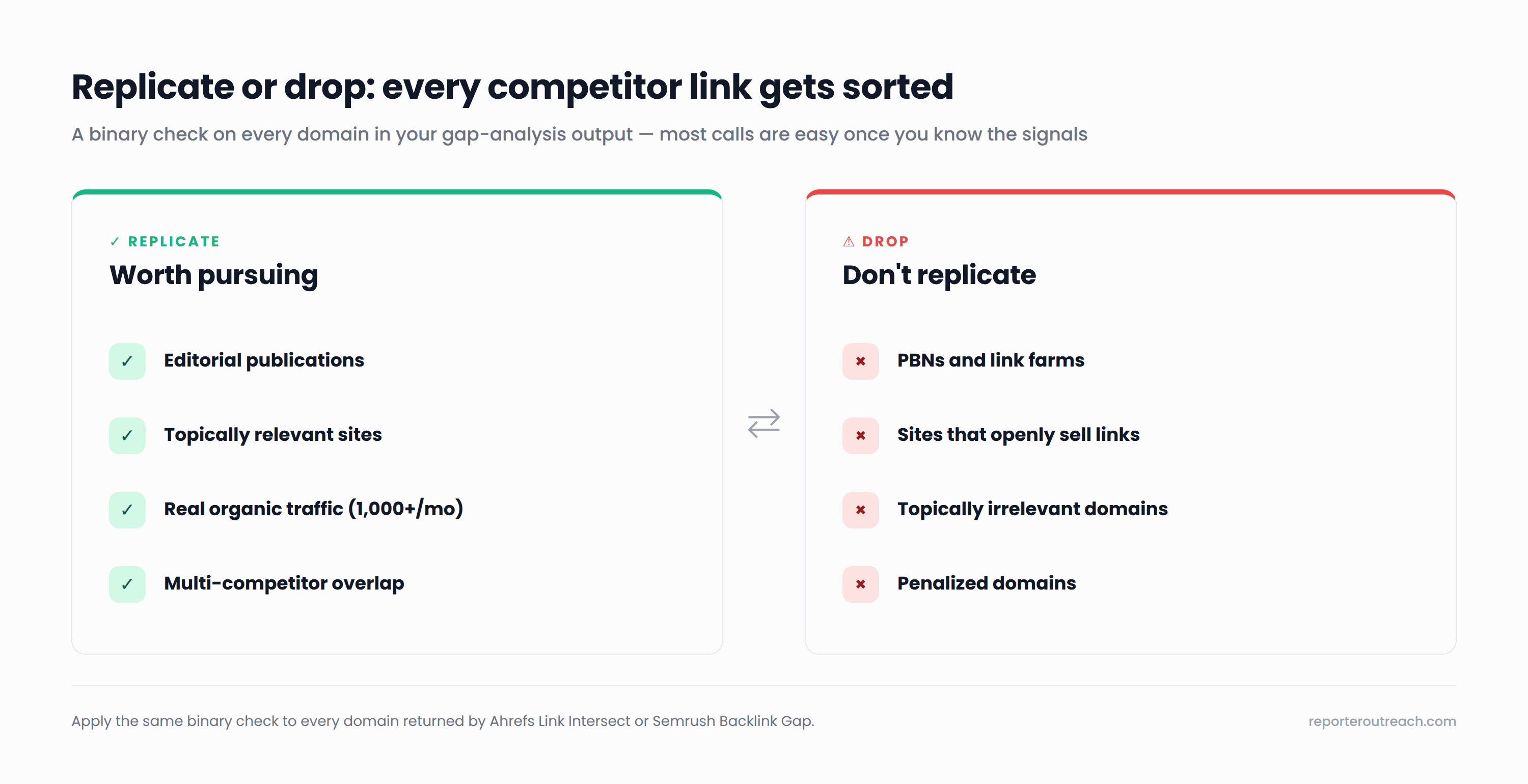
Not every link in a competitor's profile is one you want. Some are actively harmful to copy.
- PBN and link farm links. Sites with high DR but zero organic traffic, thin AI-generated content, and no topical focus. Google has already devalued these. Replicating them adds risk with zero upside. Check the Moz spam score and Ahrefs traffic data on any suspicious domain — if a DR 50 site gets 12 organic visitors per month, it's not a real publication.
- Sites that openly sell placements. If a domain advertises "write for us" pages with pricing tiers or accepts payments for link insertion, any link from that site carries risk. Google's algorithms specifically target sites that sell links.
- Topically irrelevant links. A competitor's link from a completely unrelated industry provides no signal about your niche. Google weights topical relevance heavily — a DR 40 link from a relevant industry publication is worth more than a DR 60 link from an unrelated site.
- Penalized domains. If a referring domain has lost 80%+ of its organic traffic recently, it may be under a Google penalty. Use Ahrefs or SE Ranking to check historical traffic — a sudden cliff in the graph is a clear warning sign. Links from penalized domains pass no value and may carry risk.
For a deeper breakdown of risky link patterns to watch for, see our guide to identifying unnatural links.
Best Tools to Analyze Competitor Backlinks
You need a reliable backlink analysis tool to run this process efficiently. Here's what we recommend based on running competitor analyses daily for clients since 2017.
| Tool | Best for | Starting price | When to choose it |
|---|---|---|---|
| Ahrefs | Largest backlink index; best Link Intersect feature | $129/mo | Default choice for serious analysis — most accurate data |
| Semrush | Backlink Gap tool, integrated SEO suite | $139/mo | If you also need keyword research and PPC data in one platform |
| Majestic | Trust Flow / Citation Flow metrics, historical index | $50/mo | Pair with Ahrefs to catch 15-25% more unique referring domains |
| SE Ranking | Affordable competitor tracking with backlink monitoring | $65/mo | Smaller budgets — covers the basics at lower cost |
| Moz Pro | Domain Authority metric, smaller index | $99/mo | Teams already standardized on DA as their primary authority metric |
For a detailed breakdown of each tool's link building features, see our complete link building tools guide.
Ongoing Monitoring: Stay Ahead
Competitor backlink analysis isn't a one-time project. Link profiles shift constantly — competitors gain new links, lose old ones, and change their strategies. Build monitoring into your quarterly routine.
Set up new link alerts. In Ahrefs, go to Alerts and create a New Backlinks alert for each competitor's domain. You'll get notified whenever they earn a new link — giving you real-time intelligence on their active campaigns and fresh publications to target.
Re-run gap analyses quarterly. New sites enter your space, competitor strategies evolve, and publications that weren't linking to anyone three months ago might now be active in your niche. A quarterly gap analysis keeps your target list current.
Track your own progress. As you build links from the sites identified in your gap analysis, monitor the gap closing over time. Track referring domain growth, average authority of new links, and keyword ranking movement. If the gap is closing and rankings are improving, your strategy is working. If not, revisit your target list and methods.
Watch for velocity spikes. If a competitor suddenly gains 50+ new links in a month versus their normal 5-10, they've launched a campaign or published something that's earning organic links. Investigate what they published — it might reveal a content format or data angle worth adapting.
Know Where Competitors Earn Links — Then Beat Them
We analyze your competitive landscape and earn editorial links from the same publications your rivals rely on — often at higher authority levels.
Frequently Asked Questions
What is competitor backlink analysis?
It's the process of examining which sites link to your competitors, assessing the quality and authority of those links, and using that data to find opportunities for your own site. Tools like Ahrefs and Semrush make pulling the data straightforward — the real value sits in classifying what you find and building a targeted strategy from it.
How do I find which sites link to my competitors?
Enter a competitor's domain into any backlink tool (Ahrefs Site Explorer is the most popular) and it returns every site linking to them along with authority scores and anchor text data. For a multi-competitor comparison, use the gap analysis feature — Ahrefs calls it Link Intersect, Semrush calls it Backlink Gap — which surfaces domains linking to rivals but not yet to you.
How many competitors should I analyze?
Three to five is the productive range. Fewer than three rarely surfaces enough patterns to identify repeatable opportunities. More than five creates noise without proportionally better insight. Prioritize sites that rank for your most important keywords and have profiles realistically within reach — analyzing a domain with 50x your authority won't produce actionable targets.
Should I try to replicate every competitor link?
No. Many links in any competitor's profile are low-quality, irrelevant, or from sites that openly sell placements. Treat the analysis as intelligence, not a shopping list. The goal is to identify the high-authority, editorially earned links that are actually driving rankings — then target those same publications with a method that matches how the link was originally earned.
How often should I run competitor backlink analysis?
A full analysis quarterly, supplemented by ongoing alerts for new competitor links (Ahrefs Alerts handles this automatically). The quarterly cadence catches new opportunities, emerging competitors, and strategy shifts without consuming more time than the insights justify.
What's the single most important metric to look at?
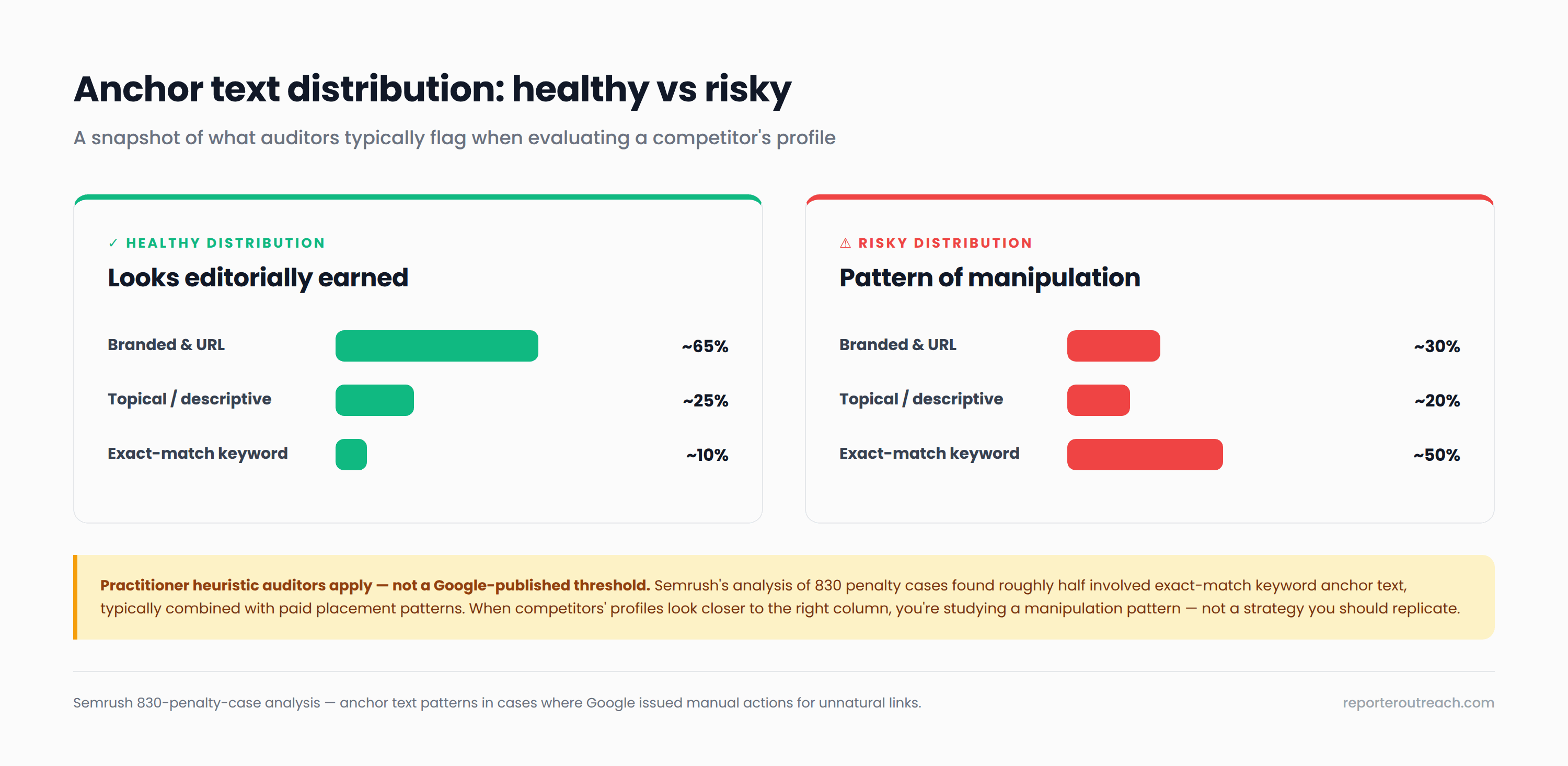
The domain authority of the linking site is what matters most — it determines how much weight each link carries. After that, check topical relevance (does the site cover your industry?), organic traffic (does Google actually trust it?), and anchor text distribution (is the profile natural or manipulated?).
Sources: Aira State of Link Building Report — Link Building Techniques and Tools Survey (54% of businesses use competitor analysis; 29% target sites where competitors have backlinks). WebFX 2026 Backlink Study (1,462 domains, 15 industries, 150 service-intent keywords; cross-industry average link velocity 48 referring domains/month). Reporter Outreach — patterns from 500+ campaigns since 2017.