Key Takeaways
- Link earning means a publisher independently chose to link to you. Most "link building" doesn't qualify, even when it's framed that way.
- Three conditions define a genuinely earned link: the publisher decided, no transaction preceded it, and the reader can't tell it was orchestrated.
- Cold-pitch reply rates fell to 5.8% in 2024 — the lower the rate, the further outreach drifts from "earning" anything.
- Reactive PR is the only method that consistently passes all three conditions, because journalists are doing the choosing.
- AI search engines disproportionately cite editorial sources, which makes link earning more valuable in 2026 than at any prior point.
"Link earning" is the most overused phrase in link building. Almost no one actually does it.
Agencies use the term because it sounds editorial and effortless — like the link arrived because you deserved it, not because someone in a Slack channel built a spreadsheet of contacts and ran an outreach sequence. The framing matters: earned links carry more weight with Google, perform better in AI search, and signal something about your brand that built links don't.
Which is exactly why the term gets attached to so much work that isn't earning anything.
This article is the honest definition. What link earning actually is, the three conditions every earned link has to pass, why most claims fail at least one of them, and the single mechanism that consistently produces the real thing.
What Is Link Earning?
Link earning is when a publisher independently decides — on the merits of what you bring, not because of payment or a pre-arranged link commitment — that you're worth citing in their content.
That's the whole definition. Everything else in the field that gets called "earning" is something else dressed up.
A backlink placed because the publisher chose to cite you on the merits — not because money changed hands, the link was promised in advance, or you wrote the content yourself. The publisher's editorial decision is the defining feature.
The reason this distinction has gotten muddy is that most modern link building involves at least some editorial mechanism — a journalist receiving a cold pitch, an editor approving a guest post, a publication accepting a sponsored placement. Each of those has the appearance of editorial consent. But appearance isn't the test. The test is whether the publisher independently chose to cite you on the merits, and that test is much narrower than the industry pretends.
Link Earning vs Link Building
Link earning is a subset of link building — but a small one, and most agencies use the terms interchangeably to obscure that distinction.
Link building is everything you do to acquire backlinks. Link earning is the narrower category where you didn't actually do anything to acquire the specific link — you did something that made you cite-worthy, and the publisher took it from there.
| Dimension | Link Earning | Link Building |
|---|---|---|
| Who decides to link | The publisher | You (via outreach, payment, exchange, or contribution) |
| Initiating action | The publisher's editorial choice | Your pitch, payment, or content placement |
| Reader can detect orchestration | No | Sometimes |
| Common methods | Reactive PR, journalist sourcing, original research, expert quotes | Guest posting, link insertions, paid placements, niche edits, exchanges |
| Passes authority | Yes — strongest signal | Yes — varies by method |
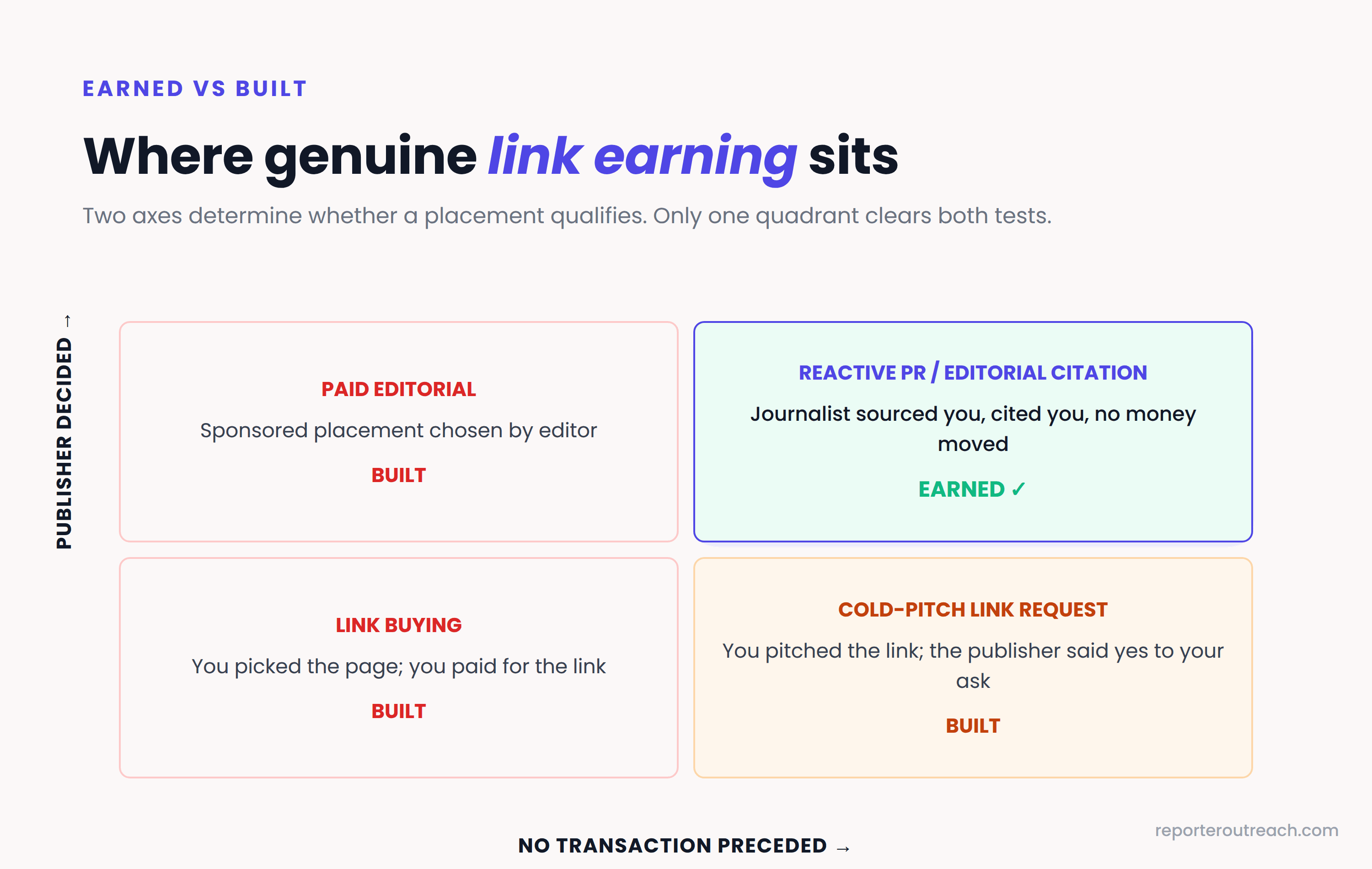
Both are legitimate categories of work. Both can produce ranking results. They aren't the same thing, and treating them as if they were is what lets agencies sell built links under earned links pricing — which is currently the most common form of mislabeling in the industry.
The highest-velocity form of earning is jumping into breaking-news cycles with expert commentary — our newsjacking guide covers when that works and when it wastes a news cycle.
The Three Conditions That Make a Link "Earned"
For a link to qualify as truly earned, three things must be true. The publisher independently decided to link, no money or favor changed hands beforehand, and the reader can't tell the link was orchestrated.
- The publisher made the decision. Not the SEO. Not the link builder. Not the outreach VA running a sequence. The journalist or editor of the publication chose to link because your input made their article better. If the placement came at the end of a transaction or a pitch process where the publisher committed to it before reviewing the actual contribution, the publisher didn't decide — you did, and they ratified it.
- No transaction preceded the placement. Money, services, products, or future link exchanges all disqualify the placement from "earned" status. The link can still be valuable, still pass authority, still drive traffic. But it isn't earned, and pretending otherwise is what makes the term useless.
- The orchestration is invisible to the reader. This is the test most "link earning" claims fail. If the reader can identify the link as a placement — by the awkward way the brand is referenced, the suspiciously neat mention pattern, the boilerplate author bio — the link is built. Genuinely earned links read like the journalist found you on their own, because they did.
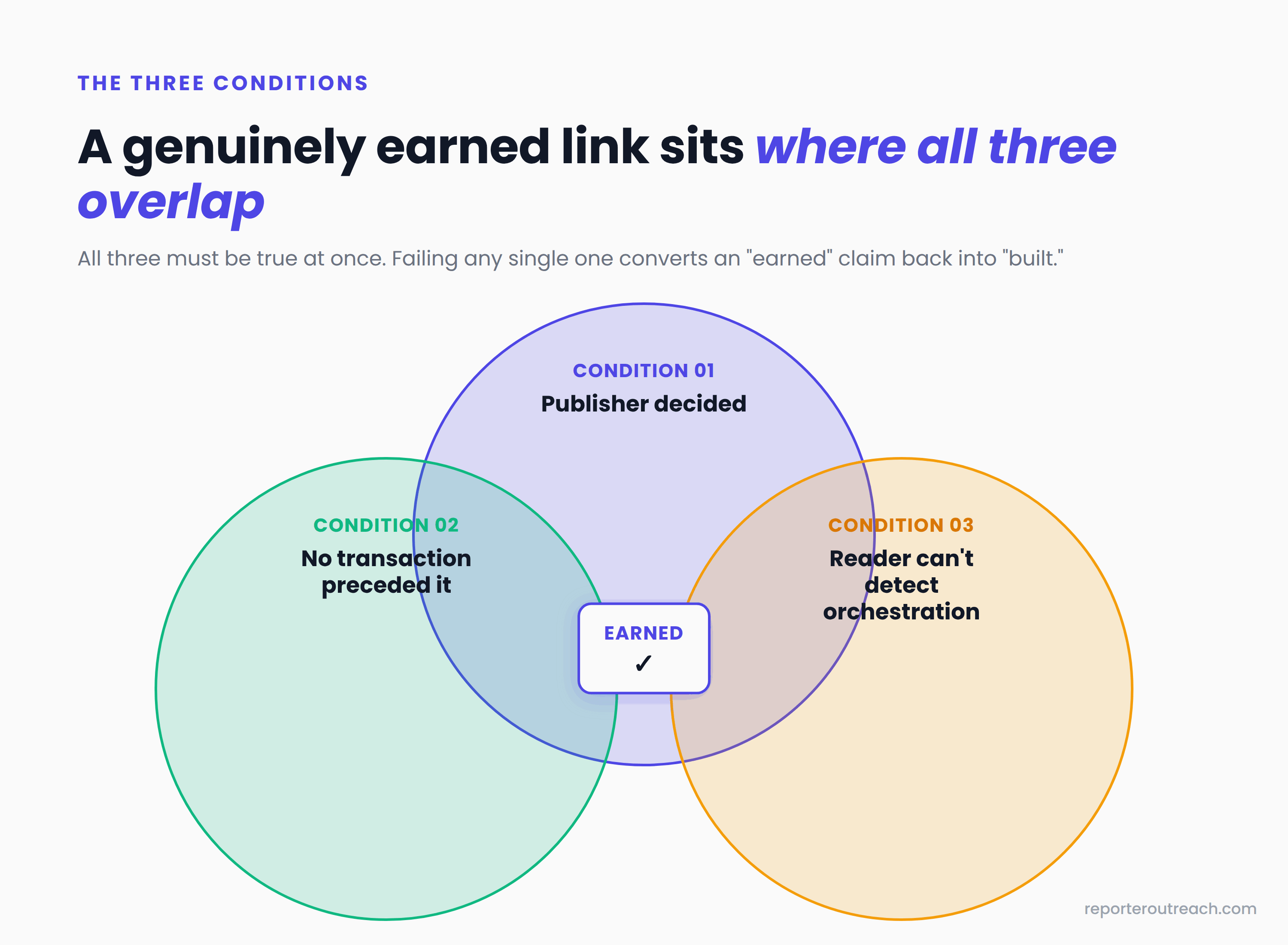
These three conditions also happen to be what Google has been trying to algorithmically distinguish since the original PageRank patent. Earned links pass authority more efficiently than any other type because they correlate with the editorial signal Google's algorithm was designed to reward. Built links can still help — but the gap between "link Google detects as transactional" and "link Google detects as editorial" is widening, not shrinking.
If you removed yourself from the loop entirely, would this link still have happened? If yes, it's earned. If no, it's built. Most "link earning" claims collapse under this single question.
Why Most "Link Earning" Claims Don't Pass the Test
Three common practices get called "link earning" by agencies that don't actually deliver it. Each fails at least one of the three conditions.
Cold-pitch outreach. The standard playbook: build a list of websites, write a personalized pitch, ask for a link or a mention. The reply rate tells the story. Belkins, analyzing 16.5 million cold emails sent in 2024, reported reply rates dropping to 5.8% — down from 6.8% in 2023. Reachoutly's data shows the floor falling further into 3-5% entering 2026, with stricter sender requirements from Gmail and Yahoo accelerating the decline. When 94% of recipients ignore the pitch and the few who do respond are saying yes to your ask (not making an editorial decision about your worth), the publisher isn't really deciding. You are, and they're agreeing. That fails condition #1.
Sponsored placements with editorial framing. Some publications offer paid placements that look indistinguishable from editorial coverage — same author bylines, same article structure, same publication branding. The link can be valuable. The "earned" claim falls apart at condition #2: money changed hands. Calling these placements earned is the most direct form of mislabeling, and the FTC takes a dim view of it when readers can't tell.
Guest posts framed as earned coverage. A guest post is content you wrote, you placed, and you self-linked from. The publisher accepted the post — they didn't choose to link to you. The publisher's contribution is the venue; yours is the link. That's legitimate link building, and at scale it can be highly effective. It isn't link earning, and the conflation is what makes the term lose all meaning when it's used in agency pitches.
| Common claim | What's actually happening | Earned? |
|---|---|---|
| "We earn links via guest posts" | You write, you place, you self-link | No |
| "We earn links via cold outreach" | You pitch; the publisher considers your ask | No |
| "We earn links via paid placements" | Money changes hands beforehand | No |
| "We earn links by being a quoted source" | A journalist evaluates your input and decides to cite it | Yes |
| "We earn links via original research" | Publishers cite the research without prompting | Yes (when citation is unsolicited) |
The rule, restated: if the link decision was made by you (or by your agency on your behalf), it's built. If the publisher made it independently, it's earned. The honest version of most "link earning" pitches is "we run high-quality outreach for placements that look editorial." That's a real and valuable service. It's just not what the words mean. Agencies that want to offer the real thing without standing up a journalist-sourcing operation in-house typically resell it instead — that's the premise behind Reporter Outreach's white label link building services.
How Reactive PR Earns Links
Reactive PR — being available to respond when a journalist is actively searching for an expert source — is the only method that consistently passes all three conditions of link earning.
The mechanism inverts cold, proactive outreach — our media outreach guide compares the two directly on speed, conversion, and control. Instead of you reaching out to publishers with a pitch they didn't ask for, journalists post queries describing the story they're working on and the expert input they need. You respond only when you genuinely match the query. The journalist evaluates responses from multiple potential sources and cites the one that best fits their story.
This pattern explains why journalist sourcing remains durable while cold-pitch reply rates collapse. According to Muck Rack's 2025 State of Journalism survey, 84% of journalists say at least some of their stories begin with a PR pitch — but 86% ignore pitches that aren't relevant to their beat. The signal isn't that PR fails. The signal is that journalists are actively pulling expertise into their stories, with a high relevance bar that randomly-targeted cold outreach can't clear.
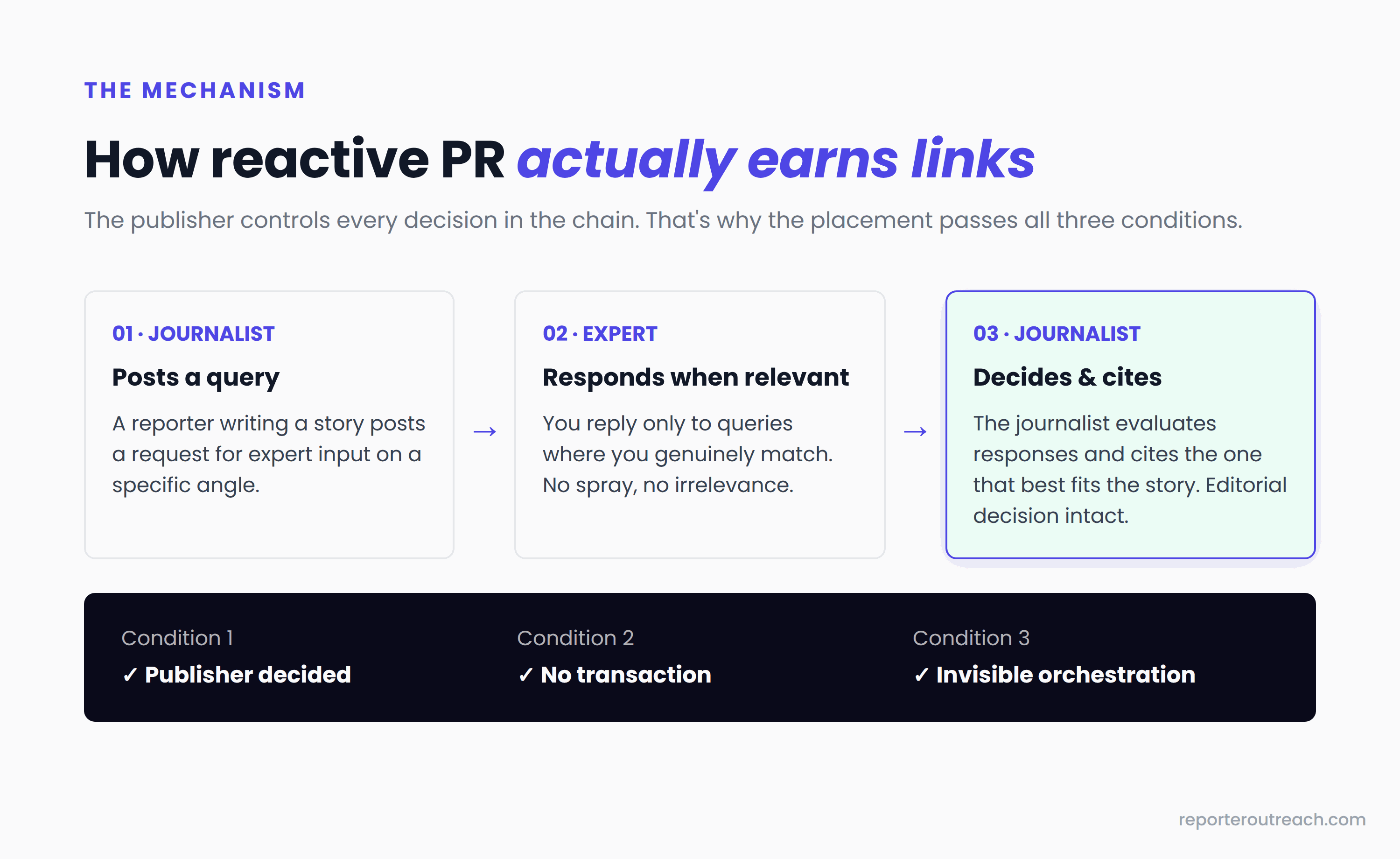
Walk it through the three conditions:
- Did the publisher decide? Yes. The journalist chose your response from a pool of potential sources.
- Did money change hands? No. The journalist isn't paying you; you aren't paying them. The query exists because they need expertise.
- Could the reader detect orchestration? No. The reader sees an expert quote inside an article. There's nothing to detect because nothing was orchestrated — you provided expertise, they used it.
This is also why digital PR through reactive sourcing passes authority more efficiently than other methods: the publication chose to cite you. From Google's algorithmic standpoint, that's the same signal the original PageRank model was built around — and it's the signal AI search engines treat as primary evidence of expertise.
Across the campaigns Reporter Outreach has run since 2017 — a representative sample being a 9-month Villa Oasis program that produced 39 editorial placements and a 352% organic traffic lift — every placement met all three conditions. The full Villa Oasis case study walks through the campaign mechanics; the underlying point is structural. When the journalist is the one deciding to cite, every condition of link earning falls into place automatically. When you're the one deciding, you're doing something else.
Why This Matters More in 2026
AI search engines disproportionately cite content that itself cites editorial, third-party sources — making earned links more valuable in 2026 than at any prior point.
Conductor's research has tracked AI Overviews appearing on roughly a quarter of desktop search queries (25.11% in their 2024 dataset, with the figure climbing each quarter since). Inside those AI-generated answers, the citation patterns favor editorial sources: brand-published content gets cited rarely; brand mentions inside editorial coverage get cited frequently. The same pattern shows up in ChatGPT and Perplexity results, where AI engines pull authority signals from a publication's editorial reputation rather than the linked brand's domain.
This shift compounds with traditional ranking signal value. According to Authority Hacker's 2024 link building survey, 93.8% of SEOs prioritize quality over quantity — but the gap between "quality link" and "earned link" is widening as AI search matures. Editorial coverage from journalist sourcing performs in both channels: it ranks in traditional Google results and gets cited in AI-generated answers. Built links underperform on the second axis even when they perform on the first.
In 2025, an agency could plausibly argue that a wide variety of placement types delivered comparable link value. In 2026, methods that produce genuinely earned coverage will outperform every other method by a widening margin — because two distribution channels (Google and AI search) now reward the same signal.
If your agency tells you they "earn" links, ask which of the three conditions every placement passes. Then check.
For the deeper mechanics of how reactive PR campaigns translate journalist queries into placements, see our digital PR link building guide. For specific tactics on responding to journalist queries effectively, our media outreach playbook covers the platforms most active in 2026. And for how this connects to AI search visibility, our guide to generative engine optimization walks through the citation mechanics in detail.
Ready to See What Genuine Link Earning Looks Like?
A 30-minute call to map reactive PR opportunities for your business. No pitch decks, no commitments — just a look at what genuine earned coverage could deliver.
Frequently Asked Questions
What's the difference between link earning and link building?
Link earning is when a publisher independently decides to link to you. Link building is anything you do to acquire backlinks — including outreach, guest posting, paid placements, and reciprocal exchanges. Earning is a small subset of building.
Can you actually earn links without doing any outreach?
Yes — through reactive PR (responding to journalist queries), original research that gets cited organically, and sustained expert visibility that leads journalists to find you on their own. None of these involve cold-pitching the publisher.
Is digital PR the same as link earning?
Not exactly. Digital PR includes both earned tactics (reactive sourcing, expert quoting) and built tactics (proactive cold pitching). Reactive digital PR earns links. Proactive digital PR is closer to traditional link building, even when the placements look editorial.
How long does link earning take to start working?
Reactive PR campaigns typically generate first placements within 30 to 45 days. Compounding traffic and authority effects show in months three to six. The path is faster than cold-pitch outreach in 2026 because reactive PR's response rate isn't gated by inbox deliverability the way cold email increasingly is.
How do you tell whether a link was earned or built?
Three checks: did the publisher choose to link, or did you ask; did money or services exchange hands; could a reader tell the link was orchestrated. Earned links pass all three. Most placements pass one or two and get marketed as if they passed all three.
Does Google distinguish between earned and built links algorithmically?
Google has been refining detection of editorial versus transactional link signals since the original PageRank patent. The exact algorithmic weighting isn't disclosed publicly, but the directional pattern is clear from the search updates of the last several years: editorial signals correlate with sustained ranking; transactional signals correlate with short-lived gains followed by penalties.
Sources: Belkins 2024 Cold Email Response Rates; Muck Rack State of Journalism 2025; Authority Hacker Link Building Survey 2024; Reachoutly 2026 Cold Email Benchmarks.