Key Takeaways
- Most tactics sold as "GEO" are just good SEO with a new label. Structured headings, schema markup, FAQ sections, and content freshness have been SEO best practices for years.
- The one genuinely new signal is third-party brand authority. Across 75,000 brands, Ahrefs found branded web mentions correlate about 3x more strongly with AI Overview visibility than backlinks do.
- Muck Rack's May 2026 Generative Pulse analysis of more than 25 million links cited by ChatGPT, Claude and Gemini found that 84% of AI citations come from earned media, not brand-owned content.
- Only 38% of AI Overview citations now come from pages ranking in Google's top 10, down from about 76% in July 2025 (Ahrefs, March 2026).
- In Stacker's March 2026 study with Scrunch (87 stories across 8 AI platforms), distributed stories earned a median 239% more AI citations than brand-owned versions alone.
There's a new acronym making the rounds in every SEO newsletter and conference deck: GEO, or Generative Engine Optimization. The pitch driving the GEO vs SEO debate is that this is a fundamentally new discipline, and that optimizing for AI search requires an entirely different playbook than traditional search.
Having watched this space closely since running digital PR campaigns that generate both backlinks and AI citations, I have a different take: most of what gets sold as "GEO" is solid SEO advice repackaged with new terminology. The genuinely new part is narrower than the marketing suggests, and it's almost entirely about one thing.
This article breaks down exactly which GEO tactics are borrowed SEO, which are actually new, and what the data says about the one lever that moves AI citations more than anything else.
What GEO Actually Means
Generative Engine Optimization is the practice of making your brand and content visible in AI-generated answers: the responses from ChatGPT, Google AI Overviews, Perplexity and Gemini that increasingly sit above the traditional ten blue links. Just how far that shift has gone is laid out in our AI search statistics roundup. And even as practitioners adopt AI everywhere, most PR pros we surveyed still won't trust it with the journalist relationships that earn the coverage AI cites.
The term comes from a 2023 Princeton-led research paper that studied how content changes affect visibility in AI-generated responses. The researchers found that adding statistics, quotations and source citations raised a page's visibility in generative engine answers by up to 40%. Useful finding. But the industry took it and ran in a direction the research didn't support, declaring GEO a brand-new discipline requiring brand-new expertise, brand-new tools and (conveniently) brand-new retainers.
You'll see it called Answer Engine Optimization, AI Search Optimization, or LLM Optimization. Same concept, different labels. The real question isn't what to call it. It's whether GEO actually requires doing anything different from what good SEO already demands.
GEO vs SEO: What's Actually New and What's Rebranded
This is the section every GEO guide buries because it undermines the pitch. Let's be specific about what's genuinely different and what's just SEO advice you should have been following anyway.
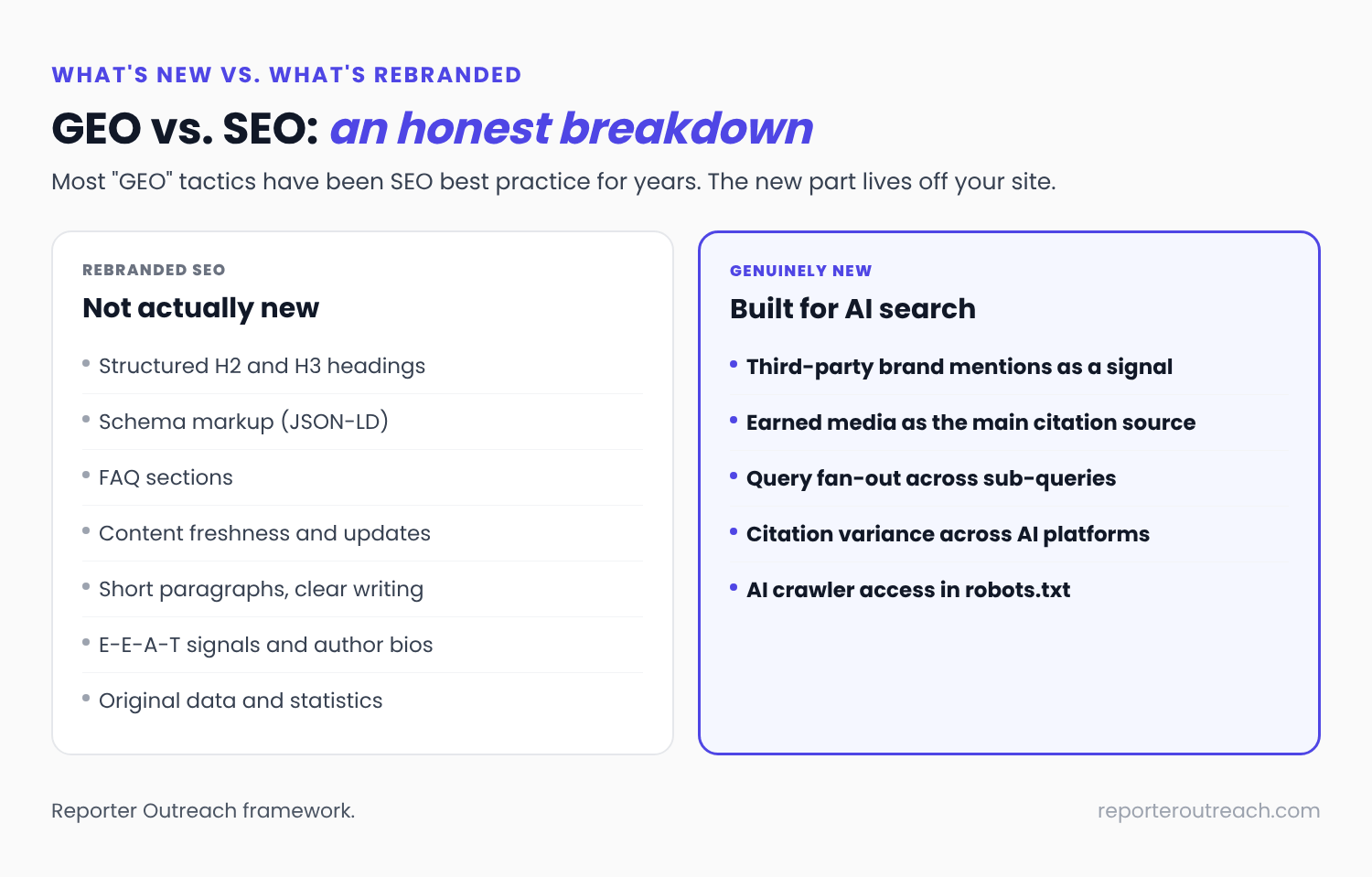
Look at the left column. Every single item has been an SEO best practice since at least 2020. Structured headings? That's been in Google's SEO Starter Guide for over a decade. Schema markup? Schema.org launched in 2011, and Google has used it for rich results ever since. FAQ sections? Content freshness? E-E-A-T? These aren't GEO tactics. They're table stakes for anyone who's been doing SEO competently.
The right column is where it gets interesting. Those are the signals that didn't exist in the pre-AI search landscape, or at least didn't matter the way they do now. And notice something? Most of them relate to how your brand shows up outside your own website.
If your "GEO strategy" consists entirely of on-page optimizations (restructuring headings, adding schema, writing FAQs, including statistics), you're doing SEO. Good SEO, maybe. But SEO. The part that's actually new requires building brand authority through third-party coverage, and that's a fundamentally different capability than content optimization.
The One Signal That's Genuinely Different
If there's a single data point that separates GEO from SEO, it's this: brand mentions track AI visibility far more closely than backlinks do.
Ahrefs studied 75,000 brands and found that branded web mentions had a 0.664 correlation with AI Overview visibility, about 3x the 0.218 correlation for backlinks. A December 2025 follow-up extended the analysis to ChatGPT and Google AI Mode: branded web mentions were again the strongest factor on all three platforms, with correlations from 0.656 to 0.709 (highest in AI Mode). In traditional SEO, backlinks are the dominant authority signal. In AI search, mentions are.
That finding alone changes the game. And two other datasets arrive at the same conclusion from completely different angles.
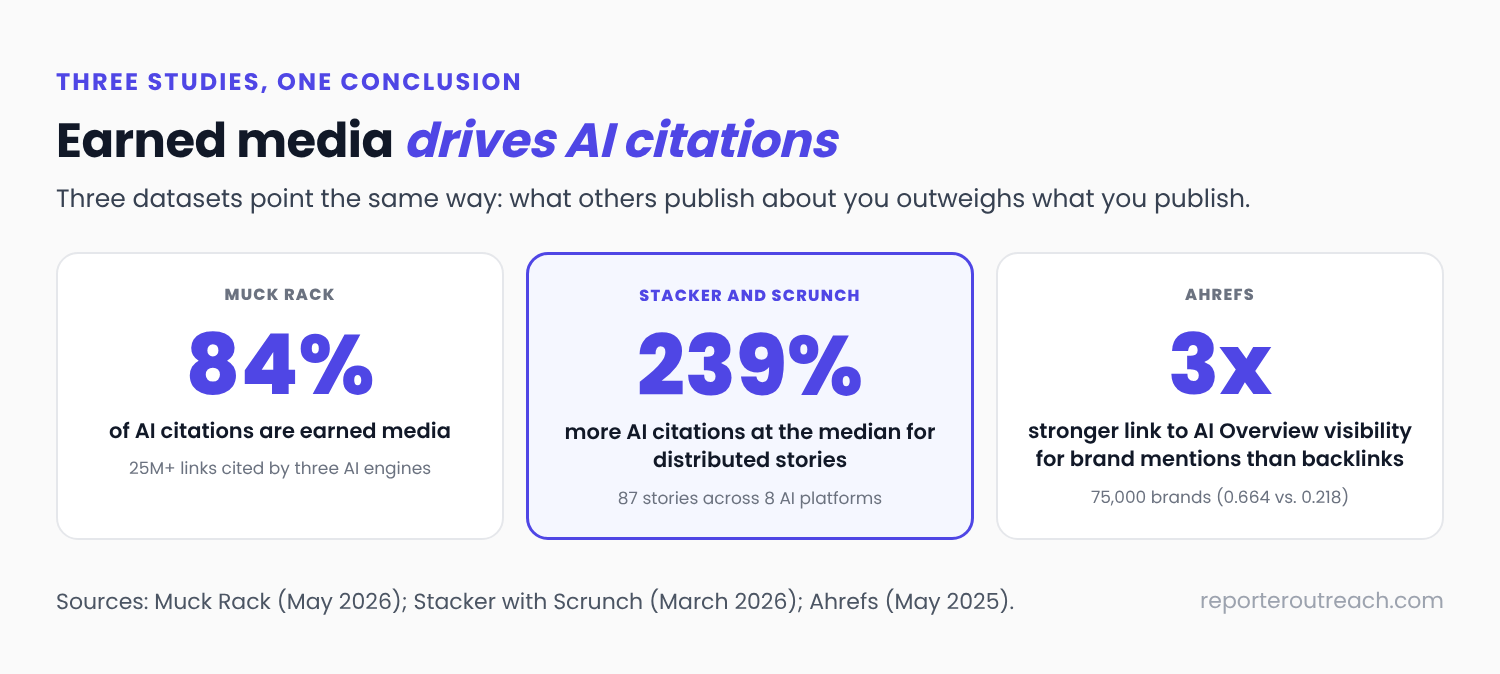
Muck Rack's May 2026 Generative Pulse analysis of more than 25 million links cited by ChatGPT, Claude and Gemini found that 84% of AI citations come from earned media, not brand-owned content. An earlier edition of the same report (December 2025) found only a 2% overlap between the journalists brands pitch most and the journalists AI cites most. A lot of outreach is aimed at reporters AI rarely draws on.
Stacker, which sells content distribution, measured with Scrunch what happens when the same story runs on third-party publishers instead of sitting only on a brand's own site. Across 87 stories and 8 AI platforms, distributed stories earned a median 239% more AI citations, cross-platform coverage rose from 5.4% to 17.9% at the median, and the distributed versions were 5.3x more likely than the brand's own page to be the only source AI cited for a story.
This is where GEO and SEO meaningfully diverge. Traditional SEO is mostly about optimizing what's on your site. The genuinely new part of GEO is about building your brand's presence across other people's sites, through editorial coverage, expert sourcing and the kind of third-party validation that digital PR generates.
You can't "on-page optimize" your way into AI citations. A brand with average content but a strong editorial presence across trusted publications tends to beat a brand with perfect on-page GEO and no third-party coverage. The trust layer is harder to build and harder for competitors to copy, which is exactly why it's more valuable.
How AI Engines Actually Pick Sources
Understanding the retrieval process explains why brand authority matters more than on-page optimization for AI citations. Here's what happens when someone asks an AI a question about your industry:
Query fan-out. The AI doesn't search your exact question. It breaks it into sub-queries. "Best digital PR agency for SaaS" might generate separate searches for "digital PR agencies," "SaaS link building," and "PR for tech companies." Your brand needs to show up across multiple related topics, not just your target keyword.
Retrieval. The AI pulls content from web search results, its training data, and structured databases. This is the RAG (Retrieval-Augmented Generation) step. It's looking for passages it can extract, not pages to link to.
Authority filtering. Here's where most brands get filtered out. The AI evaluates each retrieved source for credibility: who wrote it, who published it, whether other trusted sources corroborate it. A claim on your own blog typically carries less weight than the same claim attributed to you in a Forbes article or industry publication.
Synthesis. The AI blends information from multiple sources into a single answer and cites the ones it considers most authoritative. Your brand either makes the cut or doesn't.
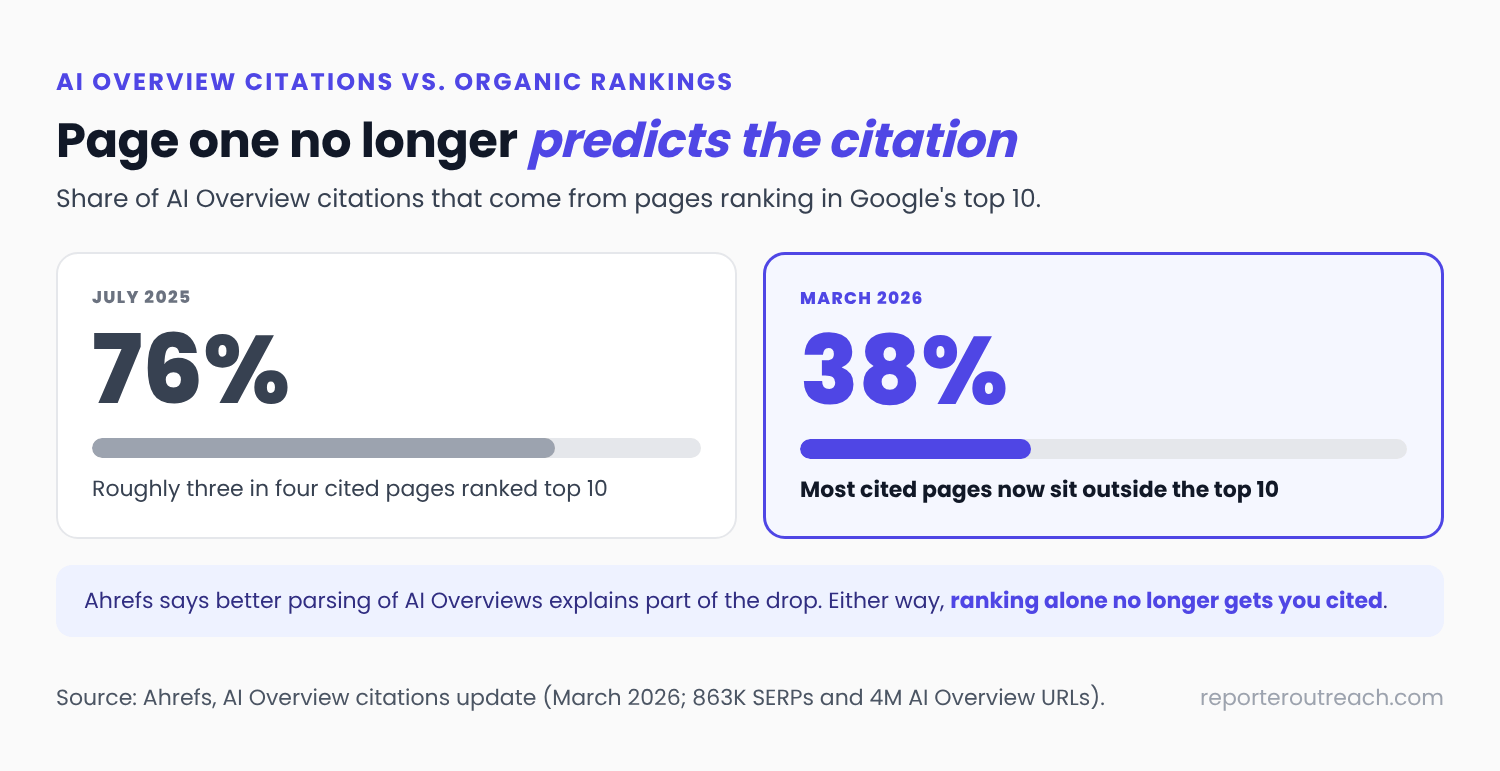
That chart shows why traditional SEO alone won't solve AI visibility. In July 2025, about three in four AI Overview citations came from pages ranking in the top 10. By March 2026, most came from pages outside it (Ahrefs says better parsing explains part of that shift). AI is drawing on sources well beyond the traditional ranking order.
The practical implication: you can rank #1 for your target keyword and still be invisible in AI answers if your brand doesn't have the third-party coverage that AI engines use to evaluate trust.
Each AI Platform Cites Different Sources
One of the more surprising GEO findings: AI answers overlap surprisingly little in which sources they cite, even within the same platform. This isn't like SEO, where Google and Bing broadly agree on who should rank.
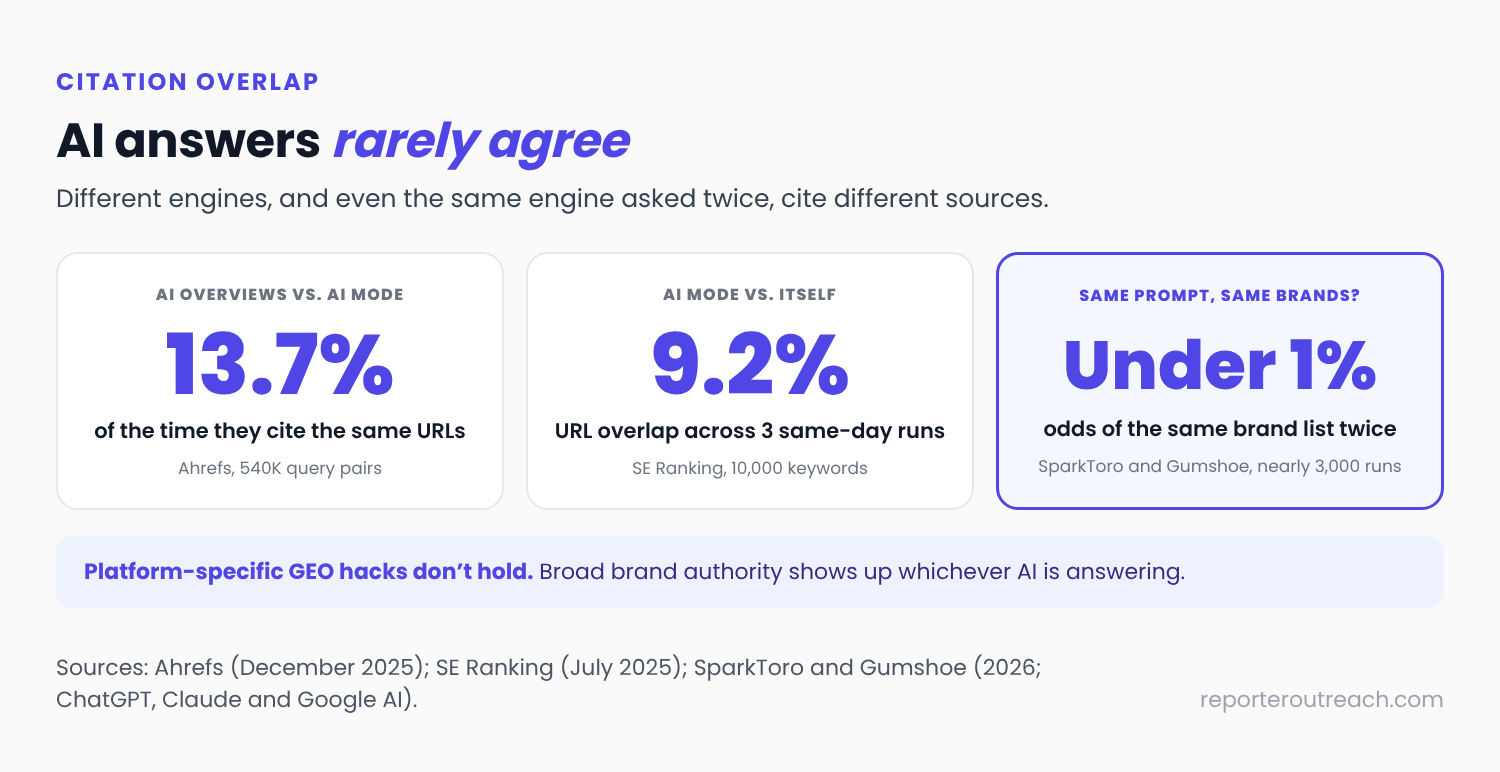
Even Google's own AI products disagree: in Ahrefs' analysis of 540,000 query pairs, AI Mode and AI Overviews cited the same URLs only 13.7% of the time. Answers also shift from run to run. When SE Ranking ran 10,000 keywords through AI Mode three times in one day, the cited URLs overlapped just 9.2%. And in SparkToro's 2026 study with Gumshoe, 600 volunteers ran 12 prompts through ChatGPT, Claude and Google's AI nearly 3,000 times; the odds of getting the same brand list twice were under 1 in 100.
This makes platform-specific "GEO hacks" largely pointless. You can't game a system that doesn't even give consistent results to the same query. What you can do is build the kind of broad brand authority that shows up regardless of which AI is answering, and that comes back to earned media and editorial coverage across a wide range of publications.
Where in Your Content AI Actually Pulls Citations
If there's one on-page finding from GEO research that's genuinely useful (and not just rebranded SEO), it's this: ChatGPT, at least, has a strong bias toward the top of your content.
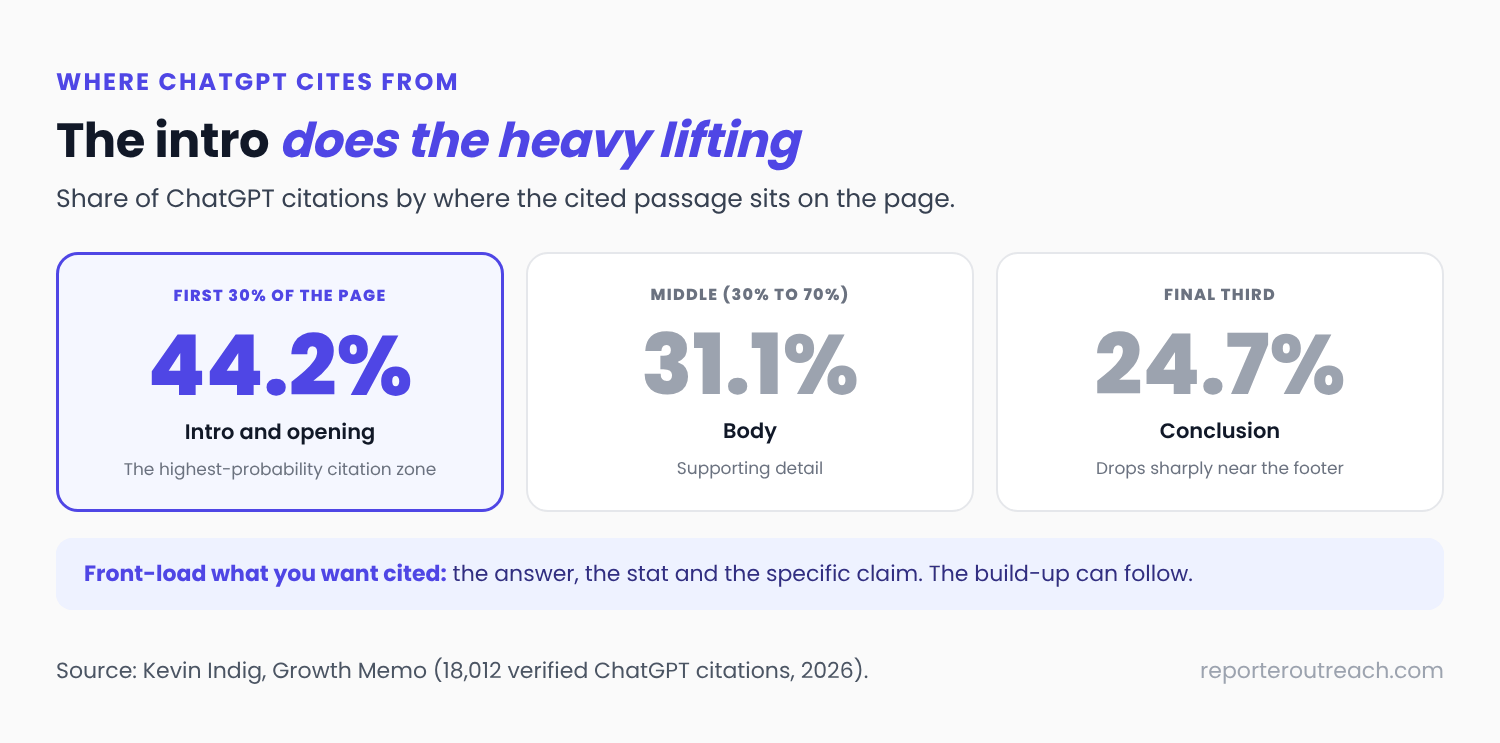
Kevin Indig's Growth Memo analysis of 18,012 verified ChatGPT citations found that 44.2% come from the first 30% of a page's content. The intro matters disproportionately. If your key claims, data points, and brand positioning aren't in the first few hundred words, you're leaving the highest-probability citation zone empty.
This actually is a meaningful GEO insight. Traditional SEO didn't penalize you for burying your best content below a 500-word preamble. AI engines effectively do. Front-load your strongest, most citable content: the answer, the stat, the specific claim. The build-up and context can follow.
A Practical GEO vs SEO Audit
If you want to take GEO seriously, here's what's actually worth doing, separated into the SEO foundations you probably have already and the new work you probably don't.
Check your SEO foundations first (skip if already solid):
- Verify AI crawlers aren't blocked in robots.txt. Since July 2025, Cloudflare blocks AI crawlers by default on new sites, so check your CDN's bot settings too. Look for "OAI-SearchBot" and "ChatGPT-User" in your server logs.
- Confirm you have accurate Article, Organization and Person schema on relevant pages (Google says AI features need no special schema).
- Make sure your top 20 pages have clean H1-H2-H3 hierarchy and short paragraphs.
- Update any cornerstone content older than 3 months with current data.
Now do the actual GEO work:
- Audit your AI visibility. Search your brand name in ChatGPT, Perplexity, and Google AI Mode for your 20 most important queries. Document where you appear, where competitors appear, and where nobody owns the answer. This baseline tells you where you stand.
- Front-load your content. For your highest-priority pages, move your strongest claim, data point, or answer into the first 200 words. That's the zone AI pulls from most heavily.
- Map your earned media coverage. Where has your brand been mentioned editorially in the past 12 months? The gap between your current coverage and your competitors' coverage is your GEO opportunity gap. Analyzing competitor backlink profiles will show you which publications are covering your space.
- Build the authority layer. This is the hard part, and the part that actually moves the needle. A consistent digital PR strategy that earns editorial mentions on trusted publications is the strongest lever for AI visibility. Every mention builds the brand signal that tracks AI citations most closely.
- Track citations, not just rankings. Set up monitoring through Ahrefs Brand Radar ($199/mo per AI engine or $699/mo for all six, on top of an Ahrefs plan), LLMrefs (free account or $79/mo All in One) or the Semrush AI Visibility Toolkit ($99/mo per domain). For a full breakdown by buyer segment, see the best AI visibility tools comparison.
Technical fixes (robots.txt, schema, content restructuring) take effect once AI crawlers re-fetch your pages. Earned media runs on a longer clock: first placements typically land in 2 to 3 weeks, ranking movement and possible AI citations show up in months 3 to 6, and results compound from months 6 to 12. Plan for quick wins early and compounding returns over time.
Mistakes That Waste Your GEO Budget
Treating GEO as a separate discipline from SEO. If you're paying one agency for SEO and another for GEO, you're paying twice for most of the same work. The on-page stuff is the same. The only genuinely new capability you need is the authority-building layer: earned media and digital PR. Our roundup of the best GEO agencies sorts vendors by which of those layers they actually deliver.
Optimizing for one AI platform. Citation patterns are so volatile that platform-specific tactics are essentially gambling. When SE Ranking ran the same 10,000 keywords through AI Mode three times in one day, the cited URLs overlapped just 9.2%. Build broad authority instead of trying to reverse-engineer one platform's behavior.
Ignoring the authority layer. You can have flawless on-page optimization and still be invisible in AI answers if your brand has no third-party coverage. This is the most common failure: brands invest heavily in content restructuring while doing nothing to build the external signals that AI engines actually prioritize.
Giving up at 6 weeks. Earned media takes time to show up: ranking movement and possible AI citations typically appear in months 3 to 6, with compounding gains from months 6 to 12. Brands that quit after a month hand that ground to competitors who keep going. Citation authority compounds the same way domain authority does.
Thinking GEO replaces SEO. It doesn't. AI systems still rely on traditional search infrastructure for content discovery. A strong organic SEO foundation is the base that AI visibility builds on, not something it replaces. Sites with weak technical SEO perform worse at GEO because AI crawlers have the same accessibility requirements as search engine bots. And for specific pages that need to rank in Google, link insertions are the direct route: you choose the page, the anchor and a vetted site with real traffic.
Build the Authority Layer AI Actually Cites
Digital PR earns the editorial coverage and brand mentions that drive AI visibility. See how it works for your brand.
Frequently Asked Questions
Is GEO just SEO with a different name?
Mostly, yes. The on-page tactics (structured headings, schema, FAQs, fresh content, E-E-A-T) have been SEO fundamentals for years. What's genuinely new is the importance of off-site brand signals: AI engines rely heavily on third-party mentions and editorial coverage when deciding which brands to cite, and that emphasis on earned media authority is a real departure from backlink-focused traditional SEO.
Do I need separate GEO and SEO strategies?
No. A solid SEO strategy with one addition, consistent earned media coverage through digital PR, covers both. The foundations are identical. The only capability gap for most teams is the authority-building layer, which requires generating editorial mentions on trusted publications rather than just optimizing owned content.
How does digital PR help with AI visibility?
Every editorial placement creates two things: a backlink that strengthens traditional SEO, and a brand mention, the signal that tracks AI citations most closely. Research from Muck Rack, Stacker and Ahrefs points the same way, and Muck Rack found that 84% of AI citations come from earned media (May 2026). That makes digital PR the strongest lever for AI visibility.
Which AI platforms should I optimize for?
None of them specifically. Citation overlap is so low (Google's AI Overviews and AI Mode cite the same URLs only 13.7% of the time, per Ahrefs) that platform-specific optimization is unreliable. The winning approach is broad brand authority that works across AI systems, which is what consistent editorial coverage provides.
How long does it take to see GEO results?
Technical fixes like unblocking AI crawlers and restructuring content take effect once AI crawlers re-fetch your pages. Earned media takes longer: first placements typically land in 2 to 3 weeks, ranking movement and possible AI citations show up in months 3 to 6, and results compound from months 6 to 12.
Does schema markup work differently for GEO than for SEO?
No. The same schema types (Article, Organization, Person) do the job for both, and Google says plainly: "There's also no special schema.org structured data that you need to add." Accurate markup helps search engines and AI tools understand who you are, but it won't earn citations on its own. The off-site signal, editorial coverage of your brand, is what moves AI visibility.
How should a GEO strategy split owned and earned media?
Treat owned content as the foundation and earned media as the ongoing investment. On-page work (crawler access, structure, schema, front-loaded answers) is mostly a one-time cleanup plus regular refreshes. The recurring budget belongs to earned coverage: 84% of AI citations come from earned media (Muck Rack, May 2026), and only a third-party publication can create that signal.
What's the difference between GEO and AI search optimization?
GEO focuses specifically on getting cited in AI-generated responses. AI search optimization is broader: it also includes defending against AI-driven traffic loss and adapting your overall strategy for changing search behavior. They're different lenses on the same shift. For the tactical side, see our AI search optimization guide.
Sources: Ahrefs, AI Overview brand visibility study (75,000 brands; May 2025) | Ahrefs, brand visibility factors in ChatGPT, AI Mode and AI Overviews (December 2025) | Ahrefs, AI Mode vs. AI Overviews (540,000 query pairs; December 2025) | Ahrefs, AI Overview citations update (March 2026; 863K SERPs and 4M AI Overview URLs) | Muck Rack, Generative Pulse (May 2026; 25M+ links cited by ChatGPT, Claude and Gemini) and What Is AI Reading?, second edition (December 2025) | Stacker and Scrunch, earned distribution study (87 stories, 30 brands, 8 AI platforms; March 2026) | SE Ranking, AI Mode volatility study (10,000 keywords; July 2025) | SparkToro and Gumshoe, AI recommendation consistency study (2026) | Kevin Indig, Growth Memo, ChatGPT citation position analysis (18,012 citations; 2026) | Aggarwal et al., "GEO: Generative Engine Optimization" (Princeton University and co-authors, 2023) | Google Search Central, "AI features and your website" | Cloudflare, AI crawlers blocked by default for new sites (July 2025)