Key Takeaways
- Organic SEO remains the largest single source of website traffic for most businesses — outpacing paid, social, and email combined (BrightEdge channel-share research). It compounds. Paid stops the moment you stop spending.
- Three pillars determine whether a page ranks in 2026: content (relevance and E-E-A-T), technical (speed, crawlability, structure), and authority (backlinks and brand mentions). Miss one and the other two can't compensate.
- Authority is the pillar most businesses neglect. Our campaign data going back to 2017 consistently shows page-1 winners with several times the backlink footprint of competitors stuck on page 2. Content gets you in the game. Authority wins it.
- Authority now drives AI visibility too. The dominant signal AI platforms use to decide which brands to recommend is editorial coverage in trusted publications — not the content you publish on your own site. Digital PR is the only tactic that builds rankings and AI citations at the same time.
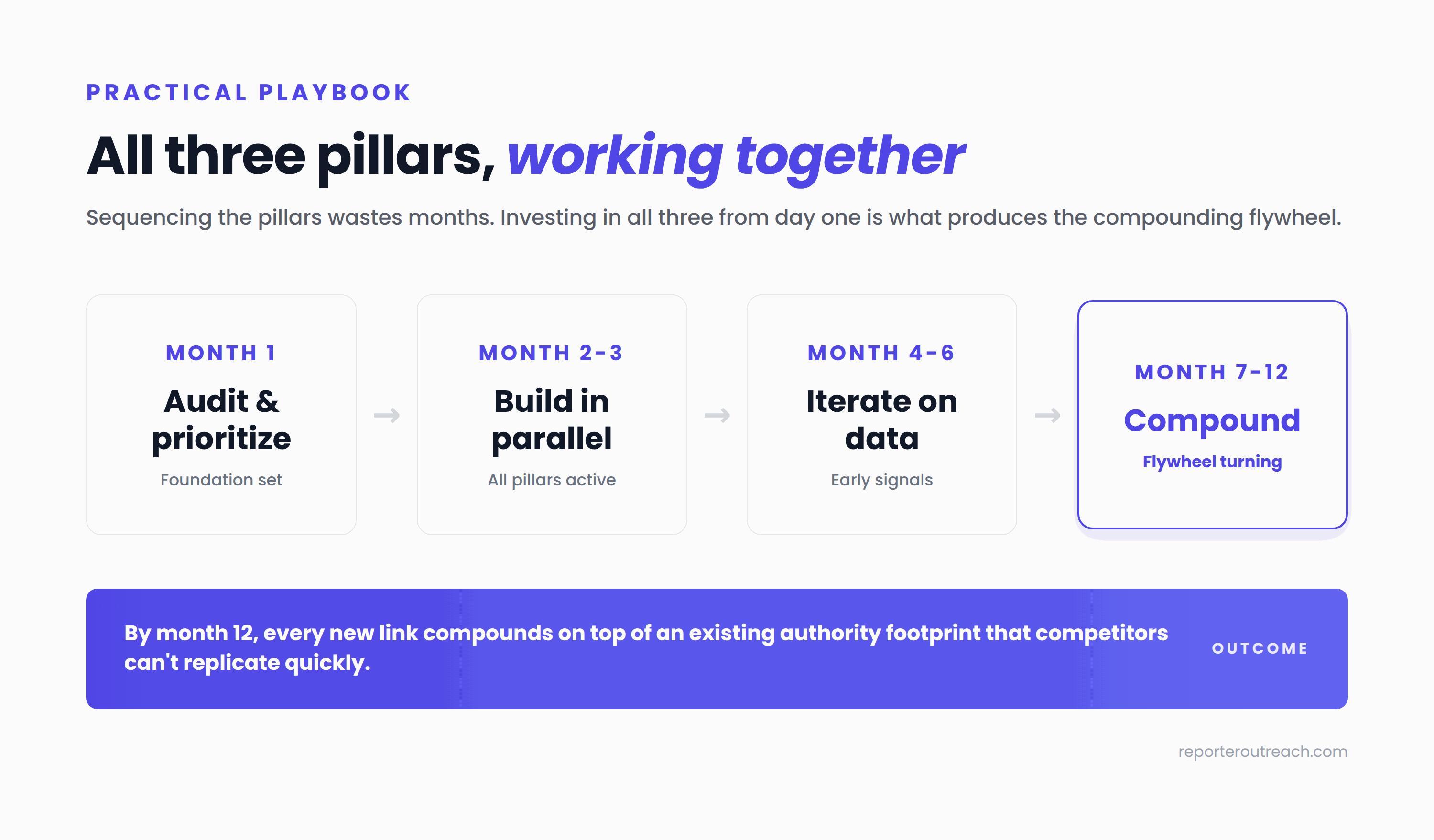
- Timeline is real. Expect 3-4 months for early signals, 4-6 months for measurable growth, and 7-12 months for compounding returns. The businesses that win invest in all three pillars from day one rather than sequencing them.
Organic SEO is how your website earns visibility in search results without paying for each click. You optimize so that Google — and increasingly, AI platforms like ChatGPT, Perplexity, Gemini, and Google AI Overviews — surface your pages when people search for topics you cover.
That definition hasn't changed in 20 years. The bar for organic SEO to actually work has. The average first-page result in 2026 is backed by stronger content, faster infrastructure, and more authoritative links than ever before. And a growing share of searches never reach a traditional results page at all — they get answered by AI systems pulling from a different (but overlapping) set of signals.
This guide breaks down what actually works. Not the textbook version. The version we see producing results across 500+ client campaigns since 2017.
The Three-Pillar Framework
Every page that ranks well succeeds across three dimensions. Content, technical, and authority. Miss any one and the other two can't carry the load.
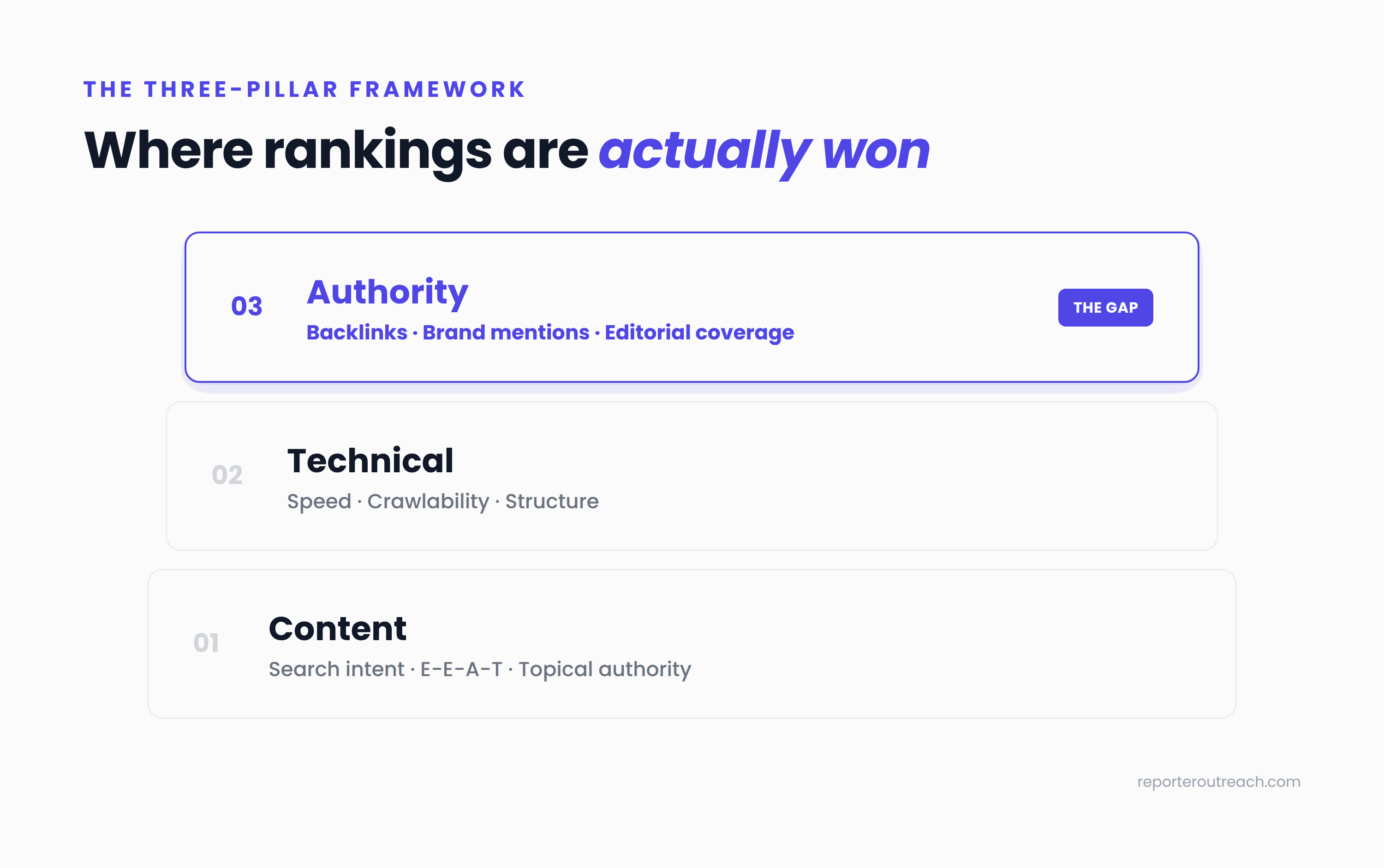
Here's the pattern we see constantly: a business publishes great content on a fast, well-structured site and wonders why they're stuck on page 2. The answer is almost always the same — not enough high-quality backlinks. They've invested in two pillars and skipped the one that actually separates page 1 from page 2.
Each pillar in detail.
Content: Everyone Has It. That's the Problem.
Content used to be the competitive advantage. Write a comprehensive guide, hit your keywords, publish consistently — outrank competitors who weren't trying as hard. That era is over.
In 2026, content is the baseline. Every serious competitor in your space has blog posts, guides, comparison pages, and resource hubs. Many are excellent. The content pillar hasn't become less important — it's become the minimum requirement rather than the edge.
Search intent match (does your page answer the actual question?), E-E-A-T signals (can you demonstrate genuine expertise?), depth without fluff (comprehensive coverage that respects the reader's time), and original value (something the reader can't find on the next 10 results).
Match search intent first. Before writing anything, search your target keyword and study what Google already ranks. If the top results are all comparison guides, publishing a philosophical essay won't rank. If they're all step-by-step tutorials, a high-level overview won't compete. Intent matching is the single most important content decision.
E-E-A-T isn't just for healthcare sites. Experience, Expertise, Authoritativeness, and Trustworthiness matter in every niche. Content backed by real credentials, real data, and first-hand experience outranks generic AI-generated guides — and that gap is widening. Google's helpful content system can detect the difference between someone who has actually done the thing they're writing about and someone who researched it for 20 minutes.
Build topical authority, not isolated posts. A site with 40 interlinked articles on link building signals more authority to Google than one with 40 articles across 40 unrelated topics. Content clusters — a central pillar page linked to supporting subtopic articles — are how you build the kind of topical depth that Google rewards.
The thing nobody wants to hear: you can have the best content on the internet and still lose to a site with good content and better links. Content gets you in the game. It doesn't win it.
Technical SEO: The Foundation Nobody Sees
Technical SEO is plumbing. Nobody notices it when it works. Everyone notices when it breaks.
The short version: if Google can't find, crawl, or render your pages properly, nothing else matters. A technically broken site wastes every dollar you spend on content and links.
Core Web Vitals still matter. Google measures page experience through three metrics: Largest Contentful Paint (under 2.5 seconds), Interaction to Next Paint (under 200ms), and Cumulative Layout Shift (under 0.1). Pages that pass these thresholds have a measurable ranking advantage, particularly on mobile. Use PageSpeed Insights to find what's slowing you down.
Structured data is underused. Schema markup helps Google understand the context of your content and enables rich snippets — FAQ dropdowns, review stars, how-to steps. It doesn't directly boost rankings, but it increases click-through rates significantly. And in 2026, structured data also helps AI systems parse your content more accurately, which matters for AI Overviews and citation.
Site architecture is strategy. Important pages should be within three clicks of the homepage. Strong internal linking distributes authority and tells Google which pages matter most. A flat, logical structure with clean URL hierarchy outperforms a sprawling site where pages are buried five levels deep.
The honest truth about technical SEO: most businesses with a modern CMS and decent hosting have the basics covered. Technical audits are worth running quarterly (we use Screaming Frog), but for most sites, technical SEO isn't where rankings are won or lost. That distinction belongs to the third pillar.
Authority: Where Rankings Are Actually Won
This is the uncomfortable part.
Authority — measured primarily through backlinks and brand mentions — is the external validation that tells Google your content deserves to rank. And it's the pillar that most businesses chronically underinvest in, for understandable reasons: building real authority is slow, expensive, and hard to scale compared to publishing another blog post.
The data doesn't care about what's convenient.

Across 500+ Reporter Outreach campaigns since 2017, top-ranking pages consistently carry 3-4x more referring domains than pages stuck on positions 2-10. Not a marginal difference. And in 2026, the value of those links has expanded — named editorial mentions from authoritative publications now drive the AI citation signals that didn't exist five years ago.
Here's what actually works, ranked by impact:
- Digital PR is the highest-impact method. You earn backlinks by getting cited as an expert source in real publications — not by writing a guest post nobody reads. The links carry high domain authority (DR 50-90+), and the journalist-validated brand mentions they generate are the signal AI systems weight most heavily. The only tactic that builds traditional and AI visibility at once. Our complete digital PR guide covers the mechanics.
- Link insertions place your link into existing, relevant articles on authoritative sites. Faster and more cost-effective than most alternatives, with strong authority when sourced carefully.
- Linkable content assets — original data studies, comprehensive tools, interactive resources — attract backlinks naturally. The most sustainable approach, and the least predictable. You can't guarantee that publishing something great will earn links on a timeline.
- Competitor backlink replication analyzes where your competitors earn links and pursues the same publications with better expertise. Smart, but it only gets you to parity — not ahead.
Across 500+ campaigns since 2017, the clients who see the fastest ranking improvements are the ones who start building authority from month one — not the ones who wait until their content is "ready." Authority compounds. Every month you delay is a month of compound growth you don't get back.
The Practical Playbook: Growing Organic Traffic
Theory is great. Here's the actual sequence we'd recommend if you were starting today.
- Month 1 — Audit and prioritize. Run a technical audit (Google Search Console + Screaming Frog). Fix anything preventing proper crawling and indexing. Build a keyword list using Ahrefs or Semrush — prioritize terms where your domain authority makes ranking realistic. Long-tail keywords first; they're easier to win and often convert better than head terms.
- Month 1-2 — Start content and authority simultaneously. Don't fall into the trap of "we'll build links once we have content." Create your highest-priority pages while initiating authority building in parallel. Content without authority sits on page 2. Authority to a thin site wastes link equity. They need to grow together.
- Month 3-6 — Iterate based on data. Track rankings in Google Search Console. Identify "striking distance" keywords — positions 11-20 where a small push could move you to page 1. These are your highest-ROI opportunities: add internal links, update the content, or point a few quality links at those pages. For a framework on measuring what your link building investment is actually producing, see our link building ROI guide.
- Month 6+ — Compound. This is where the math gets interesting. Pages that have been building authority for six months start climbing faster because each new link compounds on top of existing ones. Content you published in month 2 starts ranking for keywords you didn't even target. Your domain authority rises, making future content easier to rank. The flywheel — and it's why organic SEO is worth the patience.
Local SEO note: If you serve specific geographic areas, local optimization (Google Business Profile, local citations, location-specific keywords, reviews) can produce results faster than national SEO because competition is thinner and intent is highly specific.
Organic SEO vs. Paid Search
These aren't competitors. They serve different purposes. Understanding the tradeoffs helps you allocate budget without wasting money.
The smartest approach: use paid search for immediate visibility while organic SEO builds momentum. Data from paid campaigns — which keywords actually convert, which messages resonate — directly informs your organic strategy. As rankings grow, gradually shift budget away from keywords where you already rank well organically.
Many businesses start with paid ads to generate leads while their organic efforts compound. Then the math tips: the organic channel starts producing more volume at lower cost-per-acquisition, and paid spend shifts to defending high-value terms and testing new ones.
AI Search Changes the Equation
The biggest shift in SEO right now isn't an algorithm update. It's that a growing share of searches are being answered by AI systems instead of traditional results pages.
Google AI Overviews now appear in a meaningful and growing share of search results. Standalone AI tools — ChatGPT, Perplexity, and Gemini — handle an increasing share of informational searches. These platforms decide which brands to cite based on signals that overlap heavily — but not completely — with traditional SEO.
The good news: if you're already doing organic SEO well, you have a foundation for AI visibility. The overlap is substantial.
The important nuance: editorial citations are the strongest signal for AI recommendation. Not just backlinks — named mentions from authoritative publications, journalists, and industry sources. Muck Rack's Generative Pulse analysis (May 2026) measured AI citations across ChatGPT, Perplexity, Gemini, and Google AI Overviews and found 84% came from earned editorial coverage — not brand-owned content, not paid placements. This is why digital PR has become the highest-value SEO investment in 2026. The only tactic that simultaneously improves rankings in traditional results and increases the probability that AI systems cite your brand.
For the complete playbook, see our AI search optimization guide.
What All Three Pillars Look Like Working Together
Theory is useful. Results are better. Here's what happens when content, technical, and authority all get the investment they need.
MEDvidi — Online Mental Health Care
An online telehealth platform competing in one of Google's most scrutinized YMYL categories. Strong clinical team, clean technical foundation — but the rankings wouldn't move without external validation Google could trust. A digital PR campaign earned editorial backlinks and named mentions from health publications including Healthline, Verywell Mind, and PsychCentral, providing the trust signals Google requires in healthcare. The placements delivered both link equity and brand validation that moved rankings in a space where content alone wasn't enough.
83 placements and mentions averaging DR 81 over 12 months. See more case studies.
FAQ
What is organic SEO?
It's the practice of earning unpaid search visibility through content quality, technical soundness, and external authority signals like backlinks and brand mentions. Unlike paid advertising, organic rankings compound over time — a page that ranks today can drive traffic for years without per-click costs.
How long until I see results?
Early ranking signals typically appear around months 3-4, with measurable traffic growth between months 4-6. The strongest gains happen in months 7-12 as all three pillars compound together. The timeline depends on your current domain authority, how competitive your keywords are, and whether you're investing in all three pillars simultaneously or just content.
What's the single most important ranking factor?
There isn't one — Google uses hundreds of signals. But if forced to prioritize: search intent match gets you into the conversation, links from authoritative sites determine where you rank within it, and page experience (speed, mobile usability) can make or break everything else. For AI visibility specifically, named editorial mentions are the strongest predictor.
How much should I budget for organic SEO?
Content creation and technical SEO typically run $1,000-$5,000 per month whether handled in-house or through an agency. Authority building through digital PR ranges from $3,000-$12,000 per month depending on volume and publication targets. The investment is front-loaded — once pages rank well, maintenance costs drop while traffic continues to grow.
Is organic SEO still worth it now that AI search is growing?
More than ever. The signals driving AI citation — quality content, backlinks, editorial citations, demonstrated expertise — are the same signals that drive organic rankings. Investing in SEO builds visibility across both surfaces simultaneously. The brands AI systems cite most frequently are the ones with the strongest organic presence and editorial footprint.
Why isn't my great content ranking?
Almost certainly authority. Your competitors have great content too — backlinks are how Google differentiates between multiple quality pages on the same topic. If your content matches intent, your technical foundation is clean, and you're still stuck on page 2, the gap is almost always insufficient links from authoritative sites. That's the pillar to invest in next.
Content and technical get you in the game.
Authority wins it.
We build the authority pillar through editorial links from real publications — the kind that move rankings and get your brand cited by AI.
Sources: BrightEdge channel-share research (organic search traffic share); Muck Rack Generative Pulse, "What Is AI Reading?" (May 2026, 25M+ links); Reporter Outreach campaign data, 500+ campaigns since 2017 (referring domain patterns by ranking position).