
Key Takeaways
- Link building ROI is harder to measure than PPC because returns are delayed, attribution is messy, and value compounds — the returns keep arriving long after spend stops.
- The formula is simple: (Revenue from organic growth − Campaign cost) ÷ Campaign cost × 100. The hard part is accurate attribution and a realistic timeline.
- First Page Sage's 2026 ROI study puts the median SEO ROI at 748% — about $7.48 returned for every $1 spent — with break-even averaging 7–9 months across industries.
- The cost gap shows up earliest at lead generation: HubSpot benchmarks SEO at $31 per lead vs PPC at $181 — a 5.8× cost multiplier that compounds every month organic carries the load.
- A link earned in month 1 is still passing authority in month 24. PPC traffic stops the day you stop paying. The gap widens every year.
"Is link building worth it?" is really a question about link building ROI. And the answer depends entirely on whether you're measuring it correctly.
Most businesses get this wrong in one of two ways. Either they don't track it at all — backlinks become a vague line item under "SEO" — or they measure it on a PPC timeline, expecting week-one returns from an investment designed to compound over months.
This guide walks through how to calculate link building ROI before you spend a dollar, how to track it while a campaign runs, what the industry benchmarks actually say, and where the math breaks down. Grounded in third-party data — HubSpot, First Page Sage, the latest 2026 reports — not hypothetical scenarios.
Why Link Building ROI Is Hard to Measure (And Why Most Get It Wrong)
Three things make this harder than measuring PPC or email.
The returns are delayed. A link earned today doesn't move rankings tomorrow. It takes 2–6 months for link building to produce measurable results, and First Page Sage's 2026 industry benchmarks put the average break-even point at 7–9 months. Evaluate at month 2 and you'll conclude the ROI is negative — even though the compounding payoff hasn't started.
Attribution is messy. Organic growth comes from content, technical SEO, backlinks, and brand signals working together. Isolating the specific contribution of one campaign means establishing a clean baseline before the work starts and tracking the delta against it. Search Console and GA4 help. Perfect attribution is impossible.
The value compounds. Unlike paid ads — where $1 in produces $X out and stops the moment you stop paying — a link earned in month 1 is still passing authority in month 24. Standard ROI math doesn't capture this, which is why most companies dramatically undervalue the returns on work they've already done.
Evaluating link building on the same timeline as PPC. $5,000 on Google Ads produces measurable ROI within days. The same $5,000 on outreach produces measurable ROI six to nine months out. Comparing them at month 1 is like comparing a savings account to a slot machine. Different instruments, different timelines, different return profiles.
The Link Building ROI Formula With Real Numbers
Calculating returns before investing requires three inputs: the revenue potential of ranking, the realistic cost to build the equity needed, and a defensible timeline for when it matures.
ROI = (Revenue from organic growth − Campaign cost) ÷ Campaign cost × 100
Three inputs to estimate before you commit budget:
- Revenue potential. Search volume × estimated CTR at target position × your conversion rate × average customer value.
- Campaign cost. All-in: agency fees, content production, internal time, tooling.
- Timeline. Most campaigns break even in months 7–9 (First Page Sage 2026). Highly competitive verticals push to month 12.
Run the formula with aggressive discounting: halve the conversion rate you assume, target position 5 instead of position 3, add 50% to costs. Most commercial keywords with clear buyer intent still produce positive first-year returns. If yours doesn't, either the keyword lacks commercial value or the competitive gap is too wide for your budget to close.
Pick the link building method that matches the gap. Digital PR earns top-tier editorial placements at higher per-link cost but comes with brand and AI visibility upside. Link insertions on relevant mid-authority sites cost less per placement and work for filling specific topical gaps. The right method is the one that closes your specific ranking gap at defensible cost — not the one with the lowest sticker price.
Industry ROI Benchmarks (And Why They Span So Wide)
The headline number every CFO wants is the median. First Page Sage's 2026 SEO ROI report — based on proprietary data from campaigns running Q1 2021 through Q3 2025 — puts that figure at 748%. About $7.48 returned for every $1 spent.
That's the median. The range is wider than the headline suggests. E-commerce campaigns sit at the low end around 317% — still strong, but pressured by thinner margins and higher competitive intensity. Real estate sits at the high end at 1,389%, driven by transaction values that make a single closed deal pay for years of organic investment. B2B SaaS lands around 702% with break-even closer to 7 months.
Three things explain the variance: average transaction value, sales cycle length, and customer lifetime value. Industries where one conversion is worth $5,000+ produce dramatically higher ROI from the same organic traffic than industries where the average order is $35. Knowing where your vertical sits matters before setting expectations.
The cost gap shows up clearest at the front of the funnel:

HubSpot's 2025 CPL/CAC benchmarks put SEO leads at $31 each. PPC at $181. That's a 5.8× cost multiplier that compounds with volume — a $50,000 monthly budget allocated to PPC generates roughly 276 leads, while the same budget pointed at organic generates over 1,600 once content is ranking.
The lead-quality gap is even sharper. SEO leads close at 14.6% versus 1.7% for outbound (HubSpot), reflecting the difference between someone actively searching for your solution and someone interrupted by an ad. Higher volume at lower cost with better conversion isn't marginal. It's structural.
For named campaign breakdowns by vertical, our client case studies walk through month-by-month results across healthcare, SaaS, eCommerce, and food/recipe content.
Why Links Compound And Ads Don't
This is the most misunderstood part of link building economics. The compounding argument lives in one chart:
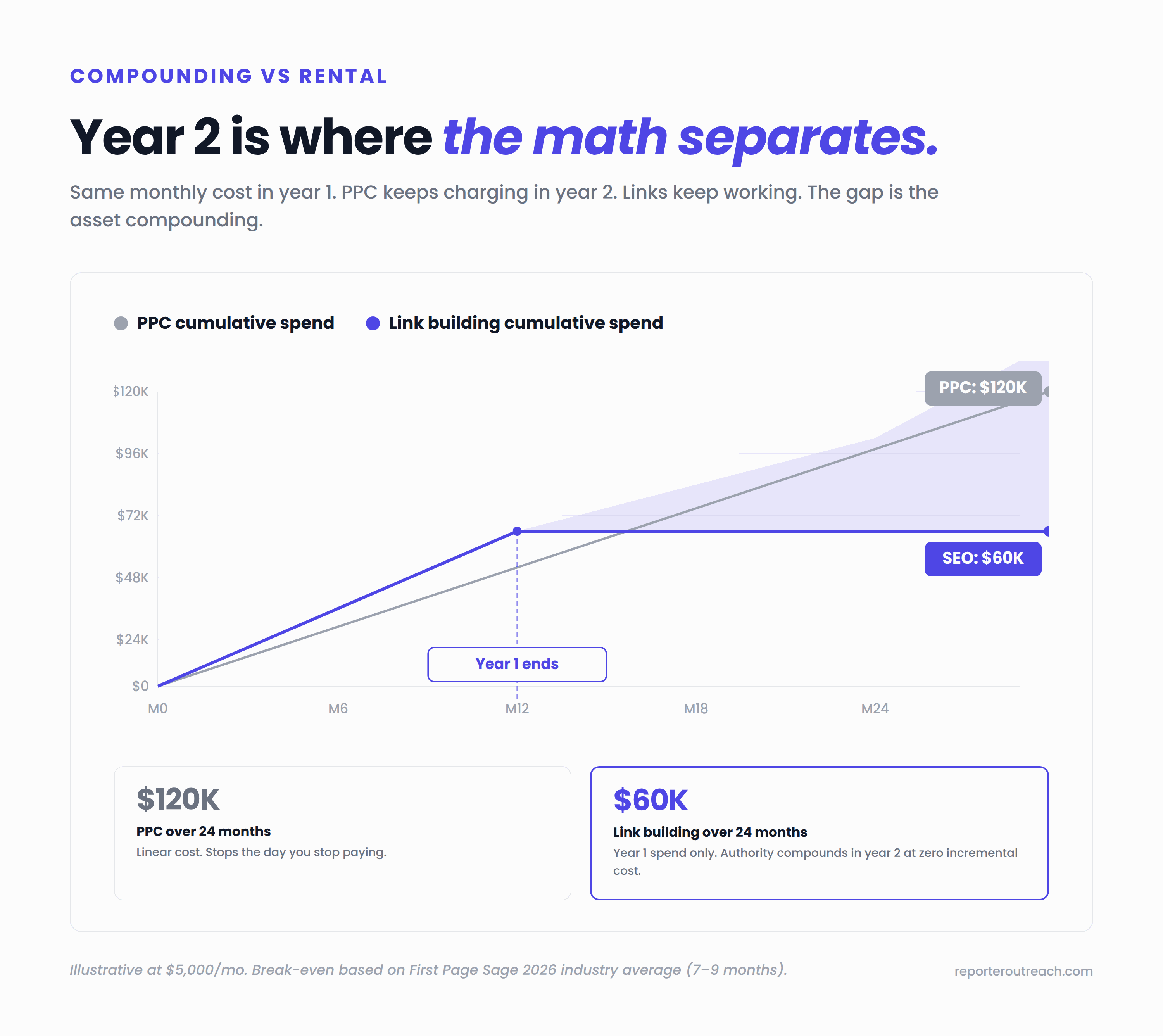
PPC is a rental. You pay monthly for traffic that disappears the second you stop paying. Link building is equity — you're buying an authority asset that appreciates.
Month 13's organic traffic costs nothing because the links from months 1–12 are still doing the work. Meanwhile, your competitor's PPC bill keeps going up. CPCs inflate every year — healthcare and legal keywords routinely hit $25–$100+ per click. The longer the time horizon, the wider the gap.
Traditional ROI math captures Google rankings only. Editorial mentions and high-authority links also drive AI search citations — and First Page Sage's 2026 data shows AI Overviews now appear in 31% of search results, fundamentally changing what "ranking" delivers. Brand mentions on publications cited by ChatGPT, Perplexity, Gemini, and Google AI Overviews are real returns most companies aren't tracking yet. The actual ROI on a digital PR campaign today is meaningfully higher than the reported number — because the report is missing a channel.
This compounding effect is the single biggest reason organic search investment makes financial sense over multi-year horizons. Our 2026 State of Link Building survey found most SEOs are increasing link building budgets year-over-year for exactly this reason — when the math is run honestly across years 2 and 3, the case becomes hard to argue against.
How to Track Link Building ROI While a Campaign Runs
You don't have to wait 9 months to know if the work is performing. The trajectory is visible in three tiers:
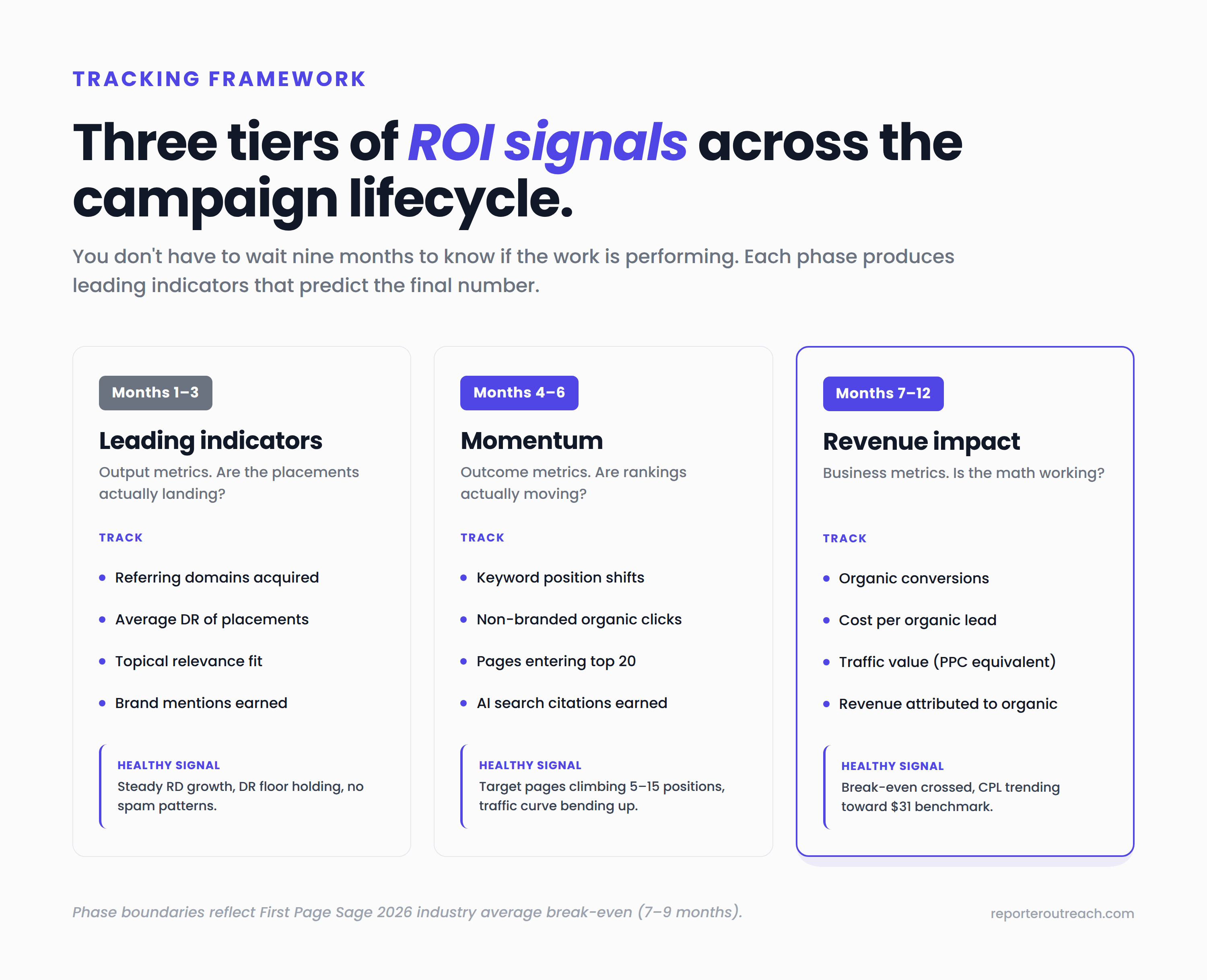
Set up the tracking infrastructure before the campaign starts. If you don't capture a clean baseline — referring domains, keyword positions, traffic volume, conversion rate from organic — you can't calculate ROI afterward. You can only guess at it.
Most of the campaigns that get labeled "inconclusive" at month 9 weren't actually inconclusive. The team just didn't set up tracking properly in month 0.
One piece of the framework worth flagging specifically: track non-branded organic clicks separately from branded ones. Branded growth often reflects awareness from PR mentions independent of rankings — useful, but it's not what your ranking-driven ROI looks like in isolation.
What ROI Looks Like Across Investment Levels
Here's how the math plays out at three common investment levels, using actual Reporter Outreach package tiers and assuming competitive B2B verticals.
| Variable | Starter | Growth | Elite |
|---|---|---|---|
| Monthly investment | $3,000 | $6,000 | $12,000 |
| 12-month total | $36,000 | $72,000 | $144,000 |
| Cadence | Reactive | Reactive + proactive | Sustained editorial |
| First placements | 2–3 weeks | 2–3 weeks | 2–3 weeks |
| Break-even | ~9 months | ~7 months | ~6 months |
| Year 1 ROI | ~50–150% | ~150–300% | ~300–500% |
| Year 2 ROI (no new spend) | ~250%+ | ~500%+ | ~750%+ |
Three things are constant across all tiers: publication caliber (Tier 1 publications regardless of engagement scale), first placements (2–3 weeks), and the underlying compounding curve. What scales with investment is volume and cadence — Starter runs reactive PR, Growth layers in proactive pitching, Elite sustains editorial cadence with AI visibility focus.
The bottom row is the one that matters. Even if you stopped investing after year 1, the traffic from those links keeps flowing. Year 2's revenue numerator is roughly the same. But the cost denominator doesn't grow. ROI effectively doubles without any new work.
This is the part that rarely makes it into stakeholder decks. If you're presenting a campaign proposal internally, project the year 2 and year 3 curves explicitly. Anyone modeling it as a single-year expense is missing the entire point.
When Link Building Isn't Worth It
Honest answer: sometimes it isn't. Four scenarios where the ROI math breaks down.
When your content isn't ready. Links amplify good pages. They don't save bad ones. If your target pages aren't comprehensive, well-optimized, and aligned with search intent, building links to them produces low or negative ROI. Fix the pages first. Then invest in authority.
When your keywords have no commercial value. Ranking #1 for queries that don't convert produces traffic, not revenue. ROI depends on pointing equity at pages with business impact — not every blog post you've ever published. Prioritize service pages and commercial-intent content.
When your budget can't match the competitive bar. If competitors have 500+ referring domains and you can afford 5 links per month, closing the gap might take 3+ years. In hyper-competitive verticals with insufficient budget, start with longer-tail terms where the gap is reachable — or use PPC to buy time while you build authority gradually.
When you're buying cheap, spammy links. $1,000 a month on PBN networks or directory placements isn't link building. Google's SpamBrain devalues these automatically, and at worst they trigger manual actions. Save until you can afford quality placements rather than spend on tactics that produce nothing.
We turn away prospects in these situations. Not because we can't execute — because the ROI won't justify the spend, and we'd rather they wait six months and invest properly than pay now for a weak result.
Link Building ROI FAQ
What's a good ROI for link building?
First Page Sage's 2026 industry data puts the median SEO ROI at 748% — roughly $7.48 back for every $1 spent — with industry-specific ranges from 317% (e-commerce) to 1,389% (real estate). The number that matters most for stakeholder decks is year 2: with no new spend, traffic continues flowing, so the same revenue divides by a smaller cost base — and ROI effectively doubles. A campaign that looks break-even in year 1 usually looks strong by year 2.
How long until I see positive returns?
Industry break-even averages 7–9 months. Lower-competition keywords with strong placements can break even in month 5 or 6. Highly competitive verticals may take 10–12 months. If you're not seeing leading indicators by month 3 — growing referring domains, positions shifting, organic impressions climbing — something's wrong with execution, not patience.
Is link building worth it for small businesses?
Often more so than for enterprise. Smaller competitive bars mean fewer links to rank. A local dental practice might dominate with 15 quality placements; a national SaaS company might need 100+ (our dental SEO guide walks through the small-practice version of that math). Per-dollar returns tend to be higher in less saturated markets, which is why HubSpot's CPL benchmarks ($31 SEO vs $181 PPC) skew so favorably for small businesses paying down per-lead acquisition costs.
Should I prioritize content or links first?
Content. Links amplify what's there — they don't manufacture value that doesn't exist. Get your priority pages optimized, comprehensive, and conversion-ready before pointing authority at them. The pages that benefit most from link investment are the ones already converting visitors well; the bottleneck is just visibility.
How do I present link building ROI to stakeholders?
Lead with traffic value. The translation is immediate: "this is what the traffic would cost us in paid ads at current CPCs." Show baseline-to-current organic traffic alongside PPC-equivalent cost. Then layer in the compounding curve — that traffic keeps flowing whether you keep spending or not. CFOs respond to the asset framing. Annual expense ≠ annual value when the asset appreciates.
What should I keep in-house vs. outsource?
Content in-house. Link acquisition outsourced. Product knowledge and editorial judgment live with you. Specialist relationships, outreach scale, and journalist access live with agencies. The hybrid model produces the strongest ROI because each side is doing what it's structurally best at.
See what the ROI looks like for your business
We'll run a competitor backlink gap analysis and project the return on a digital PR campaign for your specific keywords and vertical. No obligation.
Sources & References
- First Page Sage — SEO ROI Statistics 2026 (proprietary data, Q1 2021 – Q3 2025 campaigns)
- HubSpot — 2025 CPL and CAC Benchmarks (cost per lead by channel; SEO vs outbound close rates)
- Reporter Outreach — 2026 State of Link Building Survey
- Reporter Outreach — Client Case Studies (named campaign breakdowns by vertical)
- WordStream — Annual Google Ads CPC Benchmarks (healthcare and legal vertical CPC data)