Key Takeaways
- Most campaigns produce measurable ranking movement in 3 to 6 months. First placements land in 2 to 3 weeks regardless of engagement scale. Compounding traffic growth follows over the next 6 to 12 months.
- Across four Reporter Outreach campaigns, timelines ranged from six months (Qooper) to twelve months (MEDvidi). The fastest results came in verticals where the client already had solid on-page SEO and a working baseline of authority.
- Starting authority is the single biggest speed factor. A DR 30 site with 200 existing referring domains moves faster than a DR 10 site with 15. Links amplify trust that's already there.
- YMYL verticals (healthcare, finance, legal) take longer regardless of link quality. Google holds these spaces to a higher E-E-A-T bar, so the same inputs produce slower output.
- The most common mistake is stopping at month three. Compounding accelerates in months four to six — cutting the campaign before that means paying for the foundation and never building the house.
"How long does link building take?" is the first question almost every prospect asks. The honest answer is: it depends. But "it depends" isn't useful — so this article breaks down the actual timelines from five Reporter Outreach campaigns, what drove the differences, and what to expect month by month.
Nothing below is theoretical. Every timeline comes from campaigns with verifiable results in the Reporter Outreach case studies. If you're deciding whether to commit three months or six, or wondering why your current campaign isn't producing what you hoped, this is the context you need before signing the next contract.
How Long Does Link Building Take? The Short Answer Is Three to Six Months
Most sites see measurable ranking improvements within three to six months of consistent link building. Long-tail keywords can move in four to twelve weeks. Head terms in competitive verticals take longer — often nine to twelve months before stable page-one placements.
Here's the general progression:
| Phase | Timeline | What happens |
|---|---|---|
| First placements | 2–3 weeks | Initial editorial links go live. Search engines discover and index them. |
| Early movement | 6–12 weeks | Mid-competition keywords shift. Long-tail terms reach page one. |
| Measurable traffic growth | 3–6 months | Primary keywords move to page 1–2. Referring domain count climbs visibly. |
| Compounding growth | 6–12 months | High-difficulty keywords reach page one. Domain rating rises. |
| Authority established | 12+ months | New content ranks faster. Passive link acquisition starts. |
The critical detail most people miss: link building results compound. A link earned in month one keeps passing authority for years. Each new link builds on the foundation the last one laid, which is why six-month engagements consistently outperform three-month ones by wider margins than the time difference alone would suggest.
That compounding is also why links remain valuable enough for agencies to charge for them. A Backlinko study analyzing 912 million blog posts found that 94% of online content earns zero backlinks, and only 2.2% receive links from more than one site. Earning real editorial links is rare — and that rarity is what makes them move rankings.
Real Timelines: Four Campaigns Across Verticals
Each campaign below used digital PR — positioning clients as expert sources for journalists already writing relevant stories. Results pulled from live tracking, not projections.
Here's how the timeline progressed across four Reporter Outreach campaigns in different verticals:
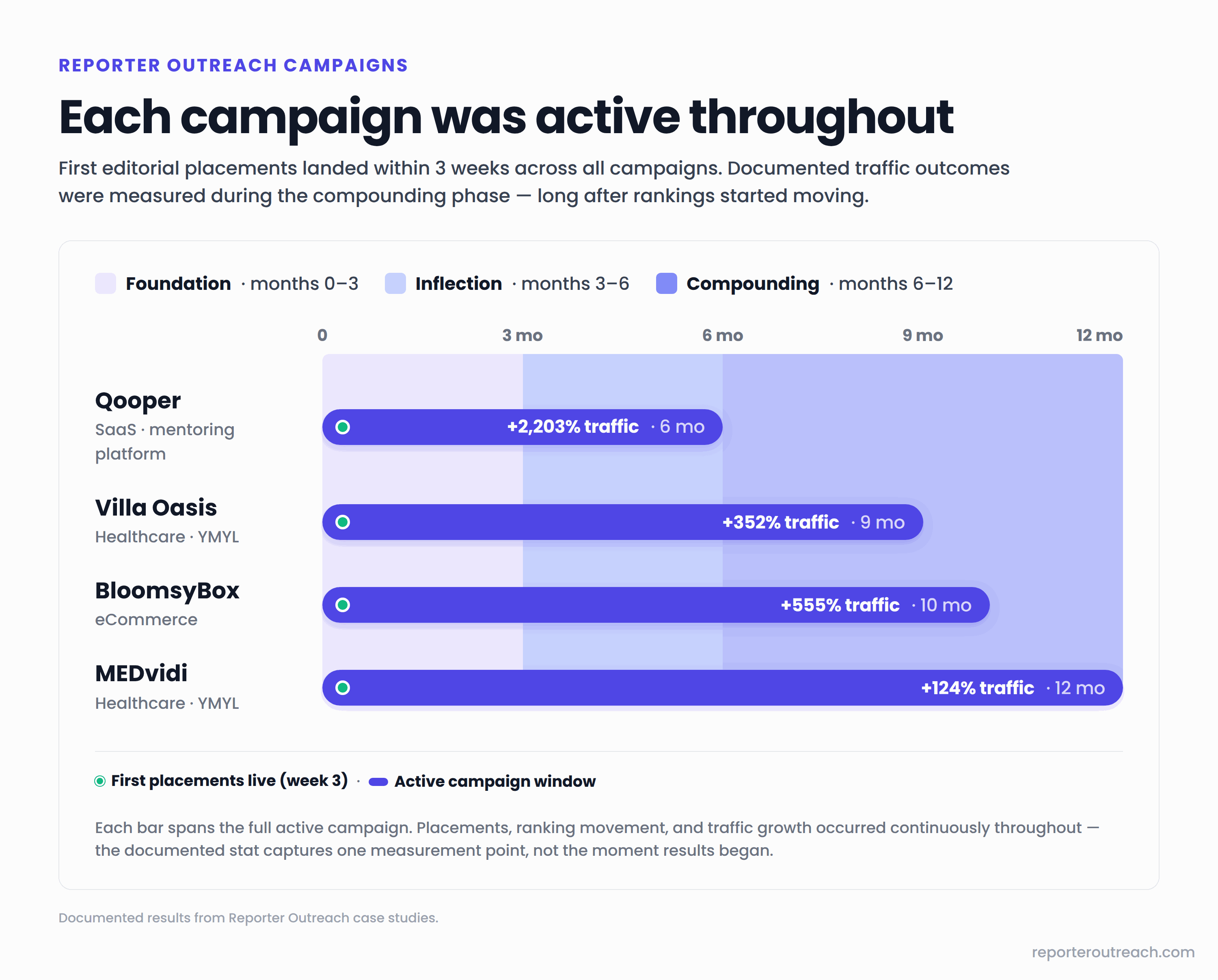
Qooper — SaaS mentoring platform
Qooper had a deep content library but almost no organic traffic. The pages existed. Google just didn't trust the domain enough to promote them. Six months of editorial placements in DR 75+ publications gave the domain the authority signal it needed, and traffic compounded fast. Pages stranded on page three or four climbed into the top five — sometimes within the same month a major placement landed.
Why it was fast: content was already strong. On-page SEO was sound. Authority was the missing piece, not a rescue operation. Full Qooper case study →
BloomsyBox — eCommerce
BloomsyBox was competing against national retailers with a decade of accumulated authority. Lifestyle and gift placements built credibility slowly for the first six months. The accumulated weight crossed a threshold around month seven, and high-value commerce keywords started moving together rather than one at a time.
Why it took longer: the competitive field was brutal. Competing against DR 80+ retailers with thousands of referring domains required more weight before anything moved. Full BloomsyBox case study →
The healthcare pattern: MEDvidi and Villa Oasis
MEDvidi (online telehealth, +124% over twelve months) and Villa Oasis (luxury addiction treatment, +352% over nine months) both ran in classic YMYL territory. The links were the same quality as campaigns in non-YMYL verticals. The outreach followed the same process. But Google applies a heightened E-E-A-T bar to anything that touches physical or mental health, and that shows up as slower rankings response even when inputs look identical. Full MEDvidi case study →
Healthcare, finance, and legal verticals are evaluated against a higher E-E-A-T bar. The same link quality that produces six-month results in SaaS often takes nine to twelve months in YMYL — not because the links are weaker, but because Google holds those rankings to a stricter trust threshold. Plan campaign length accordingly. A nine-month YMYL engagement frequently outperforms a six-month one by a wider margin than the math would suggest.
Seven Factors That Affect Your Link Building Timeline
Every campaign is different, but the variation isn't random. These seven factors explain most of the difference between a six-month timeline and a twelve-month one — listed in rough order of impact.
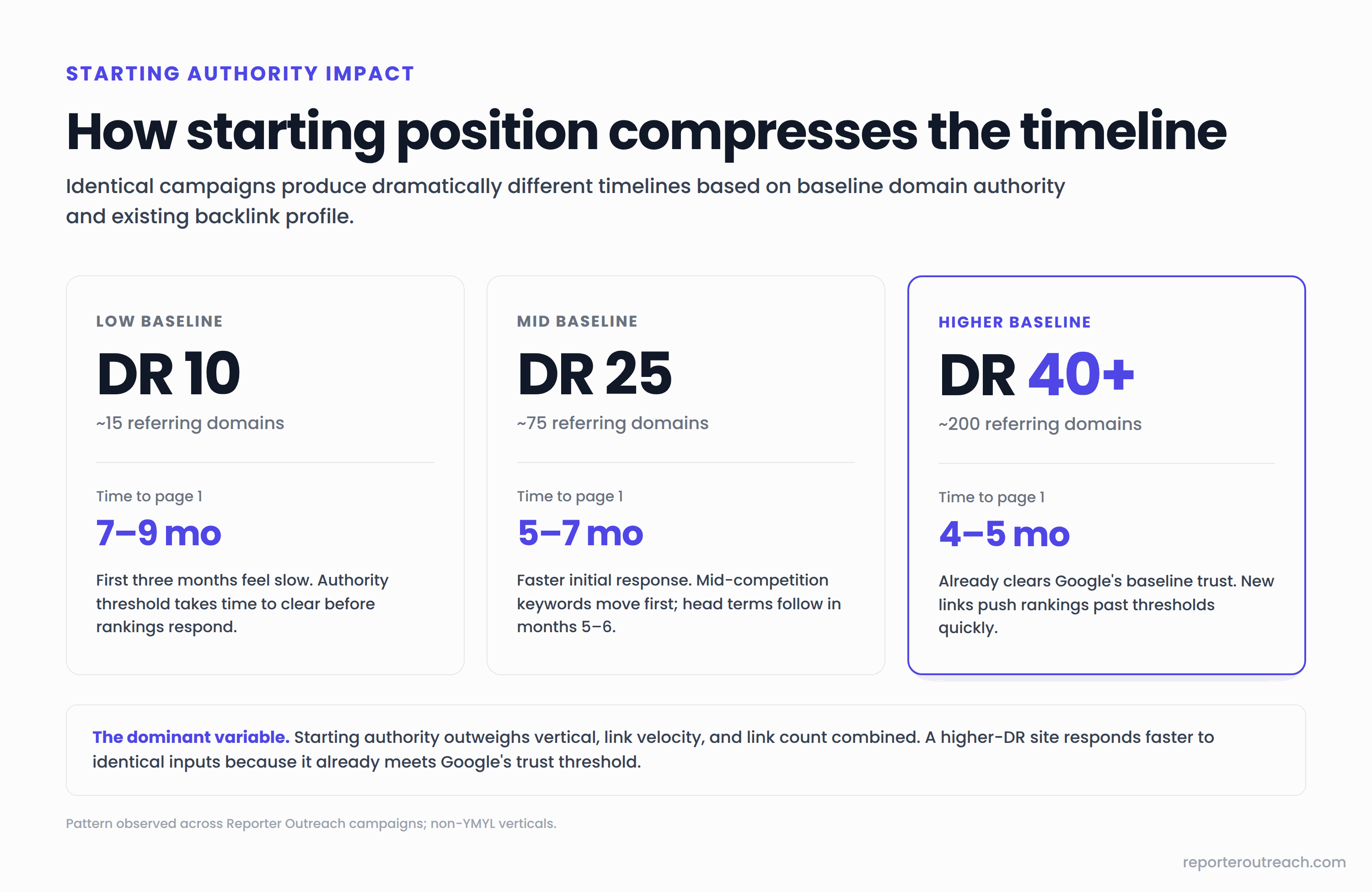
- Starting domain authority and backlink profile. The single biggest variable. A DR 40 site with 200 existing referring domains responds faster than a DR 10 site with 15 — even to an identical campaign with identical link quality. The higher-authority site already clears Google's baseline trust bar, so new links push it past ranking thresholds faster. Starting near zero means the first three months will feel slow — that's runway being built before the plane can take off.
- Content quality and on-page SEO. Links amplify pages. They can't rescue them. Qooper's six-month timeline only happened because the content was already well-written and properly structured. If your target pages have thin content, weak on-page optimization, or poor internal linking, no amount of link building fixes that — and you'll waste months learning that lesson the expensive way.
- Competitive landscape. If competitors are DR 30 to 50, a handful of quality links can overtake them. If they're DR 70+ with thousands of referring domains (the BloomsyBox situation), you need to accumulate enough weight to crack a much higher ceiling. Run a competitor backlink analysis before committing to a timeline.
- Link quality. The authority of the linking site does more work than the number of links. A single editorial link from a DR 75 publication moves rankings faster than a dozen DR 20 guest post farms combined. Authority Hacker's research found that 73.5% of practitioners build fewer than 10 links per month — the working consensus is that volume at the wrong DR doesn't compound, while a few high-quality placements per month do.
- Link velocity. Earning 20 links in month one and then stopping is less effective than earning seven per month for six months in a row. Google rewards the pattern that looks like genuine editorial interest — a steady, natural climb. It's skeptical of sudden spikes followed by silence. The monthly retainer model exists because the math favors consistency. See the link building pricing breakdown for how retainers price the cadence.
- Link type. Digital PR generates both a backlink and an editorial brand mention, which helps ranking authority and AI search visibility (ChatGPT, Perplexity, Gemini, and Google AI Overviews all parse editorial mentions). Link insertions produce faster page-level movement because the host page is already indexed — search engines discover the new link within days of placement rather than weeks. A combined strategy typically produces the fastest overall timeline.
- YMYL classification. Sites in healthcare, financial services, legal, and real estate face a higher trust bar. MEDvidi and similar healthcare campaigns regularly take nine to twelve months to see full compounding despite high-DR links because Google applies heightened E-E-A-T scrutiny to YMYL categories. Plan accordingly.
The seven factors interact, but starting authority dominates. Two campaigns with identical link quality and identical verticals but different starting positions will see dramatically different timelines:
How Search Engines Process New Links (And Why It Takes Time)
Understanding why the timeline exists helps explain why rushing it doesn't work. When a new link goes live, three things need to happen before it moves rankings — and none of them happen instantly.
Discovery. Google's crawlers have to find the linking page. For major publications that Google crawls multiple times per day, this takes hours. For smaller niche sites that get crawled weekly or less, it can take weeks. This is one reason links from high-authority publications produce faster ranking response — not just because they pass more authority, but because they're found sooner.
Evaluation. Once discovered, Google's algorithm weighs the linking site's authority, the topical relevance, the anchor text, and the surrounding context. A link from a trusted health publication to a health site carries obvious topical weight. A link from a gardening blog to a SaaS company does not, no matter how high the gardening blog's DR is.
Authority redistribution. After evaluation, authority flows to the linked page. But rankings don't shift in real time — Google's algorithm updates its ranking calculations in waves, and moving from position 15 to position 8 usually happens faster than moving from position 3 to position 1. Competition intensifies at the top of the SERP, where every inch of gain is contested.
Put together, this is why most campaigns need three to six months of sustained work before stable page-one results appear. It's not about waiting for "enough" links. It's about letting the full cycle — discovery, evaluation, redistribution — complete across enough target keywords to move the needle.
What to Expect Month by Month
Here's a realistic breakdown for a campaign at the Starter tier ($3,000/mo) — see the full pricing breakdown for how higher tiers compress this timeline by adding volume and cadence:
| Month | Cadence | What to expect |
|---|---|---|
| Month 1 | Setup + first pitches | First placements go live weeks 2–3. No ranking movement yet — this is normal. |
| Month 2 | Pipeline flowing | Long-tail keywords start moving. Referring domain count visibly climbing. |
| Month 3 | Inflection point | Mid-competition keywords move from page 3 to page 2. Some break page one if content is strong. |
| Months 4–5 | Compounding kicks in | Accumulated link weight starts producing exponential rather than linear results. Primary keywords reach page 1–2. Traffic growth visible. |
| Month 6 | Business impact | Stable page-one rankings on primary terms. Consistent traffic growth. AI search visibility rising. |
| Months 7–12 | Acceleration | New content ranks faster. Difficult keywords become realistic targets. Passive links start arriving. |
The table shows discrete monthly milestones. The actual trajectory looks more like a continuous curve — slow build, sharp inflection at month three, and acceleration through the second half of the campaign:
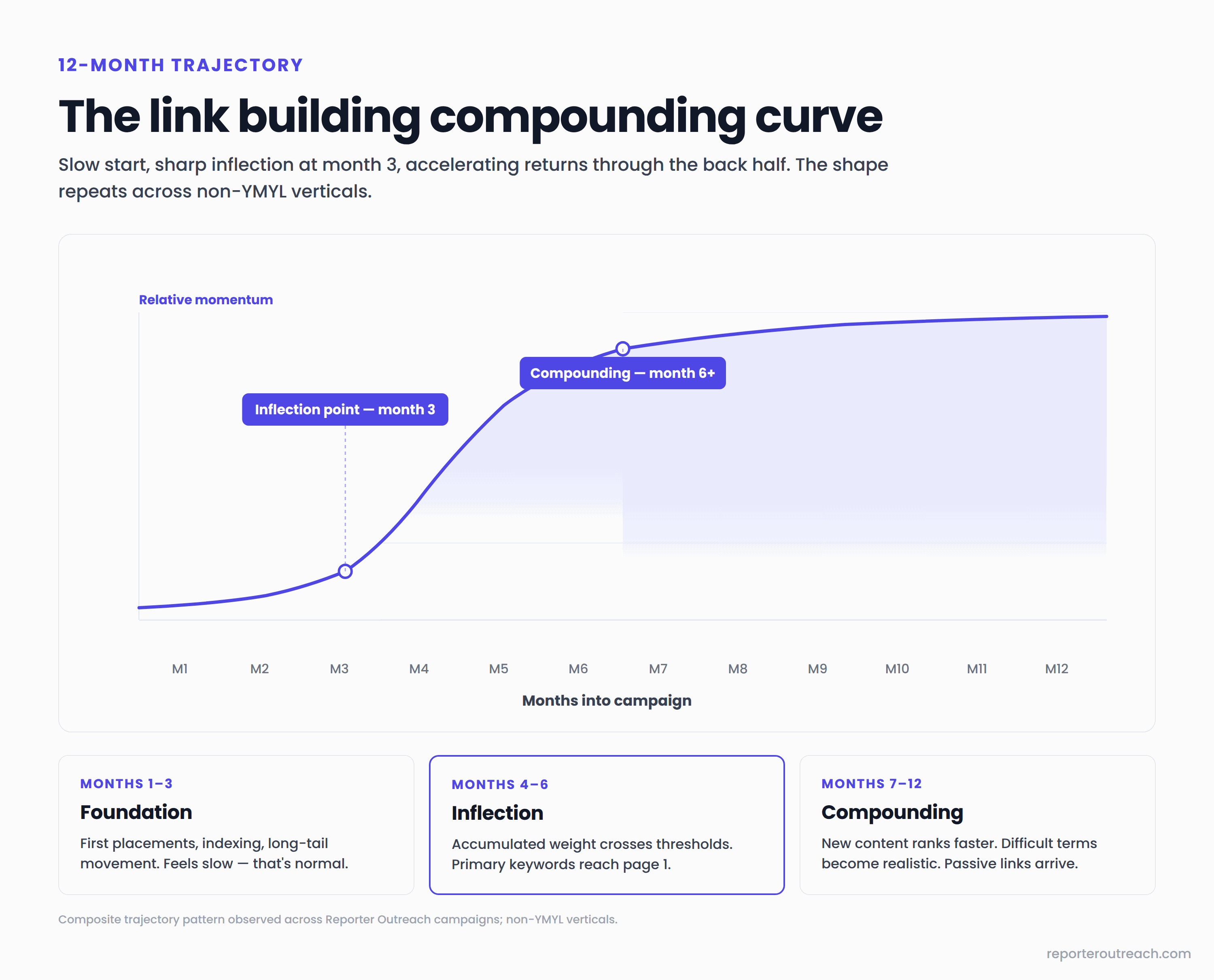
Every campaign deviates in the details. Some clients see page-one movement in month two because those keywords were one nudge from breaking through. Others wait longer in tougher competitive fields. But the shape — slow start, inflection at month three, compounding from month four — is consistent across verticals.
How to Speed Things Up
Google's algorithm isn't a controllable input, but the inputs that affect how fast search engines respond are.
Fix on-page SEO before the campaign starts. Title tags, header structure, internal linking, content depth — these are the foundation. Links amplify good pages. They can't save bad ones. Spending two weeks on on-page fixes before outreach begins pays for itself inside the first three months.
Combine digital PR with link insertions. Digital PR builds domain-wide authority through fresh editorial placements. Link insertions produce faster page-level movement because the host pages are already indexed. Using both is how to get both the authority flywheel and the near-term wins.
Concentrate links on highest-value pages. Focus on the three to five pages that drive actual revenue. Spreading links across every page of a site dilutes the authority signal. Concentration creates momentum.
Target lower-competition keywords first. A handful of mid-tail and long-tail wins builds the internal momentum and historical ranking data that help in going after head terms later. Starting at the top of the difficulty scale is how campaigns stall.
Publish new content during the campaign. New pages benefit immediately from rising domain authority. A content calendar running in parallel with link building produces a multiplier effect that sequential campaigns don't.
Don't stop at month three. The single most common mistake — and the expensive one. Most campaigns show modest results at month three and dramatic results at month six. Stopping before the compounding phase is paying for the foundation and abandoning the house.
When to Worry: Red Flags
Slow results aren't always a timeline problem. Sometimes they're a signal that something is actually wrong. Watch for these:
- No movement after 4 months. Long-tail keywords should have moved by now. Investigate content quality, technical SEO, or link quality before adding more spend on top.
- Links from DR 20 guest-post farms. Paying for placements that barely register. Audit the backlink list and stop the bleeding.
- Traffic declining despite new links. Technical issue, algorithm hit, or content quality problem links can't overcome. Diagnose the underlying cause first.
- Referring domain count not growing. Either the links aren't indexing or they don't exist. Verify in Ahrefs monthly.
- Unaddressed technical SEO issues. Crawl errors, slow load times, bad redirects. Links can't fix foundational problems.
Most agencies that deliver disappointing results have one of these five issues driving it — and fixing the underlying problem matters more than adding more links on top of a broken system.
Is It Worth the Wait?
The wait is real. The math is decisive. (For a full breakdown, see the link building ROI guide.)
Qooper's numbers tell the story: a sustained six-month investment produced a traffic increase that continues generating leads today, years later, without additional spend. The inputs stopped. The output didn't.
PPC traffic disappears the moment the spend stops. Link building builds an authority asset that keeps delivering for years — and every future piece of content ranks faster because of it. Break-even typically arrives between months six and twelve. After that, ROI compounds indefinitely.
This is why practitioners keep increasing spend year over year. The ones who stay in long enough to see compounding returns don't look back. The ones who stop at month three usually conclude "link building doesn't work" — and they're partly right. It didn't work for them, because they left before it had a chance to.
Ready to Build Authority That Compounds?
Tell us the vertical, the competition, and the timeline — and we'll build a campaign around realistic expectations from day one.
Link Building Timeline FAQ
How long does a single backlink take to affect rankings?
Roughly four to ten weeks from the moment it goes live. Discovery and indexing happen first (one to four weeks depending on the host site's crawl frequency), then the evaluation and ranking incorporation adds another two to six. A link from a daily-crawled major publication shows up in Ahrefs within days. A link from a weekly-crawled niche blog takes considerably longer. One link alone rarely shifts anything dramatically — the actual movement comes from accumulated quality over time.
Can link building produce results in under three months?
Yes, for lower-competition keywords on sites with existing authority. A domain at DR 40+ with decent content can see a few editorial placements push borderline page-two keywords onto page one within weeks. The three-to-six-month timeline applies to competitive keywords and sites starting from a lower baseline. Set expectations against the actual starting point — not a blanket promise.
Why do some agencies promise 30-day results?
Three reasons: targeting keywords so low-competition the movement was likely to happen anyway, using tactics that carry penalty risk, or redefining "results" as link placements (which do happen in 30 days) rather than actual ranking and traffic change (which doesn't). Be skeptical of any guaranteed result shorter than three months. Anyone promising faster either knows something the rest of the industry doesn't — or is about to learn an expensive lesson.
Should I commit to three months or six?
Six, for any competitive vertical. Reporter Outreach campaign data consistently shows compounding acceleration in months four and five — the results at month six are usually two to three times what they were at month three. If budget is tight, a smaller monthly commitment sustained for six months beats a larger one that stops at month three, every time.
Do results disappear when I stop link building?
Not immediately. Already-earned links keep passing authority indefinitely. But if competitors keep building and you don't, they'll eventually pass you. Most businesses find a sustainable maintenance pace after the initial growth phase — a smaller monthly volume that holds position rather than aggressively expanding it.
Does link building affect AI search on the same timeline?
AI visibility often moves faster than traditional rankings. ChatGPT, Perplexity, Gemini, and Google AI Overviews pick up brand mentions from editorial publications within weeks of publication — they don't apply the months-long ranking evaluation Google uses for organic results. Digital PR produces the editorial mentions these systems use to evaluate credibility, so campaigns frequently generate AI visibility gains before traditional ranking gains become measurable.
What's the ideal number of links per month?
It depends on vertical and starting authority, but as a rough baseline: five to ten quality editorial links per month produces steady, natural-looking growth for most sites. Competitive spaces (eCommerce, SaaS in crowded categories) may need more. YMYL verticals benefit from fewer, higher-authority placements rather than volume. The right number is the one that's sustainable for six-plus months without quality dropping.
Sources
- Reporter Outreach — Qooper SaaS case study
- Reporter Outreach — BloomsyBox eCommerce case study
- Reporter Outreach — Villa Oasis healthcare case study
- Reporter Outreach — MEDvidi healthcare case study
- Backlinko–BuzzSumo — Content study analyzing 912 million blog posts (94% of pages have zero backlinks)
- Authority Hacker — Link Building Survey (73.5% of practitioners build fewer than 10 links per month)
- Google Search Central — Documentation on crawl frequency and indexing