
Key Takeaways
- Digital PR is the standout method — 34% of respondents named it their best-performing tactic, nearly twice as many as guest posts (18%) and well ahead of HARO (21%).
- 76% of buyers will pay $300 or more per link, and 31% are now in the $500–$1,000 range. The bottom of the market has shrunk to 6%.
- 58% increased their link building budget in 2026 compared to 2025. Only 14% cut back. The market is still growing.
- 74% believe backlinks impact AI search visibility — but only 24% are tracking it, and just 19% have changed how they build. The first-mover window is open.
- 75% expect costs to keep rising over the next two years. The window for building authority at today's rates is narrowing.
This is the third year we've run our State of Link Building survey, and the 2026 edition is the largest yet. We surveyed 500 SEO professionals — agency owners, in-house marketers, specialists, and freelancers — to produce a complete picture of how link building actually works in 2026. Budgets, methods, quality standards, AI search impact, and what practitioners expect from the next two years.
This isn't a roundup of other people's research. Every number in this report comes from our original survey of practitioners actively building links right now. Use it to benchmark your own program, set realistic budgets, and understand where the industry is heading next.
500 SEO professionals surveyed in Q1 2026 via online questionnaire distributed across SEO communities, professional networks, and the Reporter Outreach client and partner base. Respondents include agency owners (32%), SEO specialists (27%), in-house marketers (21%), freelancers (15%), and others (5%). All data is self-reported. Where third-party research is referenced, sources are linked at the end of the report.
Who Took the Survey
The market is dominated by agencies and experienced practitioners. Nearly half of respondents (47%) are agency owners or freelancers serving clients — meaning most link building spend flows through intermediaries rather than directly from brands.
| Role | % of Respondents |
|---|---|
| Agency owner | 32% |
| SEO specialist | 27% |
| In-house marketer | 21% |
| Freelancer | 15% |
| Other | 5% |
SaaS is the largest single vertical at 22%, but multi-industry agencies control the lion's share of budgets at 38%. Healthcare (9%), finance (7%), and legal (5%) round out the top verticals — all spaces where editorial authority carries extra weight under YMYL standards.
This is also a mature market. 66% of respondents have three or more years of experience, and 35% have been at it for five years or more. The people making buying decisions know exactly what they're looking for. Quality standards have never been higher.
Respondents also report that link acquisition accounts for the largest share of their overall SEO budget — ahead of content marketing or technical SEO. That allocation tells you how the industry actually prioritizes spend.
Budgets and Pricing
The market has moved firmly upmarket. The era of bargain link buying is fading fast — both in monthly budgets and in what buyers are willing to pay for a single placement.
Monthly budgets
| Monthly Budget | % of Respondents |
|---|---|
| $0–$1,000 | 12% |
| $1,000–$3,000 | 24% |
| $3,000–$6,000 | 26% |
| $6,000–$12,000 | 21% |
| $12,000+ | 17% |
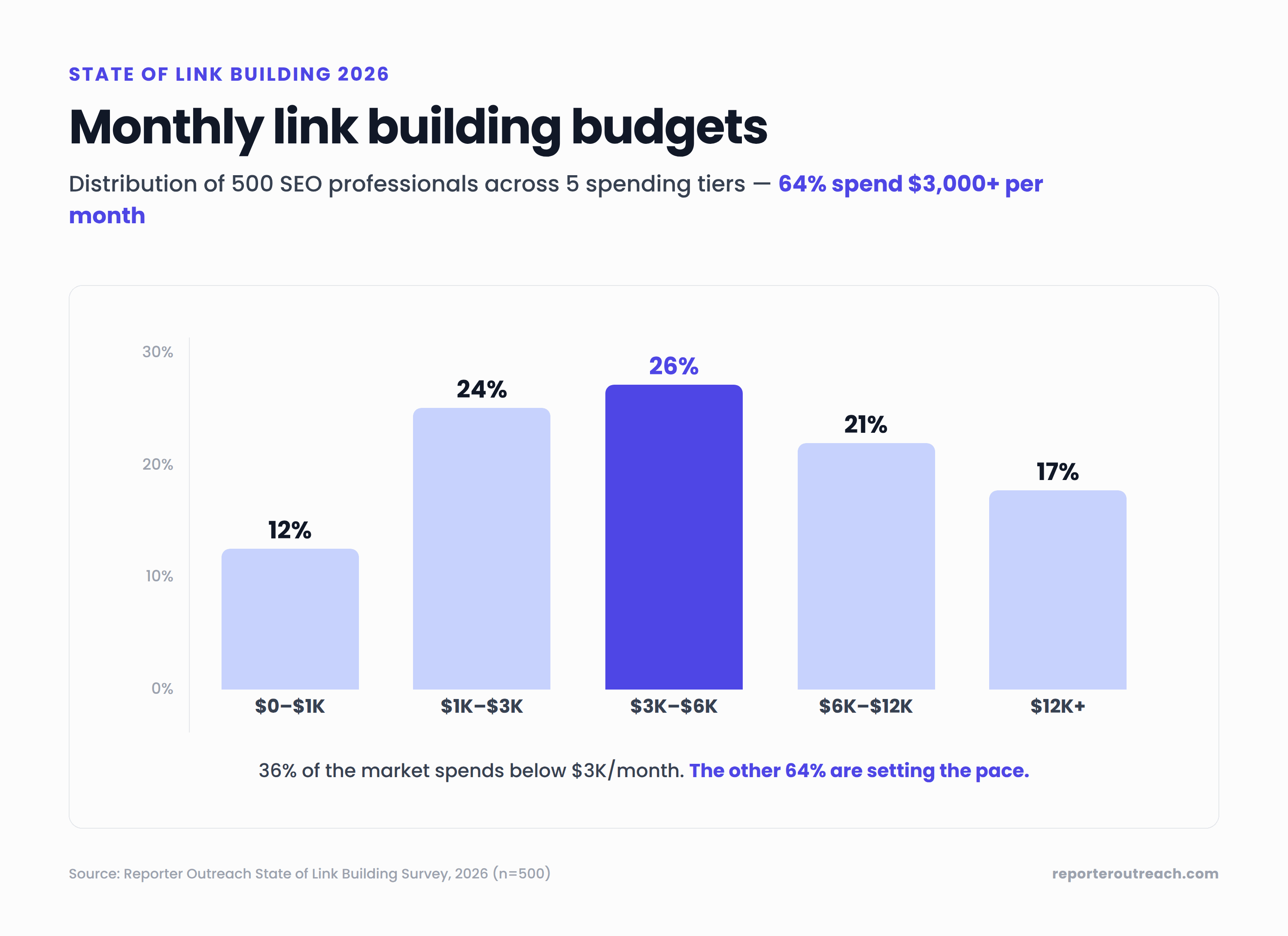
64% of respondents spend $3,000 or more per month on link building. 38% spend $6,000 or more. The heaviest spenders are concentrated in SaaS and competitive eCommerce — verticals where ranking improvements translate directly to pipeline and revenue. The fastest-growing tier is $6,000–$12,000.
The distribution below shows the full picture and where the median sits.
Maximum price per link
We asked respondents the most they'd pay for a single high-quality placement. The bargain-hunting era is over:
| Max Price Per Link | % of Respondents |
|---|---|
| Under $100 | 6% |
| $100–$300 | 18% |
| $300–$500 | 29% |
| $500–$1,000 | 31% |
| $1,000+ | 16% |
76% will pay $300 or more per link. The largest single segment (31%) sits in the $500–$1,000 range. Only 6% of the market is still shopping under $100 — and most of that 6% is freelancers serving smaller clients. Among agencies and in-house marketers at established companies, the floor for what's worth paying for is now firmly above $300.
Year-over-year budget changes
Budgets are still expanding. 58% of respondents increased link building spend year-over-year, while only 14% cut back. Two forces are driving this: rising placement costs (which require bigger budgets to maintain the same output) and growing recognition that authority links are now a prerequisite for both traditional rankings and AI search visibility.
If you're spending under $3,000 per month, you're below the median for the market. That doesn't mean you can't get results — but the practitioners outspending you are accumulating authority faster, and the gap compounds. For a detailed breakdown of what each budget tier actually buys, see our link building pricing guide.
What's Actually Working
We asked two separate questions: which methods are you using (multi-select), and which single method delivers your best results? The gap between adoption and performance is where the real insight lives.
Adoption vs. performance
| Method | % Using It | % Say It's Best |
|---|---|---|
| Digital PR | 45.6% | 34% |
| Broken link building | 44.0% | — |
| Link exchanges / reciprocal | 43.8% | — |
| Guest posts | 42.4% | 18% |
| Content-led outreach | 42.2% | 9% |
| Link insertions (niche edits) | 42.0% | 14% |
| HARO / journalist sourcing | 41.6% | 21% |
HARO and journalist sourcing technically sit inside digital PR — specifically the reactive side. We treated them as separate categories in the survey because most practitioners think of them as distinct day-to-day workflows: digital PR as proactive campaigns and original research, journalist sourcing as reactive responses to specific journalist queries. Both are PR-style approaches, and the combined figure later in this section reflects that.
Adoption rates are remarkably uniform — every major method clusters between 41.6% and 45.6%. Everyone has access to the same playbook. But performance is wildly uneven.
Among the five methods where respondents reported both adoption and best-performer data, the divergence is sharper than the table makes obvious:
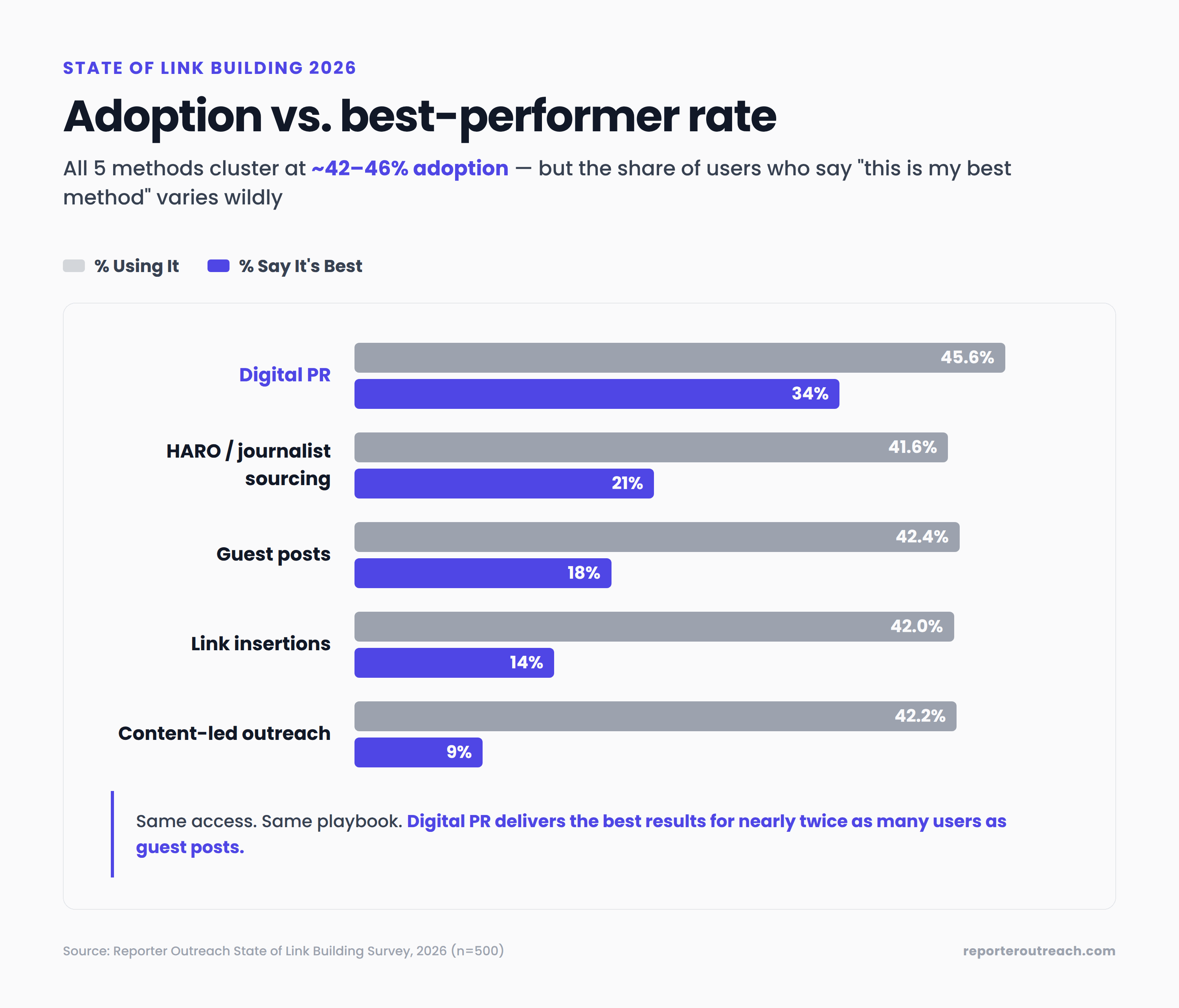
The digital PR gap is the headline. 45.6% of respondents use it, and 34% say it's their top performer — meaning roughly three-quarters of digital PR users rate it as their single best method. That conversion rate doesn't exist for any other tactic in the survey.
Compare that to guest posts. 42.4% adoption, but only 18% rate it their best — fewer than half of guest post users consider it their top method. The guest post market has saturated, and the same effort directed toward editorial outreach almost always produces better results.
Link exchanges tell the most damning story of all. 43.8% adoption — and zero respondents named it their best-performing tactic. A lot of practitioners are still doing reciprocal swaps. None of them are getting their best results from it.
When you combine digital PR (34%) and HARO/journalist sourcing (21%), 55% of respondents say PR-style approaches deliver their best results. That's more than every other method combined. The structural shift away from transactional outreach toward earning coverage through editorial relationships is the dominant story of 2026.
Every link building method has roughly identical adoption. But digital PR link building is rated the top performer by nearly twice as many respondents as guest posts — and well ahead of every other tactic in the survey. If you're spreading effort equally across tactics, the data argues for reweighting toward editorial outreach. We've also ranked the top digital PR agencies in 2026 if you're evaluating providers.
Quality Standards: DR Targets and the Quality Debate
What domain rating are practitioners targeting?
| Minimum DR Target | % of Respondents |
|---|---|
| No minimum | 9% |
| DR 20+ | 11% |
| DR 30+ | 18% |
| DR 40+ | 21% |
| DR 50+ | 19% |
| DR 60+ | 13% |
| DR 70+ | 9% |
The sweet spot is DR 40–60, where 53% of respondents target. That's the band where the cost-to-authority ratio is most favorable — high enough to move rankings, accessible enough to scale. Only 9% target DR 70+, which is premium territory typically reached through digital PR rather than guest posts or insertions.
Most practitioners aren't chasing the highest possible domain rating. They're balancing authority with topical relevance and referring-domain diversity. A portfolio of DR 40–60 placements from relevant sites often outperforms a handful of DR 80+ links from unrelated publications.
Quality vs. quantity
This debate is effectively settled. 62% of respondents prioritize quality, and only 9% still chase volume. The remaining 29% pursue both. One well-placed editorial link from a trusted publication outperforms dozens of placements on low-authority sites — that's not opinion anymore, it's how the market is voting with its dollars.
The Biggest Challenges in 2026
Three frustrations dominated the open-response data:
Rising costs. Publisher fees continue rising annually, and 75% of respondents expect that to continue. Every dollar requires more careful allocation toward the tactics that actually deliver. The era of buying links at scale to "test what works" is gone — testing now happens at $300–$1,000 per placement.
Finding quality at scale. Most practitioners need 5–15 quality placements per month to move rankings meaningfully. Sourcing that volume on authoritative sites is the core operational bottleneck — and the primary frustration among those who outsource. Cheap inventory is everywhere; quality inventory is finite.
Earning vs. buying. The tension between creating linkable content and acquiring placements through transactional outreach defines the industry right now. Editorial approaches produce better results but require significantly more upfront investment in content. Agencies report this as their hardest internal trade-off.
For context on just how rare quality coverage actually is: a Backlinko–BuzzSumo analysis of 912 million blog posts found that 94% of all content has zero backlinks. Most pages on the internet never attract a single external link. Active outreach exists because organic link attraction alone won't build the authority needed to compete.
AI Search and the Awareness-Action Gap
This is where the most interesting data in the survey lives. The gap between what practitioners believe about AI search and what they're doing about it is the largest in any section of the report.
Do backlinks impact AI visibility?
| Response | % of Respondents |
|---|---|
| Yes, significantly | 28% |
| Yes, somewhat | 46% |
| Unsure | 21% |
| No | 5% |
74% believe backlinks impact AI search visibility. Only 5% say they don't. The perception aligns with what's emerging from independent research: editorial mentions and citations across publications that ChatGPT, Perplexity, Gemini, and Google AI Overviews crawl are increasingly correlated with which brands those engines recommend.
But who's actually doing anything about it?
Here's where the gap gets uncomfortable. 74% believe AI search matters. But only 24% are tracking their AI visibility, and just 19% have actually changed how they build links in response.

That's the awareness-action gap. Three-quarters of the industry sees the shift coming. Fewer than one in five has done anything about it. The remaining 81% are either planning changes (34%) or sitting still (47%).
AI search is roughly where Google was in 2005. The brands building editorial authority now will be the defaults that ChatGPT, Perplexity, Gemini, and Google AI Overviews recommend for years. The 19% who've already adapted are quietly accumulating the citation footprint that AI tools will keep referencing. Digital PR delivers both a backlink and a citation from every placement — dual value from a single effort. Our generative engine optimization framework walks through how to start.
Emerging Trends
Three patterns emerged from the data that point toward where the industry is heading.
Content marketing and outreach are converging. The most successful campaigns combine data-driven content (studies, original research, comprehensive guides) with active promotion. Creating the asset is half the job. Getting it in front of journalists and editors is the other half. 42% of respondents now use content-led outreach as part of their strategy — and when paired with digital PR, the results compound.
Unlinked brand mentions are an underused acquisition channel. Practitioners who monitor unlinked mentions and convert them into linked citations report some of the highest ROI in their programs. This works especially well for established brands with existing coverage that haven't captured the link value from it.
Diversification is winning. No single method dominates the full results picture. The practitioners reporting the most consistent ranking improvements combine digital PR for high-authority placements, guest posts for relevant topical links, content-led outreach for natural attraction, and proactive monitoring of brand mentions. Single-method strategies are increasingly fragile.
Price Outlook
We asked whether respondents expect costs to rise or fall over the next two years. The consensus was overwhelming:
| Price Expectation (Next 2 Years) | % of Respondents |
|---|---|
| Much more expensive | 26% |
| Somewhat more expensive | 49% |
| About the same | 17% |
| Less expensive | 8% |
75% expect prices to rise. Only 8% think they'll decrease. The supply-demand dynamics make this almost inevitable: publisher fees continue rising annually, quality editorial inventory is finite, demand from both traditional SEO and AI optimization is increasing, and experienced practitioners are commanding higher rates.
The implication is straightforward. Authority compounds. What you build today gets more valuable as the cost of building it rises. Brands that start now lock in relationships and accumulate the editorial presence that gets harder and more expensive to build later.
What These Findings Mean for Your Strategy
Five conclusions from the data:
1. If you're below $3,000 per month, you're behind the median. 64% of practitioners spend more. The competitors outspending you are accumulating authority faster, and the gap compounds. Either increase budget or be extremely strategic — prioritize digital PR and high-DR insertions over volume.
2. Make digital PR your primary tactic. 34% of the market says it delivers their best results — nearly double guest posts at 18%, and well ahead of every other tactic. If you're spreading budget equally across tactics, reweight toward editorial outreach.
3. Start tracking AI visibility now. 74% believe links matter for AI search, but 81% haven't adjusted how they build. The brands optimizing today will own the recommendation slots as AI-driven search scales.
4. Act before prices climb further. 75% of the market expects costs to increase. What you build today compounds. What you delay gets more expensive.
5. Quality has won. 62% prioritize quality, and 76% will pay $300 or more per link. The bottom of the market is shrinking. If your strategy depends on high volume at low prices, the math is working against you.
State of Link Building FAQ
How many people were surveyed for the 2026 State of Link Building report?
500 SEO professionals responded in Q1 2026, distributed across agency owners (32%), SEO specialists (27%), in-house marketers (21%), freelancers (15%), and others. The sample skews toward experienced practitioners — 66% have been building links for three years or more, and 35% have five-plus years of experience.
Can I cite these statistics?
Yes. Attribute findings to "Reporter Outreach, State of Link Building 2026" and link back to this page. Citations in your own content, presentations, and research are welcome.
What's the single most important finding?
The awareness-action gap on AI search. Roughly three-quarters of practitioners believe authority links influence AI visibility, yet fewer than one in five has changed how they build. That disconnect is the biggest first-mover opportunity in the report — and the window is narrowing as more brands catch on.
How does this compare to other industry surveys?
Our 75% price-rise expectation closely matches Editorial.link's 80.9% figure from their 2025 SEO survey. Where this report adds unique value is the AI search section — most existing surveys don't cover visibility perception and tracking behavior with this level of detail, and the gap between belief and action is the most actionable insight here.
Will you publish this survey again?
Yes. The Reporter Outreach State of Link Building survey runs annually. We track how the industry evolves around AI search adoption, budget shifts, pricing tolerance, and which methods continue to deliver results.
Build Authority Before Prices Rise.
75% of practitioners expect costs to keep rising over the next two years. Start building at today's rates.
Sources
Reporter Outreach State of Link Building Survey (2026, n=500). Backlinko–BuzzSumo Content Study (912M blog posts analyzed). Editorial.link Link Building Survey (2025, n=518) for cross-industry price-rise expectation comparison.