Key Takeaways
- Domain Rating (DR) is an Ahrefs metric measuring a site's backlink strength on a 0–100 scale. It's not a Google ranking factor — but it correlates with ranking ability because the underlying signal (link authority) is something Google values.
- DR measures one thing: backlink profile strength relative to other sites in the Ahrefs index. It ignores content quality, traffic, topical relevance, and user experience. A site can have DR 70 and zero visitors.
- The scale is logarithmic. DR 10→20 is easy; DR 70→80 requires exponentially more links from authoritative domains. Each ten-point increment is harder than the last.
- DR can be inflated with junk links — making it unreliable when used alone. The fix: always cross-reference with organic traffic.
- The most effective way to improve DR sustainably is earning editorial backlinks from real publications — the same signal that drives AI search citations.
Domain rating is one of the most referenced metrics in SEO — and one of the most misunderstood. SEO professionals use it constantly to evaluate link prospects, benchmark against competitors, and measure authority growth. But treating DR as the definitive measure of quality leads to bad decisions. In an analysis of 7,548 placements, the strongest links paired a high DR with editorial origin and real traffic — what we mean by high authority backlinks.
This guide covers what DR actually measures, how it's calculated, where it's useful, where it's misleading, and how to improve it in ways that translate to real ranking gains.
What Is Domain Rating?
Domain rating is a metric from Ahrefs that estimates the strength of a website's backlink profile on a 0–100 logarithmic scale. Higher numbers indicate stronger link authority. The metric sits alongside competing scores from other SEO tools — Moz's Domain Authority, Semrush's Authority Score, and Ahrefs's own URL Rating for individual pages. None of them are Google ranking factors. They're third-party proxies for a signal Google actually does use: backlink quality and quantity.
The distinctions between tools matter when evaluating link prospects or benchmarking competitors. The comparison breakdown follows in a later section — what matters first is understanding what DR is built to measure and what it deliberately ignores.
What DR Actually Measures
What DR measures: the quantity and quality of unique referring domains linking to your site. More links from more unique, high-authority sources produce higher DR.
What DR does not measure: content quality. Organic traffic. Topical relevance. Domain age. User experience. Page speed. On-page SEO. Spam patterns. Brand mentions. Engagement signals.
This distinction matters more than most people treat it. A site can have DR 70 with zero visitors (inflated by junk links), while a DR 30 site might get 50,000 monthly visitors from relevant content and genuine editorial coverage. DR tells you about backlink strength only. It does not tell you whether search engines actually trust the domain — that signal lives in traffic, not in DR.
How DR Is Calculated
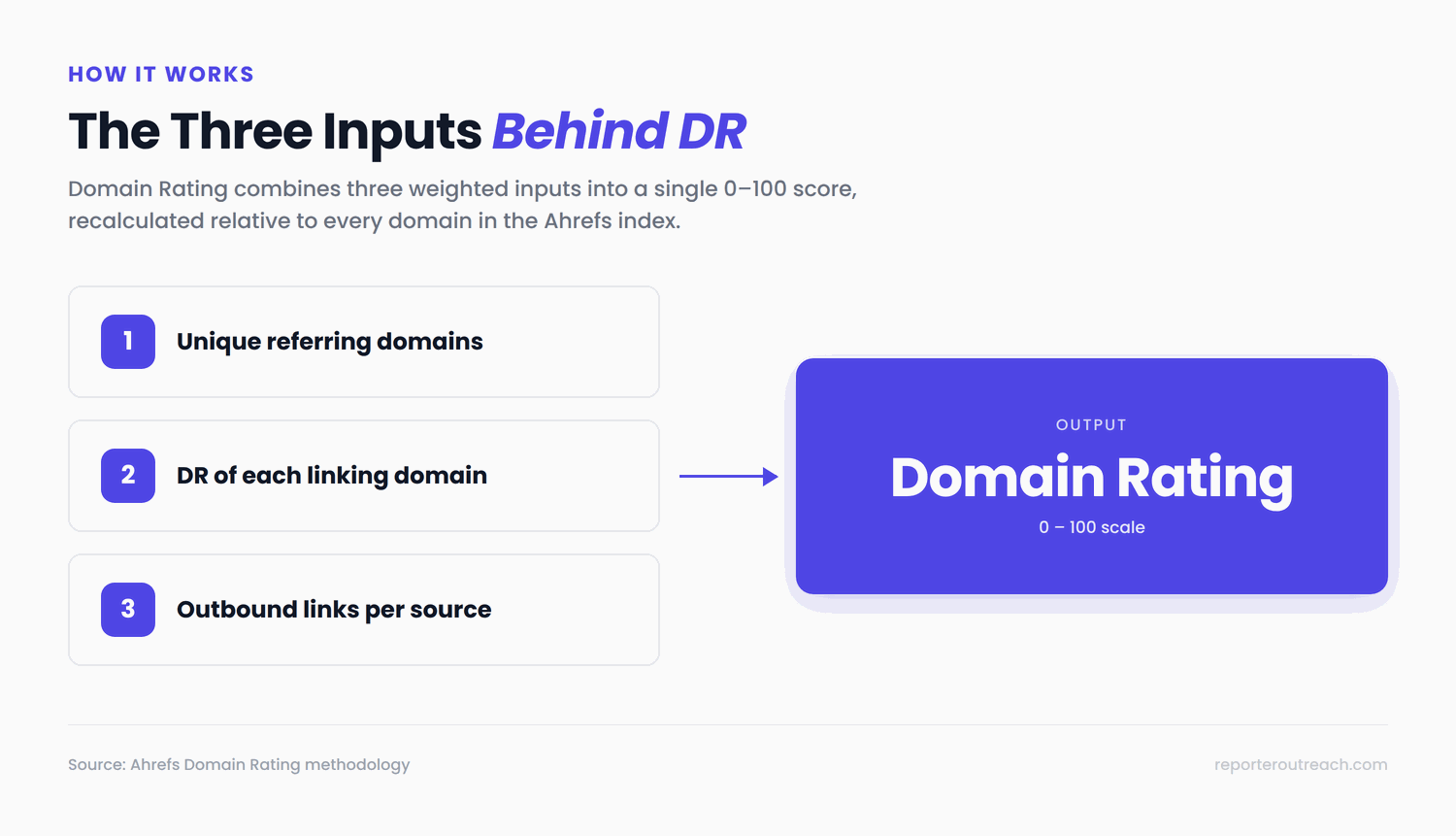
Understanding the calculation explains both DR's usefulness and its limits. Three factors feed it:
1. Unique referring domains. Ahrefs counts unique sites with links pointing to you. Ten links from one site count the same as one — what matters is the number of unique sources, not total link count.
2. The DR of those linking domains. Links from high-DR sites pass more authority than links from low-DR sites. A single link from a DR 80 site moves DR more than dozens from DR 10 sites.
3. How many other sites each source links to. If a high-DR site links to thousands of domains, the authority passed to each is diluted. A link from a site that links to 50 others is more impactful than one from a site linking to 50,000.
Ahrefs then plots all domains on the 0–100 scale relative to each other. Only links that pass ranking authority are counted — tagged, sponsored, and user-generated links are excluded.
DR vs UR: Domain Rating vs URL Rating
URL Rating (UR) is Ahrefs's page-level counterpart to DR: where domain rating scores the backlink strength of an entire domain, UR scores the link authority of one specific page, on the same 0–100 logarithmic scale. The two answer different questions. DR asks "how strong is this site's overall link profile?" UR asks "how much link authority does this exact URL hold?"
When calculating URL Rating, Ahrefs counts both internal and external links pointing to the page, applies PageRank-style damping, and respects nofollow attribution — so a page's UR reflects everything linking to it, including links from elsewhere on the same site. That last part explains the question people actually type into Google: why is my URL Rating higher than my Domain Rating? Usually because the page concentrates links the rest of the domain doesn't share. Homepages are the classic case — every internal link on the site points there, so a modest site's homepage routinely carries a UR well above the domain's DR. The two numbers also sit on separate curves, calculated against different comparison sets, so they were never meant to be read against each other in the first place.
| Domain Rating (DR) | URL Rating (UR) | |
|---|---|---|
| Scope | The whole domain | One specific URL |
| What feeds it | Unique referring domains and their authority | Internal and external links to that page |
| Best used for | Sizing up a site's overall authority | Diagnosing why a specific page ranks or doesn't |
Which one matters depends on the job. Evaluating a site as a link prospect: the domain's DR, cross-referenced with traffic, is the primary read — that's the authority a placement inherits — with the linking page's UR as secondary context. Diagnosing your own pages: UR is the closer proxy for a specific page's ability to rank, since it measures the links that page actually holds rather than the domain around it. A strong DR with a weak UR on your money page usually means the authority exists but isn't flowing where you need it — an internal linking problem, not a link acquisition problem.
DR vs Domain Authority
DR and DA are often used interchangeably — but they measure slightly different things and weigh inputs differently.
| Metric | Tool | What It Measures |
|---|---|---|
| Domain Rating (DR) | Ahrefs | Backlink profile strength from authority-passing links only |
| Domain Authority (DA) | Moz | Predicted ranking ability, includes spam score signal |
| URL Rating (UR) | Ahrefs | Page-level link authority for individual URLs |
| Authority Score | Semrush | Combined score of link strength and organic traffic |
Most SEO professionals prefer DR because Ahrefs has the largest backlink index in the industry. DA is more common in general marketing tools. Semrush takes a different approach entirely — combining link signals with organic traffic into a single number, which makes Authority Score directionally closer to what Google probably measures but harder to compare across tools.
The right move: pick one and stay consistent. Mixing DR from Ahrefs with DA from Moz across the same audit produces noise, not signal — the same site routinely scores 10–20 points apart across tools because each index and formula is different, so a cross-tool comparison isn't comparing anything real.
Realistic Benchmarks
The most common DR question — "what's a good score?" — has only one honest answer: it depends entirely on the sites you're competing against.
Run a competitor analysis. If the top three sites ranking for your target keywords sit at DR 50–65, that's your gap. If they're at DR 25–35, you're already in the game and the work shifts to content and on-page. The point isn't an absolute target — it's the relative position needed to compete for the specific keywords that drive your business. Competitor backlink analysis quantifies the gap.
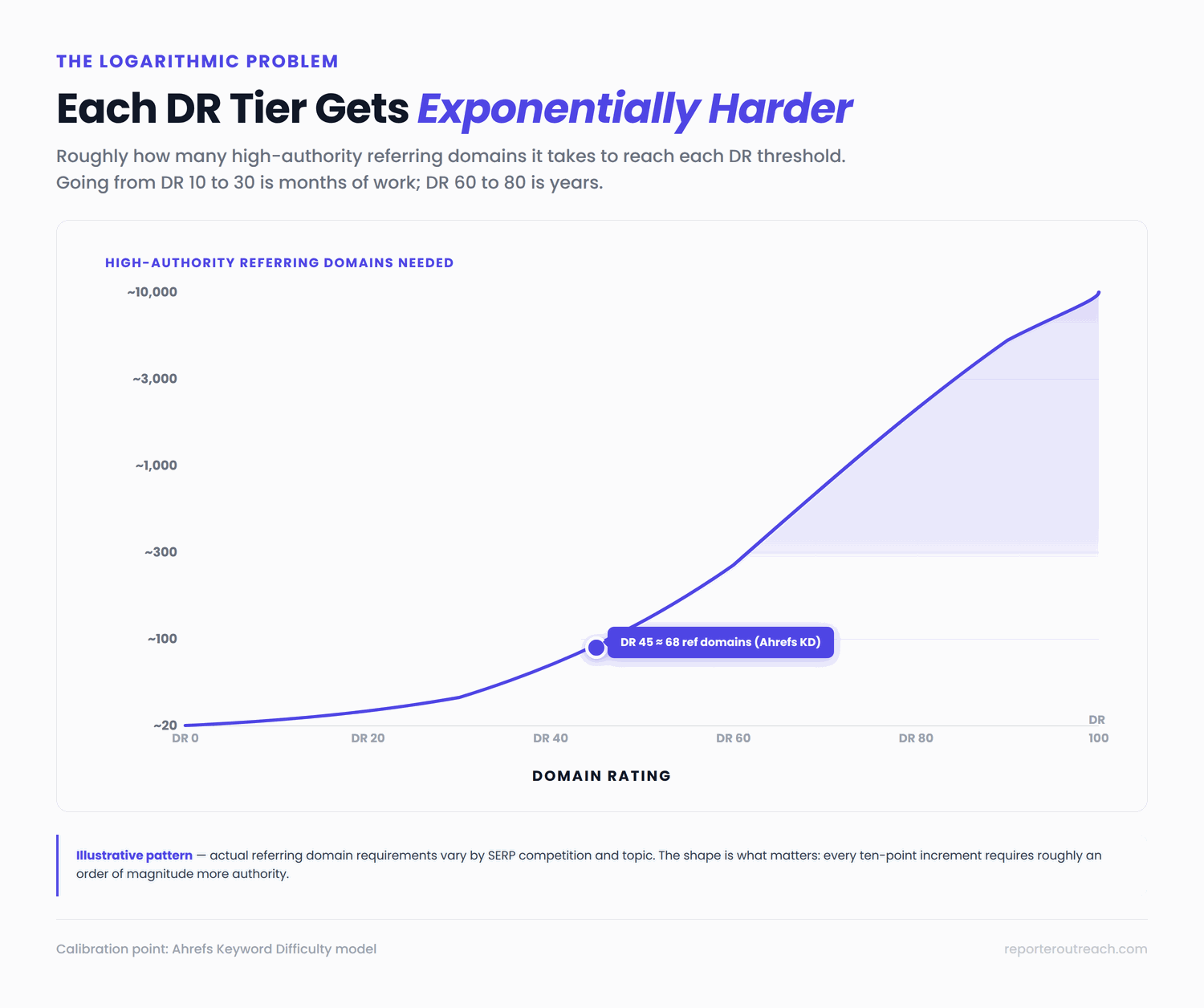
The complication: the scale is logarithmic. Moving from DR 10 to DR 30 is achievable with a few months of consistent link acquisition. Moving from DR 60 to DR 80 takes years of high-authority editorial coverage. Each ten-point increment requires exponentially more links from increasingly authoritative domains.
With that caveat locked in, here's how the bands typically read:
| DR Band | What It Typically Means |
|---|---|
| 0–20 | New sites and thin link profiles. A handful of quality links moves the score quickly at this stage. |
| 21–40 | Established but link-light. Typical for small businesses that have never done deliberate outreach. |
| 41–60 | Solid for most niches. This is where serious mid-market competitors tend to sit. |
| 61–80 | Competitive in commercial spaces. Built over years of consistent editorial coverage. |
| 81+ | The rare tier — major publications and category leaders. Supply of links from here is genuinely scarce. |
As one calibration point: Ahrefs's own keyword difficulty model estimates that ranking in the top ten for the query "domain rating" itself — a moderately competitive term at KD 45 — requires roughly 68 referring domains. That number scales sharply at the top of more competitive SERPs, and the required quality of those domains scales with it.
When DR Is Misleading
This is the section most DR guides skip — and it's the most important for making good decisions.
Junk links inflate the score. Because DR is purely link-based, it can be artificially boosted with PBN links, link farms, and comment spam. A site with DR 60 from thousands of junk links is far less valuable than a DR 45 site built on genuine editorial references. Never evaluate a prospect on DR alone.
DR doesn't account for organic traffic. Does the site actually get visitors from search engines? DR 70 with zero traffic means Google has already devalued it. DR 40 with 20,000 monthly visitors means Google trusts the content. Always check traffic alongside DR.
DR doesn't measure topical relevance. A DR 80 technology site linking to your healthcare company is less valuable than a DR 50 health publication. Google evaluates topical alignment — DR doesn't capture this.
DR is relative. Your DR can drop even if nothing on your site changes — because other domains in the Ahrefs index gained links and shifted the curve. Track total referring domains (an absolute count) alongside DR to monitor genuine progress.
The fix is a two-axis framework. Every prospect site sits somewhere on a matrix of DR against organic traffic — and the quadrant matters more than the DR number alone. Real authority sits in one corner. Inflated DR, undervalued content, and baseline domains each sit in their own.

Before agreeing to any placement, pull up the prospect site in Ahrefs and check DR and organic traffic side by side. The matrix above tells you which quadrant you're looking at — the same workflow applies to niche edits evaluation and link prospect vetting more broadly. DR alone has gotten more SEOs into trouble than almost any other metric.
Does DR Matter for AI Search?
Indirectly — and the indirection matters.
AI search engines (ChatGPT, Perplexity, Gemini, and Google AI Overviews) don't query a DR database when deciding what to cite. They pull from the open web and surface sources their training and retrieval pipelines treat as authoritative. Research from Fullintel and the University of Connecticut presented at IPRRC in February 2026 found that more than 89% of AI citations come from earned media — coverage in real publications and news outlets, not brand-owned content.
Here's why that connects to DR: the signal that drives DR (editorial backlinks from real publications) is the same signal that drives AI citation. A site with high DR earned through digital PR gets cited by AI engines. A site with high DR inflated by junk links does not. DR is downstream of what AI engines care about — useful as a proxy when DR is measuring honest authority, useless when it isn't.
This is why pursuing DR through cheap junk links is a worse trade in 2026 than it was three years ago. AI search visibility doesn't track DR directly, but it tracks what DR is trying to measure when DR measures the right thing.
How to Improve DR the Right Way
Since DR is based on backlinks, improving it means earning links from more unique, authoritative sources. Not all methods produce the same DR movement — and several common tactics produce DR gains that don't translate to ranking gains.
- Digital PR (highest impact). Editorial backlinks from real publications through digital PR are the most effective way to improve DR sustainably. Across 500+ campaigns since 2017, well-executed digital PR campaigns earn links from dozens of unique domains at DR 70+. One link from a DR 80 publication moves the needle more than ten DR 20 links — that's how the math of the calculation works.
- Niche edits from high-DR sites. Placing your link into established articles on relevant, high-authority sites adds new referring domains efficiently. At $300–$500 per placement at the relevant DR tiers, niche edits are the most cost-effective way to grow referring-domain count when budget is the bottleneck.
- Linkable content assets. Original research, free tools, and comprehensive guides attract links naturally over time. A well-promoted data study can earn referring domains for years after publication — though this is the slowest of the three paths and the hardest to predict.
- Clean up toxic links. Won't directly raise DR, but prevents your profile from looking manipulative to Google. Periodic backlink audits matter most for sites with histories of aggressive link acquisition.
Total referring-domain count is a more stable signal than DR itself. It's absolute (not relative to other sites in the index), it directly drives DR, and it can't be gamed the way a single composite number can. Watch both — but trust the underlying count over the score.
When DR Is Actually Useful
Despite the limitations, DR is genuinely useful when used correctly — and the limitations don't disqualify the metric, they just define its job.
Evaluating link prospects. DR gives a quick authority estimate. But cross-reference with traffic. A DR 50 site with 15,000 monthly visitors beats a DR 65 site with zero, every time.
Competitive benchmarking. Comparing your DR against sites ranking for your target keywords reveals the authority gap. If competitors average DR 55 and you're at DR 25, that quantifies the investment needed to compete.
Tracking authority growth. Monthly DR monitoring shows whether your efforts are accumulating. Stagnation usually means you need more high-authority links — adding DR 30 links won't move a DR 60 site noticeably.
Pricing context. DR is the standard for tiered pricing in link-building markets. Higher-DR placements cost more because they pass more authority and because supply of those sites is genuinely concentrated. The 5W AI Platform Citation Source Index released in May 2026 found that 68% of AI citations are concentrated in the top 15 publisher domains across the web — those are the DR 80+ sites every brand competes to reach, and the supply doesn't scale with demand. See our pricing guide for current rates at each tier.
What This Looks Like in Practice
A SaaS mentoring platform — Qooper — needed to build DR quickly against established HR tech competitors. Rather than chasing link volume, the strategy focused on editorial placements from authoritative publications: each link from a unique high-authority source where the DR math actually translated to ranking gains. Over six months, the campaign produced a 2,203% increase in organic traffic. The number that made that possible was the average DR of the placements earning those links.
Editorial placements from publications at this authority level — not bulk acquisition from low-DR sources — is what made the ranking gains compound. See more case studies.
Build DR That Translates to Real Rankings.
Editorial links from top publications — building authority that improves DR and drives traffic simultaneously.
Frequently Asked Questions
What is domain rating?
A metric from Ahrefs that estimates backlink profile strength on a 0–100 logarithmic scale. Higher numbers mean a stronger profile of links from unique authoritative domains. Domain rating is not used by Google directly — but the underlying signal it measures, backlink strength, is one of Google's confirmed ranking factors.
Does Google use DR to rank sites?
No. DR is a third-party Ahrefs metric. Google has its own internal authority signal it doesn't publish. But sites with higher DR tend to rank better because the link strength DR approximates is what Google actually values when it ranks pages.
What's a good DR score?
Always relative to your competitors. If sites ranking for your target keywords sit at DR 40–55, that's the benchmark — not arbitrary thresholds. Generally: DR 40+ is solid for most niches, 60+ is competitive in commercial spaces, 80+ is rare and earned over years of consistent coverage.
What's the difference between DR, DA, and URL Rating?
DR (Ahrefs) measures domain-level backlink strength from authority-passing links. DA (Moz) includes a spam-score component and weighs all link types. URL Rating (also Ahrefs) measures page-level authority for individual URLs rather than the whole domain. Pick one tool and stay consistent — mixing metrics across the same audit produces noise.
Why is my URL Rating higher than my Domain Rating?
Because UR counts every link to that one page — internal links included — while DR reflects the whole domain's referring-domain profile. Homepages collect an internal link from nearly every page on the site, so their UR often outruns the domain's DR. The two scores are also plotted on separate scales, so a gap between them isn't an error; it's a scope difference.
Why did my DR drop without losing links?
DR is relative to all other domains in the Ahrefs index. If competing sites gained substantial links, their scores rise and yours can drop without your profile changing at all. Small fluctuations of one to three points are normal. Watch total referring-domain count for a more stable signal.
How quickly can I improve DR?
Depends entirely on starting point. At DR 0–30, a handful of high-authority links can move the score within weeks. At DR 50+, meaningful improvement takes months because each increment is exponentially harder. Digital PR campaigns typically show measurable DR gains in three to six months.
Does DR affect AI search visibility?
Indirectly. AI engines cite earned media from authoritative publications — the same signal that produces high DR honestly. Sites with high DR built through editorial coverage get cited by ChatGPT, Perplexity, Gemini, and Google AI Overviews. Sites with high DR inflated by junk links don't.
Sources: Ahrefs — Domain Rating Definition & Methodology · Ahrefs — URL Rating Definition · Moz — Domain Authority Overview · Fullintel-UConn IPRRC Generative Pulse Research (Feb 2026) · 5W AI Platform Citation Source Index (May 2026)