Key Takeaways
- Brand mentions correlate 3x more strongly with AI visibility than backlinks (0.664 vs. 0.218) according to Ahrefs' study of 75,000 brands. Digital PR produces exactly those signals.
- 25% of Google searches now trigger AI Overviews (per Conductor — other trackers report up to 48%). When they appear, organic click-through rates drop by up to 61%. The brands getting cited inside those summaries capture the attention everyone else loses.
- AI-referred traffic converts at 14.2% — nearly 5x the traditional organic rate. Fewer clicks, but each one is worth dramatically more.
- 74% of SEOs believe links impact AI search optimization, yet 76% aren't tracking it and only 19% have adjusted their strategy (Reporter Outreach, State of Link Building 2026).
- Content with original data and source attributions earns up to 40% more AI citations than generic content (Princeton GEO study). If you're not publishing original research, you're invisible to AI.
The goal used to be simple: rank on page one, win the click. Now the game is bigger. AI search optimization is about becoming the source AI chooses to cite, summarize, and recommend — even when the user never touches a blue link.
Google's AI Overviews reach 2 billion monthly users across 200 countries. ChatGPT processes 2.5 billion daily prompts. And when AI-generated summaries appear at the top of a results page, clicks to traditional results collapse. One Seer Interactive study measured a 61% drop in organic CTR — and while their April 2026 longitudinal update shows organic CTR has rebounded somewhat, the gap between AIO-present and AIO-absent queries remains the new normal. These figures move fast; we keep the latest AI search data in one place.
That sounds brutal if you're thinking about it as lost traffic. But the flip side is remarkable: visitors who arrive via AI citation convert at 14.2%, compared to 2.8% for traditional organic (Clickcentric). They show up pre-sold. The volume shrinks, the value per visit skyrockets.
If your brand relies on organic traffic, this isn't optional anymore. Here's how to win visibility in an AI-first search landscape — and why digital PR has become the most powerful lever in the playbook.
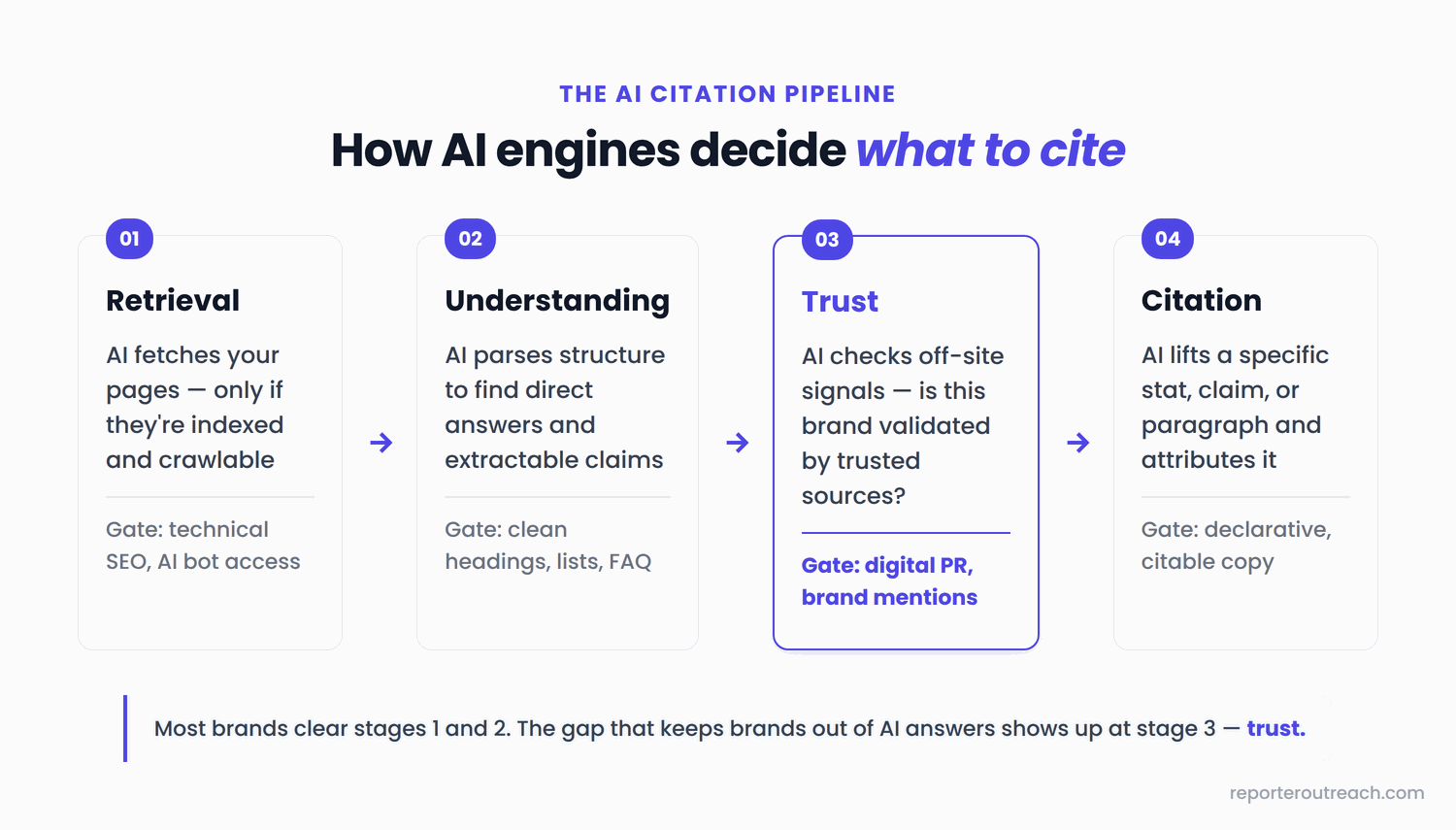
How AI Search Engines Decide What to Cite
Most brands that complain about AI visibility have the same problem: they assume it's a content issue when it's actually a trust issue.
The pipeline above looks linear, but here's what matters in practice. Steps 1 and 2 — query fan-out and retrieval — are table stakes. If you have decent SEO and your pages are indexed, you clear those hurdles. The gap between brands that get cited and brands that don't almost always shows up at step 3: re-ranking.
AI systems are conservative. They default to sources that appear widely validated — brands mentioned across many authoritative domains, content backed by external references, experts quoted in trusted publications. Google has said there aren't "special" requirements to appear in AI Overviews beyond solid SEO. That's technically true. But the sites that actually get cited share specific patterns that go well beyond basic optimization.
Think of it this way: AI doesn't evaluate whether your content is "good." It evaluates whether citing your content is safe. Citing a widely-mentioned brand with editorial backlinks and consistent entity signals is low-risk for the AI. Citing an unknown brand with thin off-site presence is high-risk. AI optimizes for its own credibility — and that changes what you should be optimizing for.
When a brand is missing from AI responses, it's usually failing at one of these four points:
| Stage | Why You're Not Getting Cited | What Fixes It |
|---|---|---|
| Retrieval | Pages aren't indexed, content is thin, or AI crawlers are blocked | Fix technical SEO, unblock AI bots, add content depth |
| Understanding | Content is vague, unstructured, or lacks clear claims | Structured headings, lists, direct definitions, FAQ sections |
| Trust | Weak off-site presence — few editorial mentions, low brand recognition | Digital PR, editorial placements, expert source campaigns |
| Citation | Nothing extractable — no stats, no declarations, no mini-conclusions | Original data, declarative statements, cite-ready paragraphs |
Most SEO advice focuses on retrieval and understanding. That's the easy part. The brands winning AI visibility are investing in trust and citation-readiness — and that requires a fundamentally different approach than traditional content optimization.
The Signals That Actually Move the Needle
Not all signals are created equal. Here's where the data gets interesting.
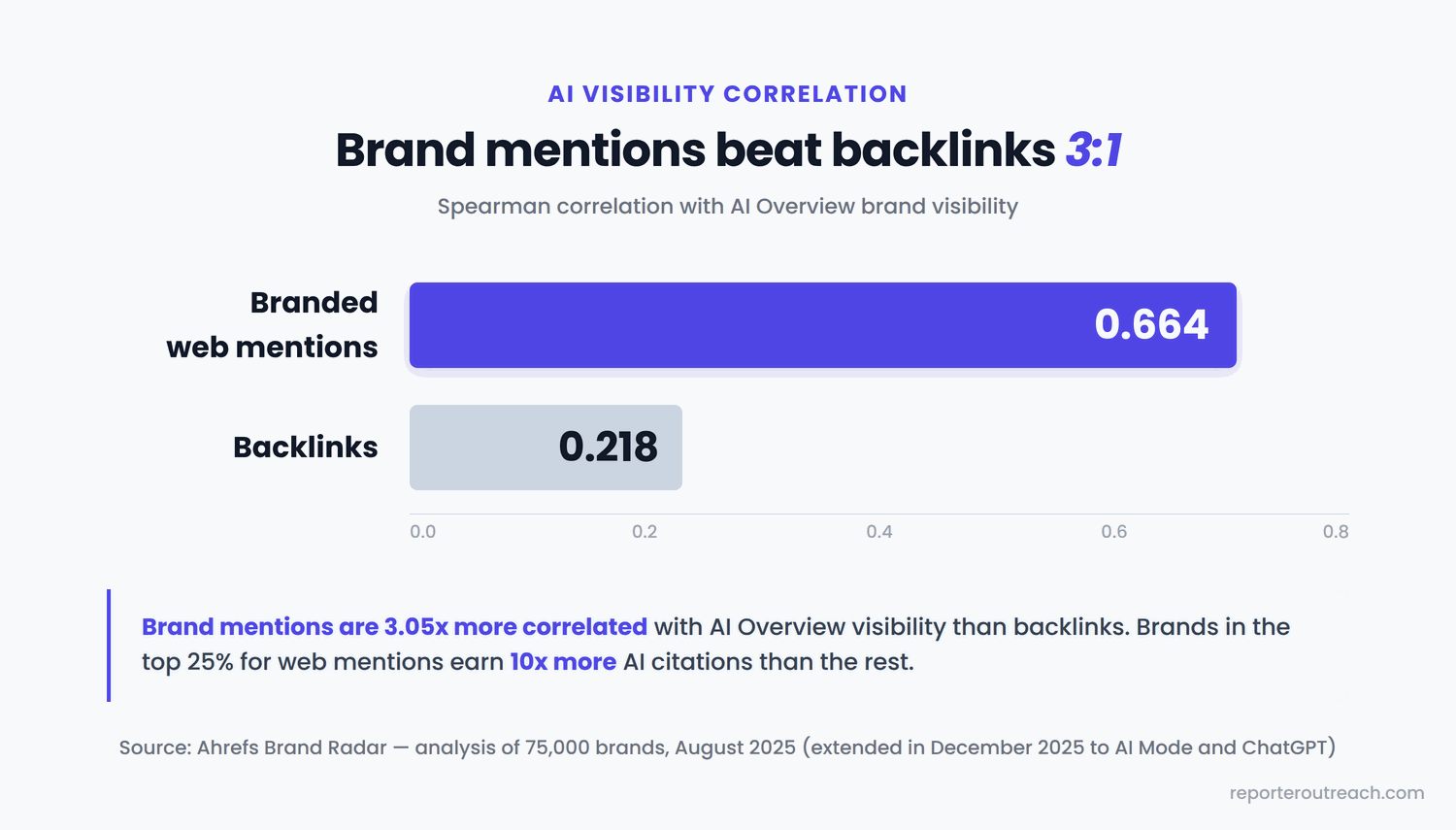
That graphic tells the whole story. Backlinks still matter for traditional rankings (and rankings feed the retrieval pipeline). But when it comes to whether AI actually cites you in its response, brand mentions across authoritative domains are 3x more predictive than raw link count.
Think about why. A backlink says "this page is worth linking to." A brand mention in an editorial context says "this brand is a recognized authority in this space." AI systems are making editorial judgments about credibility — and editorial mentions are the signal most aligned with that judgment.
Make your content worth extracting
AI answers aren't built from "top 10 tips" fluff. They're assembled from chunks that look like definitions, steps, comparisons, stats with context, and specific recommendations. The Princeton GEO study found that content enriched with original data and source attributions earned up to 40% more AI citations than generic content.
Practical rules:
- Lead with the answer. Put a direct, extractable definition or claim in the first 100-200 words of every major section. AI pulls the direct answer first.
- Publish original data. Survey results, campaign benchmarks, pricing analyses — anything an AI can cite as a specific number attached to your brand.
- Write declarative statements. "The average digital PR campaign earns links from 42 unique domains with a DR of 61" is extractable. "We believe in quality results" is not.
- Add mini-conclusions under each section — one or two sentences that summarize the key insight. AI systems love these as standalone extractable facts.
Ask yourself: if an AI wanted to quote one paragraph from this page, which one would it choose? If the answer isn't immediately obvious, you have a citation-readiness problem.
Structure for extraction, not just readability
The formatting data is clear. Pages structured into 120–180-word sections earn 70% more citations than pages with very short sections under 50 words (SE Ranking). Pages with structured lists and tables consistently outperform paragraph-only content in AI citation studies. Pages with FAQ sections earn an average of 4.9 citations versus 4.4 without. And content updated within the last two months earns an average of 5.0 AI citations versus 3.9 for older content (SE Ranking).
None of this is surprising. AI needs to parse your content programmatically before it can cite it. Clean heading hierarchy, real list elements, tables for comparisons, and FAQ markup all make extraction easier. The brands that treat content structure as an afterthought are making themselves harder to cite — and AI will always choose the path of least resistance.
AI systems weight recency. A page updated this month outperforms an identical page last touched six months ago. Build a quarterly content refresh cadence for your highest-value pages — even small updates (new stats, current year references, added FAQ questions) signal to AI that the content is actively maintained.
Build topical authority through clusters
AI systems favor brands that are clearly "about something." One pillar page linked to 5-10 supporting articles that interlink creates semantic clarity that both Google and AI platforms use to assess expertise. Disconnected blog posts scattered across random topics don't build that signal.
The cluster model also helps you target the longer, conversational queries that AI surfaces disproportionately. Users ask AI things like "how do I get my SaaS brand cited in ChatGPT" — not "AI SEO." Supporting content that targets these specific variations strengthens the entire cluster's relevance.
Why Digital PR Is the Fastest Path to AI Visibility
Digital PR produces the exact off-site signals AI systems weight most heavily — editorial brand mentions, expert quotes attached to your name, and contextual citations from publications AI already trusts. Here's the uncomfortable truth that most AI search optimization guides skip: you can't content-optimize your way to AI citations if your brand doesn't have off-site authority.
Structured headings and FAQ markup are table stakes. The differentiator is trust — and trust is built off your website, not on it. Digital PR is the only off-site channel that consistently produces editorial-grade signals at scale: real journalist coverage in publications AI engines already index, not paid placements, not directory listings, not link exchanges.
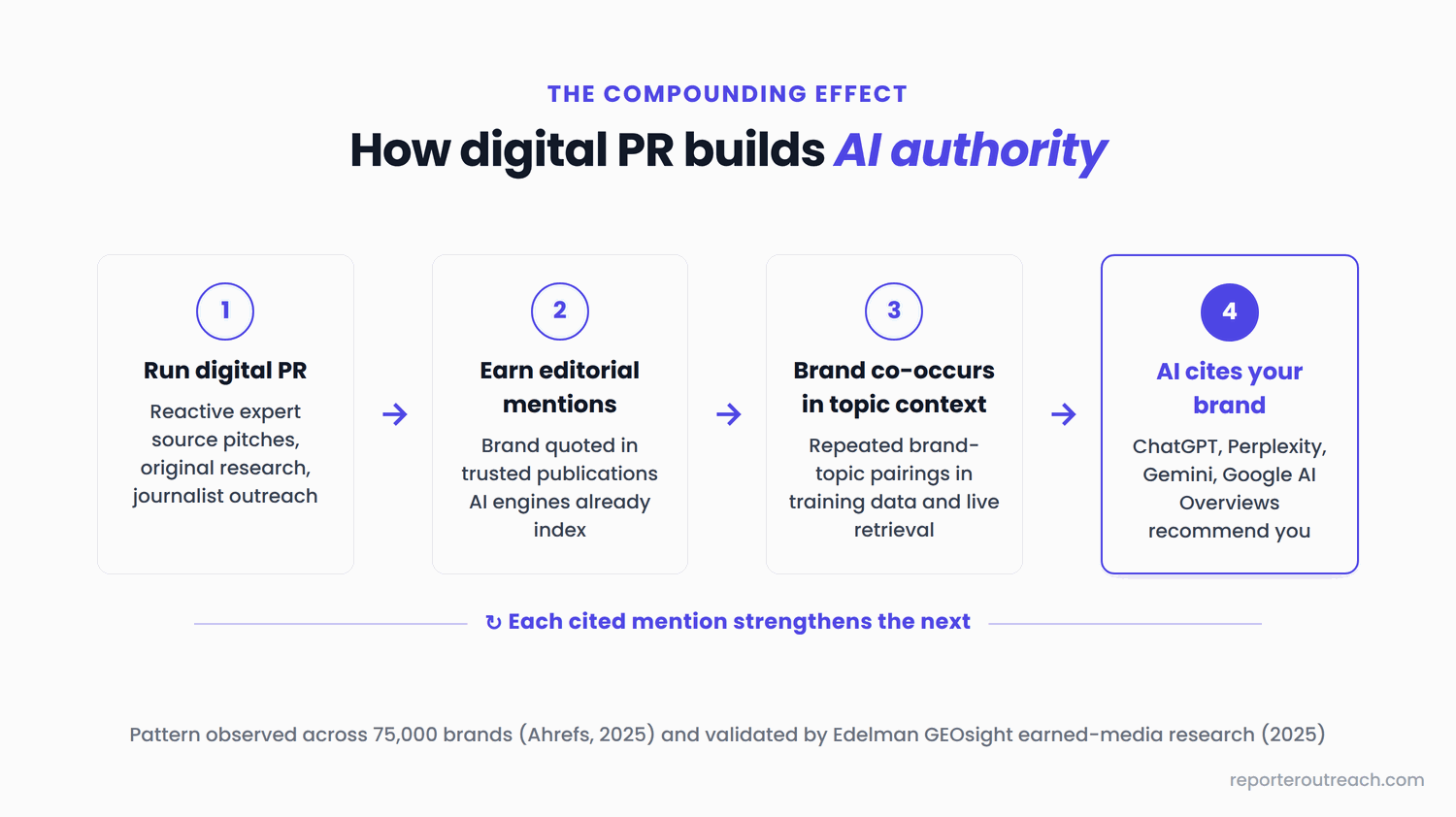
The data backs this up at every level. Edelman's research found that up to 90% of AI citations driving brand visibility originate from earned media — not paid placements. Ahrefs' data shows that brands in the top 25% for web mentions get 10x more AI visibility than the rest. And according to our State of Link Building 2026 survey, the gap between awareness and action is staggering:
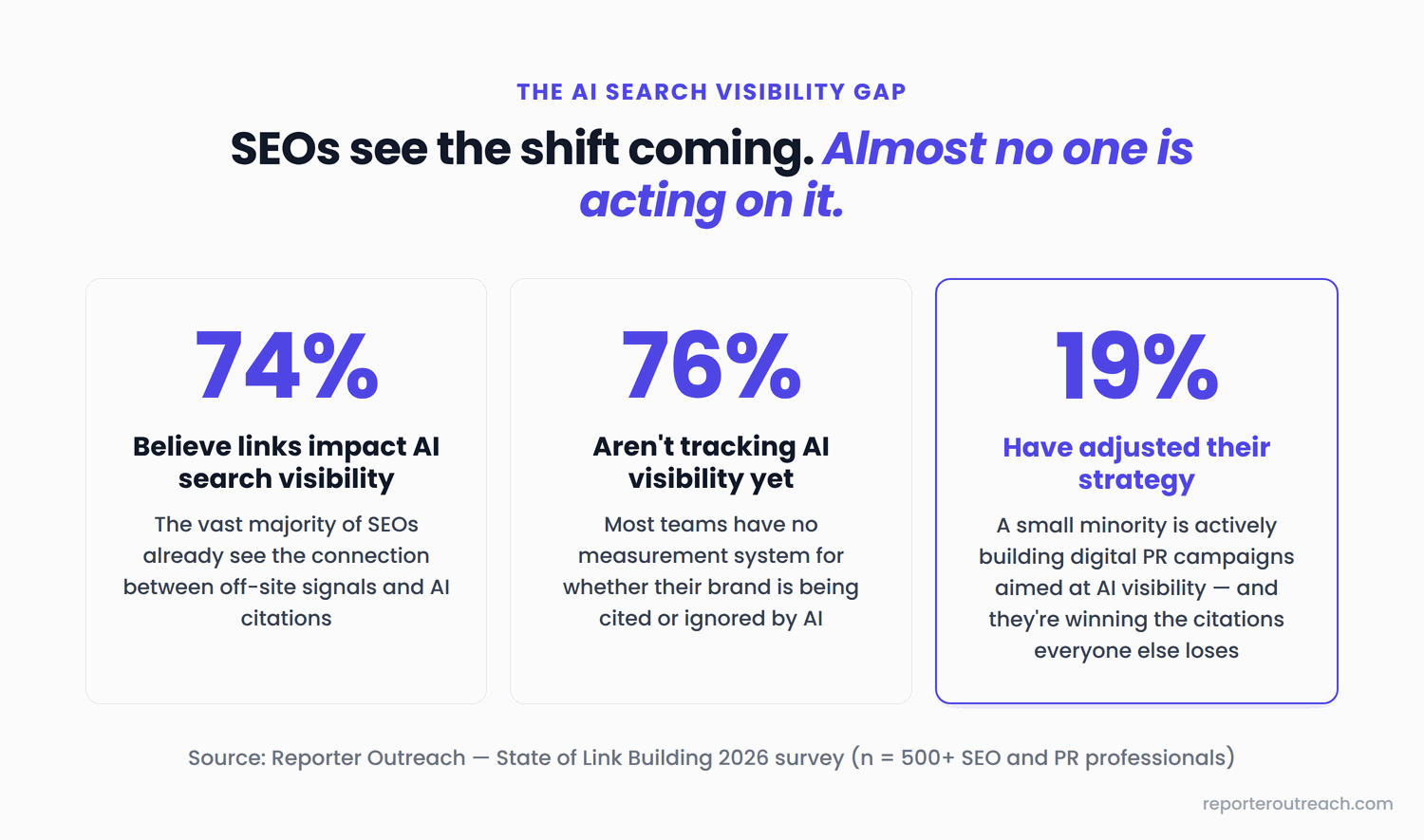
That's a massive gap — and the brands filling it right now will own the AI recommendation slots before everyone else catches up.
A practical workflow: "Answer-Layer Link Building"
- Pick 3 topics you want AI to cite you for. These should be terms your ideal customers actually search — and where AI answers are already appearing. Test them in ChatGPT and Perplexity. See who's getting cited. If it's not you, you have your roadmap.
- Create one citation-ready asset per topic. Original research, expert benchmarks, or statistical analyses with real numbers. Not "ultimate guides." Not listicles. Assets with data points an AI would actually want to extract and attribute.
- Build a quote bank. Write 10-20 short, punchy expert quotes reporters can use directly. "In AI search, a backlink is helpful — but a repeated brand mention in the right context is what teaches the system who you are" is the kind of quote that gets lifted into articles verbatim.
- Run consistent outreach. Journalist request platforms (Qwoted, Featured), targeted pitching to niche writers, and reactive PR on trending topics. The cadence matters more than any single placement — AI trust is built through repeated mentions over time, not one viral hit.
- Consolidate. Add earned coverage to a "Featured In" section. Link from your homepage. Publish press recaps. Each piece of coverage makes the next placement easier, the next AI citation more likely. That's the compounding effect.
Technical Foundations You Can't Skip
You don't need "AI-specific markup." But you need the basics done extremely well — because AI is far less forgiving of technical gaps than traditional search.
Unblock AI crawlers. This is the single most common mistake we see. Cloudflare recently changed its default to block AI bots automatically. If you're using Cloudflare (and millions of sites are), you may be blocking ChatGPT, Perplexity, and other AI crawlers without knowing it. Check your robots.txt for "ChatGPT-User" and review your server logs quarterly. You can't get cited if AI can't read your pages.
Implement structured data. JSON-LD schema helps AI systems categorize and understand your content at scale. At minimum: Article or BlogPosting for content pages, Organization site-wide, Person for author pages with real credentials, and FAQPage for genuine Q&A sections. If you have a local presence, align structured data with your Google Business Profile for entity consistency.
Use semantic HTML properly. One H1 per page, logical heading hierarchy, real list elements (not line breaks pretending to be lists), and tables for comparison data. AI parses your DOM structure before deciding whether to cite you. Sloppy markup makes extraction harder, and AI doesn't try very hard.
Internal linking. Links between your pillar and cluster content tell AI how your topics relate. But don't overdo it — 3-5 genuinely useful internal links per page that help readers go deeper on subtopics they care about. Forced links to every service page on every article dilute the signal.
AI models evaluate E-E-A-T signals — Experience, Expertise, Authoritativeness, Trustworthiness. Author pages with real credentials, linked to external works, and backed by Person schema give AI a clear entity to associate with your expertise. A byline that links to a blank page or a generic "About the Author" sentence does nothing.
Measuring Progress When Clicks Go Down
Here's where most teams panic. Traditional organic traffic flatlines on certain queries because AI summaries absorb the clicks. But if you're being cited in those summaries, your brand awareness and conversion quality may be climbing — you just can't see it in the old dashboard.
The metrics that matter now:
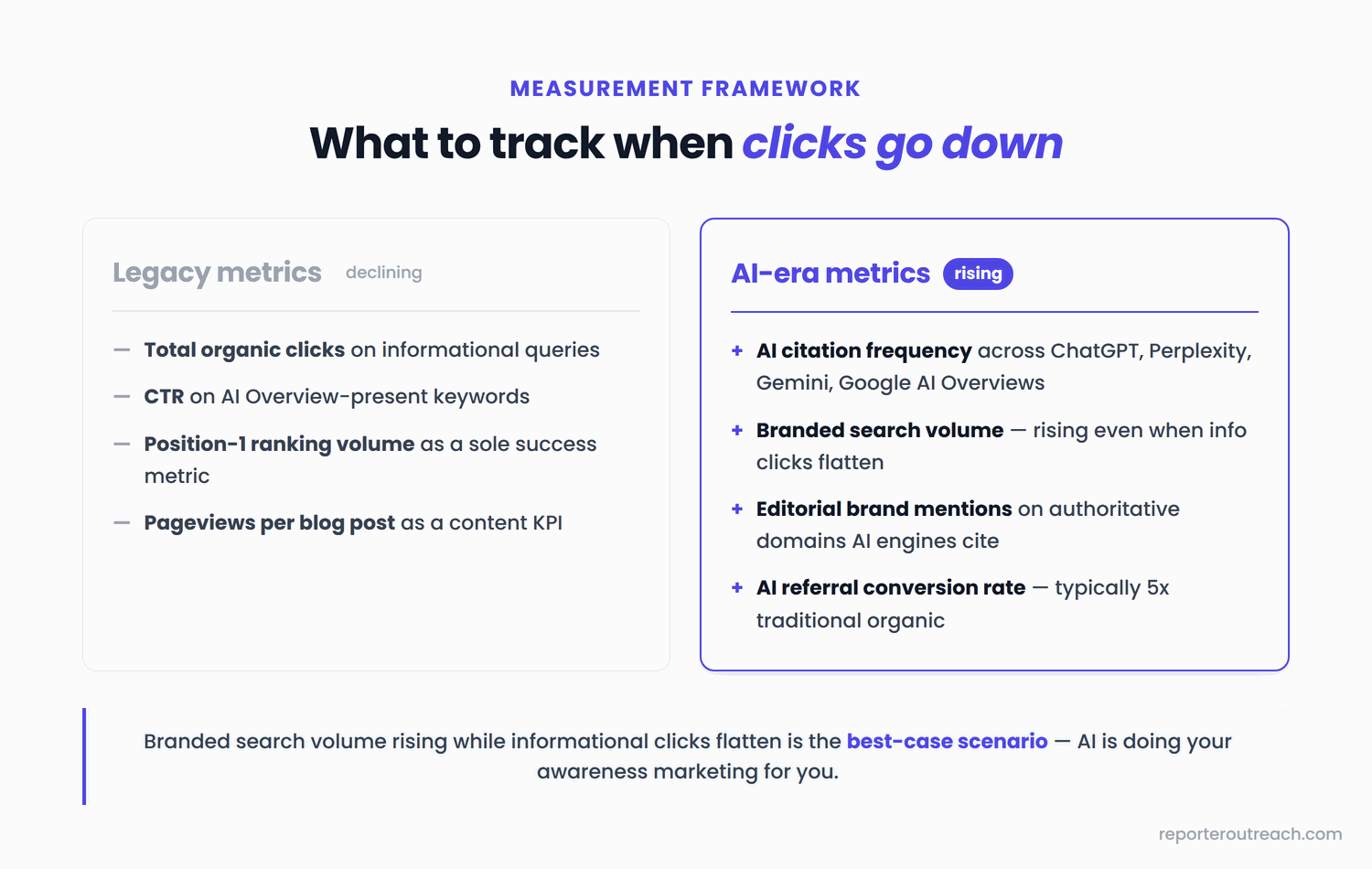
The hardest mindset shift is accepting that total clicks may stagnate on informational queries where AI answers on-SERP. That doesn't mean you're losing. If your brand is being cited in those AI summaries, you're building awareness and trust at scale — the same way a brand mentioned in a magazine article builds authority even if the reader never visits the website.
Watch the downstream effects. Branded search volume rising while informational clicks flatten is actually the best-case scenario — it means AI is doing your awareness marketing for you, and interested users are searching for you by name. That's a warmer lead than any organic click ever was.
The AI Search Optimization Playbook
Here's the full picture, compressed into what actually moves the needle. No filler, no "step one: have good content" platitudes.
| Priority | Action | Why It Works |
|---|---|---|
| 1 | Run monthly digital PR — editorial mentions, expert quotes, reactive commentary | Brand mentions are 3x more correlated with AI visibility than links. This is the #1 lever. |
| 2 | Publish original data — surveys, benchmarks, campaign analyses with real numbers | Content with original data earns up to 40% more AI citations. Original numbers make you citable. |
| 3 | Structure content for extraction — clean headings, lists, tables, FAQ sections, mini-conclusions | 2.8x citation advantage for properly structured pages. AI needs to parse before it can cite. |
| 4 | Build topic clusters — one pillar with 5-10 supporting articles, all interlinked | Topical authority signals help AI identify you as an expert on a subject, not just a page on a keyword. |
| 5 | Implement Article, Organization, Person, and FAQ schema (JSON-LD) | Structured data makes content machine-readable. AI can categorize you faster and more accurately. |
| 6 | Unblock AI crawlers and audit quarterly | Can't get cited if AI can't read your pages. Cloudflare's default blocks AI bots — check yours. |
| 7 | Refresh high-value content quarterly — new stats, updated references, added FAQ questions | Content updated within 2 months earns 28% more AI citations than older content (SE Ranking). |
Notice what's not on this list: buying AI-specific tools, hiring a "GEO agency," or gaming the system with prompt optimization. AI search optimization isn't a new discipline bolted onto SEO. It's the natural evolution of what already works — authoritative content, strong off-site signals, and technical foundations — applied to the way search is actually consumed now.
The brands that treat this as a separate initiative will waste money. The brands that integrate it into their existing content and digital PR strategy will compound their advantage every month.
Ready to Become the Source AI Trusts?
We run digital PR campaigns that earn the editorial mentions and brand signals AI systems rely on — building both traditional rankings and AI citations.
Frequently Asked Questions
Does AI search optimization replace traditional SEO?
No — it builds on top of it. Traditional SEO still feeds the retrieval pipeline that AI relies on. What changes is the emphasis: beyond rankings and clicks, you're optimizing for citation-readiness, brand authority signals, and structured content that AI can extract and attribute. Think of it as an additional layer, not a replacement.
Should I block AI crawlers from my site?
If your goal is visibility, generally no. Blocking AI crawler access means removing yourself from the citation pipeline entirely. The exception is if your business model depends on gating content (paywalls, proprietary databases). For most brands, the visibility benefit of being crawled far outweighs the risk. Just audit your Cloudflare and CDN settings quarterly — many sites are blocking AI bots without realizing it.
What's the fastest way to get cited by AI?
Publish original data and back it with digital PR. Content that contains unique statistics, expert analysis, or proprietary research gives AI something concrete to attribute to your brand. Then editorial mentions across authoritative publications reinforce your credibility as a source. Neither content alone nor authority alone is enough — you need both working together.
If AI reduces clicks, why invest in AI visibility?
Because the clicks that come through are worth far more. AI-referred visitors convert at 14.2% versus 2.8% for traditional organic traffic. They arrive already understanding what you do and why you're credible — the AI pre-qualified them. Beyond direct traffic, being cited builds brand awareness at scale. Users who see your brand recommended by AI search later for you by name, creating branded demand that converts at even higher rates.
What tools track AI citation performance?
Ahrefs Brand Radar and Semrush AI Visibility Toolkit are the most comprehensive incumbent options. Lower-cost specialists like LLMrefs (free tier or $79/mo Pro) and Peec AI ($95-$241/mo) track citation frequency across AI platforms. For a full comparison by buyer segment and budget, see the best AI visibility tools breakdown. For referral traffic, filter GA4 by ChatGPT, Perplexity, and other AI referrer domains. But honestly, the most underrated method is manual testing — open ChatGPT, Perplexity, and Google AI Mode, type your target queries, and see who gets cited. That 10-minute exercise tells you more than any dashboard.
What's the difference between AI search optimization and GEO?
Same concept, different labels. Generative Engine Optimization (GEO), Answer Engine Optimization (AEO), and AI SEO all describe the practice of optimizing content so large language models and AI platforms treat your brand as a trusted, citable source. The terminology is still settling — the strategy is the same regardless of what you call it.
Sources: Ahrefs — Brand Radar AI Visibility Correlation: 75,000 Brands (2025) | Conductor — AEO/GEO Benchmarks Report, Q1 2026 | Seer Interactive — AI Overviews CTR Impact Study | Clickcentric — AI Referral Traffic Conversion Data | Princeton University — GEO Citation Impact Study | SE Ranking — AI Mode Citation Factors (December 2025) | Edelman — Trust Barometer & AI Citation Data (2025) | Reporter Outreach — State of Link Building 2026