Key Takeaways
- HR tech is a $47.5 billion market growing at 10.35% CAGR (Mordor Intelligence). The companies winning organic search aren't the ones with the best content — they're the ones with the deepest editorial footprint across publications like SHRM, HR Dive, and Human Resource Executive.
- Enterprise HR buyers research for an average of 47 days before contacting a vendor, comparing 5.3 tools along the way (SpotSaaS, 2026). If you're invisible during that window, you've already lost the deal.
- HR content sits in YMYL territory — payroll compliance, benefits administration, and employment law all carry legal weight. Google holds this content to elevated E-E-A-T standards, meaning editorial backlinks aren't optional.
- The workplace is a permanent news beat. Every jobs report, wage law change, and AI hiring regulation creates media demand for expert sources — making HR one of the strongest verticals for reactive digital PR.
- AI search is reshaping vendor discovery. ChatGPT and Perplexity recommend HR vendors based on editorial coverage breadth, not ad spend. Brands without media presence don't get recommended.
SEO for HR is a different kind of hard. You're not competing against other startups with similar domain authority — you're up against ADP, Workday, UKG, Paychex, and SAP SuccessFactors. Companies with decades of press coverage, tens of thousands of referring domains, and brand recognition that algorithms reward automatically.
If you're marketing an HRIS platform, staffing agency, payroll provider, or any other HR service, you already know the frustration. Your product might be better. Your content might be more useful. But you're buried on page three because the authority gap is enormous.
This guide explains why that gap exists and how to close it — specifically through the digital PR and link building strategies that actually move the needle for HR companies. Not generic advice about "creating great content." The structural approach to building editorial authority in a vertical where authority is everything.
Why HR Companies Struggle to Rank
HR companies struggle against incumbents like ADP, Workday, and UKG who hold tens of thousands of referring domains from years of media coverage — an authority gap that content quality alone can't close. A mid-market HRIS with 200 referring domains isn't just behind. It's playing a different game.
This matters because Google's algorithm weighs domain authority heavily for competitive commercial queries. "Best HRIS software," "applicant tracking system comparison," "payroll services for small business" — these keywords don't go to the company with the best answer. They go to the company search engines trust most. And trust, in Google's framework, is built primarily through who links to you.

What makes this worse: the buyer journey is painfully long. SpotSaaS tracked over 150,000 HR software buyer journeys in 2025-2026 and found that enterprise buyers research for an average of 47 days before contacting any vendor. They compare 5.3 tools. And 72% have already compared three or more options before booking a single demo.
That means your entire chance to influence the buying decision happens while the buyer is reading articles, checking comparison pages, and asking AI chatbots for recommendations. If you don't show up in those places, you don't exist.
The YMYL Factor in HR Content
A significant portion of HR content falls under Google's Your Money or Your Life classification — the content that matters most for commercial rankings (payroll compliance, benefits administration, employment law guidance, tax withholding) carries direct financial and legal implications for the reader.
Google evaluates YMYL content with elevated E-E-A-T standards. The algorithm doesn't just look at whether your content is comprehensive. It looks at whether credible third parties vouch for your expertise. In practice, this translates to: do recognized HR publications link to you? Do journalists cite your leadership on workforce topics? Does your editorial footprint signal that the industry considers you an authority?
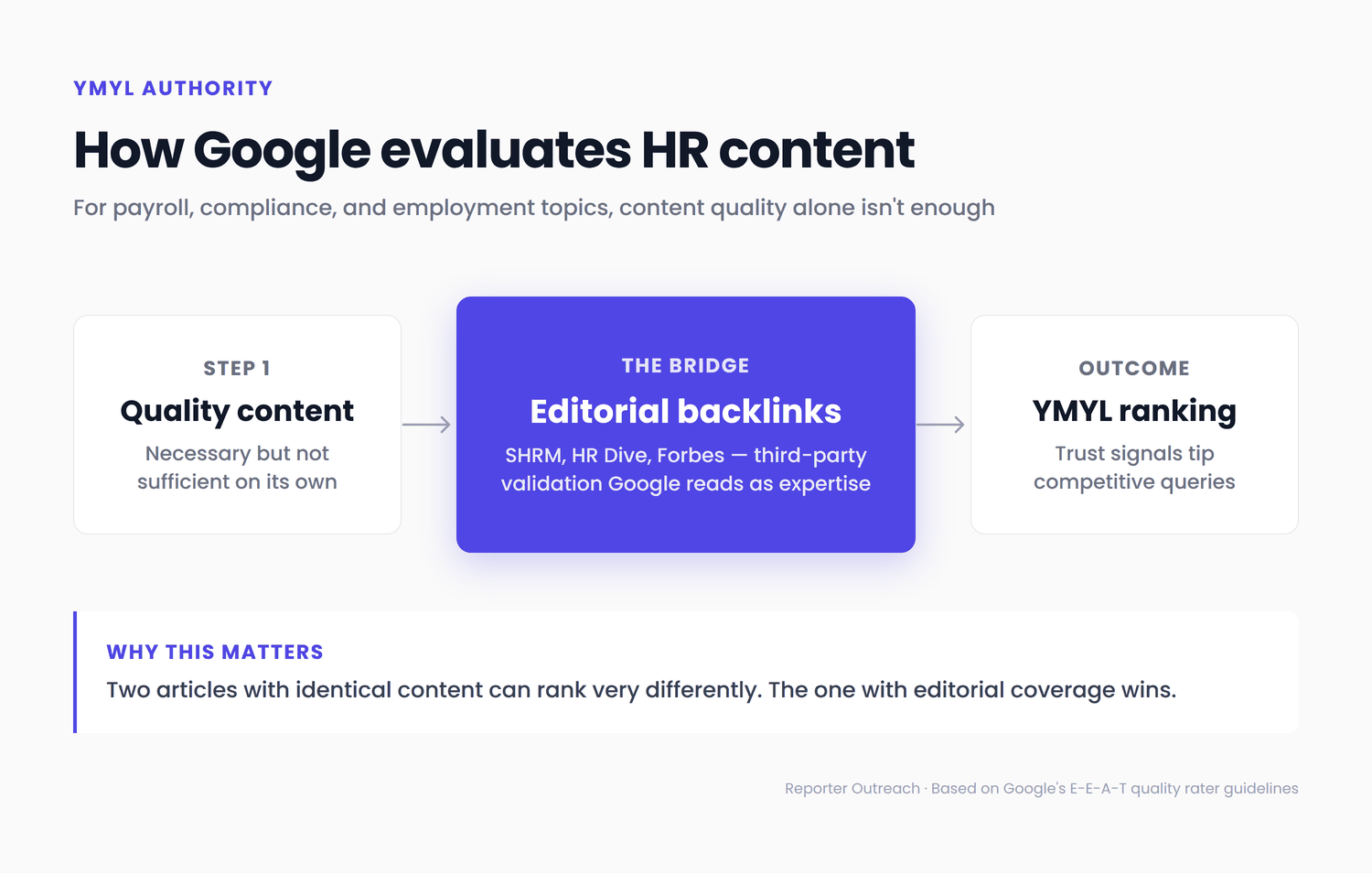
A well-researched blog post about overtime compliance won't rank if Google has no external signals that your company knows anything about employment law. But the same post backed by editorial coverage in SHRM and HR Dive — where your employment attorney was quoted on the same topic — sends a clear E-E-A-T signal. The content quality is identical. The authority signal is what changes the ranking outcome.
This is why content marketing alone fails for HR companies. You can publish a guide to every FMLA edge case in existence, and it won't outrank ADP's version because ADP has 30 years of editorial coverage reinforcing their authority on exactly that topic. The content isn't the bottleneck. The authority is.
Why Digital PR Is the Best Fit for HR Link Building
HR has a structural advantage for digital PR that most B2B verticals simply don't have: the workplace is a permanent news beat.
Every monthly jobs report from BLS needs expert commentary. Every state-level pay transparency law needs compliance analysis. Every AI hiring regulation needs practitioners to weigh in. Remote work policy shifts, mass layoff events, union developments, DEI legislation — there is never a week without multiple HR stories running in national and trade media.
This constant editorial demand is what makes reactive PR so effective for HR companies. Journalists covering the workplace beat need credible sources on a rolling basis. If your CHRO, VP of People, or employment attorney can provide specific, practical commentary on breaking HR news, those placements happen reliably.

Muck Rack's 2026 State of Journalism report puts a number on this: 86% of journalists say at least some of their stories originate from PR pitches. But 88% immediately delete pitches that miss their beat. The delta between those two numbers is the entire game — relevant, beat-matched outreach works. Everything else is noise.
For HR companies, this means your spokespeople are your most valuable SEO asset. Not your blog. Not your keyword strategy. The CHRO who can speak to implementation challenges with real specificity. The employment attorney who can break down a new pay transparency law on deadline. The talent acquisition VP who has data on what's actually happening in hiring.
These are the people journalists want to quote. And every quote that runs in SHRM, HR Dive, Forbes' workplace section, or Human Resource Executive is a backlink from a high-authority domain that directly strengthens your ability to rank for competitive HR keywords.
HR clients consistently see faster placement timelines than other B2B verticals. The volume of journalist demand on workforce topics — especially AI in hiring, compliance changes, and labor market commentary — means there are more opportunities to respond to per week. Most HR campaigns secure their first placements within 2-3 weeks.
Target Publications for HR SEO
The most valuable HR SEO backlinks come from HR trade publications like SHRM and HR Dive — topical relevance compounds in ways that generic business media doesn't. A link from SHRM carries more topical authority than a link from a generic business blog, even if the generic blog has a higher domain rating.
Here's how we tier publication targets for HR campaigns:
| Tier | Publications | DR Range | Why It Matters |
|---|---|---|---|
| Tier 1 — HR Trade | SHRM, HR Dive, Human Resource Executive, Workforce, HR Brew | DR 75–88 | Topical authority; what CHROs actually read |
| Tier 2 — Business | Forbes, Inc., Fast Company, Business Insider, Bloomberg | DR 90+ | Highest raw domain authority; broad reach |
| Tier 3 — Vertical | Recruiter.com, BenefitsPRO, Staffing Industry Analysts, Modern Healthcare HR | DR 60–80 | Niche topical fit for staffing, benefits, healthcare HR |
A note on strategy: CHROs and HR directors trust SHRM and HR Dive far more than they trust Forbes. If your entire link building strategy targets only Tier 2 business publications, you're building authority in the wrong places for your actual buyer. The most effective approach combines both — Tier 1 for topical trust, Tier 2 for raw domain authority.
Link Building Strategies That Work for HR
Workforce trend newsjacking
This is the highest-ROI strategy for HR companies, and it's not close. Every BLS jobs report, state wage law change, AI hiring regulation, and major layoff announcement creates a 24-48 hour window where journalists actively seek expert commentary. Your CHRO or employment attorney responds with specific, practical analysis — not marketing-speak — and the placement runs within days.
The key word is specific. "AI is changing the future of work" is worthless commentary. "The new NYC AI hiring audit law means companies using automated screening need independent bias audits by January — here's what the compliance process actually looks like" is what gets quoted. Specificity is what separates sources journalists use once from sources they call back repeatedly.
Original workforce research
HR companies sitting on aggregated workforce data have a link building advantage most don't realize. If your platform processes payroll for thousands of companies, that anonymized data — wage growth patterns, benefits adoption rates, time-to-hire benchmarks — is exactly what journalists need for trend stories.
Publish it as an annual report (state-of-hiring, compensation benchmark, employee engagement survey) and it becomes a citable source. Every subsequent article on the same topic references your data. The links compound without any additional outreach.
Expert commentary via journalist platforms
HR journalists on Qwoted, Featured, and similar sourcing platforms post queries daily about skills-based hiring, AI in recruitment, employee retention, workplace flexibility, and compliance challenges. These are free-throw opportunities. Your spokesperson responds with a tight, usable quote, and the placement comes to you.
The catch: speed matters. Most journalist queries have 24-48 hour deadlines. Companies with pre-approved spokesperson bios and a streamlined approval process win disproportionately. The ones routing every response through legal and marketing review miss every window.
Targeted link insertions
Digital PR builds domain-wide authority, but link insertions address a different problem: getting links pointing to specific product and solution pages. HRIS comparison articles, ATS review roundups, staffing software buyer's guides — these are existing articles with established rankings where a relevant link to your product page carries outsized SEO value.
AI Search and HR Vendor Discovery
HR technology buyers are increasingly using AI search for vendor research. "Best HRIS for mid-size companies," "top applicant tracking systems," "staffing agencies for healthcare recruiting" — these queries are being asked in ChatGPT, Perplexity, and Google AI Mode. And the recommendations are shaped almost entirely by which brands have the broadest editorial coverage across trusted publications.
AI doesn't recommend the company with the best product. It recommends the company it's seen referenced most frequently in credible sources. That's the fundamental mechanic — and it's why editorial coverage has become a dual-purpose asset. Every backlink from SHRM or HR Dive strengthens both your traditional search rankings and your visibility in AI-generated recommendations.

Three specific dynamics make this urgent for HR companies:
- Committee decisions amplify the problem. Enterprise HR purchases involve CHROs, CFOs, IT, and sometimes legal. Each stakeholder researches independently using different queries. If AI recommends your competitor across all of those queries and never mentions you, you've lost influence at every touchpoint before your sales team gets involved.
- AI is cautious about employment recommendations. Similar to financial advice, AI applies extra scrutiny to HR vendor recommendations. It favors brands with deeper, more diverse editorial footprints — not the ones mentioned in a single roundup article.
- Platform overlap is low. What ChatGPT recommends differs from Perplexity, which differs from Google AI Mode. Your brand needs broad editorial coverage across the full HR media landscape, not just one or two publications.
Approach by HR Subcategory
HR is a massive umbrella. The link building approach that works for an HRIS platform is different from what works for a staffing agency, which is different from a PEO. Here's a quick reference:
| Subcategory | Primary Strategy | Top Target Publications | First Placement |
|---|---|---|---|
| HRIS / HCM | Newsjacking + original workforce data | SHRM, HR Dive, Forbes | 2–4 weeks |
| Staffing & Recruiting | Labor market commentary | SIA, HR Dive, sector trades | 3–5 weeks |
| Payroll & Compliance | Tax law and compliance commentary | SHRM, HR Dive, BenefitsPRO | 2–4 weeks |
| ATS / Recruiting | AI hiring law + original hiring data | HR Dive, Recruiter.com, TechCrunch | 3–5 weeks |
| Benefits & PEO | Benefits trends, ACA reporting | BenefitsPRO, SHRM, Inc. | 3–5 weeks |
| Talent Management | Performance and engagement research | HR Dive, HRE, Fast Company | 4–6 weeks |
Common Mistakes in HR SEO
- Leading with product features instead of workforce insight. Journalists covering the workplace beat don't want to hear about your platform's new scheduling module. They want expert commentary on what's actually happening in the labor market. If your pitches read like product announcements, they get deleted — 88% of journalists say so explicitly.
- Missing the policy cycle window. When a new pay transparency law passes or BLS releases a jobs report, the media window is 24-48 hours. HR companies without pre-approved spokesperson materials and a fast-track approval workflow miss every single opportunity. By the time legal approves the quote, the article is published without you.
- Ignoring niche HR publications. A common instinct is to target only Forbes, Inc., and Business Insider. But CHROs read SHRM and HR Dive far more than general business media. If your link profile is all Tier 2 with no Tier 1, you're building authority where your buyer isn't looking.
- Treating link building as a one-time project. Authority compounds. A three-month sprint followed by silence won't close the gap against incumbents who've accumulated coverage for decades. This is a long game — see our timeline guide for realistic expectations on when rankings start moving.
- Sending the marketing team instead of practitioners. HR journalists overwhelmingly prefer quotes from CHROs, VPs of People, and heads of talent acquisition over marketing teams. A CHRO who can speak to real implementation challenges carries far more editorial weight than a polished marketing quote.
Budget and Timeline
HR sits in the mid-to-high range for B2B link building budgets, primarily because the competition includes some of the most authoritative domains in all of SaaS. Here are the realistic numbers:
| Investment Tier | Monthly Budget | Realistic Output | Best Suited For |
|---|---|---|---|
| Entry | $3,000–$5,000 | 4–6 placements/mo, mostly Tier 2 and niche | Early-stage HR tech, boutique staffing |
| Standard | $5,000–$10,000 | 8–12 placements/mo, mix of Tier 1 + 2 | Funded HR SaaS, mid-market platforms |
| Aggressive | $10,000–$20,000+ | 15+ placements/mo, regular Tier 1 wins | Brands competing for head terms vs. incumbents |
HR companies often see faster initial placement timelines than other B2B verticals because the volume of journalist demand on workforce topics is consistently high. But ranking movement takes the standard 3-6 months because the competition is fierce. The companies that see the best results commit for 6-12+ months — long enough for authority to compound across multiple publications and topic areas.
Getting Started
- Audit your backlink profile against the incumbents. Pull your referring domains in Ahrefs and compare against whoever's ranking above you for your most important keywords. The size of the authority gap tells you what kind of investment and timeline to plan for.
- Identify your credentialed spokespeople. Who holds SHRM-SCP, SPHR, or PHR certifications? Which leaders have deep expertise on specific workforce topics? These are the people journalists want to quote, and they're the foundation of any digital PR campaign.
- Build a rapid-response process. Pre-approved expert bios, a one-person approval chain (not five), and a commitment to respond to media opportunities within hours, not days. When the next BLS report drops, you want to be quoted — not still drafting a response.
- Talk to a specialist. A 15-minute strategy call with our HR digital PR team can identify which publications to target, which spokespeople to lead with, and what timeline to expect for your specific competitive landscape.
Ready to Close the Authority Gap?
Free competitive analysis showing which HR publications to target for maximum ranking impact.
Frequently Asked Questions
Why can't HR companies just outrank incumbents with better content?
For high-value commercial keywords, the ranking algorithm heavily favors established domains. An HR startup with DR 30 might produce a more useful guide than ADP, but ADP's DR 91 — accumulated over decades of press coverage — wins every time. Better content only becomes the differentiating factor when two sites have comparable authority levels. That's why building editorial backlinks comes first.
What types of HR companies benefit most from digital PR?
Any company with subject matter experts who can comment on workforce trends: HRIS platforms, staffing agencies, payroll providers, PEOs, benefits platforms, and talent management software. The companies that see the fastest results are the ones with credentialed spokespeople (SHRM-SCP, SPHR) and a willingness to respond to journalist queries quickly.
Do we need HR-certified professionals for media placements?
Certifications increase placement rates because HR journalists prefer practitioner sources with demonstrated credentials. But they're not strictly required — founders with deep domain expertise and companies with original workforce data can also earn coverage. Credentialed spokespeople simply make the process faster and more consistent.
How long before we see ranking improvements?
First placements typically arrive within 2-4 weeks for HR campaigns, thanks to the constant journalist demand on workforce topics. Ranking movement for competitive keywords takes 3-6 months. The real compounding effect — where authority accumulates enough to compete for head terms — usually becomes visible at the 6-12 month mark.
Should we target HR trade publications or general business media?
Both, but for different reasons. HR trade publications (SHRM, HR Dive) carry stronger topical relevance — search engines recognize these as authoritative sources on workforce topics. General business publications (Forbes, Inc.) carry higher raw domain authority. The most effective campaigns target both tiers to build authority that's both topically relevant and broadly recognized.
What ROI should we expect from HR link building?
HR keywords carry Google Ads CPCs of $10-$40+, with competitive terms like "best HRIS software" reaching $50+ per click. Every organic ranking replaces paid traffic at those rates. Over time, the authority you build compounds across all your pages — not just the ones you're targeting. A single editorial placement in SHRM strengthens your entire domain, improving rankings for every keyword you're pursuing.
Sources
- Mordor Intelligence — HR Technology Market Size & Growth Forecast, 2026
- SpotSaaS — HR & Payroll Software Buying Trends, 150,000+ buyer journeys tracked (March 2025–March 2026)
- Muck Rack — State of Journalism 2026 (897 journalist respondents)
- Staffing Industry Analysts (SIA) — US Staffing Industry Revenue, 2024
- SHRM — 2025 HR Benchmarking Reports (2,371 respondents)