Key Takeaways
- The best link building tools depend on what you're actually doing. Digital PR, guest posting, and link insertions each need different stacks — this guide is organized by workflow stage instead of alphabetical order.
- If you only buy one paid SEO platform, start with Ahrefs or Semrush. Everything else gets built around whichever one you pick.
- Journalist sourcing is the most underrated category. Qwoted, HARO (back from the dead in 2025), Featured, and Source of Sources produce editorial placements at DR 70+ publications for less than a single Ahrefs seat.
- Free tools carry more weight than most guides admit. Google Search Console, Google Alerts, HARO, and Screaming Frog's free tier handle most of what an agency's monitoring stack does.
- Every tool on this list is one we open every morning. Not affiliate picks — the actual stack behind our campaigns.
Most "best link building tools" articles list the same fifteen tools with rewritten feature blurbs and an affiliate code at the bottom. This one is different in one specific way: it's organized by the stage of the workflow you're weakest at, not alphabetically.
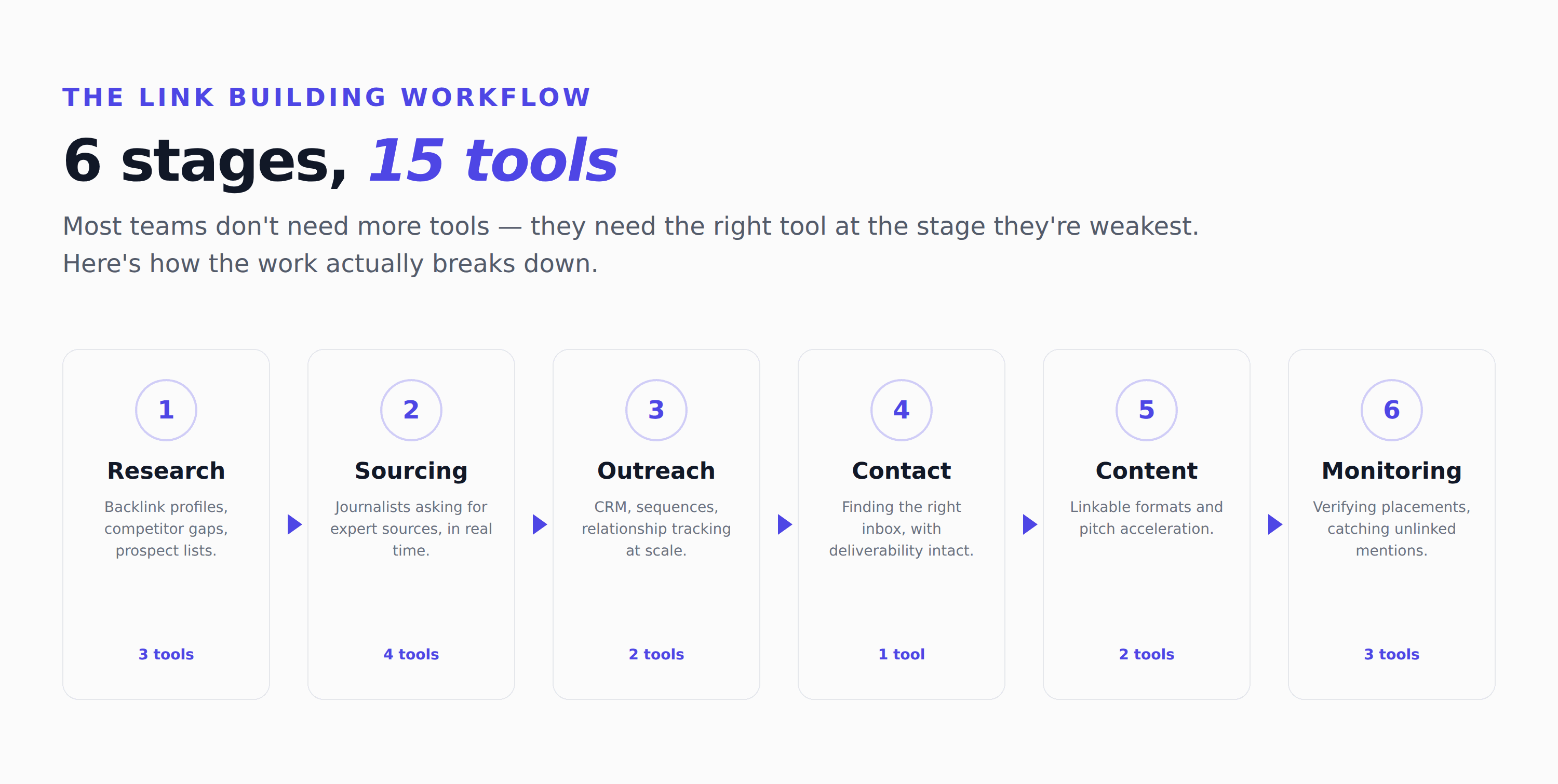
Research. Prospecting. Outreach. Contact finding. Content research. Monitoring. Each stage has its own tools, and most teams don't need more of what they already have — they need the one missing piece that closes the loop.
Fair warning: this skips a category almost every guide ignores. Journalist sourcing platforms. If you're doing digital PR link building, these are the most important tools in your stack, and they cost less combined than a single enterprise seat anywhere else.
Here's how the work actually breaks down across the six stages, and how many tools live in each:
Backlink Research and Competitive Analysis
Every campaign starts here. You need to understand what you already have, what your competitors have that you don't, and which opportunities sit within reach. Two platforms do most of this work. A third fills in the gaps.
1. Ahrefs
Best for: Depth of backlink data, competitor profiling, link gap analysis
Pricing: $129/mo (Lite) to $1,499/mo (Enterprise). New $29/mo Starter plan added in early 2026.
Ahrefs runs the second-most active crawler on the web — behind only Google — and its backlink index is the largest commercial one available. For link builders, three features matter. Site Explorer gives you any domain's full backlink profile with anchor text, referring domains, and DR breakdown. Content Explorer surfaces pages in any niche sorted by how many referring domains they've earned, which tells you what formats actually attract links in your space. Link Intersect shows you sites that link to your competitors but not you — the fastest prospect list you can generate.
It's been the industry default for over a decade. We use it daily to evaluate backlink profiles, vet insertion sites before we quote them, and watch domain rating shifts across client campaigns. Link Intersect alone pays for the subscription most months.
One important caveat after the 2024 pricing restructure: Lite no longer includes Content Explorer — that requires Standard ($249/mo). If link prospecting is the main reason you're considering Ahrefs, Lite is the wrong tier.
Ahrefs and Semrush aren't really interchangeable — they emphasize different things. Ahrefs has the deeper backlink index. Semrush has the broader toolkit. Most agencies we know run both. Most in-house teams pick one and live with the tradeoff.
2. Semrush
Best for: All-in-one platform with outreach features built in
Pricing: $139.95/mo (Pro) to $499.95/mo (Business)
Semrush spans 55+ tools across SEO, content, and competitive research. For link building specifically, the Backlink Gap tool compares your profile against up to four competitors at once. The built-in Link Building Tool handles prospecting, outreach, and tracking without making you export to another platform — which is the main reason teams choose Semrush over Ahrefs. Everything happens in one dashboard.
The tradeoff is that its backlink index isn't quite as deep as Ahrefs. For most teams that gap doesn't matter. If you're specifically vetting high-DR link insertion sites at scale, it might.
3. Moz Pro and Link Explorer
Best for: Domain Authority scoring, spam detection, prospect vetting
Pricing: $49/mo (Standard) to $249/mo (Premium)
Domain Authority is still the metric half the web uses to evaluate your site. Even publishers who know what DR is will often ask for DA. That alone is a reason to have Moz access somewhere in your workflow.
The more interesting feature is Spam Score. It flags toxic sites before you approach them — something Ahrefs and Semrush do less aggressively. If you inherit an old backlink profile and want to audit what's actually helping versus hurting, Moz's spam detection is worth the entry tier on its own.
Journalist Sourcing Platforms
This is the category every guide skips. And it's the one producing the highest-quality placements in most of our campaigns.
The model is simple: journalists post what they're working on and what kind of expert they need. You respond with commentary that fits the angle. If yours is the best fit, you get quoted — and when the article runs, you've earned an editorial backlink from a real publication because someone decided your expertise was worth citing.
No cold outreach. No guest post negotiations. No pitching article ideas to editors who are drowning in pitches. You're answering a question that was already being asked.
4. Qwoted
Best for: Connecting with journalists at top-tier publications
Pricing: Free (2 pitches/month, 2-hour delay) | Pro $99/mo (unlimited pitches, no delay)
Qwoted is where we spend most of our sourcing time. Journalists from Forbes, Healthline, Bustle, Allure, and similar outlets post requests, and the dashboard shows you response analytics — when the journalist opened your pitch, whether they saved it, whether they replied. That visibility alone makes it worth the Pro tier.
The platform also runs AI-detection on incoming pitches via Pangram, which filters out the spam responses that plague older platforms. If you write thoughtful pitches, you're competing with a smaller field than you'd expect.
5. HARO
Best for: Free, low-friction journalist queries delivered to your inbox
Pricing: Free
HARO is back. Cision shut it down in December 2024 (after a brief, unloved rebrand to Connectively), and Featured.com bought the brand in April 2025 and relaunched it as a free, ad-supported email newsletter. Three digests a day, same model that worked for fifteen years.
The honest caveat: it's not what it used to be. At its peak, a single HARO digest had over 100 journalist queries. Today it's closer to 20. The journalist density hasn't recovered — a lot of reporters moved to Qwoted, Featured, or Twitter during the Connectively era and haven't come back. Still worth running because it's free and the queries that are there cover publications you can't reach through any other channel.
Treat it as a passive feed rather than an active workflow. Set the email rule, scan the digests, respond to the 1–2 queries per day worth pitching. For the full playbook on pitching these platforms — what converts and what gets deleted — see our media outreach guide.
6. Featured
Best for: Email-based workflow with DA-filtered query targeting
Pricing: Three free pitches/month (basically a demo) | Paid plans roughly $100/mo for the useful tier
Featured (the parent of HARO since the 2025 acquisition) runs its own paid platform that's structurally different from the HARO newsletter. Instead of three daily digests, you get filtered queries based on your expertise areas, with DA scoring on each query so you can prioritize which ones to pitch.
The free tier exists but isn't really usable — three pitches per month is a demo, not a workflow. If you're committing to the platform, you're on a paid plan. The paid tier earns its place if your goal is volume on tier-2 publications; you'll pitch more queries on Featured than on Qwoted, but the average publication tier sits a notch lower.
We pair Featured with Qwoted rather than choosing between them. Different journalists use different platforms, and the average overlap between any two journalist platforms sits below 20% — missing queries costs more than running two subscriptions.
7. Source of Sources
Best for: The original HARO model, run by HARO's original founder
Pricing: Free
When Cision shut down Connectively, Peter Shankman — the guy who created HARO in 2008 — built Source of Sources as a direct replacement. Same email-newsletter format, same one-strike-you're-out spam policy that made early HARO work. It's free and likely to stay free.
The journalist density is lower than HARO at its peak but the signal-to-noise ratio is high. If you're already running Qwoted + HARO, SoS adds maybe an extra 10–15 minutes of scanning per day for queries you'd otherwise miss.
Outreach and Campaign Management
Once you have prospects — whether for guest posts, link insertions, or journalist follow-ups — you need a system that lets you run campaigns at scale without losing the personalization that gets replies.
8. BuzzStream
Best for: Outreach CRM for solo operators and small teams
Pricing: Starter $24/mo, Growth $124/mo, Professional $299/mo
BuzzStream is what most agencies standardize on at the entry tier. Prospect management, email sequences, relationship history, and reporting all live in one place. The relationship tracking matters more than it sounds — it keeps two team members from accidentally emailing the same person at the same site about the same campaign, which is embarrassing and tanks your reply rate.
Custom fields let you organize campaigns by client, link type, or any other dimension you care about. At $24/mo, the Starter tier is the best dollar-for-dollar option in this category if you're a solo link builder. The jump to Growth at $124/mo (3 users, 25K contacts, bulk email, automated follow-ups) is where small agencies land.
9. Pitchbox
Best for: Agencies and large in-house teams running many campaigns at once
Pricing: Pro $165/mo, Advanced $420/mo, Scale $675/mo
Pitchbox is what BuzzStream aspires to. Deeper automation, more customizable workflows, and integrations with Ahrefs, Semrush, and Moz for real-time prospect scoring. The white-label reporting is cleaner if you're an agency showing campaign progress to clients.
If BuzzStream is the reliable sedan of outreach tools, Pitchbox is the luxury version — worth it at scale, overkill if you're running two or three campaigns total. The Advanced tier at $420/mo unlocks unlimited users, which is where Pitchbox starts genuinely beating BuzzStream Professional on dollar-per-seat math.
Contact Finding
10. Hunter.io
Best for: Finding email addresses
Pricing: Free (50 credits/mo) | Starter $49/mo, Growth $149/mo, Scale $299/mo
Hunter does one thing, and it does it better than alternatives. Enter a domain, get every email address associated with it, along with confidence scores. The Email Finder takes a name plus a domain and returns that specific person's address. The Chrome extension surfaces contacts while you're browsing prospect sites, which is how most of us actually use it.
With Gmail and Outlook tightening deliverability standards, sending to guessed or generic addresses is a faster path to the spam folder than it used to be. A reliable contact finder isn't optional anymore. The 50-credit free tier handles light use; serious outreach needs Starter at $49/mo.
Content Research and Ideation
11. BuzzSumo
Best for: Finding link-worthy content formats and tracking brand mentions
Pricing: Content Creation $199/mo, Enterprise $999/mo
BuzzSumo indexes content across the web and ranks it by social shares and backlinks earned. Two uses. First, it shows which formats earn links in your space — data studies, interactive tools, long-form guides, whatever it happens to be — so you can build linkable assets instead of guessing. Second, the Brand Monitoring feature tracks unlinked mentions of your brand. Those are some of the easiest links you'll ever earn — a site already referenced you, they just didn't hyperlink. One email usually fixes it.
12. ChatGPT and Claude
Best for: Pitch drafting, prospect research, sharpening email variations
Pricing: Free tiers available | $20/mo (Plus/Pro)
AI assistants have quietly become part of the daily outreach workflow — not for automating outreach, which is how you get blocked, but for accelerating the parts that were always human. Draft opening lines for journalist responses. Research a prospect site before you email them. Generate three anchor text variations when you're stuck on one. Brainstorm angles for a content asset based on what's ranking.
The rule: first-draft accelerator, not replacement. Editors and journalists can spot fully AI-generated pitches instantly, and they delete them faster than obvious spam. If you're letting the model send, you've misunderstood what the tool is for.
Monitoring, Auditing, and Verification
Link building doesn't end when the placement goes live. Links disappear. Articles get updated. Sites change hands and strip out old outbound links. You need tools that tell you what's still there — and what isn't.
13. Google Search Console
Best for: Free backlink verification from the only source that matters
Pricing: Free
The Links report in Search Console shows what Google actually sees. Not what Ahrefs has indexed. Not what Semrush has crawled. What the search engine itself has counted. After every digital PR placement, we check GSC to confirm the link was discovered and indexed. When there's a discrepancy between third-party tools and GSC, GSC is usually right.
14. Google Alerts
Best for: Catching unlinked brand mentions as they happen
Pricing: Free
Set alerts for your brand name, your founder's name, key product names, and — if you want to stay ahead of things — your competitors' names. When new content mentions any of them, Google emails you. The main use case is turning unlinked mentions into links. A short note to the editor ("Hey, thanks for the mention — would you consider adding a link?") converts at a surprisingly high rate because they already know who you are.
It's also a passive competitor intelligence tool. When a competitor gets quoted somewhere, that publication just became a warm prospect for your own outreach.
15. Screaming Frog
Best for: Technical audits and broken link prospecting
Pricing: Free (up to 500 URLs) | £199/year (~$259, unlimited)
Screaming Frog is a desktop crawler. Point it at any site and it returns every URL, every internal and external link, every redirect, every 404. Two use cases for link builders specifically. First, finding broken outbound links on prospect sites — a classic angle for pitching your content as the replacement. Second, auditing your own internal link structure so authority from earned backlinks actually flows where you want it to.
The free tier handles sites up to 500 URLs, which covers most prospect audits. The paid license unlocks unlimited crawls, scheduled runs, and a few advanced features. £199/year is a rounding error at agency scale.
Monitolink
Best for: Backlink monitoring and automated link recovery
Pricing: Free plan available | Paid plans from $29/mo
Monitolink tracks your full backlink profile around the clock and flags broken or removed links faster than the weekly refresh cycles on the bigger SEO platforms. Speed matters here — most broken links get restored or replaced quickly once someone notices, so a same-day alert is the difference between recovering a link and losing it for good.
The differentiator versus passive monitoring is the recovery workflow built in. You can contact the publisher straight from Monitolink — no second CRM, no separate email tool. For agencies, the white-label PDF reports (active, lost, recovered links per client) replace a manual export-and-assemble process that used to eat hours.
At $29/mo entry pricing, it's the cheapest way to add genuine link protection to a stack that already handles acquisition.
Quick Comparison
Every tool above, condensed to the line that matters:
| Tool | Best For | Starting Price |
|---|---|---|
| Ahrefs | Backlink depth, link gap analysis | $29/mo (Starter), $129/mo (Lite) |
| Semrush | All-in-one with built-in outreach | $139.95/mo |
| Moz Pro | DA, Spam Score, prospect vetting | $49/mo |
| Qwoted | Top-tier journalist sourcing | Free / $99/mo Pro |
| HARO | Free email-based queries | Free |
| Featured | DA-filtered, volume on tier-2 outlets | ~$100/mo |
| Source of Sources | Original HARO model, free | Free |
| BuzzStream | Outreach CRM, solo to small team | $24/mo |
| Pitchbox | Agency-grade automation at scale | $165/mo |
| Hunter.io | Finding email addresses | Free / $49/mo |
| BuzzSumo | Linkable content research, mentions | $199/mo |
| ChatGPT / Claude | Pitch drafting, prospect research | Free / $20/mo |
| Google Search Console | Verifying what Google sees | Free |
| Google Alerts | Unlinked brand mention tracking | Free |
| Screaming Frog | Technical audits, broken-link prospecting | Free / £199/yr |
Recommended Stacks by Budget
Here's how the fifteen tools above combine into three realistic stacks at three different price points. We've run campaigns on all three.
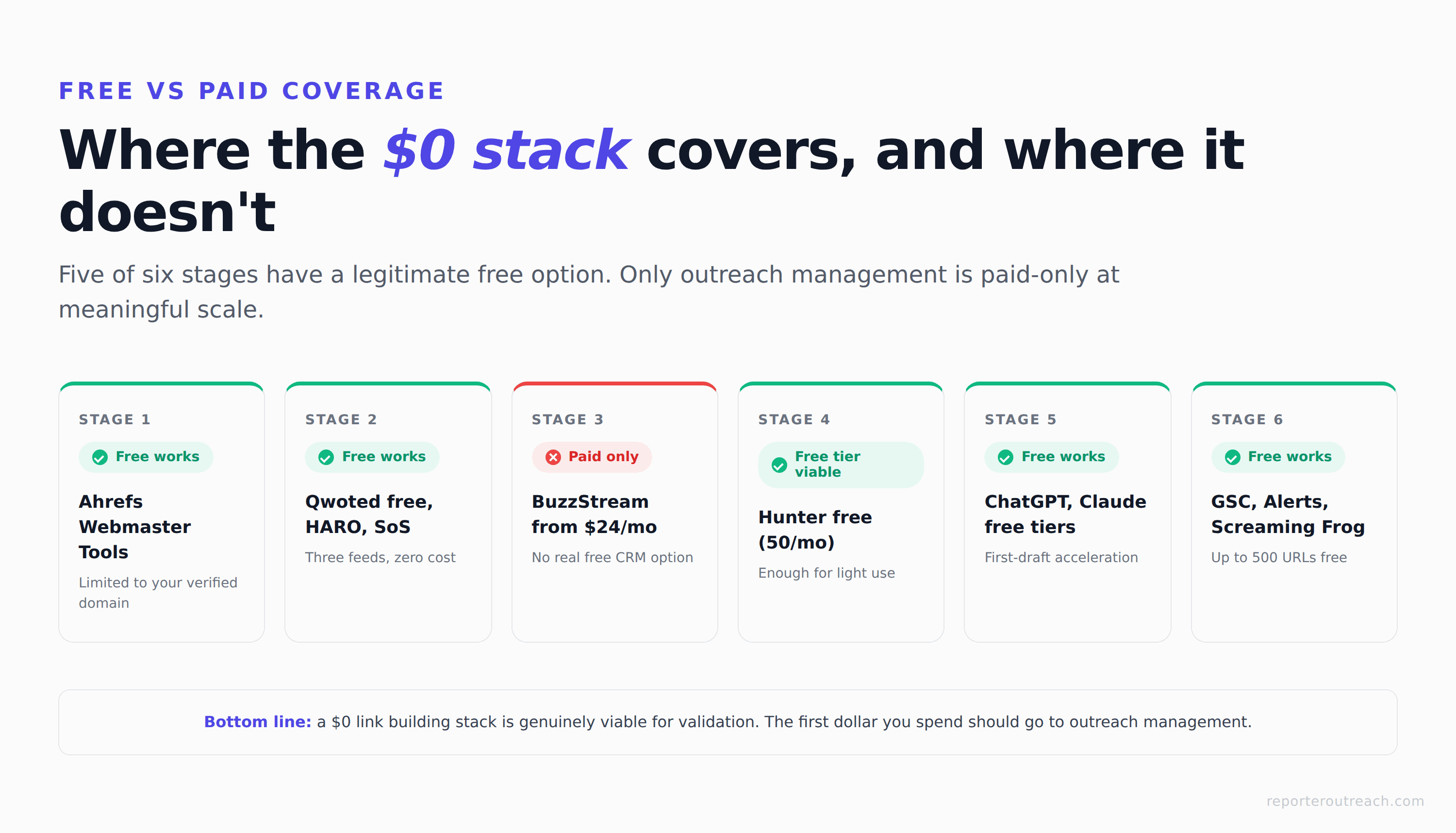
One thing worth knowing before you choose: a $0 stack covers more of the workflow than most people assume. Five of the six stages have a legitimate free option. Only the outreach-management stage is paid-only at any meaningful scale.
From that free baseline, the stack grows as the budget allows. Each tier inherits everything from the one before it — so the question becomes which tools to add next, not which to buy from scratch.
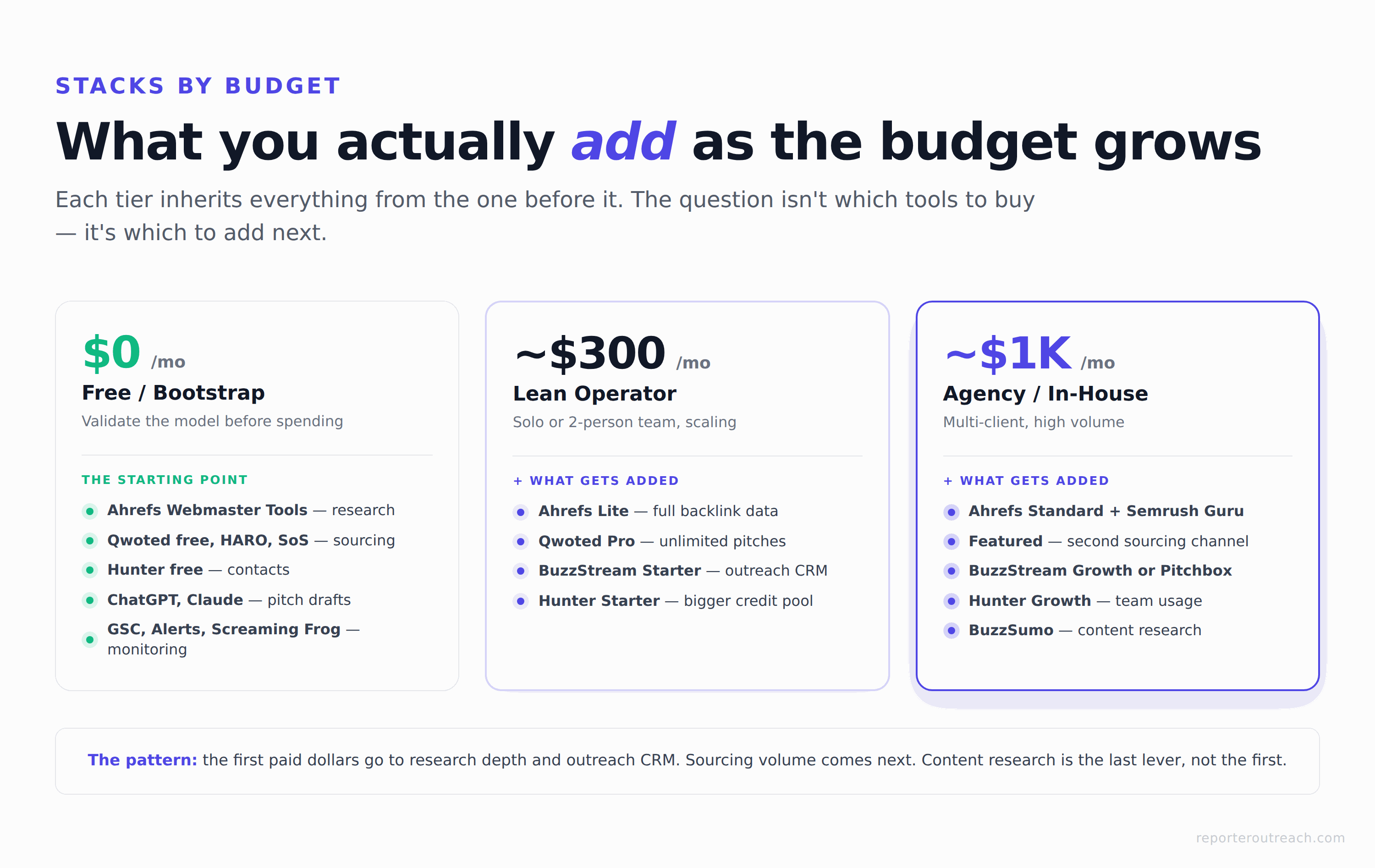
For a flat reference of the three tiers and what each contains:
| Stack | Tools | Monthly Cost |
|---|---|---|
| Free / Bootstrap Validate the model | Qwoted (free) + HARO + Source of Sources + Hunter free + Screaming Frog free + GSC + Google Alerts + Ahrefs Webmaster Tools | $0 |
| Lean Operator Solo or 2-person team, scaling | Ahrefs Lite ($129) + Qwoted Pro ($99) + BuzzStream Starter ($24) + Hunter Starter ($49) + free monitoring stack | ~$300/mo |
| Agency / Serious In-House Multi-client, high volume | Ahrefs Standard ($249) + Semrush Guru ($249.95) + Qwoted Pro + Featured + BuzzStream Growth ($124) or Pitchbox Pro ($165) + Hunter Growth ($149) + BuzzSumo | ~$1,000–1,200/mo |
Most teams overspend at the middle tier. If you're paying $300/mo and not earning placements, the bottleneck isn't the tools.
Why the Best Link Building Tools Aren't Enough
No tool writes a pitch a journalist actually wants to respond to. No tool turns mediocre content into a linkable asset. No tool builds relationships with editors — those take years and reputation and a track record of being useful to reach out to.
The most common pattern we see with teams that stall: they stack expensive tools on top of strategies that aren't working. A $1,000/month stack with weak pitches produces worse results than free tools plus a few well-written emails. Get the fundamentals right first. Then invest in tools that let you do those fundamentals at more volume.
If you'd rather skip the stack and let people who've built the relationships handle the campaigns, our pricing breakdown has the actual numbers on what campaigns cost.
Frequently Asked Questions
What is the single best link building tool?
Depends entirely on what you're doing. For research and backlink analysis, Ahrefs has the deepest index. For outreach management, BuzzStream offers the best dollar-for-dollar value. For earning the highest-quality placements, journalist platforms like Qwoted produce results no other category can match. If you have to pick one paid SEO subscription to start with, Ahrefs or Semrush cover the widest range of workflows.
Can I run campaigns with only free tools?
Yes, and more teams should try this before spending. The free tiers of Qwoted, HARO, Source of Sources, Hunter, and Screaming Frog — plus Google Search Console, Google Alerts, and Ahrefs Webmaster Tools — give you a functional stack at zero cost. You'll hit usage caps faster than a paid stack, but it's enough to earn placements and prove the model works before committing budget.
Ahrefs versus Semrush — which one?
Ahrefs if backlinks are your primary focus. The index is deeper and updated more frequently. Semrush if you want one platform that does SEO research, outreach, keyword tracking, and content work in a single dashboard. Plenty of agencies run both for specific reasons — Ahrefs for research depth, Semrush for the broader toolkit. If you're forced to choose, your answer follows from how link-focused your team actually is.
What happened to HARO?
Cision acquired HARO years ago, rebranded it to Connectively in 2024, and shut it down on December 9, 2024. Featured.com bought the brand in April 2025 and relaunched HARO as a free, ad-supported email newsletter — three digests a day, same model that worked for fifteen years. The journalist density is lower than at HARO's peak (around 20 queries per digest now versus 100+ at its peak), but the price is right and the queries that are there cover publications you can't reach through other channels.
Should I use tools or hire an agency?
If you have the time, expertise, and patience to learn the craft, tools let you run campaigns yourself for less money. If link building isn't your core competency — or you need results faster than you can build that expertise — an agency brings existing journalist relationships and pitch templates refined across hundreds of campaigns. It's a speed-versus-cost tradeoff, and the answer depends on how much runway you have.
Want the Links Without Running the Stack?
We use these tools daily to earn editorial placements for our clients. If you'd rather have the placements than manage the outreach, let's talk.
Sources: Ahrefs, Semrush, Moz, Qwoted, Featured, HARO, Source of Sources, BuzzStream, Pitchbox, Hunter.io, BuzzSumo, Screaming Frog. Pricing verified April 2026.