Key Takeaways
- Unnatural links are backlinks created to manipulate rankings rather than to genuinely reference useful content. Common examples: PBNs, paid placements on irrelevant sites, link exchanges at scale, and sitewide footer/sidebar links.
- Google's SpamBrain uses machine learning to detect manipulation automatically — analyzing anchor text patterns, link velocity, network relationships, and site quality. It has been running continuously against link manipulation since late 2022.
- Most of the time, Google simply devalues suspicious links — ignores them. But severe patterns can trigger a manual action that suppresses your entire site. Semrush's analysis of 830 penalized profiles found that roughly half involved aggressive keyword-rich anchors, typically combined with paid placement patterns.
- The fix: run a thorough backlink audit, remove or disavow what is genuinely manipulative, and replace those links with editorial placements that carry zero penalty risk.
- A profile built on earned media does not just avoid penalties — it sends the trust signals that both Google and AI search engines weight most heavily.
If you have ever hired a link building agency, bought links from a marketplace, or worked with a service that promised fast rankings, there is a real chance your backlink profile contains unnatural links right now.
Sometimes that is fine. Google quietly ignores most low-quality links — you do not get penalized, but you also get zero value from the money you spent. Other times, the pattern is bad enough to trigger a manual action that wipes out your organic traffic overnight.
We see both scenarios regularly across the 500+ clients we have worked with since 2017. The difference between a quick cleanup and a months-long recovery usually comes down to one thing: whether someone caught the problem early or ignored it until Google did not.
This guide covers what unnatural links actually are, how Google detects them now, how to audit your profile to find them, what to do when you do, and how to build a profile that never has this problem in the first place.
What Are Unnatural Links?
Google's spam policies define them clearly: links that are "artificial, deceptive, or manipulative." In practical terms, an unnatural link is any backlink that exists because someone arranged for it to be there specifically to influence rankings — not because a real editor independently decided your content was worth referencing.
That distinction matters more than people think. A journalist citing your CEO as an expert source in a Forbes article? Editorial decision. Natural link. A blogger adding your link to a sponsored post because you paid $200? Manipulative. Unnatural link. The intent behind the placement is what separates the two, and SpamBrain has gotten very good at reading intent through patterns.
The most common types you will encounter:
| Link type | What it is | Penalty risk |
|---|---|---|
| PBN links | Networks of sites built specifically to link out, often sharing hosting, templates, or registration patterns | High |
| Paid placements on irrelevant sites | Direct payments to site owners for link placement, especially when the site has no topical connection to yours | High |
| Large-scale link exchanges | Reciprocal "you link to me, I link to you" arrangements at scale, often coordinated across 10+ sites | High |
| Sitewide footer / sidebar links | A single link appearing on every page of a domain, usually negotiated rather than editorial | Medium-High |
| Comment spam | Auto-posted links in unmoderated blog comments and forums | Low (usually devalued, not penalized) |
| Mass-submitted directories | Bulk submissions to low-quality web directories that exist mainly to host links | Low (usually devalued) |
| Aggressive exact-match anchor text | Links repeatedly using the exact keyword you want to rank for as the anchor | High when paired with any paid pattern |
Links earned through digital PR link building — where a journalist independently decides to cite your expert in their article — are not unnatural. The journalist made an editorial decision to reference your brand. That is exactly how links are supposed to work, and it is why these placements carry zero penalty risk.
How Google Detects Them in 2026
Google runs two systems: SpamBrain (algorithmic, continuous) and manual review (human reviewers in the webspam team). Understanding both tells you what to actually worry about in your link profile.
SpamBrain: always on, always learning
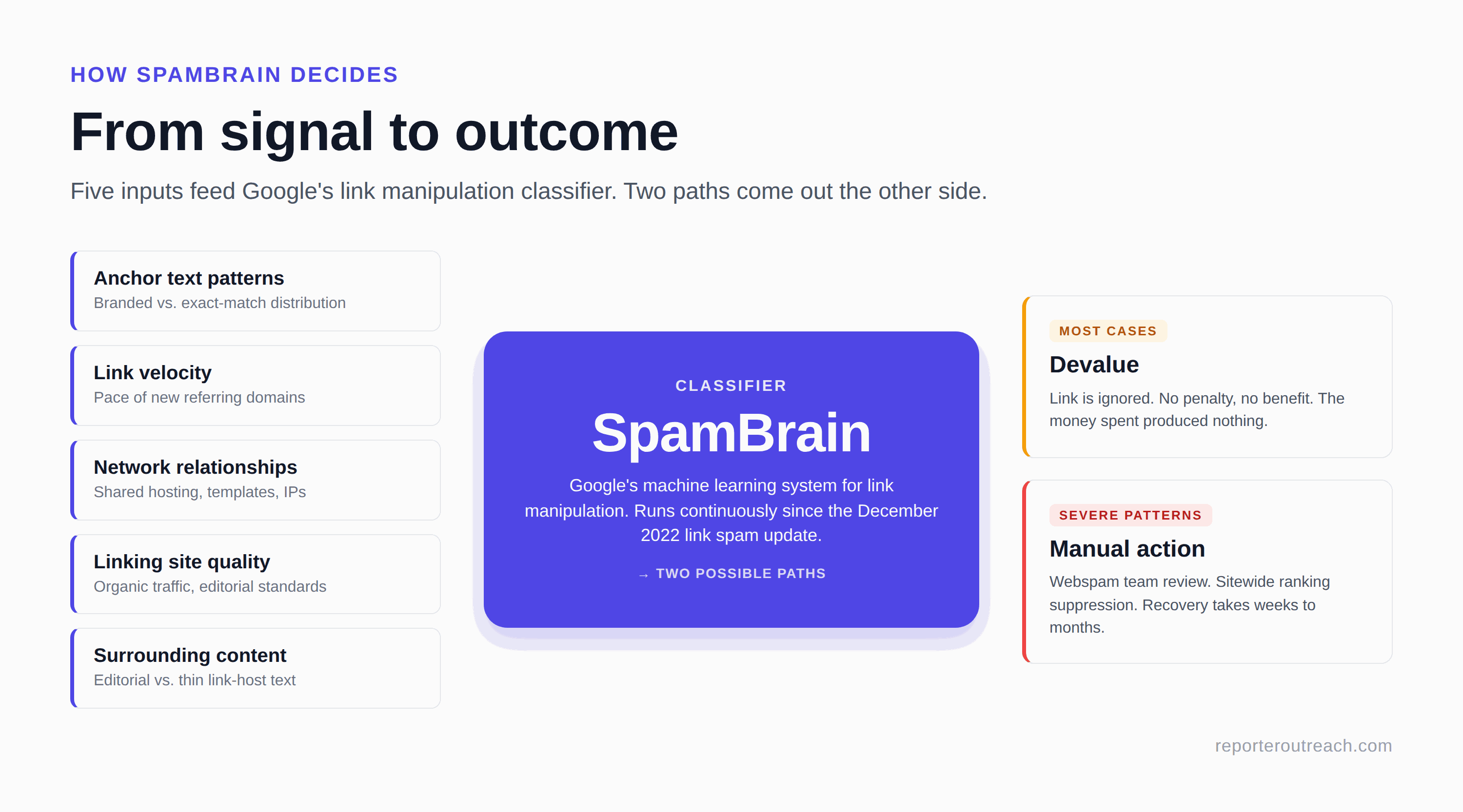
SpamBrain is Google's machine learning system for identifying link manipulation at scale. The December 2022 link spam update was the first time Google deployed it specifically against link manipulation — and unlike scheduled algorithm refreshes, it has operated continuously ever since. New patterns get caught as they emerge, not in periodic sweeps.
What it evaluates:
- Anchor text patterns. Distribution across branded, URL, topical, and exact-match anchors. A profile heavy on commercial keywords gets flagged before any individual link does.
- Link velocity. The pace at which new links appear. A site that gained 500 referring domains in a month after a year of flatline growth raises an obvious flag.
- Network relationships. Shared hosting IPs, common WHOIS data, similar templates, and sites that link in tight reciprocal clusters. PBN footprints are exactly this.
- Site quality of linking domains. Whether the linking site has its own organic traffic, real editorial standards, and content unrelated to selling links.
- Content quality around the link. Whether the link sits inside genuine editorial content or in thin, AI-generated, keyword-stuffed text that exists to host the link.
When SpamBrain flags links as manipulative, it typically devalues them — ignores them entirely. No penalty, but no benefit either. The money spent on those links produced nothing.
Manual actions: the real danger
In severe cases, Google's webspam team manually reviews your site and issues a penalty. This shows up in Search Console under Security & Manual Actions with one of two messages: "Unnatural inbound links to your site" (others pointing to you) or "Unnatural links from your site" (you linking out in a scheme).
A manual action is a different animal entirely. It can suppress your entire site in search results — not just the pages with bad links. Rankings can drop from page one to invisible overnight. Recovery requires a comprehensive audit, documented cleanup, and a reconsideration request that can take weeks to months to process.
That number is worth sitting with. Roughly half of the penalty cases Semrush studied involved one specific pattern: paying for placements and stuffing them with anchor text matching the keywords the site wanted to rank for. Not complicated schemes. Not sophisticated manipulation. The most obvious, detectable pattern in the book.
How to Run a Backlink Audit
The only way to know if you have a problem is to look. Here is the process we walk clients through — the same one we use internally on our own link profiles.
Step 1: Export your link data. Pull your full backlink list from Google Search Console (Links > Export External Links > Latest Links) and from Ahrefs or Semrush. Cross-reference both. Search Console shows what Google actually sees; third-party tools provide quality metrics like DR and traffic estimates.
Step 2: Group by referring domain. Any single domain linking to you 10+ times deserves a closer look. That is unusual for editorial links and often indicates sitewide placement, automated insertion, or widget-injected links.
Step 3: Categorize link types. Sort links into buckets: earned editorial placements, guest posts, profile links, comment links, directory submissions, widget links, footer/sidebar links, and anything from sites that look like they exist only to sell links. The distribution tells you a lot — a healthy profile is dominated by that first category.
Step 4: Check the red flags. For your top referring domains, run through these signals:
| Signal | Why it matters |
|---|---|
| Domain has no organic traffic | If the linking site doesn't rank for anything, Google has already decided it isn't credible |
| Site is in an unrelated niche | A pet supply blog linking to a B2B SaaS site rarely happens organically |
| Sells links openly or via marketplaces | Pricing pages, "advertise with us" forms, or marketplace listings are explicit footprints |
| Same template as 50 other sites | PBN tell — sites built from a single template often share IP ranges and hosting providers |
| Thin content, mostly outbound links | Pages exist to host links rather than to inform readers |
| Foreign-language site, English commercial anchors | Classic spam pattern — auto-generated content with injected English links to commercial pages |
Step 5: Analyze your anchor text distribution. This is the single most important step. Export your anchor text report from Ahrefs and look at the ratios.
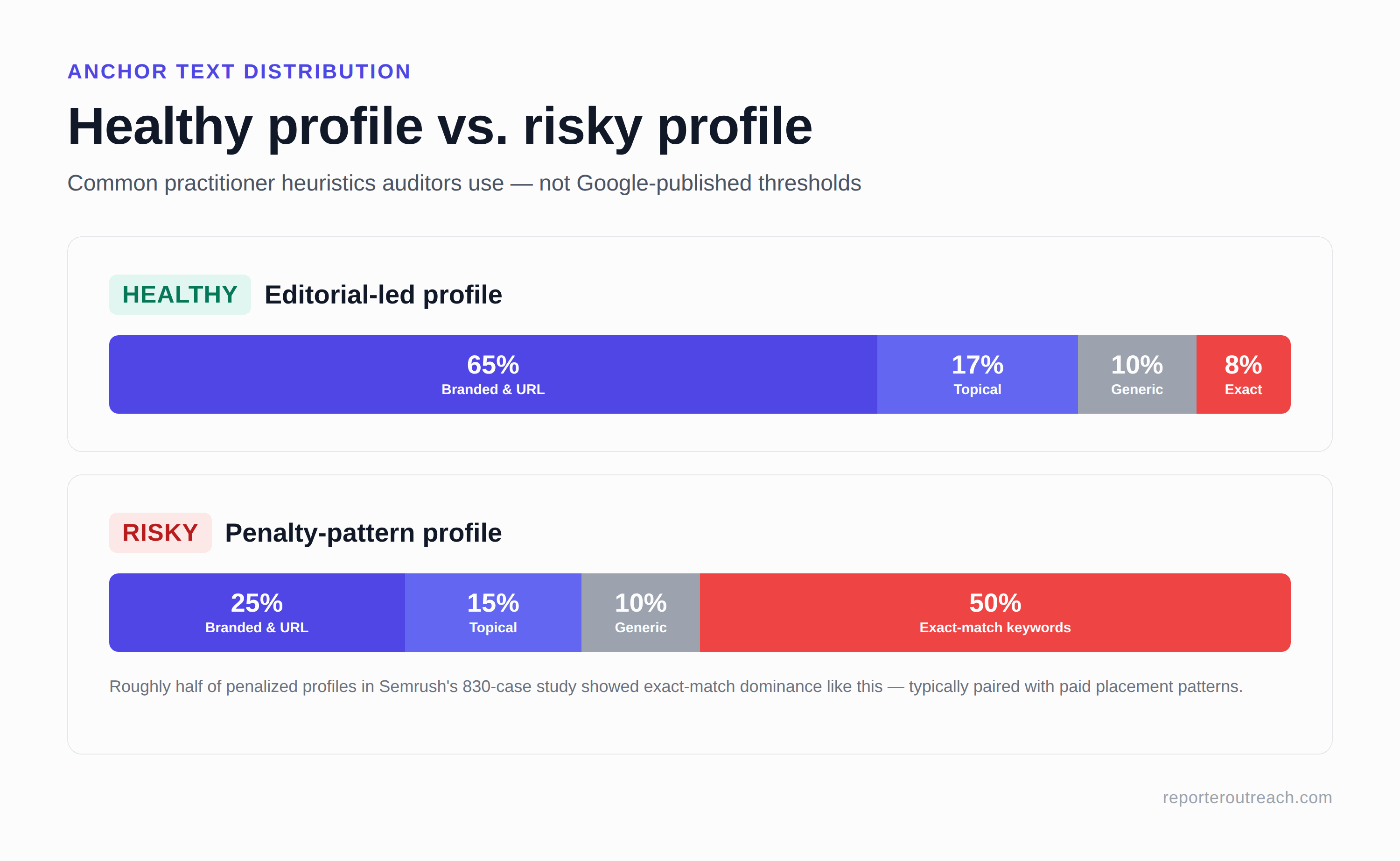
If your exact-match keyword percentage is above 15-20%, you have an anchor distribution problem. That is the single biggest risk factor identified in penalized profiles — and the easiest one to spot in an audit. These ranges are common practitioner heuristics that auditors use, not Google-published thresholds.
Step 6: Look for scheme patterns. Reciprocal links with the same group of sites, clusters from the same IP range or hosting provider, links from sites that all use the same template. These are footprints of PBNs and link exchange networks.
Step 7: Categorize and prioritize. For everything you flagged, sort into three buckets: (a) clearly manipulative — remove or disavow, (b) borderline — monitor quarterly, (c) low-quality but not manipulative — Google is almost certainly already ignoring these.
What to Do About Unnatural Links
Your response depends on one thing: do you have a manual action in Search Console, or just a messy profile?
If you have a manual action
This requires immediate, documented cleanup. Google's reconsideration process rewards thoroughness, not speed.
Document your current state. Before touching anything, screenshot your link profile metrics — total links, referring domains, anchor distribution, and the specific problematic links you identified. You will need this evidence for the reconsideration request.
Contact site owners for removal. Reach out to the sites hosting your worst links and ask for removal. Keep records of every email — addresses, dates, responses. Most will ignore you. That is fine. Google wants to see you made the effort.
Disavow what you cannot remove. For links that site owners will not take down, use Google's Disavow Tool in Search Console. Upload a file listing the offending domains or URLs. Be precise — over-disavowing legitimate links can hurt you more than the bad links themselves.
Submit a reconsideration request. In Search Console, go to Security & Manual Actions > Manual Actions > Request Review. Explain what happened, what you found, what you fixed, and what you have changed going forward. Be specific. Google's reviewers read hundreds of these — the ones that get approved are the ones with documentation, not excuses.
Wait. Reviews typically take several weeks. Severe cases can take months and multiple rounds of cleanup. Do not resubmit before getting a response.
Google's own guidance: use it only when you have a manual action, or when your audit reveals strong evidence of manipulation. In most other cases, algorithms already discount junk links automatically. An unnecessary disavow file can do more harm than the links it targets.
If you do not have a manual action
If Search Console is clean but your audit turned up some ugly links, the math changes.
Do not panic-disavow. SpamBrain is designed to ignore bad links rather than penalize you for them. A handful of suspicious links in an otherwise healthy profile are almost certainly already being discounted. We have seen more damage from aggressive disavow files than from the original bad links.
Focus forward. The most effective response to a messy profile is not spending months cleaning up links that Google is already ignoring — it is diluting them with quality editorial links that actually move your rankings. New legitimate placements reduce the percentage of bad links naturally over time.
Monitor quarterly. If your profile is dominated by suspicious sources (60%+ from flagged domains), a targeted cleanup is worthwhile. If it is 10-20% low-quality with a solid editorial foundation, Google is handling it. Run an audit every quarter to track the trend.
Building a Penalty-Proof Profile
The best defense is anchor distribution. Get this one ratio right and the others rarely matter.
Anchor diversity is non-negotiable. Keep your distribution natural: 60-70% branded and URL anchors, 15-20% topical phrases, under 10% exact-match keywords, and a scattering of generic anchors. This is the single highest-leverage thing you can control. The thresholds are auditor practitioner heuristics, not Google-published rules — but they reflect what natural editorial profiles actually look like.
Diversify link types. The strongest profiles include a mix of editorial placements, targeted niche edits on high-traffic pages, and organic links earned through valuable resources. No single type should dominate.
Prioritize editorial links. Links placed by journalists in editorial content are the gold standard. They are indistinguishable from organic links because they are organic links. This is what digital PR delivers, and it is the only category that carries zero penalty risk by design.
Vet every provider. If you are working with an agency, ask: Where do the links come from? Can I approve each placement before it goes live? What is the anchor text strategy? Any provider that cannot answer transparently is a risk.
Audit quarterly. Do not wait for a penalty to find problems. A quarterly link audit takes a few hours and catches issues before they compound. We run them internally on our own profiles — it is the minimum viable maintenance for anyone serious about search.
Unnatural Links and AI Search Visibility
There is a dimension to this that did not exist two years ago: AI search engines are evaluating your link profile too.
When ChatGPT, Perplexity, Gemini, and Google AI Overviews decide which brands to cite, they assess your web presence for trust signals — and your backlink profile is part of that equation. Ahrefs analyzed 75,000 brands and found that the top 25% by web mentions earn roughly 10x the AI visibility of the rest. The signal that matters is breadth of editorial coverage, not raw link count.
A profile dominated by PBN links and paid placements on irrelevant sites does not just risk a Google penalty. It tells AI systems your brand lacks genuine third-party validation. Even without a formal penalty, a spammy link profile reduces the likelihood that AI platforms surface your brand in their answers.
The fix is the same as for traditional search, but the stakes are compounding: replace manipulative links with editorial placements that generate both backlinks and branded mentions — the dual signal that AI systems weight most heavily. For the full framework, see our guide to Generative Engine Optimization.
Replace Toxic Links with Editorial Authority
We earn placements from real publications — links that build trust with search engines and AI systems, not the kind that trigger penalties.
Frequently Asked Questions
What happens if I have unnatural links?
Two possible outcomes. In most cases, Google simply ignores them through algorithmic devaluation — no penalty, but no ranking benefit either. If the manipulation is severe enough (large-scale paid links, aggressive anchor stuffing, PBN networks), you could receive a manual action that suppresses your entire site. Check Search Console under Security & Manual Actions to see your current status.
Should I disavow every suspicious link I find?
No — and this is where a lot of people make things worse. The Disavow Tool should be reserved for links that are clearly manipulative, especially when you are dealing with a manual action. Adding borderline or merely low-quality links to a disavow file can strip legitimate equity from your profile. If Google's algorithms are already ignoring a link, disavowing it is redundant at best and harmful at worst.
How long does penalty recovery take?
After submitting a reconsideration request, initial review typically takes a few weeks. But full recovery — meaning your rankings return to pre-penalty levels — can take three to six months. Some sites need two or three rounds of additional cleanup and resubmission before the action is lifted entirely.
Can competitors build bad links to my site on purpose?
Negative SEO attacks exist, but Google has stated their algorithms can identify and ignore most of them. If you notice a sudden influx of spammy links you did not build — especially from link farms or irrelevant foreign-language sites — document the spike and use the Disavow Tool as a precaution. Building a strong editorial profile is the best long-term defense, since it makes your natural link ratio resilient against injection attacks.
Are all paid links considered unnatural?
Google's policies prohibit buying links that pass ranking signals. But the practical distinction is between paying for a link (sending money to a site owner for placement — risky) and paying for a service that earns links through editorial means. When a journalist cites your expert because the insight was genuinely useful, that is an editorial decision — regardless of whether an agency facilitated the connection.
How often should I audit my link profile?
Quarterly is the sweet spot for most sites. That is frequent enough to catch new problems before they compound, but not so frequent that you are chasing noise. Each audit should take a few hours: export from Search Console and Ahrefs, check for new flagged domains, review anchor distribution trends, and verify that recent link building activity looks clean.
Sources: Google Search Central Spam Policies (developers.google.com) | Google Search Central — December 2022 Link Spam Update Announcement (SpamBrain deployment) | Semrush — 8 Insights from 830+ Link Penalty Cases | Ahrefs Brand Radar — AI Visibility Study: 75,000 Brands (2025)