Key Takeaways
- A backlink exchange (trading links with another site) is something Google's spam policies call out when it's excessive. The real risk usually isn't a penalty; it's wasted effort, because links Google identifies as exchanges tend to be ignored, so they pass no value to your site.
- In our survey of 500 SEO professionals, 43.8% use link exchanges, but none ranked them their best-performing method. Digital PR topped the list at 34% (Reporter Outreach, 2026).
- AI search makes the case weaker still. ChatGPT, Perplexity, Gemini and Google AI Overviews lean heavily on earned editorial coverage, not the sites you trade links with, so a swap does little or nothing for AI visibility.
- The narrow exception: links that would exist regardless of SEO, such as integration partners, genuine editorial cross-references and real business relationships. Time spent on anything else is better spent on one-directional links.
"You link to me, I'll link to you." Simple enough. On the surface, a backlink exchange sounds like a fair deal: both sites benefit, nobody pays, everybody wins.
Except Google has been watching for exactly this for more than a decade.
In 2026, exchanging links is one of the least effective ways to build authority. Not for the reason most people assume: the real problem isn't penalties. It's something more subtle, and arguably worse for long-term growth.
This guide covers what actually happens when you exchange links, how exchange platforms work, the narrow cases where it's fine, and, more importantly, what to do instead.
What Is a Backlink Exchange?
A backlink exchange is when two sites agree to link to each other. Site A links to Site B, Site B links back. The goal is for both sites to benefit from the additional inbound link.
There are a few variations, each trying to be slightly less obvious than the last:
Direct reciprocal exchange. The simplest version. Two sites link to each other, which makes it the easiest pattern to spot.
ABC (three-way) exchange. Site A links to Site B, but instead of B linking back to A directly, B links to Site C (which you also own). It adds a layer of indirection. Since its December 2022 link spam update, Google says its SpamBrain system can detect sites used to pass outgoing links, which makes this kind of indirection less and less effective.
Group exchange networks. Facebook groups, Slack channels, dedicated platforms where dozens of sites trade links in organized rounds. This is the highest-risk category: once a network is identified, links from across it can be discounted together.
Guest post swaps. Two sites publish guest posts on each other's sites, each containing links back. It's still an exchange, just disguised as content contribution.
Exchange platforms. Marketplaces and communities that match sites for swaps, often tracking who owes whom or using credits, and often routing links through third sites so no two sites link directly to each other. They make trading easier, but the result is still a network of links built for SEO.
Direct swaps are the easiest pattern to spot. ABC exchanges add indirection, but Google says SpamBrain can now detect sites used to pass outgoing links. Group networks carry the most risk, because once one is identified, links across it can be discounted together.
What Google Actually Does With Exchanged Links
Google's spam policies list "Excessive link exchanges ('Link to me and I'll link to you') or partner pages exclusively for the sake of cross-linking" as link spam. The key word is "excessive": some reciprocal links happen naturally. Two businesses in the same industry referencing each other, an agency linking to a client, partners mentioning each other's tools. That's how the web works.
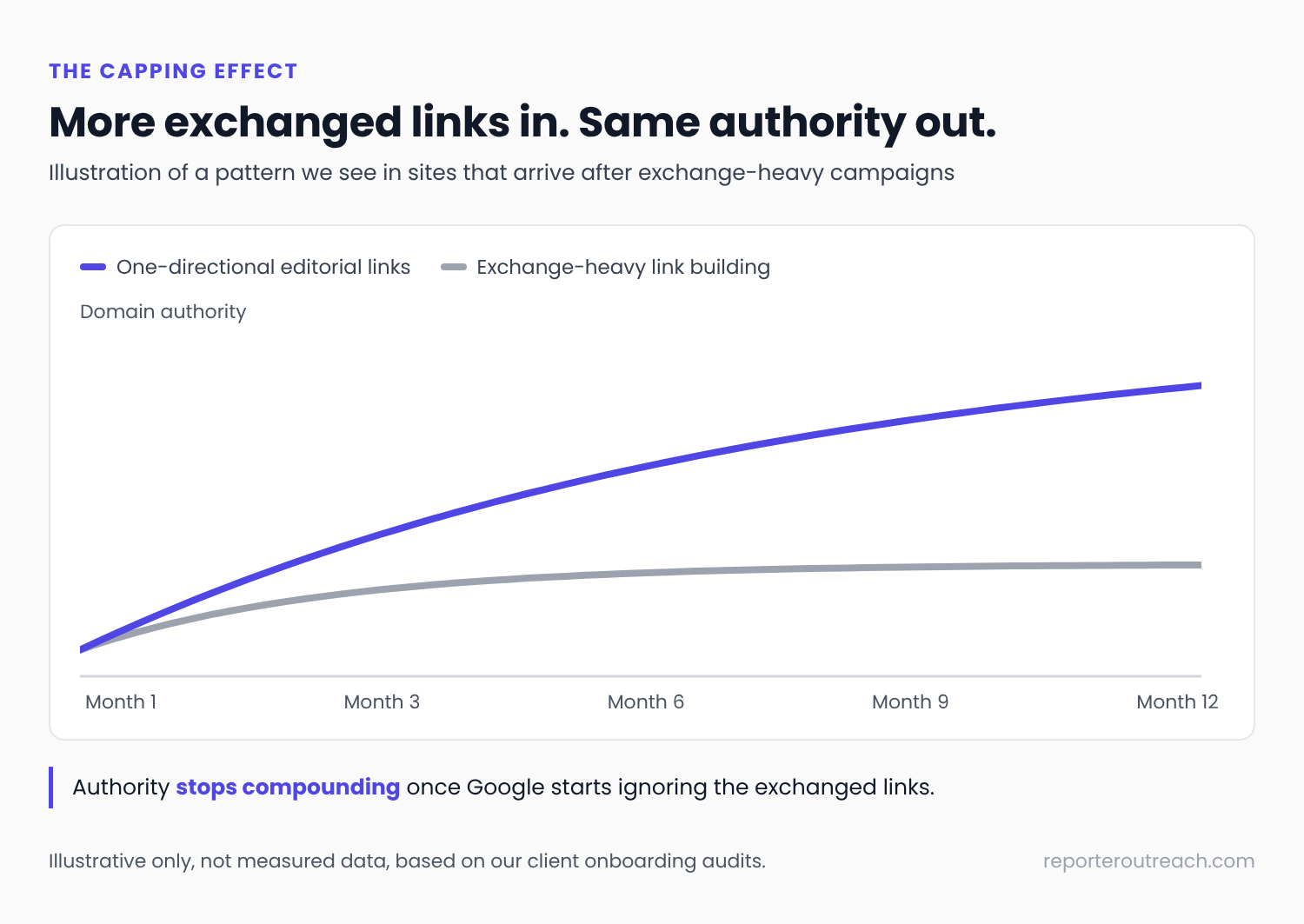
The problem is when you're doing it for SEO. And here's what most articles about this topic get wrong: Google usually doesn't penalize exchanges. It devalues them. When it rolled out its December 2022 link spam update, Google said credit passed by unnatural links is lost. That distinction matters.
| Response | What it means | When it happens |
|---|---|---|
| Devaluation | The link is ignored and passes no value | Most exchanges Google identifies |
| Algorithmic suppression | Rankings plateau as authority signals are discounted | Moderate-scale campaigns |
| Manual action | A Google reviewer applies a manual action, shown in Search Console's Manual Actions report | Large-scale networks |
We've seen this pattern across clients who come to us after running exchange campaigns: Domain Rating stops growing even as they add more links. From the outside it looks like SEO "stopped working." In reality, Google stopped trusting those link signals. This is harder to diagnose than an obvious penalty, and most site owners never connect the stagnation to their exchange activity.
The practical result: you invest time in outreach, negotiations, and coordination for links that Google is probably ignoring. Even if there's no penalty, that's time you could've spent earning links that actually move rankings.
It gets worse in the AI era
Until recently, the worst case for an exchanged link was "Google ignores it." Now there's a second loss. ChatGPT, Perplexity, Gemini, and Google AI Overviews increasingly shape how buyers discover brands, and they rarely cite the kinds of sites involved in link swaps.
A September 2025 study by University of Toronto researchers, "Generative Engine Optimization: How to Dominate AI Search" (arXiv:2509.08919), found that AI search shows "a systematic and overwhelming bias towards Earned media" over brand-owned and social content. Muck Rack's May 2026 Generative Pulse analysis puts the share at 84% of AI citations coming from earned media.
Exchange-derived links are the opposite of that. They tend to live on sites that trade links with everyone, with thin editorial standards, and AI engines rarely draw on those sites. The link itself, whatever Google does with it, was never the kind of citation AI search is looking for.
The Data Is Pretty Clear
The industry data doesn't leave much room for debate.
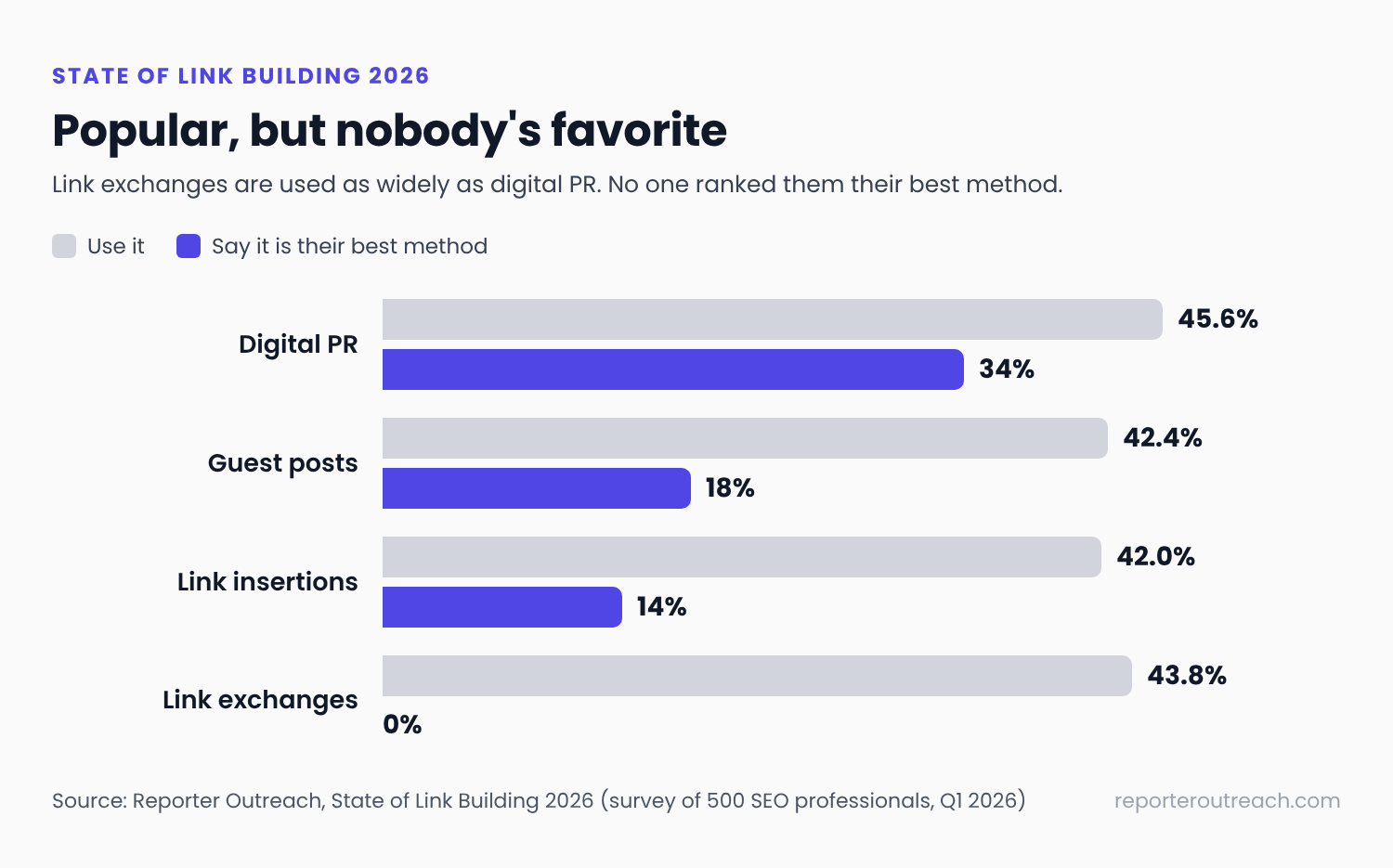
In our survey of 500 SEO professionals, 43.8% use link exchanges, about as many as use digital PR (45.6%), yet not one respondent named exchanges their best-performing method. Digital PR led at 34%. Editorial.link's survey of 518 SEOs points the same way: 48.6% call digital PR the most effective tactic, against 16% for guest posting.
Ahrefs found that 73.6% of the sites it studied (140,592 sites with at least 10,000 monthly Google visits) have some reciprocal links, which sounds contradictory until you see the distinction. Having reciprocal links is not the same as deliberately engineering them. Two industry blogs referencing each other because the content is genuinely useful? That happens organically. The problem is when you're systematically trading links through organized networks and expecting ranking benefits.
When Exchanging Links Is Fine
Not every reciprocal link is a scheme. There are situations where two sites naturally end up linking to each other, and Google recognizes these for what they are:
Integration partners. Your SaaS tool integrates with another platform. Both sites mention the integration. The reciprocal link is expected and natural.
Genuine editorial cross-references. You write a post citing another company's research. Months later, they write something citing your data. Neither was coordinated. Both were independently useful editorial decisions.
Real business relationships. A wedding photographer linking to a florist they regularly work with, and vice versa. These reflect real-world relationships that searchers actually find useful.
Co-marketing content. Two companies promote a shared webinar or joint report. The links exist because there's real collaborative content, not because someone proposed a trade.
Would this link exist even if SEO didn't matter? If yes, you're fine. If the only reason the link exists is to try to manipulate rankings, Google will probably ignore it.
What to Do Instead (Strategies That Actually Work)
If you need links (and you do, because authority still matters), here's where to spend your time instead of chasing exchanges.

Digital PR
This is the highest-impact approach available right now, and it's not particularly close. You earn editorial placements by getting cited as an expert source in real publications. Journalists place the link in editorial context, so there's no reciprocal pattern to flag, and every placement adds a brand mention that supports AI search visibility alongside ranking authority.
The math: digital PR produces links from real publications that count as editorial votes, plus the brand mentions AI engines draw on. An exchange produces a link Google probably ignores, on a site AI engines rarely cite. See our full digital PR breakdown.
Niche edits
Niche edits place your link into existing, already-indexed content on relevant sites. They're one-directional, faster than most other tactics, and when sourced from sites with real traffic and authority, they deliver genuine ranking power, which makes them the most direct way to push a specific page up the rankings. No reciprocal obligation, no exchange pattern to detect. We offer them as link insertions.
Guest posting (one-way)
Contributing genuinely useful content to authority sites in your space is still effective, as long as you're not doing guest post swaps. The difference: in a swap, two sites trade guest posts with embedded links. In ethical guest posting, you earn a one-way link by providing real value to the host site's audience. One creates an exchange pattern. The other doesn't.
Linkable content assets
Create something so genuinely useful that other sites link to it without being asked. Original research, free tools, comprehensive guides. This generates one-directional links indefinitely. Unlike exchanged links that get discounted, links earned through genuinely useful content count as real editorial votes.
| Strategy | AI visibility | Devaluation risk | Referral traffic |
|---|---|---|---|
| Digital PR | High: earned coverage is what AI answers cite most | Very low | High |
| Niche edits | Indirect: pages that rank feed AI answers | Low | Moderate |
| Guest posts (one-way) | Low | Moderate | Low |
| Linkable assets | Moderate | Very low | Moderate |
| Link exchanges | Little to none | High | Little to none |
How to Audit Existing Exchange Links
If you've participated in exchanges in the past, it's worth checking your backlink profile for patterns that might be hurting you.
- Export your inbound and outbound links. Pull your backlink profile from Ahrefs or Semrush. Then export your outgoing links (Ahrefs → Outgoing links → Linked domains).
- Cross-reference the two lists. Domains that appear in both your inbound and outbound link lists are your reciprocal links. Some overlap is normal; you're looking for suspicious volume.
- Check the share. Google publishes no threshold, so look for a high or fast-growing share of reciprocal domains, especially from sites unrelated to yours.
- Evaluate each reciprocal link for relevance and quality. Links from irrelevant sites, thin content, or domains with excessive outbound links are the ones most likely to be hurting you.
- Don't panic; build forward. Rather than trying to disavow or remove old exchange links (Google suggests the disavow tool mainly when spammy links have caused, or are likely to cause, a manual action), focus on earning new one-directional links through digital PR and other legitimate strategies. As your profile grows with quality links, the exchange percentage naturally shrinks. For the complete process, see our backlink audit guide.
There's no published percentage that triggers discounting, and some reciprocity is natural, so you don't need to hit zero. The goal is dilution through better links, not removal of old ones.
What Happens When You Replace Exchanges With Editorial Links
Here's what the shift actually looks like in practice. (More case studies here.)
MEDvidi: online mental health care
An online telehealth platform needed authority in one of Google's most scrutinized YMYL categories, where exchange patterns would be particularly risky. The program earned one-directional editorial placements in health publications by positioning MEDvidi's clinicians as expert sources for journalists: 83 placements over 12 months, with no exchanges or swaps.
Skip the Exchange. Build Authority That Actually Counts.
We earn one-directional editorial links from real publications: links that improve rankings and help your brand get cited by AI. No exchange risk, no devalued signals.
FAQ
Are link exchanges safe?
A handful of natural reciprocal links won't trigger a penalty. The issue is that they won't do anything positive either, because Google's systems are built to spot links made for SEO and ignore them. So the question isn't really about safety. It's about whether the time spent coordinating exchanges could be better spent on tactics that actually move the needle.
Will Google penalize my site for exchanging links?
For small-scale activity, Google devalues rather than penalizes. Manual actions are typically reserved for large-scale schemes. The bigger concern is the "capping" effect, where authority stops growing because Google discounts your link signals. That's harder to diagnose than an obvious penalty. For more on how Google handles unnatural patterns, see our unnatural links guide.
Do ABC (three-way) exchanges still work?
The whole point of three-way exchanges was to hide the reciprocal pattern from algorithms. Google now says SpamBrain can detect sites used to pass outgoing links, so the indirection buys less than it used to. Add the coordination overhead of managing three sites per exchange, and the ROI doesn't make sense even in a best-case scenario where the links aren't caught.
Do AI engines like ChatGPT and Perplexity care about exchanged links?
Not in any way that helps you. AI engines lean on editorial coverage in real publications (84% of AI citations come from earned media, per Muck Rack), the kind you get from being quoted as a source, not from a swap. A link on a site you traded with does little or nothing for AI visibility, whatever Google does with it for rankings.
Should I respond to cold exchange requests?
Almost always no. Cold exchange requests come from people trying to manipulate rankings, exactly the pattern Google's link spam policy describes. The rare exception: if the requesting site is genuinely relevant and would provide real editorial value. Evaluate the link on its own merit. If it only makes sense as a trade, pass.
What if a relevant, high-authority site proposes an exchange?
Even with a strong site, a reciprocal arrangement carries less value than a one-directional link from that same site. If the opportunity is there, consider whether you could earn a one-way link instead: through a guest post, a data citation or a digital PR mention. That link will carry more weight than a mutual swap.
How do backlink exchange platforms work?
They match sites that want to trade links. Some track who owes whom; others use credits you earn by placing links for other members and spend on links back. Many route links through third sites (the ABC model) so no two sites link directly to each other. That makes each swap harder to spot on its own, but the network is still built for SEO, which is exactly what Google's link spam policy describes.
What are the best alternatives to exchanges?
Digital PR (editorial links from real publications), niche edits (links placed in existing indexed content), one-way guest posting, and linkable content assets. All of these produce one-directional links, the opposite of the devalued signals from exchanges.
Sources
- Google Search Central, "Spam policies for Google web search" (link spam section)
- Google Search Central Blog, "December 2022 link spam update releasing for Google Search" (December 14, 2022)
- Reporter Outreach, "State of Link Building 2026" (survey of 500 SEO professionals, Q1 2026)
- Editorial.link, link building statistics survey (518 SEO professionals; updated March 2026)
- Ahrefs, "Reciprocal Links: Will They Hurt Your SEO?" (Tim Soulo, updated March 2020; 140,592 sites)
- Chen, Wang, Chen and Koudas (University of Toronto), "Generative Engine Optimization: How to Dominate AI Search" (arXiv:2509.08919, September 2025)
- Muck Rack, Generative Pulse analysis of AI citations (May 2026)