Key Takeaways
- A link audit covers both external backlinks and internal links. Most guides skip the internal side entirely, which is where the biggest untapped opportunities usually hide.
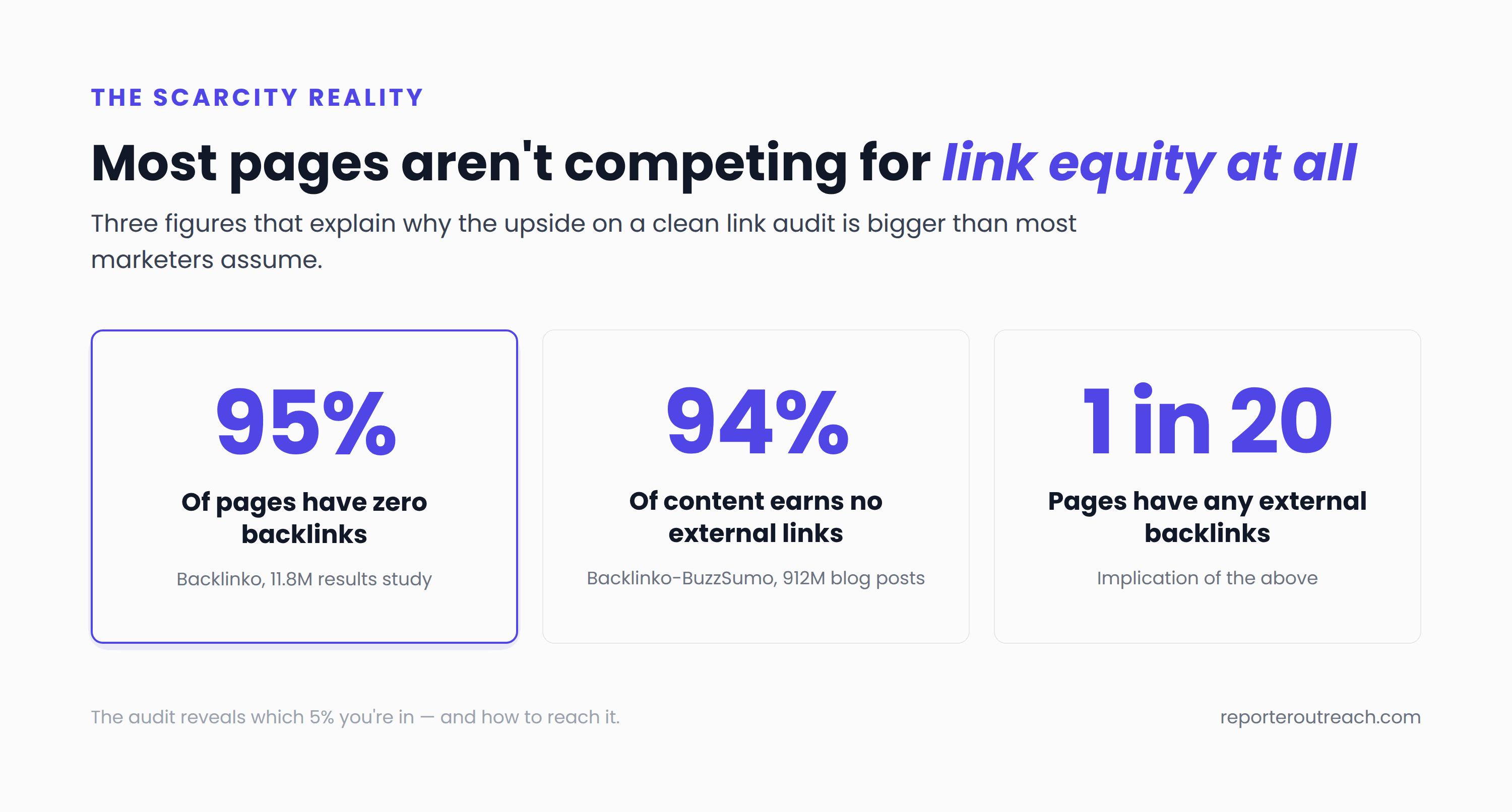
- Roughly 95% of all web pages have zero backlinks (Backlinko, 11.8M results study). An audit reveals whether your pages are in that 95% and what to do about it.
- The disavow tool is rarely necessary. Google's SpamBrain filters most spam automatically. Over-disavowing quality links is a bigger risk than leaving borderline ones alone.
- The real value isn't removing bad links — it's finding the gaps in your profile that competitors have already filled and turning those gaps into a targeted outreach plan.
- Tools like Screaming Frog, Ahrefs, and Google Search Console can map your entire link ecosystem in an afternoon. The audit itself is fast. Acting on the findings is where the results come from.
A link audit is a full review of every link connected to your domain — the links pointing in from other sites, and the internal links connecting your own pages. It answers three questions: What's helping your SEO? What's hurting? And where are the gaps that your competitors have filled but you haven't?
Most guides frame this as a cleanup exercise. Find spammy links, disavow them, move on. That's the least interesting part. The real leverage — the part that actually moves rankings — is discovering that your competitor has 40 referring domains you don't, or that your best blog content has zero internal links pointing to your money pages, or that half your site is buried four clicks deep where Google barely bothers crawling.
We run these quarterly using Screaming Frog for the internal side and Ahrefs for the external side. After auditing hundreds of client sites since 2017, the pattern is consistent: the internal linking problems are almost always worse than the backlink problems. Nobody talks about that because it's less dramatic than "toxic links." But it's where the real leverage sits.
What a Link Audit Actually Covers
There are two sides to this, and most SEOs only do one of them.
The external audit looks at every inbound link from other domains. You're evaluating domain authority, anchor text distribution, spam signals, and whether the sites linking to you are topically relevant. The goal is to understand whether your backlink profile signals trustworthiness to search engines — or whether it's dragging you down.
The internal audit looks at how your own pages connect to each other. This covers crawl depth (how many clicks from the homepage), orphan pages (content with zero internal links), how authority distributes across your site, and whether your linking structure actually supports the pages you want to rank. If the external audit tells Google your site deserves authority, internal linking tells Google where to send it.
| Audit side | What it evaluates | Main risk if ignored |
|---|---|---|
| External | Inbound link authority, anchor distribution, source relevance, toxicity signals | Manipulative profile drags down rankings; missed opportunities for editorial coverage |
| Internal | Crawl depth, orphan pages, authority flow, anchor descriptiveness | Authority earned externally never reaches the pages you want to rank |
Here's the uncomfortable truth: most "backlink audits" miss the internal half entirely. A site with a strong backlink profile and terrible internal linking will underperform a site with a moderate profile and excellent structure. We've seen this play out hundreds of times.
Why This Matters More Than You Think
The standard pitch for auditing your links is "protect against Google penalties." That's true but it's also the least compelling reason. Manual penalties from link spam are genuinely rare for most legitimate businesses. Google's SpamBrain handles most of it algorithmically — Google's December 2022 link spam update was the first deployment of SpamBrain specifically against link manipulation, and the system has been quietly neutralizing manipulative links rather than triggering manual actions ever since.
The better reasons to run one regularly:
The competitor gap analysis — sites that link to your competitors but not you — is the single most actionable output. These aren't cold prospects. They've already demonstrated willingness to link in your space. Your job is just to give them a reason to include you too.
Your internal structure is probably leaking authority. This is the finding that surprises people the most. You've got blog posts earning external links, but those posts have zero internal links pointing to your service pages. The authority comes in and just... sits there. It doesn't flow to the pages you actually want to rank. One client we audited had 30+ referring domains pointing to a single blog post — and that post didn't link to a single service page on the site. All that equity, going nowhere.
Orphan pages are more common than you'd expect. Every site redesign, every URL change, every deleted navigation item creates orphan content. Pages with zero internal links are essentially invisible to Google's crawler — it has to discover them through your sitemap alone, which means less frequent crawling and no authority transfer from the rest of your site.
You need a baseline before spending money. Before investing in digital PR or any link building campaign, you need to know where you're starting. How many referring domains do you have? What's your domain authority? What does your anchor text profile look like? Without this baseline, you can't measure whether your investment is working.
The External Audit: Evaluating What Points In
Start by pulling your full link data from at least two sources. No single tool captures everything — Ahrefs, Semrush, and Majestic all have different crawlers that find different links. Export from your primary tool and supplement with Google Search Console, which shows links Google has actually discovered (even if third-party tools haven't found them yet).
You're building a master spreadsheet with: linking domain, target URL, anchor text, domain rating, spam score, and whether the link is followed or not.
Evaluate link quality
Not every low-authority link is bad, and not every high-authority link is good. The signal you're looking for is whether the link was earned editorially — placed within real content because it genuinely added value — or whether it was manufactured through a link scheme, paid placement network, or bulk directory submission.
| Keep — signals of editorial intent | Flag — signals of manipulation |
|---|---|
| Link sits in real published content with author byline | Page exists primarily to host outbound links (PBN, directory) |
| Linking domain is topically relevant to your industry | Foreign-language site unrelated to your topic |
| Anchor text is descriptive or branded, not exact-match repeated | Anchor is exact-match for a money keyword across many sources |
| Linking page has its own backlinks and organic traffic | Page has hundreds of outbound links to unrelated domains |
| Site has clear About/Contact info and editorial standards | Site shows signs of a legacy black-hat campaign you've forgotten about |
Flag any links pointing to broken pages on your site — that's link equity you're wasting. Also flag pages where exact-match anchors for a single keyword make up an outsized share of inbound links — many auditors flag concentration over roughly 15% as worth investigating. That kind of skew can look manipulative to Google's systems regardless of whether it was intentional.
Handle toxic links (carefully)
Sort your flagged links into three categories: keep, monitor, and action needed. The "action needed" bucket should be small — truly toxic links are rarer than the SEO industry suggests. We're talking about links from known link farms, foreign-language spam sites, pages with hundreds of outbound links to unrelated domains, or remnants from a previous black-hat campaign.
For those genuine problems, try contacting the webmaster first. If that fails, use Google's disavow tool. But here's the thing most people get wrong:
Every backlink profile has some low-quality links. That's normal. Google's systems are better at ignoring them than most SEOs give them credit for. The disavow tool is primarily for sites that have received a manual action or have an obvious pattern of unnatural links. Disavowing a link that's actually passing value — even small value — hurts you more than leaving a borderline spammy link alone. Semrush's toxicity scoring uses 45+ markers, and many of them flag legitimate links. Don't blindly disavow everything with a high score.
Check your anchor text profile
Natural anchor text is mostly branded — your company name, your URL, or generic phrases like "click here" and "this article." A common practitioner heuristic: topical anchors ("link building guide," "SEO audit tips") around 20% of the total, exact-match keyword anchors under 10%. These aren't Google-published thresholds — they're rules of thumb auditors use to spot profiles that look more built than earned.
If your profile is heavily skewed toward exact-match anchors for a specific keyword, that's a strong signal of manipulation — even if each individual link looks fine. The distribution matters more than any single link.

Run the competitor gap analysis
This is the most strategically valuable step in the entire process. In Ahrefs or Semrush, plug in your domain alongside 3-5 direct competitors. The gap report shows referring domains that link to them but not to you — sorted by authority.
These are your highest-probability outreach targets. The editorial appetite for your topic has already been proven. You're not cold-pitching a publication that's never covered your space — you're reaching out to one that already has, and simply hasn't included you yet. For a deeper walkthrough on this specific analysis, see our guide on finding competitor backlinks.
Reclaim broken and lost links
External sites linking to URLs on your domain that return 404s? That's authority evaporating. Find these through your audit tool and either set up 301 redirects to the most relevant live page, or contact the linking site and ask them to update the URL.
This is one of the fastest authority recovery tactics available — the links already exist, you just need to fix the destination. No outreach required for the redirect approach.
The Internal Audit: Where Most of the Leverage Is
If you take one thing from this article, let it be this: an hour spent fixing internal architecture usually beats an hour spent chasing new backlinks. External backlink profiles get all the attention because they're more dramatic — "toxic links" sounds scary. But a site with great backlinks and broken internal architecture will underperform every time.
Crawl your site with Screaming Frog
Screaming Frog SEO Spider is the industry standard for this — see our breakdown of internal linking tools for alternatives. Run a full crawl and you'll get every URL on your site, its status code, crawl depth, number of internal links pointing to it, and the anchor text used on those links. Export the whole thing to a spreadsheet.
In a single crawl, you can flag 404 errors, redirect chains, orphan pages, and pages with weak internal link support. For larger sites (10,000+ URLs), configure the crawl to respect your server capacity. Alternatives like Sitebulb or Ahrefs Site Audit work too, but Screaming Frog gives you the most granular control over what gets crawled and how the data is exported.
Find orphan pages
Compare every URL in your crawl results against every URL in your sitemap and Google Search Console index. Any page that appears in your sitemap or index but not in the crawl has zero internal links — it's orphaned.
The fix is simple: add 2-3 internal links from topically relevant pages. If the page is outdated and no longer useful, redirect it to the closest relevant URL or remove it from your sitemap. Every indexable page on your site should have at least a few internal links pointing to it. Orphan pages are among the most common issues we find in audits, and among the easiest to fix.
Map crawl depth
How many clicks does it take to reach your most important pages from the homepage? If the answer is more than three, those pages aren't getting the crawl attention they deserve. Google prioritizes content it can reach quickly — pages buried four or five levels deep get crawled less often and typically rank worse.
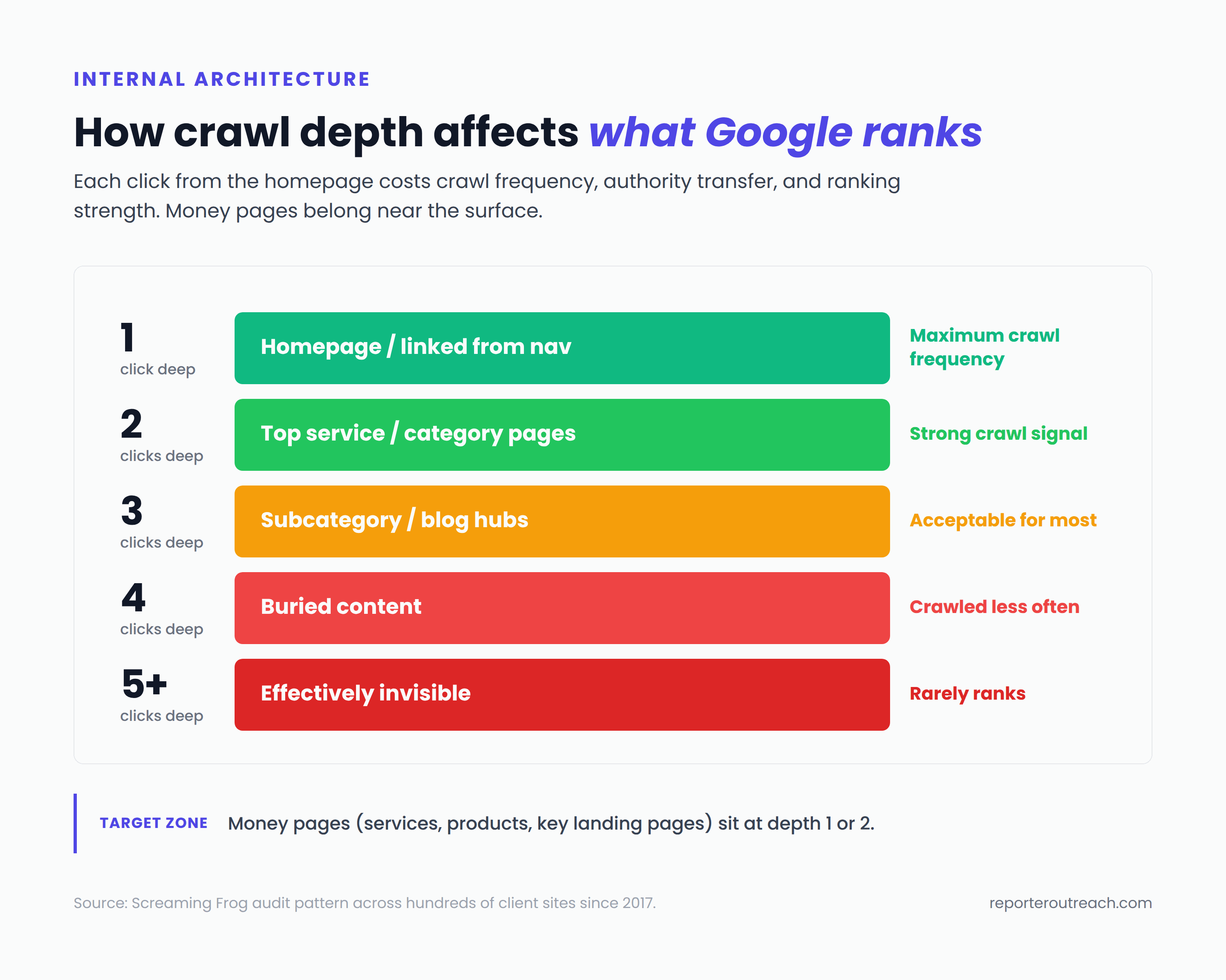
Your money pages — service pages, product pages, core landing pages — should sit at depth 1 or 2. If your crawl shows important content at depth 4+, add internal links from higher-authority pages to bring those URLs closer to the surface.
Redirect authority to your priorities
Pull up the "Inlinks" report in Screaming Frog. Cross-reference which pages receive the most internal links against the pages you actually want to rank. Are your highest-value keywords being supported by strong internal link signals? Or is authority flowing to your privacy policy and outdated blog posts instead?
Common problems: the homepage links heavily to low-value pages instead of core services. Blog posts earning external links have no contextual links to service pages. New content gets published with zero internal links from existing pages. The fix is manual but straightforward — add internal links from your strongest pages to your ranking priorities.
Fix broken internal links and clean up anchors
Every broken internal link is wasted authority and a dead end for users. Screaming Frog flags all of them. For each one, either fix the URL, create a 301 redirect, or remove the link. Fast win, immediate impact.
While you're at it, check your internal anchor text. Unlike external anchors where you want natural variation, internal linking benefits from being more descriptive. "Our complete guide to building a healthy backlink profile" tells Google far more about the destination than "read more." Audit for generic anchors and replace them with descriptive alternatives that signal the topic of the target page.
Tools That Actually Matter
You don't need every SEO tool on the market. Here's what does the real work:
| Tool | Use it for | Free tier |
|---|---|---|
| Screaming Frog | Internal crawl, orphans, depth, broken internal links | Yes — up to 500 URLs |
| Ahrefs | Backlink data, competitor gap, lost/broken inbound links, anchor distribution | Limited webmaster tools only |
| Semrush | Alternative backlink data, toxicity scoring, gap analysis | Limited free trial |
| Google Search Console | What Google has actually discovered; manual action notifications; disavow file submission | Free |
The minimum viable audit stack: Screaming Frog for internal, Ahrefs or Semrush for external, Google Search Console for baseline validation. Google Analytics is a bonus — it tells you which inbound links actually send traffic, which helps prioritize what to protect vs. what to ignore.
After the Audit: Turning Findings Into Action
The audit is the diagnostic. Here's the treatment plan:
If your internal structure has problems (it almost certainly does): Fix orphan pages first — highest impact, easiest fix. Then reduce crawl depth for important pages. Then add strategic internal links from high-authority content to your ranking targets. A focused internal linking overhaul can produce noticeable ranking improvements within weeks.
If your external profile has genuine toxic links: Disavow only the clear-cut problems. Then shift focus to shifting your budget to digital PR link building — this is how you shift your profile's quality ratio over time. Removing bad links is defense. Building good ones is offense.
If your competitor gap is significant: Prioritize outreach to publications where multiple competitors already have coverage. These represent the highest-probability link opportunities in your market. A consistent digital PR campaign earning 7-15+ links per month can close a meaningful gap within 3-6 months. See our pricing for campaign details.
If you received a manual penalty: Clean up the violations documented in Search Console, submit a disavow file for links you can't get removed, then file a reconsideration request. Document every action taken — Google's team expects a thorough explanation. Most sites see the penalty lifted within 2-4 weeks of a successful request.
How Often to Run One
Quarterly works for most businesses. Monthly if you're actively building links, in a hypercompetitive niche, or have a history of negative SEO targeting. The internal side is fast enough to run monthly on even large sites — Screaming Frog crawls are measured in minutes, not hours.
Run an immediate audit if: you see sudden ranking drops, you receive a manual penalty notification, you're about to invest in link building, or you're onboarding with a new SEO partner. Setting up automated alerts in Ahrefs for new and lost links gives you visibility between formal audits — you'll know immediately if a high-value link disappears or a suspicious pattern emerges.
Know Your Gaps. Then Fill Them.
We help brands turn audit findings into digital PR campaigns that earn links from real publications — while you fix internal structure in parallel.
FAQ
What is a link audit?
It's a systematic review of every link connected to your site — both inbound links from other domains and the internal links connecting your own pages. You're evaluating quality, toxicity risk, anchor distribution, crawl depth, and competitive gaps. The goal is understanding where your link ecosystem is strong, where it's weak, and what to prioritize next. For more on what a healthy profile looks like, see our guide on backlink profiles.
How is the external audit different from the internal audit?
The external side evaluates links from other domains — their authority, relevance, anchor text, and risk. The internal side evaluates how your own pages connect to each other — crawl depth, orphan content, authority distribution, and structural efficiency. Most SEOs only do the external half. That's a mistake, because internal linking issues are typically easier to fix and produce faster results.
Should I disavow links that look spammy?
Probably not. Google's SpamBrain is effective at filtering low-quality links automatically. The disavow tool is a targeted instrument — use it when you've received a manual action or when there's a clear, documented pattern of manipulative links (like a legacy PBN campaign). Disavowing borderline links that are actually passing small amounts of value will hurt you more than leaving them alone.
What are orphan pages and how do I fix them?
Pages on your site with zero internal links pointing to them. Google's crawler can only find them through your sitemap, so they get crawled less often and receive no authority from neighboring content. Compare your crawl results to your sitemap — any indexed URL that doesn't appear in the crawl is likely orphaned. Fix by adding 2-3 internal links from relevant existing pages, or redirect the URL if the content is no longer useful.
What tools do I need?
Minimum: Screaming Frog for internal auditing (free up to 500 URLs) and Ahrefs or Semrush for the external side. Google Search Console is essential and free — it shows links Google has discovered and is where you submit disavow files if needed. Google Analytics helps you see which inbound links drive actual referral traffic, which is useful for prioritizing what to protect.
How often should I audit?
Quarterly is the standard cadence. Monthly if you're actively building links or in a competitive niche. Always run one before starting a new link building investment, after noticing ranking drops, or when onboarding a new SEO partner. The internal crawl is fast enough to do monthly regardless — Screaming Frog can crawl most sites in minutes.
Sources
- Backlinko — Search Engine Ranking Factors Study (11.8M results, 2025)
- Semrush — Backlink Audit Tool: 45+ Toxic Markers Documentation
- Google Search Central — December 2022 Link Spam Update Announcement (SpamBrain deployment)
- Google Search Central — Link Spam Policies Documentation
- Screaming Frog — SEO Spider User Guide