Key Takeaways
- We analyzed 7,548 of our own backlink placements from the past few years, all at DR 40 or above. The median came in at DR 81. In the data, high authority is the norm, not the exception.
- 83% of placements sit at DR 70 or higher, and 55% are DR 80 or higher. Fewer than one in thirty fall in the DR 40 to 49 range.
- 87.7% were earned editorial coverage (articles and mentions), and link insertions made up most of the rest.
- Where traffic was recorded, the sites linking back pulled a median of 793,000 monthly organic visits, and 89% had at least 10,000. Authority and real traffic, not one without the other.
- The links span 1,481 distinct publications across 201 client programs.
Every link building agency on the internet promises high authority backlinks. Almost none of them show you what that phrase means in practice: what Domain Ratings they actually hit, what kinds of placements make up the mix, and whether the sites linking back have any real audience. So we pulled our own numbers. This is an analysis of 7,548 backlink placements we built for clients over the past few years, all at DR 40 and above, with the Domain Rating and organic traffic of each linking site recorded at the time it went live.
What follows is the full breakdown, and what it says about what a high authority backlink should actually look like, whether you build them yourself or hire someone to.
What we analyzed
The dataset is our own placement records, not a survey or a scrape. Each row is a single link we secured for a client, logged with the publication, the live URL, the anchor, the type of placement, the linking domain's Domain Rating, and that domain's monthly organic traffic. We filtered to placements at DR 40 and above, which left 7,548 links across 1,481 distinct publications and 201 client programs.
A few honest caveats. Domain Rating and traffic were recorded at the time of placement, so a site's score today may read differently. Traffic figures were available for 68% of the links, so the traffic numbers below describe that subset. And the data covers the past few years of client work, not every link we have built since 2017. With that out of the way, the findings.
The median high authority backlink is DR 81
Domain Rating is Ahrefs' 100-point score for the strength of a site's backlink profile. Google does not use it, but it is the most common shorthand for how much authority a linking site can pass, so it is where we started. Across all 7,548 placements, the median Domain Rating was 81. That is not an average inflated by a handful of giants; it is the middle of the distribution. Half of the placements sat at DR 81 or higher.
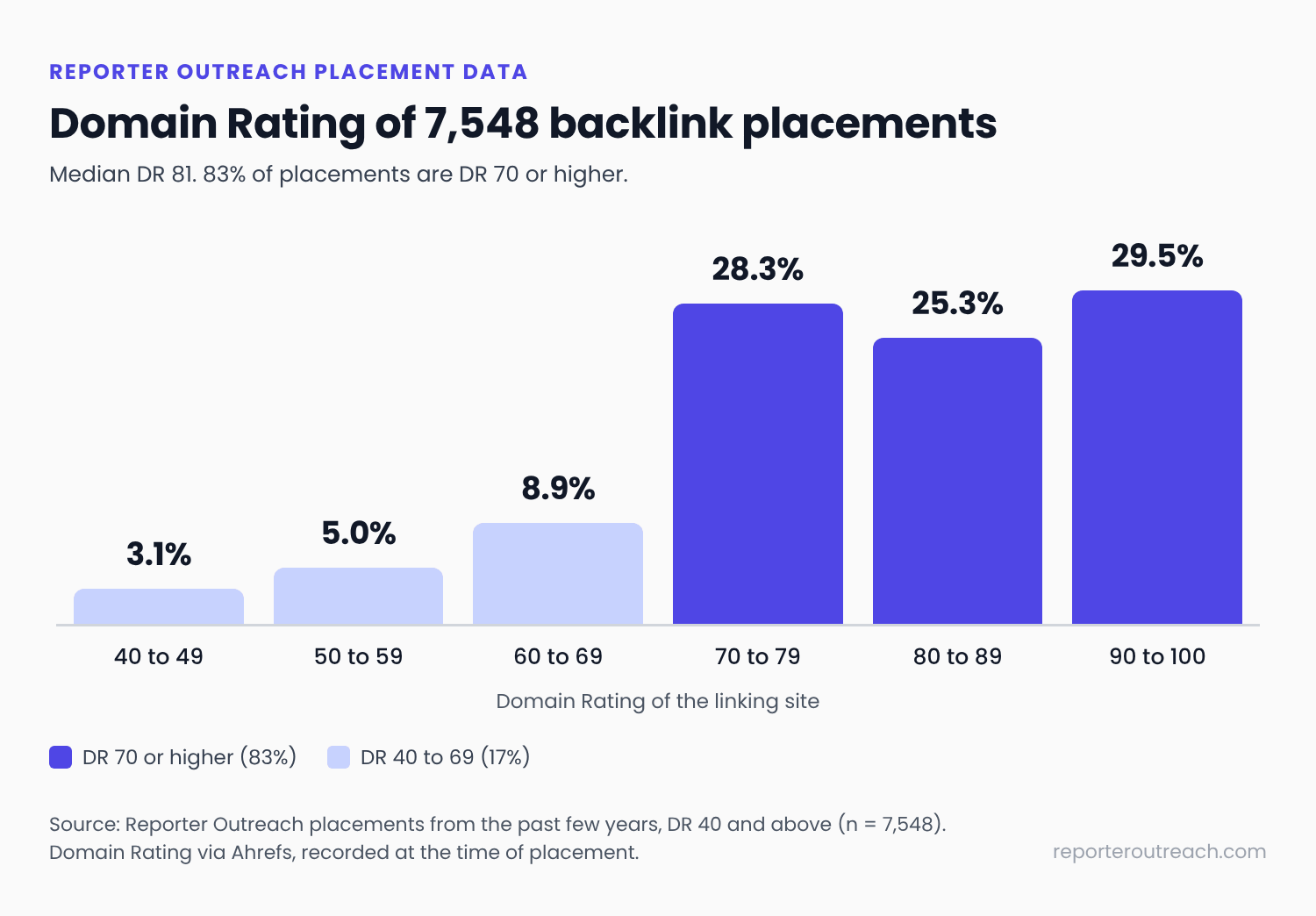
The shape matters more than the single number. More than four in five placements (83%) were DR 70 or above, the range most SEOs would call genuinely high authority. Over half (55%) were DR 80 or higher. Fewer than one in thirty landed in the DR 40 to 49 band, where a link usually earns its place through relevance rather than authority. The full distribution:
| Domain Rating | Share of placements |
|---|---|
| DR 90 to 100 | 29.5% |
| DR 80 to 89 | 25.3% |
| DR 70 to 79 | 28.3% |
| DR 60 to 69 | 8.9% |
| DR 50 to 59 | 5.0% |
| DR 40 to 49 | 3.1% |
If Domain Rating is new to you, we cover how it is calculated and what counts as a strong score separately.
88% was earned editorial coverage
Domain Rating describes the site. The type of placement describes the link itself, so that is what we looked at next. Here is the split: 78.9% were editorial placements, meaning links inside articles written and published by the outlet. Another 8.7% were editorial mentions, where the brand was cited in coverage. Together, 87.7% of the links were earned editorial coverage. Link insertions accounted for 7.5%, and everything else (guest posts, exchanges and the like) made up under 5%.
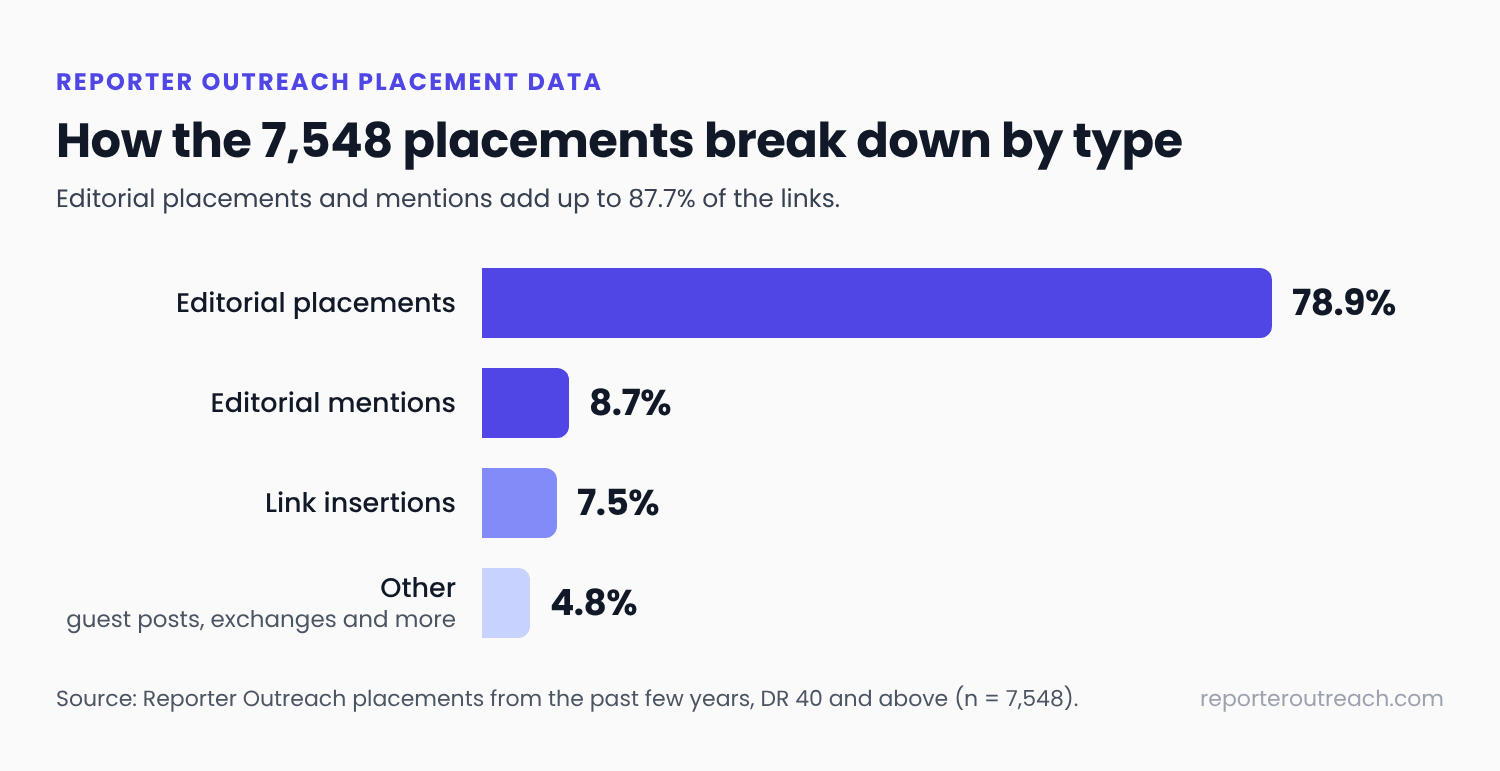
That ratio reflects how we build authority: the bulk of these links came from pitching journalists and editors real stories through our digital PR work. Earned coverage is also what we lead with for AI visibility, since third-party publications are the source AI answers cite most (our AI search statistics roundup has the data). Link insertions do a different job. They place a relevant, contextual link on a vetted, high-authority host site so a specific page can rank in Google, and we use them where a page needs that push. When you compare providers, ask what each part of the mix is for, not just what the Domain Ratings say.
Authority backed by real traffic
A common problem with high DR links is that the score is the only real thing about them. Plenty of high Domain Rating sites pull almost no actual readers; the authority is technical, not human. So we looked at the monthly organic traffic of every linking site we had data for. The median was roughly 793,000 visits a month. Nearly nine in ten placements (89%) were on sites pulling at least 10,000 monthly visits, and 70% were on sites above 100,000.

Almost half of those links (47.8%) came from sites with over a million monthly visits. This is the part that is hardest to fake and easiest to verify: a link is only worth the audience and trust of the site it sits on, and these placements skew heavily toward sites with both. A DR 85 domain with 2,000 monthly visitors and a DR 85 domain with two million are not the same link, however identical they look in a backlink tool.
The real publications behind the data
Numbers describe the portfolio; names make it concrete. Below is a representative sample of outlets where we have earned editorial placements, grouped by the category they cover. It is not a ranked list, and it is filtered to direct placements rather than the syndicated pickups that pad most agencies' logo walls. Domain Rating in parentheses, recorded at the time of placement.
| Industry | Example publications |
|---|---|
| Health & wellness | Verywell Health (DR 90), Everyday Health (DR 89), Healthgrades (DR 87), EatingWell (DR 85), SingleCare (DR 77) |
| Finance & business | Forbes (DR 94), Business Insider (DR 92), Inc. (DR 91), U.S. Chamber of Commerce (DR 88), Benzinga (DR 87), Kiplinger (DR 85) |
| Technology | Shopify (DR 96), CNET (DR 92), Tom's Guide (DR 86), InformationWeek (DR 86), CMSWire (DR 85), Toggl (DR 84) |
| Real estate & home | Realtor.com (DR 91), The Spruce (DR 90), Martha Stewart (DR 88), House Beautiful (DR 86), Southern Living (DR 86), Homes & Gardens (DR 81) |
| Food & recipe | Allrecipes (DR 89), Food & Wine (DR 88), Delish (DR 86), Simply Recipes (DR 82), Tasting Table (DR 81), Eat This, Not That (DR 81) |
| Lifestyle & consumer | HuffPost (DR 92), New York Post (DR 91), Travel + Leisure (DR 89), Bustle (DR 88), Real Simple (DR 87), Parade (DR 85) |
These are a slice of the 1,481 publications in the dataset. We match outlets to each client's category and audience across a dozen industries: the publication that carries authority for a SaaS brand is rarely the one that moves the needle for a recipe site.
What makes a good backlink: the benchmarks
Put the three findings together and you get a usable definition of a high authority backlink, one you can hold your own links (or a vendor's) against. None of these is a hard rule, and relevance always matters alongside the metrics. But as a screen, they catch most of what separates a link worth having from a number on a report. The first three rows are what this data measured; the last four are standard quality checks worth applying to any link.
| Signal | What to look for |
|---|---|
| Domain Rating | DR 70+ for genuinely high authority. Median in this data: 81. |
| Link type | Matches the job: earned editorial coverage for domain-wide authority and AI visibility, a vetted insertion when one page needs to rank. |
| Linking-site traffic | 10,000+ monthly organic visits; 100,000+ is stronger. |
| Relevance | The page and site relate to your topic or audience. |
| Editorial standards | Real editors, original content and a reason to exist beyond hosting links. |
| Indexation and freshness | The site is indexed in Google and still publishes new content. |
| Anchor | Reads naturally: branded or contextual, not stuffed with exact-match keywords. |
If you are evaluating a provider and their placements do not clear most of this, or they will not show you live examples to check, the Domain Rating on the proposal is not telling you much. For how the wider industry thinks about link quality versus what actually gets built, our link building statistics roundup is a useful companion to this data.
Want high authority backlinks like these?
The placements in this study come from the same programs we run for clients today. If you want links like these, with high Domain Rating on sites people actually read, let's talk through your targets.
Frequently asked questions
What is a high authority backlink?
A high authority backlink is a link from a website with a strong Domain Rating and a real audience. In our placement data, the median link sat on a DR 81 site, the median linking site drew roughly 793,000 monthly organic visits, and nearly 88% of links were earned editorial coverage. It is authority, audience and relevance together, not a high score on its own.
What makes a good backlink?
Four things: a strong Domain Rating (DR 70+ is a reasonable bar), a linking site with real editorial standards, genuine organic traffic, and topical relevance to your site. A link that clears the first three but has nothing to do with your industry is weaker than its metrics suggest.
What is a good Domain Rating for a backlink?
DR 70 and above is generally considered high authority. For context, 83% of the placements in this analysis were DR 70+ and the median was DR 81. Links below DR 50 can still be worth it for relevance, but they should not be the bulk of a high-authority campaign.
How do editorial links and link insertions differ?
They do different jobs. Editorial placements, earned through coverage, made up the large majority of our links. They build domain-wide authority and are the strongest lever for AI visibility. Link insertions add a relevant, contextual link on a high-authority host site, which makes them the direct route to ranking a specific page. The warning sign in any program is links from sites with no real audience, whatever the method.
Do high authority backlinks help with AI search visibility?
Yes, in two ways. Links help the pages they point to rank in Google, and pages that rank make up a big part of the pool AI search tools draw from. And earned coverage on widely read publications is itself the kind of source AI answers cite most, which is why we lead with digital PR for AI visibility. Our AI search statistics roundup has the data.
Sources
- Reporter Outreach placement records: 7,548 links at DR 40 and above from the past few years, across 1,481 publications and 201 client programs. Domain Rating and linking-site monthly organic traffic were recorded at the time of placement; traffic data is available for 68% of placements.
- Ahrefs Help Center, What is Domain Rating (DR)?