Key Takeaways
- There are four ways to outsource link building — freelancers, link marketplaces, specialist agencies, and white label partners — and the route shapes cost, quality, and risk more than the decision to outsource itself.
- 56% of SEO professionals already run at least part of their link building through external partners (Editorial.link, 2025).
- Marketplace inventory looks cheap until you filter for quality: the average guest post runs $365, but high-quality placements average $930 — and only 4.6% of marketplace sites clear a real quality bar (BuzzStream).
- A salaried specialist at the surveyed average output works out to roughly $590–$830 per quality link — price parity with managed retainers. The real differences are capacity, ramp, and continuity.
- Agencies reselling links should default to the white label route — a 2x markup and 40–60% gross margins are the market standard.
Outsourcing link building means choosing one of four delivery models: hiring a freelancer, buying from a link marketplace, retaining a specialist agency, or — if you run an agency yourself — partnering with a white label provider. Most advice treats these as interchangeable. They're not.
The route you pick sets your per-link cost (from under $400 to over $1,200 per link), your quality floor, and how much of the work quietly lands back on your desk. It also determines what happens when something goes wrong — a freelancer who disappears mid-campaign and an agency that misses a month are very different problems.
Outsourcing itself is no longer the contrarian move. 56% of SEO professionals already run at least part of their link building through external partners, per Editorial.link's 2025 survey of 518 senior SEOs. If you're still deciding whether to outsource at all — what to keep in-house, the salary math, the risk profile — start with our SEO outsourcing guide. This article answers the next question: which route.
The 4 Ways to Outsource Link Building
The four routes are freelance link builders, link marketplaces, specialist agencies, and white label partners — ordered roughly by how much management stays on your plate. Here's the comparison at a glance:
| Route | Typical cost | You still manage | Best for |
|---|---|---|---|
| Freelancer | $4,200/mo average (BuzzStream) | Strategy, QA, continuity | Teams with SEO expertise and time to direct the work |
| Link marketplace | $365 avg per guest post; $930 for quality sites (BuzzStream) | Site vetting, anchors, everything else | Occasional one-off placements with hands-on QA |
| Specialist agency | $3,000–$12,000/mo retainers; ~$597 avg cost per link (BuzzStream) | Goals and approvals | Brands running an ongoing authority program |
| White label partner | Wholesale rates + your 2x markup | The client relationship | Agencies reselling link building under their own brand |
Notice what the table doesn't say: that one route is best. The honest split isn't between cheap and expensive — it's between self-managed and managed. Plot the four routes on those axes and the clustering is hard to miss:
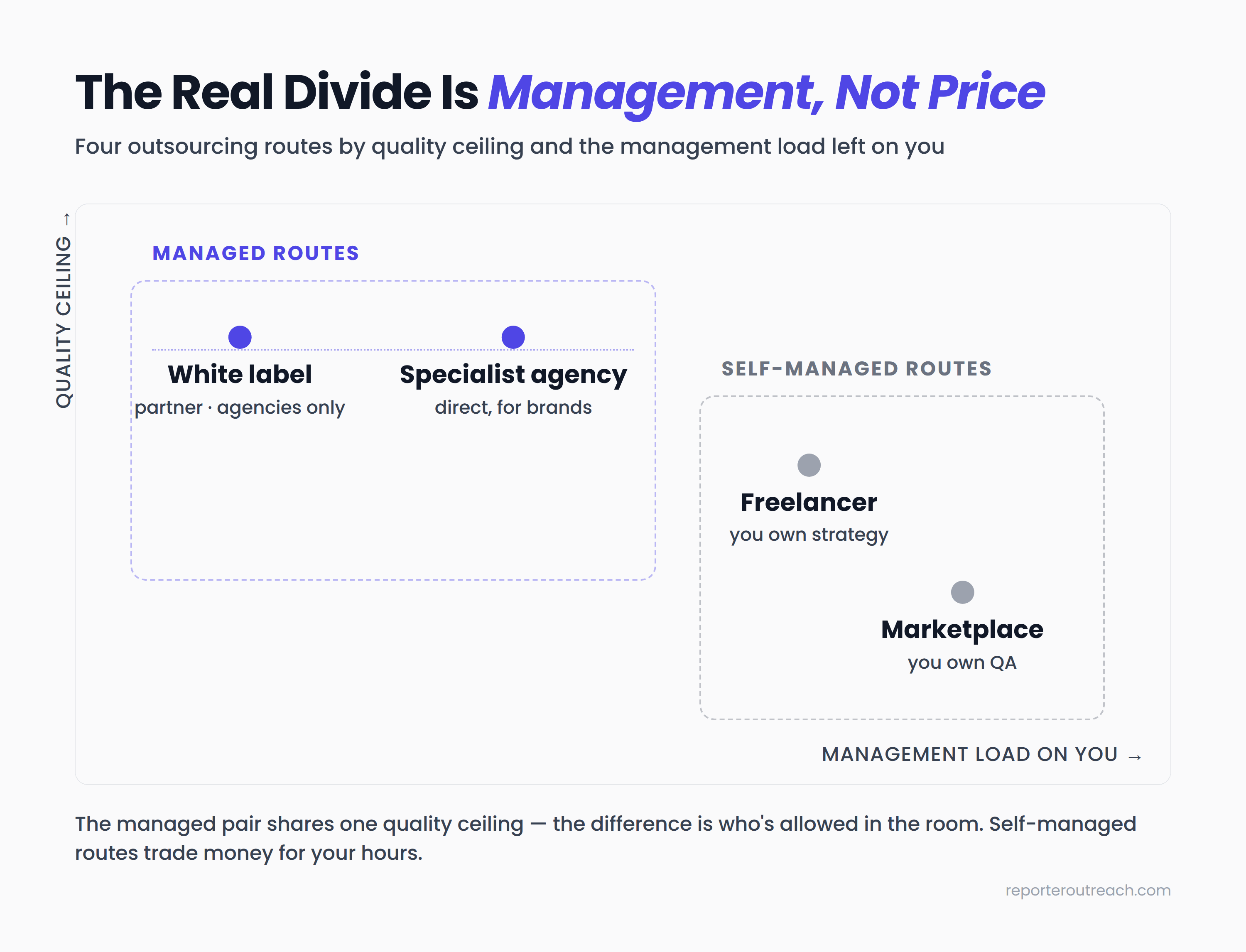
The managed pair shares one quality ceiling — white label and a direct retainer are often literally the same supply. The difference is who's allowed in the room: white label exists for agencies serving clients, while a direct agency retainer is the brand-side equivalent. The self-managed pair trades money for your hours — which only works if your hours are actually available.
Route 1: Freelance Link Builders
Freelancers cost the least to start and the most to manage. In BuzzStream's 2025 digital PR cost survey, freelancers averaged $4,200 per month against $6,357 for agencies — agencies charge roughly 50% more, a premium that buys creative production, reporting, and a bench instead of one person's pitch capacity.
That last part is the real tradeoff. A good freelancer brings their own relationships and instincts, but the output ceiling is one human: one inbox, one set of publisher contacts, one vacation calendar. When they're heads-down on another client, your pipeline pauses. When they leave the industry, the relationships leave with them.
The route works when you already own strategy — you know which pages need authority, you can write the brief, and you can QA the placements yourself. It fails when you hire a freelancer hoping they'll be the strategy. That's an agency's job, at an agency's price.
Route 2: Link Marketplaces
Marketplaces sell placements that existed before you showed up — pre-built inventory, browsable by DR, niche, and price. It's the fastest route to a live link and the easiest one to get burned by.
BuzzStream's analysis of 26,000 guest post sites puts numbers on the problem. Over 85% of listed sites are low-quality. Only 4.6% clear a meaningful bar (DR 71+ with 50K+ organic traffic). The average guest post costs $365 — but filter to quality sites and the average jumps to $930. The discount you came for evaporates the moment you start filtering, which is the only responsible way to buy.
Link insertions on marketplaces average $141 in the same dataset, with BuzzStream's own caveat attached: high-quality, high-traffic sites rarely offer them. Cheap insertion inventory is cheap because the host sites have nothing to lose.
Before buying any listed placement, verify three things: real organic traffic in Ahrefs (not just DR), topical relevance to your site, and a domain with history beyond the listing itself. A DR 60 site with a few hundred monthly visits is manufactured authority — the exact inventory Google's SpamBrain exists to devalue.
Used with that discipline, marketplaces are fine for an occasional one-off. As the engine of an ongoing program, the math and the risk both work against you — every placement requires the vetting labor you were trying to outsource in the first place.
Route 3: Specialist Agencies
A specialist agency is the only route where strategy, outreach, content, and QA arrive bundled — you bring goals and approvals, they bring the machine. Retainers typically run $3,000–$12,000 per month depending on placement volume and publication caliber.
The per-link economics are better than the sticker price suggests. Standalone digital PR links price at $1,250–$1,500 each in BuzzStream's data, but across managed digital PR services the surveyed average cost per link lands at $597 — retainers spread campaign overhead across every placement they produce. For most brands running an ongoing program, that's the efficient way to buy editorial coverage. The full market behind those numbers — retainer benchmarks by provider type, model comparisons, and the traditional PR gap — is in our digital PR pricing guide.
Two things to hold the route accountable on. First, the timeline: first placements in 2–3 weeks, ranking movement in months 3–6 — any agency promising faster is selling something other than editorial links. Second, the specialist test: the difference between a specialist and a generalist with a good pitch deck is covered in detail in our SEO outsourcing guide, and it comes down to whether they'll show recent placements with full traffic data.
Route 4: White Label Partners
White label is the agency reseller's route: a specialist provider builds the links, your agency brands the deliverables, and the client never sees the provider. If you're a brand, this route isn't for you — it exists so agencies can sell link building without standing up an outreach team.
For agencies, it's usually the highest-leverage option on this page. Your cost scales 1:1 with what you sell, you skip the six-figure hire, and the capability gap closes the week you sign. The full agency playbook — delivery models, provider vetting, the margin math in detail — lives in our white label link building guide.
Market standard is a 2x markup on wholesale: buy a placement at $250, bill it at $500. Packaged into monthly retainers, white label link building typically holds 40–60% gross margin. Reporter Outreach runs this model as the provider behind dozens of agencies — details on the white label services page.
In-House vs. Outsourced: The Per-Link Math
A salaried link builder costs roughly $590–$830 per quality link at the surveyed average output — effectively price parity with a managed retainer. The cost side: a dedicated specialist runs $110,000–$155,000 a year fully loaded (salary, benefits, tools, ramp-up — the full cost stack is broken down in our SEO outsourcing guide). The output side: BuzzStream's digital PR survey puts a single link builder at an average of 15.6 links per month — a cohort working with agency campaign assets behind them, and counting syndicated pickups. The constraint isn't hours, it's the funnel: it takes an average of 15 pitches to secure one guest post placement (OutreachMonks), so a 10-link month means 150-plus targeted pitches before follow-ups. Most of the workweek goes into attempts that die.
Experience moves both axes together — you can't pair a junior's output with a specialist's salary, in either direction. Authority Hacker's 755-person survey has five-year veterans averaging 25 links a month and delivering a 41% lower cost per link than less experienced builders, despite earning more. At the top of the cost stack, that veteran works out to roughly $515 per link — below the managed average. If you can hire that person, keep them, and keep them fully utilized, in-house wins on price. Most companies can't, which is why the market prices below hold.
Here's how the routes stack up per link:
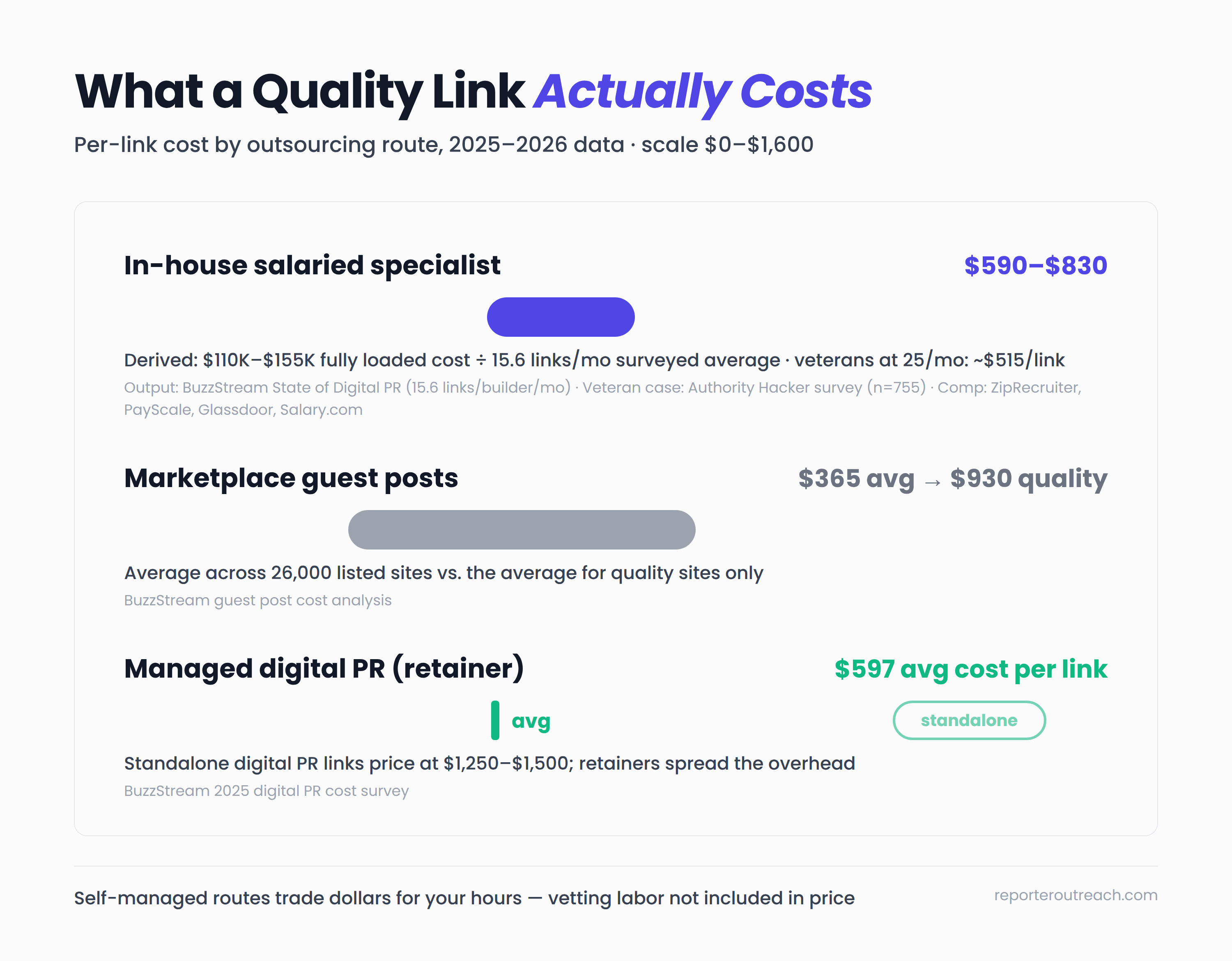
Two honest footnotes. The in-house bar assumes a ramped specialist holding the surveyed average every month — the first six months of a real hire run below it, and vacation, churn, and competing duties all push the effective number up. Veterans and full teams move it the other way, which is why large brands and PR-first agencies keep it internal. And the marketplace bar is the average before you account for the vetting hours each purchase demands. Per-link price is only half the cost; the other half is whose calendar absorbs the work. Full pricing detail by method and DR tier is in our link building pricing guide.
Which Route Fits You?
Match the route to three variables: whether you're an agency or a brand, whether the need is ongoing or one-off, and how much management you can genuinely absorb. The decision compresses to a short flowchart:
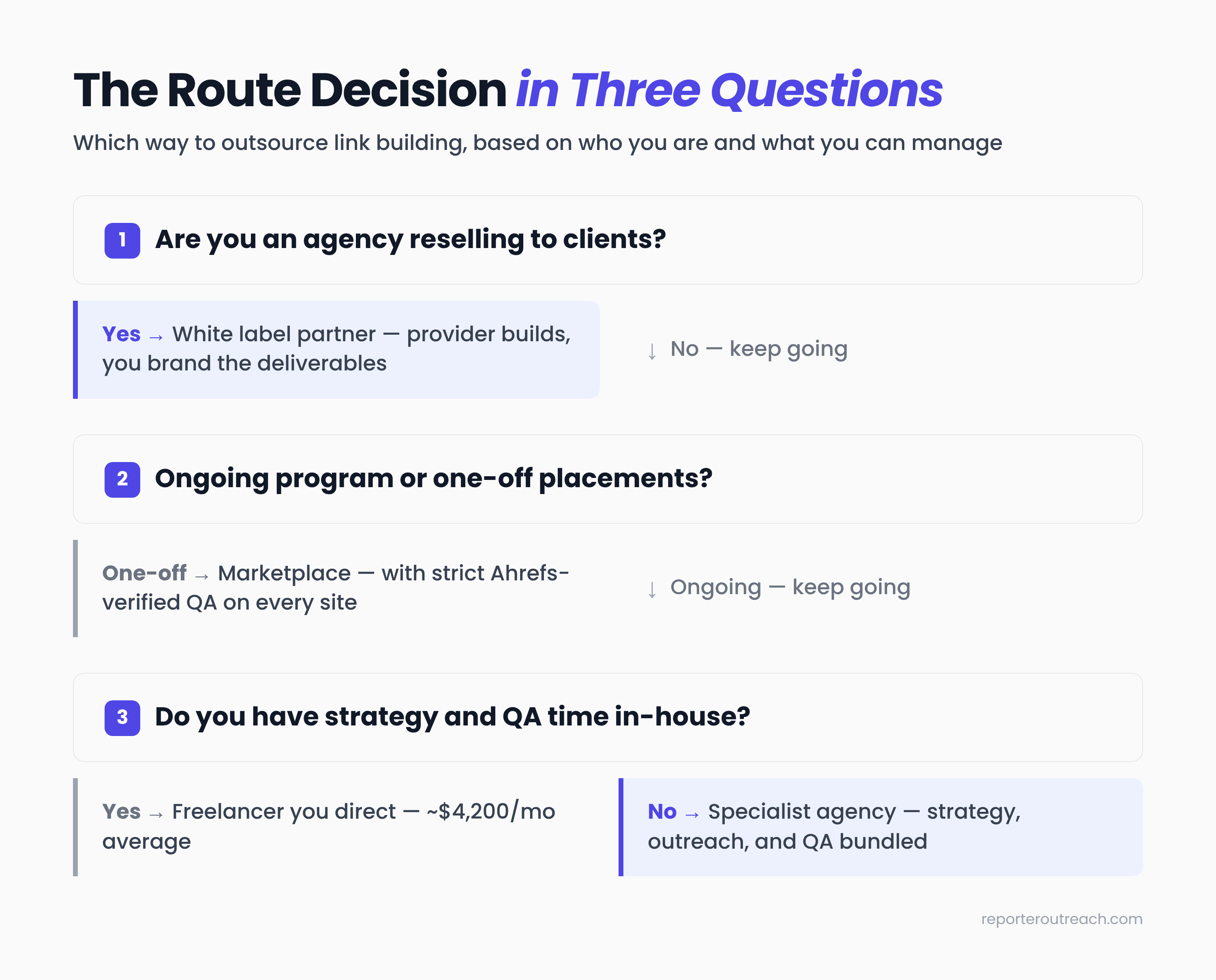
One scenario the flowchart can't capture: hybrids. Plenty of teams run a specialist agency for editorial digital PR while an internal marketer handles the occasional niche-specific placement directly. The routes aren't exclusive — but one of them should own the core program, or nobody's accountable for the pipeline.
Two of These Routes Lead Here.
Reporter Outreach runs editorial digital PR and link insertions for brands directly — and operates as the white label partner behind agencies that resell it. Tell us which seat you're in and we'll scope the program.
Outsource Link Building FAQ
How much does it cost to outsource link building?
Depends on the route. Marketplace guest posts average $365, with quality placements averaging $930. Freelancers average $4,200/month, agencies $6,357/month, with a surveyed average cost per link of $597 across managed digital PR. Agency retainers generally run $3,000–$12,000/month depending on volume and publication caliber.
Is it better to outsource link building or keep it in-house?
On per-link price it's close to a wash: a salaried specialist at the surveyed average output runs roughly $590–$830 per quality link against a $597 average for managed digital PR. The decision turns on everything price hides — ramp time, vacation and churn risk, and a hard capacity ceiling of one person. In-house wins with a proven veteran at full utilization (Authority Hacker has five-year specialists averaging 25 links/month at a 41% lower cost per link), at team scale, or when publisher relationships are the company's core identity.
What's the cheapest way to outsource link building?
Nominally, marketplaces — but the cheap tier is cheap for a reason. Over 85% of marketplace sites are low-quality, and wholesale links at $50–$80 are PBN territory by definition. The cheapest route that doesn't create penalty risk is a managed engagement sized to your actual volume needs.
How long does outsourced link building take to work?
First placements typically land in 2–3 weeks. Ranking movement shows up in months 3–6, with compounding gains over 12 months as authority builds. Any provider promising top rankings inside 30 days is selling something other than editorial links.
Can a freelancer do digital PR?
Rarely well. Digital PR depends on daily journalist-platform monitoring, fast response windows, and publisher relationships built across many campaigns — infrastructure that's hard for one person to maintain alongside client work. Freelancers tend to fit better on content-led tactics where output is self-contained.
Sources
BuzzStream — Link Building Pricing: Statistics and Analysis (2025); BuzzStream — The Cost of Guest Posts Based on 26K Sites; BuzzStream — How Much Does Digital PR Cost? survey (2025); Editorial.link — State of Link Building 2025 (n=518); Authority Hacker link building survey (n=755); OutreachMonks outreach benchmarks (2024); in-house compensation data via Reporter Outreach's SEO outsourcing guide (ZipRecruiter, PayScale, Glassdoor, Salary.com, May 2026).