
Key Takeaways
- AI in PR is no longer a question of adoption. Of the 200 PR professionals in our 2026 survey, 83% use AI and 64% reach for it daily or weekly.
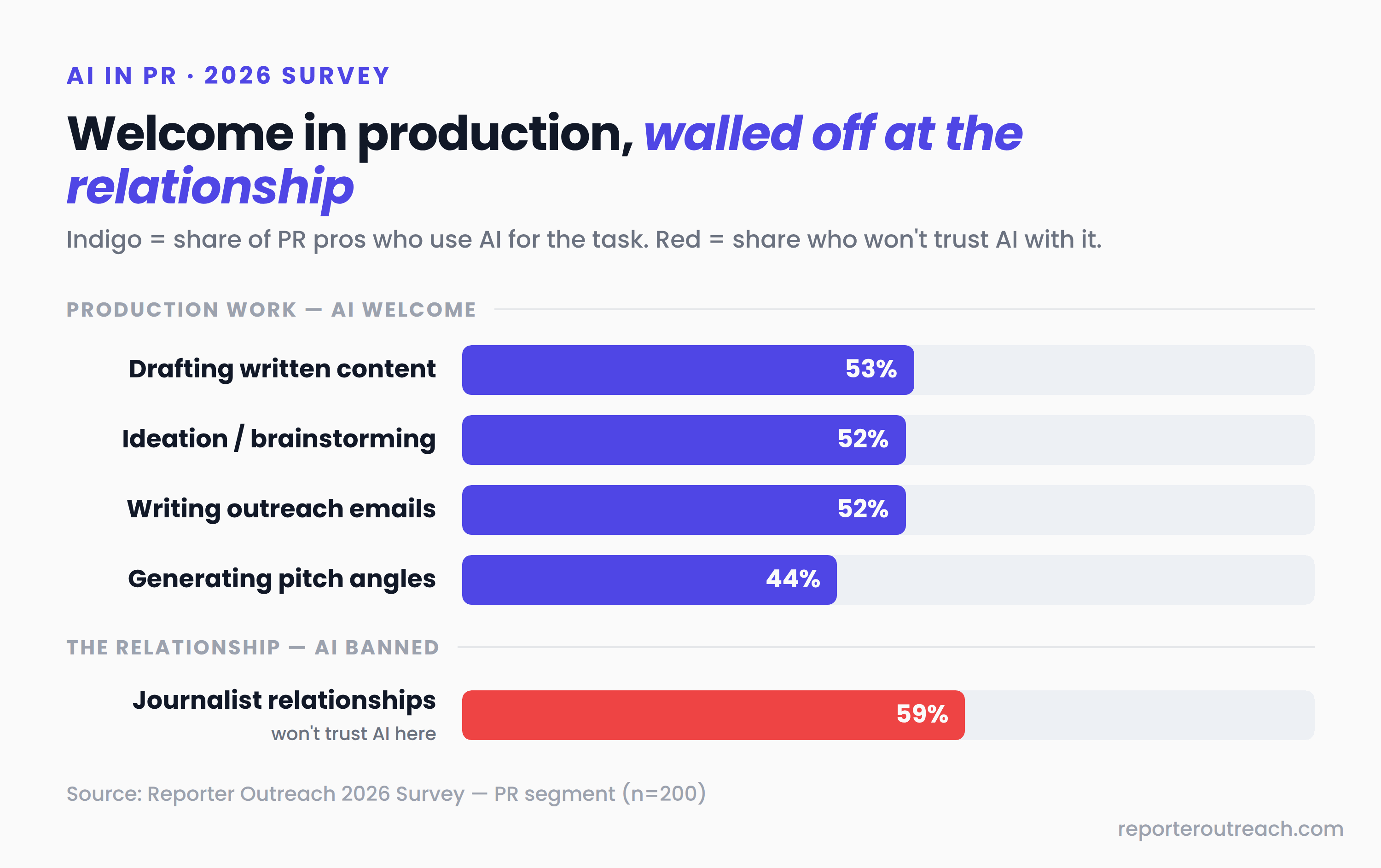
- PR teams lean on AI hardest for production work — drafting (53%), ideation (52%), outreach emails (52%), and generating pitch angles (44%).
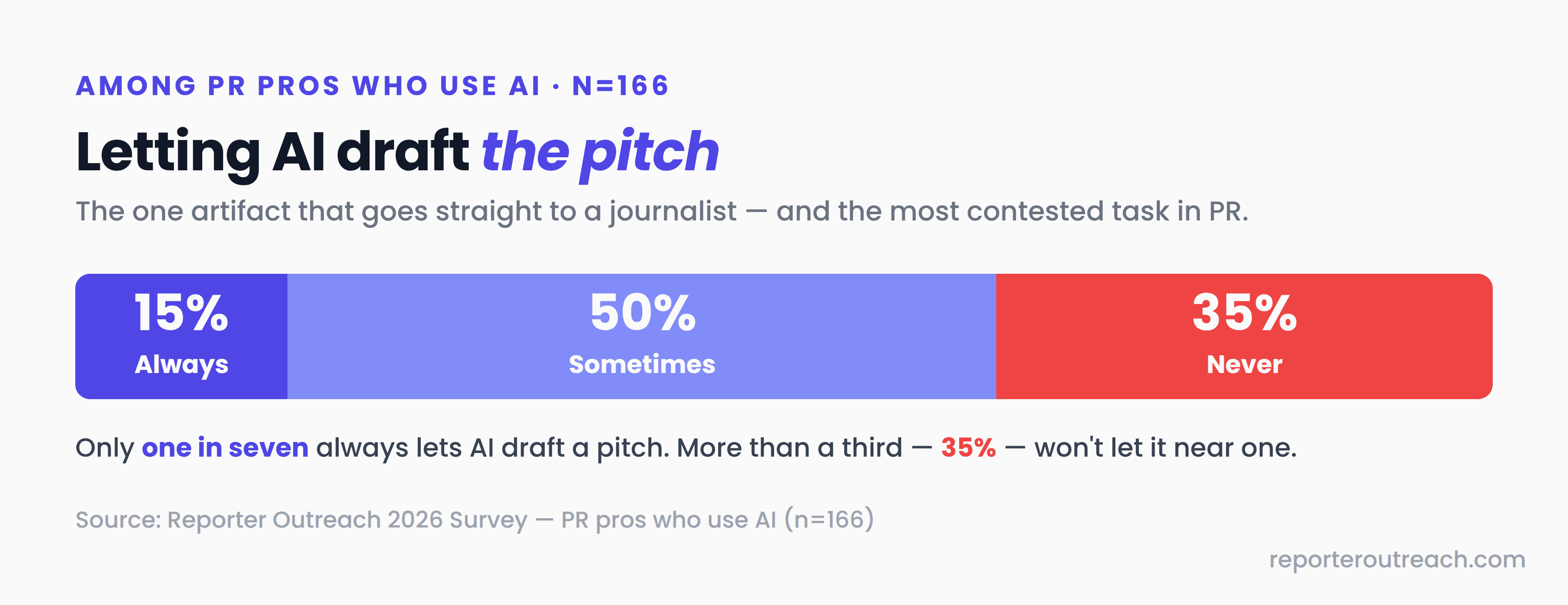
- The pitch is the dividing line. Among PR pros who use AI, only 15% always let it draft a pitch, 50% do so sometimes, and 35% never do.
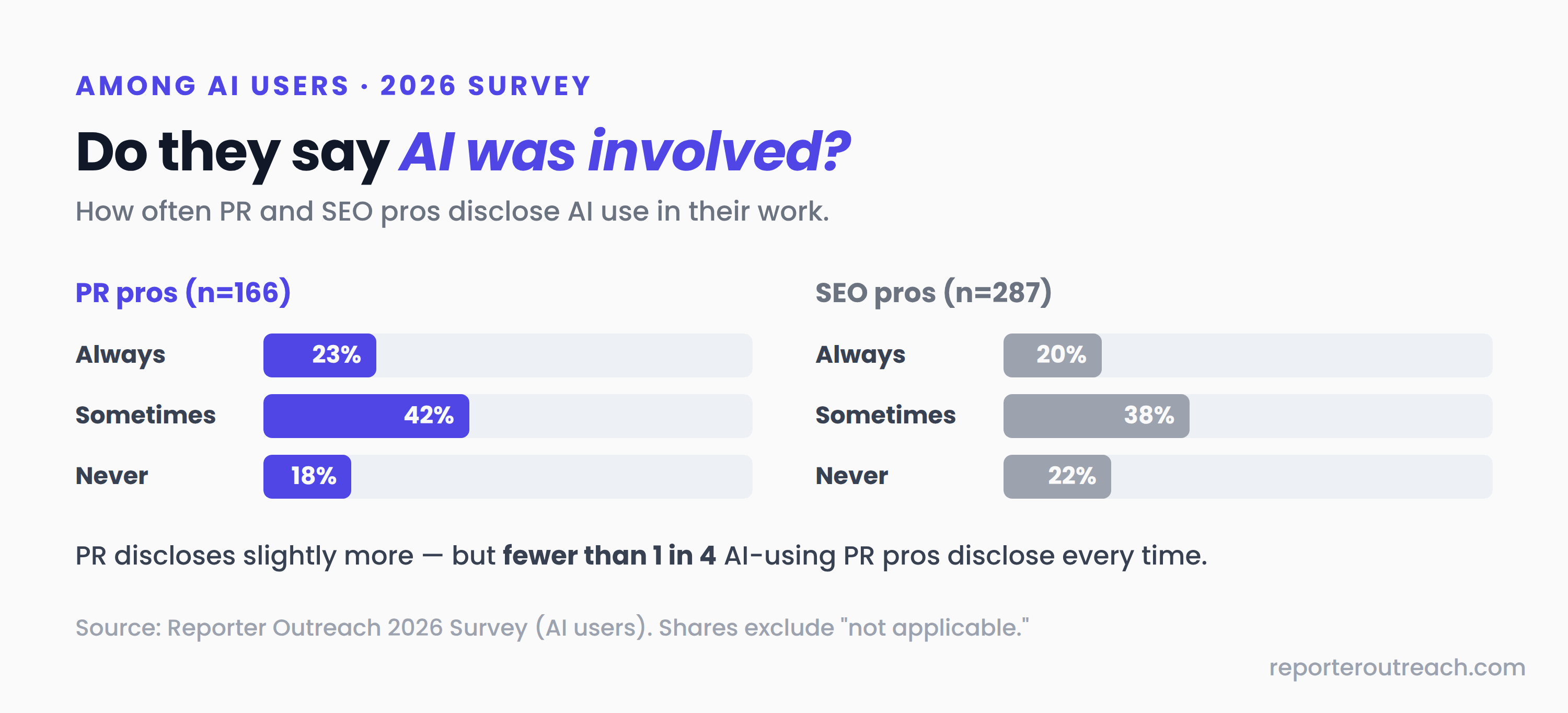
- Disclosure is inconsistent. Just 23% of AI-using PR pros always say when AI was involved; 18% never do.
- The hard wall is the relationship itself: 59% won't trust AI with journalist relationships — nearly three times the rate SEOs say the same.
Ask whether AI in PR has arrived and you're asking a question that's already settled. The interesting question is narrower and more revealing: once a PR pro has AI open, what do they let it touch, and what do they keep their hands on?
We put that question to 200 public relations and earned-media professionals as part of a larger survey of 500 SEO and PR practitioners. The SEO findings split off into their own story. This one is about PR — and it traces a clear line through the workflow. AI has saturated the production end of PR. It hits a wall the moment the work gets close to a journalist.
AI in PR already runs the back office
Adoption inside PR is near-total. 83% of the PR pros we surveyed use AI in their work, and 64% use it daily or weekly. That's a few points behind the SEO crowd — SEOs sit at 74% daily-or-weekly — but the gap is closing, not widening, and it tells you nothing about how the two groups actually use the tools.
This isn't an early-adopter story. When two-thirds of a profession reaches for the same category of tool every week, AI has become infrastructure — the thing you assume is running in the background, not the thing you're testing. The external data agrees. USC Annenberg's 2025 Global Communication Report, a survey of more than 1,000 communicators, found AI already embedded in press-material drafting (36%) and social content (43%), with most professionals expecting it to make their jobs easier over time.
So the headline isn't that PR uses AI. It's where PR points it.
What PR teams actually hand to AI
PR hands AI the production work — the drafting, the brainstorming, the first-pass research. The tasks PR pros use AI for most are the ones furthest from the journalist:
| Task | Share of PR pros using AI for it |
|---|---|
| Drafting written content | 53% |
| Ideation / brainstorming | 52% |
| Writing outreach / pitch emails | 52% |
| Summarizing research or transcripts | 46% |
| Generating pitch angles / media lists | 44% |
| Editing / proofreading | 42% |
Notice what's at the top. Drafting, ideation, and outreach copy — the raw material of a campaign — all cluster around half. These are the tasks where a wrong word costs you a rewrite, not a relationship. When a PR pro names the single task AI changed most, drafting wins outright (27% of AI-using PR pros), with pitch-angle generation a distant second (15%).
AI use in PR runs high on internal production and falls off a cliff at the journalist. The further a task sits from a reporter's inbox, the more comfortable PR pros are handing it over.
The pitch is where PR pros hesitate
The pitch is the exception to PR's comfort with AI. It's the one artifact that travels directly from the PR pro to a journalist — and the data shows pros treat it as contested ground. Among PR professionals who use AI, only 15% always let it draft a pitch. Half use it sometimes. And 35% never let AI near a pitch at all.
| How PR pros use AI to draft pitches | Share (AI users) | What it signals |
|---|---|---|
| Always | 15% | Treats AI as the default first drafter |
| Sometimes | 50% | Reaches for it case by case, not reflexively |
| Never | 35% | Keeps the pitch fully human, on principle |
Put the two extremes side by side. A third of AI-using PR pros won't let the technology touch a pitch, while only one in seven leans on it fully. Compare that to drafting written content, where AI use is comfortably above half. The same person who happily lets AI draft a blog post or a backgrounder pulls back when the words are headed for a reporter.
Why the pitch specifically? Because a pitch isn't just copy — it's a bid for a relationship. A generic, obviously-automated pitch doesn't just fail; it spends down trust with a journalist you may need for years. And the stakes are unforgiving on their own terms: across hundreds of thousands of real pitches analyzed by Propel's Media Barometer, journalists respond to roughly 3% of what lands in their inboxes. When 97 of every 100 pitches already go nowhere, "good enough" copy that sounds machine-made is a luxury most pros won't risk.
Almost nobody says the pitch was AI-drafted
Disclosure is the loose thread in all of this. If PR pros are using AI to help write pitches — even sometimes — how often does anyone on the receiving end find out? Rarely. Among PR professionals who use AI, just 23% always disclose that AI was involved. 42% do so sometimes, 18% never do, and the rest say it doesn't apply to their work.
PR is, by a slim margin, more transparent than SEO here — 23% of AI-using PR pros always disclose versus 20% of SEOs. But "more transparent" is grading on a curve when roughly three-quarters of a relationship-driven profession don't disclose AI use as a matter of course.
| Disclose AI involvement | PR (AI users) | SEO (AI users) |
|---|---|---|
| Always | 23% | 20% |
| Sometimes | 42% | 38% |
| Never | 18% | 22% |
This is less a scandal than a norm still forming. Nobody discloses that they used spell-check or a thesaurus. The open question PR hasn't answered yet is whether AI drafting belongs in that bucket — invisible tooling — or whether a pitch a journalist believes is personal deserves a different standard. The 35% who refuse to let AI draft pitches at all have effectively answered it for themselves.
The wall AI doesn't cross
Past the pitch, the line stops being a gradient and becomes a wall. When we asked what PR pros won't trust AI with under any circumstances, the top answer wasn't strategy or client deliverables — it was the relationship itself. 59% of PR pros won't trust AI with journalist relationships, versus 20% of SEOs who say the same. It's the single sharpest divergence between the two disciplines in the entire survey, and we unpack the full cross-discipline split in the broader state-of-AI findings.
That gap makes sense once you see what each discipline guards. SEOs guard the published artifact — half won't ship anything AI-wrote unedited. PR guards the connection. The relationship with a reporter is the asset a PR career is built on, and it's the one thing in the workflow that doesn't get faster when you automate it. USC Annenberg's data lands in the same place from the other direction: 68% of agency executives strongly agree that people will remain essential to PR, even as AI takes over more of the production load.
AI welcome at the production layer, contested at the pitch, banned at the relationship. The closer a task gets to a human on the other end, the faster PR pros take their hands back off the wheel.
What this means for PR teams and their clients
If you run a PR team, the data is a permission slip and a warning at once. The permission: automate the production layer aggressively — research, first drafts, media-list building, summarizing. Two-thirds of your peers already do, and the time it frees is real. The warning: the pitch and the relationship are where AI stops being leverage and starts being a liability, and the pros pulling ahead are the ones spending the freed-up hours on the human work, not on sending more automated pitches into a 3% response rate.
If you're hiring a PR partner, this is the question worth asking: where do they draw the line? An agency that lets AI draft and send pitches unsupervised is optimizing for volume in a channel that punishes it. The work that earns coverage — the judgment about which angle fits which reporter, the relationship that gets a pitch read at all — is exactly the work the profession refuses to hand to a machine. Media outreach done well still runs on that human layer. Reporter Outreach builds digital PR campaigns around it, using AI to clear the production work so the editorial judgment gets more attention, not less. For the wider numbers on cost, effectiveness, and benchmarks, our digital PR statistics roundup goes deeper.
Want coverage built on judgment, not automation?
We use AI to clear the busywork and put human judgment where it earns placements — in the pitch and the relationship.
Frequently asked questions
How widely is AI used in PR?
Very widely. In our 2026 survey of 200 PR professionals, 83% reported using AI in their work and 64% use it daily or weekly. Adoption is no longer the dividing question in PR — how pros apply AI to different tasks is.
Do PR pros use AI to write pitches?
Some do, cautiously. Among PR pros who use AI, 15% always use it to draft pitches, 50% do so sometimes, and 35% never do. The pitch is the most contested task in the PR workflow because it goes straight to a journalist.
What won't PR professionals trust AI with?
The journalist relationship above all else. 59% of PR pros say they won't trust AI with journalist relationships — the highest off-limits category in our survey and nearly three times the rate among SEOs.
Do PR pros disclose when they use AI?
Not consistently. Just 23% of AI-using PR pros always disclose AI involvement, 42% disclose sometimes, and 18% never do. PR discloses slightly more often than SEO, but most of the profession treats it case by case.
What does AI do best in PR right now?
Production work. PR pros lean on AI most for drafting content (53%), ideation (52%), and writing outreach copy (52%), and they name drafting as the single task AI has changed most. The internal, pre-journalist work is where AI adds the most value with the least risk.
Sources: Reporter Outreach 2026 Survey of 500 SEO and PR Professionals (PR segment, n=200; AI-user subset n=166); USC Annenberg Center for Public Relations, 2025 Global Communication Report; Propel Media Barometer.