

Key Takeaways
- Business Wire publishes exactly one price: $475 for a 400-word release on U.S. domestic local distribution. Every other figure requires a quote.
- Documented rate cards put the U.S. national base at $760 to $940 for 400 words, plus $195 per additional 100 words and $425 for the first multimedia attachment.
- A 600-word national release with one image lands around $1,575. A 1,000-word release with two attachments and amplification clears $2,600.
- Wire distribution buys syndication, not coverage. No specific publication is guaranteed, and Google's spam policies list links with optimized anchor text in press releases distributed on other sites as link spam.
- For SEC disclosure and regulatory announcements, Business Wire is the standard. For visibility, a full-feature article costs about the same as one national release and buys a different product.
Business Wire pricing used to be simple to describe: call sales, find out. That has changed, sort of. The company now runs a public pricing page with exactly one number on it: $475 for a 400-word release on U.S. domestic local distribution. Everything past that number (national circuits, extra words, multimedia, ongoing plans) still routes through a quote.
This guide assembles the rest: the documented rate card, three worked cost examples with the math shown, what the money actually buys, and what the same budget gets you outside the wire.
Business Wire Pricing: The One Number They Publish
Business Wire's official pricing page lists a starting price of $475 for 400 words on U.S. domestic local distribution, and no other figure. The "Ongoing Distribution" plan next to it carries no price at all, just a "Build Your Distribution Plan" button and a note that flat-rate packages are available for qualifying U.S. customers.
Read the page and you'll see how the rest of the cost is framed: "The final cost depends on three things: the length of the release, the geographic circuit it goes to, and any enhancements you add, such as multimedia or translation." Longer releases bill in 100-word increments and multimedia is priced per asset. At what rates is a conversation with their team, though the page does promise that "the number on the quote is the number on the invoice."
That structure matters more than it looks. $475 is the floor circuit: local distribution in one U.S. market. It's an honest number, but it's not the number most buyers are shopping for. The typical searcher wants a national release, and a loaded national release runs roughly three to six times the published floor.
Publishing the cheapest circuit as the "starting price" while quoting everything else is a classic enterprise pricing move. It's not deceptive (the $475 tier is real), but budget against the rate card below, not the anchor.
The Documented Rate Card
Business Wire doesn't publish these rates, so the figures below come from documented third-party rate cards compiled and updated through 2025 and 2026, cross-checked against each other. Where sources disagree, we show the range instead of picking a number.
| Line item | Documented rate | Notes |
|---|---|---|
| U.S. local circuit (400 words) | $475 | The only rate Business Wire publishes |
| U.S. regional circuit (400 words) | $510+ | Single-source figure; verify on quote |
| U.S. national base (400 words) | $760 to $940 | $760 across four 2025 to 2026 rate cards; $940 in one tiered listing |
| Additional words | $195 per 100 | Applied above the 400-word base |
| First multimedia attachment | $425 | One 2026 source reports bundling at the national tier; confirm on quote |
| Additional attachments | $225 each | Photos, video, infographics |
| Amplification add-on | $95 | Visibility, engagement and analytics bundle |
| International circuits | $1,500 to $10,000+ | Varies widely by country combination |
| Ongoing and volume plans | Quote only | Flat-rate packages for qualifying U.S. customers; discounts negotiated on volume |
One structural point in Business Wire's favor: unlike PR Newswire, there is no annual membership fee, and every release includes a full-color linked logo. You pay per release. That makes one-off comparisons cleaner, and makes the per-release math below the whole story.
What a Real Release Costs: Three Worked Examples
The rate card only becomes useful when you run it against a real release. Here are three scenarios with the math shown, using the corroborated $760 national base:
| Scenario | The math | Total |
|---|---|---|
| 400 words, local circuit | Published starting price | $475 |
| 600 words, national, one photo | $760 + (2 × $195) + $425 | $1,575 |
| 1,000 words, national, two attachments, amplification | $760 + $1,170 + $650 + $95 | $2,675 |
Notice what drives the total. It isn't the base rate; it's the meter. Words past 400 cost almost $2 each. Here's the third scenario broken into its parts:
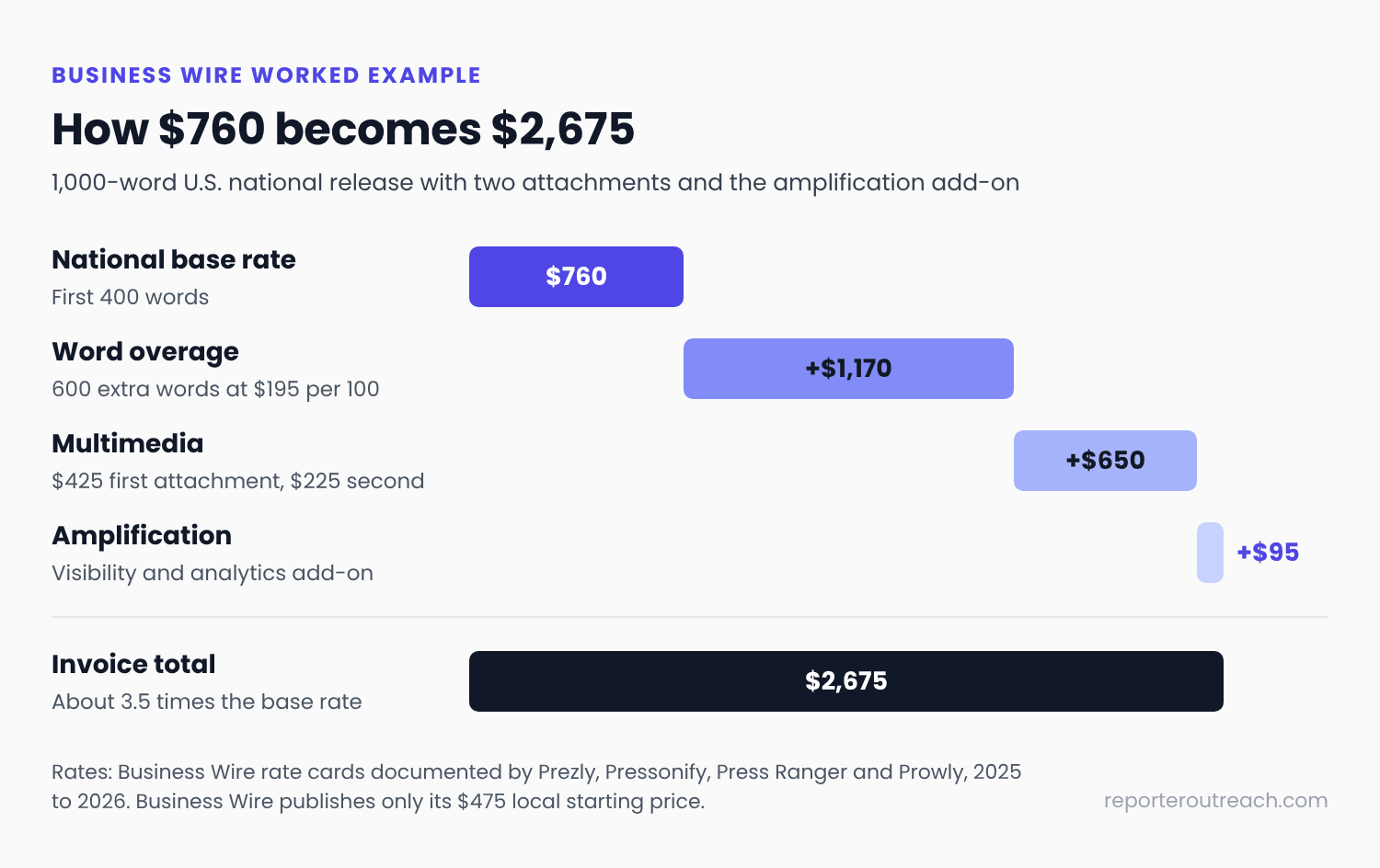
A 1,000-word announcement is not an unusual release. Add a second image and the analytics bundle and you've more than tripled the base rate before touching international circuits. If your quote comes back near $3,000, nothing went wrong; that's just what the meter reads.
For a like-for-like comparison, a 1,000-word national release with one image comes to about $2,355 here, logo included, against $3,330 to $4,055 on PR Newswire's rate cards. Our PR Newswire pricing guide has that line-item math.
What You're Buying (and What You're Not)
You're buying distribution: your release, verbatim, pushed to a circuit of syndication partners, financial terminals and media endpoints. Business Wire does this with genuine infrastructure (editorial review before distribution, compliance documentation, analytics), and 26,000+ companies use it, by the company's own count.
What you are not buying is coverage.
No specific publication is guaranteed. You purchase the circuit, not placement: whether any journalist reads the release, let alone writes about it, is entirely outside the transaction. Most of what the circuit produces is your text duplicated across syndication pages that exist to republish wire content.
There's a tell in Business Wire's own feature list: every release includes 400 words "with unlimited hyperlinks." Publications with editorial standards limit links; a feature typically carries two or three. Syndication networks don't, because nobody there is exercising editorial judgment about what gets linked.
Google's spam policies list "links with optimized anchor text in articles, guest posts, or press releases distributed on other sites" as an example of link spam. The unlimited hyperlinks are real. Their ranking value is not.
This is the distinction that costs companies real money, and it's worth being blunt about: wire distribution and earned media coverage are different products that happen to share the word "press." A journalist choosing to cite your expertise in a story they're writing is coverage. A syndication network republishing your announcement is distribution. Search engines treat the two very differently, and so do AI assistants: the engines answering buyer questions lean on editorial coverage from publisher domains, a dynamic we've broken down in our guide to generative engine optimization. For the full distinction between distribution and earned outreach, see our media outreach guide.
Business Wire Alternatives, Compared
Every wire service prices differently, but they sell the same category of product: your announcement, distributed. Here's the current landscape, at published prices checked in October 2026:
| Service | Published pricing | Model |
|---|---|---|
| Business Wire | $475 (local only) | Per release, no membership; national quoted |
| PR Newswire | From $355 (state); $850 national | Per release plus an annual membership; four-release bundles |
| GlobeNewswire | None | Quote only |
| Newswire.com | From $399 | Per release |
| ACCESS Newswire | From $934 a month | Monthly subscription (per its G2 listing) |
| PRWeb | $245 to $480 | Per release |
| eReleases | From $399 | Per release |
| EIN Presswire | From $149 | Per release |
The spread from $149 to $2,675 looks dramatic, but read it carefully: the price differences buy bigger circuits and better compliance infrastructure, not a different kind of outcome. A cheaper wire is a smaller version of the same product. Where the wires sit against everything else you could buy (writing fees, agencies and the editorial route) is mapped in our complete press release cost guide.
When Business Wire Is Worth It
For regulatory disclosure, Business Wire is worth every dollar, and this isn't a grudging concession. Under the SEC's Regulation FD, material information has to reach the public broadly rather than selectively, and a wire release is the classic way to do that. In the UK, Business Wire's regulatory disclosure service is one of the FCA's approved Primary Information Providers. The time-stamped compliance documentation is legally meaningful. Public companies filing earnings, material disclosures and investor communications are the buyers this product was built for, and its Berkshire Hathaway ownership carries real weight with financial terminals and institutional media.
If that's you, stop reading and get the quote.
If you're a founder or marketing lead whose actual goal is "get my company seen" (visibility, authority, links, showing up when buyers ask AI assistants about your category), then the honest answer is that no wire service is the right tool at any price point. The product doesn't produce coverage. It produces distribution, and distribution is not what you're actually shopping for. Earning coverage is what digital PR is for, and if you're mapping what the editorial side of the budget looks like, our breakdown of digital PR pricing covers campaign and retainer economics.
The Editorial Alternative: Same Budget, Different Product
Here's the comparison that matters, because the numbers land almost exactly on top of each other.
A 600-word national wire release runs about $1,575. A full-feature article, a full-length feature about your brand on a high-authority publication you choose, starts at $1,500: placement in editorial context on publisher domains that search and AI engines treat as sources, distinct from wire syndication and from content you publish on your own site.
Reporter Outreach places full-feature articles across 200+ publications from DR 70 to 93, with USA Today, VentureBeat, HackerNoon and the Los Angeles Times among them. Each typically includes 2 to 3 contextual links inside the article, goes from pitch to published in about three weeks, and you approve every word before it publishes. Pricing starts at $1,500 per article, all-inclusive, and you pay once the publication's editor approves your topic.
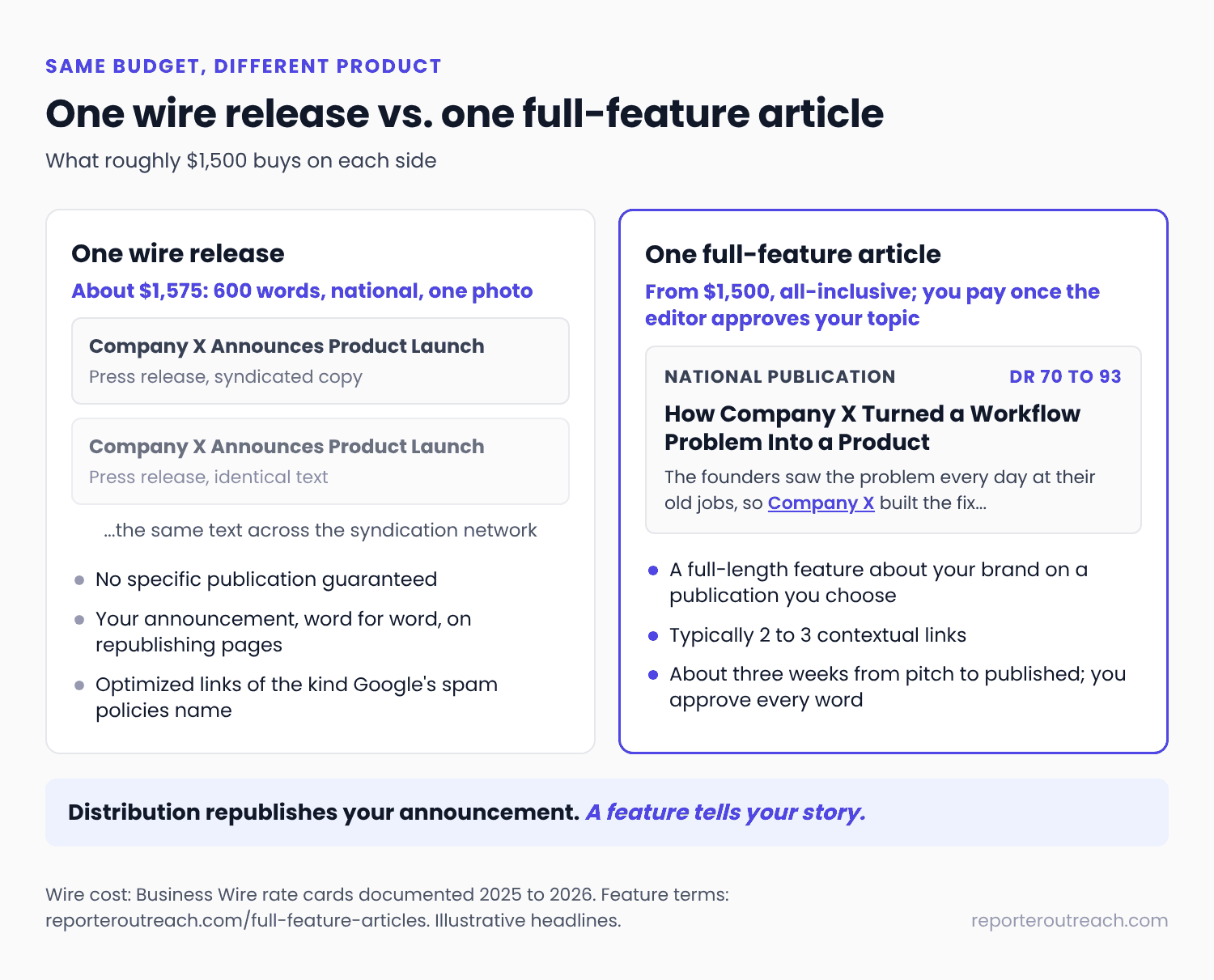
Same rough spend. One buys your announcement duplicated across pages built to republish announcements. The other buys a full feature on a publication readers and AI engines already trust. That's not a pricing difference; it's a category difference wearing similar price tags.
Spending Wire Money? Buy the Feature.
A full-feature article on a DR 70 to 93 publication costs about the same as one national wire release, and you approve every word before it runs.
Frequently Asked Questions
How much does Business Wire cost per press release?
The published starting price is $475 for 400 words on U.S. local distribution. Documented rate cards put the national base at $760 to $940, with $195 per additional 100 words and $425 for the first multimedia attachment. Loaded national releases typically land between $1,500 and $2,700.
Does Business Wire require a membership?
No. Business Wire charges per release with no annual membership fee, which sets it apart from PR Newswire's membership-plus-fees model. Ongoing plans exist, including flat-rate packages for qualifying U.S. customers, but they're priced only through sales.
What does the $475 starting price include?
A 400-word release on a U.S. domestic local circuit, with unlimited hyperlinks, a full-color linked logo, editorial review, rich-text formatting and analytics reports included. National distribution, extra words and multimedia all bill above that floor.
Is Business Wire cheaper than PR Newswire?
Usually, for national releases. A 1,000-word national release with one image comes to about $2,355 on Business Wire's documented rates, logo included, against $3,330 to $4,055 on PR Newswire's rate cards, and Business Wire charges no membership. For small circuits it can flip: PR Newswire lists a state release at $355, below Business Wire's $475 local price.
Is Business Wire worth it for SEO or link building?
No. Wire releases syndicate your links across republishing pages, and Google's spam policies list links with optimized anchor text in press releases distributed on other sites as an example of link spam. Business Wire earns its cost for regulatory disclosure and investor communications, not for search visibility.
What's the difference between a wire release and a full-feature article?
A wire release is your announcement distributed verbatim across a syndication network. A full-feature article is a full-length feature about your brand on one high-authority publication you choose, with typically 2 to 3 contextual links and your approval on the final copy. They cost about the same; they are entirely different products.
Sources
- Business Wire, pricing page (businesswire.com/en/pricing, checked October 2026)
- Documented Business Wire rate cards: Prezly, "Business Wire Pricing 2026" (updated September 2026); Pressonify, "Business Wire Pricing 2026"; Press Ranger; Prowly
- PR Newswire, pricing page (checked October 2026) and 2021 and 2024 domestic pricing guides
- Vendor pricing pages, checked October 2026: EIN Presswire, PRWeb, eReleases, Newswire.com; ACCESS Newswire pricing as listed on G2
- Google Search Central, "Spam policies for Google web search" (link spam)
- U.S. Securities and Exchange Commission, Regulation FD (17 CFR 243)
- Financial Conduct Authority, list of approved Primary Information Providers