Key Takeaways
- Writing the release costs $0 in-house or roughly $150–$500 freelance for a typical 500 words, based on the EFA's 2026 rate survey.
- Distribution is where the money goes: budget wires run $149–$399 per release, while documented premium-wire invoices reach $1,575–$4,055 once word counts and multimedia are added.
- The line items that inflate premium invoices are word meters ($195–$325 per 100 words) and multimedia fees ($425–$595 per asset), not the base rate.
- A distribution fee buys guaranteed syndication — automated pickup on network pages — not editorial coverage. No journalist chooses to run your release.
- A loaded premium release costs about as much as two editorial feature articles on DR 70–94 publications.
How much does a press release cost? Anywhere from nothing to more than $10,000 — and the honest answer is that the price depends almost entirely on distribution, not the release itself. Writing is cheap. In-house it's free; a freelancer will produce a solid 500-word release for $150–$500. Distribution is the real invoice: $149–$399 on budget wires, and $1,575–$4,055 on the premium wires once you add a normal word count and an image, per their documented rate cards.
This guide breaks down every route with sourced numbers — and then asks the question most pricing guides skip: what are you actually buying?
Here's the per-release spread at documented prices:
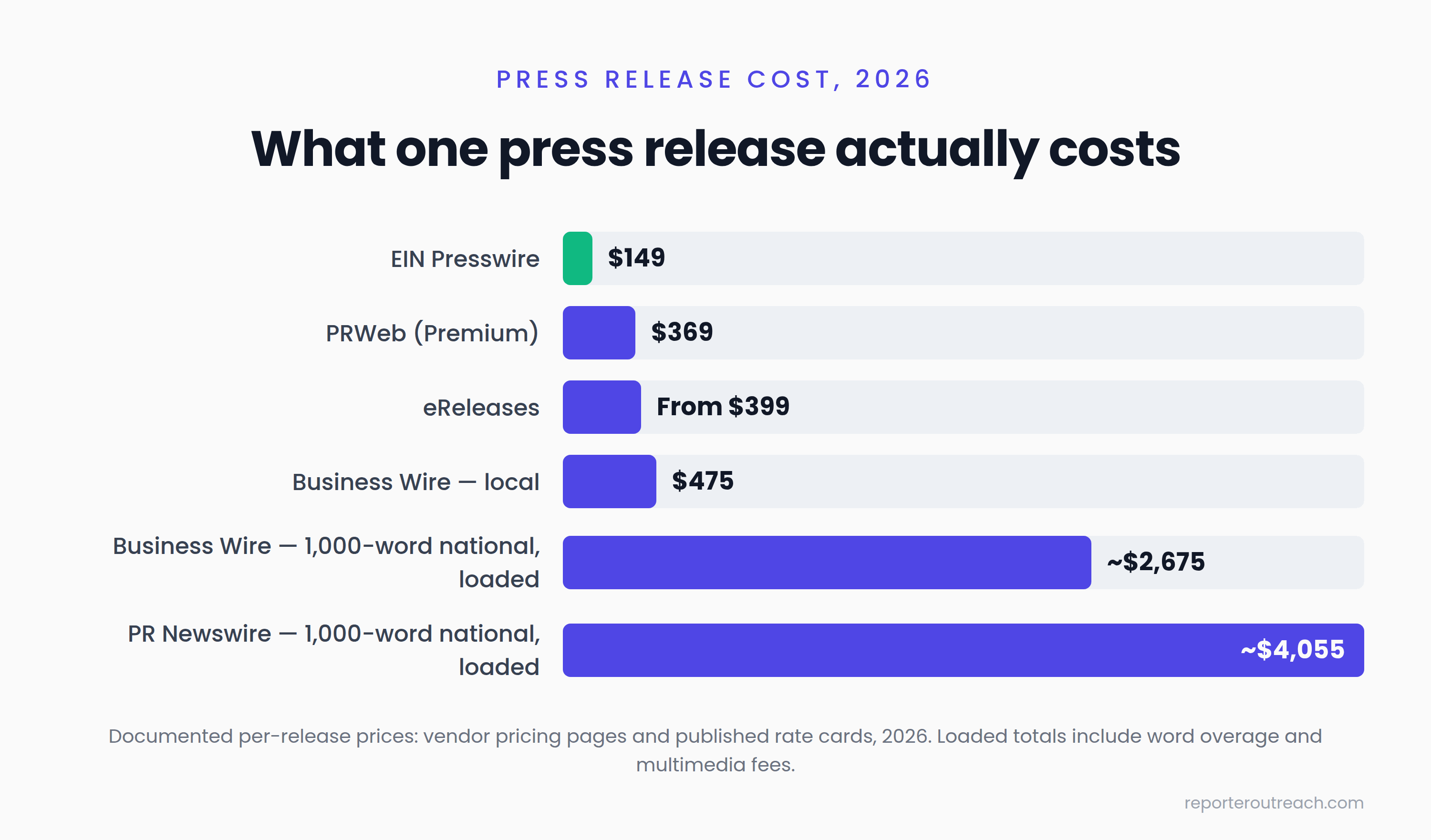
Two orders of magnitude between the cheapest and most expensive routes — and the differences aren't random. Each price tier is a different product with a different buyer, which is why a single "average press release cost" number is useless.
Press Release Costs at a Glance
Every route for getting a press release written and out the door, with documented costs:
| Route | Documented cost | What the money buys |
|---|---|---|
| DIY (own newsroom + direct pitching) | $0 | Your time; no guaranteed pickup anywhere |
| Freelance writing | $150–$500 (500 words, EFA 2026 rates) | The document itself, professionally written |
| Budget wire distribution | $149–$399 per release | Smaller syndication circuits |
| Premium wire distribution | $475–$4,055+ per release | National syndication, compliance infrastructure |
| PR agency retainer | $5,000–$25,000+/month | A full media relations program, not per-release pricing |
| Editorial feature articles | From $1,500 per article | A written feature on a DR 70–94 publication |
The retainer row is a different market entirely — you're buying a program, not a release. If that's the decision you're actually weighing, our guide to digital PR pricing covers campaign and retainer economics. The rest of this article sticks to per-release money.
How Much Does Writing a Press Release Cost?
Between $0 and about $500 for a standard release — and this is the one part of the process where paying more is rarely justified. The Editorial Freelancers Association's 2026 rate survey (1,100+ respondents) puts release-style writing at a 30¢-per-word median, or $70–$100 per hour. Business and marketing ghostwriting, the premium end of the same survey, runs 50¢–$1.00 per word.
In practice:
| Writing option | Rate (EFA 2026) | 500-word release |
|---|---|---|
| In-house | — | $0 |
| Freelance writer | 30¢/word median; $70–$100/hr | ~$150 |
| Business/marketing ghostwriter | 50¢–$1.00/word | $250–$500 |
The tempting shortcut is having AI draft it for free. Be careful with that one.
In Cision's 2026 State of the Media survey of 1,899 journalists, 53% said they object to receiving AI-generated pitches and press releases. If any part of your plan involves a reporter actually reading the release, obvious AI drafting works against you. Write it, or pay a human $150 to.
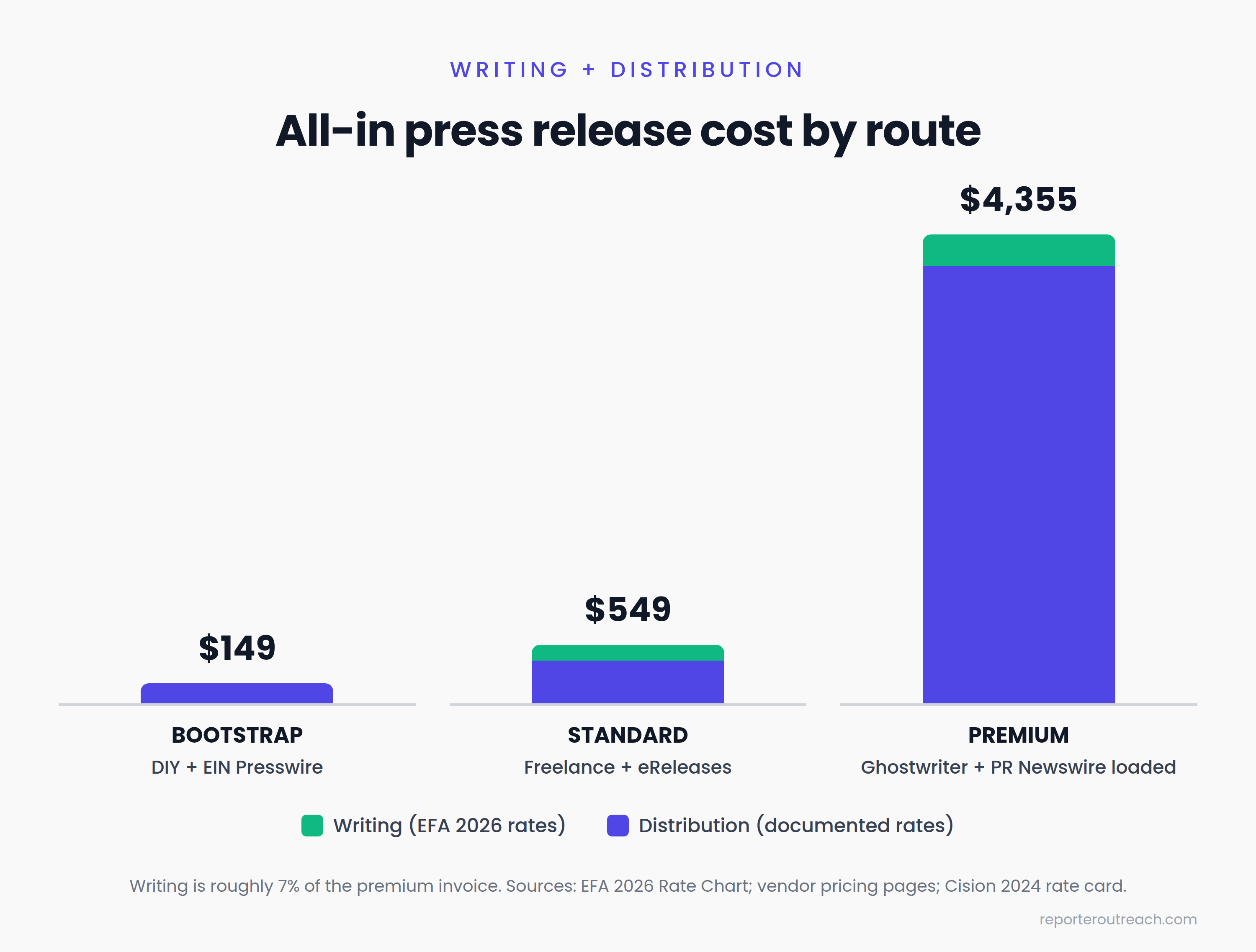
And that's the entire writing market: cheap, fast, and settled in a week. It is a rounding error next to what comes after it. Put writing and distribution on the same chart and the shape of the purchase becomes obvious:
Press Release Distribution Pricing
Distribution pricing splits into two markets: budget wires with published prices, and premium wires that mostly quote-gate theirs. Budget wires first, at their published rates:
| Service | Published price | Model |
|---|---|---|
| EIN Presswire | From $149 | Per release |
| PRWeb | $369 (Premium) | Per release |
| eReleases | From $399 | Per release |
| ACCESS Newswire | From $934/month | Subscription |
| Newswire.com | $1,074 for 6 releases | Prepaid pack |
The premium tier is where invoices surprise people. Business Wire publishes exactly one number — $475 for a local release — and quote-gates everything else, but documented rate cards put its U.S. national base at $760–$940 for 400 words, plus $195 per additional 100 words and $425 for the first image. That's how a 600-word national release with one photo lands at $1,575, and a 1,000-word release with two attachments and amplification reaches $2,675. The full line-item math is in our Business Wire pricing breakdown.
PR Newswire runs higher. Its official 2024 rate card — still the current public document — requires a $305 annual membership, then charges $1,020 for a 400-word national release plus $325 per additional 100 words, with images at $490 and logos at $595. A 1,000-word national release with one image and a logo totals $4,055, or $4,360 first-year all-in. Our PR Newswire pricing guide walks through the entire official rate card, including the regional circuits most guides never mention.
GlobeNewswire, the third of the big-three wires, publishes no rates at all — every tier is quote-gated. Documented third-party estimates put a standard release around $900–$1,200; our GlobeNewswire pricing breakdown assembles the full spread, source by source.
Premium wires advertise their 400-word base prices, but almost no real announcement is 400 words. Word overage ($195–$325 per 100 words) and multimedia fees ($425–$595 per asset) routinely double or triple the invoice. If you take one number from this article, take the loaded totals: $1,575–$4,055, not the base rates.
What Distribution Fees Actually Buy
Guaranteed syndication — and only that. Your release appears on the wire's network of pickup pages, automatically, verbatim. What no distribution fee at any price buys is a journalist deciding your story is worth covering. Those syndication pages aren't read by people; they're duplicated copies of the same text on sites nobody visits by choice.
The ranking value is no better. Google's spam policies explicitly list optimized press-release links among the link schemes it ignores or penalizes, and search engines treat hundreds of identical syndicated copies as exactly what they are: duplicates.
Here's the twist, though — the release itself isn't worthless. In Cision's 2026 State of the Media survey, 66% of journalists said they rely on PR-provided content, including press releases, for story ideas — making PR material their top source of story leads. That finding comes from the company that owns PR Newswire, and it points at something their own rate card doesn't: the value lives in the document reaching the right journalist, who might then write something original. The syndication you're billed thousands for is the byproduct. When a reporter does pick up the story, that's earned coverage — the thing real media outreach is built to produce directly, without paying a network to duplicate your announcement first.
When Paying for a Press Release Makes Sense
There are three buyers for whom wire fees are rational money:
- Public companies with disclosure obligations. Simultaneous, timestamped, wide dissemination is a regulatory requirement, and premium wires are built around exactly that. This is the buyer the infrastructure — and the pricing — was designed for.
- Funding and M&A announcements. News that databases, aggregators, and analysts index from wire feeds. The syndication record is the point.
- Announcements that need a formal public record. Product recalls, legal notices, executive changes — situations where "we announced this on the record, on this date" matters more than readership.
If your goal is any of those, buy the wire and don't overthink it. If your goal is visibility — rankings, brand awareness, being cited when AI engines answer questions in your category — you're the wrong buyer paying for someone else's infrastructure.
The Editorial Alternative
Run the numbers on what visibility budgets could buy instead. A full-feature article — an editorial piece on a single high-authority publication, written around your expertise, with 2–3 contextual links and copy you approve before it goes live — starts at $1,500 all-inclusive through Reporter Outreach's full-feature article service, with placements on DR 70–94 publications and payment only for articles that go live.
Hold that against the distribution market. The $549 "standard" scenario buys syndication nobody reads. Step up to a loaded premium release and the comparison gets uncomfortable: at the $1,500 starting rate, Business Wire's $2,675 covers one editorial feature with budget left over, and PR Newswire's $4,055 covers two with change — against a single announcement that appears everywhere and gets read nowhere. Same budget, two different products: one is volume of appearance, the other is placement in editorial context on publisher domains that search and AI engines treat as sources.
Same Budget. Real Coverage.
A loaded wire release runs $2,675–$4,055. The same budget funds full-feature articles on DR 70–94 publications — editorial pieces written around your expertise, with copy you approve.
Frequently Asked Questions
Can you distribute a press release for free?
Yes. Publish it on your own newsroom page and pitch journalists directly at no cost, or use free submission sites like PRLog and openPR. Free routes come with minimal syndication and no guarantees of any kind — but since paid syndication also isn't read by people, the gap is smaller than the invoices suggest.
How much should I pay someone to write a press release?
Around $150 for a typical 500-word release at the EFA's 2026 median rate of 30¢ per word, or $250–$500 if you hire at business ghostwriting rates (50¢–$1.00 per word). Hourly, expect $70–$100. Paying much beyond $500 for a standard announcement buys polish the format doesn't reward.
How much does press release distribution cost?
Budget wires charge $149–$399 per release at published rates. On documented premium rate cards, Business Wire runs from $475 (local) to about $2,675 for a loaded 1,000-word national release, and PR Newswire from $1,020 base to about $4,055 loaded, plus a required $305 annual membership.
Do press release links help SEO?
Not meaningfully. Google's spam policies name optimized press-release links as a link scheme, and syndicated copies are treated as duplicates. Ranking value comes only when a journalist independently covers the story on a real publication — which the distribution fee doesn't buy.
Sources: Cision 2026 State of the Media Report (1,899 journalists, May 2026); EFA 2026 Editorial Rate Chart (1,100+ respondents); Cision PR Newswire 2024 Domestic Pricing Guide (effective January 1, 2024, via IBPA); documented Business Wire rate cards, 2025–2026 (Prezly, Pressonify, Press Ranger, Prowly); vendor-published pricing (EIN Presswire, PRWeb, eReleases, ACCESS Newswire, Newswire.com); Google Search Central spam policies.