Key Takeaways
- The verdict of this EIN Presswire review: a legitimate service at the category's lowest credible prices — $149 for a single release, $499 for 5 (Pro+), $999 for 15 (Corporate, $66.60 per release). The $99.95 entry price most guides still cite is gone.
- Every tier caps word count — 700, 1,000, or 2,500 words — instead of metering it. On the premium wires, the same 1,000-word release costs $1,930–$2,970 in distribution and word fees alone.
- All tiers include placement on AP News, Nexstar Media Group sites, and the USA TODAY Network — a vendor-claimed combined reach of 350 million monthly users. Roughly 484,000 releases moved through the platform in the past year.
- Trustpilot rates EIN Presswire 3.2/5 across 160+ reviews. Praise clusters around support and ease of use; complaints cluster around editorial rejections and low-visibility partner pages.
- EIN Presswire is the rational buy when cheap syndication is genuinely what you need. What no wire sells, at any price, is a journalist's decision to cover you.
Every EIN Presswire review starts from the same fact: it's the cheapest credible name in press release distribution. So here's the verdict up front — EIN Presswire is a legitimate service that does what it says at a price the premium wires can't touch, and whether it's worth even $149 depends entirely on whether syndication is what you actually need. Most buyers haven't asked themselves that question, which is why the reviews split so hard.
This review covers the current pricing ladder (which has quietly changed — more on that in a second), how budget wire pricing structurally differs from Business Wire and PR Newswire, what the distribution claims actually mean, and what a few hundred customers say on the record.
EIN Presswire Pricing in 2026: The Current Ladder
EIN Presswire charges $149 for a single release, with bundles that drop the per-release price to $66.60. If you've read that it costs $99.95, you've read a stale guide: that entry price is gone from the pricing page, and third-party rate archives show $149 in effect since at least early 2026. Sound familiar? It's the same drift we found in PR Newswire's pricing, where most of the internet still cites a rate card two revisions old. Pricing guides get written once and recycled forever.
Here's the ladder as published today:
| Plan | Price | Per release | Word limit | Targeting |
|---|---|---|---|---|
| Basic (1 release) | $149 | $149 | 700 | 1 country, 1 industry |
| Pro+ (5 releases) | $499 | $99.80 | 1,000 | 2 countries, 5 industries |
| Corporate (15 releases) | $999 | $66.60 | 2,500 | 2 countries, 5 industries |
A few mechanics worth knowing before the numbers sink in. Bundled releases stay valid for 365 days from purchase, so a Corporate pack is really a year of distribution inventory. Images scale with tier (1, 3, or 5 embedded), every tier includes one video, and every release — on every tier — carries a hard limit of 3 keyword anchor-text links. Hold onto that last detail; it matters later.
The unit economics are the whole pitch. One price buys a release; commitment buys the same release cheaper and longer:
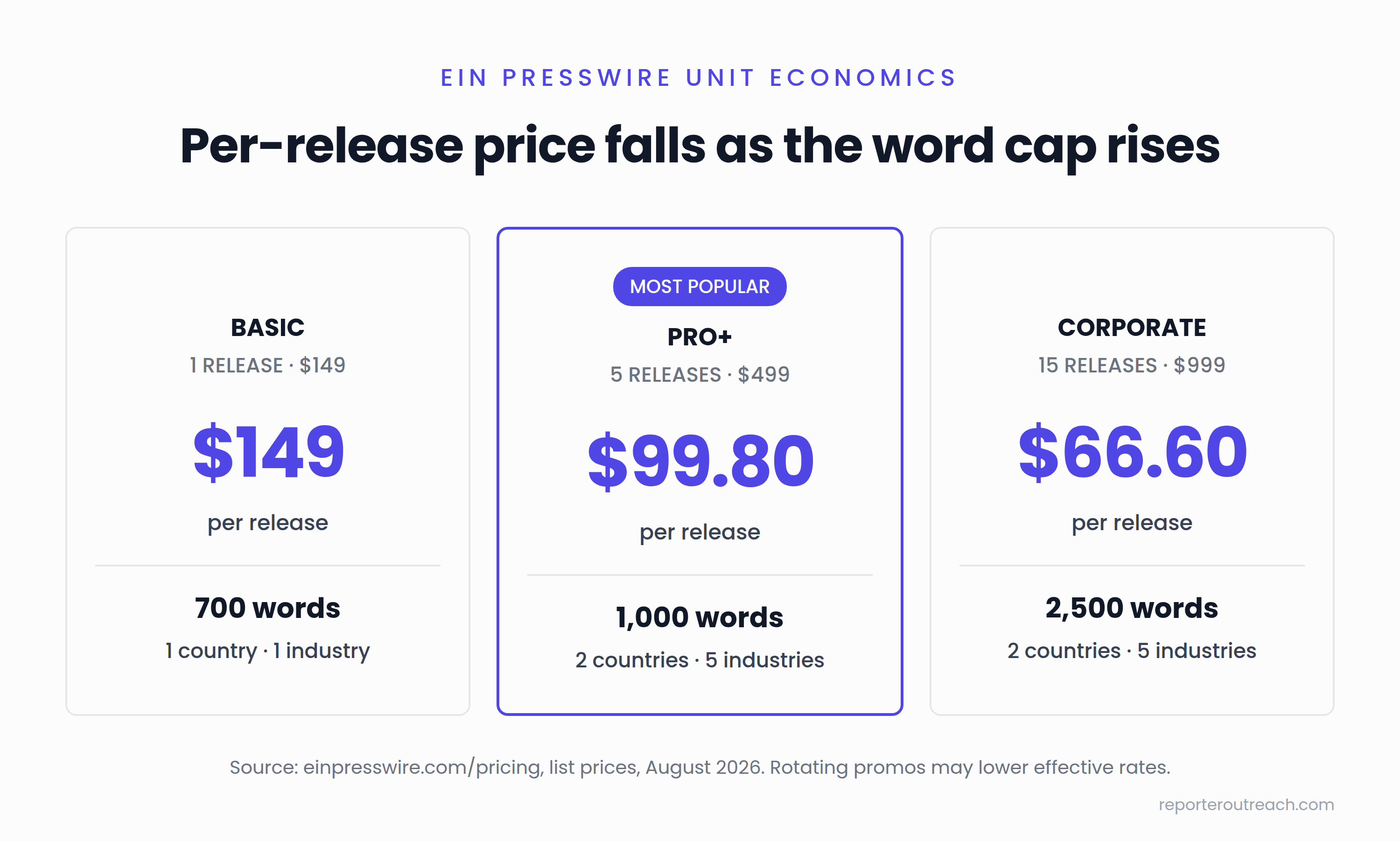
Read left to right and the pitch writes itself: commit to fifteen releases and each one costs less than half the single-release price while carrying more than three times the words. Whether the promo machinery around those numbers deserves your urgency is a separate question.
The pricing page runs a countdown clock and a "limited-time" offer — currently a sixth release free with Pro+, which cuts the effective per-release price to $83.17. Urgency marketing on a pricing page tells you the promos rotate rather than expire. Budget against the list prices; treat whatever promo is running as a bonus, not a deadline.
Caps, Not Meters: How Budget Wire Pricing Works
Budget and premium wires don't just charge different amounts — they price in opposite directions. EIN Presswire caps your word count and sells you a bigger cap. The premium wires meter your word count and bill the overage: Business Wire charges $195 per 100 words past its 400-word base, PR Newswire $325. One model punishes long releases with an upgrade prompt; the other punishes them with an invoice.
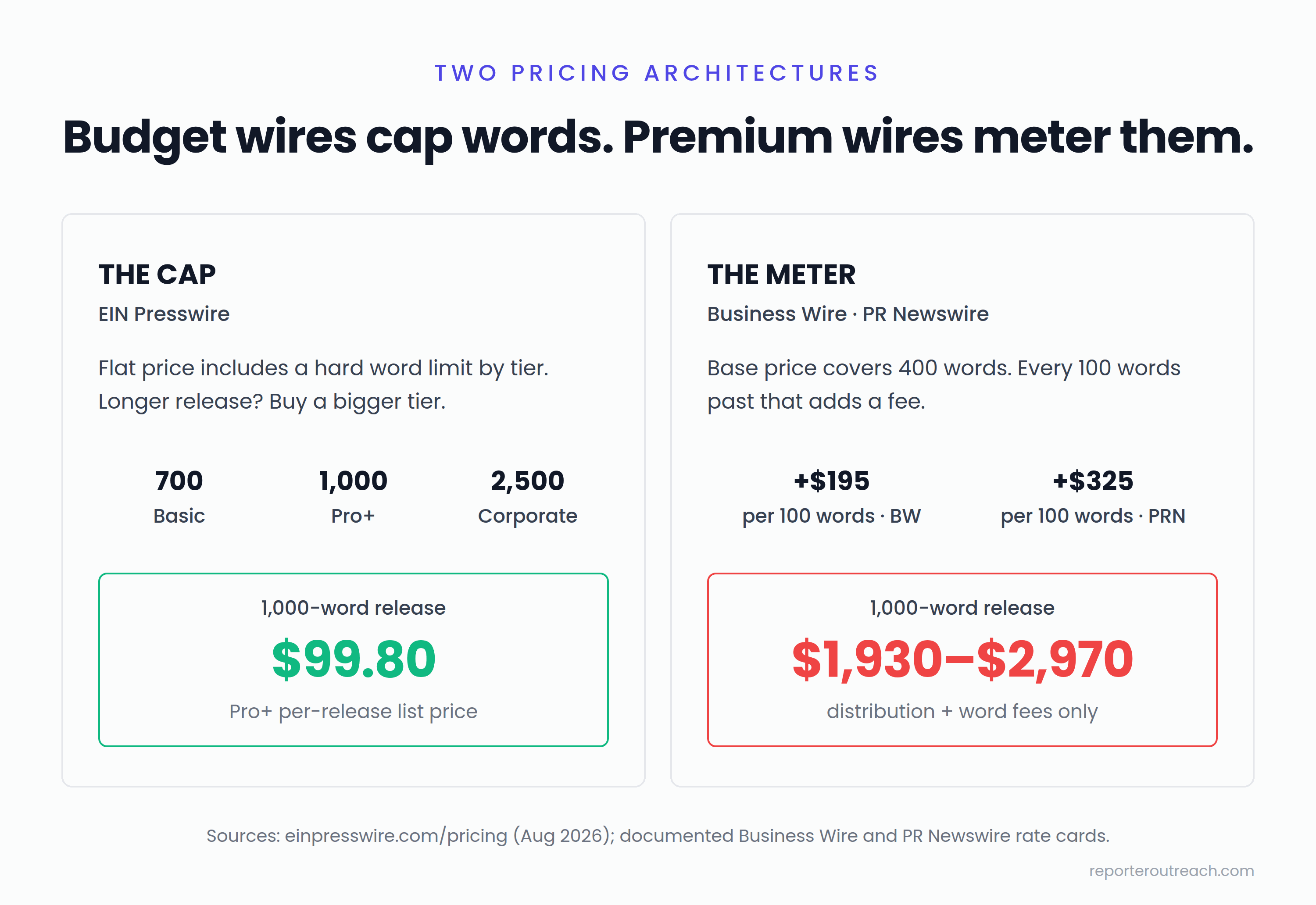
Run the numbers on a normal 1,000-word announcement and the gap is absurd on its face: $99.80 on EIN's Pro+ tier against $1,930 on Business Wire ($760 base plus $1,170 in word fees) or $2,970 on PR Newswire ($1,020 plus $1,950) — before either premium wire bills a single image. The full line-item math for the expensive end lives in our Business Wire pricing breakdown.
So is the premium wire 20x better? No — and that's not a defense of EIN so much as an observation about the category. The extra money buys bigger circuits, financial terminals, and compliance infrastructure built for SEC disclosure. It does not buy a different kind of outcome. A cheaper wire is a smaller helping of the same dish, and the dish is syndication.
What the Money Actually Buys
Syndication at genuine scale, delivered as promised. Every EIN tier includes placement on AP News, distribution to Nexstar Media Group sites and the USA TODAY Network based on relevance, listing in aggregators and research tools (Google News, Bloomberg Terminals, Muck Rack), and placement across 3,900+ Affinity Group Publications. EIN claims the AP–Nexstar–USA TODAY combination reaches 350 million monthly active users, with AP News alone offering "potential reach" of 35 million monthly visitors. Those are vendor figures, and "potential reach" is doing heavy lifting — it counts everyone who visits the properties where your release could appear, not anyone who sees it.
The scale of the pipe is real, though. By the platform's own live counter, roughly 484,000 releases moved through EIN Presswire in the past year — more than 1,300 per day. Sit with that from a reader's perspective: your announcement joins that stream, formatted identically, on pages built to hold announcements. That's what guaranteed placement means at every wire, and at $149 EIN is at least charging syndication prices for syndication.
One newer claim deserves a harder look. The pricing page now advertises distribution to "AI/LLM platforms" — your release "ingested by prominent AI and LLM infrastructures." Technically plausible: wire content is crawlable and does enter the corpora AI systems retrieve from. But ingestion is not citation. When AI engines answer a buyer's question, they lean on editorial coverage from publications they treat as sources — not on one of 1,300 identical daily announcements. If AI visibility is the actual goal, the mechanics of what gets cited (and why) are covered in our guide to generative engine optimization.
Remember the 3 keyword anchor-text links per release? Business Wire sells "unlimited hyperlinks"; EIN caps you at three. Either way, the tell is the same: real publications don't sell links by the unit, in any quantity. Syndication networks do, because no editor is deciding what deserves to be linked. Price the links at zero and evaluate the syndication on its own merits.
What EIN Presswire Reviews Actually Say
Start with legitimacy, since "is EIN Presswire legit" is half the search demand: yes. The service is operated by Newsmatics Inc., a news technology company whose history runs back to 1995, and it delivers the distribution it sells. Legitimacy isn't the interesting question. Reputation is — and the reputation is genuinely mixed.
On Trustpilot, EIN Presswire holds a 3.2/5 "Average" score across 160+ reviews as of mid-2026. Read the actual reviews and the split is unusually clean. The five-star side praises three things over and over: responsive support (the team replies to 93% of negative reviews, typically within a week), an easy submission flow, and the price. The one-star side clusters around two complaints:
- Editorial rejections that feel arbitrary. EIN screens every release against editorial guidelines, and rejected submitters describe unclear reasons, shifting explanations, and no real appeal path. To be fair to EIN, a budget wire that screens content is doing something the category's bottom feeders skip entirely — but the experience of being screened is a recurring source of fury.
- Low-visibility partner pages. Multiple reviewers report discovering that partner-network pages carrying their release are tagged noindex or simply never surface in search. One of the most-read one-star reviews warns against using the service for search visibility at all, on exactly those grounds. Customers, in other words, arrive expecting rankings and discover they bought syndication.
EIN's response to its critics is itself a data point. The company maintains a public page addressing its Trustpilot presence, arguing that many one-star reviews come from submitters whose releases were rejected on editorial grounds — retaliation, in its framing, rather than customer experience. That's probably partially true and entirely revealing: a meaningful share of EIN's unhappiest customers are unhappy about content screening, not distribution failures.
Practitioner reviews land in the same place as this one. Agency write-ups — ContentGrip's review is a good example — describe using EIN selectively where a client's budget or target country fits, checking the media directory for country-level coverage before buying, and treating it as one distribution tool among several rather than a coverage engine. Nobody serious mistakes it for PR.
Who EIN Presswire Is Right For
EIN Presswire is the right buy when you need a formal, timestamped public record of an announcement — a launch, a partnership, an executive change — and you need it syndicated credibly without premium-wire money. It's also the rational pick for organizations that publish regularly into a niche or a specific country: the Corporate tier's $66.60 per release with country and industry targeting is the cheapest credible way to keep a steady announcement cadence, and the 365-day validity window means you're not racing a clock.
It's the wrong buy — at $149 or any price — if what you actually want is coverage: journalists writing about you, links from real publications, showing up when AI engines answer questions in your category. That's not an EIN weakness. No wire service produces coverage, because no wire service sells a journalist's judgment; the honest ones, EIN included, sell exactly what they deliver — syndication. If you're still mapping which product your budget should buy, our complete press release cost guide lays out every route from $0 to $4,055 side by side.
The buyers who end up disappointed with EIN Presswire are almost never disappointed by EIN Presswire. They're disappointed by the category — they wanted visibility, bought circulation, and found out the difference on delivery. If that's the realization you're circling, the fix isn't a better wire. It's a different product: editorial placement, where the story runs because a publication chose to run it.
Syndication Has a Ceiling. Coverage Doesn't.
Full-feature articles place your story on named DR 70–94 publications — editorial pieces written around your expertise, with copy you approve before it runs.
Frequently Asked Questions
Is EIN Presswire legit?
Yes. It's operated by Newsmatics Inc., a news technology company with roots back to 1995, and it delivers the syndication it sells — including AP News, Nexstar, and USA TODAY Network placement. Its Trustpilot score sits at 3.2/5, with complaints centering on editorial rejections and low-visibility partner pages rather than non-delivery.
How much does EIN Presswire cost in 2026?
$149 for one release (Basic, 700-word limit), $499 for five (Pro+, 1,000 words, $99.80 each), or $999 for fifteen (Corporate, 2,500 words, $66.60 each). Bundled releases stay valid for 365 days, and rotating promos — currently a sixth free release on Pro+ — trim the effective per-release price further.
What happened to the $99.95 plan?
It was retired. EIN Presswire's single-release price moved to $149, with third-party rate archives showing the change in effect since at least early 2026 — yet most pricing guides still cite the old figure. The $99.95-adjacent number that survives is Pro+'s $99.80 per-release rate, which requires buying five.
Does EIN Presswire really distribute to AP News?
Yes — releases appear in AP News' press release section, clearly labeled as EIN Presswire content, alongside relevance-based distribution to Nexstar and USA TODAY Network sites. That's genuine placement on a major property, but it's labeled wire syndication, not AP journalism, and readers and search engines treat the two differently.
What's the difference between EIN Presswire and PR Newswire?
Product architecture, mostly. EIN charges flat per-release prices with word caps and no membership; PR Newswire layers a $305 annual membership under quote-gated releases that meter words at $325 per 100. PR Newswire's premium buys bigger circuits and compliance infrastructure for public companies — the category of outcome, syndication, is the same.
Sources: EIN Presswire pricing page and Pricing Overview PDF (verified August 2026); Trustpilot — EIN Presswire reviews (August 2026); EIN Presswire — Trustpilot response page; ContentGrip — EIN Presswire review; NewswireJet — EIN Presswire review (May 2026); Pressonify — EIN Presswire pricing archive (June 2026).