
Key Takeaways
- Addiction treatment marketing is a connection problem, not a demand problem. SAMHSA's 2024 survey found 80% of people who needed substance use treatment didn't receive it — and "lack of knowledge of resources" is one of the top reasons why.
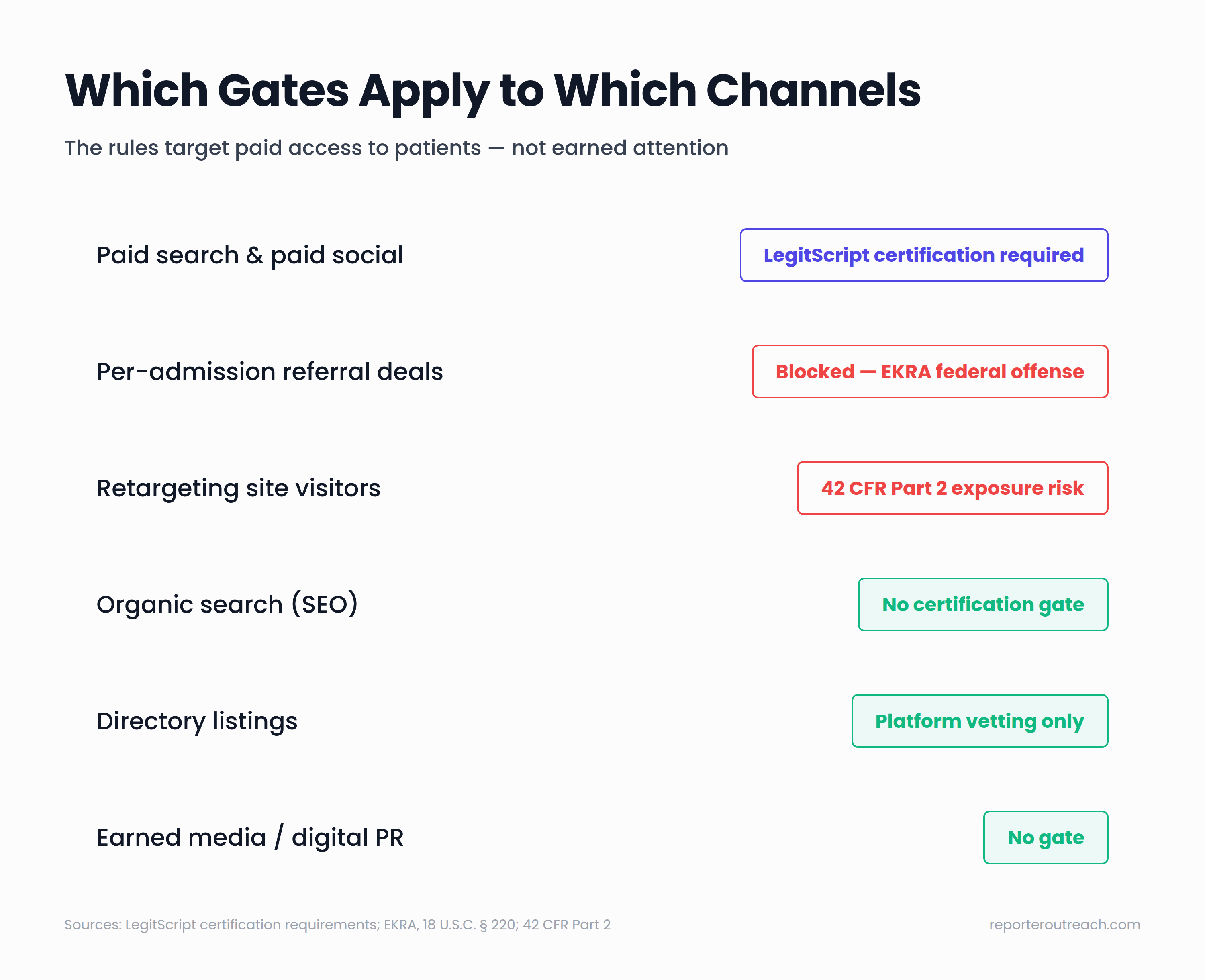
- Compliance shapes every channel: LegitScript gates paid ads, EKRA criminalizes per-admission referral deals, and 42 CFR Part 2 makes standard retargeting risky.
- Addiction and rehab keywords make up 4.9% of the 5,000 most expensive Google Ads terms. Paid search works, but it's a treadmill priced for desperation.
- AI engines — ChatGPT, Perplexity, Gemini, Google AI Overviews — now answer treatment questions directly, and they cite independent editorial coverage, not treatment center websites.
- Earned media is the only channel that clears the compliance gates, compounds over time, and feeds AI visibility simultaneously.
Most addiction treatment marketing advice reads like it was written for a dental practice: run Google Ads, claim your listings, post to the blog. This vertical doesn't work that way. Paid search is gated by certification and priced for desperation. Referral arrangements that are routine in other industries are federal crimes in this one. And the channel quietly deciding which programs get recommended — AI search — rewards the one thing most treatment centers have never built: independent editorial coverage.
This guide covers what actually determines marketing outcomes for treatment centers in 2026 — the regulatory floor, the real economics of each channel, and where the compounding returns are. If your organization treats mental health without SUD programs — therapy practices, telehealth psychiatry, IOP — most of the gates below won't bind you; our guide to behavioral health marketing covers that side of the umbrella.
What Makes Addiction Treatment Marketing Different?
Two things separate this vertical from general healthcare marketing: a regulatory layer that criminalizes standard growth tactics, and a trust deficit the industry earned. Between 2017 and 2018, patient brokering scandals and predatory lead generation got so bad that Google restricted rehab advertising entirely, Congress passed a law making paid referrals a federal offense, and ad platforms outsourced facility vetting to a third party.
Every gate that exists today is a response to that era. That's worth internalizing, because it changes how you should read the rules: they're not bureaucratic friction to route around. They're the market's immune response — and the operators who treat them as a floor rather than an obstacle inherit an advantage, because the gates screen out competitors who can't or won't clear them.
The federal Anti-Kickback Statute only applies to federal healthcare programs. EKRA (18 U.S.C. § 220) applies to recovery homes, clinical treatment facilities, and laboratories regardless of payer — private insurance and cash-pay included. A commission structure that's legal for a med spa can be a felony for a treatment center.
The Market Reality: Demand Isn't the Problem
The gap between people who need treatment and people who get it is enormous, and it's widening. SAMHSA's 2024 National Survey on Drug Use and Health found that 80% of people who needed substance use treatment did not receive it. In raw numbers: 52.6 million Americans aged 12 or older needed treatment in 2024. About 10.2 million received it.
Here's what that gap looks like at scale:

And the trend is going the wrong direction. Treatment receipt actually fell from 13.1 million people in 2023 to 10.2 million in 2024 — fewer people connected to care year over year, not more.
The reasons people cited for not getting treatment matter for anyone doing marketing in this space. Alongside stigma, cost, and insurance gaps, SAMHSA's data names lack of knowledge of resources as a common barrier. Read that again. A meaningful share of the treatment gap is, literally, a discoverability problem. When someone finally reaches the moment of willingness and can't figure out where to turn, that's not a demand-generation failure — it's a connection failure. Marketing in this vertical isn't about manufacturing interest. It's about being findable and credible at the moment someone is already looking.
The Compliance Layer Every Campaign Runs Through
Four sets of rules shape what treatment centers can and can't do. Here's each one and what it means in practice:
| Rule | What it governs | Marketing implication |
|---|---|---|
| LegitScript certification | Access to paid advertising on Google (required since 2018), Meta, and Microsoft | No certification, no paid search or paid social. Certification takes weeks to months and requires licensing, staffing, and billing documentation. |
| EKRA (18 U.S.C. § 220) | Payment for patient referrals to treatment facilities, recovery homes, and labs — all payers | Per-admission and percentage-based marketing compensation is a federal crime. Flat-fee marketing services are the compliant structure. |
| 42 CFR Part 2 | Confidentiality of substance use disorder patient records — stricter than HIPAA | Ad pixels and retargeting on treatment site visitors carry real exposure risk. Tracking configurations need compliance review, not default installs. |
| State patient-brokering laws | State-level referral payment bans (e.g., Florida's Patient Brokering Act, § 817.505) | Some states go further than federal law. Multi-state operators need the strictest applicable standard, not the home-state one. |
Notice what these rules have in common: they all target paid access to patients — bought ads, bought referrals, bought data. None of them restrict earning attention on merit. That asymmetry is the single most underused strategic fact in this vertical, and the map below shows how it plays out channel by channel:
Channel Economics: Where the Money Actually Goes
Every treatment center marketing budget flows through some mix of four channels. The economics differ enough that getting the mix right matters more than execution quality within any single channel.
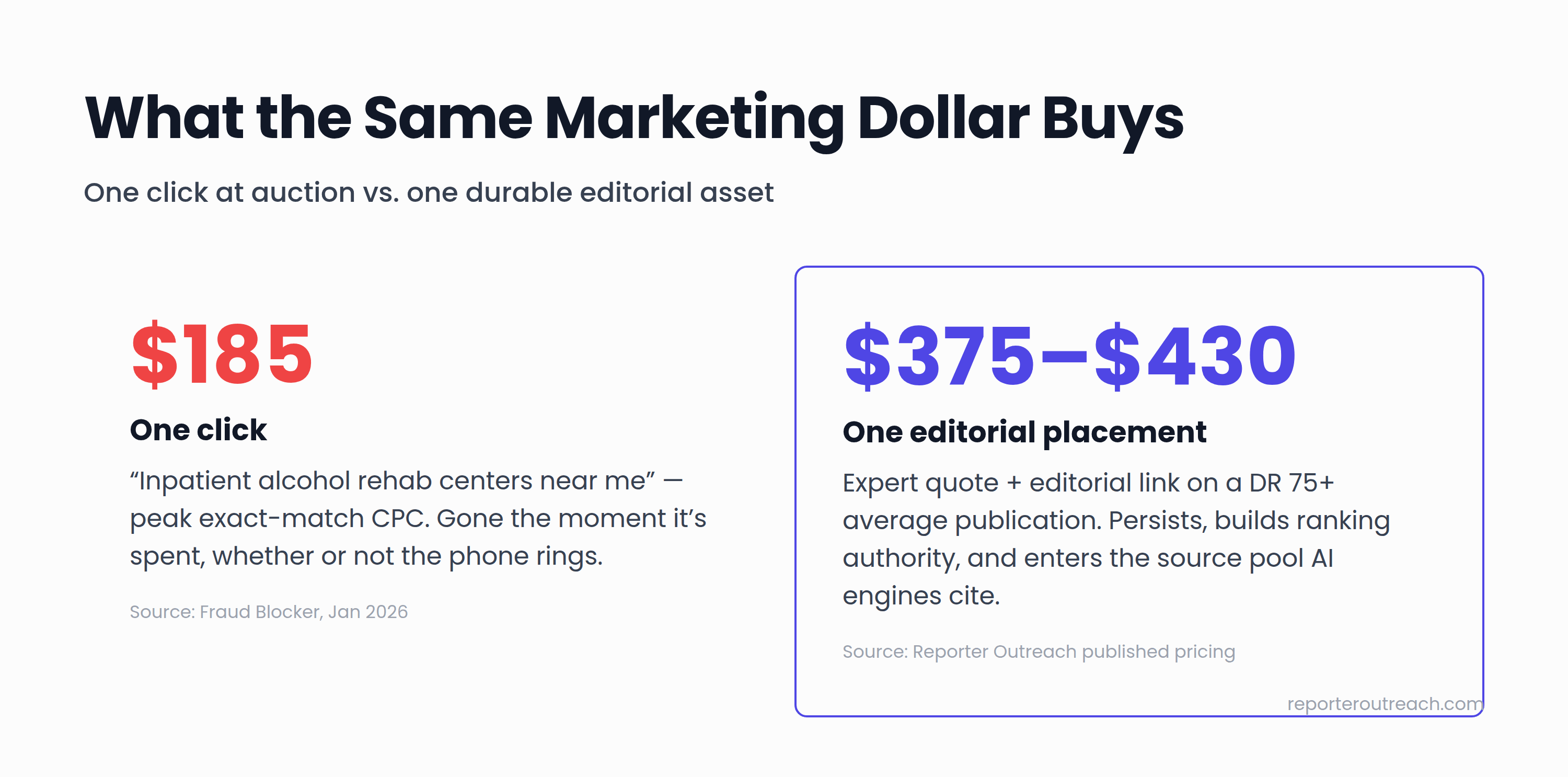
Paid search. Addiction and rehab terms make up 4.9% of the 5,000 most expensive keywords on Google Ads, according to Fraud Blocker's January 2026 analysis — one of the priciest categories on the platform, behind only legal, education, and insurance. Localized exact-match terms peak at $185 per click. Paid search converts, because the intent behind "detox near me" at 2am is as real as intent gets. But the structure is a treadmill: the moment spend stops, visibility stops, and every competitor bidding on the same desperation keeps the auction brutal. What one of those clicks costs — and what it buys compared to a durable editorial asset — is worth seeing side by side:
Organic search. SEO is the scalable alternative to those CPCs, but this vertical sits under Google's strictest YMYL scrutiny — every page is held to the highest trust standard the algorithm has. Rankings here are won on authority signals more than content volume, which is why most treatment center SEO stalls: the content gets produced, the links never do. The full playbook is its own topic — our guide to drug rehab SEO covers site structure, local rankings, and the authority problem in depth.
Directories. Psychology Today, SAMHSA's treatment locator, Recovery.com, and similar platforms are table stakes — families use them, and absence reads as a red flag. But directory presence is rented ground. You're one profile among hundreds, differentiated mostly by geography and whatever the platform's sort order favors. Claim them, complete them, and don't mistake them for a growth strategy.
Earned media. When a journalist writing about treatment access quotes your clinical director, three things happen at once: the publication's authority flows to your site through an editorial link, the coverage becomes a trust signal a family can independently verify, and the article enters the source pool AI engines draw from when someone asks them where to get help. No certification gate, no referral-fee exposure, no auction. It's the only channel where the compliance rules above simply don't bite — because nothing is being bought.
The comparison at a glance:
| Channel | Cost structure | Compliance gate | Compounds? |
|---|---|---|---|
| Paid search / social | Per click, up to $185; stops when spend stops | LegitScript certification required | No |
| Organic search (SEO) | Monthly program cost; assets persist | None, but strictest YMYL scrutiny | Yes, if authority builds |
| Directories | Listing fees; rented visibility | Platform vetting varies | No |
| Earned media / digital PR | Per placement; coverage persists and accrues | None | Yes — authority, trust, and AI citations |
AI Search Is Rewriting How Families Find Treatment
A growing share of treatment research never touches a traditional search results page. Someone types "how do I find a good rehab for my son" into ChatGPT, Perplexity, or Gemini — or Google answers the query itself with an AI Overview before a single organic listing appears. Search the phrase "addiction treatment marketing" right now and an AI-generated answer occupies the top of the page. The pattern holds across treatment queries.
What makes this a strategic shift rather than a formatting change is what these engines cite. AI assistants build answers from sources they can verify independently — journalist-written articles, expert commentary in established publications, coverage that exists because an editor chose to run it. A treatment center's own website describing its own program is precisely the kind of source these systems discount. The mechanics of earning AI citations are covered in our guide to generative engine optimization, but the short version for this vertical: the facilities getting recommended by AI engines are the ones that exist in independent editorial coverage. Almost none do. That's not a threat — for any center willing to put its clinical expertise in front of journalists, it's the most open competitive lane in the industry.
Families researching treatment verify harder than almost any other consumer. Editorial coverage does double duty here: it feeds the AI and search systems, and it's what a parent finds at 1am when they Google your facility's name before calling. The same asset serves both machines and humans.
What Earned Media Looks Like in This Vertical
The model that works for treatment centers is reactive digital PR: positioning your clinical leadership as expert sources in stories journalists are already writing. Reporters covering addiction, recovery, mental health, and public health need credentialed voices on deadline. A medical director who can speak to fentanyl trends or a therapist who can explain what family intervention actually involves is genuinely useful to them — and every quote earns an editorial link and a brand mention on a publication with real authority.
Villa Oasis, a residential detox and addiction treatment center, ran exactly this play:
Over nine months, 39 editorial placements at an average domain rating of 80 drove 352% organic traffic growth — placements earned by putting Villa Oasis's clinical team in front of journalists covering stories where their expertise fit. No ads, no referral arrangements, nothing a regulator would blink at. The full breakdown of how this applies to treatment centers specifically — publication targets, story angles, expert positioning — is on our behavioral health digital PR page.
Where to Start
The sequence matters more than the channel list. For most treatment centers, it looks like this:
- Fix the compliance floor first. Audit every marketing arrangement against EKRA — anything per-admission or percentage-based gets restructured to flat fees. Review your site's tracking pixels against 42 CFR Part 2 exposure. If you plan to run paid ads at all, start LegitScript certification now; it takes weeks to months.
- Claim and complete the directory layer. Psychology Today, SAMHSA's locator, and the major platforms in your state. This is an afternoon of work that removes a red flag, not a growth strategy.
- Pick one compounding channel and fund it properly. For most centers that's earned media, because it clears every compliance gate, builds the authority organic search requires, and feeds AI citations — three outcomes from one investment. SEO and digital PR reinforce each other; paid search can layer on top once certified, as a faucet you control rather than the foundation.
- Vet partners against the rules, not just the portfolio. Any agency proposing per-admission pricing has already told you they don't know this vertical. Our comparison of the best addiction treatment marketing agencies breaks down who specializes in what — and what compliant engagement structures look like.
Make Your Program the One That Gets Cited.
We put treatment center clinical teams in front of journalists writing about addiction and recovery — earning the editorial coverage that Google ranks and AI engines cite.
Frequently Asked Questions
Do you need LegitScript certification to market an addiction treatment center?
Only for paid advertising. Google, Meta, and Microsoft all require LegitScript certification before addiction treatment ads can run. Organic search, directories, and earned media have no certification requirement — though certification still functions as a trust signal worth having.
Is it legal to pay a marketing agency per admission?
No. EKRA makes paying for patient referrals to treatment facilities a federal crime, regardless of whether the payer is government, private insurance, or cash. Per-admission and percentage-based compensation structures are exactly what the statute targets. Flat-fee marketing services — where payment doesn't vary with patient volume — are the compliant structure.
How much does addiction treatment marketing cost?
It depends heavily on the channel mix. On the paid side, a single click on competitive rehab keywords can cost up to $185. Comprehensive organic programs combining SEO and digital PR typically run $3,000–$12,000+ per month depending on market competitiveness. The relevant question isn't the monthly number — it's whether the spend produces assets that persist (coverage, authority, rankings) or visibility that disappears the moment payment stops.
What's the fastest marketing channel for treatment centers?
Paid search delivers the fastest response — once certified, ads can drive calls within days. It's also the first thing to vanish when budgets tighten. Earned media sits in the middle: first placements typically go live within 2–3 weeks, with authority and visibility compounding over the following 6–12 months rather than resetting each month.
How is addiction treatment marketing different from general healthcare marketing?
The regulatory layer is heavier and the trust bar is higher. EKRA and state patient-brokering laws criminalize referral arrangements that are legal elsewhere in healthcare, 42 CFR Part 2 imposes confidentiality rules stricter than HIPAA, and ad platforms require third-party certification just to run campaigns. On top of that, families researching treatment scrutinize providers more intensely than almost any other healthcare decision — which makes independently verifiable coverage disproportionately valuable.
Sources: SAMHSA — 2024 National Survey on Drug Use and Health (treatment gap and treatment receipt data); National Association of Counties — 2024 NSDUH summary (52.6M needed treatment / 10.2M received); Fraud Blocker — Most Expensive Google Ads Keywords, January 2026 (addiction category CPC data); LegitScript — Addiction Treatment Certification requirements; Reporter Outreach published pricing.