Key Takeaways
- Behavioral health marketing covers the full umbrella — therapy practices, telehealth psychiatry, IOP and PHP programs, community organizations — while addiction treatment marketing is its own SUD-specific discipline with different compliance gates.
- Demand is not the problem. 46% of psychologists have no openings for new patients, yet 48% of adults with any mental illness received no treatment last year. Marketing's job is trust and findability at the moment of care-seeking, not demand generation.
- Mental health is a YMYL category: Google and AI search hold it to stricter trust standards, which makes editorial authority — not ad spend — the gating factor for organic growth.
- Pure mental health advertisers are not gated by addiction-treatment ad certification or 42 CFR Part 2. HIPAA marketing rules, ad-platform health restrictions, and professional ethics codes on testimonials still apply.
- Roughly half of adults in outpatient mental health care now use telehealth for some or all of it — the patient journey starts online and often stays there.
Behavioral health marketing starts from a condition almost no other industry shares: more people need the service than the system can deliver. Therapists carry waitlists. Psychiatry appointments book out for weeks. And yet mental health organizations still struggle to grow — because the constraint was never demand. It's trust, at the exact moment someone finally decides to look for help.
Most of what ranks for behavioral health marketing or mental health marketing ignores that inversion. The advice reads like it was written for a SaaS product: run ads, post content, optimize the funnel. This guide takes the opposite position — that in a category where demand already outstrips capacity and Google treats every page as a Your Money or Your Life decision, the entire game is being the organization that search engines, AI assistants, and referral paths surface and trust first.
One scope note before anything else: this guide covers the mental health side of the behavioral health umbrella. If you operate addiction treatment programs, that side has its own playbook — and its own regulatory gates.
What Behavioral Health Marketing Actually Covers
Behavioral health marketing is the work of building visibility and trust for organizations that treat mental health and substance use conditions — outpatient therapy practices, telehealth psychiatry platforms, intensive outpatient (IOP) and partial hospitalization (PHP) programs, community mental health organizations, and treatment centers. In practice, the terms "behavioral health marketing" and "mental health marketing" overlap almost completely; buyers use them interchangeably, and the strategies are the same.
The meaningful split runs elsewhere: between the mental health side of the umbrella and substance use disorder (SUD) treatment. The audiences differ, the referral paths differ, and — as covered below — the compliance regimes differ substantially. SUD marketing is regulated tightly enough that it functions as its own discipline; our guide to addiction treatment marketing covers that side in full.
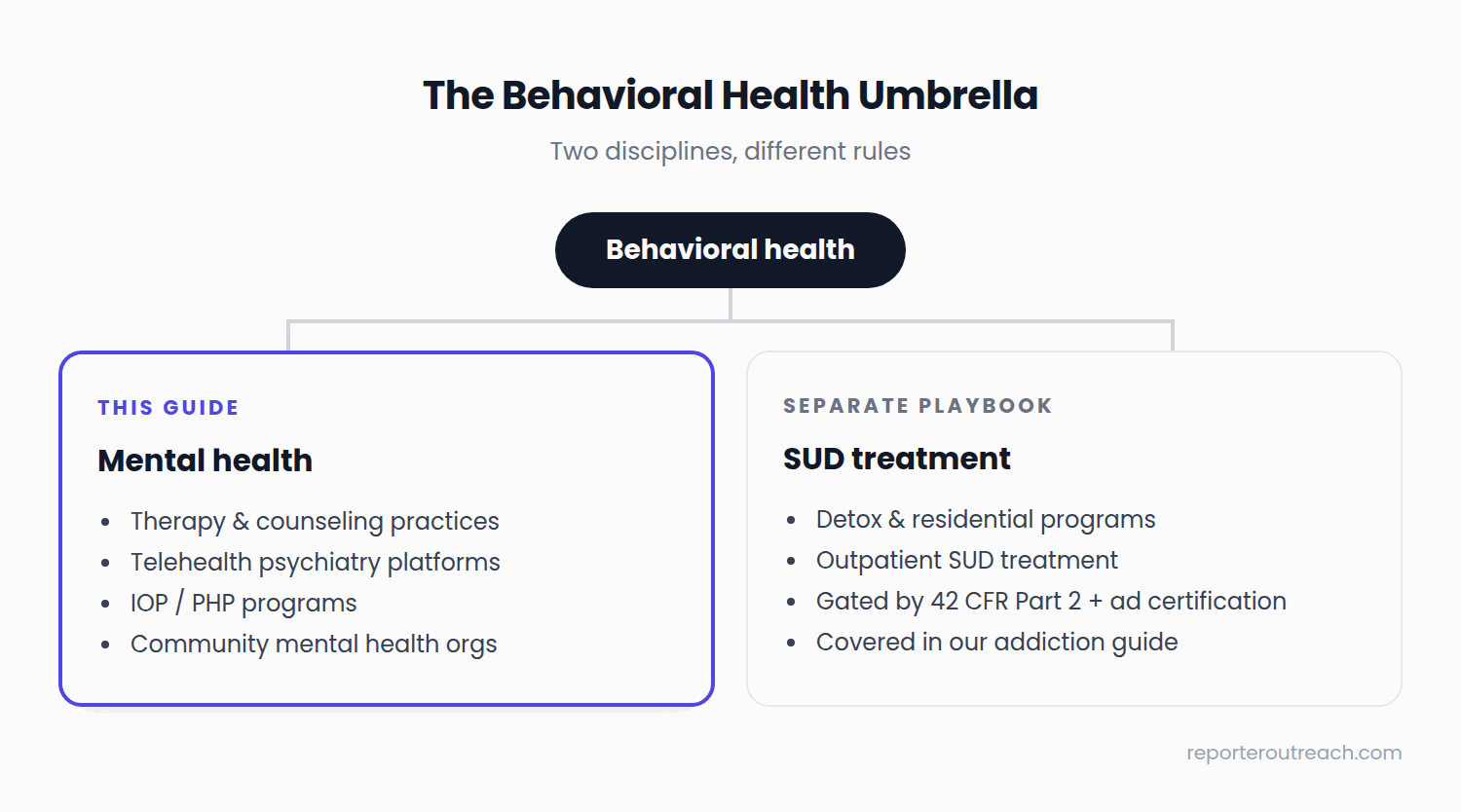
Why does the distinction matter for a marketing guide? Because the most common failure mode in this category is borrowing the wrong playbook. Mental health organizations adopt SUD-style compliance caution they don't need and skip growth channels that are fully open to them. SUD programs do the reverse and get ad accounts suspended. Know which side of the umbrella you're on before you spend a dollar.
Behavioral Health Marketing Isn't Demand Generation
In most industries, marketing exists to manufacture demand. In behavioral health, demand already exceeds the system's capacity to serve it — on both sides of the equation, simultaneously.
On the supply side: in the American Psychological Association's 2025 Practitioner Pulse Survey, 46% of psychologists reported having no openings for new patients, and 40% maintain a waitlist. On the need side: SAMHSA's 2024 National Survey on Drug Use and Health counted 61.5 million US adults — 23.4% of the adult population — with any mental illness (AMI), and 48% of them received no treatment that year. Among adolescents with a major depressive episode, 40% went untreated.
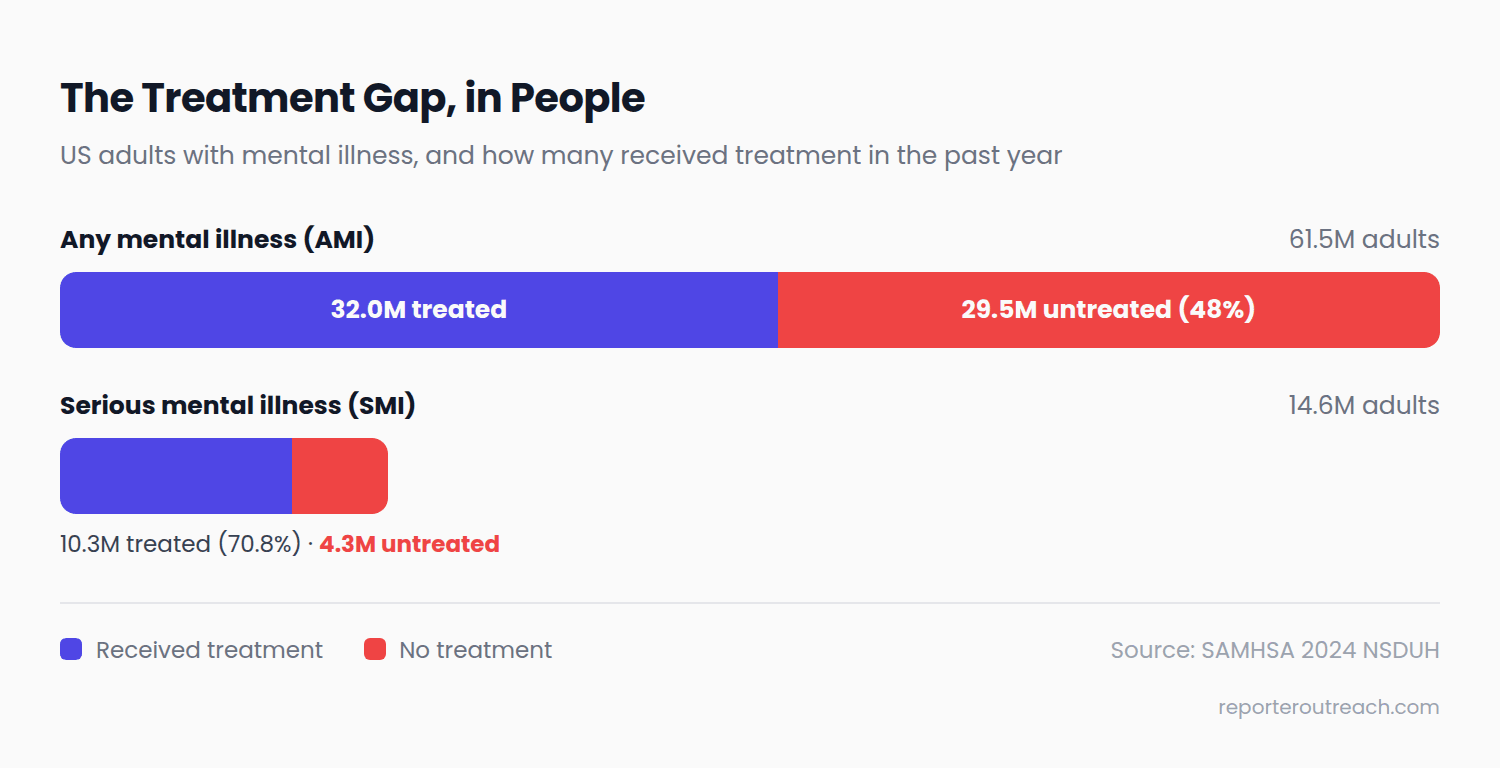
Sit with the shape of that for a second. Nearly 30 million adults needed care and didn't get it — inside a system where almost half of psychologists can't take a new patient. The bottleneck isn't want. It's the messy middle: finding a provider who fits, takes your insurance, has an opening, and — hardest of all — feels trustworthy enough to call about the most private thing in your life.
That reframes what marketing is for. A behavioral health organization doesn't need to convince anyone that therapy matters. It needs to be the answer that appears — and holds up to scrutiny — during the short, fragile window when someone is actually looking. Visibility and credibility at the moment of care-seeking. That's the whole job.
Spend less on manufacturing urgency and more on being findable and credible when urgency arrives on its own. Awareness campaigns compete with stigma; trust signals compete with hesitation. In behavioral health, the second fight is the one worth funding.
The Trust Gate: YMYL, AI Search, and a Digital-First Patient Journey
Mental health content sits squarely inside Google's YMYL ("Your Money or Your Life") classification — the tier of queries where a bad answer can hurt someone, and where Google's quality systems lean hardest on E-E-A-T: experience, expertise, authoritativeness, and trust. A behavioral health site doesn't rank because it publishes more; it ranks when independent, trusted sources treat it as credible. The same logic now extends to AI search: when ChatGPT, Perplexity, Gemini, or Google AI Overviews assemble an answer about anxiety treatment or online psychiatry, they cite the providers and publications that already carry editorial trust.
And the stakes of that gate keep rising, because the care journey itself has moved online. In a 2025 JAMA Psychiatry analysis of federal survey data, 27.8% of US adults receiving outpatient mental health care got all of it via telehealth, and another 21.5% used a hybrid of virtual and in-person care — roughly half of outpatient mental health care touching telehealth at some point. For a growing share of patients, every step from "should I talk to someone" to the first session happens on a screen. There is no storefront, no front desk, no physical cue of legitimacy. Your search presence, your reviews, your coverage in publications people recognize — that is the trust surface.
Stigma sharpens the effect. Care-seeking in this category is often private by design: people research quietly, compare carefully, and abandon easily. They rarely ask friends for referrals the way they would for a dentist. Which means the signals that convert — credentialed clinician bios, editorial mentions on health publications, a coherent presence across directories — do disproportionate work compared to almost any other vertical.
For behavioral health organizations, editorial authority is the binding constraint on organic growth. Content and ads scale output; only third-party trust clears the YMYL bar that decides whether that output ranks, gets cited by AI engines, and converts a hesitant care-seeker.
The Compliance Picture — and What Doesn't Apply to You
Most behavioral health compliance advice is written for addiction treatment and then applied to everyone, which leaves mental health marketers either over-cautious or misinformed. The rules split cleanly once you map who each one actually binds.
| Rule | Who it actually binds | Marketing implication |
|---|---|---|
| HIPAA marketing rules | All covered providers | No using patient information for marketing without authorization; regulators have scrutinized ad pixels and tracking tech on provider sites |
| Ad-platform health restrictions | All health advertisers | Google and Meta restrict health-condition targeting and limit conversion data sharing for health advertisers — expect blunter paid tools than other verticals get |
| Professional ethics codes | Licensed clinicians | APA and ACA ethics codes bar soliciting testimonials from current therapy clients — audit any marketing built on patient stories |
| 42 CFR Part 2 | SUD treatment records specifically | Confidentiality regime beyond HIPAA — applies to substance use disorder programs, not to pure mental health practices |
| LegitScript certification | Addiction treatment advertisers | Required to run addiction treatment ads on major platforms — does not gate mental-health-only advertisers |
The last two rows are the ones mental health organizations most often get wrong in both directions. If you don't treat substance use disorders, you are not subject to Part 2's record rules and you don't need addiction-treatment ad certification — paid search is open to you, within the platform health policies every health advertiser faces. If you do operate SUD programs, even alongside general mental health services, the stricter regime follows those programs.
The addiction side has its own full playbook: start with our addiction treatment marketing guide, the deep dive on drug rehab SEO, and the shortlist of addiction treatment marketing agencies if you're hiring for it.
The Channel Landscape, Honestly Assessed
Every channel works somewhere. The question is what each one can and can't do in a trust-gated, capacity-constrained category. Here's the comparison:
| Channel | What it does well | The behavioral health catch |
|---|---|---|
| SEO & content | Captures care-seekers at every stage; compounds over time | YMYL means content alone can't rank — clinical review and domain authority are prerequisites, not nice-to-haves |
| Digital PR & earned media | Builds the third-party trust YMYL and AI search actually check for; every placement compounds | Requires credentialed clinicians willing to be quoted, and patience — this is an authority investment, not a lead faucet |
| Paid search & social | Immediate visibility for high-intent local and telehealth queries | Health-category targeting and tracking restrictions blunt optimization; costs stop the moment spend does |
| Directories & referral networks | Where many patients actually compare providers; table stakes for therapy practices | Everyone is listed — profiles differentiate on completeness and credibility, not presence |
Our position, stated plainly: digital PR is the only channel on that list that manufactures the input the others depend on. Content needs authority to rank. Paid needs trust to convert a hesitant clicker. Directories reward the credibility built elsewhere. Editorial coverage — a licensed clinician quoted in journalist-written stories on publications people recognize — is upstream of all of it, for rankings and AI citations alike. The SEO side of that equation — how mental health practices and telehealth platforms win the local, directory, and AI-citation lanes — is covered in full in our mental health SEO guide.
A Working Sequence for Behavioral Health Organizations
The order matters more than the tactics. Trust infrastructure first, authority second, capture and measurement after.
- Fix the trust surface. Credentialed clinician bios with license numbers and headshots, named clinical review on every condition page, clear pricing and insurance information, and a site that reads like a care provider rather than a lead-gen funnel. This is the E-E-A-T groundwork every later channel depends on.
- Earn editorial authority. Position your licensed clinicians as expert sources for health journalists — commentary on sleep, anxiety, medication questions, workplace stress. Coverage on trusted health publications builds the domain-level credibility YMYL rankings and AI citations run on, and it accrues whether or not the story is about you.
- Clean up the comparison layer. Complete, consistent, credential-forward profiles on the directories and referral platforms your patients actually use, plus reviews handled within ethics-code limits. This is where hesitant care-seekers cross-check you.
- Build decision-stage content. Not another "what is anxiety" post — the comparison, cost, insurance, and "what happens in the first session" content that meets people at the point of choosing. Clinically reviewed, honestly written.
- Measure AI visibility alongside rankings. Track whether ChatGPT, Perplexity, Gemini, and Google AI Overviews surface your organization for the queries that matter, not just where you rank in blue links. In a category this trust-gated, AI citation share is becoming the leading indicator.
What This Looks Like in Practice
MEDvidi is a telehealth platform for online psychiatry, ADHD care, and medication management — exactly the trust-gated territory this guide describes. Its content engine was already strong; the missing input was third-party credibility. Over a 12-month engagement, Reporter Outreach positioned its clinical team, led by its medical director, as expert sources for health journalists — earning 83 editorial placements on publications averaging DR 81, including HuffPost, LiveScience, and EatingWell.
The record month arriving after outreach stopped is the point: editorial trust compounds instead of expiring. The full numbers, chart, and verified placements are in the MEDvidi case study, and our broader work across the category is on the behavioral health industry page.
Build the Trust Signals Behavioral Health Demands.
We position licensed clinicians as expert sources for health journalists — editorial coverage on the publications Google and AI engines already trust. First placements in 2-3 weeks.
Frequently Asked Questions
What is behavioral health marketing?
It's how providers across the behavioral health umbrella — therapy and counseling practices, telehealth psychiatry, IOP and PHP programs, community organizations — become the option care-seekers find and believe. With clinical capacity already stretched thin, the discipline is less about creating demand and more about earning credibility where people compare providers.
Is behavioral health marketing the same as mental health marketing?
In practice, yes — the terms are used interchangeably and the strategies are identical. The distinction that actually matters sits inside the behavioral health umbrella: substance use disorder treatment marketing operates under stricter, SUD-specific rules like 42 CFR Part 2 and platform certification requirements, while pure mental health marketing does not.
What compliance rules apply to mental health marketing?
HIPAA marketing rules, ad-platform restrictions on health-condition targeting and tracking, and professional ethics codes limiting client testimonials apply to mental health organizations. The addiction-specific gates — 42 CFR Part 2 record confidentiality and addiction-treatment advertising certification — bind SUD treatment programs, not mental-health-only providers.
What marketing channels work best for behavioral health organizations?
A sequenced mix: a credentialed, clinically reviewed website as the trust foundation; digital PR and earned editorial coverage to build the authority YMYL rankings and AI citations require; complete directory and referral profiles; and paid search for high-intent queries within platform health policies. Editorial authority is the input the other channels depend on.
How long does behavioral health marketing take to show results?
For editorial digital PR, first placements typically go live within 2-3 weeks. Because mental health is a YMYL category that demands extra trust-building, meaningful ranking movement usually shows in months 3-6, with compounding through months 6-12 — and the authority earned keeps working after active outreach ends.
Sources: SAMHSA 2024 National Survey on Drug Use and Health; American Psychological Association 2025 Practitioner Pulse Survey; JAMA Psychiatry (2025), outpatient mental health care modality analysis; Google Search Quality Rater Guidelines (YMYL/E-E-A-T).