Key Takeaways
- Mental health search runs in two lanes with opposite rules. Google removed AI Overviews from local "near me" provider queries entirely, while clinical and informational queries are 93–100% AI-saturated. Each lane needs a different strategy.
- Demand keeps climbing: 14% of US adults — 1 in 7 — received counseling or therapy in the past year per the CDC's 2024 National Health Interview Survey, up from the year before. The care-seeker journey starts in search.
- You will not out-rank the directory layer. Psychology Today pulls an estimated 7.8 million monthly organic visits at DR 93. The winning play is joining it with a complete profile and winning the verification click that follows.
- Authority sets the ceiling on everything else. MEDvidi, a telepsychiatry platform, started with 597 referring domains against BetterHelp's 22,757 — and closed the trust gap through editorial coverage, not content volume.
- The clinical lane now belongs to whoever AI engines cite. ChatGPT, Perplexity, Gemini, and Google AI Overviews pull overwhelmingly from earned editorial sources — not from practice websites describing themselves.
Mental health SEO has a reputation for being gentle territory — smaller practices, softer competition, none of the regulatory violence of rehab search. That reputation is wrong. This is a YMYL vertical where Google's trust standards are fully loaded, where a DR 93 directory sits on most of the commercial SERPs, and where the informational queries that used to feed practice blogs have been almost completely absorbed by AI answers.
What makes it navigable is that the battlefield split cleanly in two. One lane still works the way local SEO always has. The other has been rebuilt around AI citation. Practices and telehealth platforms that treat these as one strategy lose in both; the ones that run each lane on its own rules compound in both. This guide covers how — for solo and group practices, telepsychiatry platforms, and the marketing leads responsible for their growth.
One scope note: this is the SEO-discipline companion to our behavioral health marketing guide, which covers the full channel picture for mental health organizations. If you're choosing help rather than doing this in-house, the mental health marketing agencies compared by product and price map which kind of agency fits each lane. If you operate addiction treatment programs, that side carries its own gates — certification requirements, stricter record rules — covered in our drug rehab SEO guide.
What Makes Mental Health SEO Different?
Three structural facts, and every tactic in this guide traces back to one of them.
The searches are private by design. Someone looking for a therapist rarely asks around the way they would for a dentist. They research quietly, compare carefully, and abandon at the smallest trust wobble. Your search presence isn't one touchpoint among many — for a large share of care-seekers, it's the entire pre-contact relationship. And that share keeps growing: per the CDC's 2024 National Health Interview Survey, 14% of US adults — 1 in 7 — received counseling or therapy from a mental health professional in the past 12 months, a higher rate than the year before. Every one of those journeys started somewhere, and increasingly that somewhere is a search box.
It's YMYL without an off-ramp. Google classifies mental health squarely as Your Money or Your Life content, which means E-E-A-T signals — named credentialed clinicians, editorial validation, institutional trust — gate rankings in a way that content volume can't buy through. There's no keyword small enough to escape it.
The SERP real estate is pre-occupied. Between the directory layer, the telehealth giants, and AI-generated answers, the classic "publish good content and rank" playbook has less open ground here than in almost any other vertical. Which is why the first strategic decision isn't a keyword list. It's understanding which lane each query lives in.
The Two Lanes of Mental Health Search
Google itself split this vertical in two, and the data on it is unambiguous. BrightEdge tracked AI Overview presence across healthcare queries from 2023 through the end of 2025: local "near me" provider searches went from 100% AI Overview presence to zero — Google pulled AI answers out of them entirely — while clinical and informational queries climbed to 93–100% saturation.
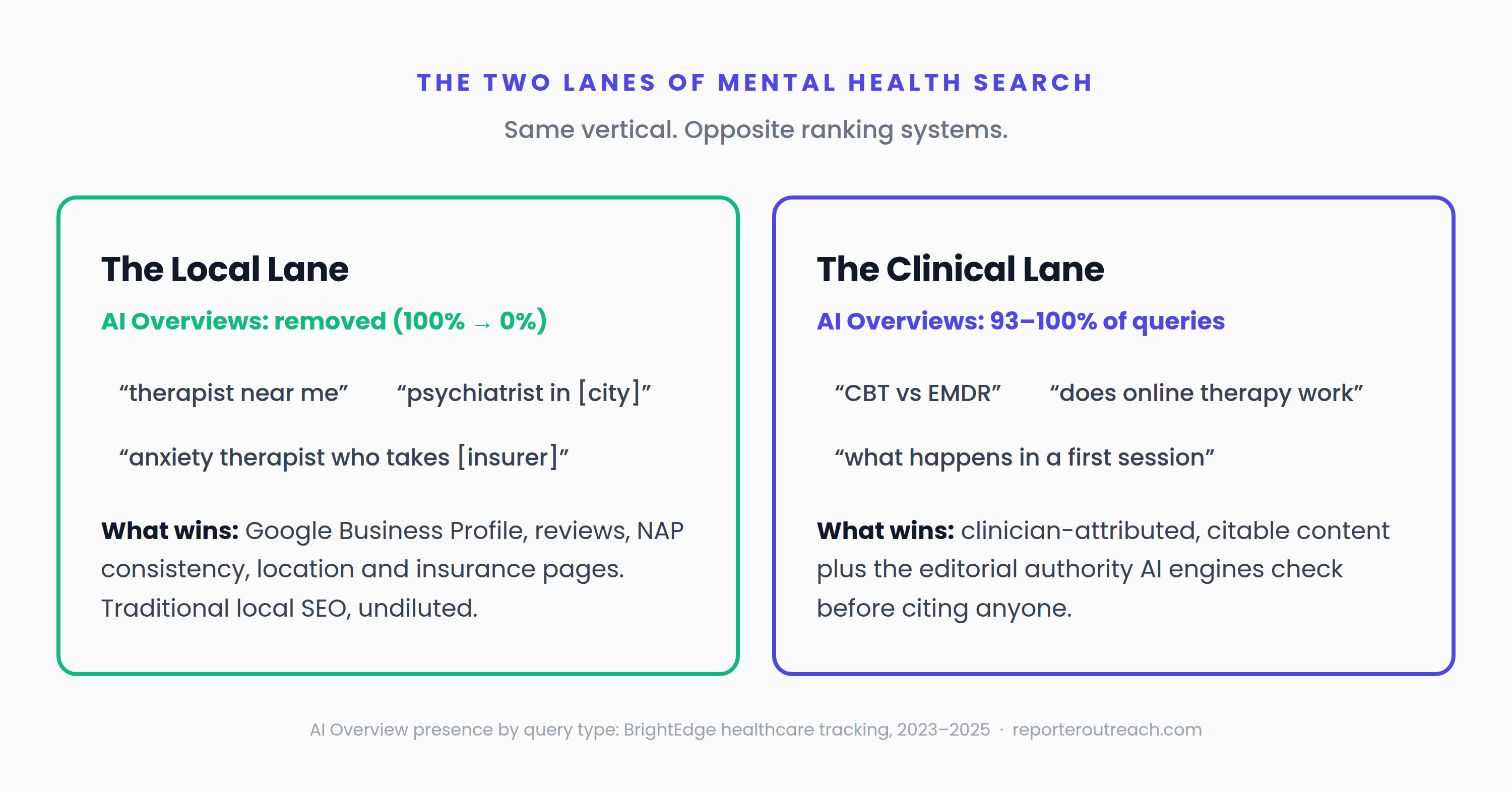
The strategic consequence: your Google Business Profile investment and your content investment are now playing different games. The local lane rewards operational discipline — complete profiles, consistent data, steady reviews. The clinical lane rewards being the kind of source an AI engine is willing to quote. Neither transfers to the other, and budget allocated as if they're one channel gets diluted across both. Here's the split as a reference:
| The Local Lane | The Clinical Lane | |
|---|---|---|
| Example queries | "therapist near me," "psychiatrist in [city]," "anxiety therapist who takes [insurer]" | "CBT vs EMDR," "does online therapy work," "what happens in a first session" |
| AI Overview presence | Removed entirely — 100% to 0% between 2023 and 2025 (BrightEdge) | 93–100% of queries — near-total saturation |
| What wins | Google Business Profile, reviews, NAP consistency, location and insurance pages | Clinician-attributed, citable content backed by editorial authority AI engines trust |
Winning the Local Lane: Where Clients Actually Convert
Start here, because this is the lane where rankings turn into booked sessions fastest — and the lane Google deliberately handed back to traditional results.
Google Business Profile is the front door. Complete every field: categories (psychologist, psychotherapist, mental health clinic — every one that genuinely applies), real office photos rather than stock, services listed by the names clients use, and hours that are actually accurate. For group practices, individual practitioner profiles linked to the practice profile multiply your surface area in the map pack.
NAP consistency is boring and non-negotiable. Your name, address, and phone number need to match across your site, your Psychology Today profile, insurance directories, and state licensing listings. Mismatches read as unreliability to Google's local systems — and this vertical has more directory listings per provider than almost any other, which means more places for drift to creep in.
Reviews, within the lines. Review volume and recency move local rankings, but mental health has an ethics constraint most local-SEO advice ignores: APA and ACA ethics codes bar soliciting testimonials from current therapy clients. Google reviews aren't testimonials on your website, but the prudent pattern is the same across both — no direct solicitation of current clients. Make leaving a review easy and visible for those who choose to; never make it an ask attached to care. Respond to every review without ever confirming anyone is a client — a HIPAA line practices cross constantly without realizing it.
Telehealth platforms play this lane differently. No physical location means no map pack — but "online therapy in [state]" and "[state] telehealth psychiatry" queries are the telehealth equivalent, and state-by-state licensure pages that name the specific clinicians licensed there are how national platforms capture them. A single generic "we serve all 50 states" page captures none of it.
The Directory Problem: You Don't Out-Rank It, You Join It
Here's the number that should end a common argument. Practices regularly ask whether they should invest in beating Psychology Today for "[city] therapist" queries. Per Ahrefs, psychologytoday.com currently pulls an estimated 7.8 million organic visits per month at DR 93, with 417,000 ranking keywords built on nearly 293,000 referring domains — more organic search traffic than the biggest telehealth platforms combined:
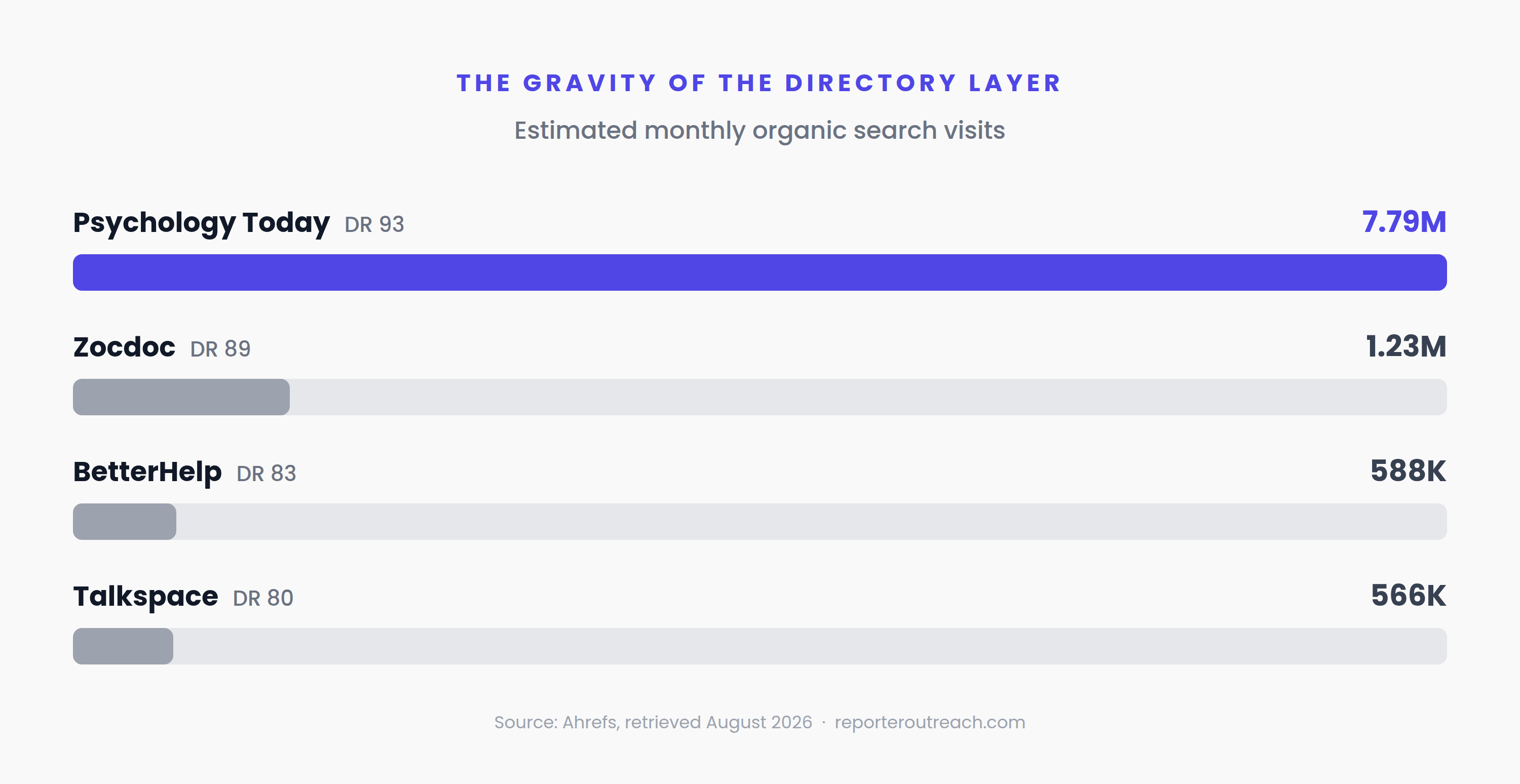
You are not out-ranking that with a practice website. Nobody is. So stop treating the directory as a competitor and treat it as a SERP feature you can occupy: a complete, credential-forward, genuinely written profile on the directories your clients use is a ranking asset that happens to live on someone else's domain.
The differentiation happens one click later. Care-seekers who find you in a directory verify you before they call — they search your name, land on your site, and decide in about ninety seconds whether you feel legitimate. That verification click is where your own SEO pays off: a fast site, a real clinician bio with license numbers, clear pricing and insurance information, and any editorial coverage you've earned. The directory gets you found. Your search presence gets you chosen.
Most practices obsess over "[city] therapist" and never once check what their own name returns. Search every clinician's name plus your practice name monthly. Stale directory listings, an abandoned social profile, or a review platform outranking your homepage are all fixable — and they're costing you clients who found you and then quietly changed their minds.
Content That Clears the YMYL Bar
The condition-library era is over. A practice blog explaining "what is anxiety" is competing with medical publishers, the directory layer, and an AI answer — all of which outrank it, and none of which it will displace. In the clinical lane, publish only where you have one of two advantages: clinical authorship or decision-stage relevance.
Clinical authorship means a name, not a badge. Every clinical page attributed to a specific licensed clinician — name, credentials, linked bio — not "reviewed by our team." Google's quality raters are explicitly instructed to evaluate who created YMYL content, and anonymous mental health content is treated as fundamentally less trustworthy. If your clinicians won't put their names on it, that's a signal about the content, not just the bylines.
Decision-stage content is the open ground. The queries AI hasn't fully absorbed — and converts when it ranks — are the ones where the searcher is choosing, not learning: what a first session actually involves, how to think about CBT versus EMDR for their situation, what therapy costs with and without insurance, how out-of-network reimbursement works, when to see a psychiatrist versus a therapist. This content serves someone at the exact moment of committing to care, it naturally features your clinicians' judgment, and it's the page a directory visitor lands on during the verification click.
Write in the client's language. Clients search "can't stop overthinking at night," not "rumination." They search "marriage counseling," not "couples psychotherapy." The gap between clinical vocabulary and search vocabulary is wider in mental health than nearly anywhere else, and the practices that map their service pages to client language capture demand their clinically-worded competitors never see.
Authority: The Ceiling on Everything Above
Everything in the previous three sections has a ceiling, and the ceiling is domain authority. In a YMYL vertical, Google won't rank — and AI engines won't cite — a mental health site that independent, trusted sources haven't validated, no matter how good its content is.
The scale of that gap is usually invisible until you measure it. When MEDvidi — a telehealth platform for online psychiatry and ADHD care — started its digital PR engagement, it had 597 referring domains. BetterHelp had 22,757. Talkspace had 13,304. That's the real shape of mental health search competition: not better content, but a 38-to-1 trust deficit against the incumbents. Closing a gap like that is what link building for healthcare brands exists to do; content volume alone never touches it.
You don't close that gap with guest posts or directory links. You close it the way MEDvidi did: by putting licensed clinicians on the record. Its medical director became a regular expert source for health journalists — commentary on sleep, stress, medication safety — earning 83 editorial placements on publications averaging DR 81, including HuffPost and LiveScience. Organic traffic grew 124% over the 12-month engagement, and its record traffic month landed two months after outreach ended, because editorial trust compounds instead of expiring. The full numbers are in the MEDvidi case study.
That's the mechanism behind digital PR in this vertical: journalists need credentialed mental health voices constantly, your clinicians are exactly that, and every quote earns an editorial link plus a brand mention on a domain Google and AI engines already trust. It's the same clinician-led model we run across mental health and behavioral health organizations — and it's the one channel that raises the ceiling on both lanes at once. First placements typically go live within 2–3 weeks; meaningful ranking movement usually shows in months 3–6, compounding through months 6–12.
The Clinical Lane's New Landlord: AI Search
If clinical queries are 93–100% AI-saturated, then ranking in the clinical lane increasingly means being cited by the answer rather than sitting under it. And the citation logic is knowable. Muck Rack's May 2026 Generative Pulse analysis of more than 25 million links cited by ChatGPT, Claude, Gemini, and Perplexity found that 84% of AI citations come from earned media: coverage a third party chose to publish, not content brands wrote about themselves.
Read that against the previous section and the strategy collapses into one sentence: the editorial coverage that closes your authority gap is the same asset that makes you citable when someone asks an AI assistant whether online therapy works or how to choose a psychiatrist. One investment, both surfaces.
On your own site, the job is making content extractable once the authority exists: direct answers in the first sentences under each heading, real HTML structure, clinician attribution machines can parse, and FAQ schema. The mechanics are covered in our guide to generative engine optimization — but structure without editorial authority is a well-organized site AI engines still won't quote. Sequence matters.
The Priority Order for a Mental Health Organization
Run the lanes in this sequence. It's ordered by time-to-impact against effort, not by importance — everything on the list matters, but doing them out of order wastes the early months.
- Lock the local lane basics. Complete Google Business Profile (or state licensure pages for telehealth), NAP consistency across every directory, an ethics-compliant review process. Weeks of work, and the lane Google cleared of AI answers for you.
- Fix the verification click. Named clinician bios with credentials, transparent pricing and insurance pages, site speed. This is where directory traffic converts or evaporates.
- Occupy the directory layer properly. Complete, credential-forward, genuinely written profiles on the directories your clients actually use — treated as ranking assets, not as checkbox listings.
- Start earning editorial authority. Clinicians positioned as expert sources for health journalists. This is the longest lever and the slowest, which is exactly why it starts before the content engine, not after.
- Build decision-stage content on top. Clinician-attributed, client-language, structured for AI extraction — published onto a domain that's accumulating the authority to rank it and the citations to prove it.
Own Both Lanes of Mental Health Search.
We position licensed clinicians as expert sources for health journalists — earning the editorial coverage that YMYL rankings require and AI engines cite. First placements in 2–3 weeks.
Frequently Asked Questions
What is mental health SEO?
Mental health SEO is the work of making a therapy practice, psychiatry group, or telehealth platform visible in search at the moment someone decides to seek care. Because Google treats mental health as YMYL content, it depends more on trust signals — credentialed clinician attribution, editorial validation, consistent local data — than on content volume, and it now spans traditional rankings, local results, and AI-generated answers.
Can a therapy practice outrank Psychology Today?
For head terms like "[city] therapist" — realistically, no. The directory pulls an estimated 7.8 million monthly organic visits at DR 93 per Ahrefs, and its position on those queries is structural. The productive strategy is occupying it with a complete, credential-forward profile, then winning the verification search that follows, where care-seekers look up your name before contacting you. Practices can absolutely outrank directories for specific decision-stage and long-tail queries in their specialty.
Do telehealth mental health platforms need local SEO?
Not map-pack local SEO — without a physical location there's no map presence to win. The telehealth equivalent is state-level visibility: dedicated pages for each state where the platform's clinicians hold licenses, naming those clinicians and the services available there. That's how national platforms capture "online therapy in [state]" demand that a single nationwide page never ranks for.
How long does mental health SEO take to work?
By lane. Local improvements — profile completion, data consistency, reviews — can move visibility within weeks. Authority-dependent gains follow the editorial timeline: first placements typically live within 2–3 weeks of starting digital PR, meaningful ranking movement in months 3–6, and compounding through months 6–12 as trust accumulates at the domain level.
How does mental health SEO differ from rehab SEO?
Same YMYL trust bar, lighter regulatory load. Mental-health-only providers face no ad-certification gate and none of the addiction-specific record rules — those bind substance use disorder programs, which also carry a fraud-history scrutiny layer in organic search that pure mental health doesn't. If you operate SUD programs, the stricter playbook in our drug rehab SEO guide applies to those programs.
Sources: CDC/NCHS — Mental Health Treatment Among Adults: United States, 2024 (NHIS Data Brief 564); BrightEdge — healthcare AI Overview tracking, 2023–2025; Ahrefs — domain metrics for psychologytoday.com, zocdoc.com, betterhelp.com, talkspace.com, retrieved August 2026; Muck Rack — Generative Pulse, AI citation analysis of 25M+ links, May 2026; Google Search Quality Rater Guidelines (YMYL/E-E-A-T).