Key Takeaways
- "Generative engine optimization agency" had zero search volume through all of 2024 and now draws roughly 3,000 US searches a month (Ahrefs, September 2026). The category is real, and it is about 20 months old.
- Three different vendors sell under the GEO label: on-page and technical consultancies, AI visibility tools, and earned-citation builders. Most brands hire the first when their gap is the third.
- Buyers are ahead of the definitions. 41.5% of US companies already use GEO (The CMO Survey, January 2026), and 94% of enterprise digital leaders plan to increase AEO/GEO investment in 2026 (Conductor).
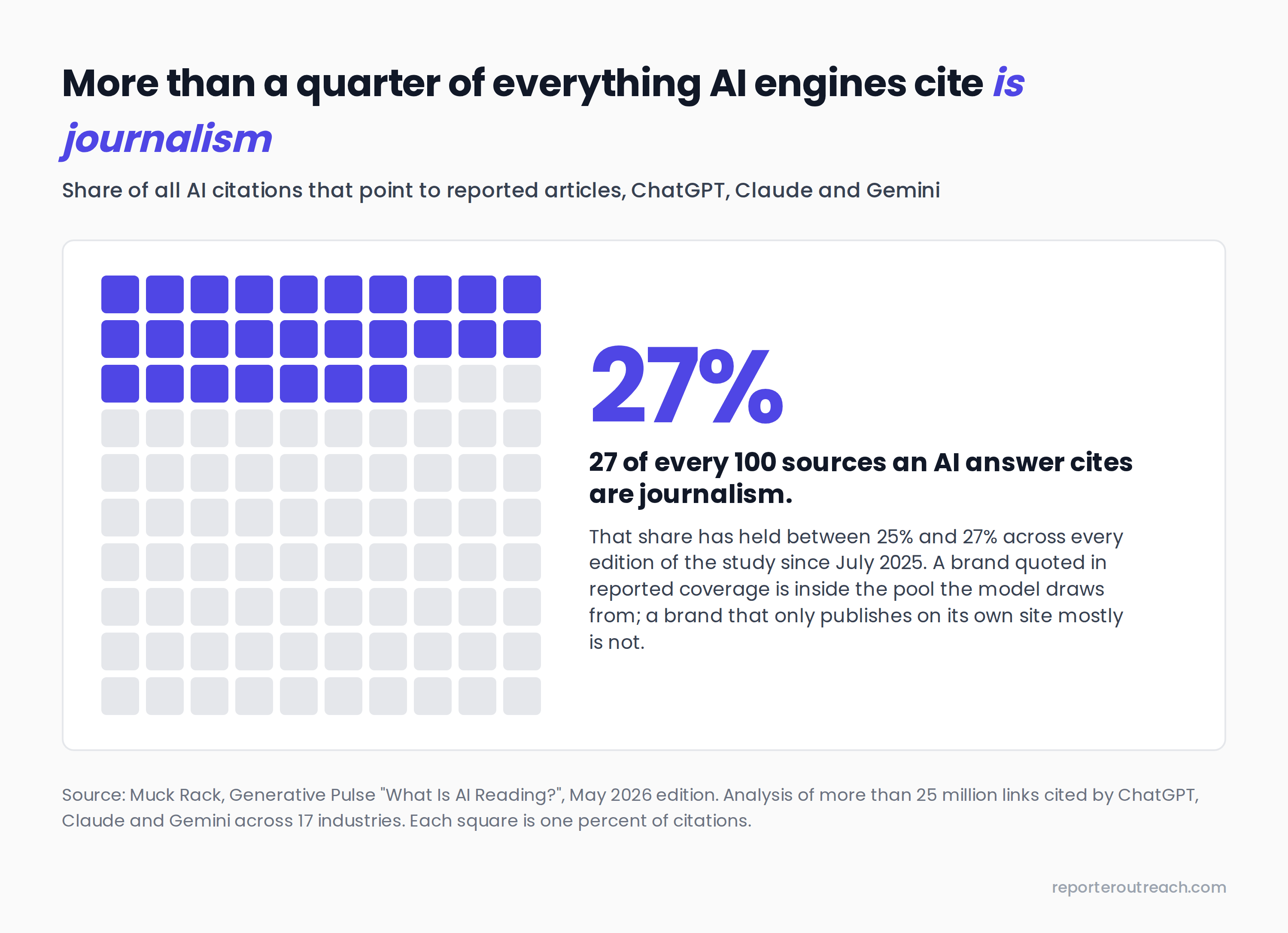
- More than a quarter of everything AI engines cite is journalism: 27% of all citations, steady across three editions of Muck Rack's Generative Pulse study (May 2026). For best-of queries, models lean on reported coverage and third-party lists, not the brand's own pages.
- Six of the ten agencies here publish a price floor. Published retainers start at $3,000 a month; the rest quote custom.
Search for a generative engine optimization agency and the results tell you how young the category is. Half the page is roundups written by agencies that rank themselves first. The other half is service pages for firms that were SEO or PR shops eighteen months ago and rebadged. None of it answers the question that matters: which of these agencies can change what ChatGPT, Gemini, and Google AI Overviews say when a buyer asks for the best option in your category, and which are selling a dashboard or a schema audit and calling it GEO.
This list of the best GEO agencies for 2026 sorts ten firms by the one job each does better than anyone else on the list, with published pricing where it exists and a plain note on what each one does not do. Before the names, you need to know which of the three things called "GEO" you are shopping for. They are not interchangeable.
What a Generative Engine Optimization Agency Actually Does
A generative engine optimization agency works to get a brand named, cited, or recommended inside AI-generated answers from ChatGPT, Gemini, Perplexity, Claude, and Google's AI Overviews and AI Mode. That is the whole definition. What varies wildly is where in the process each agency does its work.
An AI answer is assembled in stages. The model breaks your question into sub-queries, retrieves candidate passages from the open web and its training data, filters them by how much it trusts the source, and then writes an answer that names the sources it kept. A brand can be reached at three of those stages, and the three vendor types map to them almost exactly. Here is where each one intervenes:
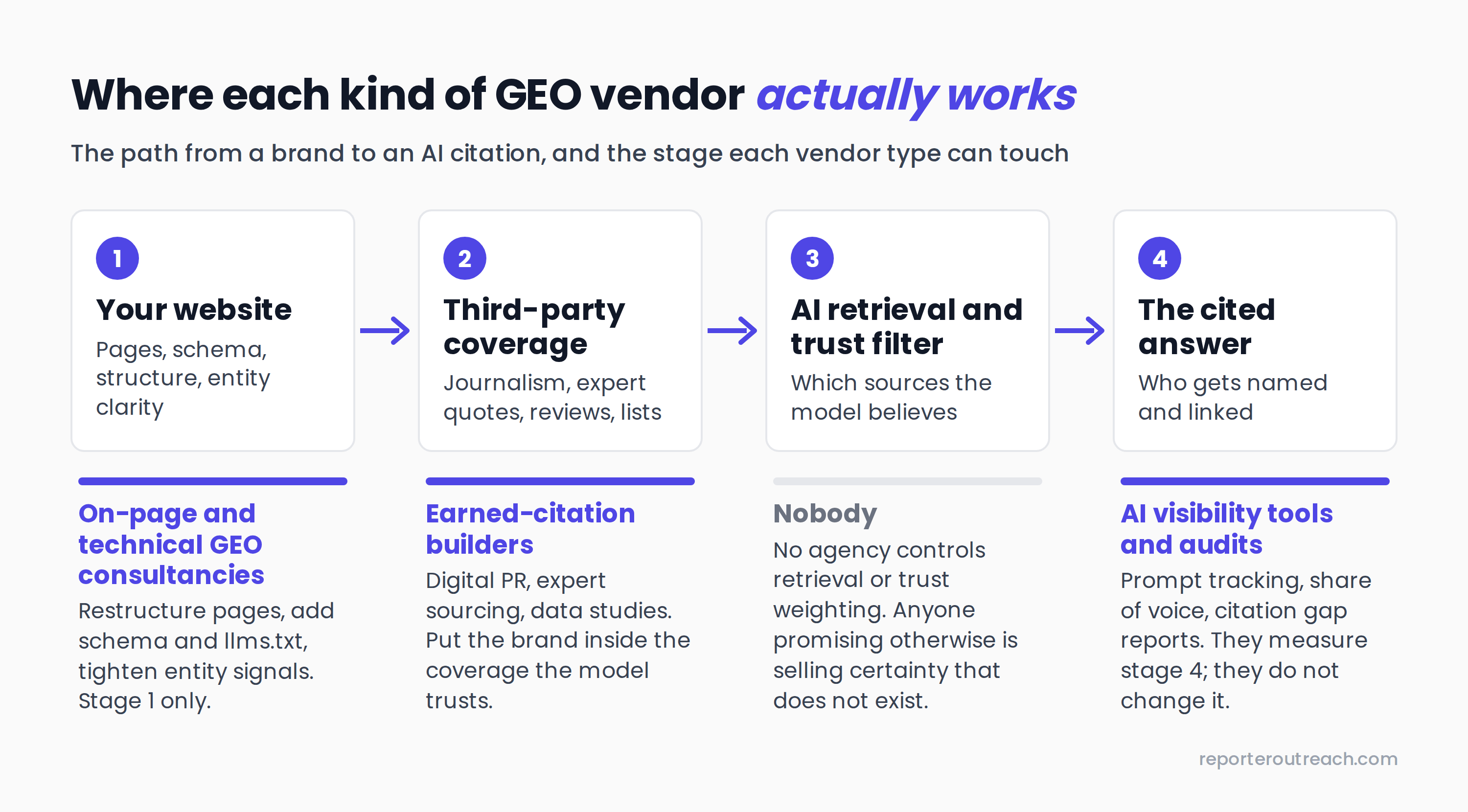
The uncomfortable part for buyers is that the stage which most determines whether you get cited is stage 2: the coverage that already exists about you on sites the model trusts. That is also the stage most GEO agencies are not built to touch. Our breakdown of GEO versus SEO goes through the evidence in detail; the short version is that on-page work is table stakes and third-party authority is the differentiator. The three vendor types break down like this:
| Vendor type | What you get | Hire it when |
|---|---|---|
| On-page and technical GEO consultancies | Content restructured for extraction, schema, llms.txt, entity clarity, AI crawler access. SEO fundamentals applied to a new reader. | Your site is technically messy or your content buries the answer. Necessary, and not sufficient. |
| AI visibility tools and audit shops | Prompt tracking across engines, share of voice, citation gap reports. Measurement, often with recommendations attached. | You need to know where you stand and prove movement. Tracking shows the gap; it does not close it. |
| Earned-citation builders | Editorial coverage, expert quotes, data studies, and reviews on the third-party sites AI engines cite. The authority layer. | Your pages are fine and you still do not appear. This is the gap for most established brands. |
Most agencies below sell some mix. Each entry says which one the agency is really built for.
How Fast the GEO Agency Market Is Moving
Faster than the category can define itself. The CMO Survey, fielded in January 2026 among 308 senior US marketing leaders, found that 41.5% of companies already use generative engine optimization, for a capability that did not exist as a survey option a year earlier. Conductor's 2026 CMO Investment Report, covering more than 250 enterprise digital leaders, found they allocated an average of 12% of their digital budgets to AEO and GEO in 2025, and 94% plan to increase that spend in 2026.
Search demand for the agencies themselves tells the same story. The phrase "generative engine optimization agency" had no measurable volume in any month of 2024. Here is what happened next:
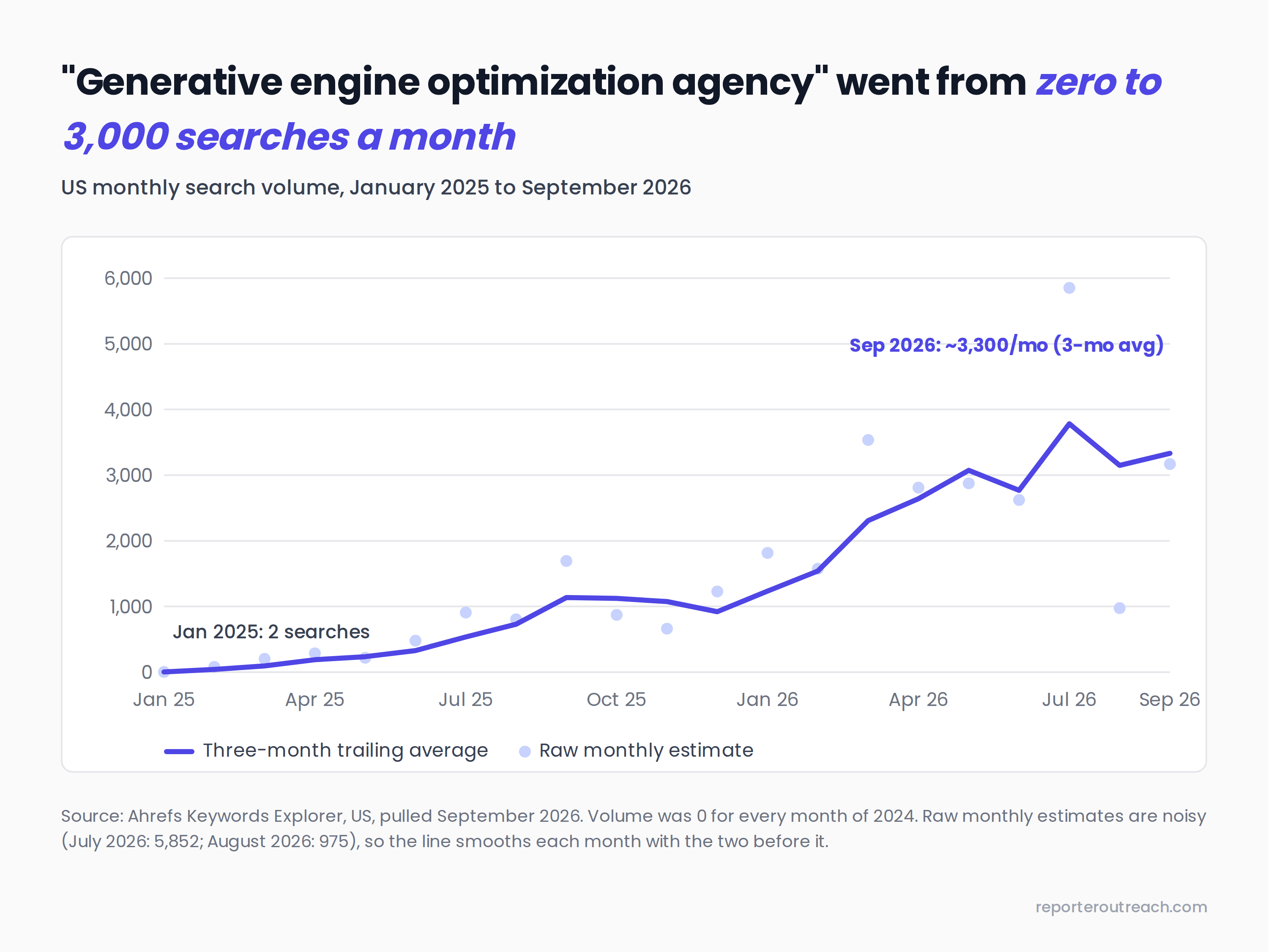
Two things follow. Every agency on this list built or rebadged its GEO offer inside the same 18-month window, so "years of GEO experience" is a claim to treat with suspicion from anyone. And the buyers arrived before the definitions did, which is why the three-vendor confusion above costs so many brands their first GEO budget.
How This List Was Built
Four filters, applied to every entry:
- Verifiable GEO work. A dedicated GEO service page or a documented GEO methodology on the agency's own site, not a paragraph bolted onto an SEO page. Every claim below was checked against the agency's site or its Clutch profile in September 2026.
- One distinct job. Each agency gets a single "best for," stated as a job rather than a list of outcomes. An agency that claims to be best at everything has made a marketing choice.
- Pricing transparency. Agencies that publish a floor rank ahead of those that make you book a call to hear a number, all else being equal.
- Honest limits. Every entry names what the agency does not do. No vendor covers all three stages well, including the one publishing this list.
The order runs from earned-citation builders through hybrids to on-page and full-service shops, because that is the order in which most established brands' gaps actually show up.
The Best GEO Agencies for 2026
1. Reporter Outreach
| Headquarters | San Diego, CA |
| Founded | 2017 |
| Core Services | Digital PR, Link Insertions, Full-Feature Articles |
| Best For | Brands that want a fixed number of editorial placements every month (DR 75+ average) at published pricing, on the publications AI engines cite |
| Pricing | From $3,000/mo (7 placements) to $12,000/mo (32 placements) |
Reporter Outreach is the agency you hire when you want the citation footprint built rather than audited: a fixed number of editorial placements every month (DR 75+ average) at published pricing. The model is reactive digital PR. Clients are quoted as expert sources in stories journalists are already writing, on the topics they want to be known for, sourced through Qwoted, HARO, and direct reporter relationships. That puts the brand inside the reported coverage AI engines cite most, rather than on pages the brand controls. Since 2017 the model has produced over 25,000 placements at an average of DR 75+. First placements typically land within 2–3 weeks, meaningful ranking movement shows in months 3–6, and the effect compounds over months 6–12.
Qooper, an HR tech SaaS platform, is the canonical example of what that looks like over one cycle:
The full write-up is on the case studies page. The limitation is that Reporter Outreach is a placements specialist. It does not restructure your pages, implement schema, write llms.txt files, or run prompt-tracking dashboards. If your gap is on-page, pair it with one of the consultancies further down. Tiers run from Starter at 7 placements a month for $3,000 to Growth at 15 for $6,000 and Elite at 32 for $12,000, with a three-month minimum and month-to-month after, all listed on the pricing page. Rated 5.0 on Clutch and Google.
2. Percepture
| Headquarters | New York, NY |
| Founded | 2004 |
| Core Services | Digital PR, GEO, SEO, Paid Media, Reputation Management |
| Best For | Complex B2B verticals (telecom, data centers, staffing) that want communications-led GEO with reputation management attached |
| Pricing | Custom (not published) |
Percepture is the communications-first entry. President Bob Generale has run search and PR programs since the mid-2000s, and the GEO offer pairs digital PR with entity optimization, schema work, and AI visibility tracking across ChatGPT, Grok, Perplexity, Gemini and AI Overviews. The client base skews toward hard B2B categories (telecom, fiber, data centers, staffing, enterprise technology) where buyers ask AI which vendor to trust and the answer turns on third-party evidence. Percepture's own site is unusually direct that no agency controls AI outputs; it sells probability, not placement.
The trade-off is that you are buying a visibility system, not a placement count. Scope is bespoke, pricing is not published, and the engagement is built around the whole comms function rather than a monthly editorial quota.
3. Go Fish Digital
| Headquarters | Raleigh, NC |
| Founded | 2005 |
| Core Services | GEO, Digital PR, SEO, Paid Media, Reputation Management |
| Best For | Brands that want an audit-first GEO program run on proprietary tooling, with PR as one component |
| Pricing | Custom ($5,000+ minimum project size on Clutch) |
Go Fish Digital has the deepest internal toolkit on this list. Barracuda, its AI-powered platform, scores pages against 14 factors drawn from Google's own patents; an AI Overview Analyzer audits reference frequency in Google's AI answers; a Semantic Content Audit maps how AI systems read topical authority across a site. The method is page by page and passage by passage, with digital PR and reputation work layered on for the authority signals.
Two things to weigh. The tools stay internal, so you rely on Go Fish's team to interpret and report rather than logging in yourself. And the integrated model means overhead if all you want is the coverage layer; for a brand that wants PR working alongside paid and technical SEO under one roof, that same integration is the point.
4. Siege Media
| Headquarters | Austin, TX (100% remote) |
| Founded | 2012, by Ross Hudgens |
| Core Services | Content Marketing, SEO, Digital PR, GEO |
| Best For | Brands that want to earn citations through original data studies and interactive content assets |
| Pricing | Custom ($5,000+ minimum project size on Clutch) |
Siege Media approaches GEO from the asset side. Its GEO service page describes the model plainly: data journalism plus digital PR plus freshness tooling, on the theory that both Google and language models prefer unique data they cannot get elsewhere. DataFlywheel keeps published data updated automatically; BlueprintIQ builds the content roadmap. The client list (Zendesk, Zapier, Figma, Instacart) and a Mentimeter case study on AI visibility show the model working at scale.
The dependency is the caveat. This works when you fund sustained research and content production, and the flywheel takes longer to spin up than direct outreach. If you need to appear in AI answers next quarter, Siege is the wrong tool. If you are building a citable data moat over years, few do it better.
5. Minuttia
| Focus | Established B2B SaaS, typically $10M+ ARR |
| Core Services | Google and AI Search Strategy, Content, Digital PR, Agent Analytics |
| Own Research | AI Search Visibility Data Study (24,067 prompts, five platforms); State of AEO Report 2026 |
| Best For | B2B SaaS content teams that want GEO folded into an existing content program with proprietary visibility tracking |
| Pricing | $4,000+ minimum project size (published) |
Minuttia calls itself an adaptive content marketing agency, and the GEO practice is built on that base: search strategy that spans Google and AI engines, content production, digital PR, and a set of proprietary AI visibility tracking tools. It publishes its own research, including a data study built on 24,067 prompts across five AI platforms, which is more original evidence than most agencies in the category can show, and the Toggl case study on its site is the reference point for what the program looks like at scale.
The eligibility bar is the caveat. Minuttia works with established, growth-stage B2B SaaS companies with real marketing budgets, and it is sales-led with no self-serve path. Outside that profile, or if you want placements without a content program around them, the fit is not there.
6. Omniscient Digital
| Headquarters | Austin, TX |
| Founded | 2019 |
| Core Services | SEO, GEO, Content, Digital PR, Analytics |
| Best For | B2B software companies that measure GEO by qualified pipeline rather than visibility scores |
| Pricing | Full-service from $10,000/mo (published) |
Omniscient Digital works exclusively with B2B software companies and runs GEO as a named service rather than a bolt-on, with a dedicated services page, a partnership with Peec AI for tracking, and published research on AI content strategy. Founded by alumni of HubSpot, Shopify, and Workato, the agency starts research at the buyer level, with voice-of-customer work and sales call analysis, before anything gets optimized, and reports on pipeline rather than rankings. Clients include Jasper, SAP, Asana, and Loom.
You hire Omniscient for the whole organic system, not for citations alone; digital PR is one instrument in it. The $10,000 monthly floor also prices out earlier-stage teams.
7. Directive
| Headquarters | Irvine, CA |
| Founded | 2014 |
| Core Services | GEO, SEO, Paid Media, RevOps, CRO, Demand Generation |
| Best For | Enterprise B2B brands with a mature SEO and paid program that need GEO layered on top of it |
| Pricing | Custom (not published) |
Directive is a B2B performance marketing agency whose GEO service sits inside its Customer Generation methodology: entity and topic mapping, structured data, answer-focused content, topical authority built through linked content hubs, and dashboards that track citations and impressions from generative engines. It serves B2B and enterprise brands, and the pitch is consistency: every channel and every AI surface describing the brand the same way.
Directive works from the on-page and paid side of the pipeline. Authority is built through content clusters more than through journalism, so if your gap is third-party coverage, that layer comes from somewhere else. Pricing is custom and the engagement is enterprise-sized.
8. iPullRank
| Headquarters | New York, NY |
| Led By | Mike King |
| Core Services | Relevance Engineering, Enterprise SEO, Content Strategy, GEO |
| Best For | Enterprise sites that need technical GEO (passage-level retrieval, entity mapping) at scale |
| Pricing | Custom (not published) |