Key Takeaways
- Most of what gets sold as "digital PR" is resold marketplace inventory. BuzzStream's 2026 analysis of 257,267 sites on link marketplaces found only 1.37% qualify as high quality or top tier.
- Clients end agency relationships over delivery and strategy, not price. Clients rank poor delivery as the #1 reason they leave; agencies rank it #7 (Swydo, 2026).
- The fastest vetting tool is live placement URLs from the last 90 days. Refusal to share them ends the call.
- Earned coverage cannot be guaranteed. Paid placements are a legitimate product when sold as paid — the red flag is paid placements dressed up as earned coverage.
- A realistic timeline: first placements in 2–3 weeks, ranking movement in months 3–6, compounding through months 6–12. Anyone promising rankings in 30 days is lying.
Every agency pitch deck looks the same. High DR averages, a wall of publication logos, a case study with a hockey-stick chart. The decks are identical because decks are cheap — and because most of the companies behind them are doing very different work under the same label.
Knowing how to choose a digital PR agency comes down to one skill: asking questions the resellers can't answer. Underneath the "digital PR" label sits a marketplace where BuzzStream's 2026 study of 257,267 sites found 96.2% are low quality, 39.6% have zero organic traffic, and the average domain rating is 24. Plenty of agencies are simply resellers sitting on top of that inventory, marking it up, and calling it PR.
The twelve questions below expose which kind of agency you're talking to — usually inside one call.
Decide These Three Things Before You Call
Vetting goes faster when you know what you're vetting for. Settle three things internally first.
Your budget floor. Quality programs from agencies targeting real publications generally run $3,000–$12,000 per month. If your budget is $500, the honest answer is that no legitimate agency fits it — and knowing that saves you from the vendors who will happily take it.
Your timeline tolerance. Authority compounds over months, not weeks. If you need results inside 30 days, digital PR is the wrong purchase, and any agency that tells you otherwise is disqualifying itself.
Earned coverage or controlled messaging. These are different products from different kinds of firms. If you need a product launch covered on a specific date with your exact messaging, that's proactive brand PR. If you need durable authority, links, and AI-search visibility, that's earned editorial coverage. More on this trade-off below — it matters more than most buyers realize.
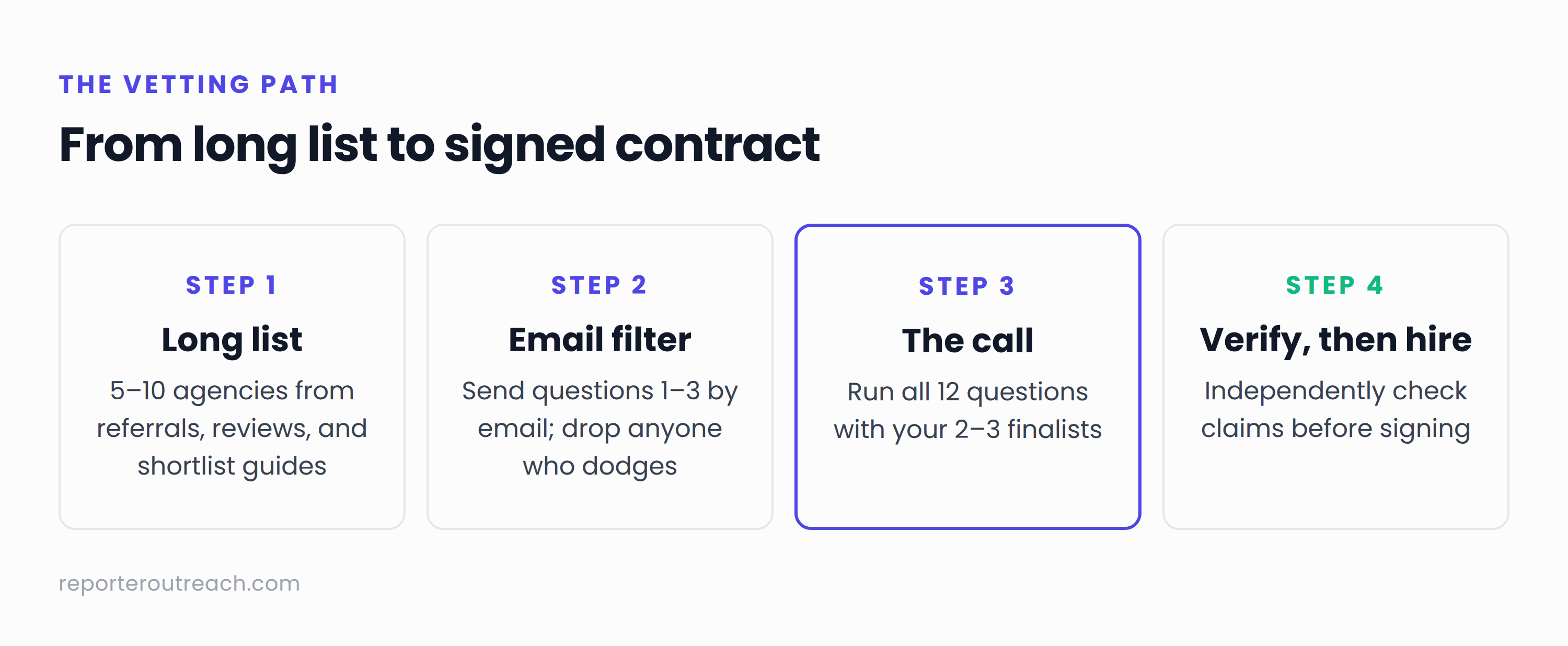
With those settled, the efficient path looks like this:
The 12 Questions to Ask a Digital PR Agency
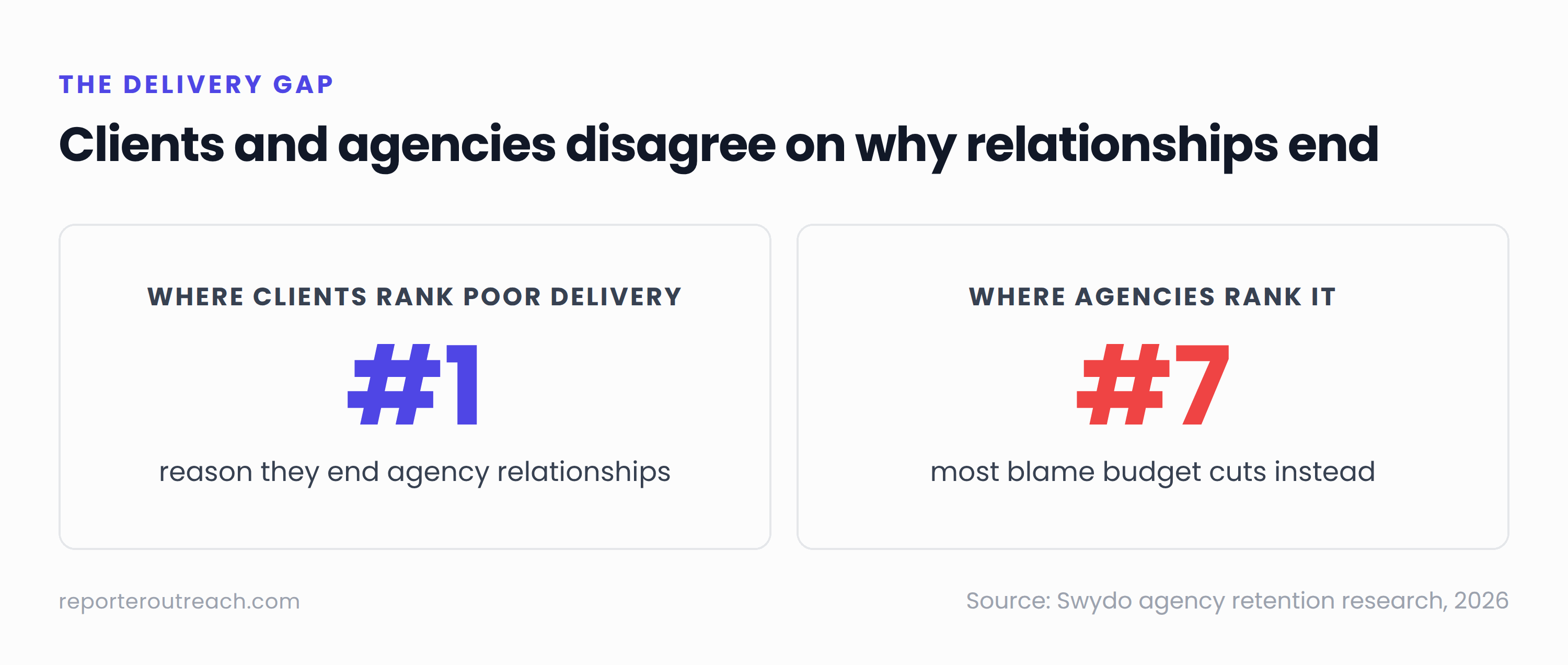
Notice what these questions are not about: price. That's deliberate. Swydo's research on why clients leave agencies found that clients rank poor delivery as the number one reason they end relationships — while agencies rank it seventh, blaming budget cuts instead. Price is where buyers instinctively negotiate; delivery, strategy, and honesty are where engagements actually die. The gap looks like this:
So ask about the things that predict delivery. In order:
- Where do your links actually come from? A good answer names the mechanism — journalist pitching, expert commentary, data campaigns, direct publisher relationships — and walks you through one recent placement end to end. "Our proprietary network" is not a mechanism. It's a marketplace login.
- Can I see live placement URLs from the last 90 days? Clickable URLs on the actual publications, not a PDF or a logo wall. Recency matters: a portfolio of 2022 wins says nothing about what the team can deliver this quarter.
- Is your DR figure an average or a floor? "DR 70+" can mean an average of 70, or one DR 70 outlier propping up a pile of DR 15 blogs. Ask for both the average and the minimum, then check them against last month's placement list yourself.
- Who are you pitching — journalists or site owners? Real digital PR pitches journalists and editors who are already writing stories; your team gets quoted as an expert source in coverage that would exist anyway. If the answer is "webmasters" or "our publisher partners," you're buying placements, not earning coverage.
- Do you guarantee coverage in specific publications? This one is a trap, and the right answer is nuanced. Earned coverage cannot be guaranteed — anyone promising earned placements in named publications is either lying or quietly paying for them. Guaranteed placements do exist as a paid product, and they're legitimate when they're sold and disclosed as exactly that. What should end the conversation is an agency selling paid placements as earned coverage.
- What happens if a placement disappears? Links get removed when articles are updated or pruned. You want a written replacement policy: how long placements are monitored, and who pays for a replacement. "That rarely happens" is not a policy.
- What exactly will I see in your reporting? The bar is verifiability. Good reporting lists every placement as it lands, with the live URL and the underlying data — domain rating, anchor text, host metrics — so you can click into any link and confirm it yourself. What should worry you is reporting you can't audit: summary PDFs, aggregate counts with no URLs, or a deck that shows up with the invoice and nothing checkable in between.
- What's your average client tenure? A healthy agency answers with a specific number and renewal examples. Vague warmth — "most clients love us" — is what churn sounds like from the inside.
- What's the realistic timeline? The honest version: first placements inside 2–3 weeks for reactive campaigns, meaningful ranking movement in months 3–6, and compounding gains through months 6–12. Distrust both extremes — rankings promised in 30 days, and agencies with nothing to show for the first quarter.
- How does your work show up in AI search? The good answer is a mechanism, not a buzzword: AI assistants cite earned editorial coverage on authoritative publications, so the same placements that build rankings also build citation visibility. The red flag is a bolt-on "GEO package" that turns out to be the same links with a new name.
- Which of your placements are paid, and how are they disclosed? An honest agency answers instantly, per placement type. If everything is somehow simultaneously "earned" and "guaranteed," the model doesn't add up — and neither will the invoices.
- Why shouldn't I hire you? The only question that tests honesty directly. Every model has losing scenarios: launch-day coverage, narrative control, local press. An agency that can't name its own will also never tell you when your campaign is underperforming.
Good Answers vs. Red Flags
For the call itself, here is the full list, one row per question:
| Question | A good answer | Red flag |
|---|---|---|
| Where do links come from? | Named mechanism plus a recent example walked end to end | "Proprietary network," no examples |
| Live URLs from the last 90 days? | Clickable, recent, on real publications | PDF decks, logo walls, "client confidentiality" |
| DR average or floor? | States both and invites you to verify | One number, no minimum, no recent list |
| Who gets pitched? | Journalists and editors writing real stories | "Webmasters" and "publisher partners" |
| Do you guarantee coverage? | "Earned coverage can't be guaranteed; paid placements are sold and disclosed as paid" | Guaranteed earned coverage in named publications |
| What if a link disappears? | Written replacement policy with a monitoring window | "Links rarely disappear" |
| What will I see in reporting? | Every placement with a live URL and per-link data you can verify | Summary PDFs and counts with nothing to click |
| Average client tenure? | Specific number with renewal examples | "Most clients love us" |
| Timeline? | Placements in 2–3 weeks; rankings months 3–6; compounding 6–12 | Rankings in 30 days — or nothing to show for months |
| AI search visibility? | Earned editorial citations on authoritative publications | Renamed link packages sold as "GEO" |
| Paid vs. earned? | Instant, per-placement-type answer with disclosure | Everything is both "earned" and "guaranteed" |
| Why shouldn't I hire you? | Names real losing scenarios for their model | "We're a fit for everyone" |
Four Red Flags That Should End the Call
Some answers don't need a follow-up question. They need a polite goodbye.
- Rankings promised inside 30 days. Authority does not work on that clock. This promise is either ignorance or bait, and both cost you the same money.
- High-DR claims with no live URLs. If the average is real, showing you last month's placements takes five minutes. Refusal is the answer.
- Pricing that violates the market curve. Twenty "DR 70 news placements" at $150 each is not a deal — it's arithmetic that doesn't exist, as the next section shows.
- Refusal to distinguish earned from paid. Agencies that blur the line with you are blurring it with publishers too — and that risk lands on your domain, not theirs.
The Pricing Sanity Check
You don't need to know what an agency should charge. You only need to know when a quote is impossible — and the market data draws the curve:
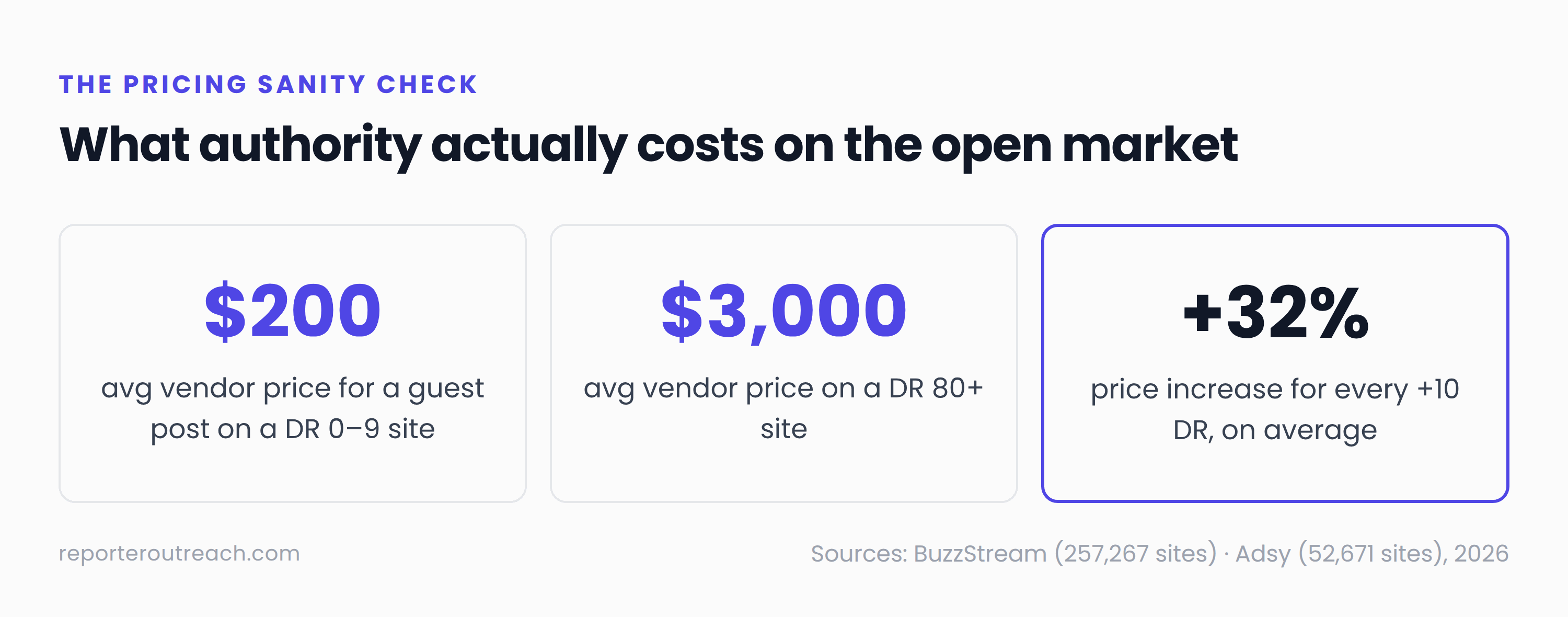
Now apply it. The average guest post costs $295 bought directly from a site and $461 through a vendor — but that average is dragged down by junk, because 96.2% of marketplace inventory is low quality and the average domain rating across the entire marketplace is 24. A genuinely high-quality placement averages $3,130 through a vendor, and top-tier news publications average $7,209. Of everything labeled a "news site" for sale, only 4.2% actually qualifies as high quality or top tier.
So when an agency quotes you twenty DR 70 news placements at $150 each, one of two things is true: the DR claim is fake, or you're buying from the 96%. There is no third option. The inventory doesn't exist at that price.
Earned coverage changes this math, because there's no publisher fee to mark up — the cost is the labor of pitching and writing. That's why earned-media retainers in the $3,000–$12,000 monthly range can deliver placement quality that would cost multiples per-link on the open market. For the full cost breakdown, see our guide to what quality link building actually costs; if you're comparing against one-off placements, our breakdown of link insertion pricing covers that market's rates.
Cheap and high-authority cannot coexist at scale. Any quote that claims both is lying about one of them.
When a Different Model Fits You Better
A vetting guide that concludes "everyone should hire an earned-media agency" is a sales page wearing a disguise. So, honestly: sometimes you shouldn't.
If you need coverage of a product launch on a specific date, with your messaging intact and your executives quoted saying exactly what legal approved — that's proactive brand PR, and a traditional retainer firm will serve you better. Earned editorial coverage trades away narrative control: journalists write their own stories, on their own schedule, and your expert commentary lives inside their framing. That trade is the entire reason the coverage carries authority, but it is still a trade.
Same for crisis communications, analyst relations, and hyper-local press — different specialists, different vetting questions. And if you have an in-house team with real journalist relationships and time to pitch daily, you may not need an agency at all.
What you should not do is hire a proactive brand-PR firm expecting link and citation outcomes, or an earned-media agency expecting launch-day control. Most agency disappointment is a model mismatch that no amount of good execution can fix — which is why the third question in the section above, the one you answer before any call, is the one that saves the most money.
How to Verify Claims Yourself
Everything the finalists told you can be checked in under an hour.
- Pull their placement URLs into an SEO tool. Check the domain rating and the host page's organic traffic in Ahrefs or a comparable tool. Traffic is the harder metric to fake — a DR 60 site with zero visitors is inventory, not media.
- Check the distribution, not the highlight. Ask for the last 20 placements and look at the spread. One DR 80 win surrounded by DR 15 blogs tells you what the average client actually receives.
- Read reviews for patterns, not stars. On Clutch and G2, ignore the rating and read for repeated complaints: missed placement counts, communication gaps, surprise fees. One bad review is noise; the same complaint three times is the product.
- Demand verifiable proof, not adjectives. Real case studies name the client, the timeframe, and the numbers, with placements you can click and confirm — here's what that format looks like. "We got great results for a brand in your space" is not evidence.
If an agency survives all twelve questions and the verification pass, you've likely found a real one. They're rarer than the pitch decks suggest — our shortlist of digital PR agencies worth evaluating is a reasonable place to start the long list, and our digital PR service page shows how one earned-media model answers these questions, if you want a baseline to compare against.
Ready to Ask Us All 12?
Book a strategy call and run every question in this guide on us — live placement URLs, DR averages, timelines, all of it. If our answers don't hold up, don't hire us.
Frequently Asked Questions
Quality programs from agencies targeting real publications generally run $3,000 to $12,000 per month on retainer. For context on per-placement economics: genuinely high-quality bought placements average over $3,000 each on the open market (BuzzStream, 2026), which is why earned-media retainers tend to be the more cost-efficient path to high-authority coverage.
Reactive campaigns typically land first placements within 2–3 weeks. Meaningful ranking movement usually shows in months 3–6, with compounding gains in authority and AI-search visibility through months 6–12. Treat promises of rankings within 30 days as a disqualifier.
Not earned coverage — journalists decide what they publish, so guaranteed earned placements in named publications are a false promise. Guaranteed placements exist as a legitimate paid product when sold and disclosed as paid. The dealbreaker is an agency selling paid placements as earned coverage.
Ask for live placement URLs from the last 90 days, then check each host page's domain rating and organic traffic in an SEO tool. Review the distribution across the last 20 placements rather than a highlight reel, and confirm case studies link to placements you can click.
Refusal to show recent live placement URLs. Everything else an agency claims can be debated; this one can only be shown or hidden. Close behind: guaranteed earned coverage and pricing that quotes high-DR placements below what that inventory costs anywhere on the market.
Sources: BuzzStream Guest Post Cost Study (2026) · Adsy Link Building Pricing Analysis (2026) · Swydo agency retention research (2026)