Key Takeaways
- Unlinked brand mentions are references to your business in published content that don't include a link back. The tactic has existed for a decade — 2026 changed why it matters.
- Brand mentions now correlate more strongly with AI search visibility than backlinks. ChatGPT, Perplexity, and Google's AI Overviews use mention frequency to decide which sources to cite.
- Warm reclamation outreach converts at 15-40%. Cold link requests sit at 3-8%. The gap is because the author already referenced you — adding a link is an edit, not a new editorial decision.
- About 20% of digital PR placements arrive without a link on first publish. The reclamation step recovers them.
- Most guides treat reclamation as a standalone tactic. It compounds best as the back half of an active digital PR program — not a substitute for one.
An unlinked brand mention is any reference to your company, product, executive, or branded term in published content that doesn't include a clickable link back to your site. The mention exists in plaintext. The author already trusts you enough to name-drop. No link equity passes.
This tactic isn't new. SEO teams have been auditing for unlinked mentions since at least 2014, when Ahrefs first popularized the workflow. What changed is the value of an unlinked mention in 2026.
Two forces matter:
The first is that tier-1 publications no longer respond to cold outreach. Forbes, Reuters, The Wall Street Journal, Bloomberg — these outlets ignore link insertion requests and routinely strip hyperlinks during the copy edit. The only realistic way most brands earn links from those outlets is to convert an existing mention into one. Cold pitching doesn't work. Reclamation does.
The second is that AI search engines treat brand mentions as entity signals — independently of whether the mention carries a link. The mechanics matter for prioritization, and we'll cover them in section seven. The takeaway up front: a reclaimed mention does double duty in 2026. It adds the link equity AND extends the brand's footprint in the data AI models actually cite.
What unlinked brand mentions actually are
The definition above is the technical one. The variations in the wild are messier.
What an unlinked brand mention looks like in practice:
- A journalist writes "tools like [Your Brand] help teams track conversion rates" without linking.
- A roundup article lists your company among ten competitors and links to nine but not you.
- A podcast transcript names you as a source and the show notes don't link.
- An industry report cites your survey data but credits a competitor's URL.
- A reporter quotes your CEO and links to her LinkedIn profile instead of your site.
All five are reclaimable in principle. They convert at different rates because the friction to add the link varies — fixing a roundup is easier than fixing an industry report. Section four covers qualification in detail.
One distinction worth getting right early: unlinked mention reclamation is not the same as brand mention building. Reclamation converts mentions you've already earned. Building generates new mentions through expert sourcing, listicle placement, podcast appearances, and active digital PR. Reclamation is one tactic inside the broader program. Treating it as a standalone strategy is the most common mistake.
Why this matters more in 2026 than five years ago
Two structural shifts changed the calculus.
Shift one: tier-1 outlets are functionally unreachable through cold outreach.
Forbes, The Times, TechCrunch, WSJ, Reuters — these publications don't accept cold guest post pitches and almost never respond to cold link insertion requests. Five years ago, a polite email to a reporter could occasionally land a link. That window closed. Inbox volume is too high, editorial standards are tighter, and the wide adoption of paid link placement at lower-tier sites poisoned the well for honest outreach at the top.
But tier-1 reporters do mention brands in editorial coverage constantly. They cite companies in industry context, name vendors in analysis pieces, reference data from category leaders. They forget to link, or their CMS strips the hyperlink during the publish workflow, or they cite a competitor that ends up with the link instead. Each of those is a reclaimable mention on an outlet you couldn't have reached cold.
This is the only outreach path that consistently produces tier-1 links for brands that aren't household names. Our reactive PR playbook covers what generates these mentions in the first place — reclamation is what recovers their link value.
Shift two: brand mentions feed AI search visibility independently of links.
Ahrefs published a follow-up study in December 2025 to their earlier 75,000-brand analysis. The follow-up extended the methodology across ChatGPT, Google AI Mode, and AI Overviews simultaneously, and measured which signals correlate with brand visibility across all three. YouTube mentions came in at a 0.737 correlation — the strongest single signal they measured, ahead of branded anchors, branded search volume, and domain rating.
The mechanism is straightforward. AI models train on indexed web content. When independent sources consistently reference your brand in editorial context, the model learns the association between your brand and your category. It then surfaces you when someone asks a category question. Whether the original mention carried a hyperlink is largely irrelevant to that mechanism — what matters is that the mention existed in editorial content the model ingested.
Gartner forecasted in 2025 that traditional search traffic would decline 25% by the end of 2026 as AI alternatives absorbed queries. That projection is playing out. The mentions AI models use to decide who to cite are the same mentions sitting unlinked in your existing coverage right now.
How to find unlinked brand mentions
Five tools cover the practical workflow. The right stack depends on mention volume and budget.
| Tool | Cost | Strongest at | Weakness |
|---|---|---|---|
| Google Alerts | Free | Daily monitoring of new mentions as they publish | No filtering by authority; misses 20-30% of mentions; spammy alerts mixed in |
| Ahrefs Content Explorer | $129+/mo | Bulk discovery + filtering by DR, traffic, recency | Subscription cost; some indexing gaps on smaller publishers |
| Brand24 | $99+/mo | Real-time alerts, sentiment analysis, social + forum coverage | Less coverage on long-tail editorial sites |
| Semrush Brand Monitoring | $129+/mo (add-on) | Integration with broader Semrush workflows | Weakest on podcast and video transcript discovery |
| Mention.com | $41+/mo | Lightweight monitoring for smaller teams | Manual qualification still required |
The pragmatic stack for most teams: Google Alerts for free daily coverage, plus one paid tool for monthly bulk audits. Most teams already have Ahrefs or Semrush — use what you have rather than adding another subscription.
Manual searches still matter. Run "Your Brand Name" -site:yourdomain.com in Google once a month. The advanced operator strips your own properties and surfaces external mentions. You'll catch things alerts miss — older content that just got reshared, articles updated to add your name after publication, mentions on sites the alert services don't crawl.
Set alerts to weekly digest, not daily. Daily alerts get ignored after the first month. Weekly hits the inbox at a frequency teams actually review and act on.
Which mentions are actually worth reclaiming
Not every unlinked mention is worth the outreach effort. Most teams have more reclaimable mentions than they have outreach bandwidth, so the qualification step matters more than most teams realize.
Five criteria, in order of weight:
- Domain authority threshold (DR 40+). Mentions on low-DR sites add minimal link equity. Below DR 30, the reclamation usually isn't worth the email — you're spending team time for a link that won't move metrics.
- Page traffic. A mention on a well-trafficked article on a high-DR site is a high-value conversion target. A mention on a zero-traffic page on the same domain is not. Check the page's own traffic estimate before sending outreach, not just the domain's overall DR.
- Context fit. A mention that naturally calls for a link — referencing your specific tool, your research, a guide you published — converts at far higher rates than a passing brand drop where adding a link would feel forced.
- Recency. Articles published in the last 90 days convert dramatically better than older content. Editors lose context on old posts and become defensive about updating them.
- Author reachability. Some publications publish reporter emails. Some hide everything behind a generic editorial inbox. The first kind converts. The second rarely does — and burning team time on unreachable editors is the most common waste in reclamation workflows.
Conversion rates by mention tier, based on what shows up across industry data and on the campaigns we run:
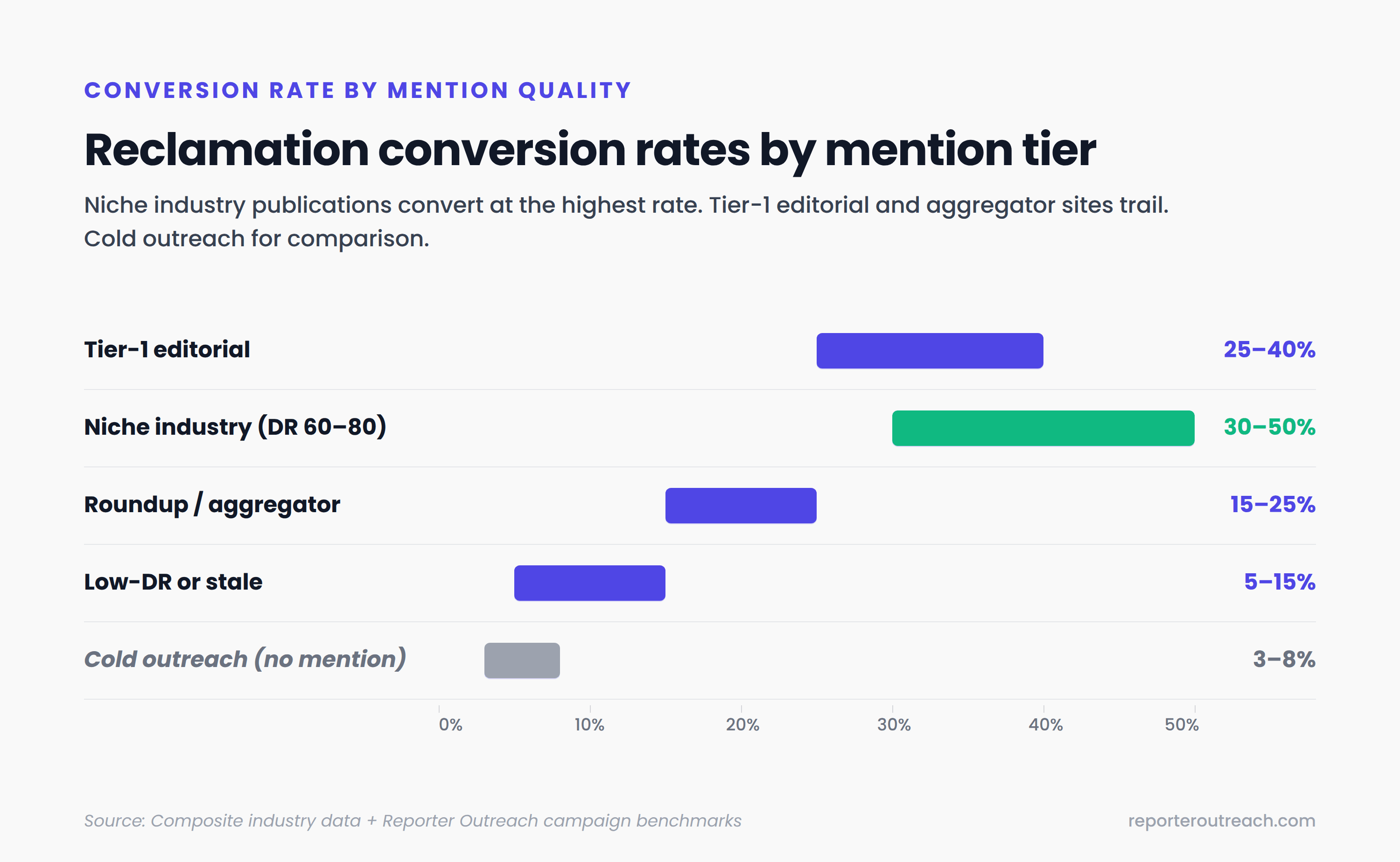
The mid-tier — niche industry publications at DR 60-80 — typically converts at the highest rate. Counterintuitive, but it tracks. Tier-1 editors are time-poor and skeptical. Niche editors care more about the topic, have closer relationships with sources, and respond more often to specific, well-framed asks.
The outreach that actually converts
Find. Qualify. Outreach. Convert.
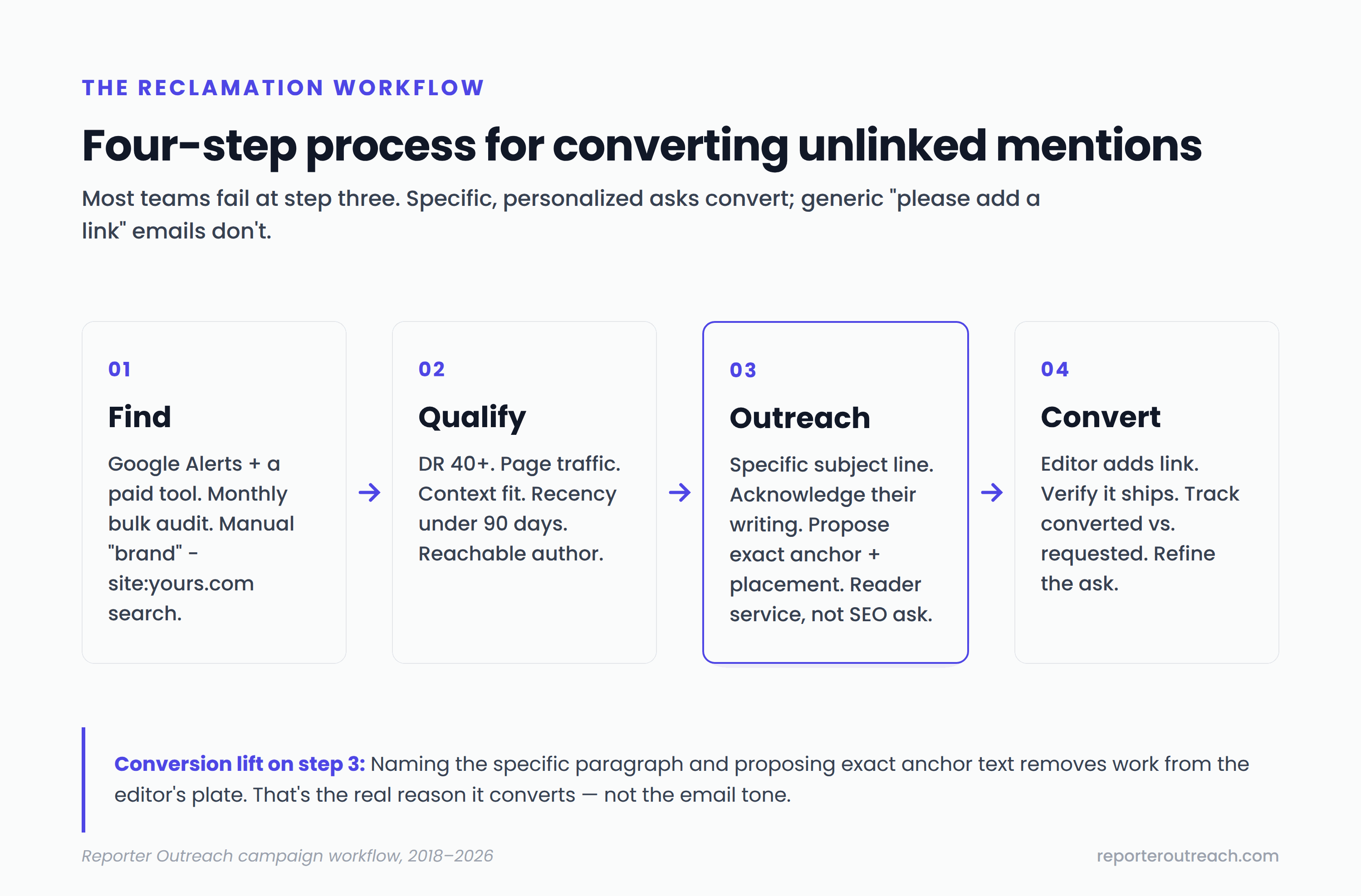
Find and qualify were sections three and four. Convert is mostly editor-side. The outreach step is where most reclamation campaigns fail.
The mistake most teams make: a generic "would you mind adding a link" email. Editors get dozens of those per week. They tune out.
The format that converts has four elements:
- Subject line names the article. "Quick fix for your [topic] piece" — not "Link request" or "Featured in your article."
- Open by acknowledging what they wrote. One sentence proving you read the piece. "Just read your [topic] breakdown — useful angle on [specific point you wrote about]."
- Make the ask specific. Don't ask them to add a link. Suggest the exact anchor text and exact placement. "When you mention [brand] in paragraph 4, would you consider linking to [URL]? The page covers [specific reason it's useful to their reader]."
- Frame as reader service, not SEO request. "Your readers might want the underlying [report/tool/data]." Never mention rankings, DA, or link juice in outreach. Editors read SEO terminology as a tell that the email is mass-blast.
Specific placement asks outperform generic ones across most teams' data — the lift varies by industry but the direction is consistent. Naming the paragraph and proposing the anchor text removes work from the editor's plate, which is the real reason it converts.
Timing matters more than most teams account for. Outreach within 48 hours of publication converts at the high end of the range. Past 90 days, conversion rates fall sharply. Editors lose context on old articles and stop wanting to touch them.
Subject: Quick fix for your [article topic] piece
Hi [Name],
Just read your piece on [topic] — useful framing on [specific point]. Saw you mentioned [Brand] in the section about [specific section]. Any chance you'd consider linking it to [URL]? The page covers [specific reason it's useful to readers].
No worries if it's not a fit. Thanks for the mention either way.
[Your name]
Three sentences plus the ask. No padding. No SEO terminology. Rewrite for your voice — never paste verbatim.
What conversion rate to actually expect
The honest range: 15-40% for well-qualified mentions. 3-8% for cold link requests for comparison.
Variation in published guides reflects two things. Industries differ — B2B SaaS converts differently than consumer ecommerce. And quality of qualification matters more than quality of outreach. Teams that send generic asks to every mention they find get the low end. Teams that ruthlessly qualify and write specific asks get the high end.
Ignore numbers like "70%" floating across the SERP without methodology. A single claim about Ahrefs research showing 70% reclamation success appears in roughly half a dozen aggregator guides. We can't find the primary study. When a single unattributed claim gets repeated until it's treated as fact, that's a content-cluster problem, not a data point. Pattern-match for it before quoting anything.
Realistic ranges by mention tier:
| Mention quality | Realistic conversion | Why |
|---|---|---|
| Tier-1 editorial, recent, contextual fit | 25-40% | Editor time-poor but mention already validates the brand |
| Niche industry, recent, DR 60-80 | 30-50% | Closer source relationships, more topic care, less request volume |
| Roundup or aggregator, DR 40-60 | 15-25% | Lighter editorial standards but high request volume |
| Low-DR or stale content (3+ years old) | 5-15% | Workflow friction; editor priority near zero |
| Cold link insertion (no existing mention) | 3-8% | No prior relationship; new editorial decision required |
The actual conversion rate depends on three things you control: the email itself, the timing, and the qualification step. Most teams underinvest in qualification and overinvest in outreach volume. Reverse the ratio.
Why unlinked mentions matter for AI search citation
This is the part most reclamation guides understate or skip.
AI search engines decide which sources to cite based on entity recognition. The model needs to see your brand referenced across credible sources to learn that your brand is a known entity in your category. When the model gets a category query — "best digital PR agencies," "tools for X" — it surfaces brands it has high entity-confidence in. Unlinked mentions feed that confidence without needing a hyperlink.
Three things follow from that.
Implied links are a real thing in Google's own documentation. Google's patent filings explicitly reference "implied links" — brand mentions without hyperlinks — as inputs to ranking algorithms. The 2012 patent USPTO 8,521,723 describes a system that treats brand-name co-occurrence with topic terms as a relevance signal even when no hyperlink exists. Google has refined related patents since. Whether implied links directly affect Google's current SERP rankings is debated. But the patent language is unambiguous: brand mentions are part of the model.
AI models train on the same web Google indexes. ChatGPT, Perplexity, Claude, and Gemini all ingest editorial content during training, and the search-enabled ones fetch live pages at query time. When models encounter your brand consistently in industry coverage, they associate your brand with that category. The Ahrefs December 2025 follow-up study found brand mentions correlate at 0.737 with AI visibility across ChatGPT, AI Mode, and AI Overviews — the strongest single signal measured.
Freshness matters more than most teams account for. Ahrefs' July 2025 freshness study found AI-cited content has an average age of 1,064 days, versus 1,432 days for Google SERP results — about 25.7% fresher. The implication for reclamation: recent mentions count more than old ones in AI citation, both because they're more likely to be in training data and because some AI search engines weight freshness explicitly at retrieval time.
The compounding effect: a mention reclaimed within 90 days of publication does double duty — it adds the link equity AND extends the freshness window of the mention itself for AI citation. The same workflow runs through our answer engine optimization framework.
When NOT to reclaim
Five scenarios where reclamation isn't worth pursuing — and some that actively hurt:
- Sites Google has flagged as spammy or penalized. A link from a known link farm or PBN is a liability. Run mentioning domains through a spam score check before outreach.
- Negative or critical mentions. A link won't fix the framing. It'll direct readers to your site with the negative sentiment fresh in mind. Address the underlying concern first; the link is downstream of that, if it makes sense at all.
- Stale archives, 3+ years old. Past a certain age, editors won't touch the article. The CMS workflows for old content are often broken, and editor mental priority on old archives is near zero.
- Publishers with disclosed editorial policy against post-publish edits. Some outlets state in their policy that they don't add links after publication. Honor it. Pestering doesn't change policy, and it burns the relationship.
- When you'd be the eleventh ask this quarter. Tier-1 reporters get dozens of link requests weekly. If your brand has pinged the same writer multiple times in recent months, give it a rest. Outreach fatigue burns the relationship you actually want.
The honest cutoff: most brands have more reclaimable mentions than they have outreach bandwidth. Prioritize ruthlessly. Walking away from low-value mentions is allocation, not laziness.
Reclamation as the second half of digital PR
Most articles on this topic treat reclamation as a standalone tactic. Find mentions you've earned passively, reach out, collect links. That works for established brands with significant organic mention volume. For brands that aren't household names, the tactic produces meager results — there aren't enough mentions to reclaim in the first place.
The compounding version: pair active digital PR with systematic reclamation as a two-phase workflow.
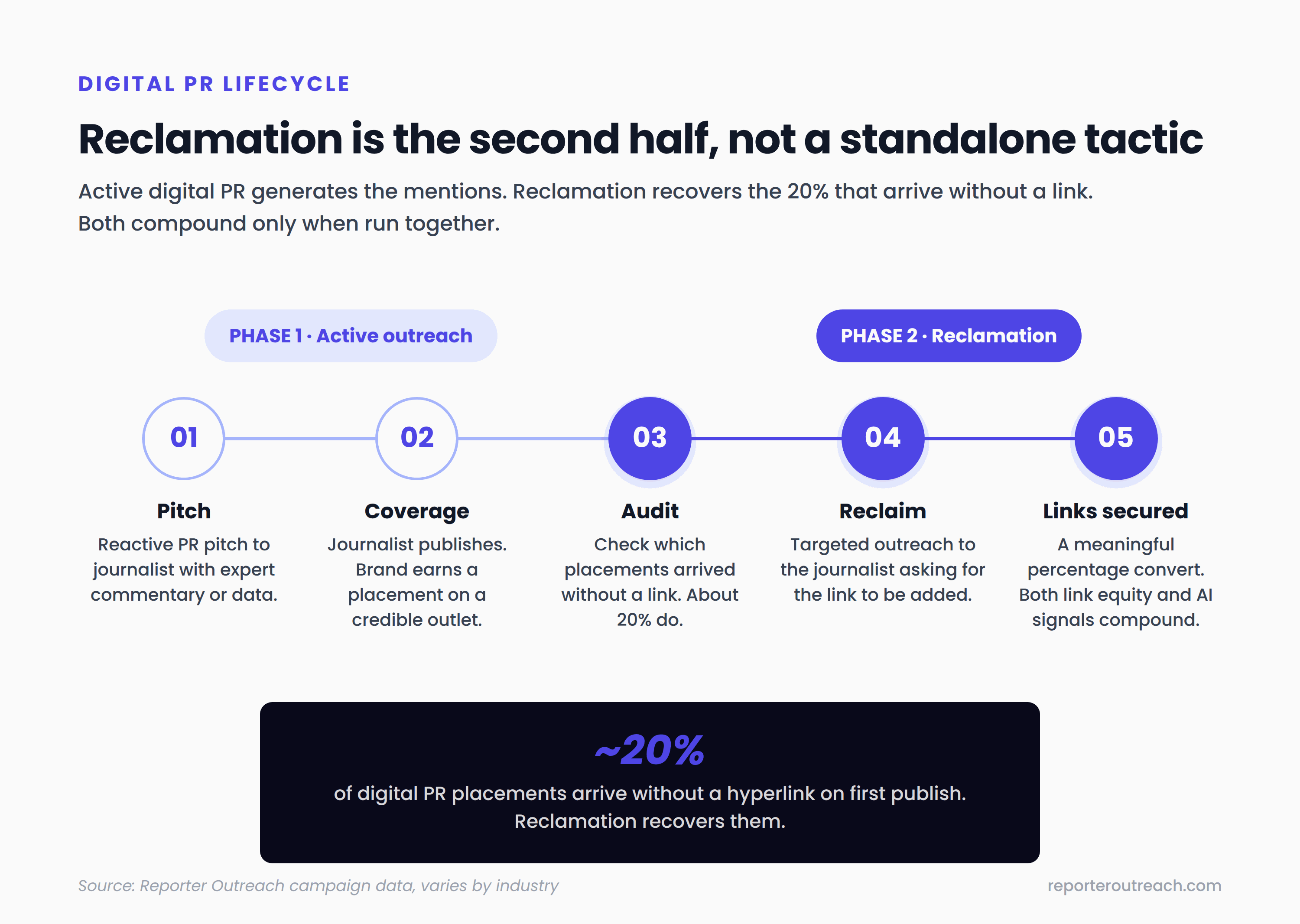
Phase one is the digital PR campaign itself — pitching journalists with reactive coverage opportunities, expert commentary, or original data. When a journalist publishes, the brand earns a placement.
About 20% of those placements arrive without a hyperlink on first publish. Sometimes the CMS strips it. Sometimes the reporter cites the brand verbally and forgets to link. Sometimes the editor cuts the link in the edit pass. The exact percentage varies by industry and outlet — finance and healthcare run higher because compliance reviews strip more links, while tech and consumer run closer to 10-15%.
Phase two is the systematic reclamation outreach against those 20%. Conversion rates here run higher than industry composite because the relationship is already warm. The writer pitched the story you contributed to. Asking for the link isn't a cold ask; it's a follow-up on an existing collaboration.
The reverse workflow — running reclamation without any active digital PR — surfaces mentions, but the absolute volume is low for most brands. Two things compound only when both run together: the active campaigns produce new mentions monthly, and the reclamation workflow converts a meaningful percentage of those into links. The digital PR link building guide covers the active side; this article is the reclamation side.
This is why reclamation isn't really a separate service. It's an operational layer of digital PR that gets ignored because it isn't glamorous. Brands that run both compound their link equity and AI-citation entity signal in a way brands that run only one cannot.
Pair active digital PR with the reclamation that compounds.
Reclamation alone surfaces too few mentions to matter. Active digital PR alone leaves 20% of placements without their link. Run both together.
Frequently Asked Questions
What is the difference between an unlinked mention and a linked mention?
A linked mention includes a clickable hyperlink from your brand name (or related anchor text) back to your site. An unlinked mention names your brand in the text without the link. The plaintext mention still feeds entity-recognition signals for AI search and Google's "implied links" framework, but no link equity passes until a hyperlink is added.
Do unlinked mentions count for SEO?
For traditional Google ranking, the evidence is mixed. Google's patents reference implied links as a signal, but Google has not publicly confirmed they directly affect SERP rankings. For AI search visibility, the answer is clearer — brand mention frequency across credible sources correlates with citation rates in ChatGPT, Perplexity, and Google's AI Overviews. So unlinked mentions count for AI visibility today, and possibly count for traditional rankings.
How long should I wait before requesting a link?
At least 24 hours after publication, but not more than 90 days. Reaching out immediately reads as monitoring obsessively. Waiting past 90 days runs into editor context loss — the article isn't top of mind and editors become defensive about touching old content. The 1-to-14-day window converts at the highest rates in most teams' data.
What conversion rate should I expect from reclamation outreach?
Between 15% and 40% for well-qualified mentions sent specific, personalized asks. The lower end is realistic for roundup and aggregator sites; the higher end is realistic for niche industry publications where the editor cares about the topic. Cold link requests for comparison run at 3% to 8%.
Should small brands bother with reclamation outreach?
Only if there's enough mention volume to justify the time. A brand earning 1-2 unlinked mentions per month should focus on generating mentions through active digital PR first; the reclamation workflow becomes worthwhile once monthly mention volume is in the double digits. The threshold isn't a hard number — it's whether your team can spend 2-3 hours a month on this without it crowding out higher-priority work.
Sources: Ahrefs Brand Mentions Study Follow-up (December 2025); Ahrefs Freshness Study (July 2025); Gartner Search Behavior Forecast (2025); Google Patent USPTO 8,521,723 (Implied Links); Reporter Outreach internal campaign data (2018-2026).