Key Takeaways
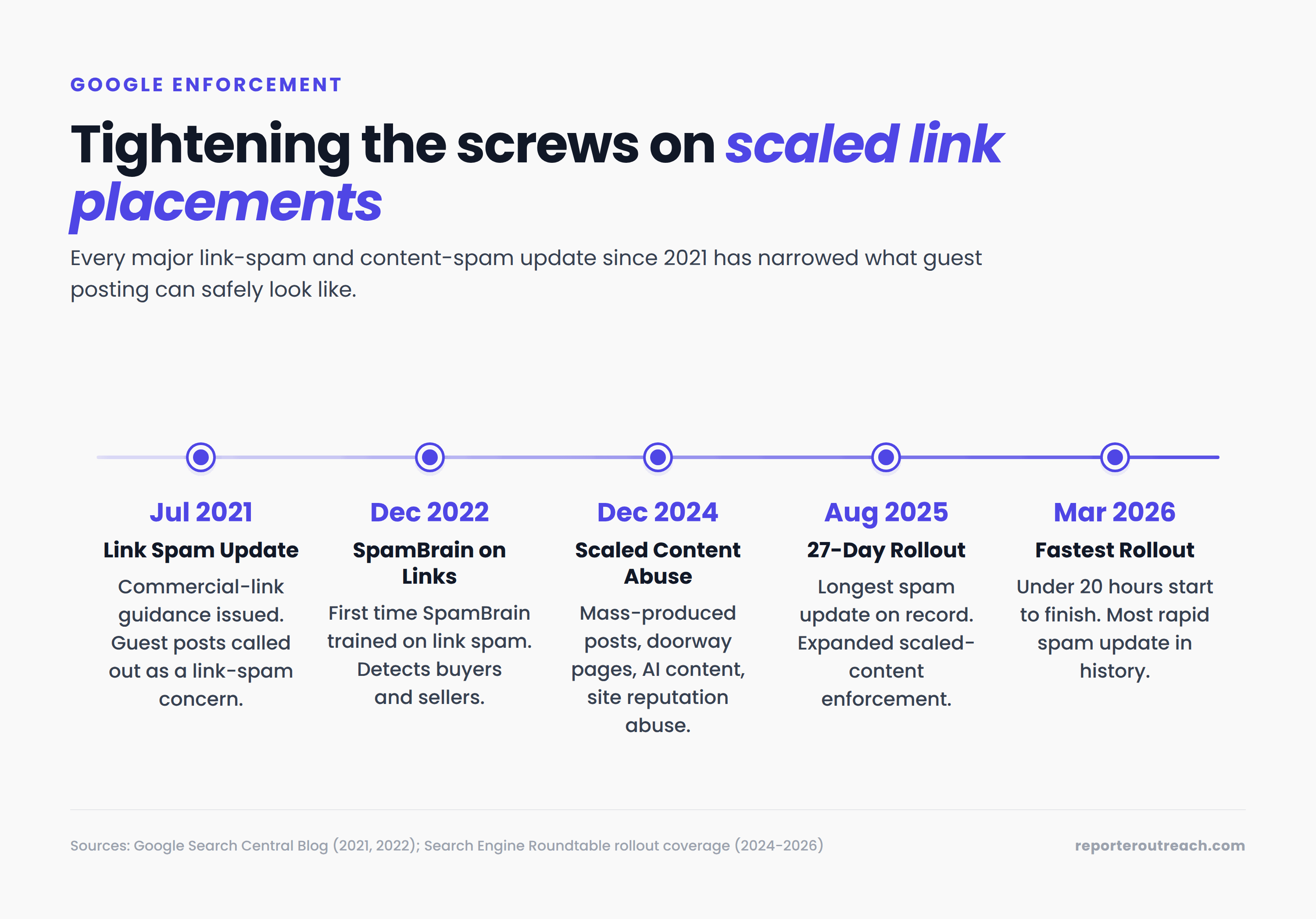
- Guest posting for SEO still works — but the version that works looks almost nothing like what most agencies sell under that label. Google has been narrowing the definition since the July 2021 link spam update, with major enforcement steps in December 2022, December 2024, August 2025, and March 2026.
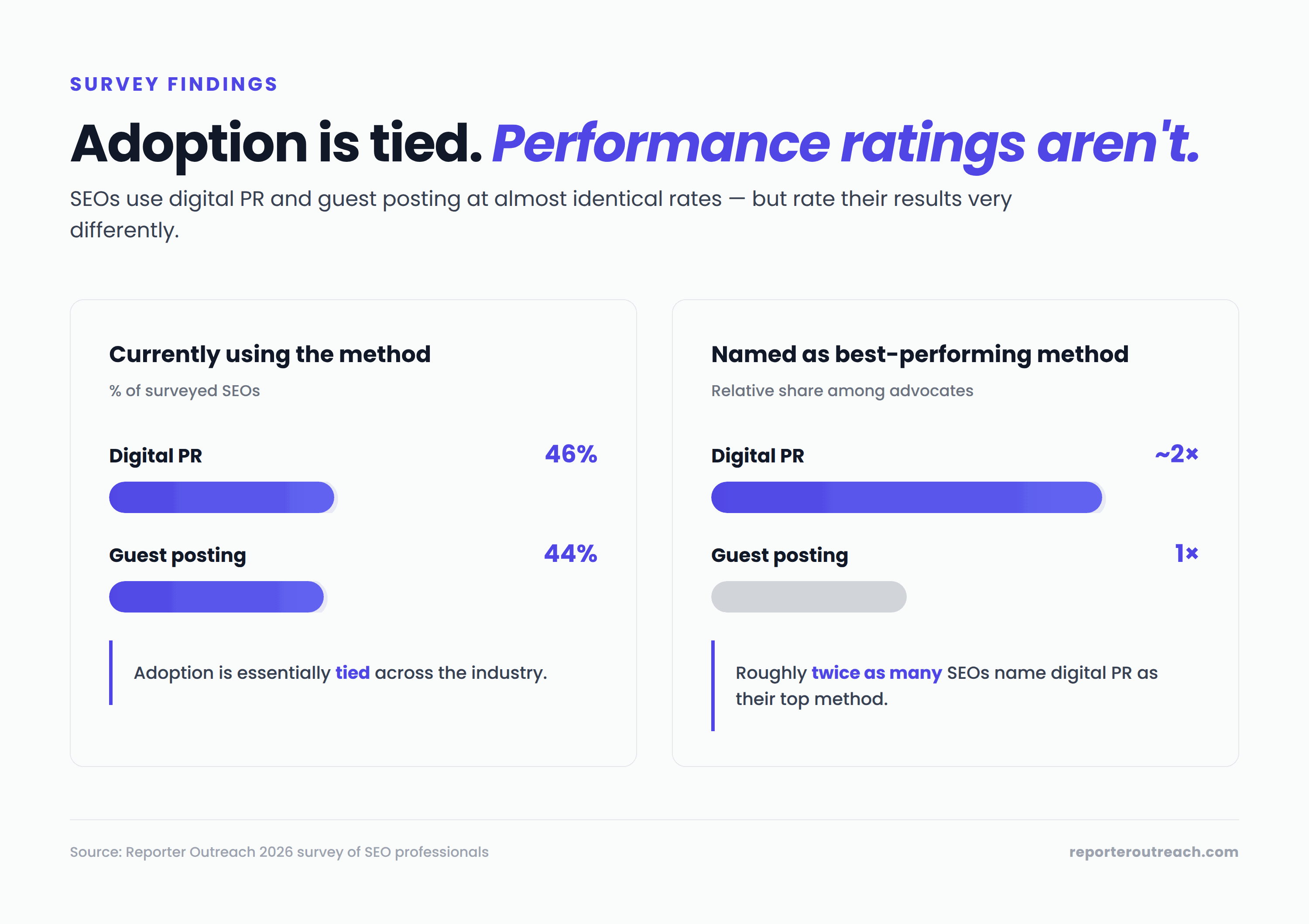
- 46% of SEOs currently use digital PR and 44% use guest posting. Adoption is almost identical. Performance ratings aren't — digital PR advocates outnumber guest posting advocates roughly 2 to 1 when SEOs are asked which method delivers their best results.
- Guest posting's three real strengths are anchor text control, niche blog targeting, and topic and angle control. Nothing else favors it over editorial placement.
- Guest post links from genuine industry publications still pass ranking value. Guest post links from sites that exist to sell placements increasingly don't — and can drag down the profiles they sit in.
- The highest-leverage 2026 approach: digital PR as the primary authority engine, with targeted guest posting or link insertions layered in only where page-level anchor control, niche relevance, or message control matters.
Guest posting for SEO has been declared dead every year since roughly 2014. It's still not dead. But it has changed enough that the current effective version barely resembles what most link building agencies package and sell under the guest posting label.
Guest posting also sits inside the broader category of blogger outreach, which covers four other practices alongside guest posting — each with its own rules, returns, and replacement risk.
This guide breaks down what guest posting actually does for rankings in 2026, where Google's spam systems now draw the line, how SEO professionals compare it to other link building methods in practice, and when it makes sense to use it at all. The short answer up front: guest posting still has a role. It's just a smaller, more specific role than the one it used to have.
The State of Guest Posting for SEO in 2026
The tension at the heart of guest posting for SEO is that Google has named it as a spam concern in its own documentation — and has been quietly escalating enforcement for years.
In July 2021, Google's Search Central blog issued formal guidance on commercial-link tagging, with specific instructions on how guest post links should be qualified. The post drew a careful line. Guest posts that inform users, educate audiences, or bring awareness to a topic remain valuable. Guest posts created primarily to gain a link were called out as the link-spam concern. That same announcement launched what Google formally called the "link spam update."
What followed confirmed the trajectory. The December 2022 link spam update was the first time Google deployed SpamBrain — its AI-based spam-prevention system — specifically against link spam. Per Google's own announcement, SpamBrain could now detect both sites buying links and sites used to pass outgoing links, and would neutralize the impact of those links rather than apply manual penalties.
The December 2024 spam update broadened the system further. While not link-spam-specific, it focused on scaled content abuse, doorway pages, AI-generated content, and site reputation abuse — categories that overlap heavily with the guest post farm model. Sites running thousands of low-value pages or stitched-together posts saw significant ranking losses, regardless of whether links were the primary motive.
The August 2025 spam update — Google's longest-running spam update at 27 days — extended that coverage with even broader enforcement against scaled content abuse and expired-domain abuse. Then in March 2026, Google rolled out a spam update in under 20 hours, the fastest in its history.
Each update narrowed the gap between what still works and what quietly stops counting.
Google's own language draws the line carefully. Guest posts that inform users, educate audiences, or raise awareness are encouraged and remain valuable. Guest posts created primarily to place a link are what SpamBrain is trained to detect. The daylight between those two groups is where the entire 2026 strategy sits.
None of this means guest posting for SEO has stopped working. It means the margin for error has collapsed. A genuine expert contribution to an industry publication your audience actually reads still carries weight. A scaled placement on a site that exists primarily to sell links does not — and SpamBrain is purpose-built to find the difference.
What Guest Posting Still Does Well
Genuine guest posting — meaning a real editorial contribution to a publication you have a legitimate reason to write for — still outperforms almost every other link building method on three specific dimensions.
Anchor text control. You write the article. You pick the anchor text. You point it at whichever internal URL you're trying to rank. No other link building method offers this level of precision. If you need partial-match or exact-match anchors to a specific landing page for keyword-level optimization, guest posting is the only editorial method that gets you there.
Niche blog targeting. For specific verticals — SaaS, B2B tech, local service industries, narrow hobbyist niches — the most relevant publications aren't major news sites. They're industry blogs read by 5,000 of exactly the right people. Digital PR can't easily target those. A well-written guest contribution to one of them builds topical relevance signals that broader news placements struggle to replicate.
Topic and angle control. With digital PR, the journalist decides the article's frame. Sometimes they make you the hero of the story. Sometimes they bury your quote three paragraphs from the bottom. Sometimes the angle they pick reflects badly on the topic you wanted associated with your brand. With a guest post, you choose the topic, the framing, the takeaways, and the call-to-action. For situations where message control matters more than third-party validation, guest posting wins on a feature digital PR can't offer.
Where Guest Posting Falls Short
The same features that make guest posting accessible are also the reasons it runs into walls editorial PR doesn't.
Lower average authority. Sites that accept guest posts tend to be smaller, more niche-focused, and lower DR than major news publications. Typical guest post placements land in the DR 30–50 range. News and trade publications that earn their content independently typically sit DR 60+. Ahrefs' analysis of 920 million pages found that referring domain count is the strongest single correlating factor with rankings — but what matters in that count isn't volume, it's the authority distribution. One genuinely authoritative news placement moves a domain further than a stack of mid-DR guest posts.
No third-party validation signal. When you write a guest post, you're the author. AI search systems — ChatGPT, Perplexity, Gemini, and Google AI Overviews — and Google's own authority models treat that differently than a journalist independently choosing to cite you as an expert source. The backlink may pass link equity. It doesn't generate the third-party endorsement signal that makes a brand show up in AI-generated answers.
The scaling risk. This is the part most agencies don't talk about. A handful of legitimate guest posts on relevant industry blogs is fine — Authority Hacker's research found that 73.5% of teams build fewer than 10 links per month, so small volume is the norm. Fifty placements with nearly-identical author bios across sites that exist primarily to accept guest posts is a different thing entirely, and it's a pattern SpamBrain is now purpose-built to detect. The December 2022 link spam update specifically targeted sites passing outgoing links — meaning the sites selling guest posts can themselves drag down the profiles they sit in.
Anchor text overexposure. Because guest posting gives you anchor text control, it's also the easiest method to over-optimize. Profiles where the paid-link portion shows aggressive commercial anchors while the organic portion shows branded anchors create a footprint Google's systems flag readily. When guest posting goes wrong at scale, it goes wrong loudly — and it goes wrong in the part of the link profile you have the most control over, which is also the part you can't easily explain away.
How Our 2026 Survey Compares Guest Posting to Other Methods
Our 2026 survey of SEO professionals surfaced three patterns most guest posting guides miss.
Adoption is nearly tied. Results aren't.
46% of surveyed SEOs currently use digital PR. 44% currently use guest posting. Those numbers are essentially identical — whatever you believe about the relative effectiveness of either method, the industry as a whole is using them at almost the same rate.
What differs is how practitioners rate the outcomes. Digital PR advocates — SEOs who name digital PR as their single best-performing method — outnumber guest posting advocates by roughly 2 to 1. Guest posting is roughly as widely adopted, but significantly fewer of the people using it consider it the thing actually moving their rankings.
Read another way: a lot of people are doing guest posting out of habit, or because it's the link building method their agency is set up to deliver — not because it's the one producing results.
Budget allocation tracks with method confidence.
Among SEOs who consider digital PR their best-performing method, 67% invest $3,000+ per month in link building. Among guest posting advocates, that figure drops to 59%. The gap grows wider at the top end — digital PR advocates are meaningfully more likely to be spending $6,000+ per month.
This isn't proof that digital PR causes higher spend. It's evidence that SEOs with bigger budgets — presumably at larger or more mature companies — lean toward digital PR when they have the option.
Guest posting advocates set higher DR floors.
The counterintuitive finding: 24% of guest posting advocates refuse any link below DR 50. Among digital PR advocates, only 14% set that bar.
The explanation is straightforward once you think about it. Digital PR placements land on established news and trade publications by default — the average is already above DR 50, so a strict minimum isn't necessary. Guest posting has enough quality variance that practitioners need stricter filters to avoid the bottom of the market. The DR threshold isn't a quality standard. It's a defense mechanism.
When you group PR-style methods together — digital PR plus reactive sourcing via platforms like Qwoted and Featured (which 21% of surveyed SEOs rank as their #1 method) — the combined share of SEOs naming an editorial approach as their best-performing method pulls ahead of every content-placement method combined. Editorial beats placement, in the aggregate.
Guest Posting for SEO vs Digital PR — Head-to-Head
Across the factors that actually affect method selection, here's how the two methods compare:
| Factor | Guest Posting | Digital PR |
|---|---|---|
| Authority of host sites | DR 30–50 typical | DR 60+ typical |
| Third-party validation signal | None — you wrote it | Strong — journalist cites you |
| Anchor text control | Full | None |
| Niche / topical precision | High | Moderate |
| Topic and angle control | Full | None |
| Scalability without penalty risk | Low | High |
| AI search visibility lift | Minimal | Strong |
| Risk profile (SpamBrain detection) | Higher — visible footprint | Low |
Guest posting wins on three things: anchor control, niche precision, and topic and angle control. Digital PR wins on authority, validation, AI visibility, scalability, and safety. If you're picking one method, digital PR wins on the factors that matter most in 2026. If you're picking both, each has a job — and a distinct one.
When Guest Posting for SEO Actually Makes Sense
Three scenarios where guest posting still earns its place in a 2026 link profile:
- You need specific anchor text to a specific page. When a product page or landing page needs three to five referring domains with partial-match anchors to cross a keyword ranking threshold, guest posting is the cleanest way to get there. Digital PR can't deliver this — journalists write the anchor text, and they rarely pick the one you were hoping for. Guest posting (or a link insertion) puts the anchor exactly where you want it.
- You operate in a vertical with specific niche publications. Some industries live in a handful of niche blogs and trade publications that general news outlets never cover. If your audience reads five specific industry sites and a genuine expert contribution to one of them would be a credible, useful piece of content — that's a guest post worth writing. Topical relevance signals from a tight niche often outweigh raw DR from a general publication.
- You need message and angle control on a sensitive topic. When the topic itself is complex or easily mischaracterized — and a journalist's framing could undercut your position — guest posting lets you keep the angle. Use sparingly. Most topics don't require this level of message control, and over-relying on it forfeits the third-party validation that earns trust in 2026 search.
That third scenario has an upgrade path most comparisons skip: full-feature articles — dedicated editorial pieces about your brand, written and placed on outlets like USA Today or VentureBeat under the publication's editorial standards. You keep the angle, the outlet keeps editorial review, and the piece runs on a publication with an actual readership. The trade-off is cost — a dedicated feature runs several times the price of a typical guest post — which makes it a positioning play for launches, founder stories, and category expertise, not a volume link tactic.
Outside these three scenarios, digital PR or contextual link insertions will usually produce better results.
The 2026 Approach: Primary + Supplement
The most effective link profiles in 2026 don't rely on a single method. They use digital PR as the primary authority engine and layer targeted guest posting or link insertions on top for page-level optimization.
A reasonable budget split for most businesses: 60–70% on digital PR for domain authority and AI visibility, with 30–40% on guest posting or contextual link insertions for targeted page-level support.
The split shifts based on context. If you're in a YMYL industry — healthcare, finance, legal, insurance — push further toward digital PR (80/20). Editorial signals from trusted publications are what satisfy Google's E-E-A-T thresholds for these verticals. Guest posts from niche blogs don't carry the same trust weight.
If you operate in a narrow B2B niche where specific industry blogs are where your actual buyers spend their reading time, a more even split (50/50 or 60/40) makes sense. The niche relevance guest posting provides matters more here than raw domain authority.
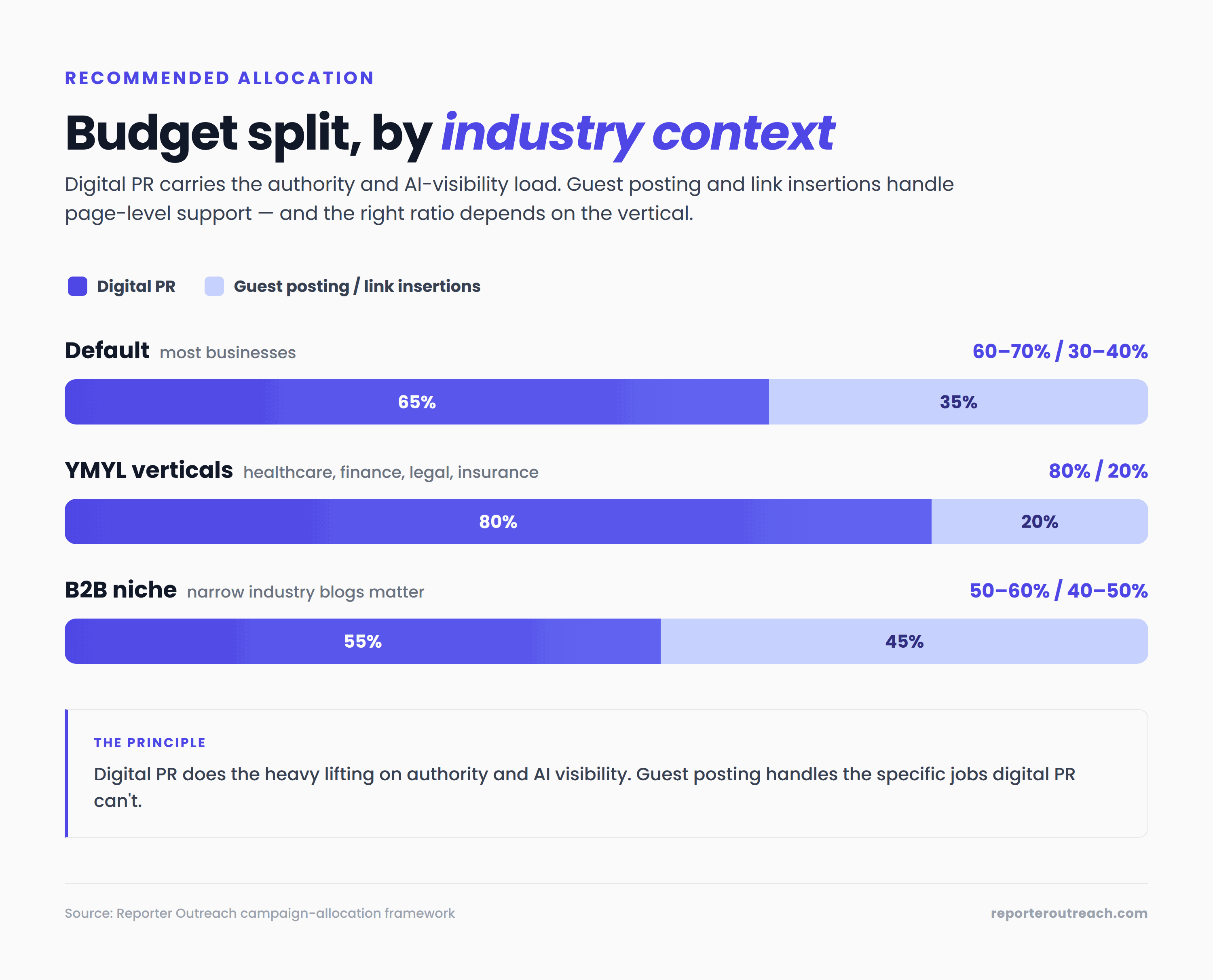
The principle underneath all three splits: digital PR does the heavy lifting on authority and AI visibility. Guest posting handles specific jobs digital PR can't. Neither method is trying to do the other's work.
Guest Posting for SEO FAQ
Is guest posting still good for SEO in 2026?
Conditionally. Genuine expert contributions to legitimate industry publications still pass ranking value. Scaled placements on sites that exist primarily to sell links are being devalued by SpamBrain — and have been since the December 2022 link spam update made that detection a core feature. The question isn't whether guest posting works. It's whether the specific guest post you're about to pay for is the kind Google still counts.
How is guest posting different from digital PR?
In guest posting, you write the article and the host site publishes it with your backlink in the body. In digital PR, a journalist writes an article for their own publication and cites you as an expert source with a link. The first is content placement. The second is earned editorial coverage. Google — and increasingly AI search systems including ChatGPT, Perplexity, Gemini, and Google AI Overviews — treat them as fundamentally different signals.
How do you tell which guest post sites Google still counts?
A few signals worth checking before paying for any placement. Real editorial standards (the site rejects pitches that don't fit its audience). Active commenting, social sharing, or referral traffic on existing posts. Author bios that reflect genuine expertise rather than a roster of generic marketers. The site doesn't lead its navigation with a "write for us" page. Recent posts cover the kind of topics the audience actually searches for. If the site reads like it exists to host paid placements, SpamBrain has probably already mapped it.
What does a safe guest posting strategy look like?
Small volume, high relevance, varied anchors, genuine content. A handful of placements per quarter on publications where the topic, audience, and author profile all make sense. Avoid recurring author bios across unrelated sites, avoid sites whose homepages advertise "write for us" prominently, and avoid anchor text patterns that look like optimization rather than attribution.
Can guest post links help with AI search visibility?
Minimally. AI search systems weight third-party validation — the signal generated when someone other than you publicly attributes expertise or information to your brand. A guest post you authored doesn't produce that signal. The link passes traditional SEO value. It doesn't change how ChatGPT, Perplexity, Gemini, or Google AI Overviews evaluate your brand as a citable source. For that, see our GEO guide.
Do guest posts still need "nofollow" tags?
Per Google's July 2021 guidance, guest post links should be tagged with rel="nofollow" by the publishing site. Failure to do so can trigger algorithmic or manual action against both publisher and acquirer. Most legitimate industry blogs handle this correctly. The bigger risk concentrates on sites that should tag and don't — those are exactly the placements SpamBrain looks for hardest.
Build Links That Actually Compound
Tell us what you're working with and we'll map out the right mix of digital PR and targeted placements for your goals.
Sources
Google Search Central Blog: July 2021 commercial-link guidance and link spam update; December 2022 link spam update announcement (SpamBrain). Search Engine Land and Search Engine Roundtable coverage of the December 2024, August 2025, and March 2026 spam updates. Ahrefs 920-million-page referring domain correlation analysis. Authority Hacker link building outreach research (73.5% of teams build fewer than 10 links per month). Reporter Outreach 2026 survey of SEO professionals.