Key Takeaways
- Link building vs content marketing isn't a real choice. Content builds the relevance and search intent match. Links build the authority that determines where that content ranks.
- Neither works alone. Ahrefs found 84% of pages on the web have fewer than three backlinks — content without authority sits invisible on page five.
- AI search has changed the equation. AirOps research (March 2026) shows 43.2% of #1 Google rankings get cited by ChatGPT — 3.5× the citation rate of pages outside the top 20.
- Editorial coverage — not content alone, not links alone — is the layer that builds both Google rankings and AI visibility simultaneously.
- The brands winning in 2026 aren't picking sides. They're layering content depth, targeted link building, and editorial coverage into one compounding system.
The link building vs content marketing debate is one of the oldest questions in SEO. Should you invest in building backlinks or creating more content?
The default answer — "you need both" — is technically correct and completely useless. It doesn't tell you where to start, where to spend more, or what actually moves the needle when budgets are finite and your CEO wants to see results this quarter.
Here's what makes 2026 different. We now have enough data to see exactly where each strategy breaks down on its own, how they compound when layered together, and why AI search has fundamentally rewritten the rules of what "authority" means. The old debate assumed Google's blue links were the only game. They're not anymore.
This is the honest breakdown — no "both are important" hand-waving, no pretending one strategy is secretly all you need.
Link Building vs Content Marketing: What Each Actually Does
The confusion starts because people treat these as competing strategies aimed at the same goal. They're not. They attack different parts of the ranking equation entirely.
Content marketing builds the relevance layer. It creates the pages that match search intent, demonstrates topical expertise, engages visitors, and converts traffic into leads or sales. Without content, there's nothing to rank. Google has nothing to show users, and you have nothing to earn links to.
Link building builds the authority layer. Backlinks from external sites signal to Google that other people vouch for your content. This is the mechanism that separates page-one results from page-ten results for competitive terms. Without links, even excellent content sits invisible on the lower pages of search results.
Here's the practical difference between what each strategy can and can't do on its own:
| Strategy | What it builds | What it can't do alone | Where it fits |
|---|---|---|---|
| Content marketing | Relevance, search intent match, topical authority, surface area to rank | Push competitive pages to page one without external authority signals | Foundation layer — required before link building has anything to amplify |
| Link building | Domain authority, ranking power, referral traffic from placement sites | Make thin pages rank, satisfy search intent that content doesn't match | Amplifier — works on whatever surface area content has built |
| Editorial coverage | High-authority backlinks and brand mentions AI systems weight as trust signals | Replace foundational content; relies on having something worth covering | Bridge layer — produces both traditional SEO authority and AI visibility |
Think of it like a restaurant. Content marketing is the food — the menu, the quality of ingredients, the cooking. Link building is the reputation — the Michelin stars, the Yelp reviews, the word-of-mouth. Amazing food in a restaurant nobody knows about doesn't fill tables. A famous name with terrible food doesn't keep them filled.
Both are required. The question is what happens when you try to rely on just one.
What Happens When You Only Do Content
The "publish great content and links will come" theory is one of the most persistent myths in SEO. It sounds logical — if your content is good enough, people will naturally link to it. But the data is brutal: an Ahrefs analysis found that 84% of pages on the web have fewer than three backlinks. The vast majority of content — no matter how well-written — never attracts links passively.
That's not because most content is bad. Over 7 million blog posts are published every single day. The internet is so saturated that even well-researched, well-written content gets buried unless something actively drives attention and authority to it.
Content marketing genuinely works — Demand Metric found it generates 3x more leads than outbound marketing at 62% lower cost, and HubSpot data shows companies with active blogs see 55% more website visitors. Conductor's 2024 State of SEO survey found 91% of marketers say SEO positively impacted their performance and marketing goals. These numbers are real. But they describe what happens at sites that already have authority — sites with strong backlink profiles where new content enters the index with an inherent advantage.
Publishing more content on a low-authority domain doesn't compound — it just creates more pages that sit on page 5. Content creates the opportunity to rank. Links create the authority that converts that opportunity into actual traffic.
We see this pattern constantly with clients who come to us after years of content investment. They have 200+ blog posts, solid topical coverage, and zero first-page rankings for anything competitive. The content was never the problem. The missing authority was.
What Happens When You Only Build Links
On the flip side, link building without content is like pouring water into a bucket with holes in the bottom.
Links need something to point to. If the page they land on has thin content, doesn't match what the searcher was looking for, or offers nothing a competitor's page doesn't already cover better — those links won't produce sustained rankings. Google evaluates both authority signals (links) and relevance signals (content quality, search intent match, topical depth). You need both sides of the equation.
There's a practical problem too. If your site has 10 pages of thin service descriptions and you're building links to them, you're playing a game with a very low ceiling. A site with 10 thin pages can only rank for a handful of terms regardless of how many backlinks it has. Content creates the surface area; links amplify whatever surface area exists.
Some of our best-performing campaigns are with clients who also invest in content alongside their link building. The ones who treat link building as a substitute for content — rather than an accelerant for it — consistently see slower, more limited results. The links work. They just have less to work with.
Then there's the AI visibility dimension, which has made the links-only approach even more limiting. But that deserves its own section.
How AI Search Changed This Debate
This is where the 2026 version of this conversation diverges sharply from the 2023 version.
The old link building vs content marketing debate assumed one playing field: Google's organic search results. Earn links, rank higher. Create content, capture more queries. The strategies complemented each other within a single system.
AI search — ChatGPT, Perplexity, Google's AI Overviews and AI Mode, Copilot — introduced a second playing field with completely different rules. Conductor research found AI Overviews now appear in roughly 25% of all queries, and the data on how those AI systems pick sources is reshaping how we think about both strategies.
AirOps studied which pages ChatGPT cites and found a clear pattern: pages ranking #1 in Google get cited by ChatGPT 43.2% of the time, while pages ranking outside Google's top 20 get cited at roughly a third of that rate. Google rankings still matter for AI visibility — but ranking position isn't a guarantee of citation, and pages can be cited by AI even when they don't rank at all.
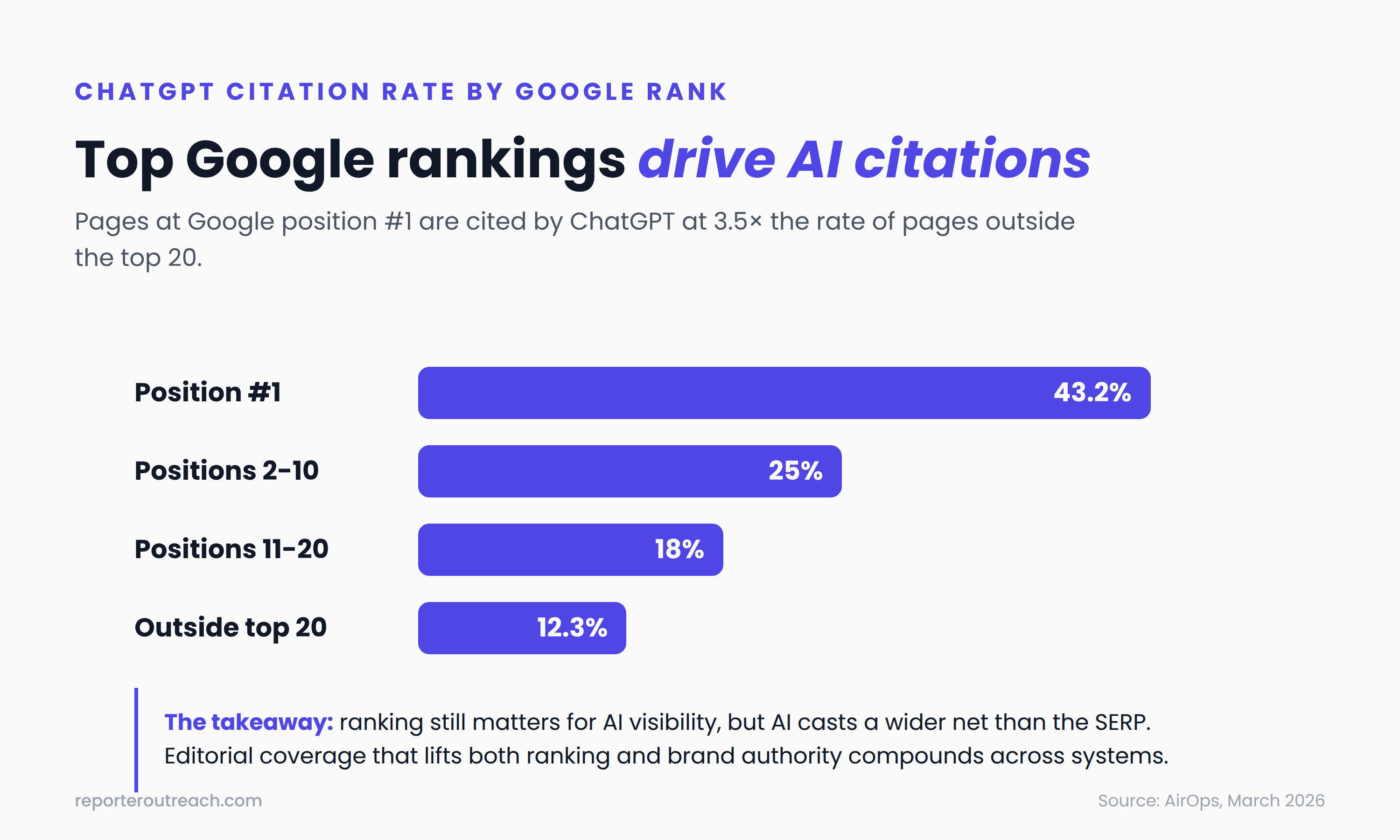
The flip side matters too. Ahrefs research from October 2025 found that among ChatGPT's most-cited pages, 28.3% don't rank in Google's organic results at all. So while ranking high helps, it isn't a prerequisite for citation — AI systems evaluate sources through a different lens that weights editorial credibility, brand mentions, and whether independent third parties vouch for you.
Content marketing alone doesn't generate the editorial brand mentions AI systems prioritize. Traditional link building (guest posts, niche edits, directory submissions) builds backlinks but not editorial coverage. Neither strategy, by itself, addresses the signal that matters most for AI visibility: third-party editorial validation of your brand.
This is the part that makes the old "link building vs content marketing" framing feel outdated. Both strategies were designed for a Google-only world. AI search introduced a third variable — brand authority built through editorial coverage — that neither strategy produces on its own. For a deeper look at how this works, see our generative engine optimization guide.
How to Actually Combine Them
The practical answer to "link building vs content marketing" in 2026 isn't picking one or even doing both in parallel — it's understanding how they layer together into a system where each piece makes the others more effective.
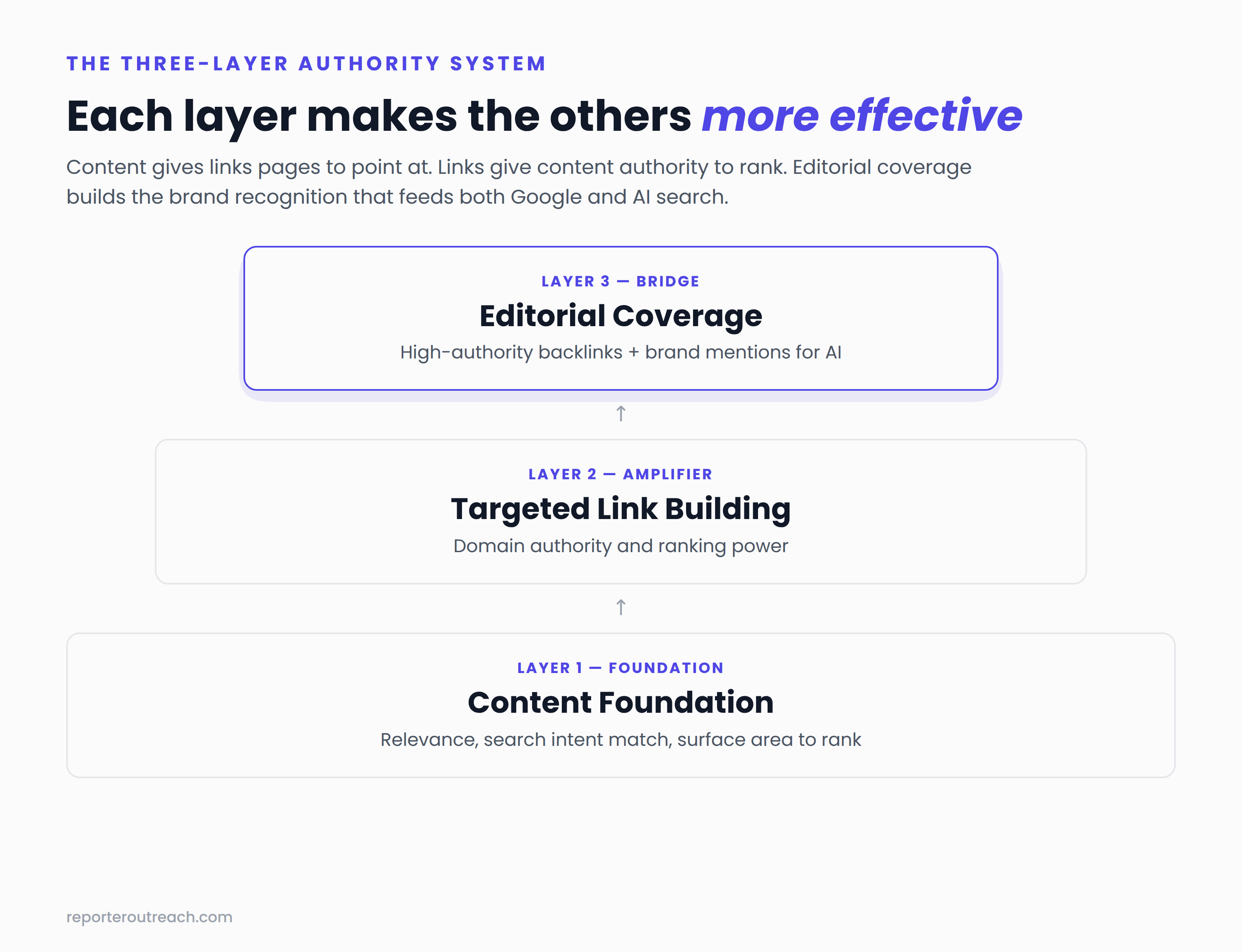
Layer 1: Content foundation. This is where most companies should start (or shore up if they've neglected it). Pillar pages for core topics, supporting blog content for long-tail queries, resource guides, and comparison pages. The goal isn't volume for volume's sake — it's covering the topics your audience searches for with enough depth that Google sees genuine expertise. Content benefits like increased traffic and lead generation only materialize when content targets real search demand and the site has enough authority to rank.
Layer 2: Targeted link building. Once you have content worth ranking, link building becomes the lever that pushes specific pages from invisible to competitive. Link insertions into relevant existing articles, contextual placements on niche-relevant sites, and resource page links all work here. The key is pointing links at your most commercially valuable pages — the ones where a rankings improvement directly translates to revenue.
Layer 3: Editorial coverage. This is the layer most companies skip — and the one that's become the most important in 2026. When journalists and independent publications feature your brand as an expert source, you earn high-authority backlinks and the brand mentions that AI systems weight as their primary trust signal. This is what digital PR does: it positions your team as expert sources in articles journalists are already writing, earning editorial links and mentions simultaneously. For the deeper mechanics, see our digital PR link building breakdown.
The compounding effect is real. Content gives link builders pages to point at. Links give those pages authority to rank. Editorial coverage builds the brand recognition that feeds both Google rankings and AI visibility — and the resulting media mentions create natural internal linking opportunities back to your content.
None of these layers work as well in isolation as they do together. That's the honest answer to the "which matters more" question: they're parts of the same system.
What This Looks Like in Practice
Theory is nice. Here's what a combined approach actually produces.
One of our healthcare clients — Villa Oasis, a luxury addiction treatment center — needed to compete in one of the most authority-sensitive niches in search (YMYL healthcare). They had decent content but almost no editorial backlinks. We ran a digital PR campaign focused on earning placements from trusted health and wellness publications while they continued building out their content foundation.
Over nine months, the campaign earned 39 editorial placements and mentions at an average DR of 80 — resulting in a 352% increase in organic traffic. The content gave Google pages worth ranking. The editorial placements gave Google (and AI systems) the authority signals to rank them for competitive health-related terms. Neither would have worked without the other. (Full case studies here.)
That mechanism — content + links + editorial layered together — is what compounds. The brands showing up in both Google rankings and AI citations aren't relying on a single channel. They're building the kind of presence that survives whichever way the search landscape tilts next.
Almcorp's analysis of 40,000 websites found organic SEO traffic declined just 2.5% in 2025 — far less than the doomsday "25-60%" figures circulating early in the year. Traditional SEO isn't dead. But the channels that drive growth in 2026 aren't single-channel anymore. The companies investing across all three layers — rather than betting everything on the one they can measure most easily — are the ones positioned for a search landscape that's still shifting.
Stop Choosing Between Content and Authority
We build the editorial coverage layer that makes your content rank in Google and get cited by AI search engines.
Frequently Asked Questions
Is link building or content marketing more important for SEO?
Neither is universally more important — they answer different questions. Content determines whether you can match search intent at all. Links determine whether the pages that match intent rank where searchers can find them. The honest decision rule: if your site lacks topical coverage, lead with content. If you have solid content but no rankings on competitive terms, lead with links. For most commercially valuable keywords, the answer is going to be "build both, with editorial coverage layered on top."
Will great content earn backlinks on its own?
Occasionally, but not reliably. Ahrefs data shows 84% of pages on the web have fewer than three backlinks — meaning the vast majority of content, regardless of quality, doesn't attract links passively. Original research, data studies, and genuinely unique tools can earn some organic links. But even the best content typically needs active promotion, outreach, or distribution to build a meaningful backlink profile.
How does AI search affect this decision?
AI systems like ChatGPT, Perplexity, and Google's AI Overviews evaluate sources differently than traditional Google rankings. AirOps research found pages at position #1 in Google get cited by ChatGPT 43.2% of the time — but pages outside the top 20 still get cited at roughly a third of that rate, meaning AI casts a wider net than traditional SERPs. Strategies that only build links or only create content miss the editorial coverage layer that drives both Google rankings and AI citations.
Where does digital PR fit into this?
Digital PR bridges link building and content marketing by earning editorial placements in real publications. When a journalist features your brand as an expert source, you get a high-authority backlink (the link building benefit) and a brand mention in editorial context (the signal AI systems prioritize). It's the strategy that produces both traditional SEO value and AI visibility simultaneously — which is why it's become a core part of how modern campaigns are structured.
Should I start with content or link building?
Start with content if your site has fewer than 20-30 pages covering your core topics. There's no point building links to thin pages that don't match search intent — the rankings won't stick. Start with link building if you already have solid content but aren't ranking for competitive terms. In most cases, the right answer is to work on both simultaneously, since content takes time to index and links take time to compound. The worst approach is doing one for a year, then switching to the other.
How long does a combined strategy take to show results?
Most combined campaigns start showing measurable movement in 3-6 months — ranking improvements, traffic increases, and new keyword positions. The timeline depends heavily on your starting authority, the competitiveness of your industry, and how quickly content gets published. Content-only strategies typically take 6-12 months because you're waiting for organic authority to build. Adding link building and editorial coverage compresses that timeline by actively building the authority signals rather than waiting for them to appear naturally.
Sources: Ahrefs (84% of pages have fewer than 3 backlinks; 28.3% of ChatGPT's most-cited pages have zero Google organic visibility, October 2025) | AirOps (43.2% citation rate for Google #1, 3.5x position 1 vs outside top 20, March 2026) | Conductor (AI Overviews appear in ~25% of queries, 2024-2025; 91% of marketers report SEO positively impacted performance, 2024 State of SEO) | Almcorp (40K-site analysis, 2.5% organic SEO traffic decline 2025) | Demand Metric (content marketing 3x leads, 62% lower cost) | HubSpot (companies with active blogs see 55% more website visitors)