Key Takeaways
- Drug rehab SEO operates under YMYL rules with extra scrutiny — Google banned all rehab ads in 2017 and now requires LegitScript certification just to run paid search. Organic SEO carries that same trust bar.
- Addiction treatment CPCs range from $25 to $150 per click, with localized terms like "inpatient alcohol rehab centers near me" hitting $185. Organic rankings aren't optional — they're the only scalable channel.
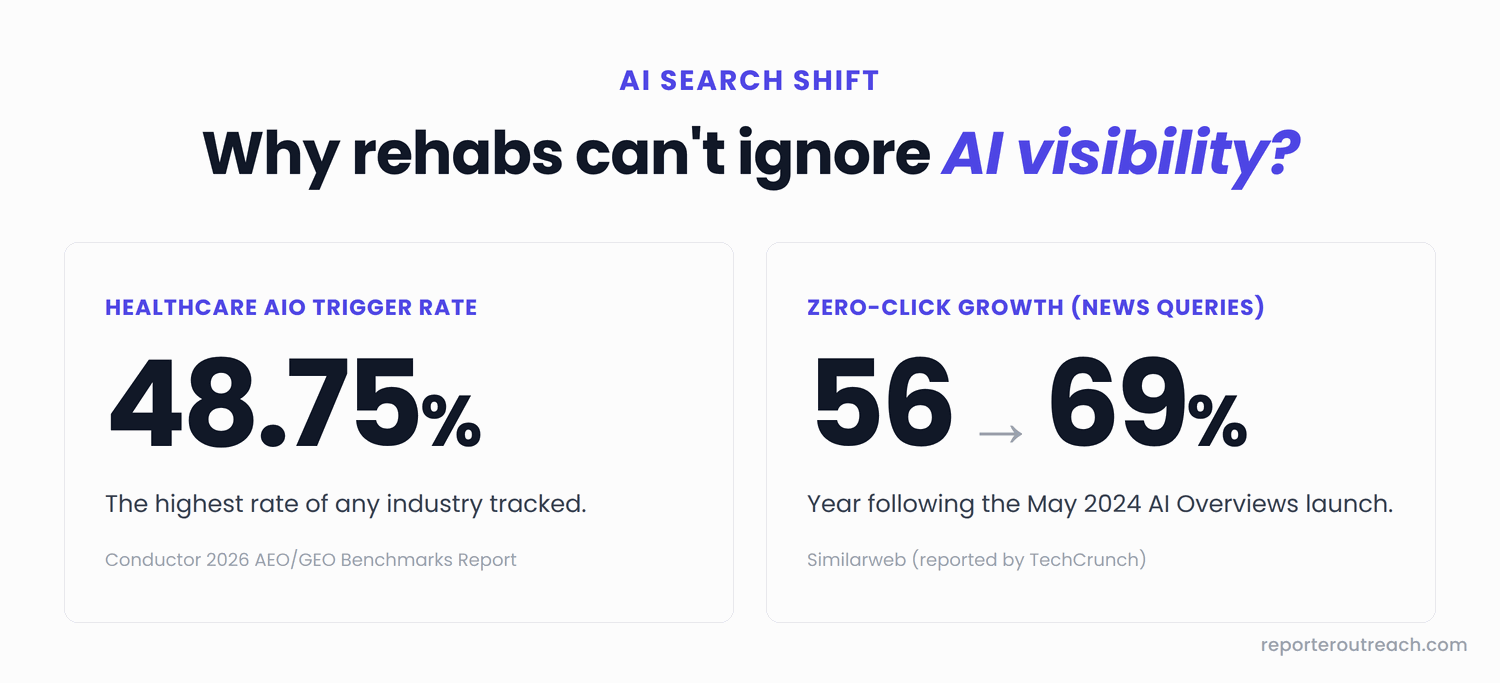
- Healthcare triggers AI Overviews on roughly half of all queries — the highest of any industry. Rehab centers that aren't building for AI visibility are already falling behind.
- Editorial backlinks from health publications — earned through digital PR — are the trust signal that moves both traditional rankings and AI citations in YMYL verticals.
- Clinician-led digital PR generates two compounding signals at once: editorial backlinks and brand mentions in trusted health publications. AI engines weight both as entity-recognition evidence when deciding what to cite.
Drug rehab SEO is one of the hardest verticals in search. Not "competitive" in the way eCommerce or SaaS is competitive — hard in a structural way that most marketing teams don't fully appreciate until they're six months in and wondering why nothing's working.
Addiction treatment sits at the intersection of three compounding challenges: YMYL scrutiny that holds every page to the highest trust standard Google has, a history of fraud that led Google to literally ban all rehab advertising in 2017, and CPCs so high that organic is the only channel that scales without bleeding budget. A single click on "inpatient alcohol rehab centers near me" costs $185 on Google Ads. How SEO fits alongside paid, directories, and earned media is mapped in our broader guide to addiction treatment marketing.
This guide covers what actually works — and what doesn't — when building organic visibility for treatment centers. It's built on the same digital PR methodology we run for addiction treatment and behavioral health brands, adapted for the specific compliance and trust dynamics of rehab search.
Why Drug Rehab SEO Is Harder Than You Think
Because it's YMYL with a fraud history layered on top. Every other healthcare vertical operates under standard Your-Money-Your-Life rules. Rehab carries the same standards plus a regulatory residue from one of Google's most aggressive trust crackdowns ever.
In September 2017, Google took the unprecedented step of removing all addiction treatment ads from its platform. Patient brokering schemes, deceptive lead generation, and outright scams had poisoned the space to the point where Google decided the entire category couldn't be trusted. When ads came back in 2018, they came with a requirement no other healthcare vertical faces: mandatory LegitScript certification — a third-party vetting of clinical licenses, criminal backgrounds, billing practices, and treatment protocols.
That history matters for SEO because the same trust deficit that prompted the ad ban affects organic rankings. Google's algorithms apply heightened scrutiny to addiction-related content. The December 2025 core update hit 67% of health and YMYL sites with ranking changes — and treatment centers with thin authority signals were among the hardest hit.
The hierarchy that drives those scrutiny levels looks like this:
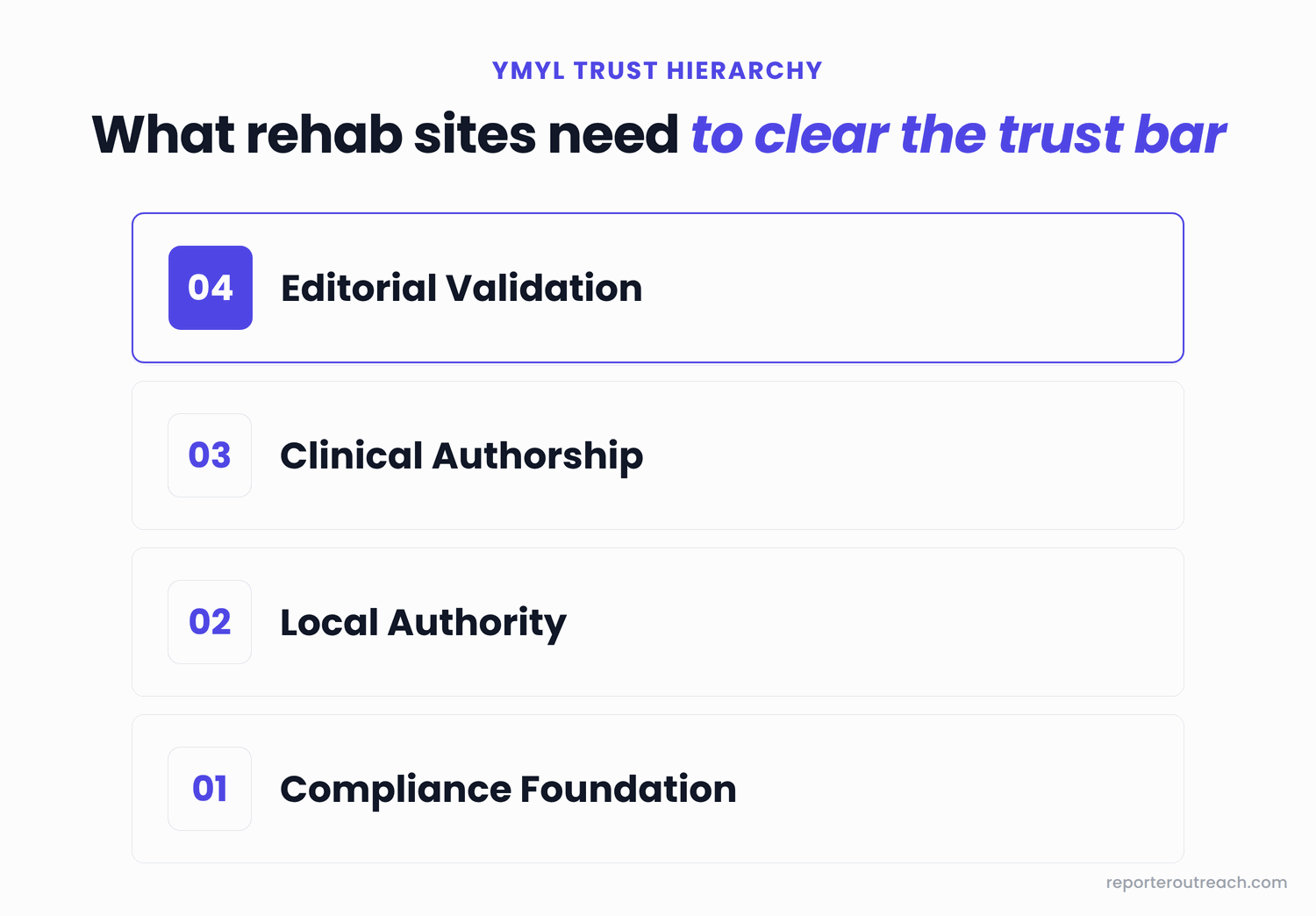
Here's what this means practically: a treatment center can publish 50 blog posts about addiction recovery, but if Google doesn't see external validation — editorial links from health publications, clinician citations in news coverage, institutional references from organizations like SAMHSA — those posts won't rank for anything competitive. Content alone doesn't clear the trust bar. Not in this vertical.
The Real Cost of Ignoring Organic
Most rehab marketing budgets lean heavily on paid search. Understandable — the intent is immediate and the conversions are direct. But the economics are brutal.
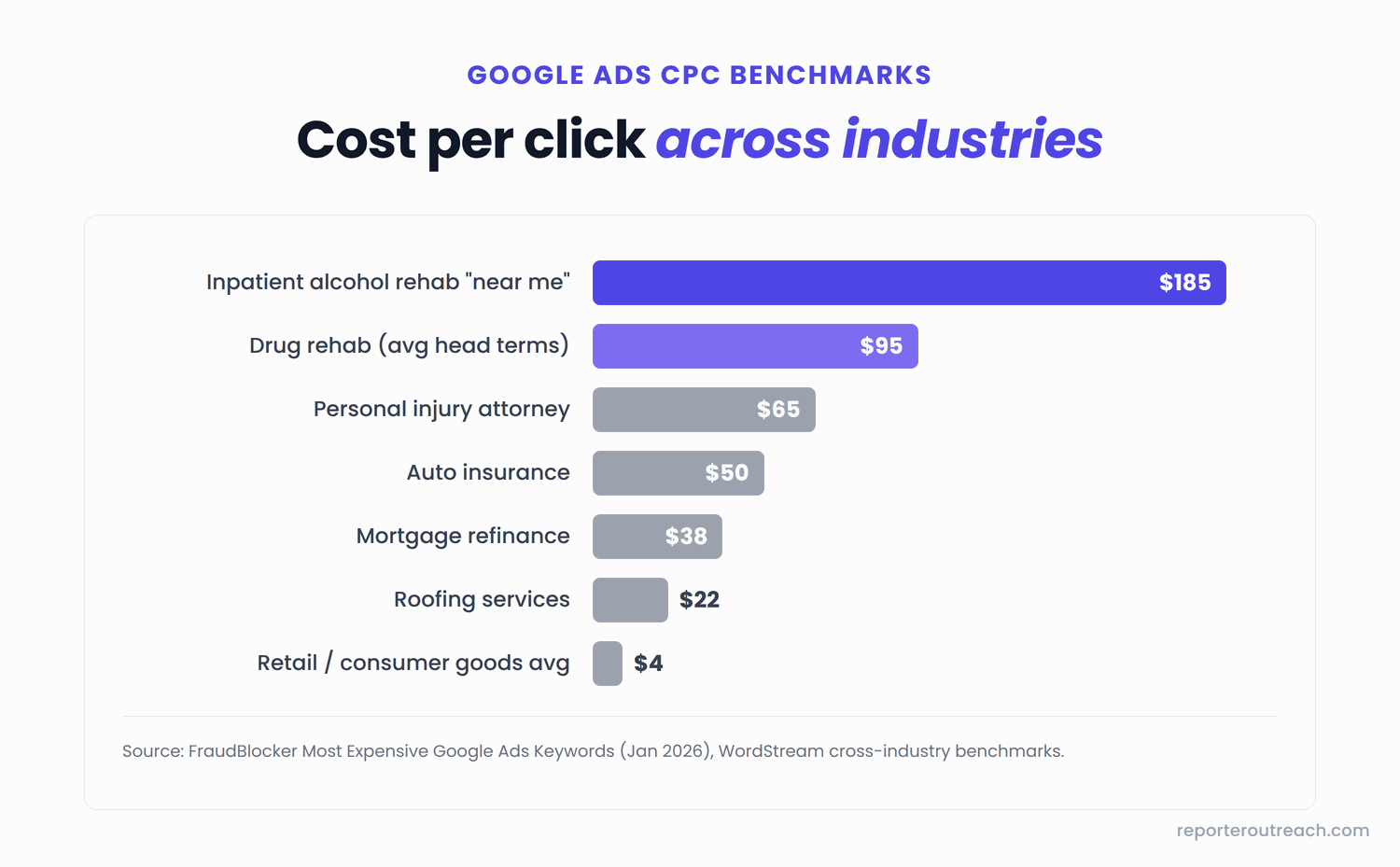
Addiction treatment ranks in the top five most expensive Google Ads categories. And unlike legal or insurance — where a single conversion can be worth $10,000+ — rehab admissions involve multi-step qualification (insurance verification, clinical assessment, family coordination) that makes cost-per-admission even harder to control through paid channels alone.
There's also the LegitScript barrier. Unlike any other healthcare vertical, treatment centers need third-party certification just to run ads on Google, Meta, and Microsoft. The certification process takes 2-4 months and requires clinical documentation, criminal background checks, and operational reviews. Many smaller facilities either can't qualify or can't justify the cost — which makes organic their only viable path to visibility.
With 48.4 million Americans aged 12 or older meeting clinical criteria for a substance use disorder in 2024, demand isn't the problem. Visibility is. More than 17,000 substance use treatment facilities operate across the U.S. — and the ones that rank organically capture intent without paying $100+ per click.
Local SEO: Where Most Rehab Searches Start
Rehab searches are overwhelmingly local and urgent. Someone searching "drug rehab near me" or "addiction treatment in [city]" isn't browsing — they're often in crisis or helping a family member who is. Google serves Maps results above organic listings for these queries, which means your Google Business Profile isn't just a local signal. It's your front door.
Google Business Profile — the non-negotiable
This is table stakes, but most treatment centers still get it wrong. The fundamentals: accurate name, address, and phone number (NAP) that matches every other listing on the web. That includes SAMHSA's treatment locator, Healthgrades, Psychology Today, and state licensing directories. Inconsistencies across these platforms are a trust-killer for local rankings.
Beyond NAP consistency, the profiles that actually outperform competitors do a few things differently. They upload real facility photos (not stock), respond to every review including negative ones, post regular updates about programs and community involvement, and list every relevant treatment category — addiction treatment center, detox, outpatient programs, behavioral health services. A fully optimized GBP with strong review signals will rank in the Maps pack even before your organic listings improve.
Local authority beyond Maps
Directory listings are the baseline. What separates rehab centers that dominate local search from those that don't: community resource page placements, local nonprofit partnerships, county health department references, and links from organizations like state behavioral health coalitions. These signals tell Google that your facility is a recognized part of the local healthcare ecosystem — not just another listing in a database.
Content That Builds Authority (Not Just Pages)
Publishing volume doesn't build authority in YMYL. A rehab center with 200 generic blog posts about "signs of addiction" and "what to expect in rehab" won't outrank a competitor with 20 pages — if that competitor's content carries clinical credibility and external validation.
The content that actually moves the needle falls into three categories:
Clinician-authored content
Every piece of clinical content on your site should be attributed to a named, credentialed clinician — ideally an MD, LCSW, or licensed counselor on your staff. Not just a "reviewed by" badge. Actually authored by someone whose credentials can be verified. Google's quality raters are explicitly told to evaluate who created the content, and in YMYL health categories, anonymous content is treated as fundamentally less trustworthy.
Data-backed local resources
This is the content type most rehab marketing teams overlook, and it's the most effective for earning both backlinks and AI citations. Think: "San Diego County overdose trends: 2026 update" or "Treatment access guide for families in Southern California." Local data reports get cited by journalists, linked by community organizations, and referenced by AI systems looking for authoritative regional data. They're also nearly impossible for competitors to replicate — the data is yours.
Decision-support content
"Questions to ask a rehab center before admissions," "How to verify licensing and accreditation," "What insurance covers for addiction treatment." This is content that serves families at a critical decision point — and it's structured exactly the way AI systems prefer to cite. Clear headings, direct answers, definitive guidance. Pages with structured headings and FAQ sections are significantly more likely to be selected as AI citation sources.
Experience, Expertise, Authoritativeness, Trustworthiness — Google's quality raters evaluate all four. For rehab content specifically, "Experience" means your facility has clinical staff who treat addiction daily. That's an advantage no affiliate site or content farm can fake. Use it. Attribute content to your clinicians, reference real program data, and connect every educational page to your actual treatment approach.
Link Building for Drug Rehab: Only One Approach Works in YMYL
Editorial placements earned through clinician-led digital PR. That's it. In a YMYL vertical with a fraud history, every other approach is either ineffective or actively dangerous — and the difference shows up fast in rankings, AI citations, and (worst case) penalty recovery timelines. It's the same healthcare link building model that applies to every clinical vertical; rehab just adds a compliance layer and a shorter fuse on mistakes.
A luxury addiction treatment center in San Diego grew organic traffic 352% through digital PR — 39 editorial placements and mentions averaging DR 80 from publications like Verywell Mind, PsychCentral, and PopSugar. The editorial footprint built the YMYL trust signals that moved rankings content alone couldn't touch.
That's digital PR. Not directory submissions. Not guest posting. Not paying "health blogs" for link placements. In a vertical where Google has specifically cracked down on deceptive practices, any link building shortcut carries existential risk — a manual penalty on a treatment center's website isn't a recoverable marketing setback. It's a crisis.
| Safe + effective | Penalty risk |
|---|---|
| Editorial coverage in health publications. Clinician-quoted in pieces at Verywell Mind, PsychCentral, PopSugar, news outlets. Backlink earned, not paid for. | Direct payment for placements. Paying "health blogs" for links with no editorial process. Manual penalty risk in YMYL is severe and slow to recover. |
| Health journalism + news outlets. Reporters cite licensed clinicians on MAT, opioid trends, treatment access — links land naturally inside coverage. | PBNs + link exchanges. Networks of low-quality sites passing manipulated authority. Detected by Google and devalued. |
| Community + institutional links. SAMHSA, state behavioral health coalitions, county health departments, local nonprofit partnerships. | Generic guest-post farms. Unrelated host sites with no clinical context. Fails the editorial standards Google's quality raters check for. |
How digital PR works for rehab
The process is straightforward. Your licensed clinicians — MDs, LCSWs, licensed counselors — get positioned as expert sources for journalists covering addiction, mental health, and behavioral health topics. When a health reporter at a major outlet needs a clinical perspective on opioid treatment trends or the effectiveness of MAT programs, your clinician provides the quote. The resulting coverage earns an editorial backlink from a high-authority health publication, plus brand mentions and expert attribution that compound over time.
Clinician credentials are the differentiator. A quote from a licensed LCSW who treats addiction patients daily carries significantly more weight — with both journalists and AI systems — than a quote from a marketing director. This is one of the few verticals where having clinical staff actively involved in your marketing creates a measurable SEO advantage.
Ethical digital PR for rehab never involves patient stories, identifiable case details, or outcome claims that could violate HIPAA or state confidentiality laws. Every pitch is built around clinical expertise and publicly available data. Credentials are verified. No unverifiable outcome claims are made.
AI Search Visibility: Why Rehab Can't Ignore This
Healthcare has the highest AI Overview trigger rate of any industry — roughly half of healthcare queries now surface an AI-generated answer above traditional results, per the Conductor 2026 AEO/GEO Benchmarks Report. For addiction treatment queries specifically, AI Overviews are appearing on everything from "what is MAT" to "how to choose a rehab center." If your facility isn't showing up in those answers, you're invisible to a growing share of searchers.
AI engines decide what to cite based on entity recognition: which sources do they recognize as authoritative for a given topic? In healthcare, that recognition is built through editorial coverage in trusted publications — the kind of coverage where your clinicians are quoted, your facility is named, and the linking domain is one AI engines have learned to trust. Digital PR generates two compounding signals at once: editorial backlinks (the traditional ranking factor) and brand mentions in authoritative health publications (the entity-recognition signal AI engines weight). The same campaign builds both.
For generative engine optimization specifically, treatment centers need to think about how their content is structured. AI systems pull from pages with clear headings, direct answers, and authoritative sourcing. If your "What is MAT?" page reads like marketing copy, AI will skip it in favor of a clinical resource. If it reads like a clinical resource that happens to be on your treatment center's domain — now you're a viable citation source.
What Doesn't Work (and Will Hurt You)
This section exists because the rehab marketing space is full of agencies selling tactics that are at best ineffective and at worst dangerous for treatment centers. Here's what to avoid.
- Pay-for-play link schemes in a YMYL vertical. Google has explicitly stated that manipulative link practices in health categories trigger heightened penalties. The rehab space already has a trust deficit from the patient brokering era. A manual penalty on a treatment center's domain doesn't just drop rankings — it signals to Google that the site shouldn't be trusted with health content. Recovery takes 6-12 months minimum, and some sites never fully recover.
- Content farms and AI-generated clinical content. The December 2025 core update specifically targeted sites publishing AI-generated health content with thin expertise signals. A health and wellness blog lost 60% of its visibility after the update for exactly this pattern. For treatment centers, the stakes are higher — clinically inaccurate content about addiction treatment isn't just an SEO problem. It's a liability problem.
- Chasing keyword volume without trust. We've seen treatment centers invest heavily in content targeting "drug rehab near me" (60,000+ monthly searches) while ignoring the fact that they don't have the domain authority or trust signals to compete for it. You can't shortcut the trust stack. Build authority first — local SEO, editorial links, clinical credibility — and the competitive keywords will follow.
- Ignoring AI search entirely. Some rehab marketing teams still treat SEO as purely a Google organic game. But for news-related queries, Similarweb data shows zero-click searches grew from 56% to 69% in the year following the May 2024 launch of AI Overviews. Even where the trend is less extreme, AI Overviews are reshaping click behavior across informational and commercial healthcare queries. If you're only optimizing for blue links, you're optimizing for a shrinking share of total search behavior.
One more category worth naming — when you're evaluating agencies pitching rehab SEO services, walk away from any of these: guaranteed rankings or admission counts (impossible to promise honestly), "high-DR backlinks" described without an editorial process (that's pay-for-play in disguise), AI-generated clinical content sold as authoritative, zero experience with LegitScript or HIPAA-aware marketing, and patient stories or outcome claims used in pitches. The penalty risk in YMYL outweighs any short-term ranking gain those tactics offer. For a vetted shortlist organized by specialty, see our ranked guide to addiction treatment marketing agencies.
Measuring What Actually Matters
Rankings and traffic are leading indicators. They matter. But the only metric that matters to a treatment center's bottom line is admissions — and the pipeline signals that predict them.
Track phone calls from organic search as your primary conversion metric. For most rehab facilities, phone calls convert at multiples of form fills — families in crisis want to talk to a person, not fill out a lead form. Set up call tracking in Google Analytics that tags organic as the source, and measure cost-per-admission against your paid channels.
Beyond direct conversions, track domain authority growth (Ahrefs DR), branded search volume (Google Search Console), and AI citation appearances (check monthly by querying treatment-related terms in ChatGPT and Google AI Overviews). These are the signals that tell you whether your authority is actually building — even before that authority translates to rankings for competitive terms.
Local SEO and GBP optimization can show results within 2-3 months. Competitive organic rankings for head terms typically take 6-12 months of sustained link building and content investment. AI visibility follows editorial coverage — expect to see AI citations start appearing 3-6 months after consistent digital PR placements begin. For pricing on digital PR and link building packages built for healthcare verticals, see our current rates.
Build the Authority That Fills Beds
We run digital PR campaigns for treatment centers — earning editorial links from health publications through clinician expertise, not paid placements or guest posts.
FAQ
What makes drug rehab SEO different from regular healthcare SEO?
A higher trust bar than any other healthcare vertical. Rehab is the only category where Google revoked an entire industry's ad access (in 2017), required third-party clinical certification to restore it, and now applies the strictest YMYL scrutiny to organic results. Other healthcare sites need credible content. Treatment centers need credible content plus visible external validation — clinician-attributed coverage, editorial links from health publications, institutional references. Content alone doesn't move rankings here.
How long does it take for rehab SEO to show results?
GBP optimization and local directory cleanup can improve Maps visibility within 8-12 weeks. Ranking for mid-competition treatment keywords typically requires 4-6 months of consistent authority building. Competitive head terms like "drug rehab [city]" in saturated markets can take 9-12 months — the timeline depends almost entirely on how quickly editorial trust signals accumulate.
Is link building safe for treatment centers?
Editorial link building through digital PR is both safe and effective — clinicians provide expert commentary to health journalists, resulting in natural editorial coverage and links. What's not safe: paying sites directly for placements, using private blog networks, or participating in link exchange schemes. In YMYL verticals, the penalty risk from manipulative link practices isn't just a ranking drop. It's a trust signal that can take 6-12 months to recover from, if recovery happens at all.
What is GEO and why does it matter for rehab?
Generative Engine Optimization is the practice of becoming the kind of source AI systems are willing to cite for sensitive health queries. Practically, this means three things for a rehab marketing team: structuring pages so AI engines can extract direct answers (clear headings, FAQ blocks, clinician attribution), getting your facility named in editorial coverage so AI engines learn to recognize you as an authority, and tracking which AI platforms cite you so you know whether your authority signals are actually working.
How much does drug rehab SEO cost?
Comprehensive programs that include local SEO, content, and digital PR typically run $3,000-$12,000+/month depending on competitive landscape and number of locations. That sounds significant until you compare it to paid search — where a single click on competitive rehab keywords costs $25-$185. The ROI math on organic is straightforward: even modest ranking improvements for high-intent terms offset thousands in monthly ad spend.
Should my rehab center focus on SEO or paid search?
Both, but with different timelines and roles. Paid search (if you have LegitScript certification) provides immediate visibility for high-intent terms while organic builds. SEO is the compounding investment — authority accumulates, rankings grow, and cost-per-admission drops over time. Most successful treatment centers use paid to capture urgent demand today while building the organic presence that will eventually be their primary channel.
Sources
- Conductor — 2026 AEO/GEO Benchmarks Report (healthcare AI Overview trigger rate of 48.75%)
- SAMHSA — 2024 National Survey on Drug Use and Health (48.4 million Americans aged 12+ with past-year SUD)
- SAMHSA — 2024 National Substance Use and Mental Health Services Survey (17,829 substance use treatment facilities)
- FraudBlocker — Most Expensive Google Ads Keywords, January 2026 (addiction treatment CPC data, $185 peak)
- ALM Corp / Emplibot — Google December 2025 Core Update Analysis (67% YMYL impact)
- Similarweb — Zero-Click Search Trends in News Queries, May 2024-May 2025 (56%→69%)
- LegitScript — Addiction Treatment Certification Requirements (Google Ads compliance)
- Sober Law News / WebFX — Google Rehab Ad Ban History (September 2017 ban, April 2018 LegitScript announcement)