Key Takeaways
- Tiered link building creates layers of backlinks in a pyramid structure — tier 1 links point to your site, tier 2 links point to tier 1 pages, and tier 3 supports tier 2. Each layer is supposed to amplify the authority flowing upward.
- The lower tiers are where things go wrong. Google's SpamBrain identifies 200x more spam than manual reviews, and industry analysis after the March 2026 spam update reported PBN networks and link-insertion schemes seeing harder enforcement.
- 62% of SEOs prioritize quality over quantity, and only 9% still chase volume (Reporter Outreach 2026 survey of 500 SEOs). The smart money in 2026 goes toward making every tier 1 placement as strong as possible — not propping up weak links with artificial tiers below them.
- Digital PR achieves what tiered link building tries to do, but safely. Editorial placements on DR 50–90+ publications naturally attract their own supporting links because the content is genuinely newsworthy.
- When you strip the risky elements out of tiered link building, what remains is just good content marketing: earn strong tier 1 links, promote them through legitimate channels, and let the organic cascade happen on its own.
Tiered link building is one of those SEO strategies that sounds brilliant on a whiteboard and falls apart in execution.
The idea: build backlinks in a pyramid. Your site sits at the top. Tier 1 links point directly to your pages. Tier 2 links point to those tier 1 pages to make them stronger. Tier 3 links point to tier 2. Authority cascades upward, and your rankings climb.
In theory, it is elegant. In practice, the lower tiers are where budgets disappear and penalties originate. Google's detection systems have improved dramatically since tiered link building first became popular, and the ground keeps shifting against manipulation tactics.
This guide covers how tiered link building actually works, where the real risks are with current data, and why most experienced practitioners have shifted to digital PR link building as a safer way to achieve the same amplification effect. If you are going to use a tiered approach, you will also find the best practices for minimizing risk at every layer.
What Is Tiered Link Building?
Tiered link building is a strategy that creates a hierarchical structure of backlinks. Each layer supports the one above it, with the goal of amplifying the authority flowing to your site.
The structure has three levels:
| Tier | Points to | Common sources | Risk level |
|---|---|---|---|
| Tier 1 | Your website | Editorial mentions, guest posts on authoritative sites, niche edits on relevant pages | Low (when sourced editorially) |
| Tier 2 | Tier 1 pages | Web 2.0 platforms, smaller niche blogs, content syndication | Medium (high if sources are low quality) |
| Tier 3 | Tier 2 pages | Forum posts, social profiles, blog comments, automated submissions | High (most penalties originate here) |
The logic is straightforward: if the pages linking to you become more authoritative, the links they pass to your site carry more weight. The boost is meant to compound from bottom to top.
On paper, it makes sense. In practice, the gap between "safe tiered link building" and "penalty-triggering link scheme" is razor thin — and it has gotten thinner every year.
How Authority Actually Flows Through Tiers
The entire premise of tiered link building depends on one mechanism: link equity flowing from one page to another through backlinks.
When a high-authority site links to your page, some of that authority transfers. That is well-established and uncontroversial. The tiered approach tries to exploit this by creating layers of reinforcement.
Here is how it is supposed to work:
Tier 3 links strengthen the pages at tier 2. Those tier 2 pages, now carrying more authority, pass stronger signals to the pages that contain your tier 1 links. Those tier 1 pages, boosted by the layers below, pass more authority to your site.
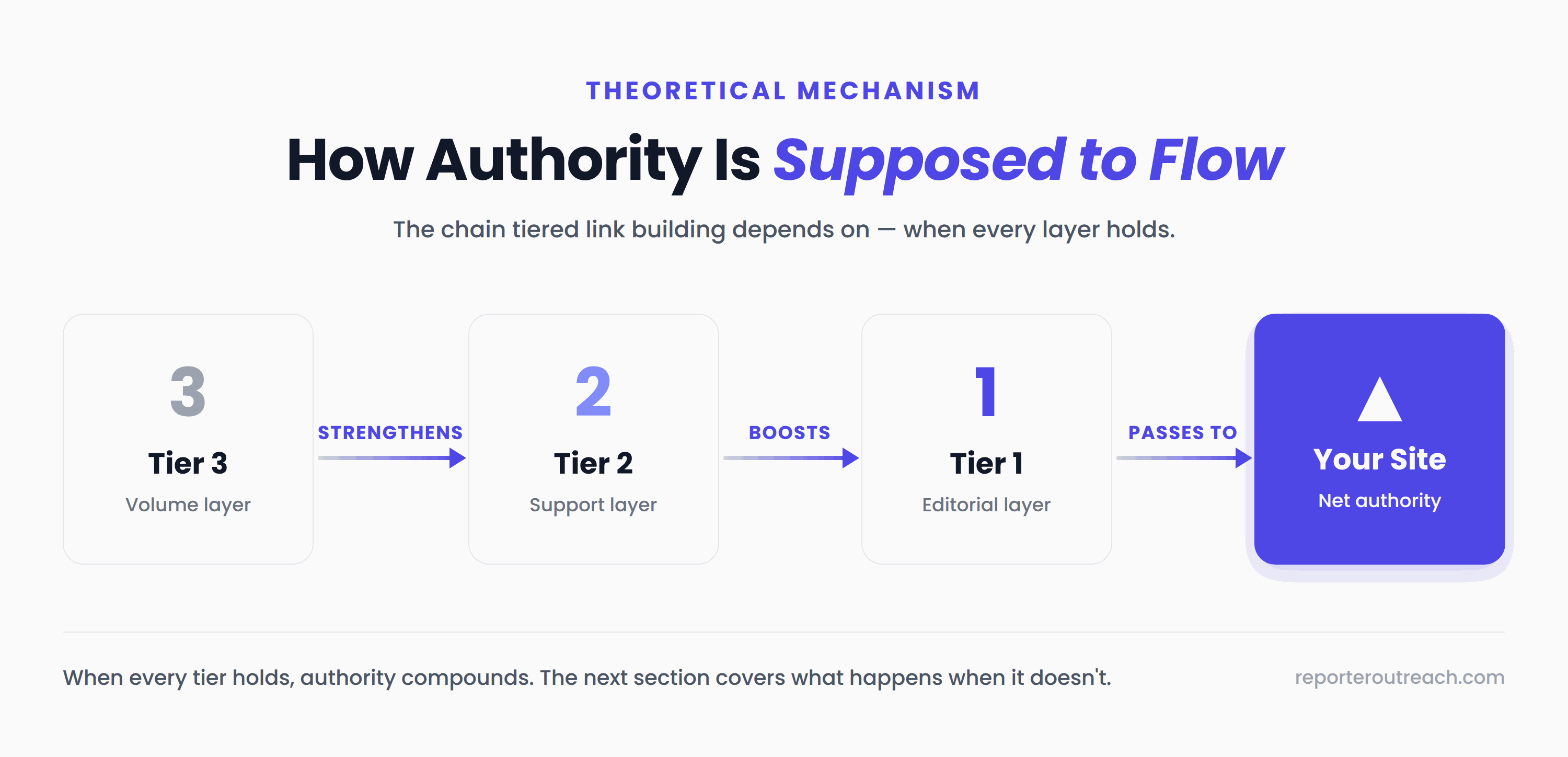
The key question everyone asks: does it actually work that way?
When every tier uses legitimate, high-quality sources, yes — authority does compound upward. But that scenario is rare. In practice, most tiered campaigns cut corners at tier 2 and tier 3, which is exactly where Google's systems focus their detection. SpamBrain analyzes link patterns in clusters, not individually. When a cluster looks coordinated, the entire group gets neutralized.
This is the fundamental tension of tiered link building: doing it safely requires so much quality at every level that you end up spending more than you would on simply earning great tier 1 links in the first place.
The Real Risks of Tiered Link Building in 2026
Most guides on tiered link building understate the risks. Here is what the current data actually shows.
The penalty escalation is worth understanding. When Google detects tiered manipulation, it does not always issue a manual action. More commonly, the system silently nullifies the link value — meaning you get zero return on your investment without any notification. You keep paying for links that do nothing.
In more serious cases, algorithmic demotion drops your rankings with no Search Console notification, making the problem hard to diagnose. And Google has stated explicitly that ranking benefits removed through link spam updates are permanent — the boost was never legitimate, so it does not come back even after cleanup.
Industry analysis after Google's March 2026 spam update reported expanded SpamBrain link graph analysis, with private blog networks and link-insertion schemes seeing harder enforcement (Search Engine Journal coverage). Google's official framing did not single out link spam — but observed impact suggests SpamBrain's detection capabilities continue to widen.
Google's Search Essentials explicitly classifies "any links intended to manipulate PageRank or a site's ranking" as a link scheme violation. Tiered link building, when the supporting tiers use artificial or low-quality sources, falls squarely within this definition.
When Tiered Link Building Can Actually Work
Not all tiered approaches are high risk. The strategy can work when quality standards hold at every level. Here is what the safe version looks like at each tier:
Safe tier 1: Editorial links from real publications earned through digital PR, original research, link insertions on relevant pages, or genuine guest contributions. Sites with real organic traffic and domain authority of 40+.
Safe tier 2: Genuine content promotion — sharing articles through real social accounts, email newsletters, relevant communities where you are an active contributor, and legitimate content syndication. Broken link building also works well at this tier: you find dead links on relevant sites and offer your tier 1 content as a replacement.
Safe tier 3: Organic social sharing, community discussions, and natural content distribution. Essentially normal marketing activity — not an artificial link scheme.
Compare safe versus risky approaches across each tier:
| Tier | Safe approach | Risky approach |
|---|---|---|
| Tier 1 | Editorial links from DR 40+ publications with real traffic | PBN links, paid placements, sponsored posts disguised as editorial |
| Tier 2 | Real content promotion, guest posts on niche blogs, broken link outreach | Web 2.0 spam, automated profile creation, link farms |
| Tier 3 | Organic social sharing, community engagement, natural distribution | GSA Search Engine Ranker, RankerX, automated comment spam |
Notice the pattern: when you remove the risky elements from tiered link building, what remains looks identical to a standard digital PR and content marketing strategy. You earn quality tier 1 links, promote them through legitimate channels, and let organic sharing create the supporting layers naturally.
The structure still happens. It just happens organically rather than artificially. And that distinction — organic vs. manufactured — is exactly what Google's systems are trained to identify.
Digital PR: Why It Replaced Traditional Tiers
This is why digital PR has become the dominant approach for practitioners who used to rely on tiered strategies. It achieves the same amplification effect — more authority flowing to your site from strong backlinks — but through a mechanism Google actively rewards.
When digital PR earns an editorial mention in a publication like Forbes, Healthline, or an industry-specific outlet, something interesting happens naturally:
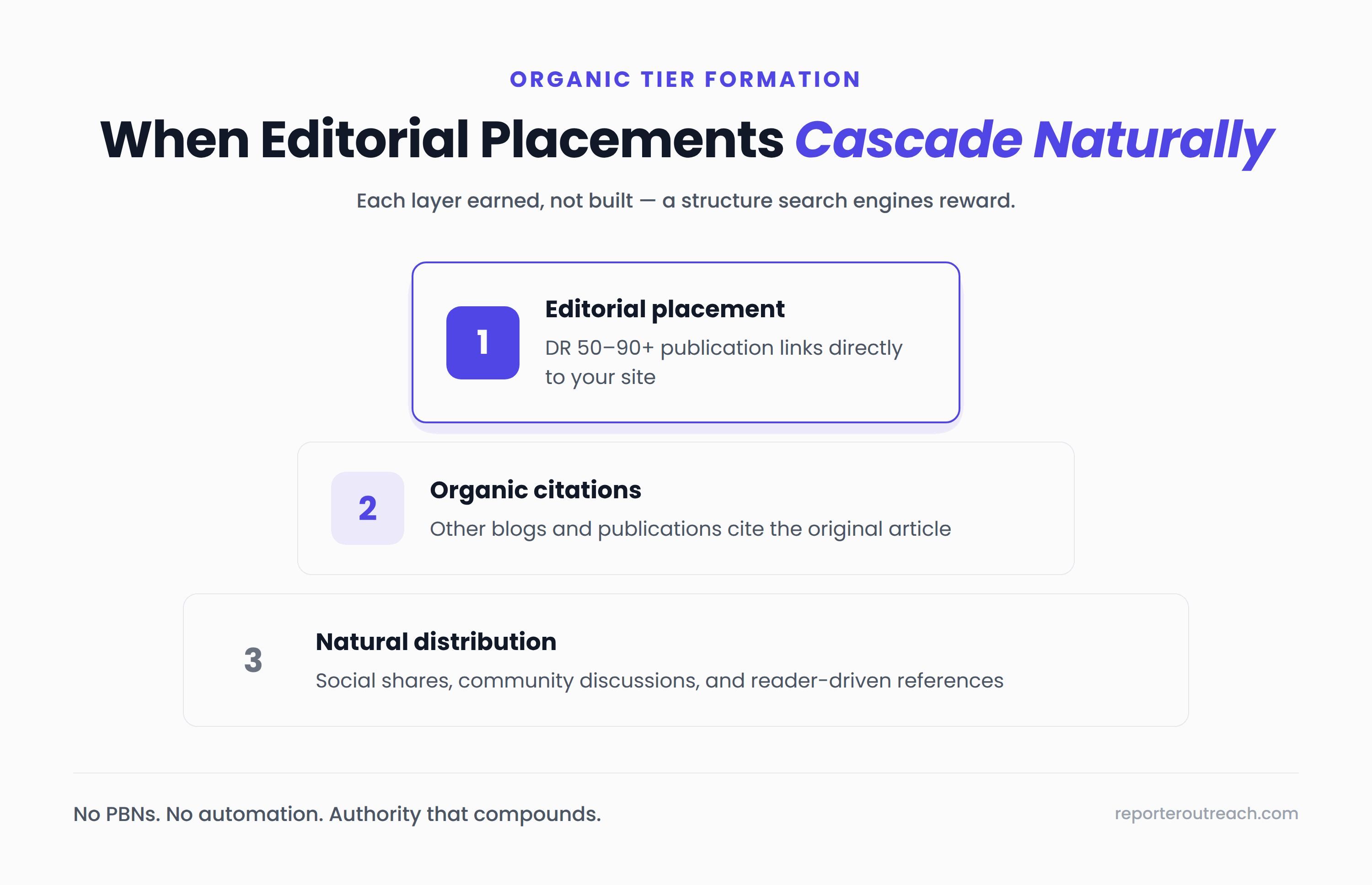
Tier 1 forms immediately. The editorial article links directly to your site from a DR 50–90+ publication. This is a genuine editorial endorsement — the strongest type of backlink that exists.
Tier 2 forms organically. Other blogs and publications cite the original article, creating legitimate supporting links. This happens because the content is genuinely newsworthy, not because you engineered the citations.
Tier 3 forms through natural distribution. Social media users share the article, discuss it in communities, and reference it in their own content. Zero effort required from you.
The result is a tiered structure that Google rewards — because every layer was earned, not built.
We have seen this play out consistently with our own campaigns. Villa Oasis, a luxury addiction treatment center, earned 39 editorial placements and mentions averaging DR 80 through digital PR over nine months — driving a 352% increase in organic traffic. Each placement attracted its own supporting citations and social shares organically. No artificial link pyramid was needed because the placements were genuinely newsworthy.
Best Practices If You Go This Route
If you decide to use a tiered approach, these six principles will help you stay on the right side of Google's guidelines.
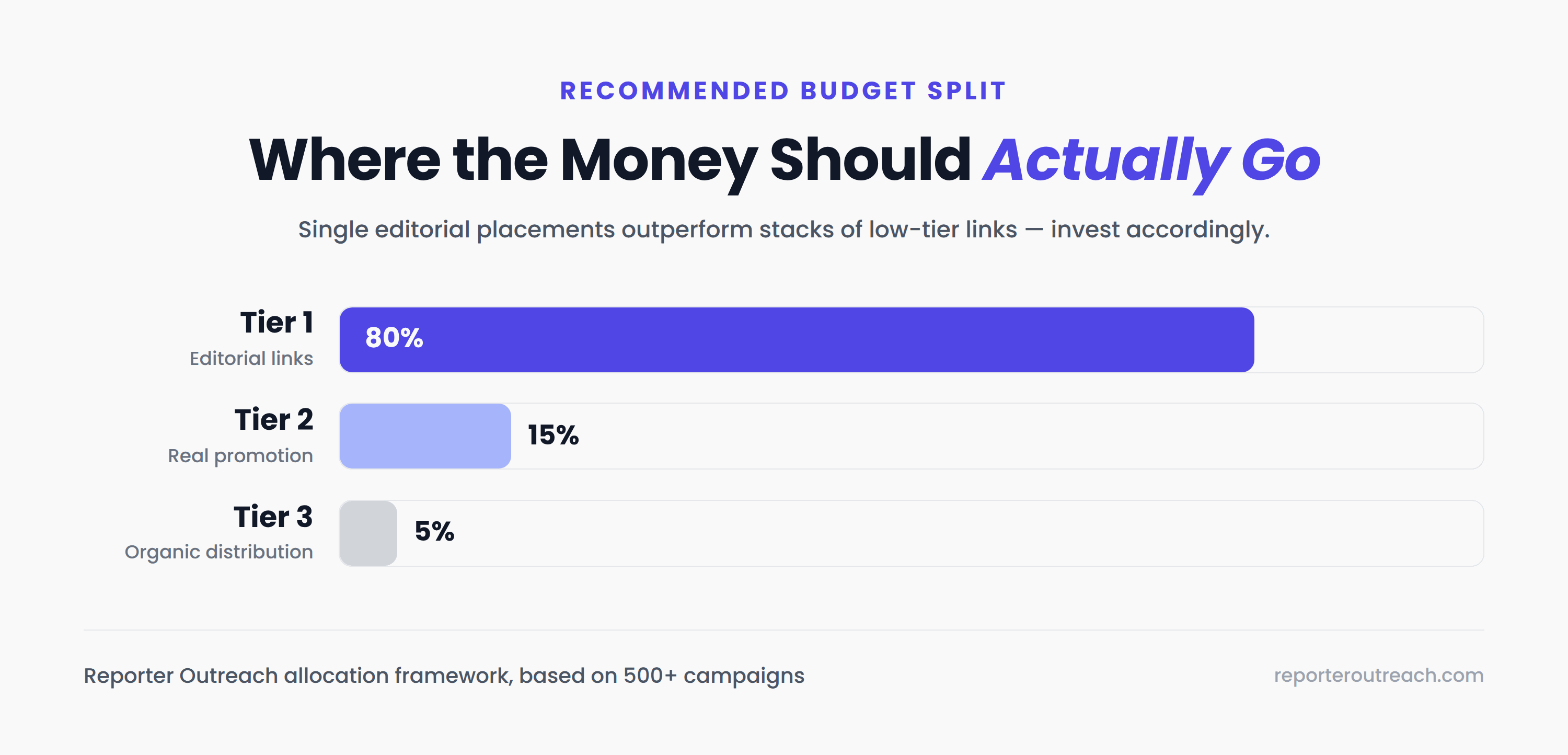
- Put 80%+ of your budget into tier 1. A single editorial link from a high-authority publication is worth more than hundreds of supporting links. Quality tier 1 placements typically range from $150 to $750 per link depending on domain authority and placement type (Authority Hacker / Editorial.link 2025 pricing surveys). Digital PR placements from sites with real traffic are the gold standard.
- Keep tier 2 human and legitimate. Real content promotion — sharing through genuine social accounts, email outreach to relevant communities, guest contributions on niche blogs, and broken link outreach — is safe and effective. If you would not be comfortable showing your tier 2 activity to a Google engineer, it is too risky.
- Skip tier 3+ entirely. The authority that lower-tier links provide is negligible compared to the detection risk. Social sharing and community engagement happen naturally when your tier 1 content is worth sharing. You do not need to manufacture it.
- Diversify your anchor text. Nearly half of link penalty cases involve exact-match anchor text on money keywords (Semrush, 800+ case study). Use a natural mix: primarily branded anchors, some topical phrases, and very few exact-match keywords. Your anchor profile should look like the pattern that forms when real editors choose their own link text.
- Monitor continuously. Use Ahrefs or Semrush to regularly check for toxic backlinks pointing to your pages. If tier 2 sources get flagged as spam, the damage propagates upward through your structure. Catch problems early before they reach your tier 1 pages.
- Create link-worthy content at tier 1. Original research, data studies, and genuinely useful resources give your pages natural link magnetism. When your content earns organic citations, you get legitimate tier 2 and tier 3 links without building them manually. This is the safest way to create a tiered effect at scale.
Want Tier 1 Links Strong Enough to Stand on Their Own?
We earn editorial links from DR 50–90+ publications that earn organic amplification on their own — no PBNs, no automation, no risk.
Frequently Asked Questions
What is tiered link building?
It is a backlink strategy built in layers. The first layer links directly to your website. The second layer links to the pages where those first-layer links live, making them pass more authority. Some practitioners add a third layer to support the second. The goal is to create an upward cascade of link equity that boosts your rankings.
Is tiered link building safe?
That depends entirely on what sources you use at each layer. If every tier relies on legitimate placements — editorial links at tier 1, genuine content promotion at tier 2, organic sharing at tier 3 — the approach is safe. The moment lower tiers involve PBNs, automated tools, or mass submissions, you cross into link scheme territory that Google's systems are specifically designed to detect.
Is this considered black hat SEO?
Traditional approaches that rely on PBNs and automation at lower tiers are classified as black hat by Google. Supporting strong editorial links with legitimate promotion, on the other hand, is standard marketing practice. The line falls on whether you are artificially inflating authority through manufactured sources or earning genuine amplification through quality content and outreach.
What works better than tiered link building?
Digital PR achieves the same authority amplification through a mechanism search engines reward. Editorial placements on high-authority publications generate their own cascade of citations and social sharing, creating an organic tiered structure without any of the manipulation risk. It also generates brand mentions that AI systems weight heavily when deciding which brands to recommend.
How much does tiered link building cost?
Quality tier 1 placements from authoritative publications typically range from $150 to $750 per link depending on domain authority and placement type, based on industry pricing surveys. Tier 2 and tier 3 add overhead in tools, content production, and management — but most experienced practitioners find better ROI by investing the full budget into high-quality tier 1 placements rather than spreading resources across manufactured layers. See our pricing page for digital PR packages.
Does this strategy affect AI search visibility?
Artificial tiered structures can hurt AI visibility. ChatGPT, Perplexity, Gemini, and Google AI Overviews all evaluate your entire backlink footprint and brand presence when deciding whether to recommend your site. Manipulative patterns signal manufactured authority. Editorial backlinks from trusted publications, combined with the brand mentions they generate, are far more effective at building the trust signals AI systems prioritize. Learn more in our GEO guide.
Sources
- Google — Search Essentials: Link Spam Policies (2026)
- Google — Webspam Report 2024 (SpamBrain detection statistics)
- Search Engine Journal — March 2026 Spam Update Coverage
- Semrush — Analysis of 800+ Link Penalty Cases
- Reporter Outreach — State of Link Building 2026: Survey of 500 SEOs
- Authority Hacker — Link Building Pricing Survey (2025)
- Editorial.link — Link Building Industry Pricing Survey (2025)