
Key Takeaways
- The average B2B technology purchase now involves 13 stakeholders, with 89% of buying decisions spanning multiple departments (Forrester, 2024). Your SEO has to map to a buying committee that searches in five different vocabularies — not just the technical evaluator.
- Editorial authority is the multiplier that makes everything else compound. FirstPageSage's 2025 ROI benchmark data shows thought leadership-driven SEO returns 748% over three years, versus 117% for technical SEO alone.
- AI search is reshaping how tech buyers discover vendors. GenAI chatbots are now the #1 channel influencing B2B vendor shortlists at 17.1% — ahead of software review sites, vendor websites, and salespeople (G2, 2025).
- Tech SEO has three pillars: technical foundations, expert content, and external authority. Most tech companies nail the first, attempt the second, and ignore the third entirely. Closing the third gap is the fastest path to compounding organic growth.
SEO for technology companies should be easy. Your engineering team understands how search engines crawl and index. Your product team can write content that actually teaches something. You probably have structured data implemented correctly because someone on your team read the documentation for fun.
And yet — most technology companies struggle to rank for the keywords that matter most.
The reason isn't technical. It's strategic. Technology is one of the most competitive verticals in organic search. You're not just competing against other SaaS platforms or IT service providers — you're competing against TechCrunch, G2, Gartner, and every comparison site that's accumulated thousands of referring domains over a decade of publishing. Closing that referring-domain gap means earning coverage in those publications yourself — the job of tech PR.
This guide breaks down what actually works for SEO in the technology sector — from technical foundations and content strategy to the authority piece that most tech companies completely overlook.
Why SEO for Technology Companies Is Fundamentally Different
SEO for technology companies isn't more technically difficult — your engineering team probably implements structured data better than the average SEO agency. What's different is the competitive dynamics, and they make tech one of the hardest verticals to win in organic search.
Four things drive that difficulty.
Your buyers search in multiple languages. A technical evaluator searches "enterprise Kubernetes orchestration platforms." The CFO approving the budget searches "cloud infrastructure cost reduction." The CIO comparing options searches "[product name] vs [competitor]." Same purchase, completely different keyword universes — and most tech companies optimize for one persona and miss the rest.
Here's how the same B2B technology purchase splits across the buying committee:
| Persona | Search vocabulary example | Buying stage |
|---|---|---|
| Technical evaluator (Engineer, Architect) | "kubernetes orchestration platforms" | Evaluation |
| IT decision maker (CTO, VP Eng) | "enterprise observability strategy" | Comparison |
| Finance / budget owner | "cloud infrastructure cost reduction" | Approval |
| Security / compliance | "[product] SOC 2 compliance documentation" | Validation |
| End user (Developer, Operator) | "how to integrate [product] with [stack]" | Implementation |
Forrester's State of Business Buying 2024 found the average B2B purchase now involves 13 stakeholders, and 89% of buying decisions cross multiple departments. For a technology company, that means your keyword research has to map to a buying committee — not just the technical evaluator.
Low search volume doesn't mean low value. Technology keywords regularly have monthly volumes under 500. That scares marketing teams who came from consumer verticals. But "enterprise cloud migration services" at 200 monthly searches represents potential six- or seven-figure contracts. The math works differently here — you don't need 50,000 monthly visitors. You need 50 of the right ones.
Your competitors have engineering teams doing SEO. In healthcare or legal, you can sometimes out-execute competitors with basic technical SEO. In technology, your competitors have dedicated engineers implementing structured data, optimizing Core Web Vitals, and building programmatic SEO at scale. Technical SEO is table stakes here — not a competitive advantage.
The AI search shift hits technology first. When a VP of Engineering asks Perplexity "best CI/CD platforms for microservices architecture," the answer gets pulled from brands that have editorial presence across trusted tech publications. Tech buyers are the earliest adopters of AI-driven research, which means the AI search disruption shows up in this vertical before others. If your strategy doesn't account for AI discoverability, you're optimizing for a search landscape that's already changing.
After working with technology brands across SaaS, cybersecurity, DevOps, and enterprise IT since 2017, the pattern is almost always the same: clean technical SEO, decent content production, and a backlink profile that's 80% directory listings and partner pages. The companies that break through are the ones that close the authority gap with editorial coverage from the publications their buyers actually read.
The Three Pillars of Tech SEO That Actually Compound
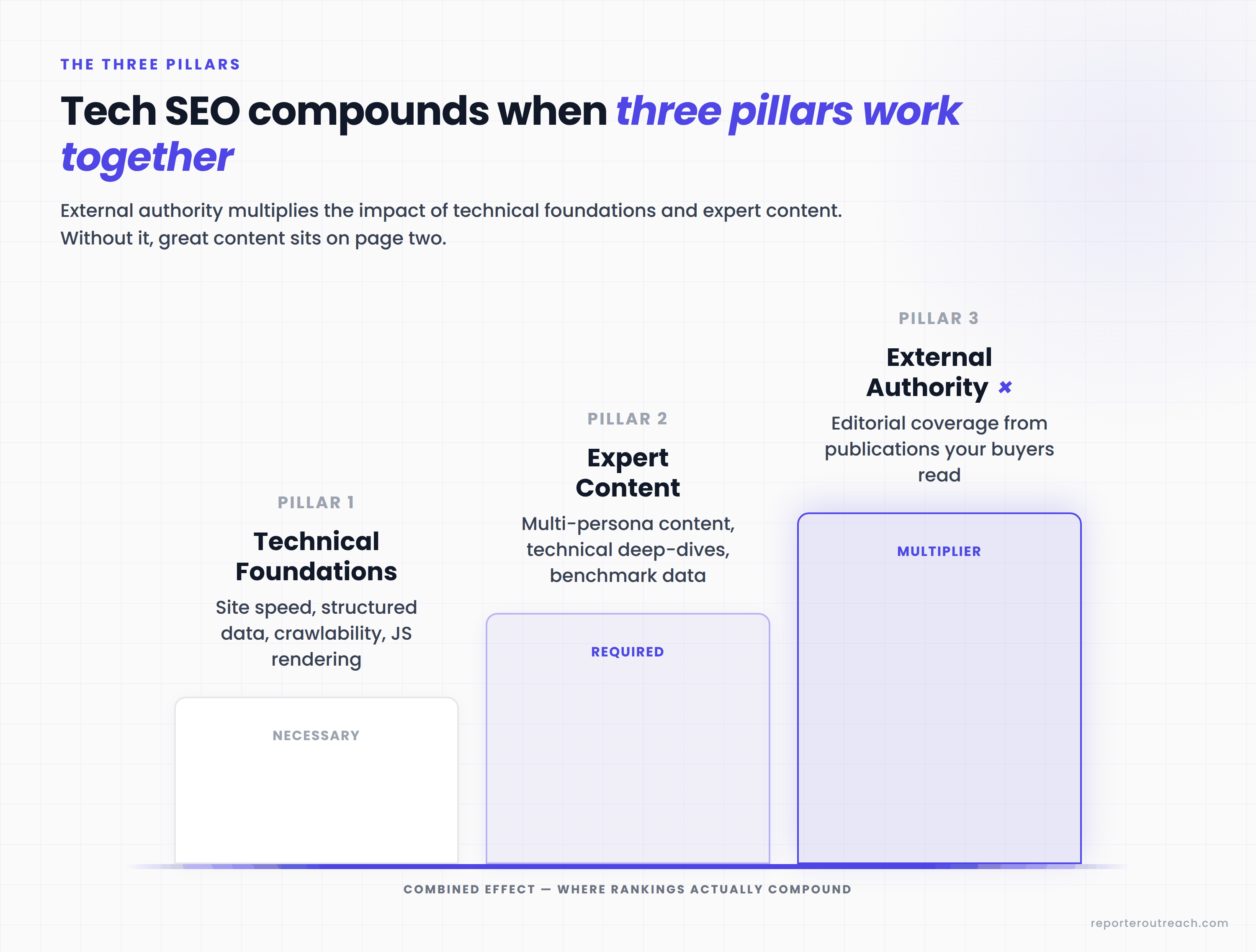
Three pillars work together to drive technology SEO performance — and they only compound when all three are in place. Most tech companies invest heavily in the first, attempt the second, and skip the third entirely. That's why their organic growth plateaus.
Pillar 1: Technical foundations (necessary but not sufficient)
You probably already know this one. Site speed, mobile responsiveness, crawlability, structured data, proper canonicalization. For technology companies, the bar is higher than average — Google expects tech sites to practice what they preach. A cloud infrastructure company with four-second page loads is sending a signal, and it's not a good one.
The technical SEO checklist for technology companies specifically:
- Core Web Vitals at green across all page types (product, blog, documentation)
- Structured data for products, FAQs, how-tos, and organization schema
- Clean crawl architecture — especially important if you have extensive documentation or knowledge bases that can bloat your crawl budget
- Proper internationalization if you serve multiple markets (hreflang tags, locale-specific content)
- JavaScript rendering handled correctly — many SaaS platforms ship JS-heavy frontends that Google struggles to index without server-side rendering or dynamic rendering fallbacks
Here's the honest truth: every technology company we work with already has this covered. Technical SEO is rarely what's holding a tech company back from ranking. It's the next two pillars where the real gaps exist.
Pillar 2: Content that matches how tech buyers evaluate
Technology companies make a specific content mistake other verticals don't: they write for the technical user and forget the rest of the buying committee. The developer evaluating your API documentation isn't the same person as the IT director comparing your platform to three alternatives, and neither is the CFO who needs to understand ROI. Your content strategy needs pages targeting each of these personas at their specific stage of the buying journey.
Here are the content types that consistently perform for technology SEO:
| Content type | Why it works for tech | Best for |
|---|---|---|
| Comparison & alternative pages | Highest-intent tech keywords. Most companies cede the territory to G2 and TrustRadius. | Decision-stage buyers |
| Technical deep-dives | Demonstrate expertise competitors can't replicate without genuine engineering knowledge. | Technical evaluators |
| Benchmark / data reports | Become the reference source other articles link back to. One report can earn backlinks for years. | Top-of-funnel + authority |
| Use case & industry pages | Convert long-tail intent for buyers searching solutions in their specific context. | Industry-specific buyers |
For comparison and alternative pages specifically: build them honestly. Acknowledge competitor strengths. Technical buyers will dismiss anything that reads like marketing within thirty seconds. The pages that rank are the ones that read like they were written by someone who actually used both tools.
Pillar 3: External authority (where most tech companies fail)
This is the uncomfortable part. You can have flawless technical SEO and the best content in your category, and you'll still lose to competitors who have stronger backlink profiles. In technology, that means losing to companies whose leadership gets quoted in TechCrunch, whose data gets cited in Wired, and whose product launches get covered by The Verge.
External authority is the multiplier that makes everything else work. Without it, great content sits on page two. With it, the same content reaches page one because Google trusts the domain it lives on.
FirstPageSage's 2025 SEO ROI benchmark data quantifies the gap:

Thought leadership SEO — the kind that combines authoritative content with editorial coverage building — returns 748% over three years. Technical SEO alone returns 117%. Basic content marketing returns 16%. Allocation matters more than total spend.
For technology companies, the most effective approach to building authority is digital PR — positioning your technical leadership as expert sources for the journalists who cover your industry. When a reporter at VentureBeat writes about AI infrastructure trends and quotes your CTO, that's an editorial backlink from a high-authority domain that also creates the kind of brand mention AI search engines use to determine which companies to recommend. How we run this motion for software, hardware, and infrastructure brands is on our technology digital PR page.
The technology media landscape is uniquely rich for this. Unlike most industries where you have to manufacture newsworthy angles, tech companies naturally generate them: product launches, funding rounds, technical research, benchmark data, and strong takes on industry shifts. The opportunity is significant. Most tech companies leave it untapped.
Technology publications carry higher average domain authority than most verticals. A single editorial placement in TechCrunch, VentureBeat, or Wired transfers more ranking authority than dozens of placements in general-interest sites. And because tech journalists cover the same beat consistently, one good source relationship can generate multiple placements over time.
AI Search Is Changing How Tech Buyers Discover Vendors
AI search has become the single biggest channel influencing B2B technology vendor shortlists. This shift deserves its own section because it's the biggest change in technology SEO since mobile-first indexing — and most companies are still pretending it's not happening.
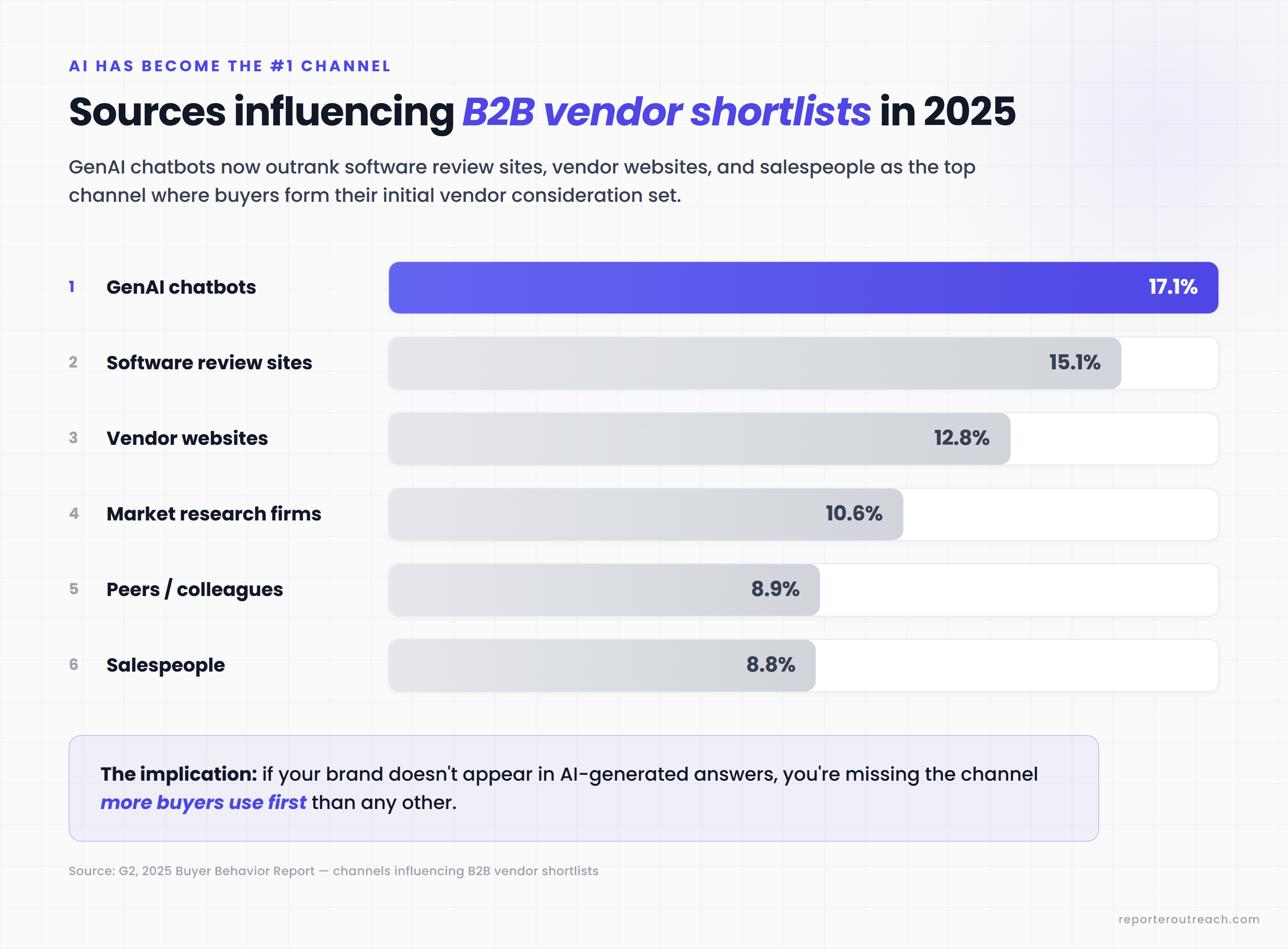
According to G2's 2025 Buyer Behavior Report, GenAI chatbots are now the #1 source influencing B2B vendor shortlists at 17.1% — ahead of software review sites (15.1%), vendor websites (12.8%), market research firms (10.6%), peer recommendations (8.9%), and salespeople (8.8%).
Here's how the channels rank in G2's most recent buyer behavior research:
TrustRadius's 2025 research on B2B tech buying in the age of AI found that 72% of technology buyers now encounter Google's AI Overviews during research, and 90% click through to source materials to verify what AI told them. That verification behavior is the opening — but only if your content is structured to actually be cited.
Forrester's State of Business Buying research adds the forward-looking number: nearly 95% of B2B buyers anticipate using GenAI to support their decision and purchasing process within the next 12 months. The shift isn't projected. It's happening now.
Here's how editorial coverage translates into AI search visibility:

AI systems don't regurgitate Google rankings. They synthesize recommendations based on which brands are most frequently mentioned across trusted publications. Ahrefs research found only 38% of URLs cited by AI systems rank in Google's traditional top 10 — meaning you can appear in AI recommendations without ranking on page one, if you have broad editorial coverage across the right sources.
Three practical implications for technology companies:
- Brand mentions matter as much as backlinks. Every editorial mention of your company — even without a hyperlink — builds the signal AI systems use to recommend you. This is a fundamental shift from traditional SEO, where unlinked mentions had minimal direct value. Digital PR generates both links and mentions simultaneously, which is why it's becoming the most important channel for technology companies that want visibility in both traditional and AI search.
- Publication breadth beats depth. Being mentioned 10 times on one site is less valuable for AI visibility than being mentioned once across 10 different trusted sources. AI platforms pull from different publication pools — the overlap between Google AI Overview sources and ChatGPT citation sources is surprisingly low. You need editorial presence across the full tech media landscape, not concentrated coverage in one outlet.
- Structured, citable content wins. AI systems prefer content that's easy to extract and cite — clear definitions, specific data points, authoritative statements. Content formatted with structured data, clear headings, and definitive answers gets cited more often than vague, hedging content. Take positions. State facts. Be quotable.
SEO Strategy by Technology Subcategory
There's no single tech SEO playbook — strategy emphasis shifts meaningfully by subcategory. A cybersecurity firm's approach looks nothing like a developer tools company's. The publications that matter are different. The content types that perform are different. The keywords that convert are different.
Here's how the strategy adjusts by subcategory:
| Subcategory | Lead with | Tier 1 publications to target |
|---|---|---|
| SaaS & developer tools | Technical content + dev community presence | TechCrunch, The New Stack, InfoQ, DZone |
| Cybersecurity | Threat research + benchmark data | Dark Reading, SC Media, CSO Online, The Hacker News |
| Cloud infrastructure | Architecture deep-dives + cost ROI analysis | The New Stack, ITPro Today, Network World, Data Center Knowledge |
| DevOps & observability | Practitioner content + workflow case studies | DevOps.com, The New Stack, InfoQ, IT Operations Times |
| Enterprise IT | Industry analyst coverage + customer case studies | CIO, ZDNet, Computerworld, IDG Connect |
| AI & ML platforms | Original research + benchmark data | VentureBeat, MIT Tech Review, The Information, Ars Technica |
The common thread across all subcategories: the highest-performing strategies combine expert content (Pillar 2) with editorial authority from the publications that matter in your specific niche (Pillar 3). Subcategory determines which publications and what content angles to lead with — not whether to invest in authority building at all.
Five SEO Mistakes Technology Companies Keep Making
After running campaigns for technology companies across multiple verticals since 2017, these are the five mistakes that come up most often when auditing tech SEO performance:
- Treating content marketing as SEO. Publishing blog posts is not an SEO strategy. It's a component of one. Too many tech companies publish four articles a month, track keyword rankings, and wonder why nothing moves. Content without supporting authority is like building a house without a foundation — it doesn't matter how nice the framing is.
- Chasing vanity link metrics. A hundred links from low-authority "write for us" blogs won't move rankings when your competitor has editorial links from TechCrunch and Wired. In tech especially, quality compounds faster than quantity. One placement from a tier-1 tech publication can transfer more authority than dozens of low-quality guest posts combined.
- Not leveraging internal expertise. Your CTO, VP of Engineering, and senior architects have deep expertise that tech journalists actively need. Most tech companies leave this asset completely untapped. A CTO who can explain container orchestration trends is infinitely more quotable than a marketing manager reciting talking points — and those quotes become editorial backlinks from high-authority outlets.
- Keyword cannibalization across documentation and marketing. Technology companies with extensive docs, knowledge bases, and marketing content frequently have multiple pages competing for the same keyword without realizing it. A product page targeting "enterprise API management," a blog post about "API management best practices," and a docs page about "API management setup" can all cannibalize each other. Clean up your content architecture before producing more content.
- Ignoring AI search entirely. If your SEO reporting doesn't include AI visibility tracking, you're measuring half the picture. Check whether your brand appears when someone asks ChatGPT, Perplexity, or Google AI Mode about your product category. If competitors show up and you don't, you need the editorial coverage that bridges both traditional and AI search visibility.
A Real Tech Example: Cybersecurity SaaS
Cybersecurity SaaS company Nightfall faced the familiar tech-vertical bottleneck: solid product, clean technical SEO, and an active content team — but couldn't break through against incumbents with years of accumulated editorial coverage. The authority gap was the bottleneck. The campaign focused on positioning Nightfall's security research and threat intelligence as media-source-grade material, earning placements that built the editorial credibility their organic search was missing.
Nightfall earned editorial placements across the cybersecurity media landscape and built the kind of brand authority that compounds across both traditional rankings and AI search. Read the full Nightfall case study →
Getting Started with Technology SEO
If you're a technology company that's done the technical SEO basics and produced content but still can't break through competitively, here's the honest diagnostic.
Check your backlink profile first. Pull your referring domain count, average DR, and compare against the competitors ranking above you. In technology, the gap is almost always about link quality, not quantity. If your competitors have editorial links from TechCrunch, Wired, and VentureBeat and you have directory listings and partner pages, that's your answer.
Audit your AI visibility. Search for your product category in ChatGPT, Perplexity, and Google AI Mode. Are you being recommended? If competitors appear and you don't, the missing ingredient is the editorial presence that drives AI citation signals.
Identify your expert spokespeople. Which team members have deep technical expertise and can speak confidently to media? Your technical leadership — the people who actually build and architect your product — are assets most PR strategies underutilize completely.
Inventory your data. What proprietary data does your company generate that tech journalists would find valuable? Usage metrics, benchmark data, adoption trends, performance comparisons — all potential PR campaigns waiting to happen.
The technology companies with the strongest organic presence — the ones ranking for competitive keywords and getting cited by AI search — aren't doing anything magical. They're combining solid technical foundations with expert content and consistent editorial authority. The first two are widely understood. The third is where the gap exists for most tech companies. Closing it is the fastest path to compounding organic growth. See more examples of how this plays out across industries.
Ready to Close the Authority Gap?
A free competitive backlink analysis showing exactly which tech publications matter most for your subcategory.
Frequently Asked Questions
How long does SEO take for technology companies?
First ranking improvements typically appear in months 2-3, with meaningful organic traffic growth measurable by months 4-6. The compounding effect — where editorial authority makes every piece of content rank faster — usually becomes clear around the 12-month mark. Companies that maintain consistent investment past 12 months build the deepest competitive advantages because each new placement amplifies everything published before it.
What makes SEO for technology companies different from other B2B verticals?
Three things. First, your competitors typically have stronger technical SEO at baseline because their engineering teams understand search infrastructure natively. Second, your buying committee involves multiple personas — technical evaluators, IT decision makers, finance, security — who search using different vocabularies. Third, the tech media ecosystem is significantly richer than most industries, creating both more opportunities for editorial coverage and a higher bar for the quality of pitches and expertise you bring.
Should technology companies prioritize traditional SEO or AI search optimization?
Both, and they're more complementary than most people assume. The editorial coverage that builds backlinks for traditional SEO simultaneously generates the brand mentions AI systems use to determine recommendations. The only piece that's purely traditional is technical SEO infrastructure (site speed, crawlability) — and even that helps AI discoverability indirectly because it makes content easier for AI crawlers to index and extract.
What's the typical investment for SEO at a technology company?
It varies significantly by competitive landscape and ambition. Enterprise tech companies in competitive categories typically invest $5,000-$15,000+/month across combined SEO and authority building. Startups and smaller tech companies can see meaningful progress at $3,000-$5,000/month. The more important question than total spend is allocation — companies investing 100% in content and 0% in authority building consistently underperform companies that split their investment across both.
Can we handle technology SEO in-house?
Technical SEO and content creation, yes — most tech companies have the internal expertise. The authority-building piece is where in-house teams typically struggle. Building journalist relationships, identifying timely pitch opportunities, and executing outreach at scale requires specialized expertise and existing media connections that take years to develop. Most successful technology companies handle technical foundations and content production internally and partner with a digital PR agency for the authority piece.
Sources
- Forrester — The State of Business Buying, 2024 (13 stakeholders per B2B purchase, 89% cross-departmental)
- TrustRadius — Bridging the Trust Gap: B2B Tech Buying in the Age of AI, 2025 (72% of tech buyers encounter AI Overviews; 90% click through to verify)
- G2 — 2025 Buyer Behavior Report (GenAI chatbots #1 source influencing vendor shortlists at 17.1%)
- FirstPageSage — SEO ROI Statistics, 2025 (748% thought leadership SEO ROI vs. 117% technical SEO ROI vs. 16% basic content)
- Reporter Outreach — Nightfall Cybersecurity SaaS case study