Key Takeaways
- You will not outrank Zillow, Redfin, or Realtor.com for head terms. You can absolutely outrank them for local terms — but only if your backlink profile reflects local authority they can't replicate.
- Directory listings (Zillow, Realtor.com, Yelp, the local MLS) are baseline, not strategy. Every competitor has them. They create zero separation in organic search.
- The highest-leverage tactic for real estate is digital PR. Journalists need expert sources on housing, mortgages, and local markets every day — and your agents are exactly what they're looking for.
- 96% of home buyers search online and 64% chose their agent based on Google visibility (NAR Profile of Home Buyers and Sellers). If you're invisible in search, you're invisible, period.
- AI search (ChatGPT, Perplexity, Google AI Overviews) is now recommending agents by name. The ones cited have editorial mention footprints — not just directory profiles.
Real estate link building is one of the most brutal local SEO fights on the internet. You're not just competing with the agent down the street — you're competing with Zillow, Redfin, Realtor.com, and national brokerages that have been accumulating links since the early 2000s.
Here's the thing nobody says out loud: you can't beat them. Not at their own game.
What you can do is win the local game — the one they structurally can't win, no matter how big their domain. National portals can't send an agent to a chamber of commerce breakfast. They can't sponsor the 5K in Scottsdale. They can't build the community partnerships that make Google treat you as a real local entity. That's the opening. Done well, local link building is the systematic exploitation of that opening.
This guide is the playbook we've built working with clients across residential, commercial, and property tech. No filler. No "make sure your NAP is consistent" basics you already know.
Why Backlinks Are the Whole Ballgame in Real Estate SEO
SEO drives 53% of website traffic for real estate agents — the single largest traffic source in the industry (REsimpli, 2025). Organic search converts at roughly 3.2% for real estate, about double what paid ads return, and the #1 search position takes a disproportionate share of clicks regardless of vertical.
Online discovery isn't optional in this category. It's where the buyer journey begins.
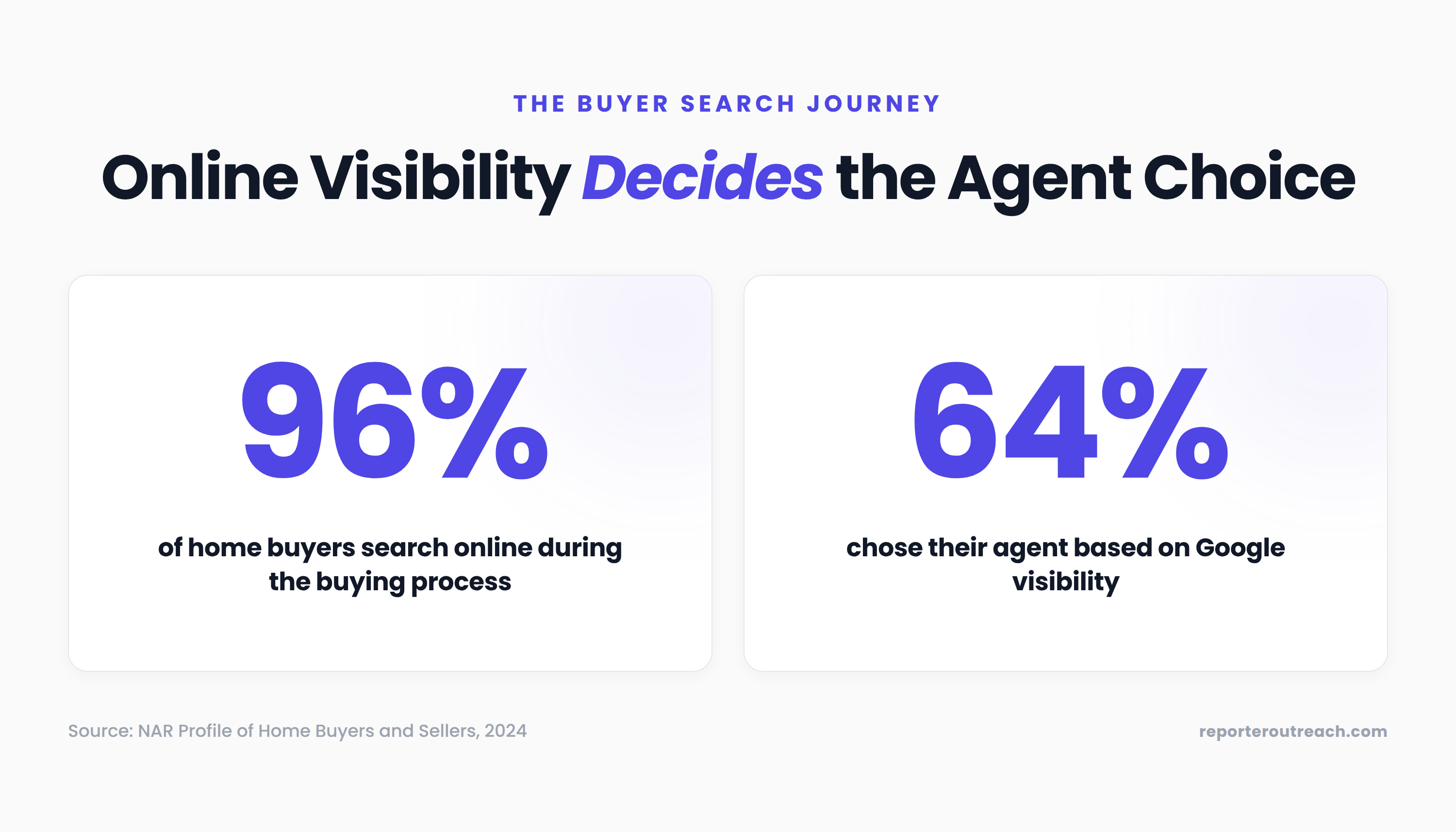
76% of real estate searches include location-specific terms (Google Trends), and 44% of local search clicks land in the Local Pack — the three-result map module above the organic results (Taboola Real Estate Marketing Trends). Both of those signals reward local relevance more than raw domain authority. That's where your opening is.
Zillow's Domain Rating is 92. Realtor.com is 91. Redfin is 89. You're not catching them at the domain level — not in five years, not in ten. But local queries don't reward raw domain authority the way head terms do. Local relevance signals — local links, local content, local entity mentions — are how you win in your market despite the authority gap.
The agents losing this fight all look the same: Zillow profile, Realtor.com profile, a few directory citations, and nothing else. The agents winning have editorial mentions in national publications that cover housing, links from the chamber and the youth sports league they sponsor, and features in personal finance outlets reaching their target buyers. The difference isn't budget. It's strategy.
Local Authority: The Foundation No National Portal Can Replicate
Start here. Not because local links are the most powerful individually — a single placement in a major publication outweighs most of this — but because these are the links your competitors will struggle to catch up on. They reinforce geographic relevance for every page on your site.
Six categories worth pursuing systematically:
| Category | What it covers | Examples |
|---|---|---|
| Business organizations | Membership and listing pages on local commerce groups. | Chamber of Commerce, BBB, industry associations |
| Community sponsorships | Local events and causes that publish sponsor pages. | 5K runs, youth sports, charity galas, school fundraisers |
| Local media | Newspapers, business journals, regional broadcast sites. | City paper, business journal, lifestyle blogs |
| Local partnerships | Co-marketing pages with complementary local businesses. | Mortgage brokers, inspectors, movers, contractors |
| Neighborhood associations | HOA pages, neighborhood blogs, civic association sites. | HOA member pages, civic groups, neighborhood Nextdoor |
| Industry & MLS | Realtor association profiles, MLS-affiliated sites. | State realtor association, MLS listings, CRE.org |
None of this is glamorous. It's also where most agents stop — and that's why the ceiling is so low. Local foundations get you onto the map. The next layer is what gets you to the top of it.
Digital PR: The Highest-Leverage Play in Real Estate Link Building
Real estate is one of the best-fit industries for digital PR, and almost nobody in the space is doing it. That gap is the opportunity.
Here's why the fit is so strong. Journalists cover housing constantly — interest rate stories, first-time buyer guides, local market snapshots, renovation ROI pieces, neighborhood roundups, investment advice, relocation guides. Every one of those stories needs expert sources. Your agents are the expert sources. The question is just whether you're in front of reporters when they're looking.
How reactive PR works
Reactive PR means monitoring the platforms where journalists post source requests — Qwoted, Featured, SourceBottle, Source of Sources — and responding with expert commentary when a query matches your agent's wheelhouse. Typical housing queries look like this:
- "Real estate agents: what are the biggest mistakes first-time buyers make?"
- "How are rising mortgage rates affecting buyer behavior in your market?"
- "What home improvements actually return their cost at resale?"
- "Experts weigh in: best neighborhoods for young families in [metro]"
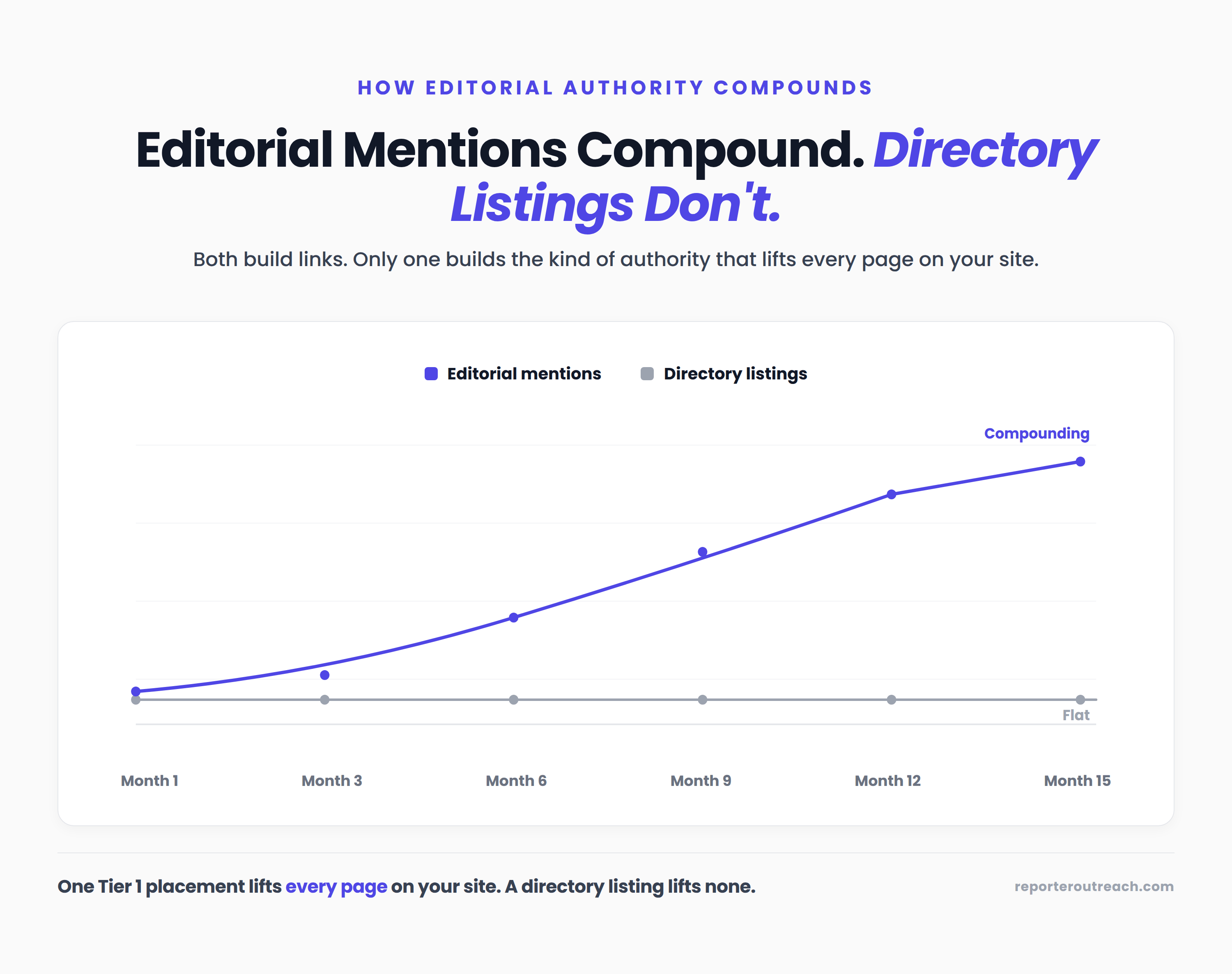
Your agent responds with a thoughtful, credentialed answer — ideally one with a specific data point or observation a journalist can't get from a chatbot. If the response lands, the quote runs in the published piece with a byline and a link back to your site. One placement in Forbes, Business Insider, CNBC, or Realtor.com's editorial section can lift the entire domain. It's the opposite of directory links: instead of reinforcing what you already have, editorial placements break the ceiling. (How we run these campaigns for brokerages, teams, and proptech brands is on our real estate digital PR page.)
Why digital PR works unusually well for this industry
| Why it fits | What it means for your link profile |
|---|---|
| Perpetual media demand | Housing stories never stop. Rate hikes, rate cuts, seasonal shifts, policy changes, inventory reports — every economic move creates new queries. |
| Local expertise is the product | National outlets need regional perspective ("How is Phoenix different from Austin?"). Your market knowledge is what they can't produce internally. |
| National authority lifts every page | Placements in Forbes, CNBC, Business Insider, Realtor.com editorial, and top personal finance sites raise sitewide domain authority. That authority flows to every neighborhood page, service page, and listing on your domain — including the local terms you're actually trying to rank for. |
| Fresh news cycle, always | Unlike evergreen industries, housing gets new hooks every week — Fed decisions, inventory data, seasonal shifts. A brand positioned as a go-to source compounds placements over months, not one-and-done campaigns. |
The downside is that reactive PR isn't a faucet you turn on and get links next week. It takes consistent monitoring, fast turnaround (usually under 24 hours), and pitches that actually tell journalists something useful. That's why most agents don't do it — and why it's such a durable advantage for the ones who do.
For a deeper look at the mechanics, see our full breakdown of how digital PR drives link building results.
Proven Results in Real Estate
An anonymized look at the same digital PR approach we run for direct mortgage, lending, and real estate clients. Buyer-facing publications are where prospective homeowners form shortlists — and that's where editorial coverage compounds fastest.
A direct-to-consumer mortgage lender competing for purchase volume against incumbents with massive paid budgets. Over a 33-month campaign, we placed the lender's mortgage advisors as expert sources across the lifestyle, real estate, and home-buying publications buyers actually read while house-shopping — earning editorial authority while prospective buyers were forming shortlists.
The pattern repeats across the housing-adjacent verticals where we run digital PR — lenders, title companies, prop tech tools, and brokerages all compete for visibility on the same publications buyers read while shopping. See more case studies →
Content That Actually Earns Links
Real estate has an unfair advantage here: you have access to data and local expertise that generic content mills can't touch. Use it. Most real estate blogs don't — they publish the same 500-word "5 tips for first-time buyers" posts as everyone else and wonder why no one links to them.
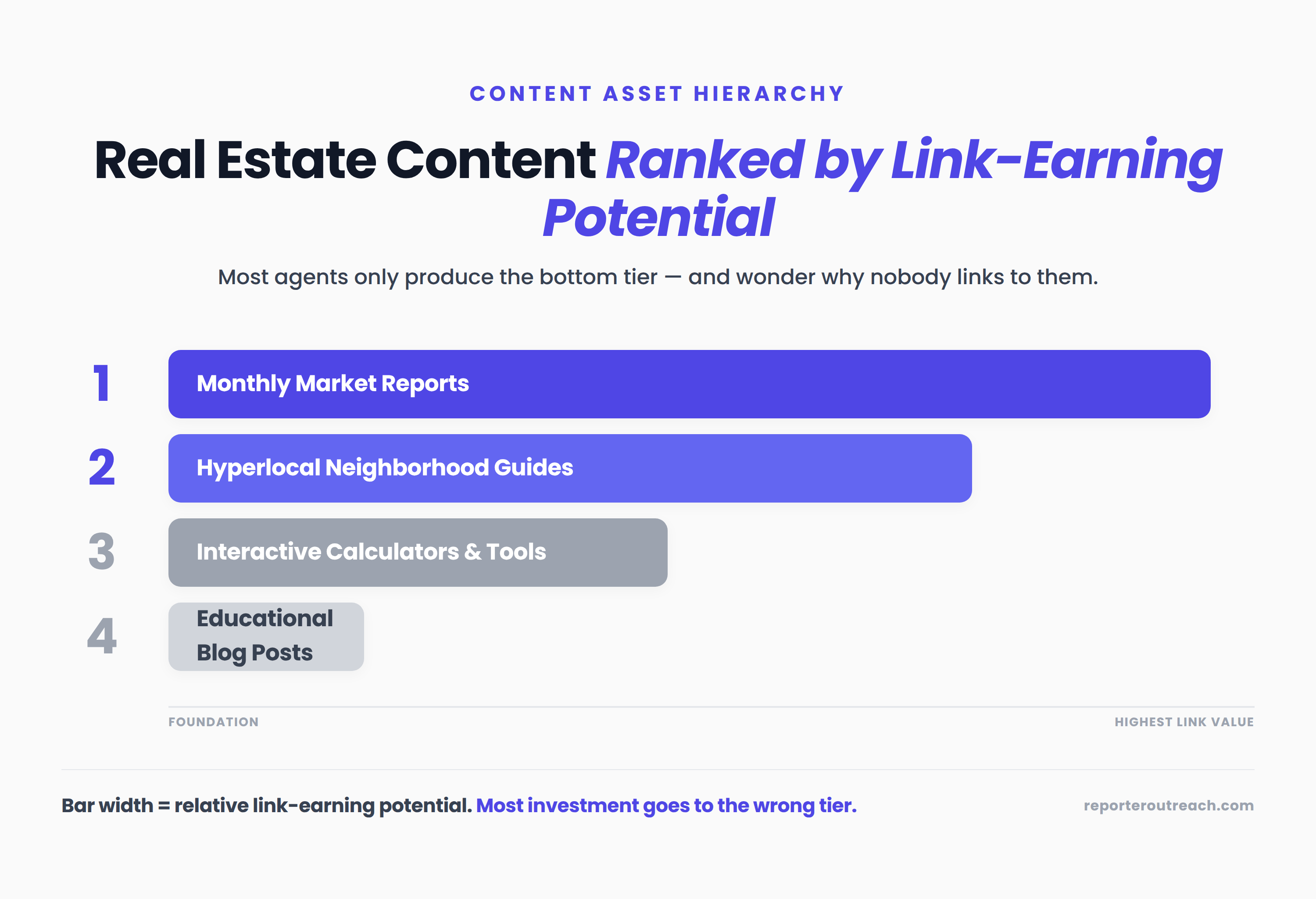
Here's what actually works, in descending order of link-earning potential.
Monthly or quarterly local market reports
This is the single highest-ROI content asset in real estate. You have MLS data nobody else has. Package it monthly: median sale price, days on market, inventory levels, price-per-square-foot trends, YoY comparisons, month-over-month changes. Add brief narrative interpretation — not just "prices went up 2%," but why.
National housing reporters need regional data constantly. Personal finance sites doing market roundups, trade publications covering housing trends, and major outlets running "state of the market" pieces all pull from agents and brokerages publishing cite-able data. Each citation is an editorial backlink you did nothing to earn beyond publishing the report on schedule. The compounding kicks in around month six.
Hyperlocal neighborhood guides
One per neighborhood you actively serve. Include:
- School ratings and district boundaries
- Crime statistics (cite the source — FBI UCR or local PD data)
- Walk score, transit score, bike score
- Property tax rates and HOA fee ranges
- Commute times to major employment centers
- Historical price trends (5-year, 10-year)
- Local amenities: parks, restaurants, grocery stores, notable shops
When a relocation guide, personal finance site, or community blog needs to reference your neighborhood, your page becomes the source. Zillow has neighborhood pages too — but they're templated, data-only, and don't match hyperlocal guides on depth. That's the gap.
Interactive tools and calculators
Higher upfront cost, passive link acquisition forever. Examples that earn the most links: home affordability calculators, mortgage payment estimators, closing cost calculators, property tax comparisons, rent vs. buy tools. Personal finance bloggers link to these because they're useful — and because embedding someone else's tool is easier than building your own.
Build it once, maintain it occasionally, earn links indefinitely. If you're choosing one content investment to make this year, make it a calculator tied to your strongest local market.
Educational blog posts (the supporting cast)
Posts like "How to Prepare for a Home Inspection in [State]" or "Understanding Closing Costs in [City]" don't earn many external links on their own. But they build topical authority across your site, feed internal linking structures, and capture long-tail traffic that converts. Think of them as the foundation, not the feature.
What to Skip (And Why)
Some of the most-recommended tactics in real estate link building guides are either weak or outright counterproductive. The pattern is the same across all of them: short-term volume that creates long-term cleanup work.
| Skip | Why |
|---|---|
| Mass directory submissions | Submitting to 200 directories doesn't move the needle. Google ignores low-quality directories almost entirely. Stick to category-relevant directories: Zillow, Realtor.com, Trulia, Homes.com, Redfin agent finder, NAR member directories, state-level realtor associations. |
| Generic "real estate" guest posts | Writing "10 Tips for First-Time Buyers" for a low-quality real estate blog doesn't drive results. Either write for genuinely high-authority publications (where the bar is editorial, not pay-to-play) or skip guest posts entirely. |
| Cheap link packages | Anything advertising "100 high-DA backlinks for $99" is private blog network (PBN) garbage. PBN links work briefly, then trigger Google penalties. Real estate is YMYL — Google scrutinizes it harder. Don't gamble your domain. |
| Comment spam and forum links | Dropping your URL in BiggerPockets comments, Reddit r/RealEstate, or random blog comment sections does nothing. These links are nofollow, frequently removed, and often tagged as spam by both users and Google. |
| Reciprocal link exchanges | "You link to me, I'll link to you" was a 2010 tactic. Google's algorithms detect reciprocal patterns easily. They cancel out at best, trigger manual review at worst. |
What Real Estate Link Building Actually Costs
Most link building guides quote vague ranges ("$1,000 to $10,000 a month") that don't help you budget. Below is what we actually charge clients across three engagement scales — and what each tier produces.
| Tier | Investment | What's included | Best for |
|---|---|---|---|
| Starter | $3,000/mo | Reactive PR cadence; mid-tier housing, lifestyle, and personal finance publications | Solo top-producing agents; small teams |
| Growth | $6,000/mo | Reactive plus proactive pitching; mix of mid-tier and Tier 1 publications (Forbes, CNBC, Realtor.com editorial) | Established teams; growth-stage brokerages |
| Elite | $12,000/mo | Sustained editorial cadence; Tier 1 housing trades, national personal finance, AI visibility focus | Brokerages, franchise offices, prop tech |
Pacing is constant across tiers. First placements land 2–3 weeks after pitching begins regardless of investment level. Ranking shifts come at 3–6 months. More pronounced authority compounding hits at 6–12 months. What scales with investment is publication tier and volume of editorial coverage — not the speed of first results.
We recommend a 3-month minimum commitment for digital PR campaigns and run month-to-month after that. Less than that and you haven't given the pipeline time to produce — outreach, pitching, and placement cycles run 30–60 days even when everything goes right.
AI Search: Why Editorial Mentions Now Matter More Than Ever
Home buyers are starting searches in ChatGPT and Perplexity now. "Best real estate agent in Denver." "Is Roseland a good neighborhood to buy in?" "How's the Austin housing market right now?" These queries used to end on Google's first page. They increasingly end inside an AI answer — and the brands cited inside those answers win.
Roughly 23% of U.S. adults have used ChatGPT (Pew Research Center, 2024), with adoption growing fastest among younger and higher-income demographics — exactly the buyer segment most agents target. Google's AI Overviews now appear above traditional results for a meaningful share of housing-related queries: "best neighborhoods in [city]," "is now a good time to buy," "average closing costs in [state]." Once an AI Overview answers the question, fewer users click through to the ranked organic results below it.
The agents being recommended by name aren't the ones with the most directory listings. They're the ones with editorial mention footprints — quoted in national publications, cited across trusted third-party sources, referenced in the housing coverage AI systems train on. Directory profiles alone don't create this pattern. Editorial coverage does.
Among agents specifically, almost nobody is optimizing for this yet. That's either an enormous opportunity or a rapidly closing window depending on when you start. For the full framework, see our generative engine optimization guide.
Practical steps: earn editorial mentions through digital PR, publish cite-able market data, maintain consistent brand presence across national publications and your own content, and audit monthly. Search your name plus your market in ChatGPT, Perplexity, and Google AI Overviews. If competitors appear and you don't, that's your signal to accelerate.
The Most Common Mistakes I See
Pattern recognition from auditing a lot of agent sites over the years:
Treating link building as a one-time project. Agents commission an SEO audit, buy 20 links, and call it done. Authority decays. Competitors keep adding links. Six months later the rankings have slipped and the "SEO didn't work" story begins. Real estate link building is a continuous program — 12 months minimum to see the compounding curve.
No linkable assets before starting outreach. If your site is a listings feed and a contact page, there's nothing for anyone to link to. You can't ask a journalist or blogger to cite you as a source if your cite-able resource doesn't exist. Build the market reports, neighborhood guides, and calculators first. Then promote.
Chasing DR instead of relevance. A DR 75 link from an off-topic site (pet supplies, unrelated tech blog) is worth less than a DR 40 link from a housing trade publication or personal finance site covering the exact topic you're trying to rank for. Relevance beats raw authority, especially when Google is evaluating E-E-A-T signals in a YMYL category.
Ignoring the YMYL implications. Real estate touches life-altering financial decisions. Google's quality raters scrutinize E-E-A-T signals here harder than in most niches. Anonymous agent bios, thin "about" pages, and missing author credentials all undermine the value of every link pointing to your site.
No tracking. If you can't name your referring domain count from three months ago, you can't tell whether anything is working. Google Search Console is free. Ahrefs or Semrush are worth it. Track new referring domains monthly, not the vanity metric (total backlinks).
A Realistic Timeline
Link building compounds, which means the first few months are thankless and the back half of year one is where the payoff lands. Fighting this timeline is fighting the math. Here's what reasonable progress looks like:
| Timeline | What happens |
|---|---|
| Month 1 | Foundation: directory audit, GBP optimization, citation cleanup, chamber membership, first neighborhood guide, first market report. Digital PR pitching begins late month 1. |
| Months 1–2 | First reactive PR placements land 2–3 weeks after pitching begins. Community sponsorships go live. Local business partnership links built. Early referring domain gains visible. |
| Months 3–6 | Ranking shifts begin. Local Pack appearances increase. Long-tail neighborhood keywords reach page 1. Market reports start getting cited externally. |
| Months 6–12 | Compounding. Each new editorial placement lifts pages across the site. Competitive local terms reach page 1. AI search citations begin appearing. Your market report becomes a go-to local reference. |
FAQ
How many backlinks does a real estate website actually need to rank?
It depends on the market. In a smaller metro with lighter competition, 30–50 referring domains with strong local signals can put you on page 1 for geographic terms. In a top-20 metro, you're usually looking at 100+ referring domains to consistently compete. The useful benchmark isn't an absolute number — it's your top three local competitors. Pull their backlink profiles in Ahrefs, note referring domain count and average DR, and match or beat it. For more on this math, see our breakdown of how many backlinks you actually need.
What should an agent or brokerage budget for link building?
Use the tier table above as the starting point: $3,000/mo at Starter for solo top producers and small teams, $6,000/mo at Growth for established teams and growth-stage brokerages, $12,000/mo at Elite for full brokerages and franchise offices serious about Tier 1 publications and AI visibility. The pricing column is fixed — what scales is publication tier and editorial volume, not the speed of first results.
Can a solo agent actually compete with a national brokerage in search?
For head terms, no. For local terms, absolutely — and often more easily than you'd think. Large brokerages have high domain authority but thin local content and shallow community ties. A solo agent who publishes detailed neighborhood guides, earns national editorial placements through digital PR, and builds partnerships with community organizations can routinely outrank a Keller Williams or Compass page for "[neighborhood] real estate agent" or "best realtor in [small city]." Specificity is the wedge.
Do I really need to worry about AI search yet?
Depends on your timeline. If you want results this quarter, focus on traditional SEO and digital PR that moves Google rankings — AI citations take longer to build and longer to translate into pipeline. If you're planning 12+ months out, AI search matters more with every passing month. Google AI Overviews now appear for a meaningful share of housing-related queries. The cost of preparing now is low. The cost of being invisible in 2027 — when buyers are starting in ChatGPT first — is high.
Should I do link building in-house or hire an agency?
Split it. Local link building — chambers, sponsorships, partnerships, community event support — is almost always better done in-house because it requires your physical presence and existing relationships. No agency can replicate you shaking hands at a chamber breakfast. Digital PR is better outsourced because it requires daily platform monitoring, journalist relationships, and pitch workflows that take years to build internally. Most of our successful clients run this hybrid model. Our take on when to outsource SEO has a longer framework for deciding.
Ready to Dominate Your Local Market?
We earn editorial links from national publications that lift sitewide authority and build AI visibility — without the churn of cheap link packages.
Sources
REsimpli Real Estate Marketing Statistics 2025 (SEO drives 53% of traffic); NAR Profile of Home Buyers and Sellers 2024 (96% of buyers search online; 64% chose agent based on Google visibility); Google Trends (76% of real estate searches include location-specific terms); Taboola Real Estate Marketing Trends 2026 (Local Pack drives 44% of local search clicks); Pew Research Center, "Americans' use of ChatGPT" 2024 (23% of U.S. adults have used ChatGPT); Adobe Digital Trends 2024 (consumer AI search adoption); Reporter Outreach campaign data — anonymized white label engagement, 33-month mortgage and lending campaign.