Key Takeaways
- Google classifies all finance content as YMYL (Your Money or Your Life) and applies its strictest E-E-A-T standards. The authority threshold for ranking is materially higher than non-YMYL verticals.
- Financial services SEO delivers a 1,031% average three-year ROI and organic search converts at 7.3x the rate of PPC in finance (FirstPageSage) — making it one of the highest-ROI channels in the industry.
- Digital PR is the dominant authority strategy for finance because it earns editorial backlinks and brand mentions simultaneously — the two signals that drive both Google rankings and AI search visibility.
- Credentialed experts (CFP, CPA, CFA, ChFC) are the single biggest competitive moat finance brands have. Most industries can't access journalist sources of that caliber; finance can.
- A complete strategy requires technical foundations, expert-attributed content, local optimization for firms with offices, and sustained off-page authority through editorial placements.
SEO for financial services is the hardest game in organic search. Not figuratively — structurally. Google classifies every page about loans, insurance, investments, credit, taxes, and planning as YMYL, and applies its most aggressive quality filters to decide what ranks.
That means the playbook that works for a SaaS company or an eCommerce brand will get you nowhere in finance. The authority bar is higher, the competitors include banks and incumbent publishers with massive domains, and the compliance layer adds friction most industries never deal with.
But here's why it's worth the effort: financial services SEO delivers a 1,031% average ROI over three years, second only to real estate (FirstPageSage). And organic search converts at 7.3x the rate of PPC in finance — the highest conversion gap of any industry FirstPageSage measured. Every ranking you earn replaces clicks that cost real money in a vertical where individual finance keywords regularly run $50–$100+ per click.
This guide covers the full picture: what makes finance SEO different, how to audit and prioritize, the content and technical foundations that matter, why digital PR has become the dominant authority strategy for finance brands, and how AI search is reshaping which companies get recommended.
YMYL — short for Your Money or Your Life — is Google's classification for content that could affect a reader's financial stability, health, safety, or legal standing. Pages about loans, insurance, investments, taxes, credit, retirement planning, and financial advice all qualify. Quality raters apply heightened scrutiny to YMYL pages, evaluating expertise, source credibility, and trustworthiness more aggressively than non-YMYL content. The result: ranking thresholds are higher, the cost of poor signals is steeper, and the strategies that work in lifestyle or eCommerce verticals often don't translate.
Why SEO for Financial Services Follows Different Rules
YMYL classification triggers a different evaluation framework — not a stricter version of the same one. Google's quality raters apply heightened scrutiny to every ranking signal for financial content because inaccurate advice could directly harm someone's financial stability. That has three concrete consequences for how you build a strategy.
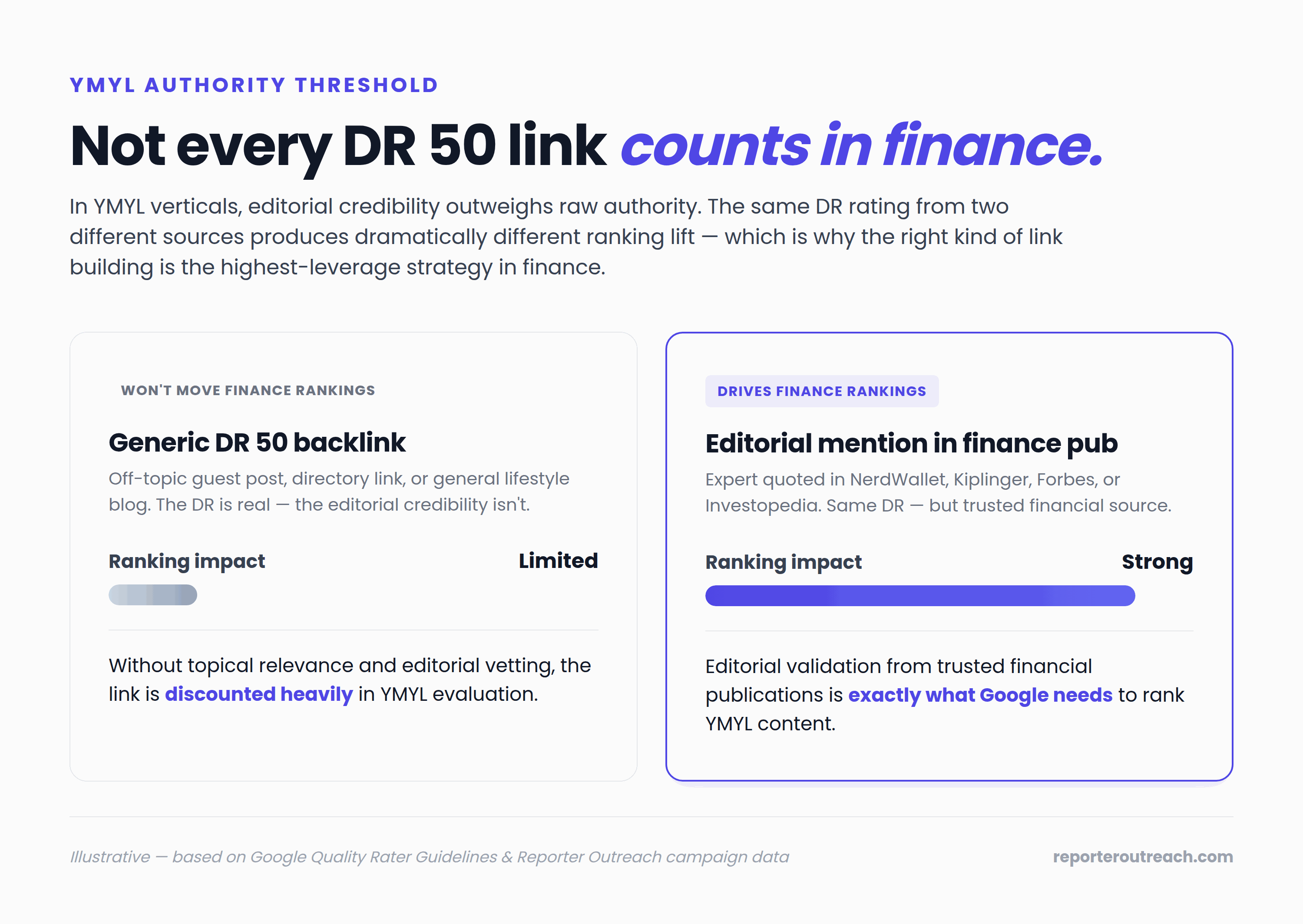
The authority threshold is real. A backlink from a DR 40 site that moves the needle in a lifestyle niche may have negligible measurable impact for a finance brand. Google needs stronger proof that your brand is editorially vetted before it'll rank your content for money keywords. We've seen this consistently — the same tactics that produce movement in other verticals flatline in finance until the domain authority gap closes.
E-E-A-T is enforced here, not aspirational. Experience, Expertise, Authoritativeness, and Trustworthiness aren't nice-to-have in finance. Quality raters specifically evaluate whether credible third parties vouch for your expertise. That's not something you can fake with author bios alone — it requires external editorial validation.
Penalty risk is amplified. Manipulative tactics carry disproportionate risk in YMYL niches. Google's algorithms are tuned to detect unnatural link patterns in finance, and recoveries from penalties take longer because the trust rebuild is steeper.
The upside of this difficulty is significant. The keywords are high-intent, customer lifetime values are substantial, and the competitive moat you build through earned authority is hard for competitors to replicate. Finance brands that invest in the right authority signals build a compounding advantage PPC can never match.
Start with an Authority Audit
Before investing in content or outreach, you need a clear picture of where the gaps are. Most finance brands skip this step and start producing content — which is like building a house without checking the foundation. An effective audit covers four areas:
- Technical health. Crawl your site with Screaming Frog or Sitebulb. Financial websites tend to have complex architectures — product pages, branch pages, compliance disclosures, regulatory filings — all of which need to be crawlable and properly indexed. Look for broken links, redirect chains, duplicate content, and missing meta descriptions. Fix these before anything else.
- Content inventory. Map existing content against the queries your audience actually uses. Most firms discover significant gaps — high-intent queries with no corresponding page. A wealth management firm might have pages for every product but nothing targeting "retirement planning for tech executives" or "Roth conversion calculator." Those gaps are immediate opportunities.
- Backlink profile. Use Ahrefs or Semrush to evaluate your referring domain count, DR distribution, and anchor text patterns. Compare against direct competitors to quantify the authority gap. In finance, identifying toxic backlinks is especially important — YMYL sites face extra scrutiny for unnatural patterns.
- Competitor analysis. Your organic competitors may not be your business competitors. You're likely competing against NerdWallet, Bankrate, and Investopedia — content publishers with massive domain authority and decade-long content libraries. Analyze which keywords they rank for, which formats perform, and where the authority gaps are widest. That's where you focus.
Algorithm updates hit YMYL verticals harder than the rest. Use Google Search Console as your primary diagnostic for indexation, crawl errors, and performance trends — and rerun the full audit every quarter rather than waiting for annual reviews.
Keyword Research for Finance
Keyword research in finance requires a fundamentally different approach. The competitive landscape is dominated by massive publishers, the intent behind financial queries is unusually nuanced, and the commercial value per keyword is extraordinary — which is why finance keywords routinely top WordStream's lists of the most expensive PPC terms across all industries.
Prioritize intent over volume. "What is a 401k" has massive volume but informational intent. "Best retirement advisor for physicians" has a fraction of the traffic but extremely high purchase intent. Map every target keyword to a buyer journey stage and weight your priorities toward terms that drive leads, not just traffic.
Target long-tail to compete. You're not going to outrank Investopedia for "life insurance" anytime soon. But "life insurance for small business owners" or "term vs whole life for high earners"? Those are winnable. Build topical authority cluster by cluster, and the head terms start moving as your domain strengthens.
Group keywords into topic clusters. A cluster around "retirement planning" might include 401k rollovers, Roth conversions, RMDs, catch-up contributions, and Social Security timing. This structure signals depth to Google — which matters significantly in YMYL evaluation.
Mine Search Console for hidden wins. Cross-reference Ahrefs keyword opportunities with Google Search Console's performance report. You'll find queries where you're ranking on page 2 or 3 — where better on-page optimization or a stronger content piece can push you to page 1 without any additional authority building.

Content That Satisfies E-E-A-T
Content is the engine. Without high-quality pages that demonstrate genuine expertise, no amount of technical optimization or link building will produce sustainable rankings in a YMYL vertical. What separates content that actually ranks in finance:
- Author credentials aren't decoration — they're ranking signals. A retirement planning guide authored by a CFP with 20 years of experience will outperform identical content without that attribution. Google uses author credentials as a direct E-E-A-T signal for YMYL content. If you have CFPs, CPAs, CFAs, or ChFCs on staff, their names should be on every piece of content in their area of expertise.
- Depth over breadth. One definitive guide on 401k rollovers covering every edge case will outperform ten thin articles on tangentially related topics. Go deep where you can demonstrate real expertise. Topical depth beats topical width in YMYL.
- Proprietary data is your moat. Consumer spending surveys, benchmark reports, financial calculators — these earn links naturally. A financial institution that publishes annual savings benchmarks gives journalists a reason to reference your content year after year, which compounds editorial authority while serving as a content asset.
- Structure for AI search. Write content that directly answers questions in natural language. AI systems parse conversational Q&A far more effectively than formal corporate prose — and this determines whether your content appears in AI Overviews and gets cited by ChatGPT, Perplexity, and Gemini.
Implement FAQ schema on educational pages, FinancialProduct schema on loan and investment pages, LocalBusiness schema for branch locations, and Article schema with author markup on blog content. Structured data helps Google understand your content — and increasingly determines whether your pages appear in AI Overviews.
Beyond what to publish, it's worth understanding how the same ranking signals are weighted differently in finance versus non-YMYL verticals. The signals haven't changed — what's changed is how aggressively Google enforces them:
| Signal | Non-YMYL weight | YMYL Finance weight |
|---|---|---|
| Author expertise & credentials | Helpful | Critical |
| Editorial backlinks | Standard ranking factor | Heavily weighted |
| Topical relevance of links | Matters | Matters more than DR |
| User trust signals (HTTPS, reviews) | Standard | Critical |
| Brand mentions in trusted media | Helpful | Required at scale |
| Manipulative pattern detection | Penalized | Heavily penalized |
Technical Foundations Finance Sites Need
Technical SEO is the foundation everything else sits on. Even great content won't rank if Google can't crawl, index, and render your site properly — and financial websites have specific technical challenges most other verticals don't face.
Site speed under compliance constraints. Financial sites run heavy compliance scripts and security layers that tank Core Web Vitals. Audit which third-party scripts are actually necessary — many finance sites load compliance tools on every page when they're only needed on specific ones. The HubSpot State of Marketing report found that page speed remains a top three technical SEO priority among in-house teams in 2024–2025, and finance underperforms most verticals on Core Web Vitals.
Mobile-first indexing. Google indexes mobile first. Financial forms need to complete easily on small screens — every extra field costs conversions, and mobile rendering issues compound that.
Security and trust signals. HTTPS across every subdomain, no mixed content warnings, trust badges displayed prominently. Non-negotiable for finance — and quality raters specifically check for these.
AI crawler access. Check your robots.txt — are you blocking GPTBot, PerplexityBot, or ClaudeBot? These crawlers determine whether AI systems can recommend your content. Implement an llms.txt file and make sure competitors aren't accessible while you're blocked. Previsible's analysis of YMYL adoption found finance significantly behind other verticals in opening up AI crawler access — which means early movers gain disproportionate AI visibility.
Local SEO for Firms with Offices
For financial service providers with physical locations, local SEO is often the highest-ROI component of the entire strategy. Someone searching "financial advisor near me" or "CPA in Phoenix" is far closer to a purchase decision than someone reading general financial education.
Google Business Profile is the starting point. Claim and optimize every location with accurate NAP (Name, Address, Phone) data, complete business descriptions, service categories, photos, and hours. Firms with multiple branches need separate, fully optimized profiles for each location — not duplicated boilerplate with the city name swapped.
Location pages must be unique. Three offices means three pages with genuinely different content — local team bios, regional market insights, community involvement. Google spots template pages with swapped city names and weights them down.
Reviews drive local rankings. Reviews on Google, SmartAsset, and WealthManagement.com signal trust to algorithms and prospects. Compliance teams often restrict what clients can say — find a process that works within your regulatory framework rather than abandoning the channel.
Citation consistency. Consistent NAP data across FINRA BrokerCheck, CFP Board, NAPFA, and local directories reinforces geographic relevance and is one of the cheapest ranking levers available.
Off-Page SEO: Why Digital PR Dominates in Finance
Authority building is where the competitive gap gets won or lost in financial services. Google needs extensive third-party validation before ranking YMYL content — and the most efficient way to build that validation is digital PR.
Editorial placements directly satisfy E-E-A-T. When Forbes, Investopedia, or NerdWallet features your expert in a real article, that's a direct signal to Google that a trusted source has editorially vetted your brand. No other tactic carries this level of authority in YMYL niches. Generic guest posts on low-DR blogs don't come close.
Credentialed sources are a built-in advantage. Financial journalists require qualified sources — CFPs, CPAs, CFAs, licensed advisors. If your team has those credentials, that's a competitive moat most industries don't have. Lead with credentials in every pitch.
Brand mentions drive AI visibility simultaneously. Every editorial placement generates both a backlink and a brand mention — and brand mentions are what AI systems use to decide which financial brands to recommend. More on this in the AI visibility section below.
5 Authority-Building Strategies That Work in Finance
- Expert commentary and reactive pitching. Financial journalists constantly need expert sources for market trends, tax changes, and regulatory updates. Platforms like Qwoted, Featured, and journalist query services connect your experts with reporters. Respond fast, lead with a usable quote, always include credentials.
- Recurring data campaigns. Finance generates mountains of citable data — tax season trends, consumer savings benchmarks, housing affordability analyses. We've seen a single recurring tax season data campaign earn 96+ placements across personal finance and small business publications. The key is making it annual, predictable, and timely — journalists know to look for the update each year.
- Regulatory newsjacking. Every Fed rate decision, tax law change, and regulatory update creates media coverage that needs expert commentary. The window is tight — often 24–48 hours. Have pre-built expert bios and quote libraries ready so you can respond same-day rather than starting from scratch.
- Targeted link insertions for money pages. Digital PR builds domain-wide authority, but link insertions let you place contextual links on existing financial articles pointing directly to your most important service pages. For finance, target DR 60+ sites with genuine traffic in the financial vertical.
- Thought leadership that earns passive links. Interactive calculators (loan, retirement, tax), annual benchmark reports, and definitive guides on complex financial topics attract links organically. These assets compound — a well-built retirement calculator can earn links for years without additional outreach.
Financial journalists have strict sourcing requirements. Pitches from CFPs, CPAs, and licensed advisors consistently outperform pitches from marketing teams. If you have credentialed professionals on staff, position them as primary spokespeople for media outreach — their qualifications are an advantage most industries simply don't have.
Tax & Accounting Education Brand
White label engagement · Client name confidential
A tax and accounting education brand competing for organic visibility against legacy publishers and incumbent software platforms. Over a 26-month campaign, the brand's CPA-credentialed experts were placed as sources across mainstream business publications and personal finance authorities — building category authority across rankings, AI search citations, and direct referrals.
Tactics That Backfire in Finance
The penalties for shortcuts are steeper in YMYL niches. Tactics that carry moderate risk in other verticals can cause real damage in finance:
- PBNs and link farms. Google's algorithms are specifically tuned to detect manipulative patterns in YMYL niches. One algorithmic penalty can wipe out months of progress, and YMYL recoveries take longer than other verticals.
- Low-quality guest posts. A guest post on a DR 20 "write for us" blog does nothing for finance rankings. Worse, a pattern of low-quality placements signals to Google that your profile is manufactured — and that signal is harder to recover from in YMYL.
- Reciprocal link exchanges. Reciprocal patterns get detected and devalued faster in finance than in other verticals because algorithms apply extra scrutiny to YMYL link graphs. The short-term lift isn't worth the trust hit.
- Ignoring topical relevance. A DR 90 backlink from a pet food blog won't help your advisory page rank. In YMYL niches, relevance matters as much as authority. A DR 60 placement from a financial planning publication outperforms a DR 90 from an irrelevant source.
AI Search Visibility: The New Battleground
This is the section that matters most for finance brands making decisions about where to invest right now. When someone asks ChatGPT "what's the best high-yield savings account?" or uses Google AI Mode for "how to choose a financial advisor," the AI doesn't just evaluate your website. It evaluates how frequently your brand appears across trusted third-party sources — and then decides whether to recommend you.
Muck Rack's analysis of over one million AI citations found that the overwhelming majority came from earned media sources, not paid placements. Edelman's research puts the non-paid share at up to 90%. If you're not getting editorial coverage, AI won't recommend you — full stop.

For finance brands specifically, two implications stand out:
- AI systems apply extra caution in YMYL. One Forbes mention isn't enough if competitors have coverage across ten publications. Breadth of editorial presence matters as much as authority of any individual placement, because AI models are tuned to be more cautious about recommending YMYL brands without strong consensus signals.
- Editorial coverage is the only signal that builds both channels. Every editorial placement creates the brand mention AI uses to decide recommendations and the backlink Google uses to rank your pages. Digital PR is the only strategy that simultaneously builds Google ranking authority and AI visibility — which is why it's become the dominant off-page approach for finance brands.
Budget and Timeline Expectations
Finance SEO requires more investment than most verticals — but the economics are proportionally better because customer lifetime values are higher and editorial authority compounds. Across every engagement tier, expect first placements within 2–3 weeks and measurable ranking shifts in months 3–6, with more pronounced movement in months 6–12 as authority compounds. What scales with investment is the publication tier and the volume of editorial coverage, not the speed of first results.
| Engagement scale | Monthly investment | What's included | Team needed |
|---|---|---|---|
| Starter | $3,000/mo | Reactive PR cadence; mid-tier finance publications | In-house lead + agency partner |
| Growth | $6,000/mo | Reactive + proactive pitching; mix of mid-tier and Tier 1 publications | Internal SEO + agency + credentialed experts |
| Elite | $12,000/mo | Sustained editorial cadence; Tier 1 publications; AI visibility focus | In-house team + agency + content + experts |
For context on volume and which tier fits your starting authority, the right benchmark depends on your competition, current DR, and target keyword difficulty — a finance-specialist agency can model this from your existing backlink profile.
How to Get Started
If you're a finance brand looking to build the search visibility needed to rank in Google and get cited by AI, here's the practical path:
- Run the audit. Technical foundations, content gaps, backlink profile. Use Ahrefs and Search Console to benchmark against competitors.
- Map your keyword landscape. Prioritize high-intent, lower-competition terms you can win now while building toward competitive head terms over time.
- Identify credentialed experts. CFPs, CPAs, CFAs — position them as primary spokespeople for content and media outreach. Their credentials are your single biggest competitive advantage in YMYL.
- Check AI visibility. Search for your brand in ChatGPT, Perplexity, and Google AI Mode. If you're not being recommended, you need the editorial mentions that digital PR generates.
- Talk to a specialist. Finance SEO requires understanding compliance, publication landscapes, and credentialing standards that general agencies miss.
Build Authority in Financial Services.
A free competitive analysis — your backlink profile, competitor gaps, and which publications to target for maximum ranking impact.
Frequently Asked Questions
Why is SEO harder for financial services than other industries?
Google applies YMYL classification to all finance content, which triggers heightened E-E-A-T evaluation across every ranking signal. Low-authority backlinks that produce results in lifestyle or eCommerce verticals have negligible impact in finance. You need editorial validation from publications Google already trusts for financial information — which requires credentialed experts and data-driven pitches, not volume tactics.
Which types of finance companies benefit most from SEO?
Advisory firms, insurance companies, fintech platforms, mortgage lenders, banks, credit unions, and tax services all compete in organic search. A local advisory firm prioritizes Google Business Profile and location pages, while a national fintech focuses on content authority and editorial placements. The framework applies across the sector — only the emphasis shifts.
Do I need licensed professionals to make finance SEO work?
Credentialed experts (CFP, CPA, CFA) significantly improve editorial placement success because financial publications require qualified sources. They also strengthen on-site E-E-A-T. Without licensed professionals in-house, data-driven campaigns and brand-level digital PR can build authority through a different path — but the placement rate will be lower without credentials to lead with.
How long before we see ranking improvements?
Technical fixes can produce quick wins within weeks for pages already ranking on page 2 or 3. Digital PR typically produces first placements in 2–3 weeks regardless of engagement scale, with measurable ranking shifts in months 3–6 and more pronounced movement in months 6–12 as authority compounds in YMYL.
What's the difference between digital PR and traditional financial PR?
Traditional PR targets brand awareness through press releases and analyst relations. Digital PR targets backlinks and brand mentions that improve rankings and AI visibility. The tactics overlap, but digital PR is optimized for measurable SEO outcomes rather than awareness impressions.
How does AI search change the strategy for finance brands?
AI systems recommend brands based on editorial presence across trusted sources, not website rankings alone. The majority of AI citations come from earned media. For finance, editorial PR is now the primary driver of AI visibility — and AI search is becoming a meaningful share of qualified leads.
Sources
- FirstPageSage — SEO ROI by Industry & SEO vs. PPC Conversion Rates (2025)
- Muck Rack — "What is AI Reading?" Citation Analysis (2025)
- Edelman — Generative Engine Optimization & AI Brand Visibility Research (2025)
- HubSpot — State of Marketing Report (2024–2025)
- WordStream — Google Ads Industry Benchmarks & Most Expensive Keywords (2024)
- Previsible — YMYL Industry AI Adoption Analysis (2025)