Key Takeaways
- Healthcare SEO lives in YMYL territory — Google holds it to the strictest authority standards. Strong content alone won't rank without third-party editorial signals backing it up.
- Editorial backlinks from health publications are the single strongest E-E-A-T signal you can build. A journalist citing your physician tells Google more than 100 directory listings ever will.
- AI Overviews appear on 48.7% of healthcare Google queries — nearly double the all-industry average (Conductor, November 2025). And 84% of AI citations come from earned media (Muck Rack, May 2026). The providers winning AI visibility are those with editorial mention footprints, not just optimized websites.
- Local healthcare SERPs got their AI Overviews removed entirely — Google reversed course on "near me" queries between 2023 and 2025 (BrightEdge). For clinical content though, AI presence climbed from 59% to 89% in the same window.
- This guide covers the full healthcare SEO playbook — foundations, the authority layer, the AI search shift, and a 90-day rollout sequence.
Healthcare SEO should be straightforward. Patients search, providers rank, appointments get booked. But nearly 8 in 10 adults turn to the internet when a health concern surfaces (Annenberg Public Policy Center, April 2025) — and the providers who actually show up in those results aren't the ones with the best content. They're the ones with the strongest authority signals.
That's the paradox. You can build the most medically accurate, patient-friendly website on the internet, and Google will still bury it behind a competitor with weaker content but stronger editorial endorsements. The YMYL classification changes the game completely.
We've watched this play out across hundreds of campaigns since 2017. The healthcare brands that break through — from solo practices to hospital systems — share one thing: journalists at trusted health publications cite their clinicians, link to their sites, and mention their brands in editorial context. Everything else is supplementary.
This guide covers how to build that authority through a combination of foundational SEO and healthcare digital PR — for both traditional Google rankings and the AI-powered search results (ChatGPT, Perplexity, Gemini, and Google AI Overviews) that are rapidly taking over healthcare discovery.
Why Healthcare Plays by Different Rules
If you run SEO for an ecommerce brand or a SaaS company, you can rank with solid content, decent links, and good technical foundations. Healthcare doesn't work that way.
Google classifies health topics as YMYL — Your Money or Your Life. Pages that could impact someone's health, safety, or financial wellbeing face the strictest quality evaluation in Google's entire system. Three things make this different from anything else in SEO:
E-E-A-T isn't a nice-to-have. Experience, Expertise, Authoritativeness, and Trustworthiness are table stakes. Google expects healthcare content authored by credentialed professionals, published on sites with demonstrated medical authority, and supported by citations from recognized sources. A beautifully written article without these signals gets outranked by mediocre content on a site with strong authority. Every time.
AI is eating healthcare search results. Conductor's 2026 AEO/GEO Benchmarks Report — released November 2025 — found that AI Overviews trigger on 48.7% of all page-one Google queries in healthcare. That's nearly double the 25.11% overall baseline across industries. And among adults who already search for health information online, 65% report seeing AI-generated responses at the top of their results (Annenberg, April 2025). For nearly half of all health-related searches, Google generates an AI answer before the user reaches your site, citing only the brands it considers most authoritative. If you're not in that citation pool, you're losing a growing share of patient visibility.

Compliance raises the bar on content. HIPAA, FDA advertising guidelines, patient testimonial restrictions, and claims substantiation requirements add layers of complexity. Healthcare content takes genuine clinical expertise to produce — which is precisely why editorial endorsements from health journalists carry disproportionate weight. They signal that qualified third parties have vetted your credibility.
The Foundations That Actually Matter
Skipping the generic "what is keyword research" tutorial. If you're reading an article about healthcare SEO, you know what on-page optimization is. What you need to know is where healthcare diverges from standard practice.
Keyword research: patients don't search like marketers think
Healthcare keyword research is different because patient search behavior is deeply personal and highly localized. Patients search in three modes: condition research ("symptoms of sleep apnea"), treatment comparison ("best treatment for rotator cuff tear"), and provider selection ("orthopedic surgeon near me"). The language patients use almost never matches clinical terminology — and the gap is bigger than in any other industry.
Long-tail keywords matter more here than in most verticals. "Anxiety therapist who takes Blue Cross San Diego" is a real search with real intent. Use Ahrefs, Semrush, or Google's "People Also Ask" to find the actual language patients use — then build service pages around that language, not your internal medical terminology.
Patients search "lump in throat won't go away" — not "globus pharyngeus." Practices that build content around patient language capture search demand that clinically-worded competitors miss entirely. Map your top 10 conditions to the actual phrases patients type, and you'll find keyword opportunities your competitors haven't touched.
Local SEO: the fastest path to new patients
For practices with physical locations, local optimization is usually the highest-ROI starting point. Most patient journeys start with a local search — and appearing in the map pack can drive phone calls within weeks, not months.
There's another wrinkle worth knowing: Google has actively pulled AI Overviews out of local healthcare results. Searches like "dermatologist near me" or "cardiologist near me" went from 100% AI Overview presence in 2023 to 0% by December 2025 (BrightEdge). For local provider intent, the traditional local pack and Maps results still own the SERP. Your investment in GBP, citations, and reviews still pays off — possibly more than ever, because there's no AI summary intercepting the click.
The basics: claim and fully optimize your Google Business Profile. Upload real photos (not stock). Write a description that includes your specialties and location. Ensure your name, address, and phone number are identical across every directory — Healthgrades, Zocdoc, Vitals, WebMD. Inconsistency kills local rankings.
For multi-location practices, create unique pages per location — not just the city name swapped into a template. Actual differentiation around the providers, services, and community each location serves.
If you run an aesthetics or med spa practice, local dynamics dominate even more — our medical spa SEO guide covers that vertical’s specifics.
And reviews. This is where most practices leave the biggest gap. Practices with 50+ Google reviews and a 4.5+ star rating dramatically outperform competitors in local results. Build a systematic process: send a follow-up text after every positive visit with a direct link to your review page. Respond to every review — positive and negative — while maintaining HIPAA compliance (never confirm someone is a patient).
Content: clinical credibility is non-negotiable
Every medical article on your site needs a named clinical author with visible credentials. Not "written by staff." Not "reviewed by our medical team." A specific physician or licensed clinician with a linked bio. Google's quality raters check for this in YMYL content, and its absence is an authority killer.
Service pages should target specific condition and treatment keyword clusters with genuine depth — not thin doorway pages with 200 words and a form. Patient-focused content that addresses real concerns (treatment options, recovery timelines, what to expect, cost considerations) outperforms generic medical overviews every time.
Technical SEO: the healthcare-specific parts
Page speed under 2.5 seconds. Mobile-responsive design. HTTPS. These are universal. What's healthcare-specific:
Schema markup — implement MedicalOrganization, Physician, and MedicalClinic schemas. These help Google surface rich results. Breadcrumb structure and clean URL architecture matter more for multi-department health systems where internal linking can make or break service line rankings.
For multi-location practices, verify Google Search Console shows every page as crawlable and indexed. Large health system sites routinely have service pages Google hasn't even found.
The Authority Gap: Why Most Healthcare Sites Stall
Here's where healthcare SEO diverges most sharply from every other industry.
You can nail the foundations — perfect on-page optimization, great content, strong local presence — and still plateau. In competitive healthcare niches, the practices that rank on page one have something the ones stuck on page two don't: third-party editorial authority.
When a journalist at Healthline, WebMD, or Psychology Today quotes your physician and links to your practice's homepage, you earn a high-DR backlink from an editorially trusted source. Your brand gets mentioned in the editorial context AI systems weight most heavily. Your E-E-A-T profile strengthens. And you build "as seen in" credibility that directly influences whether patients book or bounce.
This is what digital PR does. It earns the editorial endorsements that move rankings, build AI visibility, and drive patient trust — all from a single activity.
In most industries, you can rank with decent content and a reasonable backlink profile. In healthcare, Google's YMYL evaluation demands significantly stronger authority signals. Guest posts on generic blogs don't move the needle. Directory links don't move it either. What works: real journalists at real health publications citing your clinicians in editorial content. That's the signal Google — and now AI — trusts most. Muck Rack's May 2026 Generative Pulse analysis of more than 25 million links cited by ChatGPT, Claude, Gemini, and Perplexity found that 84% of AI citations come from earned media: content where third parties chose to mention a brand, not content brands wrote about themselves.
How healthcare digital PR works
Healthcare digital PR connects your clinicians with journalists actively writing health stories. Platforms like Qwoted, Featured, and Source of Sources post queries daily from reporters covering everything from sleep disorders to mental health.
Your team (or agency) monitors these platforms, identifies queries matching your clinicians' expertise, and responds with credentialed insight. The journalist uses the quote, credits your practice, and links to your homepage. No cold pitching — just real expertise meeting real editorial demand. This is the same reactive approach covered in our media outreach playbook, applied to healthcare.
For organizations that want a proactive layer on top, full-feature articles — complete editorial pieces placed directly with publication editors — provide controlled placements on major outlets.

How the Strategy Shifts by Vertical
The core playbook stays the same across healthcare, but the emphasis shifts depending on your specialty, competition, and how patients search for your type of care. Here's how the priorities change vertical by vertical:
| Vertical | Where to focus |
|---|---|
| Medical practices & physicians | Solo and group practices compete primarily on local visibility and reputation. GBP optimization, patient reviews, and condition-specific service pages form the foundation. Digital PR adds the authority layer that separates "another local option" from "the recognized expert." |
| Plastic surgery & cosmetic medicine | Arguably the most competitive healthcare vertical online. CPCs for "rhinoplasty near me" regularly exceed $20-$50. Patients research extensively — credentials, reviews, before-and-after galleries, media appearances. Digital PR is especially powerful here because media visibility directly influences patient trust. |
| Behavioral health & addiction treatment | One of the toughest verticals to crack. CPCs run $25-$45+, making organic traffic extraordinarily valuable. Google applies extra scrutiny due to historical abuse — E-E-A-T signals need to be bulletproof. Licensed clinicians as content authors, editorial backlinks from recognized publications, and LegitScript certification are table stakes. |
| Hospitals & health systems | Larger organizations compete on branded search, condition-specific content hubs, and physician profiles. Digital PR at this scale focuses on institutional authority — research citations, clinical trial coverage, and executive thought leadership. Internal linking architecture matters significantly: each service line needs its own topic cluster. |
| Health tech & digital health | Health tech companies straddle two search verticals — healthcare and technology. Content needs to speak to both clinical evaluators and business decision-makers. Digital PR targets health tech publications, enterprise software outlets, and healthcare business media. |
For the mental health slice of that behavioral health row — therapy practices, psychiatry groups, and telehealth platforms — our mental health SEO guide breaks down the lane-by-lane strategy in full.
The AI Search Factor
Healthcare is one of the categories most affected by AI search — and most providers aren't prepared for it.
When a patient asks ChatGPT "what's the best treatment for anxiety?", or Perplexity "find me a cardiologist," or Gemini "compare migraine medications," or Google shows an AI Overview for "symptoms of sleep apnea," the providers cited aren't chosen randomly. They're selected based on editorial authority signals found across the web — the same signals that digital PR builds.
BrightEdge tracked AI Overview prevalence in healthcare from late 2023 through December 2025. What they found:
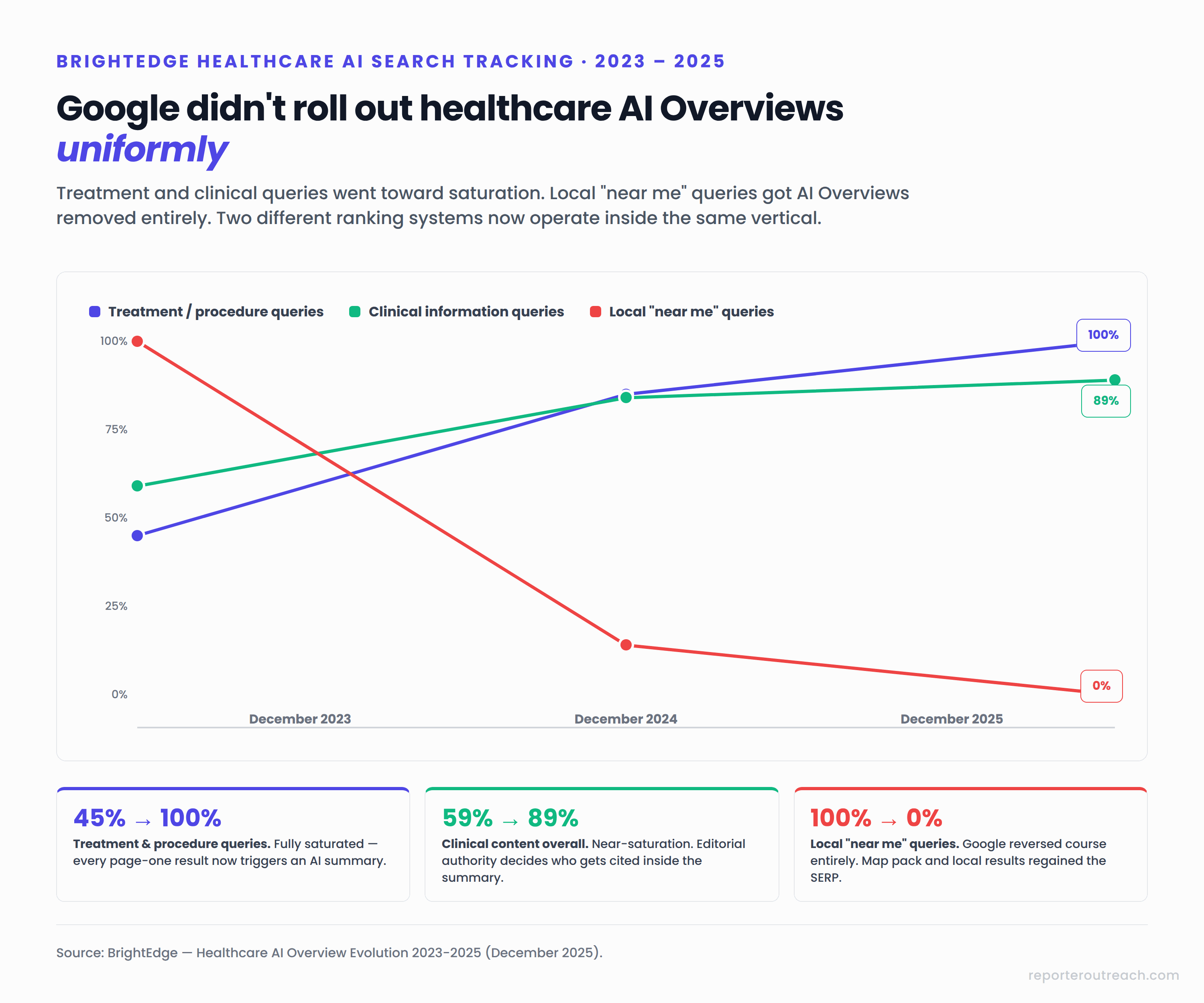
Healthcare AI Overview coverage climbed from 59% in 2023 to 89% by the end of 2025. But Google didn't apply that growth uniformly. Treatment and procedure queries went from 45% to 100% AI Overview presence — fully saturated. Clinical information queries hit 93-100%. And local "near me" queries reversed completely, dropping from 100% AI Overview presence in 2023 to 0% by December 2025.
The pattern: AI ate the clinical-information SERPs. Local provider SERPs stayed traditional. For practices, this is the actionable split — invest in editorial authority for clinical and informational content, and invest in local SEO basics for "near me" provider intent. Each lane has a different ranking system now.
And in the clinical lane, the brands cited aren't random. Conductor's data shows Healthline alone accounts for 5.76% of AI Overview share of voice in healthcare — the highest of any healthcare site. The pattern repeats across other major outlets: AI engines lean heavily on a small set of editorially trusted publications when generating health answers. A practice with 50 editorial mentions across those publications shows up in AI-generated answers. A practice with zero editorial mentions — regardless of how good their website content is — doesn't. The editorial footprint you build today determines your AI visibility for years.
Measuring What Matters
Results typically take 3-6 months to materialize in competitive niches — faster for local improvements, slower for national keywords. Track these metrics monthly:
| Metric | Tool | Why It Matters |
|---|---|---|
| Keyword rankings | Google Search Console, Ahrefs | Are you moving up for your target condition and service keywords? |
| Organic traffic | Google Analytics | Total qualified visitors from search — the volume indicator |
| Map pack visibility | GBP Insights | How often you appear in local "near me" results |
| Conversions | Google Analytics (events) | Calls, form submissions, appointment requests — the outcome that pays |
| Review count + rating | GBP, Healthgrades | Trust signals that directly influence local rankings |
| Backlink profile growth | Ahrefs | Tracks authority momentum from digital PR |
Google Search Console is the most important free tool — it shows which queries drive impressions and clicks, tracks ranking movement, and surfaces indexing problems. Pair it with Google Analytics to tie traffic to conversions and prove ROI.
Case Study: What Consistent Digital PR Actually Produces
Here's what a real healthcare digital PR campaign looks like over time.
MEDvidi — Online Mental Health Care
A telehealth platform specializing in online mental health needed authority in one of the most credentialing-sensitive corners of healthcare. We monitored journalist source platforms daily, matched health queries to their licensed clinicians' expertise, and pitched them as expert sources across publications covering anxiety, ADHD, depression, and behavioral health. Every placement: real journalists citing real clinicians.
124% organic traffic growth in a YMYL niche where editorial authority is the only path to sustained ranking gains.
See also: Villa Oasis — a luxury addiction treatment center where consistent digital PR produced 352% organic growth and 39 editorial placements over 9 months.
The 90-Day Healthcare SEO Playbook
Month 1 — Fix the foundation
Audit your Google Business Profile (or profiles, for multi-location practices). Ensure NAP consistency across every directory. Claim listings on Healthgrades, Zocdoc, Vitals, and WebMD. Upload real photos. Verify every piece of content has a named clinical author with visible credentials. Add MedicalOrganization and Physician schema. Run a backlink audit to baseline your authority.
Month 2 — Build the content layer
Optimize service pages for your highest-priority conditions — each targeting a specific keyword cluster with optimized meta descriptions. Publish 2-4 patient-focused articles answering high-volume questions. Ensure everything is clinically reviewed and dated. Build internal links between related pages.
Month 3+ — Start building authority
Begin digital PR — either by monitoring journalist source platforms yourself or by working with a specialist agency. Aim for consistent editorial placements every month. Systematize your review generation process. Monitor rankings, traffic, and conversions monthly.
The compounding nature of editorial authority means months 6-12 are when the hockey stick typically appears. Links earned in month 3 strengthen month 6 rankings, which amplify month 9 traffic.
Build the Authority That Healthcare Rankings Demand
We specialize in healthcare digital PR — earning editorial placements from health journalists that build E-E-A-T, improve rankings, and drive patient growth.
FAQ
What makes healthcare SEO different from regular SEO?
Google classifies healthcare as YMYL, applying its strictest quality standards. E-E-A-T signals — clinical authorship, editorial endorsements, and demonstrated medical authority — carry far more weight than in other industries. You can't rank in competitive health niches on content alone; you need third-party validation.
How does digital PR help with healthcare rankings?
Digital PR earns editorial backlinks and brand mentions from health journalists — the strongest E-E-A-T signals available. In YMYL categories, these signals outweigh standard link building tactics by a wide margin, and they build the citation footprint AI engines like ChatGPT, Perplexity, Gemini, and Google AI Overviews use to recommend providers.
How long until we see results?
Local improvements — GBP optimization, reviews, citation cleanup — can drive increased calls within weeks. Organic traffic growth from content and digital PR typically takes 3-6 months in moderately competitive niches, longer in highly competitive ones. Results accelerate over time as your editorial authority compounds.
What does healthcare SEO cost?
Comprehensive SEO services typically range $4,000-$8,000+/month depending on scope. Our digital PR pricing runs from $3,000/mo at the Starter tier (7 placements/mo at DR 75+ average), to $6,000/mo Growth (15 placements), to $12,000/mo Elite (32 placements). In competitive healthcare niches where a single patient can be worth $5,000-$30,000+, even modest ranking improvements produce meaningful ROI.
How do AI search engines affect healthcare providers?
AI engines like ChatGPT, Perplexity, Gemini, and Google AI Overviews select providers to cite based on editorial mention footprints across trusted sources — not website content alone. Health queries trigger AI-generated answers at a significantly higher rate than other categories, and providers without editorial coverage are effectively invisible in those results. Digital PR builds the editorial footprint these systems rely on.
How important are patient reviews for SEO?
Reviews are one of the strongest local ranking signals — and they matter even more now that Google has pulled AI Overviews out of local healthcare results. Practices with 50+ Google reviews and high ratings significantly outperform competitors in local results. Build a systematic process for requesting reviews after every positive visit.
Should we handle SEO in-house or outsource?
Most practices benefit from a hybrid: handle content and local optimization in-house (where clinical knowledge is your edge) and outsource digital PR and technical audits to specialists. The journalist relationships and cross-industry experience that agencies bring are hard to replicate internally. If you'd rather hire than build this in-house, here are the best healthcare digital PR agencies.
Sources: Conductor 2026 AEO/GEO Benchmarks Report — Healthcare (November 2025) · BrightEdge — Healthcare AI Overview Evolution 2023-2025 (December 2025) · Annenberg Public Policy Center, University of Pennsylvania — ASAPH/Annenberg Health Survey (April 2025) · Muck Rack — Generative Pulse: AI citation analysis of 25M+ links (May 2026) · Google Search Quality Rater Guidelines (2025 update)