Key Takeaways
- Medical Spa SEO operates under YMYL rules. Google applies the same E-E-A-T scrutiny to aesthetic treatment content as it does to medical content, which means editorial authority matters more than keyword targeting.
- Google reversed AI Overviews on local "near me" healthcare queries in late 2025 (BrightEdge), going from 100% coverage in 2023 to 0% by December 2025. The Local Pack is back to controlling local intent — but AI Overviews still dominate clinical and educational queries at 93–100%.
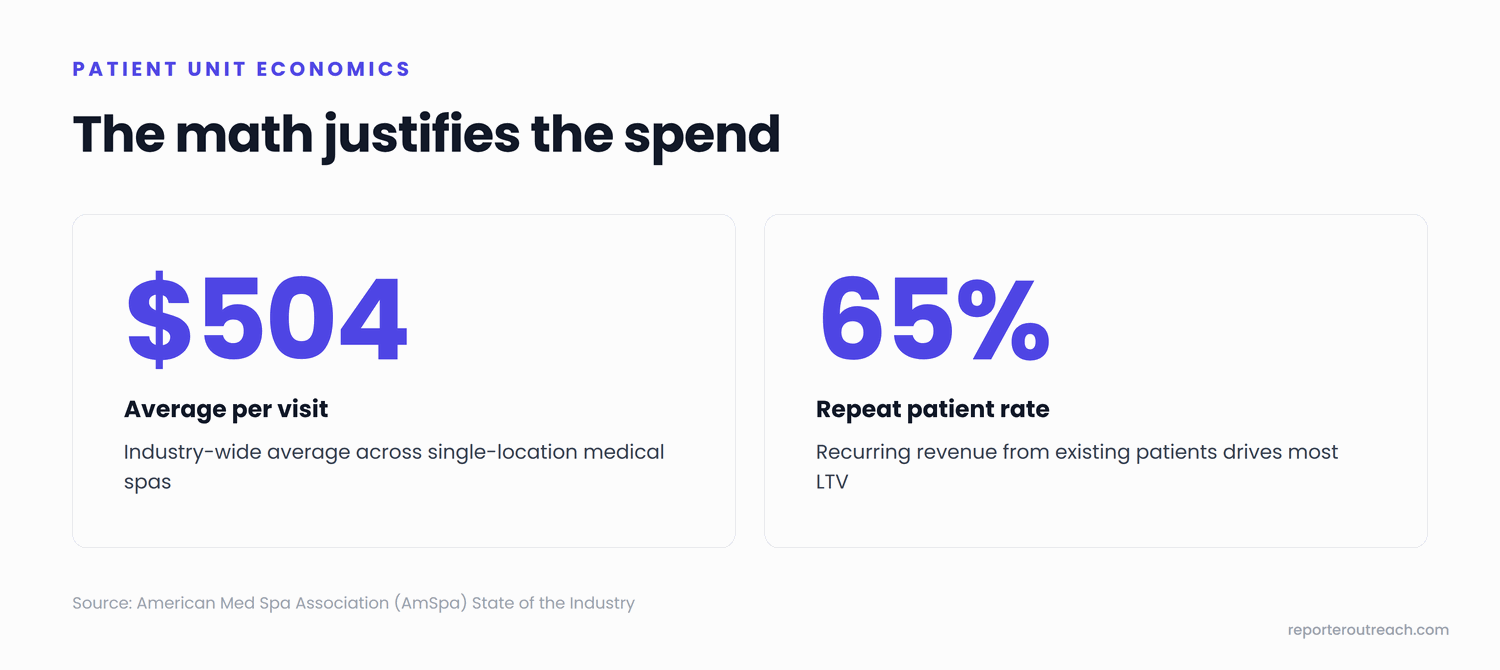
- Cost per lead on competitive aesthetic terms now routinely clears $100. With patient lifetime values of $2,000–$5,000+ and average visit spend of $504 (AmSpa), the math justifies sustained organic investment in a way few local verticals can match.
- Digital PR is the most undervalued channel for medical spas. Beauty and wellness media run on a constant supply of credentialed practitioner sources, and that demand is the leverage point most practices never use.
- The practices winning in 2026 aren't doing more SEO. They're separating their strategy into two streams: Local Pack visibility for "near me" intent, and editorial authority for AI search citations on educational queries.
Medical Spa SEO is one of the hardest local verticals to rank in, and one of the most rewarding when you do. You're not just competing against other med spas. You're competing against dermatology practices, plastic surgeons, and national chains, all chasing the same queries in the same zip codes. Cost per lead on terms like "Botox near me" routinely clears $100, with cost per click in the high single digits across aesthetic services. When the auction is that competitive on the paid side, organic competition is just as intense.
Here's what separates practices that win from those that don't: authority. Not keyword density. Not a perfect Google Business Profile alone. The practices that dominate local results have built editorial footprints — real mentions in Allure, Byrdie, Healthline, and local lifestyle press — that Google and AI systems both read as expertise signals.
This guide covers the full 2026 strategy, with a focus on what actually moves rankings in a YMYL category where every claim gets held to a higher standard. The 2026 angle that most practices are missing: AI search and local search now reward different things, and the strategy has to optimize for both.
Why Medical Spa SEO Plays by Different Rules
Three things make this vertical harder than standard local SEO.
The unit economics distort the competition. A new Botox patient is worth $2,000–$5,000 in annual revenue, with the average visit spend at $504 across the industry (AmSpa). When lifetime value is that high, paid bids reflect it, and organic competition follows the same logic. Every practice in your market is investing in the same keywords because the math works out for everyone.
Google treats your content like medical content. Med spa services fall under Your Money or Your Life — the strictest content category Google maintains. A well-written post about chemical peels won't rank if the site can't prove it has the authority to give medical advice. Authorship matters. Credentials matter. Third-party verification matters. Most of the framework from our healthcare SEO guide applies directly here, and the same constraints show up in adjacent verticals like dental SEO.
The Local Pack is the whole game for booking intent. If you're not in the top 3 map results for "med spa [city]" or "Botox [city]," you're functionally invisible for the queries that actually drive bookings. 76% of people searching for local businesses visit one within 24 hours, and 77% of patients use search engines before booking healthcare appointments (Press Ganey / Optasy). The Local Pack isn't a "nice to have." It's where bookings get decided.
Local SEO: The Foundation Everything Builds On
Before digital PR, before content, before AI optimization — get these right. They're table stakes, and practices that skip them never see the compounding effects of the work that comes later.
Google Business Profile, done properly
Your GBP controls the Local Pack. It's the single most important local asset you own, and a proper setup isn't complicated — it's just thorough. Primary category should be "Medical Spa," not "Day Spa" or "Beauty Salon." Category choice alone makes or breaks rankings. Add secondary categories for specific services (Laser Hair Removal, Skin Care Clinic, Cosmetic Surgery Clinic). Complete every field. Upload 20+ professional photos. Post weekly. Answer every review within 24 hours, positive and negative.
Review velocity, not just volume
Reviews are the second-strongest local ranking factor after GBP optimization, but the pattern matters more than the number. Practices with 100+ reviews at a consistent, steady velocity outrank competitors who got 50 reviews in one burst and then nothing. 90% of patients use online reviews to evaluate providers, and most read at least five before booking (Healthgrades). Worse, 31% of consumers in 2026 will only use a business with 4.5 stars or more — up from 17% in 2025 (BrightLocal). Standards are rising fast.
Build a system. Automated text after each appointment with a direct Google review link. Front-desk mention during checkout. Don't incentivize, don't outsource, don't script. Make it easy for happy patients to leave a review, and the volume follows.
Treatment pages that earn their ranking
A treatment page that says "We offer Botox. Book now!" will never rank. Every service needs a dedicated page — one per treatment, per location if you're multi-location. Each page should include H1 with treatment plus city, practitioner credentials (who performs it, where they trained, what certifications they hold), pricing transparency or at least a starting range, before/after photos with descriptive alt text, FAQ schema addressing common patient questions, and treatment details on candidacy, expectations, recovery, and side effects.
This isn't SEO padding. It's what a skeptical patient actually needs before booking a procedure that affects their face.
Technical basics
Load time under 3 seconds. Mobile-first — the majority of medical searches happen on phones. Clean URL structure. Internal links between treatment pages and blog content. External links to authoritative sources (American Med Spa Association, FDA device pages) where they add value. This work is boring. It's also non-negotiable.
Content That Satisfies E-E-A-T, Not Just Keywords
For YMYL queries, Google evaluates content against the strictest Experience, Expertise, Authoritativeness, and Trust standards. Healthcare organizations with physician-authored content see 3.2x higher organic traffic than those running generic marketing copy (Semrush Health Study). The signal is that strong.
Author attribution isn't optional. Every piece of clinical content needs a named author with a linked bio. "Staff writer" doesn't pass. Your medical director, lead nurse practitioner, or senior aestheticians should be the bylines on educational content. That attribution signal is how Google distinguishes authoritative medical content from content marketing noise.
Treatment education guides matter more than blog posts. Write comprehensive guides for each major procedure category — "What is microneedling," "How long does Botox last," "CoolSculpting vs. liposuction." These target informational queries from patients in the research phase, who are qualifying practices right now even if they're not ready to book today.
Practitioner-authored opinion content is where most practices leave authority on the table. Have your medical director publish opinion pieces: why they prefer one injectable over another, what they think of the latest laser device, what patient safety looks like at your practice. This builds topical authority and, critically, creates the expert profiles that journalists search for when sourcing trend pieces.
Seasonal and trend content captures time-sensitive traffic. Pre-wedding skin prep in spring. Summer body contouring in late winter. Party-ready skin in fall. These pieces support digital PR efforts when journalists are writing about the same trends.
Digital PR: Where Med Spas Have an Unfair Advantage
Here's the core argument of this whole guide: medical spas are better positioned for digital PR than almost any other local business. (How we run these campaigns across medical verticals is on our healthcare digital PR page.) Beauty, wellness, and lifestyle media are one of the largest editorial categories on the web. Every trend cycle — new injectables, new devices, skincare controversies, seasonal treatments — creates source demand. Your practitioners are exactly who those journalists are trying to reach.
How reactive PR works
Reactive PR means monitoring journalist requests and responding with expert commentary when a query matches your practitioners' expertise. Platforms like Qwoted, Featured, and Source of Sources (covered in our media outreach playbook) are where reporters for Allure, Byrdie, Healthline, Cosmopolitan, and local outlets post daily queries. Sample requests look like:
- "Best non-invasive treatments for skin tightening after 40?"
- "Dermatologists and aestheticians on the Botox backlash trend"
- "Newest laser treatments worth trying in 2026?"
- "How to choose a safe aesthetic practice"
When your medical director responds with credentialed, thoughtful commentary, the journalist often includes the quote — with a link to your site. One placement delivers three things at once: a backlink from a high-authority publication, a brand mention that AI search systems weight heavily, and direct referral traffic from readers who fit your buyer profile better than almost any other source.
Why this works better for med spas than most verticals
Beauty and wellness journalists need expert quotes constantly. Trade journals, lifestyle magazines, syndicated columns, podcast bookings — the source-demand curve is uniquely high in this category. Most local businesses can't credibly source for national media. Aesthetic practitioners can.
The typical digital PR campaign in this space earns links from publications with domain ratings of 60+, with regular placements in DR 80+ outlets. And because brand mentions correlate more strongly with AI search citations than raw backlinks do, digital PR is one of the only strategies that builds traditional authority and AI visibility simultaneously. For the deeper argument, see our breakdown of how digital PR builds links.
What this looks like in practice
Aesthetic medicine clinic, 6-month campaign
A reactive PR campaign for an aesthetic medicine clinic earned editorial placements across NBC News, The Wall Street Journal, Daily Mail, Woman's World, and Real Simple over six months. Practitioners were quoted in trend pieces on injectables, recovery protocols, and treatment safety — the exact source demand that runs continuously in beauty and wellness media.
Anonymized client. Results documented over the campaign period.
The compounding effect is what most practices miss. Editorial placements don't expire. Each link continues passing authority for years, and each brand mention continues training AI systems to associate your practice with the topics those articles cover. Six months of consistent reactive PR produces a backlink profile that would cost an order of magnitude more to acquire through any other method. More examples in our case studies.
AI Search Visibility Has a Unique Twist for Med Spas
This is where most med spa SEO advice goes wrong. The standard pitch is "AI search is here, optimize everything for it." That's incomplete. Google's AI Overview behavior on healthcare queries split sharply over the last two years, and the implications for medical spas are unique.
Here's what BrightEdge found across three years of healthcare AI Overview tracking:
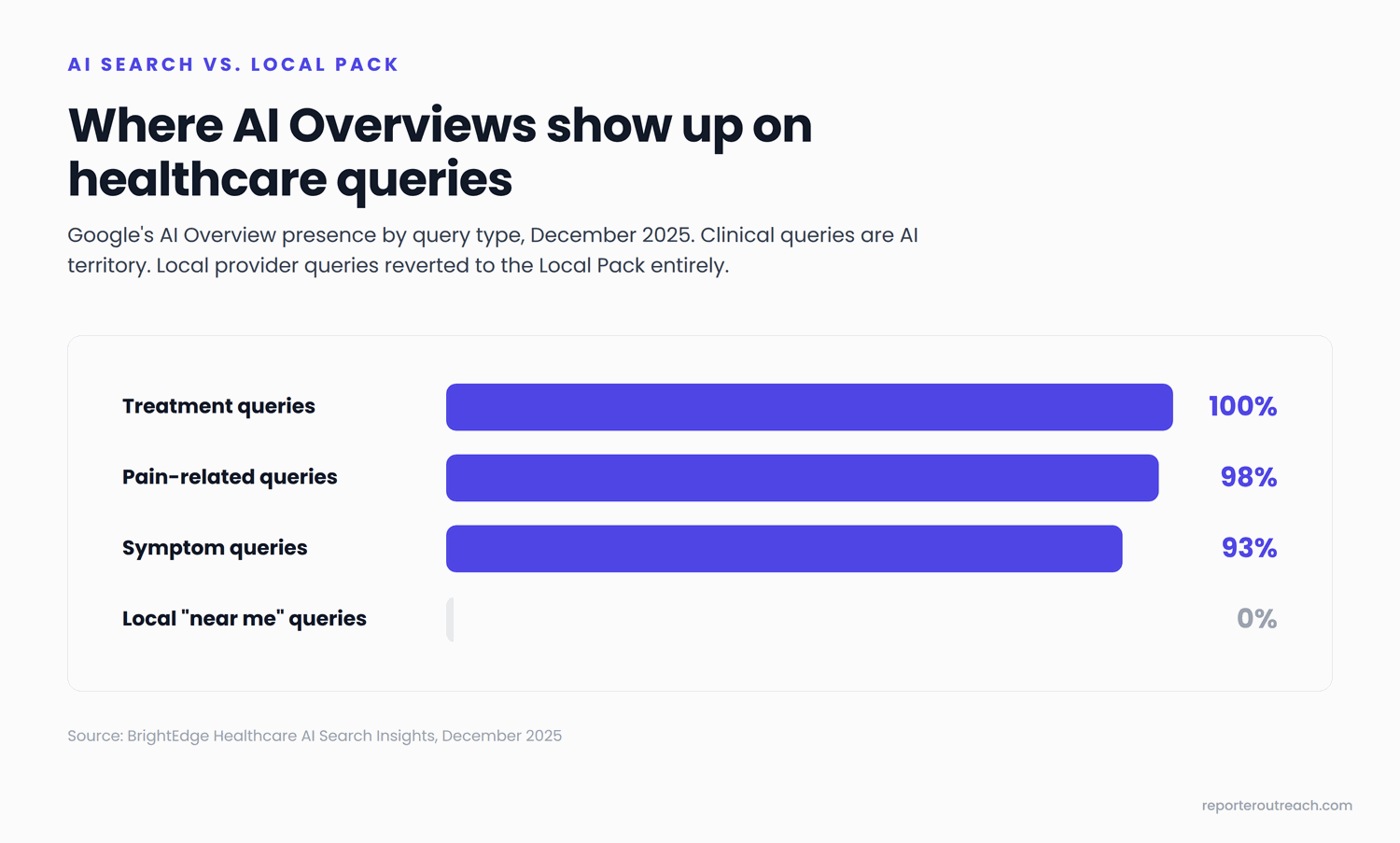
Treatment queries, pain queries, and symptom queries are now near-fully covered by AI Overviews. Clinical content is AI territory, and the brands cited inside those answers are the ones with editorial mention footprints across third-party publications.
But local provider queries went the opposite direction. "Dermatologist near me," "best med spa near me," "Botox near me" — Google tested AI Overviews on these in 2023 (100% coverage) and removed them entirely by December 2025 (0% coverage). Google reversed course on local healthcare. The Local Pack is back to controlling these queries.
For medical spas, that split is the strategy:
- For local intent ("med spa [city]," "Botox near me," "best laser hair removal [city]"): Local Pack visibility wins. Optimize GBP, build review velocity, run technical SEO basics. AI Overviews aren't competing for these clicks anymore.
- For educational and clinical intent ("how long does Botox last," "what is microneedling," "CoolSculpting recovery"): AI Overviews dominate. The way to appear in those answers is to earn the third-party editorial mentions that AI systems verify expertise through.
The practices winning in 2026 are running both streams in parallel. They're treating their educational content as AI-citation bait (with FAQ schema, named practitioner authors, and editorial mentions in the same publications AI systems trust) and their local pages as Local Pack optimization plays. ChatGPT Health launched in January 2026 and now serves 230M weekly users — a significant slice of which are asking exactly the kinds of educational health questions where editorial authority decides who gets cited. For the full framework on optimizing for AI search, see our GEO guide.
Investment Levels and What to Actually Expect
The most common question we get from med spa owners is what level of spend actually moves the needle. The honest answer depends on what publication tier and pacing you need, not on the practice's size.
Here's how investment scales — and what changes at each level:

The visual shows how the capability stack grows tier-to-tier. The table below shows what specifically each tier includes for a medical spa.
| Tier | Monthly investment | What's included | Team needed |
|---|---|---|---|
| Starter | $3,000/mo | Reactive PR cadence on Tier 1 health, beauty, and lifestyle publications | In-house lead + agency partner |
| Growth | $6,000/mo | Reactive + proactive pitching on Tier 1 publications; higher placement volume | Internal SEO + agency + credentialed practitioners |
| Elite | $12,000/mo | Sustained editorial cadence on Tier 1 publications; AI visibility focus | In-house team + agency + content + practitioners |
Pacing is the same across all three tiers. First placements appear in 2–3 weeks regardless of investment level. Ranking shifts show up in 3–6 months. More pronounced movement comes in months 6–12 as authority compounds. Publication tier is also constant — campaigns target Tier 1 health, beauty, and lifestyle publications across every package. What scales with investment is editorial volume and cadence: how many placements per month, and whether the program is reactive only or includes proactive story development. This is the most misunderstood part of digital PR economics.
Given a single Botox patient's annual revenue of $2,000–$5,000 and patient acquisition costs running $150–$350 across the industry, the unit economics work out favorably even at the Starter tier. The math gets more obvious as you scale up.
Common Mistakes That Kill Med Spa SEO
Stopping the program at month 3. This is the single most common failure. Practices invest for 90 days, see modest results, and pull the budget right before compounding kicks in. The difference between a 3-month and a 6-month commitment is rarely 2x — it's often 5–10x, because compounding is exponential. If you don't have 6 months of runway, don't start the program.
Generic blog content from a content mill. Unsigned posts about "5 benefits of Botox" don't rank in YMYL categories. Google reads unsigned clinical content as low-authority by default. Every piece of clinical content needs a credentialed byline, and ideally a real practitioner perspective rather than rewritten facts from other sites.
Hiring a generalist agency for a YMYL vertical. Aesthetic medicine SEO requires familiarity with FTC rules on cosmetic claims, AMA guidelines on practitioner credentialing in marketing, and state-by-state rules on who can perform medical procedures. A regional dental SEO agency will get you ranking, but it will also write you into compliance problems. Match the specialty to the vertical.
Buying low-quality links. PBNs and directory-farm links are net negative in YMYL categories. Google scrutinizes medical link profiles harder than almost any other vertical. Invest in editorial links or don't buy links at all.
No review generation system. Below 50 reviews or a 4.5 rating, you won't appear in the Local Pack for competitive queries. Review velocity is a ranking factor, not a vanity metric — and consumer expectations on star ratings are rising sharply year-over-year.
Treating AI search and local SEO as the same problem. They aren't. Local intent queries get the Local Pack. Educational and clinical queries get AI Overviews. Optimizing the same page for both rarely wins either.
What Results Actually Look Like
Most practices kill the program right before compounding hits. Here's the real timeline:
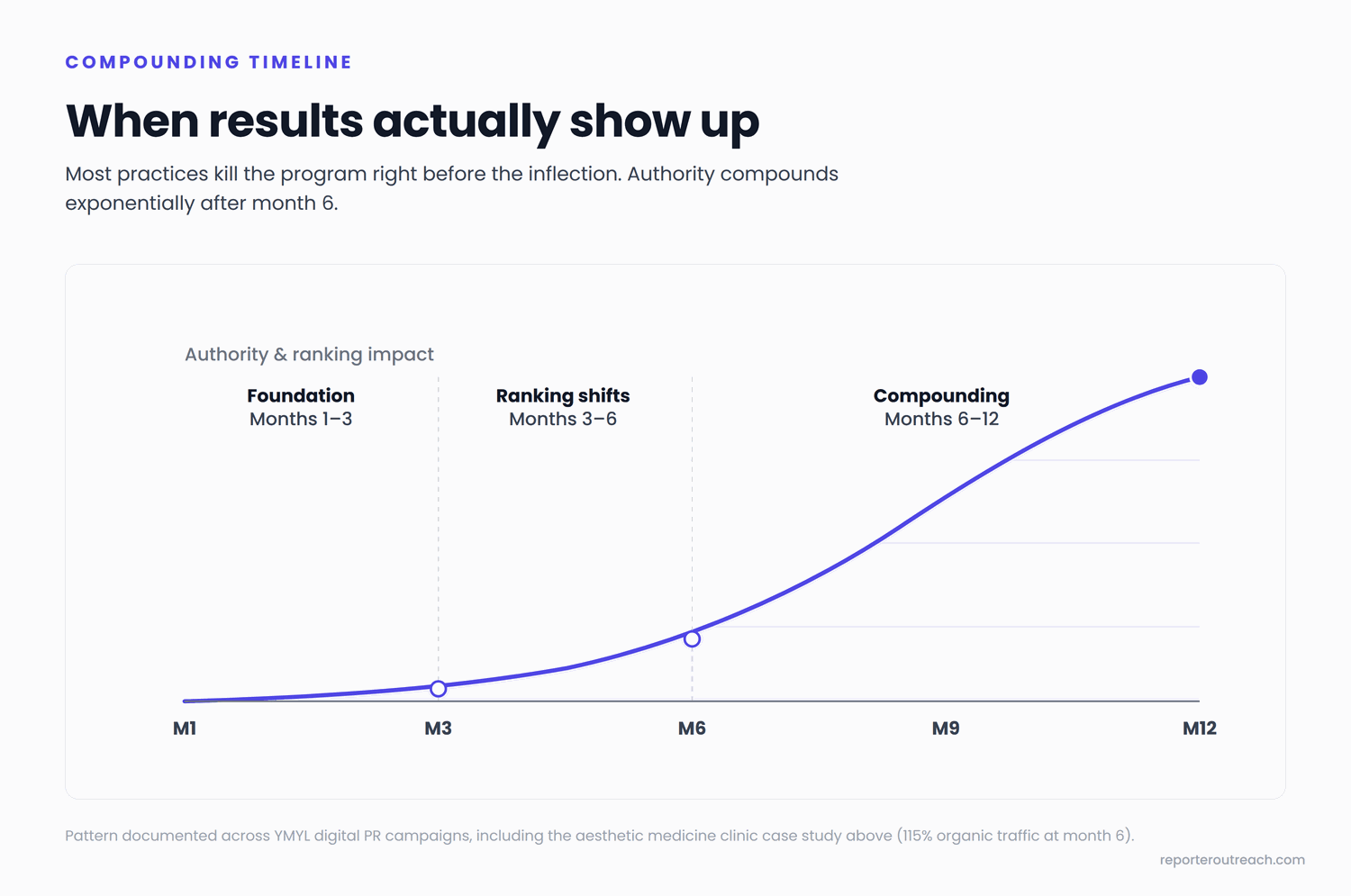
The first 90 days are foundation-laying. GBP optimization, technical fixes, content launches, first reactive PR placements. You'll see early signals — improved Local Pack positions for less-competitive queries, first wave of editorial mentions, traffic ticking up. Not a hockey stick yet.
Months 3–6 is where ranking shifts start becoming visible. Treatment pages climbing for moderate-competition keywords. Domain rating moving up as editorial links accumulate. Local Pack appearances expanding to more competitive query sets.
Months 6–12 is the inflection. Authority compounds. Each new editorial placement makes the next one easier to earn. Each ranking improvement compounds with the next as Google reads sustained authority signals. The aesthetic clinic case study above hit 115% organic growth at month 6 — that trajectory typically continues, with year-over-year gains often outpacing the first six months.
The mechanics are well-documented across YMYL verticals. Practitioners respond to journalist queries, earn editorial citations, and build the authority profile that Google and AI systems reward. The pattern is identical for medical spas, drug rehab, and other healthcare-adjacent categories. What changes is the audience — and beauty and wellness media happens to be one of the most source-hungry editorial categories on the web.
Ready to build real authority?
Reporter Outreach earns editorial links from health and beauty publications that move rankings and build AI visibility. See what's possible for your practice.
Medical Spa SEO FAQ
How long does medical spa SEO take to show results?
Most practices see Local Pack movement within 2–3 months of proper GBP optimization and review velocity. Organic ranking improvements on competitive treatment keywords typically show in months 4–6, with significant acceleration through month 12 as editorial authority compounds. First digital PR placements appear in 2–3 weeks regardless of investment scale.
How much should a med spa invest monthly in SEO?
Comprehensive programs run $3,000 to $12,000 per month depending on the editorial volume and cadence you need. Given annual patient values of $2,000–$5,000 and patient acquisition costs of $150–$350 industry-wide, the unit economics work out favorably across all investment levels. The lower tiers focus on reactive PR cadence; the higher tiers add proactive story development and sustained editorial volume.
Is digital PR worth it for a single-location practice?
Yes, and arguably more so than for multi-location chains. Editorial authority lifts every treatment page on the site, not just blog content. A single mention in Allure or Byrdie adds credibility that search engines, AI systems, and prospective patients all recognize, and the authority compounds — each placement makes the next one easier to earn.
What keywords should a medical spa target first?
Start with the highest-revenue treatments paired with city: Botox [city], CoolSculpting [city], medical spa [city]. These are Local Pack queries where AI Overviews no longer compete. Then expand into treatment education ("how long does Botox last," "microneedling recovery") and comparisons ("Botox vs. Dysport") — these are the queries where editorial authority and AI Overview citations decide visibility.
What's the difference between medical spa SEO and broader medical SEO?
Medical spa SEO is heavily local. Most bookings come from Local Pack visibility on geographic queries. Medical SEO for hospitals or specialty practices involves more informational and non-local content. Med spas operate closer to a hybrid of local retail SEO and YMYL content authority than to traditional hospital SEO.
How do I get my medical spa cited in AI search results?
AI systems cite brands they can verify through third-party editorial sources. The most effective path is digital PR that generates both backlinks and brand mentions across trusted publications. When multiple authoritative sources reference your practitioners, AI systems learn to recommend you by name on educational and clinical queries — the queries where AI Overviews now appear at 93–100% rates.
Does the Local Pack still matter if AI is taking over search?
For medical spas, yes — more than ever. Google removed AI Overviews from local healthcare queries entirely between 2023 and 2025 (BrightEdge). "Near me" intent now goes back to the Local Pack. AI Overviews dominate clinical and educational queries, but the queries that drive bookings are still won by GBP optimization, reviews, and Local Pack visibility.
Sources
BrightEdge — Healthcare AI Search Insights (December 2025); American Med Spa Association (AmSpa) — State of the Industry; Healthgrades — Online Reviews Impact How Patients Select Hospitals and Doctors (2024); BrightLocal — Local Consumer Review Survey 2026; Press Ganey / Optasy — Patient Search Behavior Analysis (2025); Semrush Health Study — Healthcare Content Performance; Google Trends — "Doctor near me" search volume (2020–2025); WordStream — Google Ads Industry Benchmarks 2026; OpenAI — ChatGPT Health Launch (January 2026); Reporter Outreach client campaign data (anonymized).