Key Takeaways
- Over 1.2 million monthly Google searches for "dentist near me" in the U.S. alone (Semrush). The top 3 organic results dominate click share; positions 4 and below are near-invisible by comparison.
- Most dental SEO guides stop at Google Business Profile and on-page optimization. Those are table stakes. The actual ranking gap between local practices is almost always off-page authority — backlinks and brand mentions from health publications and local news.
- Dental websites are YMYL (Your Money or Your Life), so Google holds them to higher E-E-A-T standards. Editorial backlinks from credible health outlets carry far more weight than directory listings.
- Digital PR is the most efficient way to close that gap — earning editorial coverage that improves Google rankings and feeds the brand signals AI search engines (ChatGPT, Perplexity, Gemini, Google AI Overviews) cite when patients ask them for recommendations.
There are roughly 135,000 dental practices in the United States (ADA, 2023). Every one serves a local market. And in every local market, patients find their next dentist the same way: they search.
Annenberg's 2025 healthcare information survey found that nearly 8 in 10 adults are likely to search online when looking up a health condition or symptom — and 65% have already encountered AI-generated answers at the top of those results. For dental practices, that means showing up in the Local Pack, organic results, and increasingly in the AI summaries Google now puts above everything else. The practices that appear in all three capture a disproportionate share of new patients. This guide is about what gets you in that group in 2026, with particular emphasis on the off-page authority work most dental SEO advice ignores.
What's Changed in 2026
Three shifts have reshaped what it actually takes to rank a dental practice:
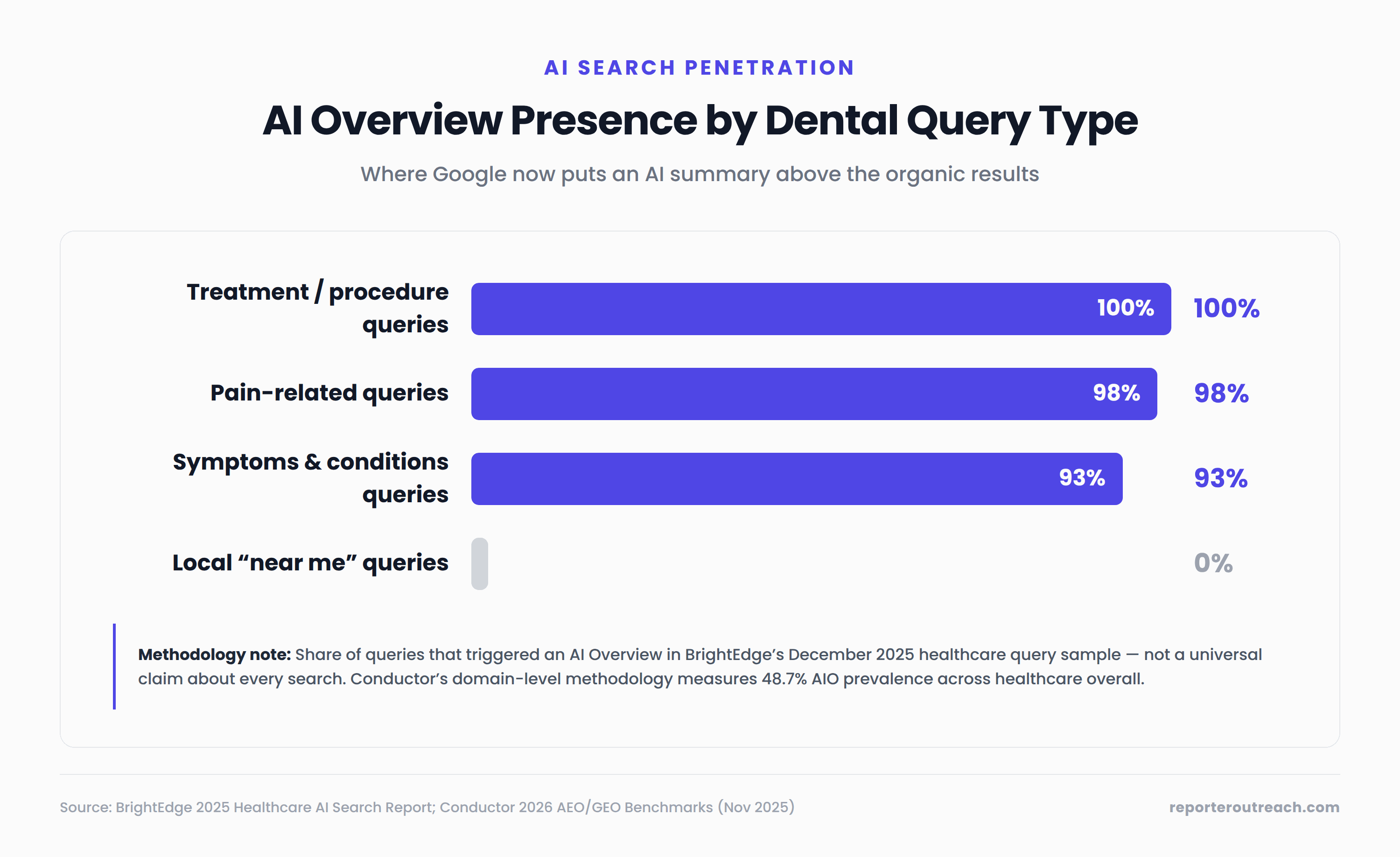
AI search is now a discovery channel — not a curiosity. Conductor's 2026 AEO/GEO Benchmarks Report (released November 2025) found that 48.7% of healthcare-related queries now trigger an AI Overview. BrightEdge's December 2025 healthcare report measured it differently and went deeper by query type — within their tracked sample, every treatment and procedure query returned an AI Overview, pain-related queries did so 98% of the time, symptoms and conditions queries 93%, while local "near me" queries dropped from 100% AI Overview presence in 2023 to 0% (Google now routes those searches to the map results below). ChatGPT, Perplexity, Gemini, and Google AI Overviews all pull from the same pool of authoritative health sources when patients ask them to recommend a provider. Practices mentioned in editorial health publications get cited. Practices that only exist on their own site and a few directories typically don't.
YMYL standards are stricter than ever. Google classifies dental websites as "Your Money or Your Life" content — the category held to the highest E-E-A-T standards on the web. A dental site needs to demonstrate genuine expertise through credentialed clinician bios, links from reputable health publications, and original content that holds up to scrutiny — not just optimized service pages. See our E-E-A-T checklist for what that actually looks like in practice.
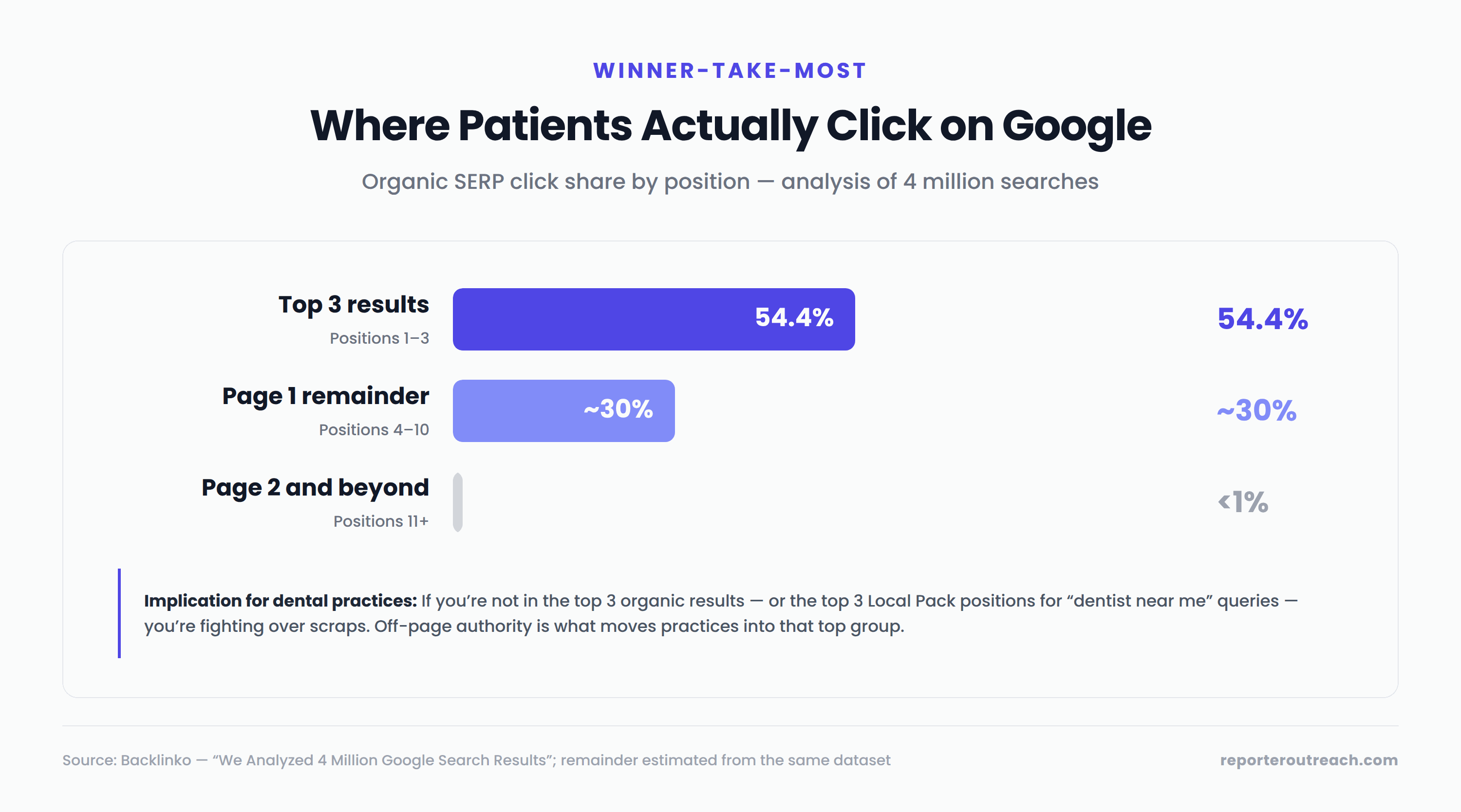
The Local Pack is winner-take-most. Backlinko's analysis of 4 million Google search results found the top three organic results capture roughly 54% of all clicks; positions 4 and below fight over the remainder. For the Local Pack specifically — the map results that appear for queries like "dentist near me" — the concentration is even tighter at the top. And the factors determining who sits in those top three positions have shifted decisively toward off-page signals: reviews, brand mentions, and backlinks.
Local SEO: The Foundation
Forty-six percent of all Google searches have local intent (BrightLocal). For dental practices, these fundamentals aren't optional — they're the price of admission.
Google Business Profile
Your GBP is often a patient's first contact with your practice. Use "Dentist" as your primary category — SterlingSky's research found it's the highest-performing primary category for the vertical. Add accurate secondary categories for services you actually provide, keep NAP (name, address, phone) identical everywhere, upload real photos regularly, and respond to every review.
Reviews are your most powerful local signal
A 2019 IronMonk survey of 1,500 Americans (published via PRNewswire) found that 43.3% of respondents said they'd choose a dentist based on online reviews — more than proximity (19.4%) or search rank (18.4%). The data is six years old, but the pattern hasn't budged: when patients see three or four practices in the Local Pack, the one with the strongest review profile typically wins the click.
The practical tipping point: a 4.7+ star rating with consistent recent volume is where new patient call volume meaningfully increases. Volume matters too — a practice with 400 reviews and a 4.6 rating absorbs the occasional bad review without flinching. A practice with 30 reviews and one bad week can drop two tenths of a star and lose Local Pack visibility for a month.
Google's local algorithm also evaluates review presence on Healthgrades, Yelp, and Zocdoc. A practice with 300 Google reviews and zero presence on health-vertical platforms looks less credible than one with 200 Google reviews and 50+ spread across health-specific sites. The latter is what Google reads as a real healthcare provider with a verifiable patient base.
NAP consistency and citations
Your practice name, address, and phone number must be identical across your website, GBP, Yelp, Healthgrades, Zocdoc, local chamber of commerce, and every other listing. Even "Suite 100" vs. "Ste. 100" erodes confidence signals over time. Submit to the major directories (Bing Places, Apple Maps, Healthgrades, WebMD, Zocdoc), then audit quarterly — listing data decays faster than most owners realize.
On-Page Essentials
Dedicated service pages. Every service — implants, Invisalign, emergency care, cosmetic dentistry, pediatric care — gets its own page with a location-modified title tag ("Dental Implants in [City] | [Practice Name]"). One sprawling "Services" page covering everything is the single most common on-page mistake for dental sites.
Content clusters. Build topical depth around your core services. A pillar page on "Cosmetic Dentistry" supported by articles on veneers vs. bonding, whitening aftercare, Invisalign timelines, and cost expectations. Internal linking between these tells Google you have genuine expertise — which matters more for YMYL content than it does for most other verticals.
Schema markup. Implement LocalBusiness, Dentist, and FAQ schema. This makes your site eligible for rich snippets and gives AI parsing tools clean structured data to work with.
Mobile and speed. Over 60% of dental searches happen on mobile. Target under 3 seconds load time and passing Core Web Vitals — anything slower and you're paying a ranking penalty on top of the bounces.
E-E-A-T on every page. Dentist bios with credentials, professional association memberships, and a real photo. Patient testimonials with names and treatments. Links to peer-reviewed sources when discussing clinical topics. This isn't optional polish — it's the baseline for any YMYL healthcare site that wants to rank.
The Authority Gap Most Practices Ignore
Here's what most dental SEO advice doesn't tell you: in any competitive local market, the biggest ranking gap between practices is almost always off-page authority.
Every serious local competitor eventually optimizes their GBP, builds decent service pages, and collects reviews. Within a couple of years, those become table stakes. The factor determining who gets position 1 vs. position 4 in the Local Pack — who ranks organically for "best dentist in [city]," who gets cited when a patient asks ChatGPT for a recommendation — is the strength of the backlink profile.
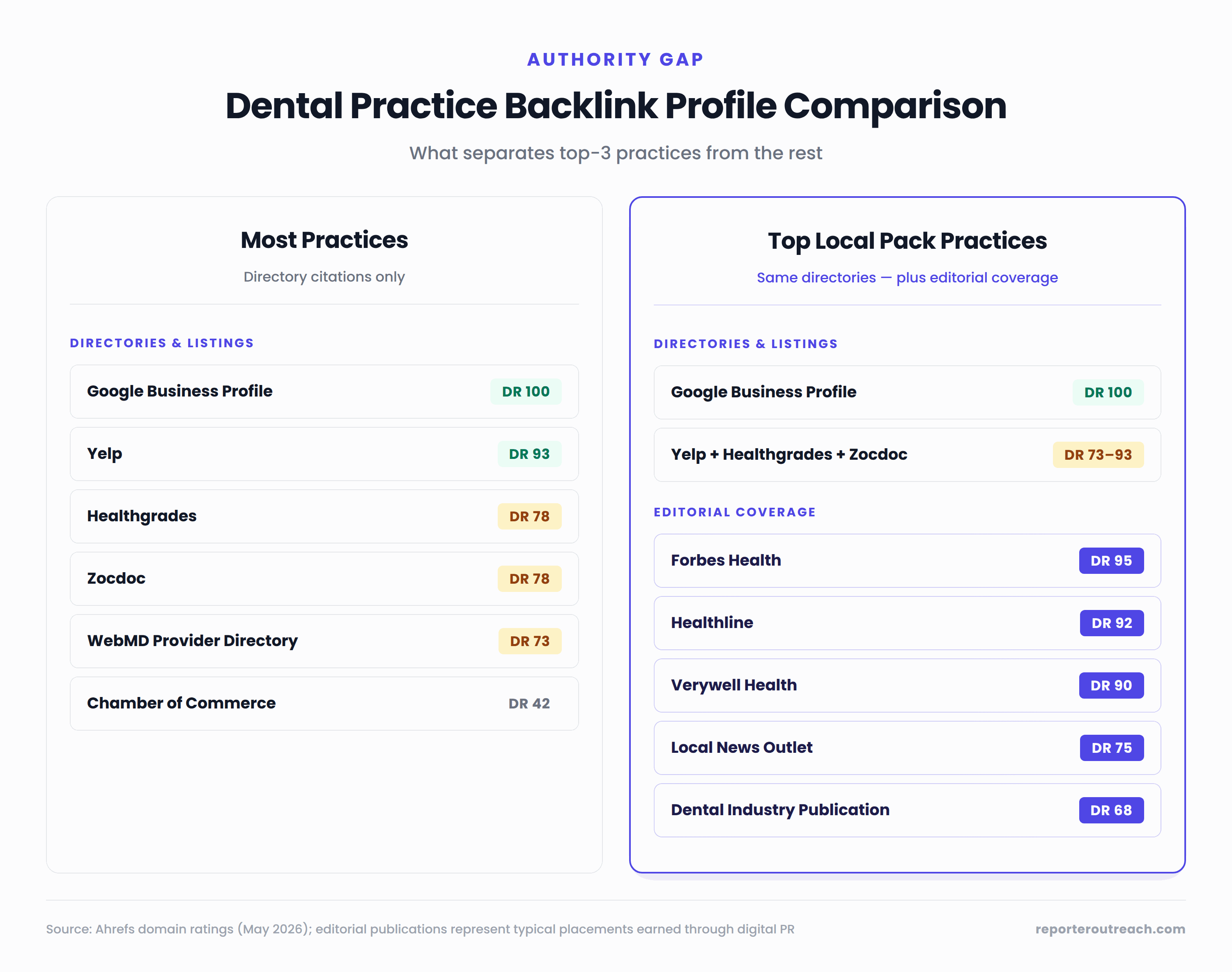
A practice with backlinks from health publications, local news outlets, and dental association sites has a fundamentally different authority profile than one with only directory listings. Google reads the first as an endorsed, credible source. AI search engines treat those same editorial mentions as primary trust signals when deciding which providers to recommend.
Local news is part of the same picture. Pew Research has consistently found that Americans trust local news brands more than national ones — 70% of U.S. adults say they trust their local news outlets, compared to 56% for national news. For a local practice, a single feature in your city's largest newspaper or local news station's site sends a stronger trust signal than a dozen low-DR directory citations.
How to Build Authority for a Dental Practice
Four approaches, ranked by impact:
1. Digital PR — earning editorial coverage as the expert dentist. Healthcare digital PR positions dentists as quoted expert sources in health publications, news outlets, and dental industry media. When a journalist needs a source for an article about whitening trends, pediatric dental anxiety, or the link between diet and oral health, your dentist gets quoted with a backlink to the practice site. These editorial links are the highest-value links a practice can earn: DR 70-90+ health and news domains, contextually relevant, and they build the brand signals AI search engines look for. A handful of placements per quarter is often enough to close the authority gap against local competitors.
2. Niche edits on health and dental sites. Editorial outreach can also place your link inside existing content on high-authority health and wellness sites. Because the linking page is already indexed and earning traffic, authority passes without the ramp-up time a freshly published article requires.
3. Linkable content assets. Create resources other sites naturally want to reference: dental anxiety statistics, an implant cost calculator, a guide to dental insurance coverage by state. These compound over time as other writers find and link to them — which is exactly what AI search engines now reward.
4. Local link building. Sponsor local events, partner with schools for dental health education, participate in community health fairs, join the chamber of commerce. Each generates a backlink from a locally relevant source that strengthens both local pack signals and overall domain authority.
Dental SEO vs. Google Ads
This is the question every practice owner asks. The honest answer is both — but the economics are lopsided.
Google Ads deliver immediate visibility that disappears the moment your budget runs out. Competitive dental keywords average around $24 per click in major metros. A $3,000/month spend generates roughly 125 clicks — and only a fraction convert to actual appointments. When you stop paying, the visibility stops with it.
Dental SEO builds compounding organic traffic. The #1 organic result captures roughly a third of all clicks, and patients consistently trust organic results more than ads. A well-optimized service page can attract patients for years without per-click costs.
The smart approach: run Google Ads for immediate patient flow — especially high-value services like implants and emergency care — while investing in SEO for sustainable growth. As organic rankings improve, gradually reduce ad spend without losing patient volume. See our breakdown of link building ROI for the full math.
Mistakes That Keep Practices Stuck
Relying on GBP alone. If your competitors also have optimized profiles (and they do), the tiebreaker is off-page authority. Many practices never invest there and stay parked in position 4 wondering what they're missing.
Buying cheap links. Dental practices are heavily targeted by vendors selling directory blasts and PBN links. For YMYL healthcare sites, Google's quality algorithms are especially aggressive at identifying these patterns — and the December 2022 link spam update remains the model for how SpamBrain handles low-quality backlinks. A site flagged here can take 12-18 months to recover.
One "Services" page. A bullet-point list of every service won't compete against a practice with 20 detailed, interlinked service pages. Topical depth is how Google determines expertise for YMYL topics, and it's the single biggest content-side gap on most dental sites.
Ignoring AI search. In 2026, AI tools don't just look at your website — they evaluate your presence across the entire web. Practices with editorial mentions in health publications are far more likely to be recommended by ChatGPT, Perplexity, Gemini, and Google AI Overviews than practices existing only on their own domain. See our generative engine optimization guide for the full framework.
All ads, no SEO. Relying exclusively on paid search means renting visibility instead of building it. A high organic ranking is a trust signal no ad placement can replicate — patients implicitly read "this practice is here because they earned it" vs. "this practice paid to be here."
What This Looks Like in Practice
Dental sites and addiction-treatment sites sit in the same YMYL bucket, and the authority-building playbook is nearly identical. Villa Oasis, a luxury rehab center in San Diego, faced the same challenge most dental practices do: how to build domain authority in a YMYL category where Google scrutinizes every link.
Instead of relying on directories and paid ads, the strategy focused on earning editorial backlinks from trusted health publications — building the E-E-A-T signals Google requires for any YMYL site. Across nine months, Villa Oasis earned 39 editorial placements and mentions averaging DR 80 across health and lifestyle outlets including Verywell Mind, PsychCentral, PopSugar, and Los Angeles Magazine.
The high-DR editorial links did more than improve rankings — they built the kind of credible third-party mentions Google requires for YMYL content and AI engines pull from when generating provider recommendations. A dental practice running the same playbook in its own city should expect similar shape, if not the exact magnitude.
Build the Authority Your Practice Needs to Rank.
Editorial backlinks from health publications and news outlets — the E-E-A-T signals Google requires for healthcare sites.
Frequently Asked Questions
How much does dental SEO cost?
Most reputable providers charge $1,500 to $5,000 per month for ongoing dental SEO services, with project-based work ranging from $5,000 to $30,000 depending on scope. The single largest line item in a serious dental SEO budget is usually link building or digital PR — which is exactly the layer most cheap providers skip.
How long until I see results?
Meaningful ranking improvements typically show up within 3-6 months. Significant results — top-3 Local Pack placements, sustained organic traffic growth — usually take 6-12 months. Practices investing in digital PR often see movement faster because high-authority editorial links carry a larger per-link impact. Our link building timeline guide has real campaign data.
SEO or Google Ads — which should I invest in?
Both, but they solve different problems. Ads deliver immediate visibility at roughly $24/click that stops when the budget stops. SEO builds compounding organic traffic that grows over time and converts at a higher rate for healthcare verticals. The strongest strategies combine ads for immediate patient flow with SEO investment for sustainable growth.
Why do backlinks matter for a local dental practice?
In any competitive local market, most practices have decent on-page SEO and an optimized GBP. The factor that determines Local Pack position is off-page authority — the number and quality of sites linking to your practice. Editorial backlinks from health publications and local news outlets satisfy Google's heightened YMYL quality standards in a way directory citations can't.
How does AI search affect dental practices?
Patients increasingly ask ChatGPT, Perplexity, Gemini, and Google AI Overviews to recommend providers directly. Those engines prioritize practices with strong third-party mentions across the web — particularly in health publications and news outlets. Practices that invest in earned editorial coverage are positioned to capture this fast-growing channel; practices that don't usually aren't cited at all.
Can a single-location practice compete with DSOs?
Yes — often more effectively in local search than at the brand level. Dental Support Organizations have domain authority at the corporate level, but local search rewards location-specific relevance. A single practice with strong reviews, locally relevant backlinks, and a few editorial mentions in city-level publications can outrank DSO locations that rely on national authority without local signal density.
Sources: ADA — 135,000+ U.S. dental practices (2023) · Semrush Keyword Overview Tool — 1.2M monthly "dentist near me" searches · Annenberg Public Policy Center / UPenn — April 2025 healthcare information survey (1,600+ adults) · Conductor — 2026 AEO/GEO Benchmarks Report (released November 2025) · BrightEdge — 2025 Healthcare AI Search Report · Backlinko — "We Analyzed 4 Million Google Search Results" click distribution study · BrightLocal — 46% of Google searches have local intent · IronMonk via PRNewswire — August 2019 survey of 1,500 Americans on dentist selection · SterlingSky — GBP primary category research · Pew Research Center — 2024 trust in local vs. national news survey · SEO.com — dental SEO pricing benchmarks