Key Takeaways
- SaaS link building has to serve a buying committee of 22 people on average — 13 internal and 9 outside — each landing on a different page through a different query.
- Editorial outreach is the only method that earns both ranking authority and AI search visibility in a single placement. Everything else is supplementary.
- The pages that drive SaaS revenue — comparison, pricing, feature, demo — almost never attract links directly. Build domain-level authority and route it inward via internal links.
- AI Overview presence on B2B tech queries jumped from 36% to 82% in twelve months. When buyers ask AI engines to recommend software, editorial footprint decides who gets named — not backlink count.
- Meaningful ranking movement lands in months 3–6; pipeline impact compounds through months 6–12. SaaS budgets need a 12-month horizon, not a three-month one.
SaaS link building is its own discipline. Your buyers don't make impulse purchases — they research, compare, run demos, consult stakeholders, and clear security review before committing. That process spans weeks or months and touches dozens of search queries.
The multi-touch journey is what makes this harder and more rewarding than other verticals. You need authority flowing to comparison pages, use-case pages, pricing pages, and product pages — most of which will never attract a single external link on their own. The strategy below is how to build that authority and route it where it actually moves pipeline.
Why SaaS Is Uniquely Challenging
Three things make this harder than other verticals.
Multi-stakeholder cycles kill single-page strategies. A B2B SaaS purchase now involves 22 people on average — 13 internal stakeholders plus 9 outside influencers, per Forrester's 2025 Buyers' Journey Survey (reported January 2026). For AI-related purchases, the buying group roughly doubles. Each member starts the journey with a different query and lands on a different page. The IT lead searches "how to evaluate vendor security." The director searches "best [category] software." The CFO searches "[Product] pricing" or "[Product] vs [Competitor]." If your authority strategy only reaches one of these pages, you've built for one stakeholder out of 22.
Your highest-converting pages are unlinkable. Nobody links to "[Product] vs [Competitor]" pages. They're overtly commercial. Same goes for pricing pages, feature comparison pages, and demo landing pages. These pages need authority to rank, but no publisher has reason to link to them. The only path is building domain-level authority elsewhere and routing it inward.
SaaS has a structural advantage most companies ignore. You're sitting on proprietary product data no publisher, blogger, or competitor can replicate. Turn that into publishable research — benchmark reports, survey data, usage trends — and you create the kind of linkable asset that earns citations for years.
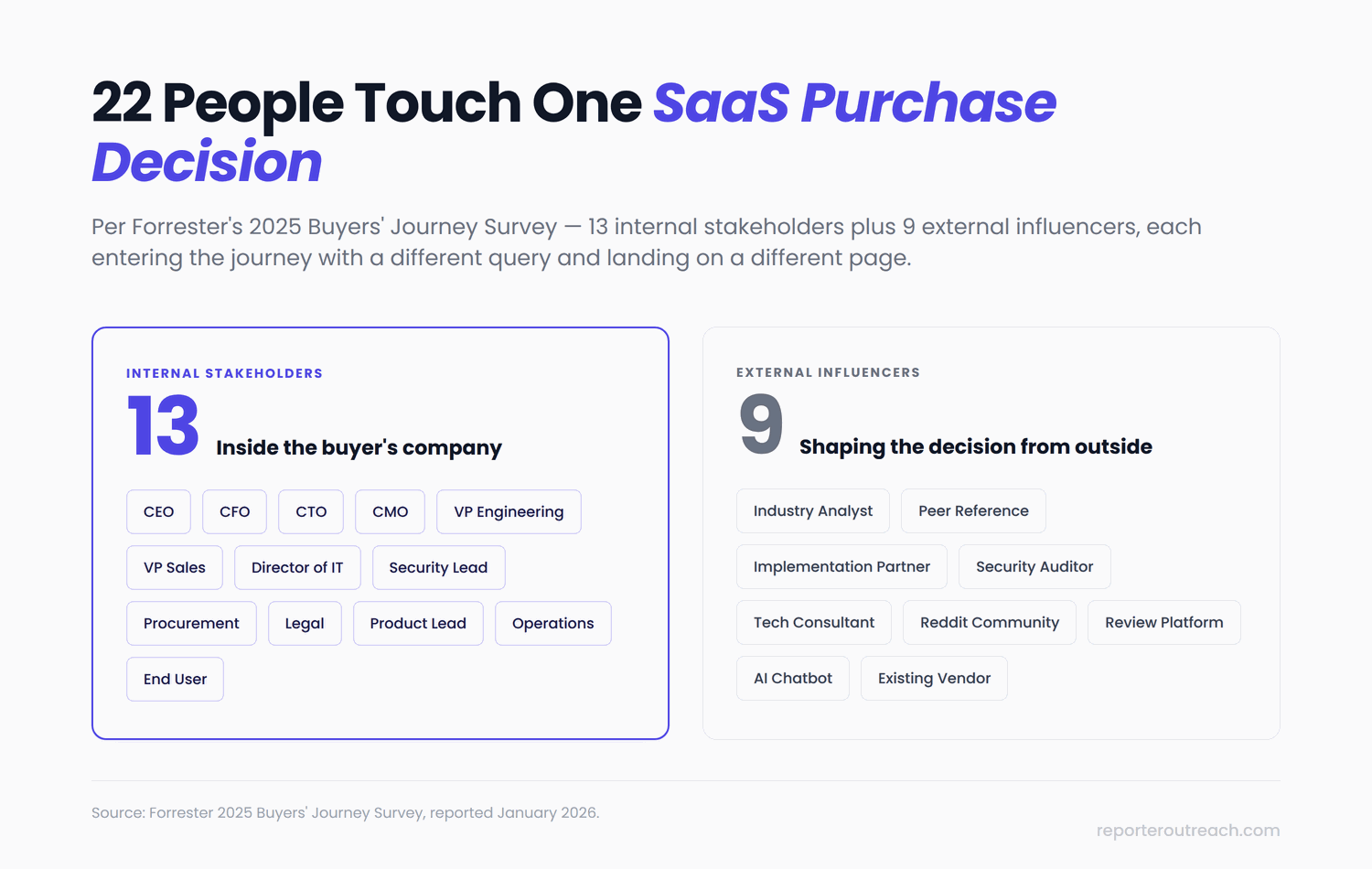
Most SaaS link-building programs route authority to one page type — the blog. The buyer touches five to seven different page types. That gap is why traffic dashboards keep going up while pipeline data stays flat.
Mapping Authority to the SaaS Buyer Journey
This is the framework that should drive every link-related decision. Most agencies skip it entirely and build links to whatever page is easiest to pitch — usually the blog.
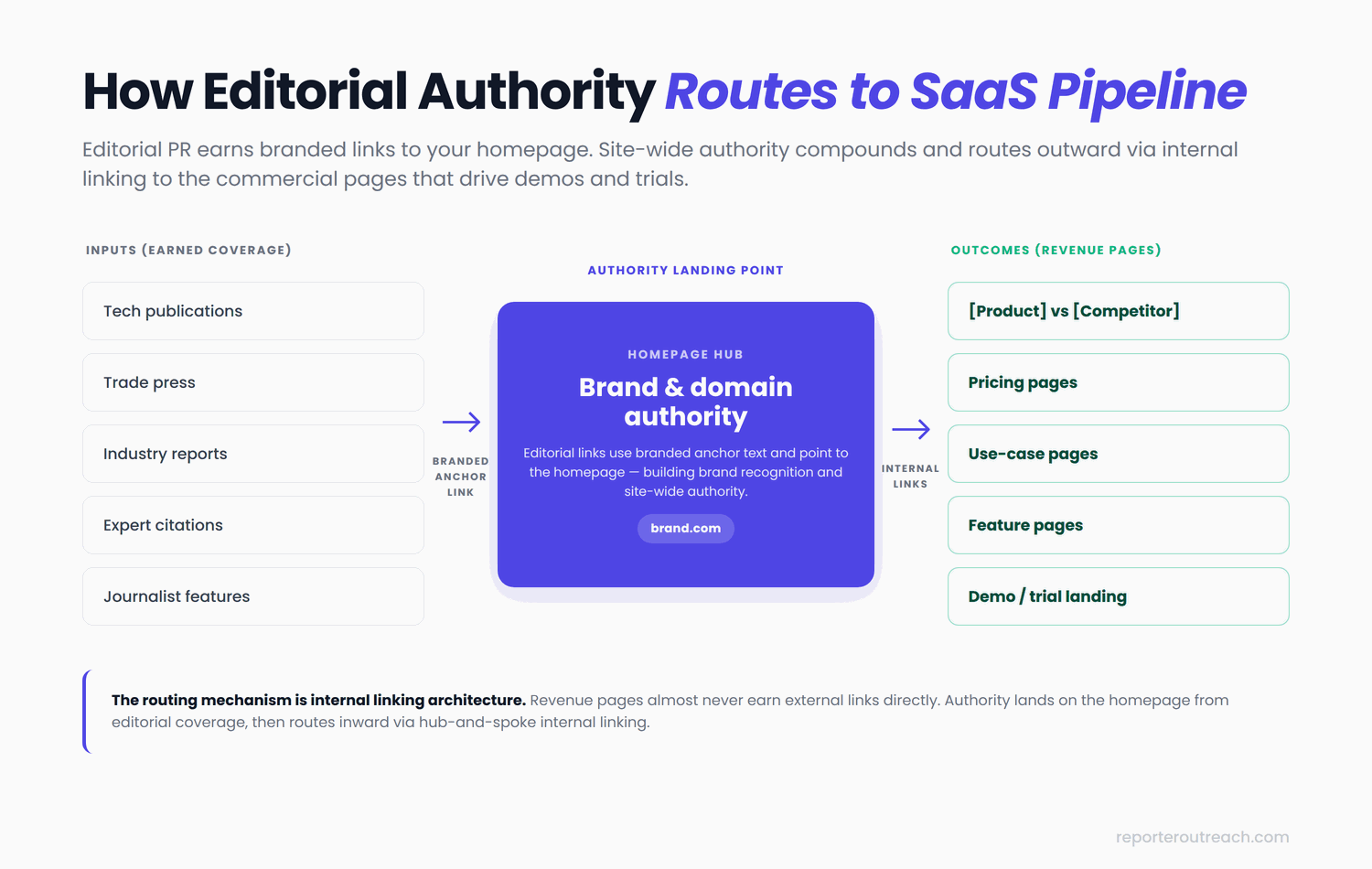
The takeaway: revenue pages will never earn links on their own. You build authority through editorial placements on publications your audience reads, then use internal links to funnel it to the pages that actually convert. SaaS companies that build links exclusively to the blog watch traffic climb while pipeline stays flat — the authority never reaches the pages that matter.
What Actually Works for SaaS Link Building
Ranked by impact, not alphabetically. The order matters — if you can only do one thing, do the first one.
1. Editorial outreach (highest impact, and it's not close)
Digital PR for SaaS positions your founder or product expert as a source for journalists covering your industry. When a tech journalist writing about workplace productivity or cybersecurity trends cites your expert, you earn a high-DR editorial backlink plus a brand mention — the dual signal that improves rankings and AI visibility in the same placement.
Why it dominates: 84% of AI citations come from earned media (Muck Rack Generative Pulse, May 2026). When a buyer asks an AI engine to recommend software in your category, the brand surfacing first is the one cited in editorial coverage — not the brand with the most backlinks. It's the only method generating both signals in one placement.
We run this daily for SaaS clients — monitoring Qwoted, Featured, and Source of Sources for journalist queries about product categories, industry trends, remote work, hiring, and technology adoption. Anywhere the founder has genuine expertise becomes an opportunity.
2. Original research from proprietary data
This is SaaS companies' unfair advantage, and almost nobody uses it.
You have product usage data, customer survey access, and industry-specific insights no publisher, blogger, or competitor can replicate. Turn that into a "State of [Industry]" report or benchmark study with 500+ respondents, and you create the single most linkable asset format available. Journalists need statistics. Bloggers need data to cite. Competitors writing about your industry will reference your numbers for years.
A single well-promoted study can earn links for two to three years as other creators discover and cite it. Update annually. We've seen individual research pieces outperform 12 months of guest posts across our SaaS client base.
3. Broken link reclamation
SaaS content goes stale fast. Tools shut down, features change, and competitors' resource pages accumulate dead links. Finding broken links on relevant publications and offering your content as a replacement is one of the most reliable quick-win tactics available.
Use Ahrefs Content Explorer to find pages in your niche with broken outbound links, filter for sites with real traffic, and pitch your content as a replacement. SaaS is uniquely good for this — sunset products, discontinued tools, and outdated comparisons are everywhere.
4. Free tools and calculators (build, don't buy)
Interactive tools attract links because they provide utility text can't. A "Cost of Employee Turnover Calculator," a "Team Capacity Planner," a "Password Strength Checker" — these become the pages bloggers reference when they want to give readers something practical.
This is a tactic you build internally, not something an agency delivers. Tool pages can become the single highest-linked asset on a SaaS site — surpassing the entire blog combined. If your dev team has bandwidth, this is a one-quarter project that earns links for years.
5. Guest posting (only on quality sites)
The host site needs real traffic, editorial review, and topical relevance — or it's not worth your time. A guest post on a SaaS publication your buyers read provides contextual authority. A post on a generic "write for us" blog provides nothing. Include original data, link to relevant pages (not just the homepage), and cap it at 2–4 placements per month.
How these stack up on the two signals that matter for SaaS:
| Tactic | Ranking authority | AI visibility lift | Best for |
|---|---|---|---|
| Editorial outreach | High | High | Category authority + AI citations |
| Original research | High | Medium | Passive long-tail link earning |
| Broken link reclamation | Medium | Low | Quick-win volume |
| Free tools | Medium | Low | Long-term passive links |
| Guest posting | Low–Medium | Low | Niche contextual coverage |
AI Search Is Becoming a Software Discovery Channel
This is the shift most SaaS companies haven't adapted to yet.
GenAI chatbots are now the #1 source influencing software vendor shortlists at 17.1%, ahead of software review sites (15.1%) and vendor websites (12.8%) — per G2's 2025 Buyer Behavior Report. When a buyer asks ChatGPT, Perplexity, Gemini, or Google AI Overviews to recommend project management software or cybersecurity platforms, AI engines name specific products. The brands getting named have the strongest editorial footprint — not the most links, the most editorial mentions.

And the shift is fast. B2B Tech queries went from triggering an AI Overview 36% of the time to 82% in the twelve months between February 2025 and February 2026 (BrightEdge). The visible search landscape for SaaS keywords reshaped faster than most agencies' strategies could adapt.
This is why editorial outreach sits at #1 above. It's the only method that builds traditional ranking authority and AI visibility in a single placement. Every other tactic builds one or the other; editorial PR builds both. For the complete playbook, see our GEO guide.
Routing Authority to Revenue Pages
Internal linking is the mechanism that turns your authority-building investment into pipeline. Editorial PR earns branded links to your homepage — without strong internal architecture funneling that authority outward, the homepage authority never reaches the comparison, pricing, and product pages that close deals.
Every linkable asset should point to commercial pages. A guide about "employee mentoring best practices" should link to your mentoring software product page. A benchmark report on cybersecurity trends should link to your security product's feature page. This is obvious, but we audit SaaS sites regularly and the majority are missing these connections entirely.
Build hub-and-spoke clusters. Pillar pages for each product category linking to all related subpages — features, use cases, integrations, comparisons. When any page in the cluster earns links, authority distributes across it. That's how comparison pages rank without a single direct link.
Three to five strong internal links per page, placed where a reader would genuinely want to go deeper. That's it.
How to Choose an Agency
Most agencies don't understand SaaS. Here's how to tell the difference — and for a ranked shortlist of agencies that do, see our breakdown of the best SaaS digital PR agencies.
Ask for SaaS case studies with pipeline metrics, not link counts. A generic agency won't understand why comparison pages matter. You need someone who's mapped link-building outcomes to demos, trials, and qualified leads — not just referring domains.
Evaluate actual placements in Ahrefs. Request sample links and check the host sites. Do they have real organic traffic? Are they publications your buyers read? "Write for us" blogs with no traffic tell you everything about the agency's standards.
Demand transparency. Quality agencies use editorial outreach, link insertions on sites with real organic traffic, and reclamation — not link farms or PBNs. If they won't share placement URLs, won't let you approve sites, or place links on sites under roughly 1,000 monthly organic visitors regardless of DR, walk away. Traffic floor is the more honest filter than price — there are legitimate sites at the lower price tiers and there are PBN networks charging $300+.
Look for content strategy alongside outreach. The best agencies help create linkable assets — data studies, free tools, reports — alongside the outreach work. If their strategy is just "we'll build X links per month to your existing pages," the ceiling is low.
The flags below mean walk away regardless of pricing:
| Green light | Red flag |
|---|---|
| Transparent placement reporting with DR + traffic data | "Proprietary network" of sites you can't audit |
| Editorial outreach + reclamation as core methods | PBNs, blog networks, or fixed-cost link packages on unknown sites |
| SaaS case studies with pipeline metrics | Generic case studies with referring-domain counts only |
| Pre-approval of every placement site | Guaranteed rankings or DR thresholds |
| Linkable-asset development alongside outreach | Cost per link well below market without traffic floors |
Nightfall — a cybersecurity SaaS company competing in a category where every player had a deeper editorial footprint — added 123% organic traffic over 13 months via 57 link insertions on high-traffic security and DevOps publications. The authority routed across the site, not just to blog posts.
See the full Nightfall case study or browse our SaaS link building agency page and pricing tiers.
Mistakes That Waste Your Budget
Only building links to the blog. The #1 mistake we see. Authority stays trapped in top-of-funnel content that never influences pipeline.
Ignoring comparison pages. "[Product] vs [Competitor]" pages convert at the highest rates but need domain-level authority to rank. The entire site has to lift, not just individual pages.
Treating link building as a 3-month project. Three months gets you to the starting line. Six shows results. Twelve is where competitive keywords start opening up. Budget for this as an operating expense, not a one-time campaign.
That timeline matches what we saw with Qooper — a SaaS platform that reached 2,203% organic traffic growth in six months of sustained editorial placements.
Using PBNs. SpamBrain gets better every year. The moment Google detects a link network, every link in it becomes a liability. Not worth the marginal short-term gains.
Not tracking lost links. Monitor lost referring domains monthly in Ahrefs and run reclamation outreach. Free hygiene step that prevents authority from eroding quietly.
Skipping original research. You have proprietary data — use it. One data study per quarter can generate more quality links than everything else combined. We see this missed on nearly every SaaS audit.
Build the Authority Your SaaS Actually Needs.
Editorial outreach, link insertions, and reclamation — tailored to the SaaS buyer journey.
Frequently Asked Questions
How is SaaS link building different from other industries?
SaaS buyers move through a multi-stakeholder research process touching many page types — not just the blog. Pricing and comparison pages can't attract links directly, so the strategy is building domain-level authority through editorial coverage and routing it to revenue pages via internal links.
What should I look for in a SaaS-focused agency?
Case studies tied to pipeline metrics rather than link counts, transparent placement reporting with DR and traffic data, editorial outreach as the core method rather than PBNs, and willingness to let you pre-approve every site. Walk away from any agency placing links on sites with no organic traffic regardless of DR.
How much should a SaaS company budget for link building?
Early-stage SaaS: $3,000–$5,000/month to build the foundation. Growth-stage: $5,000–$10,000/month combining editorial outreach with link insertions. Enterprise: $10,000–$20,000/month across multiple channels.
How long until I see results?
Meaningful ranking movement appears in 3–6 months, with material traffic and pipeline impact by months 6–12. SaaS companies that stop after 3 months see gains plateau before reaching competitive keywords.
How does AI search change SaaS authority building?
AI chatbots are becoming primary software discovery channels — generative AI is now the #1 influence on B2B vendor shortlists. Brands cited in editorial coverage get recommended by ChatGPT, Perplexity, Gemini, and Google AI Overviews; brands with only owned content stay invisible. Editorial PR is the highest-leverage investment for both traditional and AI search.
Sources: Forrester 2025 Buyers' Journey Survey, reported January 2026 (22 stakeholders — 13 internal + 9 external — per B2B purchase decision) · Muck Rack Generative Pulse, May 2026 (84% of AI citations from earned media) · BrightEdge 12-month AI Overview study, February 2025–February 2026 (B2B Tech AIO presence 36% → 82%) · G2 2025 Buyer Behavior Report (GenAI chatbots = 17.1% of vendor shortlist influence, #1 source).