Key Takeaways
- Ecommerce link building has a structural problem the rest of SEO doesn't: the pages you need to rank (products and categories) are the pages nobody links to voluntarily. The fix is building authority on content and routing it through internal architecture.
- 86% of ecommerce brands have unoptimized internal linking — even among the highest-visibility stores, 41% still get it wrong. This is the multiplier most stores never apply.
- Digital PR is the highest-impact ecommerce link tactic for a reason — 72% of the largest ecommerce sites use it. Editorial mentions build domain authority and generate the brand signals AI engines use to decide which stores to cite.
- PBNs, bulk directories, guest post farms, and link exchanges don't move rankings. For ecommerce specifically, where a Google penalty hits revenue directly, the cost of cutting corners is higher than any other vertical.
- The tactics that actually compound: linkable assets (original research, tools, buying guides), broken link reclamation, and competitor backlink analysis — paired with the internal architecture that moves authority to the pages that generate revenue.
Ecommerce link building is harder than almost any other vertical — and not because the tactics are different. The hard part is structural.
Organic search drives 43% of all ecommerce traffic and 23.6% of orders, according to Reboot Online's 2025 ecommerce SEO study. But the pages doing that work — product detail pages, category pages, the entire commercial catalog — are the pages nobody on the internet has any reason to link to. A blogger writing about home office setups will happily link to a detailed buying guide. They will not link to your standing desk PDP.
We've run link campaigns for ecommerce brands across dozens of verticals since 2017. The stores that win at SEO aren't always the ones with the best product photography or the fastest site speed. They're the ones that figured out how to build authority on content they control — and then move that authority to the pages that make money.
This guide covers the strategies that actually do that. Not a list of every tactic ever invented. The approaches that produce real ranking improvements for ecommerce sites in 2026, and the ones that drain budget without moving rankings.
The Structural Problem Every Ecommerce Site Faces
The uncomfortable truth about ecommerce SEO: the pages you most want to rank are the least linkable pages on your entire site.
Think about it from a blogger's perspective. They're writing an article about home office setups. They'll happily link to a detailed buying guide, an original survey about remote work habits, or a free desk ergonomics calculator. They will not link to your standing desk product page. There's no editorial reason to. The PDP serves you, not their readers.
This creates a gap most stores never close. They invest in technical SEO, write strong product copy, build out category pages with solid keyword targeting — and still can't rank because they have zero external authority pointing at the pages that matter.
And it gets worse. Reboot Online's analysis of ecommerce backlink profiles found that 86% of ecommerce brands have unoptimized internal linking. Even among the highest-visibility ecommerce sites by organic search traffic, 41% are still getting internal architecture wrong. So even on the rare occasions when authority does land on a content page, most stores have no system to route it to the product and category pages where it would actually drive revenue.
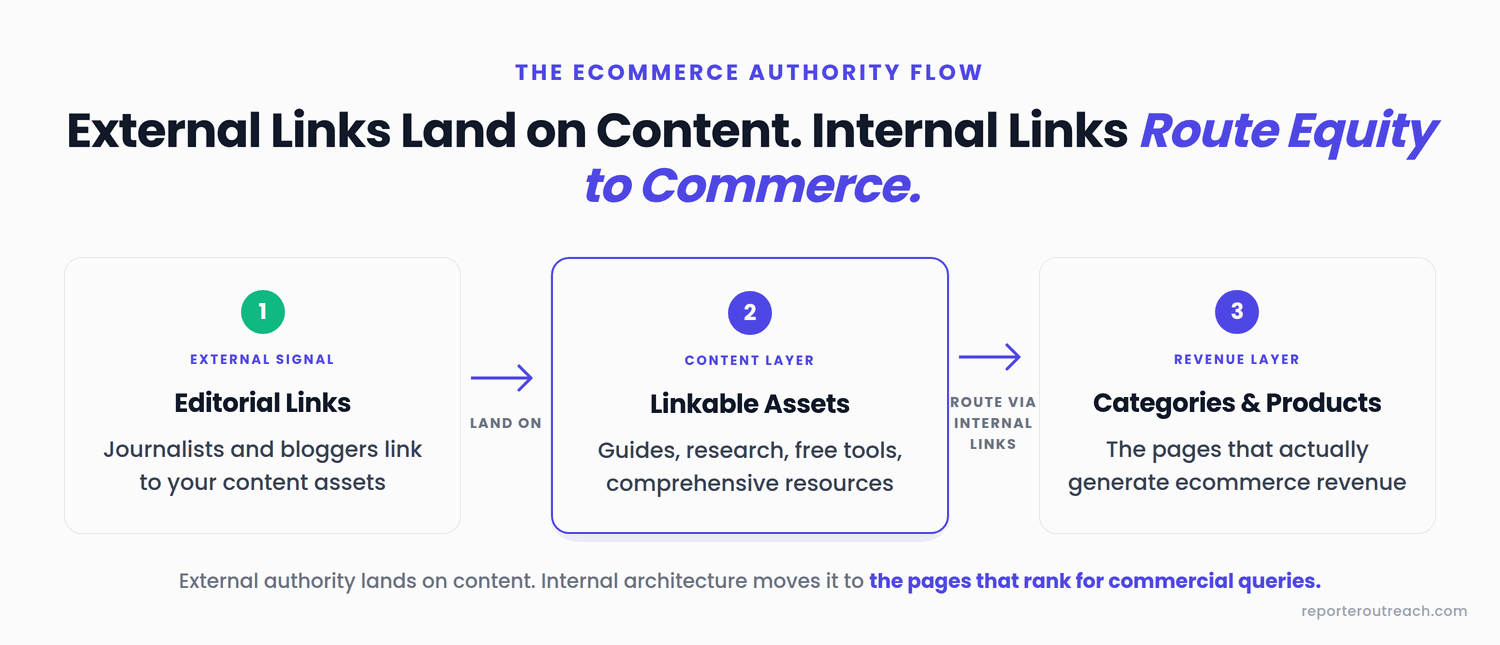
Part 1: Build links to content that earns them — original research, tools, guides, and PR-worthy stories. Part 2: Use internal linking to move that authority from content pages to your product and category pages. Every successful ecommerce link strategy follows this pattern. Stores that try to skip Part 1 and link directly to products end up buying links from PBNs — which ends exactly how you'd expect.
The best ecommerce brands we've worked with treat link building as an authority distribution problem, not a link acquisition problem. Links land on content. Internal architecture moves authority to commerce. Get both pieces right and your product pages start climbing without a single external link pointing directly at them.
Ecommerce Link Building Strategies That Actually Work
Not every tactic deserves equal weight. Some produce compounding returns for years. Others produce a brief spike and then nothing. Here's how the four strategies that actually work for ecommerce stack up:
| Tactic | Effort | Timeline to impact | Best for |
|---|---|---|---|
| Digital PR | High | 3-6 months | Domain authority + AI brand mentions |
| Linkable assets | High upfront, low ongoing | 6-12 months | Compounding links over years |
| Broken link reclamation | Medium | 1-3 months | Quick wins on niche resource pages |
| Competitor backlink analysis | Medium | 2-4 months | Finding sites already linking to stores like yours |
Digital PR — The Highest-Impact Play
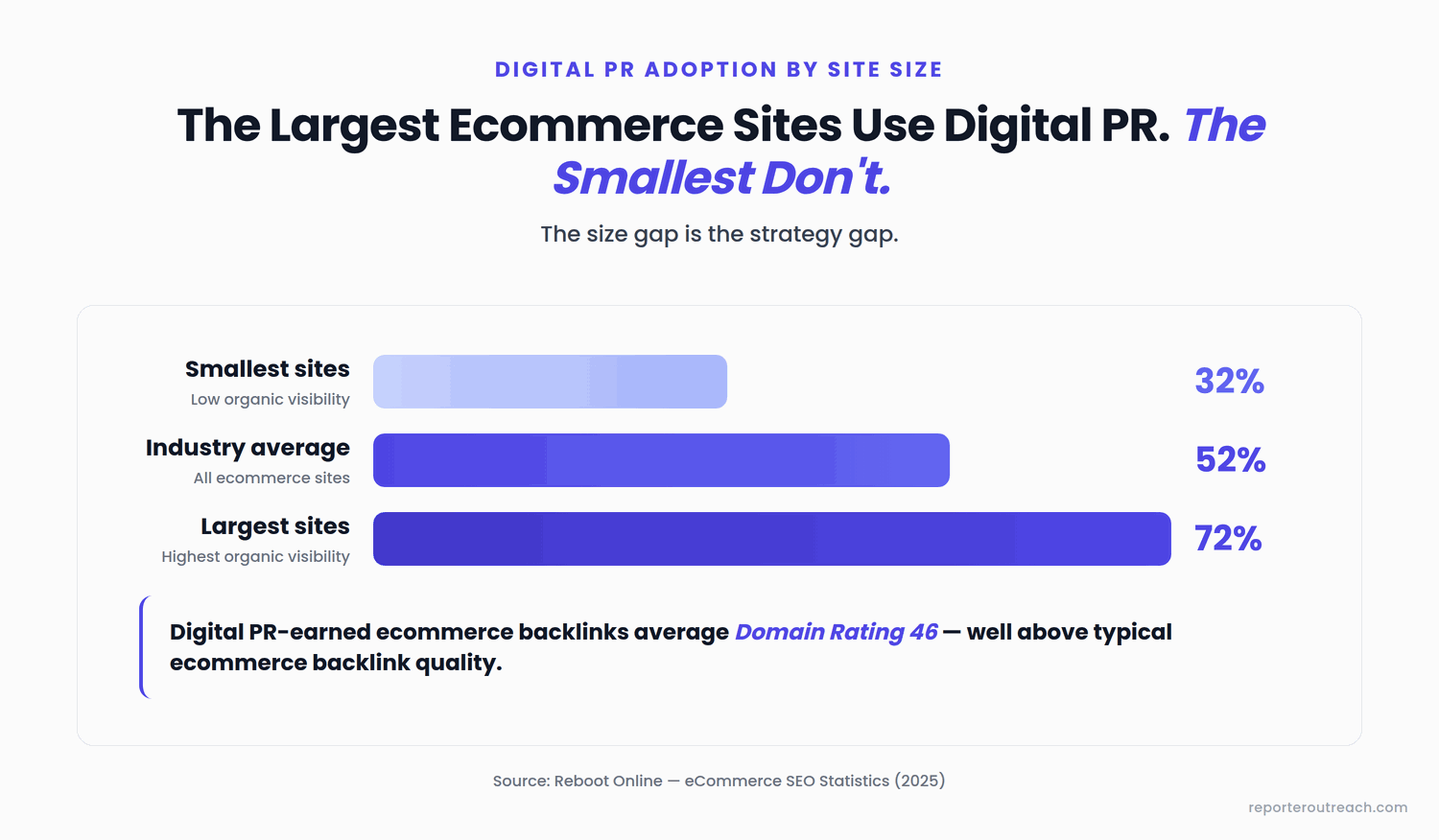
Digital PR earns editorial links from publications Google already trusts, which makes it the single most effective tactic for ecommerce brands fighting in crowded niches. When a journalist references your brand data or quotes your team as an expert source, that placement carries more authority than dozens of links from smaller sites — and Reboot's ecommerce SEO study found that digital PR-earned ecommerce backlinks average a Domain Rating of 46, well above the typical ecommerce backlink quality.
There's a quieter pattern in the same study: 52% of ecommerce sites use digital PR for link building. Among the largest ecommerce sites, that climbs to 72%. Among the smallest, it drops to 32%. The size gap is the strategy gap.
For ecommerce, the best PR angles center on data you already have. Sales trends during seasonal peaks. Customer behavior patterns. Pricing shifts across your category. Journalists need data for their stories, and ecommerce businesses sit on exactly the kind of proprietary data that makes stories credible. A DTC skincare brand analyzing ingredient trend data from its own sales gives beauty editors something they can't get anywhere else.
There's a second reason PR matters more now than it did even two years ago. AI search engines — ChatGPT, Perplexity, Gemini, and Google's AI Overviews — decide which brands to recommend based heavily on brand mentions in trusted publications. Not links. Mentions. Seer Interactive's 2025 study found that when a brand is cited within an AI Overview, it earns 35% more organic clicks than brands not cited at all.
PR is the only tactic that produces both signals at once: the link for traditional ranking and the brand mention for AI citation. For ecommerce brands fighting for visibility against Amazon and major retailers, that dual signal is increasingly what separates page 1 from page 2. Our complete digital PR guide covers the full playbook.
Linkable Assets — The Compound Interest Play
A linkable asset is any page on your site designed specifically to attract links. Not a product page. Not a category. A genuinely useful resource that bloggers, journalists, and niche curators reference because it helps their audience.
The asset types that work best for ecommerce:
- Original research. If you sell running shoes, analyze your sales data to publish insights about gait patterns, injury rates by shoe type, or seasonal buying trends. When niche sites cite your data, they link to the source. These links compound — a good data study earns links for years as new articles reference the same stats. This is probably the single most underleveraged asset type in ecommerce. You're sitting on data your competitors would kill for, and you're not publishing any of it.
- Free tools and calculators. A paint calculator on a home improvement store. A sizing tool on an apparel site. A compatibility checker for electronics. Interactive tools earn links because they provide ongoing utility — other sites reference them as a resource for their readers. The upfront development cost is higher, but a good tool can earn hundreds of links over its lifetime with zero ongoing outreach.
- Comprehensive buying guides. Not the 500-word "how to choose a mattress" posts every competitor has. Deep, opinionated guides that take a position on what matters and what doesn't. The kind of guide where someone reads it and thinks, "this person actually knows what they're talking about." Those earn links. The generic ones don't.
Infographics have a bad reputation because the internet is littered with terrible ones. But original data visualized well — a comparison chart, a process diagram, a pricing breakdown — still earns links and gets embedded across niche sites. The key: the data has to be original and the design has to be genuinely useful, not decorative.
Broken Link Reclamation
This one is straightforward and it works. Find dead links on resource pages in your industry, create (or identify existing) content on your site that matches what the missing page used to offer, and reach out to the site owner suggesting your page as a replacement.
For ecommerce, this works especially well on curated "best of" lists and recommendation pages. When a competitor goes out of business or removes a page, the broken links pointing at it are opportunities. The site owner benefits — no more dead links hurting their user experience — and you earn a contextually relevant link. Ahrefs or Semrush will surface these at scale: filter for resource pages in your niche with broken outbound links.
It's not glamorous. It's slow. But this approach converts at higher rates than almost any other cold outreach tactic because you're solving a problem the site owner already has.
Competitor Backlink Analysis
Why guess which sites might link to you when your competitors have already done the prospecting? Export your top competitors' link profiles from Ahrefs and look for patterns. Which sites link to them? What type of content earned those links? Are they getting featured on roundup posts, resource lists, or editorial articles?
Pay special attention to sites linking to multiple competitors. If a niche blog linked to three of your competitors' buying guides, they'll probably consider yours too — especially if it's better. Our competitor backlink analysis guide breaks down the full process.
Competitor analysis also reveals gaps. Maybe every competitor earns links from the same 20 resource pages — but none of them have earned PR coverage. That's your opening. The best strategies don't copy competitors; they find the channels competitors haven't exploited yet.
Tactics That Drain Budget Without Moving Rankings
Some tactics look tempting on paper but create real problems for ecommerce sites — where a Google penalty directly impacts revenue. Here's what to avoid and what to do instead:
| Tactic to avoid | Why it fails | What to do instead |
|---|---|---|
| PBN links | Sites built solely to sell links. Google identifies them at scale; the "authority" they pass is mostly fictional. | Digital PR — real publications with real audiences and real authority. |
| Bulk directory submissions | Pass no value in 2026. Submission services waste budget that could fund actual outreach. | A handful of niche-specific industry associations or curated marketplaces — selective, not bulk. |
| Guest post farms | Sites that exist solely to sell placements via "write for us" pages. Google flags them as link schemes. | Editorial features in respected industry publications, earned through expert positioning. |
| Reciprocal exchanges at scale | Organized link trading networks are easy for Google to detect. One of the fastest paths to a manual action. | Natural partnerships with complementary (non-competing) brands — sparingly, never at scale. |
If a provider can't tell you the exact sites where your links will appear — or if the per-link cost is suspiciously low — the links are almost certainly from sites built to sell links, not serve readers. Walk away.
For a deeper look at evaluating link quality, see our guide to identifying unnatural links.
Internal Linking — The Multiplier Most Stores Skip
You can build the best links in the world, but if your internal architecture is broken, that authority never reaches the pages where it matters. This is the most overlooked piece of ecommerce SEO — and the reason 86% of ecommerce brands aren't getting full value from the links they earn.
The pattern is simple. External links land on your content assets (guides, tools, research). Internal links route that authority to your categories. Categories pass it to products. Products link back to related guides and other products. You're building a web where authority flows throughout the site, not pooling on a few orphaned blog posts.

The mistakes we see constantly:
- Orphaned product pages. Products with no internal links pointing to them from blog content or related categories. Google can barely find them, let alone pass authority. Every product page should have at least 2-3 contextual internal links from relevant content.
- One-directional category linking. Categories that only link down to products but never sideways to related guides, comparison pages, or buying content. You're leaving authority on the table.
- Flat architectures. When every page is the same number of clicks from the homepage, the site has no authority hierarchy. Products in your highest-margin category should sit closer to the homepage — and your highest-authority content — than niche products that drive minimal revenue.
Fix these three things and you'll see ranking improvements within weeks — often without building a single new external link. Internal architecture is the fastest lever in ecommerce SEO, and most stores barely touch it.
How to Measure What's Actually Working
Forget total link count. Here's what to track:
| Metric | What good looks like | Red flag |
|---|---|---|
| Referring domains | Steady monthly growth from niche-relevant sites | Volume spikes from unrelated low-quality sites |
| Organic traffic to content + the pages it links to | Content earning links AND the linked-to product/category pages climbing | Content traffic up, commercial pages flat — internal linking issue |
| Referral traffic from linked pages | Real visitors from niche-relevant sites who convert | Zero referral traffic — the link is on a page with no real audience |
| Commercial keyword visibility (GSC) | Rising impressions and clicks on product + category keywords | Flat commercial KW visibility despite link growth — check architecture |
The metric most people miss is the second one. Your blog post about "how to choose a standing desk" earned 15 links — great. But is the standing desk category page climbing in rankings? If the content is earning links but the commercial pages aren't moving, the internal linking is broken.
Technical Foundations That Determine Whether Links Move Rankings
Before investing heavily in link acquisition, make sure your site is built to capture the value of every link you earn. Reboot Online's analysis found that 62.4% of ecommerce sites have at least one broken link — and on affected sites, an average of 69% of pages contain them. Every dead URL is authority leaking out of your site.
Fix broken links. When an external link points to a 404 on your site, that authority evaporates. Audit regularly — especially after product removals or URL changes. Redirect broken URLs to the most relevant live page.
Run a broken link audit before building new links. Redirecting dead URLs to live pages recovers authority you've already earned — results show up in weeks, not months.
Keep architecture shallow. Products and categories should sit within 3 clicks of the homepage. Deep architectures dilute authority. If your best products are buried 5+ clicks deep, Google treats them as low-priority.
Get canonical tags right. Ecommerce sites generate duplicate URLs constantly — same product on multiple category pages, filter parameters, pagination. Without proper canonicals, authority splits across duplicates instead of consolidating where you want it.
Build content hubs. Rather than scattered blog posts linking to random products, build topic clusters — a buying guide, comparison tool, and FAQ all interconnected and linking to relevant product categories. This concentrates authority on your highest-value pages.
How to Sequence All of This
A successful ecommerce link strategy doesn't rely on one tactic. It layers several approaches into a repeatable system. Here's the sequence that works:
- Run a baseline audit. Export your link profile from Ahrefs. How many unique referring domains do you have? What's the average authority? Are any links pointing to broken pages? This tells you where you stand and how wide the gap is between you and competitors ranking above you.
- Study your competitors. Not to copy them — to find openings. Which sites link to them? What content earned those links? More importantly: what channels are they not using? If every competitor relies on guest posts but none have earned PR coverage, that's your biggest opportunity.
- Build 2-3 linkable assets. Original research, a free tool, a genuinely in-depth guide. Not all at once — start with the asset that fills the biggest content gap in your niche. One exceptional resource outperforms five mediocre ones.
- Run campaigns in parallel. PR outreach for editorial coverage. Broken link prospecting on niche resource pages. Competitor link replication for the highest-value opportunities. Unlinked brand mention outreach if you're an established brand getting mentioned without links. Running these tactics simultaneously produces faster results than sequential campaigns.
- Strengthen internal architecture quarterly. Every time you publish new content or earn a significant link, revisit your internal linking. Add contextual links from high-authority content to your most important commercial pages. Remove links to discontinued products. Ensure every product page has internal links from relevant content.
- Measure monthly, adjust quarterly. Track referring domains, organic traffic, and commercial page rankings. Double down on what works. Cut what doesn't. The brands that build authority consistently over 12+ months are the ones that eventually dominate their category — and once you have that authority, it's very hard for competitors to catch up.
Link building for ecommerce is a 12-month game, not a 3-month sprint. The brands that dominate their category are the ones that built authority consistently — and once that lead exists, it's very hard for competitors to close the gap.
What This Looks Like in Practice
The theory is one thing. Here's what it looks like when the pieces come together.
BloomsyBox — DTC Flower Subscription
A subscription flower brand competing against 1-800-Flowers, FTD, and Amazon in one of the most saturated ecommerce niches. Previous link efforts relied on low-quality placements that moved nothing. The new strategy focused on earning editorial coverage from lifestyle and gifting publications — the kind of links that signal genuine brand trust to both Google and AI search engines.
Across a 10-month engagement (September 2023 – July 2024), 54 editorial placements at an average DR of 79 drove 555% organic traffic growth — the authority profile that moves rankings in saturated niches and generates the AI citations that are driving a growing share of ecommerce discovery. It's the same system our eCommerce link building agency runs for DTC and subscription brands. Read the full BloomsyBox case study →
Your Competitors Are Building Authority.
We earn editorial links for ecommerce brands from publications that drive both rankings and real referral traffic — the kind of authority that compounds for years.
FAQ
What's the most effective link building strategy for ecommerce?
Digital PR produces the highest-impact results — editorial links from trusted publications carry more authority per link than anything else, and they generate the brand mentions AI search engines use to decide which stores to recommend. The best results come from combining PR with linkable assets and broken link reclamation. No single approach is enough.
Can you build links directly to product pages?
Rarely. Other sites have no editorial reason to link to a product listing. The exceptions: PR campaigns that earn product mentions (gift guides, roundups, reviews) and niche "best of" lists. For everything else, build links to content and use internal architecture to distribute authority to the commercial pages.
How many links does an ecommerce site need?
No universal number — it depends on how many quality referring domains your top competitors have. For most ecommerce sites in moderately competitive niches, 10-30 quality links per month produces measurable improvements within 4-6 months.
How long does ecommerce link building take to show results?
Most ecommerce brands see measurable improvements within 3-6 months of consistent effort. Months 1-3 build the foundation. Months 4-6 show initial movement. Months 6-12 produce the strongest gains as authority compounds and internal links distribute equity across the product catalog.
Does social media help with ecommerce link building?
Not directly. Social links don't pass ranking authority. But social amplifies your linkable content to audiences who create real links — bloggers, journalists, and site owners who discover your research or tools through social sharing and then reference them from their own sites. Treat social as distribution for link-worthy content, not a link building tactic itself.
What ecommerce link building tactics should I avoid?
PBN links, bulk directories, guest post farms that accept anyone and charge per placement, and large-scale reciprocal exchanges. These produce links search engines either ignore or penalize — and for ecommerce sites, a penalty directly impacts revenue. Focus on earning editorial links through genuine value.
Sources: Reboot Online — eCommerce SEO Statistics (2025) · Seer Interactive — AI Overviews citation study (2025) · Reporter Outreach — campaign data across ecommerce clients (2017-2026)